It was a marvelous sight as nearly 70,000 students in educational institutions across Dakshina Kannada and Udupi districts simultaneously performed yoga in an attempt to enter the Guinness Book of World Records.
More than 2000 students of Sharada Vidyalaya gathered in their school ground to attempt the record.
‘Yoga for Future 2013’ has been organized by Sri Kshetra Dharmasthala Shantivana Trust in association with Sri Dharmasthala Manjunatheshwara Yoga and Ethical Education, Dakshina Kannada zilla panchayat and department of public instructions.
The students made an attempt to beat the present Guinness Book of World Record created when 29,973 students from 362 schools performed Suryanamaskar for 18 minutes at Vivekanand Kendra in Jiwaji University.
The demonstrations included Suryanamaskar, chanting of Surya mantras, Thrikonasana, Parshwakonasana, Shashankasana, Pavana Mukthasana, Sarvangasana, Vajrasana, Makarasana, Bhujangasana and Dhanurasana.
There was one yoga instructor for every 50 students, and the entire event was videographed.
Health Minister U T Khadar who was present on the occasion said, “I love yoga. I do yoga whenever I have time, which is not very often. I congratulate everyone for being part of this attempt for Guinness World Record.”
Additional deputy commissioner Dayanand and others were also present.
Udupi/Beltangady/Kundapur :
As many as 2,960 students of SDM Institutions, Ujire gathered at Ratnavarma Heggade stadium alone and performed Yoga. The historic moment was watched by Dharmasthala’s Harshendra Heggade and Hemavati Heggade.
In Kundapur, students attempted the record at Gandhi maidan and other places. As many as 3,625 students gathered at MGM grounds at Udupi and performed yoga. Altogether, 44,117 students from across the district were part of the event. District incharge minister Vinay Kumar Sorake, Sri Sugunendratirtha Swamiji of Puttige Math, Sri Laxmivaratirtha Swamiji of Shiroor Math and others witnessed the event in Udupi. Youngest film director Kishan Shrikanth is the brand ambassador for ‘Yoga for Future 2013,’ which is being held at 50 centres under the guidance of Dharmasthala Dharmadhikar Dr D Veerendra Heggade.
The event has been organized by Dharmasthala Shantivana Trust. As the yoga is being held in various centres, the success of the attempt will be known only later.
source: http://www.daijiworld.com / Daijiworld.com / Home> Top Stories / by Daijiworld Media Network – Mangalore (MD) / Friday – December 13th, 2013
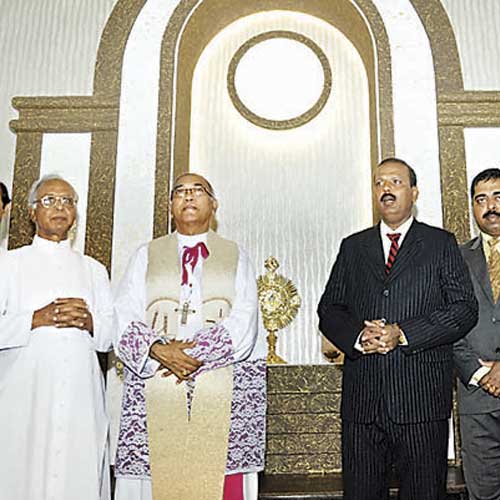
Bishop Aloysius Paul D’Souza and the Church committee with the relic of the Holy Cross in the background. – DNA
Till now this port city was called ‘Rome of the East’ for its true Catholic outlook, but now it has one more reason to sustain that name, as a relic of the Holy Cross on which Jesus Christ was crucified by Romans 2000 years ago arrived in Mangalore and has been consecrated in the Holy Cross Church in Kulashekar in the city.
Catholics in Mangalore were trying to get the relic for over seven years, and the Vatican administration finally found that the city deserved to house a relic from the biblical times, senior parishioners of the newly built Holy Cross church felt.
According to the church administrators, housing the relic of the Holy Cross will be a rare distinction for Mangalore. The relic will be open to the lay people for adoration and prayers.
In 312 AD, after his victory in one of the many battles he waged, Roman King Constantine attributed his triumph to the grace of the holy cross. In 326 AD, he sent his mother St Helen to find the Cross of Jesus in the city of Jerusalem where Jesus was crucified. The cross was installed in the Church of Sepulchre in Rome later.
Towards the end of 7th century AD, Persians tried to destroy it and took it to Persia, but in 629, King Heraclius regained the Cross and had it re-installed in the same Church in Rome.
source: http://www.dnaindia.com / DNA / Home> Bangalore> Report / Place: Mangalore, Agency:DNA / Monday – September 16th, 2013
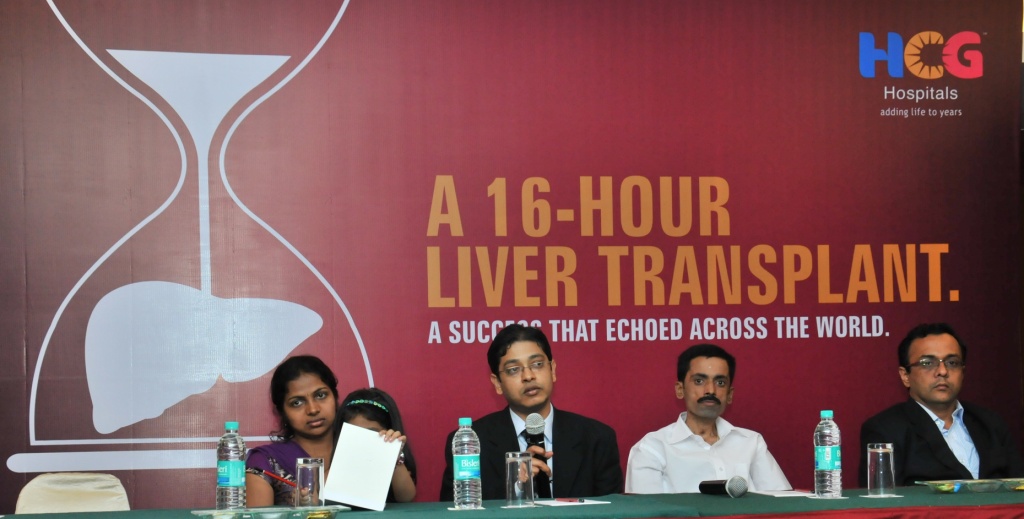
HCG Hospitals, organized a press conference on treating 36 year old Indian from USA, diagnosed with liver cirrhosis, underwent marathon 16 hour liver transplant surgery, with the organ donated from his wife.
A year ago, the patient had weakness and loss of appetite. During his routine health check-ups, he was diagnosed with liver cirrhosis, due to autoimmune hepatitis. After further investigations he was placed on the Liver Transplant waiting list in USA. With time running out, he did not get any organ offers and returned to India, for the liver transplant surgery.
Dr. Basant Mahadevappa, Consultant, Liver Transplant Surgeon, HCG Hospitals, said, “The patient was in a difficult situation, as he was decompensated with severe ascites (Liquid in the abdomen). His wife was worked up for donation. Anatomy of the donor was complicated, and was left with no other donor. With a multi-disciplinary team approach we took up the challenge and performed the transplantation. The patient & the donor are doing well and are on regular follow up.”
(From Left): Mrs. Shilpa Arun Kumar, Donor, Dr. Basant Mahadevappa, Mr. Arun Kumar, Recipient and Dr. Ganesh Bhat
Dr. Ganesh Bhat, Consultant, Gastroenterologist, HCG Hospitals, “The incidence of liver disease is on the rise and 2% to 3% of the people are living with Hepatitis B & Hepatitis C. People diagnosed with hepatitis B, are more likely to develop into liver cancer. Most of the times, its asymptomatic and when the patients start to see the see the symptoms, it’s in an advanced stage, which may require liver transplantation or a liver surgery. Early diagnosis of the disease helps in better medical outcomes.”
Mr. Arun Kumar, Recipient, said, “I was diagnosed with liver cirrhosis, and the only medical solution was Liver Transplant. With my condition worsening & surgery being an emergency I was lucky to find a donor in my wife. She came forward to donate her liver, though it was high risk surgery. I have recovered and got a new lease of life.”
source: http://www.moneylife.com / MoneyLife / Home / Bangalore, Karnataka, India / Business Wire India / November 27th, 2013
Prof. C.N.R. Rao with wife Indumathi in Bengaluru —DC/R. Samuel
Bengaluru:
Professor C.N.R. Rao’s office at the Indian Institute of Science in Bengaluru received a steady stream of visitors all through Sunday morning. Chief Minister Siddaramaiah was the first to arrive, at 8.30 am, followed by a brief interaction with the media.
A visibly exhausted Prof. Rao then retired to his study, where friends and well-wishers continued to drop by.
“I even got a phone call from someone at 1 am,” he told us, later. Why the rush? On Saturday afternoon, Prof. Rao, one of the foremost authority on solid states and materials chemistry, was conferred the Bharat Ratna, India’s highest civilian honour, felicitating decades of breakthrough research, 1,600 papers and 45 books.
In came Dr Roddam Narasimha, one of the country’s most prominent aerospace scientists and a dear friend to Prof. Rao. Dr Govindarajan Padmanabhan, Prof. Balram’s predecessor as the director of the Indian Institute of Science, the AGP and Prof. Kumar, and former director, Raman Research Institute, were also among the elite list of visitors.
Meanwhile, we were ushered into another room to speak with Prof. Rao’s wife, Indumathi, about the CNR Rao Educational Foundation.
The Foundation was formed back in 2005, the year Prof. Rao won the prestigious Dan David Prize for Science, a million-dollar grant. “We decided to use that money to give back to society,” said Mrs Rao.
The CNR Rao Hall of Science, Madan Mohan Malviya, was funded by the Ambani Trust. Each year, the Foundation honours two teachers, one from Karnataka, usually from a Kannada medium school and one from across the country.
“It’s not just what they do in class, but what they do outside of it, to enthuse their students,” Mrs Rao explained.
Prof. Rao celebrates his birthday each year (June 30) by organising a Teachers’ Day, of sorts, with lectures and a music concert. “Music is very important to us,” Mrs Rao added, with a smile. Why? “It’s so beautiful, don’t you think?” she replied.
The Foundation has remained, with intent, a tiny organisation, run on very low funding. “We don’t want to ask anybody for money and besides, I’m the one who has to manage it, which I really can’t do anymore,” Mrs Rao admitted. The couple is nearing eighty now and although they do seem full of beans, age has undoubtedly taken its toll.
The Foundation has worked with over 60,000 children since it was formed, with an average of about 2,000 students each year. “We work with rural children in particular, because they are so motivated and talented, but have no opportunities,” she said.
Prof. Rao, who was born into an educated middle-class family, attributes his success entirely to education. “We had no godfathers,” he remarked.
Nearly an hour later, we are allowed in to Prof Rao’s office. His little study is piled high with bouquets, hiding a most eclectic collection of books. Being of the firm belief that you are what you read, I rummaged only to find books on Persian poetry, music and art lying side by side with heavy volumes on Science.
I’d learned, through the grapevine at the Institute, that Prof. Rao had a green thumb.
“I’m the official tree planter,” he agreed, happily, saying he’s planted over 20,000 trees in his lifetime. Not too long ago, four trees on the border of the IISc campus were uprooted because the branches got in the way of a high-voltage wire.
“All they needed to do was trim the branches, but they cut down the trees. I was outraged and nobody said anything!” he said.
“I created a forest here, but they’ve gone and put a road there and done all kinds of foolish things,” he added crossly. “The JNCASR campus is beautiful. I don’t allow vehicles to drive through either. I like to stay in harmony with nature.”
We return to a question that first arose the evening before — should the government do more to bridge the gap between industry and research? “The industry isn’t interested in funding research,” said Prof. Rao. “In other parts of the world, nearly 60 per cent of the research being done is funded by private companies.” It is a little known fact that Prof.
Rao received a $5 million grant from Sheikh Saud of Saudi Arabia. “We met at a conference once and he really seemed to like me,” Prof. Rao explained. “Soon after, he flew down to JNCASR and gave me a grant, with no strings attached!” The Sheikh paid him another visit only last month.
“Wealthy Indians are more interested in funding universities abroad. Ratan Tata has done nothing for IISc yet, for instance. Give me three or four million dollars,” he said suddenly, “I’ll set up a university as good as Harvard.”
It doesn’t take him long to meander towards his second favourite thing in the world — music. “I listen to Hindustani classical music,” he said, delving into the small mountain of bouquets to locate his music collection —which includes cassettes, by the way! It has become customary for Prof. Rao to bring well-known musicians down to the institute, the most recent being Pt Amjad Ali Khan.
The conversation slowly veers back to science and the Bharat Ratna award. Will the award give careers in science and research a touch of glamour? Prof. Rao dismisses the idea. “Science doesn’t involve glamour for me,” he said at once. “All that matters is asking the right questions.” Prof. Rao is currently working on artificial photosynthesis, which he hopes to recreate in his lab. “I want to create material that is ordinarily useless, but which can be made to absorb sunlight.”
At the age of 80, Prof. Rao still manages to publish an astounding 30 papers each year, more than most scientists still in their prime. “I work all the time, I’m always writing something. I actually dream about how I’m going to phrase a particular sentence,” he said.
Back in 2007, Prof. Rao raised many eyebrows, by saying that IT employees are like coolies who work for wages without producing any significant intellectual material. Did Narayana Murthy call to congratulate him? “No,” he said. “I don’t call him; he doesn’t call me.” The Infosys Foundation has started giving out a Science Prize, we ventured helpfully.
“That’s not a very good prize,” Prof. Rao retorted. “There are far more deserving scientists. Besides, the Infosys Foundation tends to laud Indian scientists who are working abroad. They don’t need the help, while scientists in this country do,” he said angrily. “Narayana Murthy’s committees are full of nepotistic relationships.”
Prof. Rao then wades into an ocean of nostalgia for a little while, talking about Rajiv Gandhi, whom he served as Chairman of the PM’s Advisory Council from 1985 to 1989. “He was a wonderful man,” he said, staring glassily into the distance. “People would portray him as a party person, but he was a teetotaller.
He was also quite the moralist. The day he was assassinated was one of the saddest in my life,” he said, adding, quite succinctly, “I really admired Indira Gandhi too. She had class,” he said. Does that mean today’s politicians don’t have class? “Today’s politicians are a bunch of crazy guys,” he replied.
“Just look at the sort of language they use and the way they talk about women. The mindset in our political class today is that women are merely sex objects,” he said, a look of disdain marring his otherwise smiling face for a moment.
As the conversation drifted in and out of a plethora of issues, science, it seemed, was foremost on Prof. Rao’s mind. Funding science, he remarked, is last on the government’s priority list. “At best, we get about 20 per cent of the funding we require. I’ve never had political patronage and I’ve never sought it either. Politicians are here today and gone tomorrow.”
Prof. Rao’s Foundation does try to fill this void by promoting scientists from some of the least developed nations.
“We do offer grants of up to Rs 5 lakh each year,” he said. His family has been sending urgent messages to his study, beckoning him for lunch at once, so we take our leave too. What we did get, in the end, was a glimpse of the man behind the science – a remarkable man he is, too. All that’s left to say is this, “Professor Rao, you’ve done India proud.”
source: http://www.deccanchronicle.com / Deccan Chronicle / Home> News> Current Affairs / DC / by Darshana Ramdev / November 18th, 2013
President Barack Obama plans to nominate Dr. Vivek Hallegere Murthy, the Indian-American head of a doctors group that promotes his signature healthcare law to be the next US surgeon general.
Murthy is a hospitalist at the Brigham and is co-founder and president of Doctors for America, a Washington, DC-based group of 16,000 physicians and medical students that advocates for access to affordable, high quality health care.If confirmed by the Senate, Murthy will replace Regina Benjamin, who was appointed by Obama in 2009 and left her post last summer.
The job focuses heavily on public health issues.Murthy was appointed to the President’s Advisory Group on Prevention, Health Promotion, and Integrative and Public Health in 2011. The prevention group was created as part of the Affordable Care Act health reform law.
His group, Doctors for America, was originally called Doctors for Obama and helped to campaign for Obama’s election.
Murthy co-founded VISIONS Worldwide in 1995, a non-profit organization focused on HIV/AIDS education in India and the United States, where he served as President from 1995 to 2000 and Chairman of the Board from 2000 to 2003.
Murthy received a BA from Harvard University, an MBA from Yale School of Management, and an MD from Yale School of Medicine.
“I am confident that these outstanding individuals will greatly serve the American people in their new roles and I look forward to working with them in the months and years to come,” Obama said in announcing Murthy’s appointment along with three other key posts.
The announcement came shortly after Obama acknowledging that his administration “fumbled” in the troubled rollout of his healthcare law offered a fix that would allow insurers to keep for another year people on plans that were to be cancelled for not meeting minimum standards under the new law.
In the midst of mounting criticism of the troubled healthcare website, former President Bill Clinton had Tuesday suggested that Obama should make sure Americans can retain their current health insurance plans, even if it means revamping the Affordable Care Act.
“I personally believe, even if it takes a change to the law, the president should honour the commitment the federal government made to those people and let them keep what they’ve got,” Clinton told OZY, a news website.
Murthy, though was born in London and shifted base to the US later, he has links with the Hallegere village of Mandya district.
source: http://www.deccanherald.com / Deccan Herald / Home> International / by Agencies / Washington – November 15th, 2013
Imran Khan, a resident of Tumkur, had been bedridden for the best part of 12 years after nearly 200 kg of steel fell on his back when he was visiting a construction site.
The 28-year-old lost all hope of walking again till he found out about Ilaj bit Tadbeer (regimental therapy), a little-known system of unani medicine involving massage, cupping and leeching using herbs. Imran underwent 14 months of continuous treatment at the National Institute of Unani Medicine (NIUM), which falls under the Ministry of Health and Family Welfare. Now, he has started walking with support.
The story of Tousif Ahmed from BTM Layout is similar to Imran’s. Tousif injured his spine in an accident in Andhra Pradesh in January 2012 in which his uncle died.
“I was told by a private hospital that I would not walk again and would be bedridden for the rest of my life. But with intervention from NIUM, I am moving in a wheelchair and also walking with crutches,” he said.
Tousif has been receiving treatment at the Institute for the past four months. He is currently shooting videos of recovering patients at NIUM in order to make a short film.
“I had wanted to set up a call-centre after getting my BCA, but the accident crippled my dream. But as I can move again, I have set a target of five months to walk out of this hospital,” he said.
Dr D A Muzzaffar Bhat, resident medical officer of NIUM, said the centre was focusing on neuro-rehabilitation. This included attending to patients who suffered from stroke, myopathy, epilepsy, motor-neuron disease, Parkinson’s disease, hemiplegia and paraplegia. He said NIUM takes up cases referred from other hospitals like NIMHANS.
He referred to the successful treatment of Mohammed Farooq, who was admitted to Victoria Hospital after meeting with an accident. He was bedridden for eight months with no sensation in his lower-back. Farooq started treatment at NIUM in January and is now walking with the help of crutches.
“No surgeries are done here and our approach is to develop cells and strengthen nerves and muscles,” Dr Bhat said .
Options for Cerebral Palsy Aditya Kholi greets you with a smile and offers a chair to those who approach him and only when he tries to walk, do people notice a problem.
Aditya is a child who was born with cerebral palsy and could hardly move his legs. His father Mahesh Kohli, an IT professional, had quit his job in Dubai to research treatment options for Aditya, when a friend told him about Ilaj bit Tadbeer.
After five months of treatment, Aditya can now sit comfortably and also fold his legs and walk.
source: http://www.newindianexpress.com / The New Indian Express / Home> Cities> Bangalore / by Mohammed Yacoob – Bangalore / November 18th, 2013
Eighty-year-old Prof. Chintamani Nagesha Ramachandra Rao has been chosen for India’s highest civilian honour, the Bharat Ratna. The world renowned chemist was named for the top civilian award along with Cricket legend Sachin Tendulkar.
However, both Rao and Tendulkar share nothing in common. Sachin is a national sporting icon, India’s most famous Cricketer while Rao is an icon in the field of science, the most famous scientist of the country, a renowned Chemist in the World.
A press release from the government of India describes CNR Rao as an eminent scientist and Sachin as an eminent sportsperson. It is a very banal description of the two geniuses.
Unlike the Cricketers, scientists won’t retire. Sachin has got the highest honour, the day he has retired. Rao is still very much active. As they say “once a scientist, always a scientist”.
It is sad that the entire focus is only on Sachin and not on CNR Rao. Unlike Cricket, the science is not flamboyant. Scientists spend most of their life in unglamorous environments away from limelight and people.
The demand for Bharat Ratna for Sachin had been there for at least 6-7 years. It had polarized the public opinion. Cricket is a great entertainment. If the people from the field of entertainment can get Bharat Ratna, there is nothing wrong in Sachin also getting it. After all, he has entertained the Cricket lovers all over India for 24 years.
Rao, a Kannadiga and Sachin, a Maharashtrian have got India’s highest civilian award together. After engineering genius Sir M Vishweshwaraiah and the Hindustani music great Pt. Bhimsen Joshi, CNR Rao is the third Kannadiga to get Bharat Ratna. Sachin is the 6th Maharashtrian to get the same honour.
CNR Rao is undoubtedly a mega star among the scientists. His path breaking research in Nano science is a well known fact. His aversion to Information Technology (IT) is also a well known.
Rao is an admirer of his home town Bangalore’s science city environment and its science city tag. He feels that the undue importance given to IT has killed other forms of science, mainly the scientific research. A few years ago speaking to ‘Outlook’ magazine he famously said “‘If IT Is Going To Take Away Our Values, Burn Bangalore, Burn IT. I am a real Bangalorean. I was born in Basavangudi. The greatness of Bangalore was that it allowed simplicity and enjoyment-a cup of coffee and a masala dosa at Vidyarthi Bhavan kept you happy. I don’t see that Bangalore anymore. It is now an awful city. There was more poetry and music here before the IT boom. The city we have created in recent years is rotten-highly polluted, garbage strewn everywhere, including the intellectual garbage dumped on this city by the IT industry”.
Attacking modern icons of Bangalore, CNR Rao had said “Our society has created a bunch of icons and role models who are distorting not just the future of this city but of all India, and of our sense of values. Our people have lost respect for scholarship. Money and commerce has taken over. If IT is going to take away our basic values, then you can burn Bangalore and burn IT.”
Rao is known for his outspokenness. He is not a typical scientist. He is a man of many interests. A lover of literature, music, Kannada language, history, cinema, pure science, Bangalore’s weather and of course research.
He has been advocating more money and importance for the scientific research in India. Even at the age of 80, CNR Rao attends several seminars and symposiums stressing on the need for a scientific temperament. According to the people close to him, he works for more than 16 hours a day.
Rao, who was born in Bangalore in 1934, has received more than 40 Honorary Doctorates from various prestigious Universities across the World. A world authority on structural Chemistry, Rao taught at the IIT Kanpur, Indian Institute of Sciences (IISc) Bangalore, Oxford, Cambridge and University California in an illustrious career spanning over 50 years. He is also the foremost solid state and materials chemists in the World. Author of over 45 books on science, Rao has held various prestigious government posts. He has been the chairman of Indian scientific advisory council to the Prime Minister since 2005. He earlier held the same position between 1985-89, when Rajiv Gandhi was the Prime Minister.
He has got almost all high honours within and outside the nation including Padma Vibhushan to Karnataka Ratna Awards. His name was nominated for the Nobel Award in Chemistry several times in the past. Circles and flyovers have been named after CNR Rao in Bangalore.
Undoubtedly, CNR Rao has been one of the greatest scientists of our times and a true national icon. Good luck and best wishes to both CNR Rao and Sachin Tendulkar. Country is grateful to you.
source: http://www.ibnlive.in.com / IBN Live / Home> IBN Live> India / by DP Satish, CNN IBN / New Delhi – November 17th, 2013
There’s the Adam’s Family, the Jetsons, the Simpsons and The Flintstones and then there is Bangalore’s very own biker family —the Acharya family. This family of five — mother Jayashree, 56; father GV Acharya, 64; brother Srikanth, 31 and sister-in-law Namitha, 30 — led by daughter Shubra Acharya, holds the Limca Book Record of being the only family to have crossed the world’s highest motorable pass the Khardung La pass in Leh in 2011.
Riding through the 18,379 ft pass, Shubra, anardent biker, says, “We felt like we had conquered the world! My father owned a Bullet. Since then, we are familiar with the thump of the bike.”
It was during her MBA in 2010 that Shubra’s brother got her a Bullet Classic 500cc on her birthday. The brother-sister duo would set out on road trips around Bangalore with their dad; who would borrow a bike from friends and set out on a road trip. “I would write about the trips on my blog. Once my mother read the stories and wanted to be with us on a trip.”
It was during the Tonnur Kere ride on Mysore Road in December 2010 that they decided on a bike trip to Ladakh. “We just wanted to do it with mum. So we coaxed her to ride pillion with dad.”
It was a surreal experience for the Acharya family. “We stopped after the two and- a-half hour ride from Leh to the top of the pass and were drinking a lot of lemon tea because it was freezing,” says Shubra. They met other bikers who told them to send applications to the Limca Book of Records. They garnered two records: GV Acharya at 64 became the oldest man to have crossed the pass and the Acharya family became the “largest family” to have conquered Khardung La pass. For this family, no mountain is too high!
source: http://www.bangaloremirror.com / Bangalore Mirror / Home> Columns> Work / by Ayesha Tabussum, Bangalore Mirror Bureau / November 11th, 2013
(1-Top Left )Sabu, the elephant boy. (2-Top Right) Sabu with his father, a mahout (3- Middle) This is the rear of the building from where Kennedy was shot and killed. (4-Bottom) The memorial like a wall with vertical lines at the spot where Kennedy delivered his last speech. Dr. Sunder Raj is seen standing by the side of the information plaque.
A couple of days back, an old friend of mine from Bangalore had come to meet me and casually asked if Dr. J.K. Sunder Raj, a well-known family doctor of our city, had hung his stethoscope. Since I am in regular contact with him either in the Sports Club or Mysore Race Club or in connection with the Zoo (where he treats the gorillas), I answered in the negative.
“What makes you think Dr. Sunder Raj has called it a day and closed shop?” I asked.
It seems my friend had gone to see him at his clinic on Old Mysore Bank Road in city and found there was no clinic. That was news for me too. I called him on telephone to check. Yes, indeed he had closed his city clinic, but continues his service to the sick families from his house on Vivekananda Road in Yadavagiri. It was then that the good doctor said he was wanting to see me personally to hand over a unique newspaper that he had purchased in Dallas, Texas, where he had been recently to be with his daughter.
As promised, he came to my office with his special newspaper and more. The cover page of the newspaper is produced here… and the headline is self-speaking.
The daily newspaper ‘The Dallas Times Herald’, in its Friday evening Nov. 22, 1963 Final Edition, had carried world’s most shocking and tragic news of the day that happened in the city from where the paper was published. The assassination of US President John F. Kennedy. Looking at the paper that appeared as pulled out from the well-preserved archive, I wondered how our doctor managed to get the paper which will have huge antique value ! He asked me to take it easy. There is nothing like grabbing an old copy of that day of tragedy of Nov. 22, 1963. The credit for making available this copy of the newspaper to tourists should go to the Curator of Kennedy Museum at Dallas where Dr. Sunder Raj purchased it by paying $ 4.60. The cover price of the newspaper in 1963 was five cents.
The Museum authorities periodically print this historic newspaper as it was printed on that tragic day and sell them. What better souvenir one would want for visiting the Kennedy Museum ?
I took a copy of it before returning the original to the doctor and wondered if anything like this is being done at Gandhi Museum or Nehru Museum in our country. Readers with information on this may please write or e-mail to me.
Dr. Sunder Raj also gave me two photographs he had taken — one of the building from where Lee Oswald, the assassin, shot the President from the sixth floor which has now been converted into a Museum and another, the spot where President Kennedy delivered his last speech.
Dr. Sunder Raj also had two more surprise photographs with him which were of personal nature. One was a photograph he had clicked in the year 1951-52 at the elephant stables of the Maharaja, known famously as ‘Anekaroti.’ Now the new generation as also of the old generation may not know that the Anekaroti ever existed in Mysore, attracting huge number of tourists those days.
The stable was located where the JSS Hospital Complex is now. There used to be 20 to 25 elephants, well fed and healthy, says the doctor. The area of the Anekaroti used to be green and cool with plenty of trees, adds Dr. Sunder Raj.
The doctor recalls: Once a team of Hollywood film-makers visited Mysore in around 1950. They also visited the then famous Anekaroti. As they went around Anekaroti, they saw a young, bright and handsome boy playing with a huge elephant. His name was Sabu Dastagir who later became a famous Hollywood actor under the name Mysore Sabu (27.1.1924 – 2.12.1963). He was born in Karapore in H.D. Kote, the famous hunting forest of the Maharaja of Mysore. His father was a mahout (elephant attendant) and trainer of elephants. Sabu, his son, too was following his father’s profession where he was spotted by the Hollywood film-maker Robert J. Flaherty.
Dr. Sunder Raj says that Robert Flaherty persuaded Sabu’s father to let him take Sabu to Hollywood. Once in the US, Sabu was taught English and given training in acting.
Sabu acted in several English movies, specially connected to the jungles. His first movie was ‘Elephant Boy’ which was a great hit. Other movies were ‘Song of India,’ ‘The Jungle Book,’ ‘The Thief of Baghdad’ etc. It is sad that such a talented Mysore boy died young at the age of 39.
To those working to develop Mysore as a tourist destination, I may suggest that they revive the ‘Anekaroti’ which is sure to become a tourist attraction. Some lessons from the ‘elephant show’ of Bangkok’s ‘Rose Garden’ may be learnt and incorporated to this Anekaroti. Howzzat?
source: http://www.starofmysore.com / Star of Mysore / Home> Abracadabra….Abracadabra / by K.B. Ganapathy, Editor e-mail kbg@starofmysore.com / November 18th, 2013
Abhigya with his father Anand Ramasubramanian, mother Annu Anand and sister Abhidheya.
by Anagha Mahesh
This Children’s Day, we bring you a special feature on an 8-year-old boy, who can recite all the 700 shlokas of Bhagavad Gita with perfect pronunciation and spell out over 125 botanical names of various medicinal plants by just looking at their pictures.
Meet the wonder kid Abhigya Anand, a resident of city. Born to Anand Ramasubramanian and Annu Anand couple, residing at Emerald Enclave, behind Infosys, Mysore, Abhigya is just eight years. When he was just two-and-a-half years old, he could identify 40 flags of different countries and also about 50 car models. The virtue continued, with him learning to speak German in just a month when he was five years old and was residing at Stuttgart, Germany.
Abhigya’s father, an MBA graduate, has travelled extensively throughout the world along with family. Hence, Abhigya found it exciting to learn new languages. When he was seven years old, the family was based in Melbourne, Australia.
It is here that Abhigya drew inspiration to memorise and understand the Bhagavad Gita. He succeeded in learning 12 chapters out of 18. He chanted a few chapters at various temples in Melbourne, Mysore and Bangalore. Whatever he learnt was through You Tube videos as he didn’t have access to a teacher at Melbourne.
He was too keen on learning all the 18 chapters.
Once, Abhigya’s parents came to know that Sringeri Mutt would felicitate and honour anybody who can chant all the 18 chapters of Bhagavad Gita.
When they tried contacting them, the boy’s parents were told that all the 18 chapters should be recited at once. The parents were a little disheartened since Abhigya was confident of reciting only 12 chapters. This motivated the boy so much that he learnt the remaining six chapters and was thorough with all the 18 chapters within nine months with perfect intonation.
Abhigya will recite Bhagavad Gita at Sringeri during the end of this month.
His love for languages helped him learn how to speak and write Kannada within a month’s time. He is also fluent in Tamil and Sanskrit and has learnt and understood the meanings of over 200 Sanskrit shlokas.
The 8-year-old genius has also read over 500 Amar Chitra Kathas and can recollect most of the stories he has read. Apart from this, his other hobbies include playing cricket and football with his father and friends. He also plays mridanga.
Unlike most of the children, since there was a lot of globe-trotting involved, Abhigya has never been into a formal school. He is home-schooled by his mother Annu, a home-maker. He does attend a few classes here and there at MCS Govt. School, Belagola, for the sole purpose of socialisation with other children.
He has a four-year-old sister Abhidheya, whom he cured of dengue by suggesting a few ayurvedic medicines which he had learnt about by reading a book on Ayurveda.
Those who want to see it to believe it can watch Abhigya’s video on YouTube titled ‘7 year old Abhigya chanting Bhagavad Gita.’
Mother’s Message
Children should be encouraged to develop inclination towards spirituality as such an inclination at a tender age will help them maintain the same throughout their life. Thus, making them worthy citizens for the Nation, which claims to be a nation where spirituality occupies a vital place.
And it is also advised that children be given home food always and kept away from junk food with their future health in view.
source: http://www.starofmysore.com / Star of Mysore / Home> Feature Articles / November 14th, 2013