Category Archives: Amazing Feats

Cash-Registers for hearts?

Charitable donations of wealthy Indian firms is only 0.6-1% of GDP, compared with 2.2% for American companies

Pic: Business Standard

Many believe that Indian businessmen have cash registers for hearts. Their philanthropic contributions are believed to be insignificant in comparison to their wealth. According to the 2012 Forbes list, the wealth of the 100 wealthiest Indians is around $250 billion—13.89 per cent of India’s GDP. But, according to the estimates of a 2010 report of Bain Company, the charitable donations of Indians is only 0.6 per cent to 1 per cent of the GDP, when the charitable contribution of Americans is around 2.2 per cent of the GDP.

But, before one jumps to a conclusion, there is the other side of the story as well. On a program aired on the CNN recently, Ratan Tata, former chairman of Tata Sons, said that of 60-65 per cent of the Industrial proceedings of Tata Sons goes  into programmes for education, medical, rural development or eradication of poverty. Only two per cent of the industrial proceedings go to the family.

Tata is the chairman of the Tata Trusts, which is among the largest private sector philanthropic trusts in India.

He is not alone. In February 2013, Azim Premji, the Chairman of Wipro became the first Indian to sign the giving pledge. Premji had also donated $ 2.3 billion to a trust to fund Azim Premji Foundation, an education-oriented non-profit. The giving pledge group was founded by Warren Buffett and Bill and Melinda Gates in 2010 to urge rich businessmen to donate a significant part of their wealth. With a net worth of $ 16 billion, Azim Premji is the 3rd richest Indian, and the 41st richest person in the world. Premji is also among the world’s top five givers. But, many think of them as an anomaly in a country where businessmen have billion dollar homes.

Gurcharan Das, author and former Procter and Gamble India CEO said philanthropy is a new idea in India when countries like the United States have a culture of philanthropy. “More and more people will donate to charitable causes in the future.” he said.

However, evidence suggests that philanthropy in India is often informal, and far more than  suggested by data. Bibek Debroy, an economist, and a research professor at Centre for Policy Research said though Indians do a lot of philanthropy, much of it is to religious institutions, is informal and does not appear in the official records.

Veena Jha’s recently published work, “India Emerging: The Reality Checks” sheds light on the long philanthropic tradition in India. Charitable donations have increased radically in the post-reform period. Studies of ‘The Society for Participatory Research in Asia’ between 2000 and 2002 shows that 53 per cent of the charity in India operates in rural areas and nearly half of it is unregistered.

Some studies suggest that nearly half of Indian households give charity. In India, non-profit activity, especially private nonprofit activity, is much higher than the global average. According to Bain and India’s annual philanthropy report, the private donation to charity had gone up by 50% from 2006 to 2011.

“A part of the philanthropic donations in India is to institutions abroad, like the universities and think-tanks. This is partly for visibility. But, many of them have studied abroad, and feel indebted to their alma mater.” Bibek Debroy said.

In 2010, Anand Mahindra had donated $ 10 million to the Harvard University, and Ratan Tata’s $ 50 million donation to the Harvard Business School in 2010 was the largest international donation in its history. In December 2012, a Delhi-based entrepreneur Sharik Currimbhoy had pledged $12.12 million to Columbia University, and businessman Siddharth Yog had gifted $11 million to the Harvard Business School.

Some economists have proposed an estate tax and corporate social responsibility (CSR) practices to increase the philanthropic contribution in India. While the former was not to the liking of the Finance Ministry, at least in the budget for 2013-14, the latter is there in the Companies Bill, 2012 which is yet to be passed by the Rajya Sabha.

Ajay Shah, a professor at National Institute of Public Finance and Policy (NIPFP), said an estate tax will help inter-generational class mobility and to reduce the concentration of wealth.

“Incentives do matter. But, I do not see this as a black-and-white issue. It is perfectly possible for a man at the bottom to rise to the top, and I admire people who come from a humble background, but in our country, it is very difficult to do so,” he said.

However, he voiced views against CSR. ” But, CSR is a bad idea because it puts managers in control of the purported charitable objectives of shareholders.” Ajay Shah said.

But, doing charity is intrinsically difficult. Steve Jobs had once said that he is not deeply engaged in philanthropy because there is no measurement system—-It is very hard to measure whether you have succeeded or not.

According to the Bain and India philanthropy report, 80 per cent of the individuals and 90 per cent of the NGOs are satisfied with the efficacy of their philanthropic activities. Many economists think that this is because people often donate for the “feel-good” factor, and prefer to believe that their money goes into the right causes.

Many, like Bill Gates had proposed solutions to this problem which is magnified in India, where philanthropy is informal, and the feedback mechanism weaker. Some proposed solutions include measuring the funding for social causes, the teacher absentee rate, and the extent of corruption.

Gurcharan Das opined that this is not severe problem. “The Gates’ foundation is known for their accountability and their work to counter AIDS in many poor countries, including India. Though it is hard for individuals to do philanthropy, they can pick a good NGO to donate their money to. It only takes a Google search to find out the NGOs that are more accountable.” he said.

But, Nitin Pai, the founder of The Takshashila Institution said because it is difficult to measure the outcome in philanthropy, people often measure the outputs. “Across the world, they tend to focus on impressing the donors, which is not always a good thing. Feedback mechanisms, if not properly designed, can skew the outcome. It is important to realize that this is intrinsically difficult.” he said.

And, charity will never be sufficient. Economist Jagdish Bhagwati once said that an outright redistribution of wealth would only increase the food consumption of the poor by one chapatti a day. Some economists have estimated that sharing the total wealth in developing countries would leave its citizens with a few dollars a day. It is clear that charity will not solve the problem of world poverty.

“Poverty is too big a problem to be solved by charity alone, but that does not undermine the case for charity.”, Ajay Shah said.

source: http://www.business-standard.com / Business Standard / Home> Companies> Features / by Shanu Athiparambath / New Delhi – April 20th, 2013

Paraparies patient treated without surgery

Bangalore :

Ramesh Manikatti (50), a native of Bagalkot  was rushed to a city hospital last month with symptoms of Paraparesis, a disease of progressive weakness of the lower limbs. The disease over a few months had made his limbs weak and dysfunctional over time.

Ramesh had earlier been evaluated in Goa and Hubli but was not given a definitive treatment due to the complexity of the disease and was referred to Apollo Hospitals  in Bangalore. He was evaluated by neurosurgeons Dr K N Krishna and team, and neurologist Dr Sreekanta Swamy. The MRI of the spine showed swelling of the spinal cord due to abnormal cross connection of spinal blood vessels which is known as dural arteriovenous malformation, a surgical condition which needs spinal surgery to disconnect the abnormal connection between the vessels sitting on the spinal cord.

Dr Sharath Kumar G G, Consultant Neurointerventionist, Apollo Hospitals, further evaluated and recommended a spinal angiogram be done under local anesthesia in angiography suite. The exact site of the pathology was identified and treated simultaneously in the same sitting using endovascular glue injection, a procedure in which abnormal blood vessel was blocked with a glue like medication using small catheters in the blood vessel there by disconnecting the abnormal connection. This led to the avoidance of the surgery and the patient showed significant improvement on the next day.

According to Sharath Kumar, “The main challenge during the minimally invasive procedure was to get around the disease. Paraparesis was making the patient’s lower limbs dysfunctional with each passing day. The treatment had to proceed very cautiously as the limbs were totally distorted. The next challenge was the connection of spinal blood vessels. The task was to separate the connection between the vessels on the spinal cord.”

Ramesh was discharged after two days and is on the path of complete recovery.

source: http://www.articles.timesofindia.indiatimes.com / The Times of India / Home> City> Bangalore / by Hetal Vyas, TNN / April 15th, 2013

Mathematics wizard Shakuntala Devi passes away

Bangalore : 

Legendary Mathematics wizard Shakuntala Devi, dubbed as the world’s fastest ‘human computer’ and who made complex mental calculations as a child prodigy, died at a hospital here today following respiratory problems.

Devi, who has enthralled fans with her prowess for decades, was 83.

“She passed away at Bangalore Hospital,” Shakuntala Devi Educational Foundation Public Trust Trustee D C Shivadev told PTI. Doctors declared her dead at 8.15 a.m., he said.

Devi was hospitalised a couple of weeks ago for critical respiratory problems, Shivadev said. “She developed heart and kidney problems later,” he added.

A household name in India, Devi cast a spell adding a 16-digit number with another one and multipliying the result with an equal array of numbers almost instantaneously, finding the cube root of the resultant and pops up with an answer in just about the time taken for a wink.

Devi, who had no formal education and who simply picked up reading and writing, had the ingenous ability to tell the day of the week of any given date in the last century in a jiffy.

“God’s gift. A divine quality,” is how Devi had once felt of her unique distinction that began showing visibility since the age of three. She has been quoted as saying that none in her family showed any signs of the same head for figures. “Not even remotely, although my dad was a stage magician.”

Rated as one in 58 million for her stupendous mathematical feats by one of the fastest super-computers ever invented-the Univac-1108-, Devi believed in using grey cells to silicon chips.

Born on November 4, 1929, Devi figured in the Guiness Book of World Record for her outstanding ability and wrote numerous books like ‘Fun with Numbers’, ‘Astrology for You’, ’Puzzles to Puzzle You’, and ‘Mathablit’

Hailing from a simple orthodox Kannada Brahmin family, Devi’s father was a circus performer who did trapeze, tightrope and cannonball shows. He had rebelled against becoming a temple priest.

Devi was also an astrologer and gave remedies purportedly based on date and time of birth.

It was while Devi was playing cards with her father at the tender age of three that he found his daughter’s calculation abilities. It turned out that she beat him not by sleight of hand, but by memorising the cards.

At the age of six, she demonstrated her calculation skills in her first major public performance at the University of Mysore and two years later, she again proved herself successful as a child prodigy at Annamalai University.

However, despite apprehensions in some quarters, Devi did not lose her calculating ability when she turned adult like other prodigies such as Truman Henry Safford.

In 1977, Devi extracted the 23rd root of a 201-digit number mentally. In the same year in Dallas, she competed with a computer to see who gives the cube root of 188138517 faster and she won.

On June 18, 1980 she demonstrated the multiplication of two 13-digit numbers 7,686,369,774,870 x 2,465,099,745,779 picked at random by the Computer Department of Imperial College, London. She answered the question in 28 seconds flat.

This event is mentioned in the 1995 Guinness Book of Records.

“Why do children dread mathematics?”, she was once asked.

“Because of the wrong approach. Because it is looked at as a subject,” pat came her reply.

“Mathematics is life, you have math in everything, right from time to your date of birth to the food you eat and the air you breathe,” she states. The right age to train children in mathematics is six, says Shakuntala, who sparkled at three.

source: http://www.thehindubusinessline.com / Business Line / Home> News / by PTI / Bangalore, April 21st, 2013

An astronomical wonder

The phenomenon is a testimony to the fact that our ancient sculptors were extremely knowledgeable in the areas of astronomy and architecture | EPS

Most people in Karnataka are aware of the ancient astronomical observatories at Stonehenge in England, Newgrange in Ireland, Temple at Karnac in Egypt, Machu Picchu – Intihuatana Stone in Peru and the Jantar Mantar in Delhi but are oblivious to the astronomical wonder in the ancient cave temple of Gavi Gangadhareshwara atop a small hillock in Basavanagudi, Bangalore.

A celestial happening marks the Makara Sankranthi every year and the sun rays illuminating the South-facing idol inside the cave, indicates the shift of the Sun’s movement northwards (Dakshinayana to Uttarayana). In the evening, as the sun sets in the west, sun’s rays falling from the south-western part of the temple passes through an arch and a couple of windows placed perpendicular to each other and later through the horns of the Nandi(the bull mount of Lord Shiva) to fall on the idol of the temple for about 15 minutes(4.55 pm to 5.15 pm). It is as though the sun himself pays homage to Lord Shiva while welcoming Makara Sankranthi.

The phenomenon is a testimony to the fact that our ancient sculptors were extremely knowledgeable in the areas of astronomy and architecture. In the courtyard of the temple, there are mysterious monolithic stone structures – two large vertical discs on pillars, a large trident of Shiva, a small two-headed drum and two fans.

It is believed that such discs are not found in any other temple in Karnataka or south India. Their significance has been explained recently by scientists Dr.Jayanth Vyasanakere and Dr. B S Shyalaja of the Jawaharlal Nehru Planetarium, Bangalore, who have come to the conclusion that this temple has astronomical significance.

The study published in Current Science Journal opines that Suryapana and Chandrapana have been positioned for astronomical observations in the medieval period. The shadow of the bronze pillar (Dvajastamba) falls on the eastern disc for 40 minutes. The two discs have been installed in alignment to the summer solstice sunset and that explains the significance of the phenomenon on Makar Sankranti.

The discs stand parallel to each other a few metres apart. They have ornate sculptures of bulls appearing to support the weight of the discs and two perpendicular lines that intersect at the centre of the disc. “This kind of arrangement cannot be seen anywhere in the world. The arrangement is made specifically for astronomical purposes.” Dr. Shylaja explained.

Researchers believe that this apparatus was used to precisely mark the solstices and hence, measure time and their deductions which are based on marking the shadow of the western disc till the ‘last possible minute’ (which was around 40 minutes before the actual sunset) and then predicting the situation at the time of sunset.

The alignment of the arch, windows and Nandi to ensure that the sun’s rays fall on the idol on Jan 14th and the alignment of the two discs to summer solstice sunset is a fact that was unknown till now. The walls and windows have also been built in such a way that the light should reach the cave on Jan 14th.

Dr. S.K.Aruni of the Indian Council of Historical Research (ICHR) speculates that the cave was initially occupied by Jain monks by comparing the secluded location of the cave with similar ones in Sravanabelagola and Melkote. As per historical sources, this belief is supported by the dominance of Jainism in the region in the early part of the second millennium AD.

Later, it is believed that Kempegowda built the structures that are seen today in the early part of the 17th century, introducing the illumination event and making it a Shaivite temple.

The monolithic structures, the stone umbrella (Chatri) adjacent to the temple and a watch tower (Kavalu-Gopura) point to that fact. Legends shroud the presence of a dark tunnel going into the bowels of the hill.

Ardent devotees believe that there are actually two of these tunnels; one goes all the way to the north of India, to the City of Shiva, Varanasi, and the other to a temple town, Shivaganga, 50 km north-west of Bangalore. However this has not been proved but a tunnel exists on the banks of Kempegowda’s Kempambudhi tank, a few hundred metres away.

A high-walled prakara surrounds the cave temple considered a fine piece of Indian rock-cut architecture of the 9th century. In addition to a monolithic idol of Lord Shiva made of granite, the temple houses a rare idol of Agni, the fire god.

source: http://www.newindianexpress.com / The New Indian Express / Home> Cities> Bangalore / by Dr.Mamatha B R – Bangalore / April 11th, 2013

City lad represents champion state cricket team for deaf

guruBF03apr2013

Mysore :

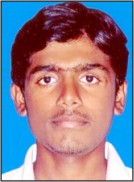
K. Guru, a student of 6th Sem. Diploma in Electronics and Communication Engineering, JSS Polytechnic for the Differently Abled played in the First National Deaf T-20 Cricket Championship held from Jan. 29 to Feb. 3 at Secunderabad representing the Karnataka State Cricket Team for Deaf.

The Karnataka team won the Championship. The Principal has congratulated Guru on behalf of the Polytechnic.

source: http://www.StarofMysore.com / Home> Sports News / March 29th, 2013

Azim Premji transfers Rs 12,300 crore to his not-for-profit foundation

Bangalore :

Azim Premji, chairman of the Azim Premji   Foundation, announced on Friday that he has transferred 295.5 million equity shares representing 12% of the total shares of Wipro Ltd , held by certain entities controlled by him, to an irrevocable trust. With this transfer (valued at about Rs 12,300 crore based on current market price), the trust’s shareholding in Wipro will go up to about 19.93%.

This trust will utilize the endowment to fund social, not-for-profit initiatives of the foundation, which are expected to scale significantly over the next few years.

The “Giving Pledge” campaign had recently announced that Premji was amongst the billionaires around the world to commit half their wealth to philanthropy. The campaign, led by billionaires  Warren Buffet, Bill Gates  and others, is a commitment by the world’s wealthiest individuals and families to dedicate the majority of their wealth to philanthropy.

Azim Premji Foundation  is a not-for-profit organization set up in 2001 with the goal to create and sustain initiatives to contribute to a just, equitable, humane and sustainable society. The foundation has worked largely in rural India, often in close partnership with various state governments, to help contribute to the improvement of quality and equity of school education.

Currently the foundation’s work is spread across Karnataka, Uttarakhand, Rajasthan, Chhattisgarh, Pondicherry, Andhra Pradesh, Bihar and Madhya Pradesh.

The foundation’s strategy focuses on creating and scaling up a network of institutions at various levels to contribute to improvement in the school education system and allied areas. As part of this strategy, over the last two years, the foundation has set up the Azim Premji University  at Bangalore, state level institutes in three states, district level institutes in seven districts and six demonstration schools associated with the district institutes. Seven more district level institutes are in various stages of formation.

The University has been established with the social purpose of developing outstanding professionals in the domains of education and development for the entire country. The University does this through offering various kinds of degree programmes, continuing education programmes and creation of knowledge in education and allied development areas. Currently, the university offers MA Education and MA Development programmes. It offers specializations in school leadership & management and curriculum & pedagogy under MA in education, and livelihood, public policy, health & nutrition and law & governance under MA in Development.

As part of scaling up of the institutional strategy, over the next 4 to 5 years, the number of district level institutions will expand to 50-60, state level institutions to 6-8 and the university will expand to have 3,500 students with 350 faculty members across multiple programs. The foundation will also have 50-100 demonstration schools associated with district level institutions. During this period, the team size is expected to grow from the current 800 people to about 4,000 people.

source: http://www.timesofindia.indiatimes.com / Home> Tech> Tech News> Software & Services / by Sujit John, TNN / February 22nd, 2013

Kush Maini becomes first Indian to win a World Series Karting race

New Delhi :

Kush Maini  created history when he became the first Indian driver ever to win a WSK (World Series Karting ) race at the La Conca international Circuit in Muro Lecce in the southern Part of Italy on Sunday the 3rd Feb 2013.

Kush who drives for Team Baby Race was third overall in qualifying out of over 41 entries in the 60 Mini category. All the participants were divided into 4 groups for the elimination heats as once 34 would Race in the Finals.

Kush was in Group C and won two of the heats while coming second in one of them. This entitled him to the Pole Position for the Start of the prefinal Race which was once again the first time for an Indian to start on Pole Position.

The Prefinal which was run over 8 laps of the 1.25 km circuit was extremely well fought with the top 4 drivers. Kush struggled a bit on the pace and finished third in the Prefinal. The Finals started with Kush in the third Place and on the very first Corner Kush moved into second Place behind Martinez.

Martinez pulled off an early lead and Kush was maintaining a distance of about 6 kart lengths as both were lapping at the same Lap times. Meanwhile Pagano who was in third showed extremely fast pace and was catching up to Kush. Soon Pagano overtook Kush and was on his way to catch up with Martinez. Kush played the waiting game and followed Pagano as both of them started to close on Martinez.

On the Eight lap Pagano overtook Martinez and on the 9th lap, Martinex took the lead again except that all the three drivers were driving like a train with no gap in between.

The three of them had broken away from the Pack and it was a very close and exciting race. On the very last Corner Pagano tried to make a move on Martinez and they both touched slowing down Martinez momentarily and also forcing Pagano off the track. Kush who was right behind Seized the opportunity and made a brilliant Pass on martinez which went all the way to the chequered flag where Kush finished just a mere.019 seconds ahead of Martinez in the mostexciting nail biting finish of the weekend.

Kush was extremely happy with the win and was continuously punching the Air to celebrate his victory.

On the Podium Kush was looking up again and again to make sure that he saw the Indian Flag that was rising behind him at the Podium Ceremony.

Kush with the three other European Champions for the other 3 events were then invited for a Press Conference to share their experience for the day.

Kush was very happy and said “I have been driving Karts from the age of 5 and started racing at the age of 7. I spent last year racing in Italy which was a great learning experience for me as I also got several podium finishes in many of the races. However WSK is the biggest race for me and to win here is fulfilling the start of a Dream to become one of the best Drivers. I am now looking forward to the balance three races of the Master Series as well as the two races of the Euro Series.”

Kush was very happy to share the same platform as Max Verstappen, Bocallachi and Alesio Lorandi.

Kush’s Elder brother Arjun Maini  did not have a good start to the event as some Kart issues prevented him from Qualifying in the front. He had a bad crash on the first Heat and followed it with a top 10 position in the second. However he has to be content starting the prefinal A in 23rd Position.

Earlier in the day Arjun was 3rd fastest and this gave him some hope to fight his way from the back of the grid. He drove brilliantly to make 10 positions and finally finish 13th in the KFJ category. This meant that he would be starting in 25th position in the finals that was run over 16 laps. Once again he had an excellent drive and finished 14th.

Still in pain from the crash on Saturday Arjun said, “It was a very tough weekend as I had a very bad start on Friday and Saturday but was very happy with the way I drove on Sunday to finish 14th from over 60 of the world’s best drivers. I will work hard to come in the top 5 for the races to follow.”

source: http://www.timesofindia.indiatimes.com / Home> Sports> Racing / by Arani Basu, TNN / February 09th, 2013

Rockets of Tipu Sultan to get pride of place

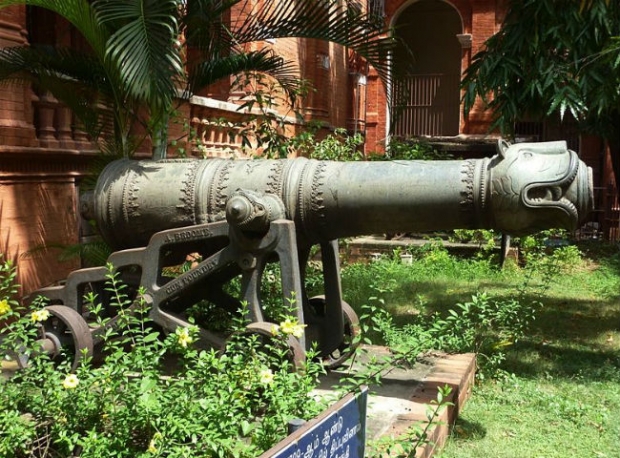
Cannon used by Tippu Sultan’s forces at the battle of Seringapatam 1799 – Wikimedia commons

Srirangapatna:

Saluting the vision of the father of  modern missile technology, Tipu Sultan, the Defence Research and Development Organisation (DRDO) plans to set up India’s first  archaeological rocket centre at his rocket court in Srirangapatna from where he fired the world’s first war rocket during the Anglo-Mysore battle.

DRDO Chief Controller (R&D), Dr W. Selvamurthy, who visited the rocket court on Friday  with other top defence scientists, was shocked  to see its condition. A portion of the front wall has collapsed and illegal constructions have cropped up on all sides.

Dr Selvamurthy said, “It’s really sad and appalling. The matter is of a great concern. The place which gave birth to the basics of rocket technology can’t be treated this way.  I will immediately write to the state Chief Secretary, the Archa­eo­logical Survey of India and the  state Dep­a­rtment of Arch­a­eology and Mus­e­u­ms  to restore and convert the mon­ument into an archaeological centre of great importance.”

He said that in the 16th century, the country’s core competence in rocket and missile technology was superior to rest of the world. The DRDO proposes to use the space to showcase India’s technological advancements. The wea­p­onry of  Mysore under Hyder Ali and Tipu Sultan was formidable and quite ahead of its time, he noted.

“We could have a life-size prototype of BrahMos, and models of a wide-range of missiles that India has developed like Prithvi, Agni and ballistic missiles, besides an original piece of Tipu’s rocket at the archaeological rocket centre we are proposing,” he added.

Meanwhile, the ASI and the state archaeological department continue to pass the buck on  the conditon of the rocket court. While  ASI representative, Satish Kumar says the department is responsible for the upkeep of the moument,  Mr. Gopal, director of the state department, contends it is the ASI’s job to restore it.

source: http://www.DeccanChronicle.com  / Home> News> Current Affairs / by S. v. Krishna Chaitanya / December 29th, 2012

From vinyl neglect to virtual safety

Vikram Sampath with his prized collection

Vikram Sampath’s book My name is Gauhar Jaan recounts the dramatic life-story of celebrated courtesan Gauhar Jaan, who was also India’s first singer to record on the gramophone. It was during the research for this book that Vikram’s penchant and passion for gramophone recordings was stirred.

“Gauhar had cut close to 600 records in her lifetime and I ended up collecting over 150 records of hers alone from the grey markets in Kolkata, Delhi and Mumbai,” he says. “In the process, I also stumbled upon priceless recordings of several of her contemporaries in the north and south of India, all tucked away in unknown quarters of the country.”

In 2010, after the book was published, Vikram went to Berlin on a visiting fellowship and came upon a treasure of recordings by Indian artistes at sound archives across Europe. “The constant refrain everywhere was, ‘Why doesn’t India have a national sound archive?’” says Vikram, the BITS Pilani alumni, who is a banker.

In the course of a conversation with Congress president Sonia Gandhi, who invited him for a tete a tete, after reading the book, Vikram brought to her attention a need for an archive. “It was a revelation to see her speak so knowledgeably and passionately about classical music,” says Vikram. “I brought up the archive idea with her and she was excited about it and immediately made connections with several government agencies.”

With a recommendation from such a high level, one would have thought the project was a done deal. But Vikram sighs, and says, “The proposal just kept moving across departments and academies, which gave empty promises.”

But the archive project survived. Help came from T V Mohandas Pai, who was then with Infosys and is now chairman of the Manipal Global Education. “He readily and generously funded the project with seed capital that helped to import state-of-the-art equipment that meets international standards,” he says.

The Manipal University also came forward to host the archive at their premises in Bangalore. A grant from the India Foundation for the Arts (IFA) has also helped Vikram to put together important research material around this era. “The Archive of Indian Music (AIM), which I have set up, has several trustees from across the country,” he says.

A not-for-profit trust, AIM will seek to digitise, preserve and disseminate an important slice of the musical and cultural history of our land. “The range of recordings to be covered would not be restricted to Hindustani and Carnatic classical music alone, but also theatre, early cinema, folk music recordings in all languages as also voices and speeches of great personalities like Mahatma Gandhi, Rabindranath Tagore, Jawaharlal Nehru and others,” he says.

AIM now has 10,000 records—both 78 RPM shellacs and vinyls—already collected from several places; a few donations, and others purchased from the kabadiwalas! “The trustees would help us source these records from their region and send them to Bangalore where my technician Chethan Kumar digitises these records and catalogues them on a daily basis,” says Vikram. “But the archive is going to be a virtual one.”

The website, www.archiveofindianmusic.org, is in its final stage of development in association with Vikram’s partners, Gaurav Vaz, and his company ‘The Random Lines’. It is expected to go live by end October 2012 with about 1,000 clips in the first round. “All these clips will be uploaded there and made available to people on free registration, for listening through streaming audio alone and not for download,” he informs.

Vikram says it is a shame that in a nation where music is so ubiquitous there is no central repository for all kinds of music of our country. “What better way than the arts to achieve a sense of national integration in these troubled times?” he says. “But it’s an endemic problem because as a country we have very little regard for our history and for documentation. Just see the kind of preservation done for even houses of musicians like Beethoven or Mozart, while a Thyagaraja’s house in Tiruvayyaru is broken down to have a garish renovation! ”

Of course there are government bodies, academies and archives. “But they need to make a reality check about whether their holdings are reaching out to anyone, especially in today’s day of technology and the internet with everything being so accessible,” he says.

source: http://www.newindianexpress.com / The New Indian Express / Home> Magazine / by Sandhya Iyer / December 02nd, 2012

Country’s first intelligent transport system launched in city

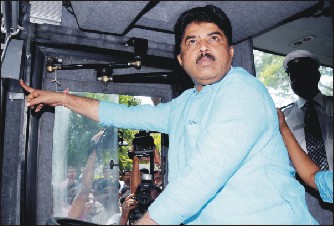
Caption: The Transport Minister R. Ashok is seen switching on the Intelligent Transport System (ITS) in a KSRTC bus in front of Senate Bhavan, Manasagangotri in city this morning.

Mysore, Nov. 17

The Intelligent Transport System (ITS), a first of its kind in the country, was launched by Deputy Chief Minister and Transport Minister R. Ashok here this noon.

Speaking after launching the ITS system at a function held at Sri Nalwadi Krishnaraja Wadiyar auditorium, Senate Bhavan in Manasagangotri, Ashok said that the system is provided at a cost of Rs. 30 crore.

“It will facilitate passengers to get information such as arrival of buses to the stops and details of bus movement from select bus stops by sending SMSes,” he said and added that the ITS system would be extended to other cities in future.

“The State Government is working towards extending transport facilities to every village,” Ashok said and added that plans are on the anvil to introduce intra-city buses in Tumkur, Gulbarga and Mangalore also, in order to prevent people from spending more on private or personal transport.

“The ITS is a game-changer,” said the Minister and added that it will make public transport more efficient and transparent.

Automatic Vehicle Location (AVL) information has been provided to track all city buses in real-time, Passenger Information System (PIS) have been installed at 193 locations, in-bus Display and Automated Voice Announcement System have been provided in all city buses, Central Control Station with Video Wall, Servers, Workstations and Software and MIS reports on fleet management providing performance of the bus system and drivers.

Informaiton can be obtained from the 167 LED display boards and 26 LFD boards at terminals, stops and others strategic locations.

For Interactive Voice Response System (IVRS) — dial 1800 4255220.

SMS 98700-11012 to get bus arrivals and departures in real-time at all bus stops in the city.

Log in to http://mitra.ksrtc.in for real-time bus location map.

Chamaraja MLA H.S. Shankaralingegowda presided over the function.

MLC Siddaraju, Karnataka Zoo Authority Chairman M. Nanjundaswamy, MUDA Chairman L. Nagendra, Karnataka Exhibition Authority Chairman B.P. Manjunath, KSRTC MD Manjunath and others were present on the occasion.

source: http://www.StarofMysore.com / Home> General News / November 17th, 2012