Category Archives: Amazing Feats

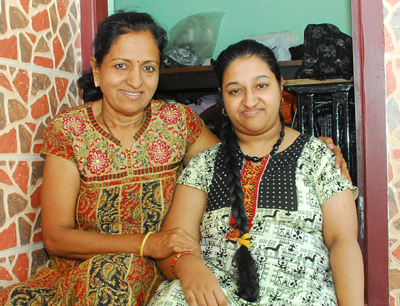
Mother takes up studies for daughter’s sake

The 4O-year-old widow who had studied up to Std VIII is now in the final year BA and wants to learn to ride an autorickshaw, so that she can take her spastic daughter to college every day without any problem

Forty-year-old Shashi has struggled hard to bring up her 17-year-old spastic daughter Vaishnavi. Besides working hard for a living, the single mother who had studied only up to Class VIII, even attended evening school so that she could teach her daughter in the morning. Today, the mother-daughter duo are doing their graduation together and both aspire to become lecturers.

Vaishnavi was born in Udupi. At the time of birth she was a healthy baby, but within a week’s time, lost weight and had no strength in her hands and legs. At that time, her parents lived in Bangalore, where the father ran a business. “Doctors at Nimhans said there was no cure for the disorder. Yet, we kept trying with oils and massages. Till she was eight years old, I used to carry her,” said Shashi.
Vaishnavi was also diagnosed with a hole in her heart. “The operation would have cost Rs 2 lakh, so we took her to Puttaparthi, where free treatment was provided. Luckily the operation was successful,” said Shashi.
“Eight years passed by. A friend suggested that I recite a prayer everyday to my daughter. I would make my daughter sit on the bed with pillows around and read out the prayer. One day she just stood up and tried to walk. That was the only development till date. Sadly her father was not with us to see her walk,” she said.
After the death of her husband, Shashi moved with her daughter to Mangalore with her life’s savings of about Rs 2 lakh and bought a small flat in Shaktinagar for Rs 1.75 lakh. It was from here that the most difficult part of her life began. She had no income and with her education, getting a job was tough.
A friend advised Shashi to take the test for insurance agents. “The study material gave me a shock as I knew very little English. But I took up the challenge for my daughter’s sake. Though I did not understand anything, I mugged up the questions and answers. I cleared the exam.”
Shashi locks her daughter inside the house when she goes out. “I am used to it. I wait for my mother to come back to have lunch because I can pick up and eat only what she leaves on the floor or table,” said Vaishnavi.
After Vaishnavi turned 14, she too wanted to go to school. “I visited several schools for admission. While schools for the differently abled turned her away saying that they were for mentally challenged children, others said Vaishnavi won’t be able to adjust with normal children.”
“It was then I heard about St Aloysius night school where classes are held from 5.30 pm to 9 pm. The principal was very encouraging.
He said my daughter needed to attend classes everyday, otherwise she would fall short of attendance. That was not possible, so I told them that I could attend the class and then go back and teach her at home. The headmaster, Praveen Hridayaraj, agreed. I found it really tough in the beginning. But I did not give up. If I gave up, my daughter would never study,” Shashi said.
In 2009, both the mother and daughter passed SSLC with good marks and decided to go to college. “Considering my age, the college asked me to go for II PUC directly, while my daughter was admitted to I PUC. Financially we were struggling. St Aloysius College helped by not charging fees till date,” Shashi said.
Shashi is now studying in final year BA and her daughter is in the second year. The college provides them auto fare. “Convincing autorickshaw drivers is a big challenge. So I want to learn to ride an auto so that I can drive my daughter to college if I manage to arrange for funds and buy an auto,” Shashi said. She can be contacted over ph: 7204651798.

source: http://www.bangaloremirror.com / Home> News> City> Story / Bangalore Mirror / by Deepthi Shridhar in Mangalore / Sunday, May 27th, 2012

Braving odds, they come out with flying colours in SSLC exams

Mysore:

The inmates of the government-run girls’ home here, who had to go through the dark realities of life, have come out with flying colours in the recently-held SSLC examinations.

Sindhu of Chitradurga secured the highest marks – 488-while Niveditha scored 412 out of 625 marks. Except one, all the 13 students appeared for the exam emerged victorious.

Girls’ home superintendent Geethalakshmi told TOI that Sindhu had struggled hard in life after her father died when she was young.

Her mother Poornima was shattered after the death of her husband Chandru. Later, she got admitted all her four girl children to government rehab centres in Hassan, Bijapur and Udupi.

Sindhu was relocated to Mysore from Hassan centre a year ago. As per her request, all her sisters were also brought to Mysore centre later. Lavanya, Ranjitha, Hemalatha, Kavitha, Niveditha, Mamatha M, Shobha S, Lakshmi N, Vidya, Kalaveni and Nirosha too had to face many challenges in their life. This success is a morale booster for them who are now hoping for a better future.

ODANADI INMATES SHINE

Six out of seven inmates of Odanadi Seva Samsthe passed the SSLC examinations this year. Rathna, who had worked as a bonded labour for two years, was one among them. Saraswathi, Nischitha, Manjunath, Ganesh and Hema are the other students. Odanadi is working for the welfare of sex workers and their children.

BLINDNESS, NO HINDRANCE

All the four students of Helen Keller Blind School in Mysore secured first classes in the examinations.

Mahadevaswamy secured the highest marks in the school with 443 marks. Prathap bagged 439 marks while Rameshnayaka and Nataraju B secured 420 and 419 respectively.

Mahadevaswamy and Prathap scored 98 marks in mathematics. Nataraju B managed to score 97 in social studies.

source: http://www.timesofindia.indiatimes.com / Home> City> Mysore / TNN / May 18th, 2012

US varsity honours Narayana Murthy

Tampa (Florida) May 16

The University of South Florida has honoured Infosys founder N.R. Narayana Murthy with the Global leadership and Free Enterprise Awards for his leadership and contributions to the international business world.

Presenting Infosys chairman emeritus Murthy with the awards at the Patel Centre for Global Sustainability here Monday, USF President Judy Genshaft praised him for his entrepreneurial spirit, according to a university press release.

Earlier, in an informal conversation with past and present students, Murthy said because of his middle class background, it was not as difficult for his company to maintain its values as it might be for the mass of people eking out a living.

‘You need a spirit of sacrifice and you need to have trust,’ he said.

Murthy explained how the company’s ethos has its roots in the very first meeting held at his house in Mumbai with his six fellow founders. Their discussion was focused on profitability.

Murthy focused their attention on ‘seeking respect’, ‘living in harmony with society’ and making sure ‘you don’t shortchange your customers,’ he said. When you do those things, ‘revenue will come. Profit will come’.

In response to a question from about the chances of Murthy entering politics, he mentioned his preference for ‘rational discussion’ and the difficulty the political world offers for such and expressed some hesitation.

Kaushal Chari, chair of the USF information systems and decision sciences department, said Murthy’s story is inspiring for students.

‘He’s a world-class business leader,’ said Chari, who leads a study abroad trip to India every year for business students.

IANS

source: http://www.india.nydailynews.com / Home> News> Desi News / Wednesday, May 16th, 2012

City-based Graduate launches new company in US

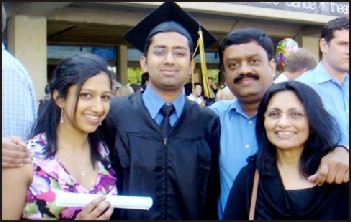
Caption: Siddarth is seen with his parents Padma & Satish and sister Anitha.

Mysore, May 11

Success does not see age or education, instead it sees hard work and enthusiasm to succeed in one’s endeavour. This is true in case of a graduate who, while most of his peers are working at entry-level jobs or in graduate school, is the Chief Technology Officer (CTO) of a medical device startup company.

Siddarth Satish, who has his roots in Mysore, started Gauss Surgical just after finishing Master of Translational Medicine (MTM) programme of Bioengineering Department at University of California, Berkeley, USA.

Siddarth has raised about $1 million in venture funding, hired several full-time staff, recruited a veteran entrepreneur as CEO, and is submitting designs to the US Food & Drug Administration (FDA).

His transition from ChemE undergrad to CTO of his own company in just under two years was due to hard work, brains, ambition and MTM programme. The MTM programme is a one-year master’s degree offered jointly by UC Berkeley and University of California, San Francisco (UCSF), aimed at accelerating the translation of cutting-edge research into advances in patient care.

Finishing up his 2010 Berkeley B.S. in Chemical Engineering, Siddarth joined MTM. He was partnered with fellow students Amer Abdulla and Charles Zhao to work with Professor in Bioengineering Dr. David Rempel. Although not all MTM graduates go on to startups or to work in industry, the unique experience helps students with ambition pursue their passion. The team explored several different projects with collaborators at Stanford Medical Center, including one on virtual instrument pedals that resulted in a patent filing and presentation at the American Academy of Pediatrics. All three decided to focus on another operating room problem: estimating surgical blood loss.

The team completed prototyping to accurately diagnose blood loss before graduating in Summer 2011, and then decided to take their work all the way and form a company: Gauss Surgical.

Siddarth is the son of Padma & Satish, residing in the US since 17 years. City’s industrialist and art patron K.V. Murthy is his maternal grandfather while late Dr. M.S. Nagaraja Rao (former Director General of ASI) was his paternal grandfather. Siddarth has a sister Anitha who will be entering medical school soon.

source: http://www.StarofMysore.com / General News/ May 11th, 2012

Bitten by the B’lore bug

LEGENDARY CONNECTION

It was in Bangalore that Ronald Ross first became interested in mosquitoes. Ross would go on to make the crucial discovery of plasmodium, the malarial parasite, in a mosquito, and win the Nobel too. Bangaloreans can truthfully say that the seeds of that great discovery were sown in our City, writes Meera Iyer

In September 1883, a British doctor named Ronald Ross was appointed the Acting Garrison Surgeon in the Bangalore Civil and Military Station. The doctor initially stayed in a bungalow close to today’s MG Road. He records in his memoirs that this was when he first became interested in mosquitoes. “They devoured me,” he writes, “until I discovered that they were breeding in a tub just outside my window.” Ross got rid of the wee beasties by the simple expedient of tipping the tub. So began a series of experiments and observations on mosquitoes that eventually led to a Nobel Prize for Physiology and Medicine in 1902.

Ronald Ross was born in Almora, Uttarakhand, on May 13, 1857, three days after the Indian Mutiny or the First War of Independence began. He grew up in Almora, Nainital and Benares and was sent to England for his education when he was eight.

The future scientist and Nobel Prize winner displayed no interest whatsoever in science but took wholeheartedly to painting, literature and the arts. He wrote poetry while still at school and at 17, decided he wanted to be a writer. But his father wanted him to join the Indian Medical Service, and so Ross resignedly joined St Bartholomew’s Hospital Medical School in London to study medicine. Ross wrote more poetry and even some short plays while at St Bartholomew’s but remained quite indifferent to medicine. He failed a qualifying exam for the Indian Medical Service, cleared it a year later on his second attempt, and then joined the Service. Ross came to India in 1882, stayed in Madras briefly and then had the first of many stints in Bangalore when he was given medical charge of a unit of the Madras Infantry for a few weeks.

Like many others before and after him, Ross loved Bangalore. He describes how he used to go for long walks every day among “rocky crests of mountains, fir woods, dells with beautiful little trickles of streamlets”. The sun and the breeze, he says, “were those not of earth but of heaven.” In a complaint that sounds all too familiar to us today, Ross says that when he looked for these same places ten years later, he found they had all been swallowed by development.

Over the next few years, Ross returned to Bangalore several times and also served in Quetta, Burma and the Andamans. He churned out more plays, novels and dramas, became very interested in mathematics, played a lot of tennis, whist and golf, but remained a completely ordinary doctor. It was only when he was on leave in England in 1888 that something ignited a spark in him: “I determined now to interest myself much more in my profession,” he writes, and he returned to India with renewed vigour.

Back to Bangalore

Ross was posted in Bangalore once again in 1890, as Staff Surgeon of the Civil and Military Station. Now married, he and his family lived in High Grounds, “in a delightful house facing the golf ground, called Uplands”. (Incidentally, this very house was where Sir M Visvesvaraya stayed for a time after his retirement in 1908). According to his Nobel lecture, it was during this 1890-1893 period in Bangalore that Ross made his first studies of malaria.

He also wrote his first research papers on the disease, including some that rejected the ‘bad air’ theory but speculated (wrongly, of course) that malaria might have an intestinal cause.

In the 1890s, scientists had begun to realise that parasites in blood caused malaria, but no one had any idea how these parasites moved from sick people to healthy people. In 1894, while on leave in England, Ross sought out Patrick Manson, a tropical disease expert who had recently discovered that mosquitoes spread the disease filariasis.

Manson told Ross he believed mosquitoes also spread malaria. This was the beginning of a long association between the two scientists.

Ross returned to India, and plunged into research, determined to prove Manson’s ‘Grand Induction’ as he called it.

Within a few months, Ross became an expert on dissecting mosquitoes, identifying parasites and diagnosing malaria. In his memoirs, Ross states that from April 1895 to February 1899, he wrote 110 letters to Manson about his research, “containing almost exactly 1,000 words each, or about one word to every ten people killed by malaria in India alone every year.”

At West End

But another disease also killed hundreds in India in those days. In 1895, Ross was called to Bangalore on special sanitary duty to contain the frequent cholera outbreaks here, especially in Shivajinagar, Ulsoor and parts of the pete.

Ross took up residence in a tent on the grounds of the (now Taj) West End Hotel. Over the next two years, he organised an overhaul of refuse-cleaning systems, suggested improvements in drainage, mapped the locations of wells and had them disinfected, and posted hospital assistants at stations to detect cases. He also frequently accompanied scavengers in their early morning work. “These experiences are not easily forgotten,” he writes.

Of the scavengers, “the poor men themselves, the last pariahs and outcasts of society, toiling while others slept,” says Ross, “None shall know of your labour, no one shall thank you, you shall die forgotten,” and yet, “the civilisation of the thronged cities was based upon their labour.” Though occupied by his sanitary work, Ross still eked out time for malaria. Until then, both he and Manson had thought that when malarial mosquitoes died, they somehow infected the water they bred in, which when ingested, caused malaria in humans. It was in Bangalore that Ross came up with another hypothesis that later proved correct: In May 1896, he wrote to Manson, “…the belief is growing on me that the disease is communicated by the bite of the mosquito. She always injects a small quantity of fluid with her bite — what if the parasites get into the system in this manner.”

Ross set out to test this hypothesis by the decidedly questionable method of getting mosquitoes to bite volunteers, mostly ‘natives’ of course, including the Assistant Surgeon of the Bowring Civil Hospital.

But as Ross had yet to discover that only the Anopheles mosquito carried the malarial parasite, his results remained negative. It wasn’t until 20 August 1897 (now commemorated as World Mosquito Day), when Ross was posted in Secunderabad, that he made the crucial discovery of a Plasmodium, the malarial parasite, in a mosquito. He came back to Bangalore on short leave a month later, staying at the West End once again (in a room this time, and not a tent!), and wrote up his exciting discovery. The paper, “On some Peculiar Pigmented Cells found in two Mosquitoes fed on Malarial Blood,” appeared in the British Medical Journal in December 1897.

In Secunderabad, the building where Ronald Ross made his landmark discovery is now called the Sir Ronald Ross Institute, and bears a plaque in appreciation of Ross’s work. But Bangaloreans can truthfully say that the seeds of that great discovery were sown in our City.

ROSS, THE POET

* Ronald Ross was known to be a poet, novelist and painter.
* His collection of poems include: ‘psychologies’, ‘Poems’, and ‘Fables and Satires’. He composed this verse about his first impressions of malaria that killed millions:

In this, O Nature, yield I pray to me.I pace and pace, and think and think, and takeThe fever’d hands, and note down all I see,That some dim distant light may haply break.The painful faces ask, can we not cure?We answer, No, not yet; we seek the laws.O God, reveal thro’ all this thing obscureThe unseen, small, but million-murdering cause.

(Courtesy: malariasite.com)

source: http://www.DeccanHerald.com / Home> Supplements> Spectrum / by Meera Iyer / May 07th, 2012
Innovation award for Skanray

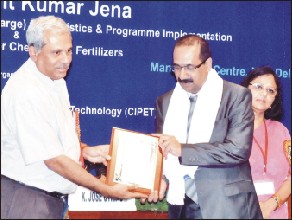
Caption: Balasubramaniam, Director & CTO, Skanray Technologies, receiving the award from K. Jose Cyriac, Secretary, Dept. of Chemicals & Petrochemicals, at New Delhi recently.

Mysore, May 3

Skanray Technologies Pvt. Ltd. won an award for innovation in polymeric products at the 2nd National Awards ceremony for technology innovation in various fields of petrochemical and downstream plastics processing industry held in New Delhi recently. The award is instituted by Ministry of Chemicals & Fertilisers, Govt. of India.

Skanray Technologies won the award for developing ‘Use of Engineering Plastics for Diagnostic X-ray equipment.’

Balasubramanian, Director & CTO, Skanray Technologies, received the award from K. Jose Cyriac, Secretary, Dept. of Chemicals & Petrochemicals.

Skanray was founded in 2007 by a team of reputed engineering and business professionals with decades of experience in industrial and medical devices sectors and having global exposure. Skanray moved into its state-of-the-art manufacturing facility in Hebbal, Mysore and commenced commercial business in 2011.

source: http://www.StarofMysore.com / General News / May 03rd, 2012

Anil Kumble 10 Wickets in an Inning

Anil Kumble from India takes 10 wickets in an inning against Pakistan, 2nd Test, 2nd Innings at Feroz Shah Kotla Delhi on February 4-8-1999. India won the toss and electing to bat, India found the off-spin of Saqlain Mustaq too hot to handle and were all out for 252 early on day two. With the pitch providing generous assistance to spinners, Kumble and Harbhajan Singh bowled out Pakistan for a measly 172.
Anil Kumble takes 10 wicket in that Inning and becomes the first Indian bowler to achieved the historic feat of grabbing all ten wickets for 74 runs in 21.3 over spell. India won by 212 runs, India went into the match already 1-0 down in the two match series, eager to avenge the narrow 12-run defeat by Pakistan in Chennai a week previously. 2 match series drawn 1-1. Player of the match Anil Kumble for 14 wickets.
Uploader:  Sreejith Sree
source: http://www.Cricchamber.blogspot.in / Cricket Chamber / Uploader:  Sreejith Sree / April 19th, 2012

‘I was fine with becoming blind, but not when asked to give up running’

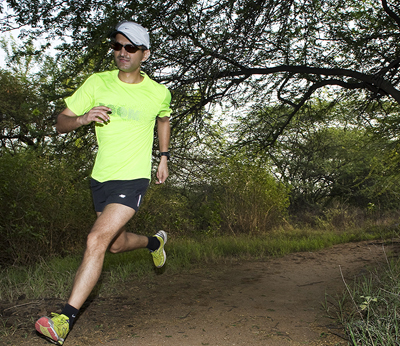
Living out loud with Dr Rajat Chauhan, (37) Marathoner, sports medicine doctor

Dr. Rajat Chauhan (37), Matathoner, Sports Medicine Doctor

The world’s highest ultra marathon, La Ultra, is his brainchild. But there was a time when this sports medicine doctor was asked to forsake his dreams because he was losing his vision


I started running when I was nine. I was studying at Wynberg Allen School, Mussorie. All the boarders had to run every Sunday morning for four kms; it was quite a distance for a nine-year-old and that too in the mountains. The one who finished last would be caned. That’s how it all started. Back then it was more of something I was expected to do. Later, the school started giving mango juice to the first six boys at the finishing line. 

There was no way I was going to miss that! I was pretty useless at other sports, so I thought why not running. I was in 9th standard when I got into the cross country team and that is when I realised how much I was hooked to running. I ran my first half marathon (the Rath half marathon in Delhi) at 16 in 1 hour 29 minutes.

My parents didn’t object to my obsession with running, but when I told them that I wanted to be a runner, they flipped. They wanted me to be a doctor. In the first year of med school I suffered from retinal detachment in my right eye. The doctors forbade me to do physical activities. I was completely fine with the idea of becoming blind; it wasn’t an issue with me, but being told that I can’t run was a huge blow. I got operated in 1994 and after that my power jumped to -6.
For the next four years, I’d run for just 30 minutes once a week. And that’s when I decided to study sports medicine in the University of Nottingham in the UK. Peter Gregory, the chief medicine officer of the English cricket team, was my immediate supervisor. He had a huge impact on me. I went to South Africa in 2004 during the World Cup; it was my first on-field exposure. That’s where I realised that the guys behind the scenes really impact the activities on the field.
I also ran my first ultra marathon from Paris to London covering 200 miles. I worked in the UK as a sports medicine doctor before moving to Bangalore in mid 2006 when my wife was expecting our second son.
I conceived La Ultra, the world’s highest ultra marathon, by chance. In 2010, I asked a friend of mine whether he wanted to go to Manali to run in the Rohtang Pass. He agreed. We couldn’t run beyond 30kms in four hours. Luckily, for our egos, there was a landslide! In Manali, we saw an altitude map from Manali to Leh in an internet café. It reminded me of the Badwater ultra marathon in Death Valley, California. Manali to Leh is 500 odd kms. I thought we could run 222 kms because I wanted to do a run that was longer than Badwater (which covered 217 kms). This route is far more difficult than Badwater! On our way back to Delhi, my friend and I charted a plan for La Ultra on the back of a newspaper. But we were told that at high altitude runs, you need to rest at 13,000 feet. But I wanted to do an uninterrupted one.  So I thought, why not descend from a higher altitude to a low altitude so that the body gets acclimatised to that condition. People thought I’d lost it and said it’s not doable because of the lack of oxygen. But we did it! We started the run from Leh. ‘La’ stands for Tibetan mountain passes. The track required us to cross four mountain passes, including the world’s highest pass, Khardung La and that’s where we got the name from. So it’s the Ultra of passes.
There was five of us, two from the UK and two from the US who got to know of the run from Facebook. A lot of strangers from Mumbai, Hyderabad and Bangalore volunteered to help, and not all of them had running backgrounds. But only one person, Mark Cockbain, finished the run. The biggest thing that this run, which has now become an annual event, taught me was discovering human nature. Out in the open, people become unpredictable.
Both my boys (one is six and the other 10) run. The older one started when he was three years old and the younger one did his first mile nonstop when he was 18 months old. I don’t push them; they love it as they find it pretty cool. But I have not been able to convert my wife into a runner, maybe I haven’t tried hard enough. She just goes to the gym. I have been running for the last 28 years and it’s a way of life. It means the life to me. When I don’t run, I am pretty miserable. In hindsight, I am grateful to the man with the stick for giving me a reason to run. It gave me so much more than just that mango drink. 

As told to Piali Dasgupta

source: http://wwww.BangaloreMirror.com / Home> Sunday Read> Special > Story / by Piali Dasgupta / Sunday, March 04th, 2012

She danced her way to the Guinness

Swati Bhardwaj has been dancing since she was four and has won several awards.

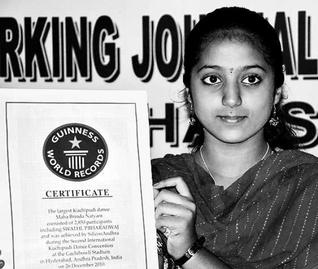
It is a dream come true for Swati P. Bhardwaj, an eighth standard student in Channarayapatna. For, she has entered the Guinness World Records as part of the 2,850-member troupe that performed the largest Kuchipudi dance.

The event was held as part of the second annual International Kuchipudi Convention at the Gachibowli Stadium in Hyderabad on December 26, 2010. Swati received the certificate from the Guinness World Records recently. The record-setting performance lasted for four hours and 26 minutes.

Swati has been into dancing since she was four and has performed Bharatanatya at various programmes.

She has won several medals in the State- and national-level dance competitions.

“Swati, who has been learning Bharatanatya for the last 10 years, now conducts classes for over 350 children in Channarayapatna,” said her father, M.K Prakash Bhardwaj, an employee in the Alur court. Swati wants to teach Bharatanatya to children in rural areas under the banner of Sri Natya Bhyravi Trust, headed by her mother, Anita. She plans to identify schoolchildren interested in learning dance and conduct classes for them during weekends from next month.

Swati performed Kuchipudi with a 2,850-member troupe for four hours, 26 minutes

source: http://www.TheHindu.com / National / by Staff  Correspondent / Hassan, July 08th, 2011


Beethoven listens as Patdeep flows in

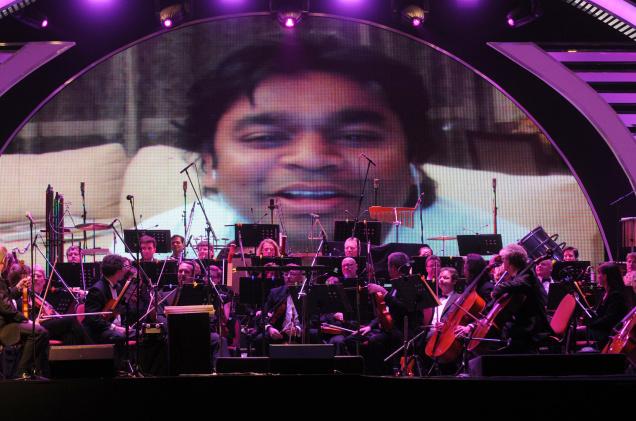
WHAT AN ORCHESTRA! Rahman’s collaboration with the Babelsberg group had its evocative moments. Photo: Sampath Kumar.G.P.  / The Hindu

The Babelsberg German Film Orchestra playing A.R. Rahman’s compositions was a rich experience. The 100-odd musicians and the audience gathered in thousands were engaged in finding home in each other’s musical ideas, says Deepa Ganesh

Music Director of the Chicago Symphony Orchestra Daniel Barenboim said this in one of his interviews. “Where are you at home?” his interviewer asked. Barenboim said, “Wherever I make music.” He further explained: “My feeling of being at home somewhere is really a feeling of transition. Music is transition, too. I am happiest when I can be at peace with the idea of fluidity.”

The air was thick with curiosity at the “Classic Incantations” concert in the city on Sunday evening — the Babelsberg German Film Orchestra performing our own A.R. Rahman’s compositions. As the phenomenal hundred-odd orchestral group presented a rich aural and visual treat, I, perhaps like several others, was trying to catch glimpses of ragas Charukeshi and Patdeep in the Soprano, and when I found shades of Yaman emanating from the absolutely grand cello portions, I was truly elated.

An audience who is witness to a synthesis of such nature, is anxiously awaiting its entry point – most in the audience found it when the theme music of Rahman’s first film “Roja” (Cry of the Rose) was played. The piece was a melange of all the musical ideas that crisscross in “Roja” – from the soft romantic tones of “Kadal Rojave” to the more forceful mood of patriotism in “Tamilah Tamilah”. Navin Iyer, Rahman’s flautist, worked his own little details, and stole the show.

The opening piece, “Warriors of Heaven and Earth suite”, was subtle and serene. It gave you a complete sense of listening to a live, full blown orchestra with a lush violin section – complete with cellos, violas, sax, cymbals and harp. The piece reminded one of many earlier musical experiences, for instance, the luxuriant violin passages were reminiscent of Ilaiyaraja, and did the overall texture of tones bring Beethoven to mind?

The challenge in most such cross cultural collaborations is the articulation of the “other”. Matt Dunkley, the conductor, orchestrator and composer of Babelsberg executed this daunting task with remarkable elan and perfection. So much so that in the piece that was a tribute to the great maestros — which the audience loved — evergreen numbers like Madan Mohan’s “Aap ki nazarone samjha”, Ilaiyaraja’s “Sindhoora Poove”, Lakshmikant Pyarelaal’s “Suhana Safar” and Rahman’s “Kehna Hai Kya” sparkled with a refreshing emotive quality.

The compositions chosen were in themselves largely “Western” in idea – “Lord of the Rings suite”, “127 hours suite”, “Elizabeth: The Golden Age Suite” and several others. Nevertheless, it needs to be said to the credit of the conductor and his remarkably-talented orchestra, that the journey was constantly outward, seeing it in Rahman’s way and never an affirmation of one’s own identity. It would have perhaps been more interesting to see what new meanings would have emerged if the orchestra had played some of Rahman’s stunning compositions in the typical Indian repertoire, like his compositions in Vasanta or Natakuranji.

The outstanding soprano singer Kavitha Baliga and Bangalore’s vibrant Arun H.K., the audience favourite Asad Ali Khan on sitar, and the perfectly co-ordinated choir group, made the concert extremely lively and also provided some of the most intense moments.

It was a perfect orchestral experience. However, I am more an admirer of Rahman’s compositions of pan-Indian feel, than those of global sounds. It could have perhaps been richer if Rahman had built some artistic tension into the Babelsberg orchestra that was so immensely accomplished.

If your passion becomes your way of life, then geographical location is less important. Daniel Barenboim, who brought together Arab and Israeli musicians to celebrate the 250th anniversary of Goethe years ago, did agree that it was impossible to have “multiple identities” but remained emphatic that the sense of belonging to different cultures can only be enriching.

At the end of all, one didn’t feel a sense of belonging.

source: http://www.TheHindu.com / Arts> Music / Bangalore / by Deepa Ganesh/ January 30th, 2012