Category Archives: Amazing Feats

Devotees donate 12 lakh rotis for month-long mass feast

It will be a unique treat for devotees who arrive here to participate in the Gavi Siddeshwara math’s jatra in Karnataka for three days from Wednesday.

No one will go hungry with anna dasoha (mass feast) being planned for the devotees which will continue for nearly a month.

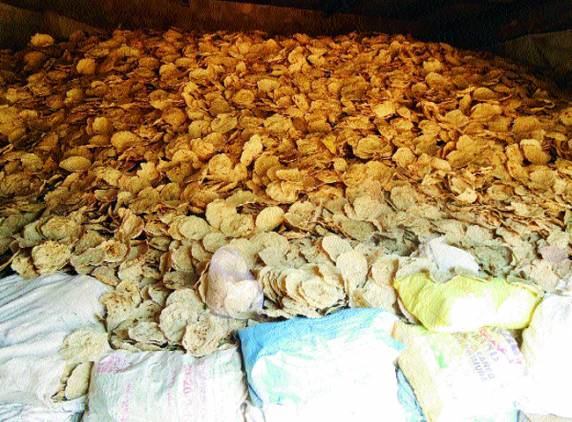
The mass feast is organised every year during Gavi math jatra besides the daily anna dasoha for devotees who visit the math. People from across the district, donate kadak roti, prepared with jowar flour for the purpose.

Rotis are dried so that they can be stored for a month without getting spoilt. They are shifted to the math just 4-5 days before the jatra.

The rotis are collected from houses in most villages by the elders who carry them to the math in bullock carts or autorickshaws. Over 12 lakh rotis have been stored in rooms belonging to the math to feed the devotees arriving for the jatra mahotsav.

More rotis are expected with people expected to continue the supply as long as the jathre lasts. This apart, the devotees have also donated thousands of quintals of rice, 5,000 litres of milk, ghee, vegetables and 200 quintals of madali or maldi, prepared by mixing jaggery, wheat flour and dried coconut.

Abhinava Gavisiddeshwara Swamiji, the pontiff of Gavi math told Deccan Chronicle that five years ago, about 80 quintals of rice was left unused in the godown.

“Hence, we decided to use it for dasoha. However, some devotees opposed the move asking what we would do the next year. Undeterred by this, we began the mass feast during the jatra mahotsav. Since then, the feast has been continuing uninterrupted with the blessings of the late pontiff of the math,” the seer added.

source: http://www.DeccanChronicle.com / Home> Channels> Cities> Bengaluru / DC, Koppal / January 11th, 2012


Three profiles of courage

In a time of increasing cynicism, three stories that illustrate hope amid overwhelming adversity

The Sceptic | Sandipan Deb

This column is called The Sceptic, but this week, perhaps especially because every passing day now makes us more sceptical, more cynical about what’s going on around us, let me just shed that hat.

Let’s feel humble.

Yes, this needs a bit of explaining. For the past few months, I have been involved in a project that identifies and celebrates bravery, bravery beyond justly rewarded militaristic valour. And for all of us on the project, it has been an extraordinary journey. But let me not bore you. Let me tell you about three women you have quite possibly never heard of.



In the car park behind one of south Delhi’s glitziest multiplexes, in a tiny hut made from plastic sheets and boxes, lives Pratibha Devi. She makes her living by scavenging and reselling the detritus of rich merrymakers who congregate at the multiplex. Twice a day, if you happen to be there at the right time, you are treated to a remarkable sight. More than a dozen stray dogs that live in the car park line up in front of her shed. Sometimes it’s khichdi for them, sometimes when she has a bit of extra money, she treats them to chunks of meat. The dogs have grown up with Pratibha Devi as the only mother they know. “Taking care of them is my life,” she says.

All around her, you hear the buzz of the well-heeled life—fancy cars, young couples hanging out dressed in the latest fashion— people who have never known want or hunger. Pratibha has been threatened, officials have tried to evict her, she has been beaten up by busybodies for taking care of street dogs. But her spirit remains unconquerable. “That one is Sultan,” she points out. “And that one there, I named him Dharmendra.”

Next stop: the Kolkata suburb of Haspukur. One rainy day in 1971, Subhashini Mistry’s husband Sadhan, an agricultural labourer, came home from work with a tummy ache. It soon turned into intense immobilizing pain. Three days later, Subhashini managed to get him to a hospital. The doctors were indifferent—it was too late, they said. All Subhashini could do was watch him die.

But even as she wept, a rage swept through her. She decided that she would save as many people as she could from Sadhan’s fate. She would build a hospital. A young widow, with four small children and 70 paise in savings, would build a hospital.

In the mornings, she sold vegetables. In the afternoons, she worked in her neighbours’ fields. In the evenings, she was a housemaid. And she saved every paisa she could, often forgoing meals. Her son Ajoy worked in a dhaba, and studied hard. He wanted to be a doctor. He achieved his dream. By 1991, Subhashini had managed to save Rs. 85,000, and bought some land. The Humanity Trust was formed in 1993, and a hospital in a 7’x10’ shed with mud flooring started functioning in 1994. Today, it is a three-storeyed building equipped with modem instruments and surgical facilities.

The battle, however, is hardly over. The hospital has a capacity of 100 beds but due to shortage of funds, it is able to service just 35. Subhashini and Ajoy have written repeatedly to the state government for assistance, and been only met with silence. But Subhashini dreams of making Humanity a 700-bed super-specialty hospital. She will possibly do it too.

Come now to a little hut on the edge of Halikal village, 70km from Bangalore, where a mother of 284 children lives—284 sturdy tall children.

The 284 banyan trees form a sweeping awning over a 4km stretch of road. It’s cool and dark even at high noon, the only sound being birdsong from high up in the trees. In 1999, the local deputy conservator of forests toldOutlook magazine: “If you factor in the cumulative effect on the environment in terms of oxygen output, soil conservation, recharging the groundwater, a green canopy giving birds ample space for nests, these trees are worth crores of rupees.”

Saalumarada Thimmakka (“saalumarada”—“row of trees” in Kannada—is an honorific people have added to her name) and her landless labourer husband Chikkannah could not have children. So one day more than 50 years ago, they started planting trees. The road to the next village Kudur was a dry hot one. They planted 10 saplings along the road in the first year, 15 the next year and so on. Every morning they would set off, with four pots of water, refilling them from wells and ponds along the way, and walk up the road watering the saplings and back again.

They covered the whole stretch. The saplings grew to become trees, the trees grew tall, and the couple rejoiced in their children. Chikkanna died in 1990, but Thimmakka continued her life’s work.

We are driving down her avenue with her, when she suddenly asks the driver to stop the car. She points to a tree towering regally over us, and says: “He is one of my favourite sons. He is 50 years old now!” Her face lights up with the smile that can come naturally only to the proudest and most loving of parents. We feel humble.

Sandipan Deb is a senior journalist and editor who is interested in puzzles of all forms

Comments are welcome at theirview@livemint.com

source: http://www.LiveMint.com / THE SCEPTIC by Sandipan Deb / Thursday, December 29th, 2011
Mysorean bags ‘Hillier Krieghbaum’ Award

Mysore, Dec. 19:

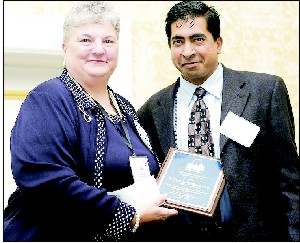
Dr. Sriram Kalyanaraman, a native of Mysore and currently a faculty member at the University of North Carolina’s School of Journalism and Mass Communication, has won the prestigious Hillier-Krieghbaum Award for 2011 conferred by the Association for Education in Journalism & Mass Communication (AEJMC) for “outstanding achievement and effort in research, teaching and service in journalism and mass communication” by anyone under the age of 40 years.

Dr. Kalyanaraman holds the rank of Associate Professor and Director of the Media Effects Laboratory at the University of North Carolina (UNC) at Chapel Hill’s School of Journalism and Mass Communication.

At UNC, he has an adjunct appointment in the School of Information and Library Science and is affiliated with the Interaction Design Lab.

Dr. Kalyanaraman has a bachelor’s degree in engineering from National Institute of Engineering (NIE), Mysore and an interdisciplinary Ph.D. in Mass Communication from Penn State University, USA.

His primary research focuses on the psychology of new technologies, particularly as they inform persuasion and attitude change in online environments. He also studies information processing of persuasive health messages, and social and marketing effects of sexual and violent media content.

Dr. Kalyanaraman is an alumnus of Nirmala Convent, St. Joseph’s High School, Mahajana College and NIE.

He is a guest faculty at Mysore’s International School of Information Management.

source: http://www.starofmysore.com / General News / Monday, December 19th, 2011

‘I’ve Been the No.1 Factor in Every Step Infy Took’

Taking his last bow at the Infosys AGM on Saturday, chairman and chief mentor N R Narayana Murthy talks of his 30-year legacy and of what it means to dare to hope


There is an almost Jesuit sense in the way N R Narayana Murthy sees the role of luck in life. The man, who has come to personify the phenomenal success story of India Inc, has repeatedly dwelt on how turning points in life are often fortuitous events though, to make the most of it, one’s response to it is anything but.

At the 30th Annual General Meeting of Infosys on Saturday, in effect his last working day before he formally retires as chairman of the board on August 20, NRN spoke of his three-decade experience leading his company with a seed capital of $250 to one that generated a revenue of $6.1 billion in 2011, as “both exhilarating and humbling”. In his valedictory speech, he went on to speak of how his story is one of what any average person anywhere is capable of doing, but behind the aspartame phrases, one could detect the grit that made him, over the years, take the life and death decisions his co-founders often shied away from.

Twenty years ago, on a blustery Saturday afternoon not very different from the one yesterday, in a small office in a leafy lane in Bangalore, NRN, by his own account, sat without saying a word for four hours. After nine years of unremitting, often despairing, work Infosys had finally begun to make some money.  The company, defying the doomsayers, had proved that it cannot be written off, and more importantly a foreign investor was willing to shell out a million US dollars to buy it. His six co-founders – including the likes of Nandan Nilekani, Kris Gopalakrishnan and Shibulal – debating the offer in the room, to a man wanted to sell.

Then NRN spoke and he provided an entirely different perspective on the Indian economy’s liberalisation that was just kicking in, of the possibilities it afforded and of which the buy-out offer itself was a small encouraging sign. He spoke passionately but to the point, and in half an hour he had won new converts and the company has since then never looked back. He was the real progenitor of Friedman’s ‘flat world’ though the credit, at least for its conceptualisation, goes to the more articulate Nilekani. On Saturday, at the AGM, NRN, untypically, allowed a little triumphalism to creep into his speech when he pronounced, “I have always been the No 1 actor in every decision this company has made.” It was sharp and unambiguous, and it was fully merited.

As a student in the district headquarters town of Mysore in the mid-1960s, NRN’s dream was to become a “junior engineer in a hydroelectric project in the new temples of Nehru’s India.”  The most he would he concede to his ambition was the “macho” one of building a generator for the power plant. But then, life began to give him chances, unlooked for, unforeseen.

Narayana Murthy’s wife Sudha with son Rohan and daughter-in-law Lakshmi Venu at the Infosys AGM

From Kanpur IIT where a fortuitous meeting with an American academic revealed to him the magic of computers and his stint in IIM-Ahmedabad, to his now mythologized hitchhike from Paris to India, rudely interrupted by 72 hours in a Bulgarian prison that rid him of his Leftist sympathies forever, NRN learnt to see both triumphs and trials as tacit lessons for continuous improvement. “Learning from experience, however, can be complicated. It can be much more difficult to learn from success than from failure. If we fail, we think carefully about the precise cause. Success can indiscriminately reinforce all our prior actions,” he said at a pre-commencement address in 2004 for students of New York University’s Stern School of Business.

It is this relentless rigour that saw him lead the Infosys turnaround in the late nineties and make it the first-ever Indian registered company on the Nasdaq. He was the main architect  when it pioneered such things as stock options for employees, internal transparency, a fun-filled workplace ethic and global delivery model that made Infosys, all of which became the industry norm for corporate governance and, far more importantly, showed the world what was capable with just brain power and sweat equity.

Of late, Infosys has slipped to second place in the IT sector behind main rival TCS in terms of net profits, and its last quarter results were not particularly favourable, a point that came in for some criticism on the part of the shareholders at the AGM. From August 20, when NRN turns 65 and will be divested of all official roles in the company he founded, a new leadership, many of them his trusted protégés, will take over. The jury, as it indeed is in such cases, is out on what they will be able to do the company in the long term, but NRN apparently has ensured that his main legacy that he bequeathed in the form of casually dressed men and women seen loitering in Infosys campuses, often the best and the brightest, who, when confronted with a problem and its even more outrageous solution, retort ‘why not’?

At the AGM towards the end, as the pathos-filled lyrics of Kabhi Alvida Na Kehna livened up a power-point presentation, NRN, seated on the dais, was a study in concentration. In the reticence, and the slightly sagging shoulders, however, one imagined a little pensiveness. But the man, as always, has his future decoded and ready. As he has said: “I believe that we have all at some time eaten the fruit from trees that we did not plant. In the fullness of time, when it is our turn to give, it behooves us in turn to plant gardens that we may never eat the fruit of, which will largely benefit generations to come. I believe this is our sacred responsibility, one that I hope you will shoulder in time.” Those words, like the man’s name, are bound to endure for a long time.

source: http://www.bangaloremirror.com / Cover Story / by Anil Nair / Sunday Jun 12th, 2011

Surgery Pumps New Life Into Her

Wockhart doctors perform rare operation that helps 13-year-old girl’s left ventricle pump more blood to the body


Looking at her sitting with quiet dignity, facing the glare of harsh lights, you would never guess what her tiny heart has been through.

Indira, 13, a farmer’s daughter from Kodagu, was born with her heart on the right side of her body, while the heart’s pumping chambers and arteries had got inter-changed.

She got a ‘new life’ after Dr Devananda from Wockhardt Hospital and his team performed three surgeries her – all within a year which has worked miracles for the child.

Ever since she was a year old, Indira used to fall sick frequently. She made trips to many hospitals, where she was prescribed medicines for for ailment. When she grew older, she had difficulty in breathing and used to turn blue after even after a little work.

Options open

Fortunately, Dr Devananda met her and explained to her family that surgery was the only chance for her survival.
Indira’s heart was unable to pump blood to the entire body as her ventricles had got interchanged. The right ventricle pumps blood to the lungs and the left ventricle to the rest of the body. As her left ventricle wasn’t strong enough to pump blood at required pressure, doctors had to train her heart by creating obstructions in the blood flow to increase blood pressure.

There have been only a handful of cases in the world where the ventricle has been trained to pump blood after the age of 12. As her parents could not afford the surgery, the Needy Heart Foundation stepped in along with Wockhardt Hospitals to facilitate the same. The final step, the ‘double switch’, was completed successfully. The girl was on artificial ventilation for two weeks as she had developed pneumonia after her surgery, on May 26 this year. Before the final surgery, doctors had given her a 25-50 per cent chance of survival. But Indira insisted she wanted the surgery and her parents relented.

Dr Prakash Vemgal, who monitored her after surgery till her discharge, spoke about how, after the tubes were removed from Indira’s mouth and she could speak, she told doctors that her birthday was on June 16.  A surprise party was arranged for her and she cut the cake.

After speaking to the press, she quietly left with her mother in an autorickshaw.

source: http://www.bangaloremirror.com / Bangalore Mirror Bureau / Monday, Sept 22nd, 2008


Personifying “never say die” Spirit

BELGAUM:

Belgaum’s teen swimming sensation has over 1,000 fractures!

Belgaum: “Never, never, never, never give up,” goes the famous saying of Winston Churchill, former British Primer Minister known for his inspiring leadership during the Second World War.

There are very few people who personify this never say die spirit. What about a 13-year-old physically challenged boy from Belgaum?

Only a few would bet that Moin Junaidi, who has suffered not less than 1,000 fractures all over his body, can aspire to take part in the World Swimming Championship.

Moin, son of Musthaq Junaidi and Kousar Banu, has a rare disease that causes zero-bone calcium. Called Osteogenesis Imperfecta in medical terms, the disease has made Moin’s bones so soft that the gentlest pat would cause fractures.

The boy can neither stand on his feet nor catch anything in his hands. His parents hail from Kudachi in Belgaum’s Raybag taluk but are settled in this border City’s Mujawar Galli locality.

2 years: 50 fractures

They say Moin suffered his first fracture when he was just nine months old. By the age of two, he had more than 50 fractures.

When doctors were called in, not only they couldn’t diagnose what he suffered from, but their treatment also worsened his condition. No orthopeadician in Belgaum, Miraj, Mumbai, or even the U.S.A. could detect this rare disease.

Moin’s parents stopped consulting doctors after spending lakhs and were told that there was no cure for the disease.

They, however, didn’t lose hope. With doctors advising them to handle Moin with utmost care and no school willing to admit him, Banu began tutoring him at home. While Moin cannot write holding a pen in his hand, he can still read.

One day, Fairoz Sait, Belgaum North MLA, happened to meet Moin at a function. Impressed by his aptitude, Sait immediately gifted him a laptop. Now, Moin can now use the laptop with his tenderest fingers.

The other day, Moin’s parents had a chance meeting with Umesh Kalghatgi, a swimming coach, at the Belgaum City Corporation pool.

Instantly recognising Moin’s potential to become a swimmer, Umesh offered to train him. Initially reluctant, his parents later accepted his proposal.

The little swimming genius

The result is spell-binding: Moin can swim for more than an hour. But whenever his legs become immovable while swimming, he pushes the water back with his hands like a tortoise.

Till date, the wonderful boy has taken part in a number of swimming competitions. In October 2008, he participated in the National Paralympics Swimming Competition in Kolkata and bagged the gold medal in the 50 metre freestyle event.

No sooner than he won the gold that awards and felicitations began pouring in. Indradhanush Samman, Belgaum District Award, B R Motage Award, Sagar Prashasti (carrying a cash prize of Rs one lakh), etc are but a handful of awards he has been honored with. Moin was also felicitated at the Shabhash India reality show aired on Zee

TV.

An avid cricket fan, Moin adores Mahendra Singh Dhoni. He also likes Shah Rukh Khan. Moin wants to showcase his talent at the World Swimming Championships. But the road isn’t easy.

Will Karnataka’s Muslim leaders lend a helping hand and help this wonder kid realise his dream? Let’s hope they do.

source: http://www.karnatakamuslims.com / Belgaum / Jan 18th, 2011