Category Archives: Amazing Feats

A monument that celebrates Gandhi

The Mahatma Gandhi statue at the Veera Soudha in Belagavi.

Veera Soudha commemorates the 34th Congress Session of 1924

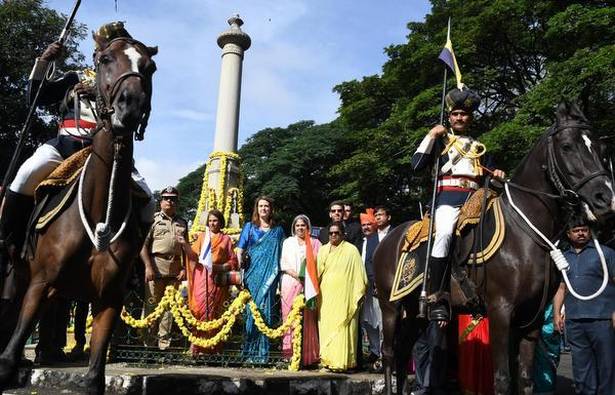
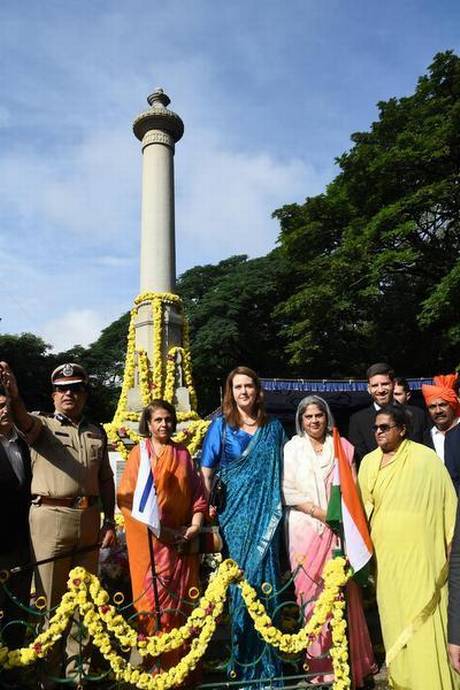
The 150th birth anniversary of Mahatma Gandhi will be celebrated in Belagavi on Wednesday at the Vijay Nagar Veera Soudha, a monument built to commemorate the 34th Congress Session in Belagavi in 1924.

The monument that encompasses a park, a well and a hall, has been cleaned and decorated. Ministers Lakshman Savadi and Shashikala Jolle will speak during the celebrations scheduled at the monument on Congress Road in Tilakwadi here on Wednesday morning.

The monument that encompasses a park, a well and a hall, has been cleaned and decorated. Ministers Lakshman Savadi and Shashikala Jolle will speak during the celebrations scheduled at the monument on Congress Road in Tilakwadi here on Wednesday morning.

The park stands at the venue of the 1924 Congress Session. The venue was named Vijay Nagar by the organisers of the conference, including Gangadhar Rao Deshpande and N.S. Hardikar. A temporary railway station was built at the venue to help delegates alight. A well was built through Shramdan to provide water for those attending the conference. The well still yields sweet, cool, potable water that is supplied to residents in the surrounding areas.

The park contains fruit and flower trees and has statues of deer and other animals. The main building has a series of photographs of the Session and Gandhiji’s interactions with the leaders of the Independence movement. He is seen with Mohammad Ali Jouhar, president of the 33th Session, and other leaders.

Gandhiji visited Belagavi (erstwhile Belgaum) three times. He attended the Bombay provincial conference of the Home Rule League in 1916, chaired the Congress Session in 1924 and spent 10 days in the Khadi and Village Industries Centre in Hudali village in 1937.

There are several monuments to the Father of the Nation in the district. The City Railway Station has a Charka installed atop its roof and a stone plaque. A pillar is erected in Shivaji Park near Kapileshwar Temple in the city apart from the Veera Soudha building. Gandhiji’s ashes are interred in Mugut Khan Hubballi, while the Khadi centre in Hudali is a living monument that celebrates the proponent of village industries.

source: http://www.thehindu.com / The Hindu / Home> News> States> Karnataka / by Rishikesh Bahadur Desai / Belagavi – October 02nd, 2019
Brothers come up with visionary app to detect lazy eye

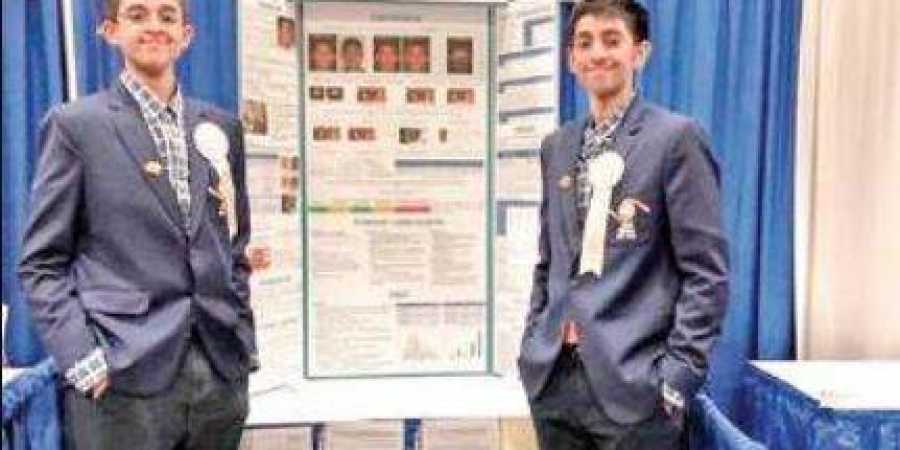
In a bid to detect amblyobia faster in children, 16-year-old Vrishab Krishna and his 18-year-old brother, Biswesh Krishna from Bengaluru, have come out with an app called Kanna.

KannaBF03oct2019

Bengaluru :

In a bid to detect amblyobia faster in children, 16-year-old Vrishab Krishna and his 18-year-old brother, Biswesh Krishna from Bengaluru, have come out with an app called Kanna. Amblyopia, also known as lazy eye, is a visual development disorder where a person slowly loses vision leading to partial blindness. It affects almost 16 million children in India and over 103 million children from all over the world.

Vrishab used to suffer amblyopia as a child, and would have difficulty while climbing down stairs. Even while playing, he would have difficulty catching the ball. But Vrishab was lucky since his mother noticed his problem when he was four years old and got him tested. The diagnosis revealed his lazy eye condition. Having received treatment in time, Vrishab has been able to see perfectly with both his eyes.
A year ago, the duo decided to study amblyopia and come up with a solution. As they worked on the project, they came up with an app wherein a child affected with the condition will just have to click two images and upload it onto the app to determine whether they have a lazy eye or not. “We wanted an accessible way to help people figure out if they have the condition. And what better than a smart phone which everyone uses,” said Vrishab.

Using patent pending image processing and machine learning algorithms, they calculate one’s risk of having a lazy eye. “After testing, we found that our algorithm to calculate amblyopia is accurate. The child will have to click one image in low light and the other in ambient light. After uploading the images, the results will be out immediately,” said Vrishab.

The duo even reached out to Sankara Eye Hospital and performed a pilot test, and the hospital is now using the device. “Three years ago, we had carried out a survey on amblyopia in Bengaluru and it showed that six percent of children in the city were at a risk. Detecting amblyopia during the critical period – that is before the age of eight – is crucial as complete treatment can be done. After that, it gets difficult as they don’t respond to visual acuity tests,” said Dr Kaushik Murali, Medical President, Quality & Education, Sankara Eye Hospital.

He added with this app will be useful for many. “Since this technique only requires access to a smartphone camera, it can be used both in rural and urban areas, and even allows for screening by untrained people,” Dr Murali added.The app is under clinical validation at Sankara Eye Hospital.

What is amblyopia?
Amblyopia, also known as lazy eye, is a visual development disorder where a person slowly loses vision leading to partial blindness. It affects almost 16 million children in India and over 103 million children all over the world.

source: http://www.newindianexpress.com / The New Indian Express / Home> Cities> Bengaluru / by Iffath Fathima / Express News Service / October 02nd, 2019

Saluting soldiers of yore: remembering the Battle of Haifa

Haifa01BF01oct2019

Proposals for restoration of the Memorial was submitted at the 101st Haifa Day Celebrations

For entrepreneur Uday Birje and financial analyst Praveen Maney, The 1918 Battle of Haifa is much more than just another historical event. They are the descendants of the soldiers of Mysore Lancers, who won a decisive victory over the Ottoman Turks and the Germans. “My great grandfather Raghunath Rao Birje was part of the Mysore Lancers. Mysuru Maharaja Nalvaji Krishnaraja Wadiyar sent his best soldiers—the Mysore, Jodhpur, and the Hyderabad Lancers— on the promise of Independence by the British,” says Uday.

In fact, the Mysuru Maharaja sent his brother-in-law Colonel J Desaraj Urs, and relatives Risaldar BP Krishne Urs and Captain A Lingaraj Urs to Haifa in Israel.

Haifa02BF01oct2019

Praveen says four of his ancestors fought in the Battle. “They were Venkata Rao Maney, Limbaji Pawar, Rajoji Kesarkar and Bhim Rao Talekar. Venkata Rao Maney passed away in the Battle of Allepo and his remains didn’t come to India. His body was buried in Israel and his name is written on the Haifa memorial in Delhi and Bengaluru. The other three descendants returned. One of the medals Limbaji Pawar won was the Indian Distinguished Services Medal for the bravery he displayed in the Battle of Haifa.”

Though much of the memorabilia has been lost, the families have maintained some of them, including medals and swords. “After the War, many people didn’t return, while some did. Those who did spread out to other villages. Some settled within Bengaluru in places around the Mysore Lancers cantonment in Munnireddy Palya (present JC Nagar), Ganga Nagar, Malleswaram, etc.,” says Uday

Uday has a replica of the honour roll by King George, which was given to his great grandmother while Praveen’s family is in possession of a medal, and a sword taken from a German soldier.

The Ottoman Turks and Germans had superior weapons such as machine guns whereas the Mysore Lancers possessed only swords and lancers. It was sheer courage and excellent battle strategy that led to the victory of the Mysore Lancers.

Once the soldiers returned, their contributions were recognised and rewarded by Nalvaji Krishnaraja Wadiyar. It was not until last year that the Battle of Haifa received national recognition. 100 years of the Battle was celebrated last year. The consequence was the renaming of Teen Murti Marg in Delhi—where there is a Haifa Memorial—to Teen Murti Haifa Marg.

At the 101st celebration held at Mysore Lancers Memorial, JC Nagar, on September 23, a formal proposal was submitted by Yashaswini Sharma, urban historian and architect, to Commissioner of Police Bhaskar Rao and corporator of JC Nagar Ganesh Rao Maney.

“The World War I memorial, which is part of the city’s tangible heritage and sets the context for the neighbourhood, is now in need of urgent attention,” says Yashaswini.

“One step of the base stands embedded inside the road, and the circle with grill barricade is too small. We have submitted a proposal for two granite plaques with the names of all the soldiers of the Mysore Lancers around an equestrian statue; and an enlargement of the Memorial circle and redesign of the grill work.

The proposed design of the grill work is inspired by the decorations of the Mysore Lancers, which includes the Mysore Royal emblem of Gandabherunda. There is bit of paint on the pillar which needs to be cleaned out—the families of the martyrs and some NGOs had earlier cleaned the Memorial, but it requires periodic maintenance. The proposed equestrian statue — Mysore Lancer soldier astride a horse — will be in metal, and we hope this can be placed in the circle right behind the War Memorial and that both the statue and the circle could be connected by a cobbled pathway. This equestrian statue will be set on a pedestal that resembles the design of the World War I Memorial and will be encircled by stone benches so that the families of martyrs can find peace and spend some time there while they pay their respects,” adds Yashaswini.

source: http://www.thehindu.com / The Hindu / Home> Society> History & Culture / by Sravasti Datta / September 30th, 2019

Vijayapura Zilla Panchayat launches YouTube channel

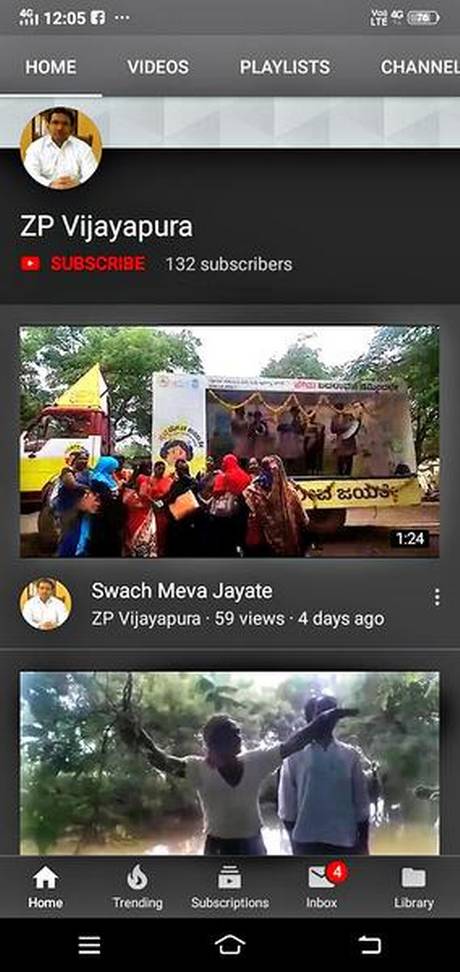
Using technology to bring efficiency and transparency in the administration, the Vijayapura Zilla Panchayat created a YouTube channel to upload videos and share information about its activities.

VijayapuraBF26sept2019

Vikas Suralkar, CEO, ZP, who got the channel ‘ZP Vijayapura’ created about over a fortnight ago, said it was aimed at disseminating people-centric information of the ZP.

Initiated on a pilot basis, the channel has already uploaded some programmes and videos of success stories, events organised through the ZP, and government programmes launched for rural development Some of these include Jalamrut scheme, construction of checkdam/ bunds, Kisan Scheme, MGNERGA, sapling plantation, rainwater harvesting, etc. The channel already has 132 subscribers and hundreds of people have watched the videos uploaded on it.

Mr. Suralkar, elated with the success and response, said the project is first of its kind to highlight government schemes and encourage the people to make use of them. He said the channel was created by local technical staff of the ZP who are also maintaining it. He said that a video of Gram Sabhas would also be uploaded. The government has made holding Gram Sabhas mandatory in selection of beneficiaries or implementing of certain schemes in rural areas. Since it is also mandatory to make the names of the beneficiaries public, the channel could be used to read out the names. This will help in maintaining transparency in selection of the beneficiaries.

“We have several plans to upgrade and update the channel to make it more comprehensive, educational and attractive for the common people. Since today, almost everyone holding a smart phone and with access to the Internet can visit the channel and get information about schemes. They can also replicate success stories in their villages and farms”, Mr. Suralkar said.

Shivayougappa Nedalgi, ZP president, said that since Mr. Suralkar was doing a good job, all the members were supporting him.

source: http://www.thehindu.com / The Hindu / Home> News> States> Karnataka / by Special Correspondent / Vijayapura – September 25th, 2019

Shorthand writers to hold centenary celebration

The Shorthand Writers’ Association of Karnataka (SWAK), will hold its centenary programme on September 14 and 15. Featuring a group discussion on English and Kannada shorthand, the release of a souvenir, honouring of Kannada and English shorthand writers who have rendered yeomen service, and more, will be done at the event at Karnataka Government Employees’ Association Auditorium, Cubbon Park. S. Ramanathan, former Secretary to GoI, and chairman, Indian Institute of Public Administration, Karnataka Regional Branch, will inaugurate the event.

Members must enrol to attend. Stenographers working in Central, State, Public and Private sector organisations and are not members may also participate by enrolling either as donors or RC members. High speed shorthand competitions both in English and Kannada will be held on August 13. Call 080-22225462 or reach the Association Secretary A.M. Muralinath on 9740285462 for details.

The association offers training in English and Kannada shorthand between 11 a.m. and 7.30 p.m. Those interested can enrol at SWAK, 3rd Floor, Right Wing, Kandaya Bhavan, K.G. Road, Bengaluru – 560029. For details, mail swakbangalore@gmail.com

source: http://www.thehindu.com / The Hindu / Home> News> States> Karnataka / by Staff Reporter / Bengaluru – September 04th, 2019

Mysuru salutes late Sally Raulston Walker, zoologist who brought wildlife closer home

Several posts, tweets and blogs were dedicated to the woman who spent almost 36 years of her life in India as a zoo professional, and was an ardent advocate of rational zoo reforms.

Sally Raulston Walker was a part of Mysuru city for many years, and inspired dreams of alternative careers in the wild | Express

Bengaluru :

Dressed in shorts and T-shirt, chatting up lions inside their cage in Mysuru Zoo, she once inspired many young Mysureans to just be Sally Raulston Walker.  The zoologist and conservationist who brought wildlife closer home, passed away in her hometown in the United States of America, on Thursday.

Several posts, tweets and blogs were dedicated to the woman who spent almost 36 years of her life in India as a zoo professional, and was an ardent advocate of rational zoo reforms. She was the driving force behind many innovative programmes in not only the Sri Chamarajendra Zoological Gardens, Mysuru, and was also director of Zoo Outreach Organisation (ZOO) in Coimbatore.Sally was a part of Mysuru city for many years, and inspired dreams of alternative careers in the wild.

Sangeetha Rajanath, a retired banker from Mysuru, remembers watching Sally interact with animals in Mysuru Zoo, and her style of working.

She said, “There were days when my friends and I would tell our parents we didn’t want to be doctors or engineers, but wanted to be Sally. She inspired many of us with the way she interacted with animals and how she ensured that we, as children, maintained the plants and trees in the zoo but also knew how not to tease animals but be friends with them.”

Sally was a critic of wild animals in captivity. She was a name to reckon with in zoo circles, and had been a member of the Central Zoo Authority of India. A US citizen, she came down to India in the 1970s to study yoga and Sanskrit with Pattabhi Jois, a Master of Ashtanga Yoga, and Sanskrit Professor in the University of Mysore.

Sally lived in Mysuru for seven years. Her friends say that a visit to Mysuru Zoo and a single meeting with newborn tiger cubs, resulted in many years of dedicated service to zoos and conservation in South Asia.

Ramesh Kumar, who has interacted with her, says, “She was a very inspiring person. There were a few who didn’t agree with her ideology. Her passion for animals and opposition to causing them harm was evident in her talks, and she would gently teach us how to behave with animals.”

Observing the misbehaviour of visitors at Mysuru Zoo, she founded ‘Friends of Mysore Zoo’ in 1981, which is now relaunched as ‘Mysuru Youth Club’ in the zoo. According to her colleagues from ZOO, she had been suffering from Alzheimer’s for the past three years.

source: http://www.newindianexpress.com / The New Indian Express / Home> Good News / by Chetana Belagere / Express News Service / August 24th, 2019

11-year-old from Bengaluru student aims to master ancient Kannada language

Finding the language filled with tongue twists, Samruddhi Yadav decided to throw herself into learning it at the age of eight years.

Bangalore University lecturer wins award for study on tribes

The award was announced on Independence Day. An elated Prabhakar said that however applying for the award was an ordeal.

Dr D K Prabhakar, guest faculty, Department of Studies in Telugu, Bangalore University.

Bengaluru :

For nearly 15 years, Dr D K Prabhakar, guest faculty, Department of Studies in Telugu, Bangalore University, with his roots in Kolar, has been studying tribal communities. Prabhakar told TNIE that his research was to take the path less trodden, an extensive focus on tribal folklore.

His study on  Dongra, Chenchu, Sugali and nomadic Koya tribes and their folklore and problems they face has not just shed light on what the government can do, but also won him the Presidential award of Maharshi Badrayan Vyas Samman for his contribution to Classical Telugu.

The award was announced on Independence Day. An elated Prabhakar said that however applying for the award was an ordeal. The application was to go in by post in June, and as soon as he was told about it he rushed to the general post office at 11.30pm to make his entry.

After two months wait, his works got a stamp of approval by the President’s office. However, this is not his first award. He has been the recipient of the ‘International excellence award’ in 2016 for the best monograph and Sri Krishadevaraya National Award, 2015.

This Kannadiga learnt Telugu literature while chasing his dream of civil services. His love for the language developed over the years, and he completed his PhD in the subject, shedding light on the roots of Telugu language and culture.

source: http://www.newindianexpress.com / The New Indian Express / Home> Cities> Bengaluru / by Pearl Maria D’Souza / Express News Service / August 19th, 2019

Indian Institute of World Culture turns 75

A view of the Library at The Indian Institute of World Culture at Basavanagudi in Bengaluru. Sudhakara Jain | Photo Credit: Sudhakara Jain

The Indian Institute of World Culture not just offers a huge library and cultural activities, but an impressive history of committed voluntary work

A huge hall nearly 100 feet in length is stacked with books running into lakhs on wooden racks. Cooled by ceiling fans on the high Madras ceiling, people of all ages are seen reading journals at the adjoining Behanan’s Reference Library. The building retains the old world charm with wide stairs and thick walls. It houses an auditorium on the ground floor where educational and cultural programmes happen throughout the year. The newly-renovated Children’s library is full of children running around and taking their books for interacting in friendly spaces. This is the Indian Institute of World Culture (IIWC), offering free programmes and activities to the public for more than seven decades now. A model institution run by a strong volunteer-base, IIWC, which stepped into its 75th year in August, was founded with a promise of creating an arena for cultural exchange.

August 1945, Bahman Pestonji Wadia, the founder-president of the institute and a well-known Thesophist, was extra jubilant as the inauguration event coincided with the message of the World War II coming to an end. “Under this double joy we flag off the Institute of World Culture and we shall move from darkness to light, illumined by culture and knowledge,” Wadia had said, as he launched one of the biggest institutes at Basavanagudi in South Bengaluru. The road named after Wadia after his death in 1958, is now an INTACH-listed heritage building.

Born in 1881, BP Wadia belonged to the famous Wadia family of shipbuilders from a village near Surat. Inspired by the Theosophical movement, Wadia had envisioned IIWC as a cosmopolitan cultural centre where books, arts and service thrived.

Wadia’s involvement is said to have been so deep that people had often joked, “if North Bengaluru has the Tata Institute (IISc.,) the South has the Wadia Institute,” says Honorary Secretary Arakali Venkatesh. “IIWC regularly had literary giants as DV Gundappa, VK Gokak, Masti Venkatesh Iyengar and MV Krishna Rao as part of their cultural events and the library during the 1950s and 60s. Its rich history is being preserved for people. And we plan to have a year-long programme of events to mark its Platinum jubilee,” adds Venkatesh.

The institute’s huge 4000 sq.ft. public library houses nearly 1.5 lakh books which are lent out free of charge, apart from a reading room called Behanan’s Reference Library (named after Dr. KT Behanan who handed a huge collection of classics in 1963) that extends 400 periodicals in various languages. The auditorium hosts public lectures, art exhibitions, film shows, and music and dance recitals. “We have had 150 programmes in a year without a break almost since the inception,” adds Venkatesh.

Former Justice MN Venkatachalaiah, past president of the IIWC Executive Committee, had wished to update the infrastructure to suit contemporary needs. “He wanted an auditorium that holds nearly 750 people. It is on our cards,” says the present president VJ Prasad adding that IIWC’s first renovation was the Children’s library. “We have ergonomically designed reading stations created for children to enjoy the near 4000 titles we have, apart from reference books and encyclopedias,” adds Prasad.

______________________

All for free
  • People are welcome to donate books to the IIWC library (080-26678581; www.iiwcindia.org) or become life members by donating ₹5000
  • The main library of IIWC houses 1.5 lakh books on a variety of subjects
  • The institute’s journal ‘Bulletin’ distributed free, has articles and event listings
  • The magazine section has rare collections offering even the first edition of Chandamama of the 1940s; old sets of comics as Tinkle, Champaka, Indrajal and Marvel DC amongst several more.
  • The reading room offers 400 magazines and 30 newspapers
  • IIWC has plans to bring in a fully-equipped auditorium and upscale its building and furniture with public funds

_______________________

From the IIWC library that started off in 1947 with 4,200 books and hundreds of people visiting, today the number has increased to nearly 40 times more. Public donations take care of the operating costs. “We have a modest budget of ₹1.5 lakh a month, but work with higher ideals that the founder believed in,” says Venkatesh.

Speaking about the nostalgia the institute is associated with, paediatric surgeon Dr. Vijayalakshmi Balekundri, Vice President of the committee says, from governors and presidents to Nobel laureates as CV Raman, Ralph Bunche and Julian Huxley, nuclear physicist Homi Bhabha, scientist Vikram Sarabhai, Maharishi Mahesh Yogi, and the erstwhile royals Jayachamarajendra Wadiyar and Travancore Marthanda Varma had visited IIWC. “The institute has been an epitome of economical functioning, but is generous in imparting culture,” adds Vijayalakshmi.

Reminiscing about his childhood who spent borrowing books from IIWC children’s library, businessman Ashish Krishnaswamy, a member of the executive committee says, “As a seven-year-old in the 1980’s I had the thrill of borrowing my first book with a library card. From all comics to Ruskin Bond and Jim Corbett’s amazing tales, the library not just offered books but had fun events to offer. We plan to get this going permanently,” says Ashish who has taken a keen interest in contributing funds and having the children’s library renovated.

The influence

BP Wadia joined the Bombay branch of the Theosophical Society in 1904, and shifted to its Madras branch in 1907. Wadia later worked in the Home Rule Movement along with Dr Annie Besant and George Arundale, which led him towards starting the first labour union in Indian history. Apart from attending conferences on trade union movement, he came into contact with United Lodge of Theosophists (ULT) founded by Robert Crosbie at the United States and worked for it. Thereafter he founded several ULTs in India and abroad along with his wife Sophia Wadia. “The institute shall remain a non-sectarian, non-governmental, private voluntary body to mainly promote inter-cultural exchanges,” Wadia had declared.

source: http://www.thehindu.com / The Hindu / Home> Society> History & Culture / by Ranjani Govind / August 21st, 2019

Let’s not repeat what was done to Fredericks

Manuel Fredericks. Picture credit: facebook.com/ Manuel Fredericks

It has taken India a very long time to recognise Manuel Fredericks and confer him with the Dhyan Chand Award for lifetime achievement. Clearly, we could have done better for the former goalkeeper who was in the bronze medal-winning hockey team in the 1972 Munich Olympics.

The least the Ministry of Youth Affairs and Sports and successive governments could have done was given him the Arjuna Award at least. Agreed that hockey is a team sport and everyone cannot get an award. But did he have to apply nine times before being finally considered for any award?

It was a well-known fact that Fredericks was not in the best of situations financially. Forget about awards, it is bewildering that he hardly received any help. He was managing to make ends meet by coaching school children and a small pension. His case is the perfect example of how we neglect our national sporting heroes.

The selection of Arjuna Awardees was ridden with bad decisions and undeserving winners. Not very long ago, it was a three-member selection committee and there was a big furore over the winners. Fortunately, it is a 12-member committee picking the winners.

It is also baffling as to why three-time Asia-Pacific Rally Championship winner Gaurav Gill had to wait this long before finally being given the Arjuna in motorsport. He was the champion in 2013, ’16 and ’17 and should have been conferred the award much earlier.

Another case is that of hockey wizard Dhyan Chand, whose birthday on August 29 is celebrated as National Sports Day. The Khel Ratna, Arjuna, Dronacharya and Dhyan Chand Awards are presented.

It is surprising that he has not been given the Bharat Ratna, considering that his feats remain unparalleled and was largely responsible for India’s first three hockey gold medals in the Olympics in Amsterdam (1928), Los Angeles (1932) and Berlin (1936). He got the Padma Bhushan, India’s third-highest civilian honour, in 1956. But he clearly deserved the Bharat Ratna, no matter how late.

When master batsman and cricket legend Sachin Tendulkar got the Ratna in 2014, several the hockey fraternity was up in arms and felt Dhyan Chand deserved it. That was probably the wrong way of looking at it. Tendulkar definitely deserved it, no question about that. However, what stopped the government from conferring it to Dhyan Chand earlier or later than 2014 is quizzing.

It is not always the fault or slip-up of the committee or Ministry that deserving candidates get left out. National federations and state associations sometimes fail to send in the nominations on time in order to be considered for the Award.

Take the case of sprinter Dutee Chand. The Odisha Government sent her nomination late and was thus rejected by the Ministry. Her nomination was also rejected because it was not in order. This is exactly the kind of lackadaisical approach that deprives a sportsperson of recognition.

Even when it comes to recognising sportspersons’ achievements and simply awarding them promotions, governments sometimes fail. For instance, sportspersons who are with law enforcement agencies like the police quite often go unrecognised. High-achieving sportspersons and employed with the Haryana or Punjab police are given generous promotions. It is difficult to think of other states that reward sportspersons as well as Punjab or Haryana.

There is one truth that we have to wake up to. If there is no timely incentive for good performances, it could very well have the negative impact of keeping youth away from sport. At a time when Indians are making their mark in international sport,  we could do well to reward them suitably.

source: http://www.deccanherald.com / Deccan Herald / Home> Opinion / by Vivek Phadnis, DH WebDesk, Bengaluru / August 18th, 2019