Indrajit with Richa Chadda on the sets of ‘Shakeela’
From being a scribe to a filmmaker, the ‘Shakeela’ director now embarks on his first Hollywood venture
Indrajit Lankesh needs no introduction. The son of popular journalist-filmmaker, the Late P Lankesh, Indrajit too started off as a journalist. He worked with his father in the famous Kannada weekly tabloid Lankesh Patrike and heads it now.
The brother of Gauri Lankesh (who was assassinated in 2017) and award-winning director Kavitha Lankesh, Indrajit started off his journey in films as director with Tuntata. The film was not only a commercial success, but also won Indrajit the V Shantaram Award as the Best Director.
Monalisa (he won the Karnataka State Award in the best director category), Huduga Hudugi and Luv U Alia are some of his other films.
That is not all, Indrajit is also the man who gave Deepika Padukone her first break in films. He cast her as the leading lady with Upendra in his block buster hit film Aishwarya. “The moment I saw her, I knew she had it in her to be a star. She is great looking and has a great personality. She is also passionate about films,” says the director, who won the Filmfare Award in Best Director-Kannada category for Aishwarya.
The man, who is a permanent judge on the television reality comedy show Maja Talkies, is set to share another exciting announcement. “Before that I want to tell you that my film Shakeela is almost ready for release. It is a Hindi film which will be dubbed in Kannada, Tamil, Telugu and Malayalam.”
Shakeela, he explains, is a biopic about the adult film star from Kerala. The film has award-winning actors Pankaj Tripathi and Richa Chadda in the lead roles.
Indrajt is all prasie for Richa and Pankaj. “They have given their best. Pankaj has a role, the like of which he has never played before. I am a big fan of his and am bowled over by his acting prowess. The film will hopefully hit screens by the end of this year. Also, Shakeela is my tenth film, and my eleventh will be in Hollywood… Yes, I have been asked to direct a Hollywood film now,” beams the director.
He will be the first director from the Kannada film industry to direct a Hollywood film. “I cannot share details as yet. But everything is finalised on paper. All I can say now is that I will off the coming week to Morocco to select the locations. The film is again about a woman, and an Oscar- nominated actress has accepted to play the protagonist. Soon, we will announce everything,” he smiles.
Then he shares the story of how this project came to be. “The producer of the Hollywood film saw the rushes of Shakeela, was impressed and approached me. I can’t express how thrilled I am. I like exploring new horizons and now it will be Hollywood,” says the man who now shuttles between running his father’s tabloid and filmmaking.
He says he ventured into films as he has “always been lured by the visual media and was influenced by my father” and the films he made. In fact, his father inspired him to tell stories. “Journalism runs in my veins. So I would like to say journalism is my profession and films my passion.” Will he ever make a film on a journalist? “I would love to! And it will be on my father His ideology, dedication and integrity need to be told as a story.”
source: http://www.thehindu.com / The Hindu / Home> Entertainment> Movies / by Shilpa Sebastian R / September 23rd, 2019
Google Research India will focus on advancing fundamental computer science and AI research.
Google on Thursday said it is setting up an artificial intelligence research unit at Bengaluru as the tech giant looks to continue developing products for India and taking them to global markets.
Google Research India, the artificial intelligence (AI) lab, will focus on advancing fundamental computer science and AI research.
Apart from the Google team led by AI scientist Manish Gupta, the company will also partner with the research community across the country to focus on tackling challenges in fields like healthcare, agriculture, and education.
“We are incredibly inspired by India. With a world-class engineering talent, strong computer science programs and entrepreneurial drive, India has the potential to contribute to advancements in AI and its application to tackle big challenges,” Google Vice President Next Billion Users and Payments Caeser Sengupta said.
He added that the company is rolling out new products and adding features to existing ones to help even the first-time internet users.
“Future is not about just tech but about inclusion, empowerment and economic opportunity. India inspires us,” Mr. Sengupta said at Google for India event.
IT Minister Ravi Shankar Prasad, who was also present at the event, said tech platforms like Google must ensure that their products are safe and secure for users.
“They must safeguard the privacy rights of individuals. Also, you must take extra efforts to ensure that people don’t abuse the system,” he added.
New programmes
Mr. Sengupta said under its Internet Saathi programme with Tata Trusts, about 80,000 ‘Saathis’ have been trained, who in turn have trained 30 million women.
Mr. Sengupta said in the last 12 months, Google Pay has grown more than three times to 67 million monthly active users, driving transactions worth over $110 billion on an annualised basis across offline and online merchants.
About two-thirds of the transactions are coming from tier-II and -III cities and towns.
Google Pay, which competes with players like Paytm and PhonePe, is introducing the ‘Spot’ platform that will enable merchants to create branded commercial experiences and reach new customers.
Google has already onboarded merchants like UrbanClap, Goibibo, MakeMyTrip, RedBus, Eat.Fit and Oven Story through its early access programme.
In addition, Google Pay is aslso rolling out ‘tokenized cards’ in the next few weeks to offer a secure way of paying for things using a digital token on the phone rather than the actual card number. Tokenized cards on Google Pay — already available in some countries globally — will be rolled out with Visa cards for banks including HDFC, Axis, Kotak and Standard Chartered.
“We will roll out support to cover Mastercard and Rupay and more banks in the coming months,” Mr. Sengupta said.
He added that Google Pay is also deepening the support for small businesses through a new app called ‘Google Pay for Business’
This is a free app for small and medium-sized merchants to enable digital payments where verification process is carried out remotely. Despite the massive growth in digital payments, a vast majority of India’s over 60 million small businesses is still not benefiting from the growing digital economy, Mr. Sengupta said.
“We hope these initiatives will help merchants adopt digital payments with more confidence and help contribute to the long term growth of online financial services,” he added.
Google has also launched ‘Jobs’ as a ‘Spot’ on Google Pay to help job seekers find and prepare for entry-level positions. “Since a number of small merchants is present on Google Pay, it provides an easy mechanism to connect with potential employees. Machine learning is used to recommend jobs and training content to help job seekers prepare for interviews and learn new skills,” Mr. Sengupta said.
Google is also introducing Job Spot with 24 early partners in retail like 24Seven and Healthkart, delivery and logistics partners like Swiggy, Zomato and Dunzo and hospitality providers like Fabhotels.
Besides, it is partnering with the National Skills Development Corporation for its Skill India programme.
Google said it is partnering state-run BSNL to bring high-speed public WiFi to villages in Gujarat, Bihar and Maharashtra. It had previously worked with Railtel to provide WiFi services at 400 train stations in the country.
It also announced its collaboration with Vodafone Idea for ‘Vodafone-Idea Phone Line’ to enable 2G customers of the telecom major get access to information without using data. The users can call a toll-free number to get answers to questions ranging from sports scores to traffic conditions or even getting help with homework.
The service, supported by Google Assistant, will be available in Hindi and English.
source: http://www.thehindu.com / The Hindu / Home> Sci-Tech> Technology / by PTI / New Delhi – September 19th, 2019
Acclaimed artiste Ravi Kashi says he responds to his times with imagery that is poetic and suggestive, he does not believe in being direct
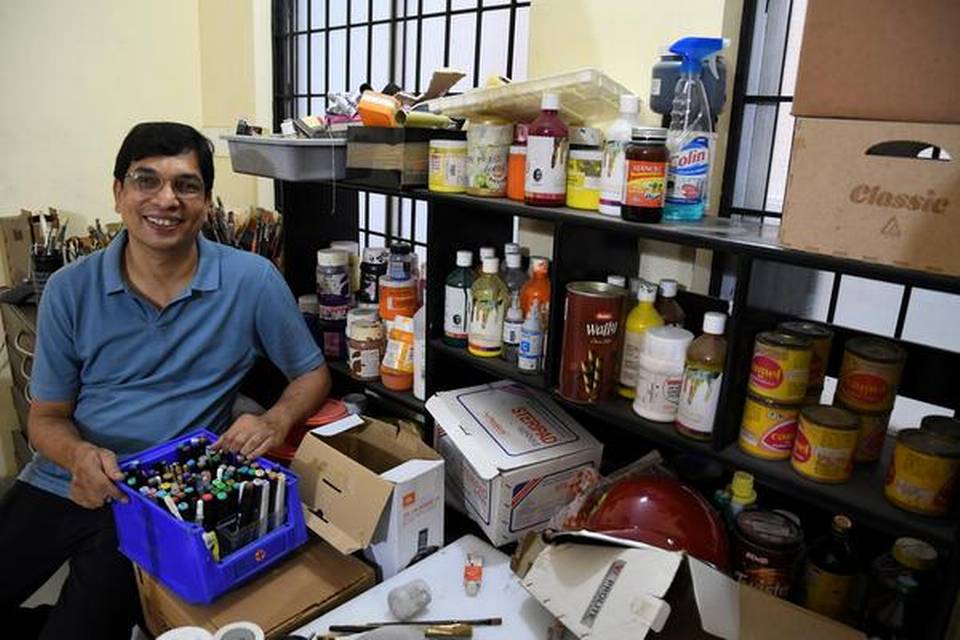
Order and chaos meet here. Pragmatism and innovation walk parallel to each other. Ideas are researched, moulded, shaped, changed and rethought. At times, concepts work and at others, they remain unresolved. It is for a good reason that Ravi Kashi calls his studio a working lab. It is a space where he invites students and young artists generously for sharing of knowledge and to even try their hand at paper-making. A rented three room house in Nagarbhavi that functions as his studio, has a mini pulp-beater, ready paper pulp in several containers, a variety of handcrafted papers, his books, book objects, catalogues, colours, brushes, and all other paraphernalia needed by an artist. And of course, paintings, what he trained to be in the 90s, after pursuing BFA and MFA from Chitrakala Parishath in Bengaluru and MS University Baroda, respectively.
We enter his studio to find a painting in progress along with a few paper sculptures that have been put to dry. It is almost after a decade that Ravi has come back to paintings. All this while, the paper kept him preoccupied. “My paintings had become predictable. Now when I have my show of paintings, most probably next year, they will be different,” says Ravi.
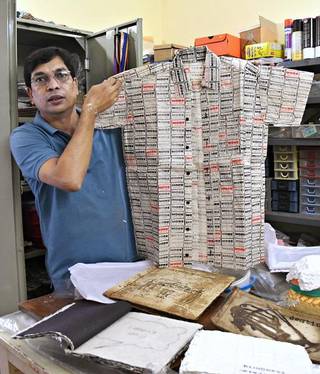
For someone who is acutely conscious of stagnation and repetition, Ravi has always strived to push the frontiers so much so that he chose a niche medium like paper. The lure to sell and pander to the market was way less stronger than the urge to “enjoy the process”. Even with the medium of paper, Ravi didn’t stop at any one thing. Over the years, he has experimented with art books, book objects, and photo-books. His studio is filled with papers made with an array of fibres – Abaca, Daphne, Montbretia, Arecanut, Banana, Daphne bark, Hanji paper of Korea and tea-stained paper.
The tactility of paper fills him with joy him but more than that it is the challenge of working with what seems like a flat surface. “I make sculptural forms, objects, and installations out of it. Paper seems like a flat surface, but it is not. Paper is so versatile. I keep discovering different aspects to it,” the artist expresses.
The call of art For Ravi Kashi, the lure to sell and pander to the market was way less stronger than the urge to enjoy the process Photos cover and centre spread: Sampath Kumar G.P. | Photo Credit: G_P_Sampath Kumar
Invitation to an artist’s studio is exclusive and even more special is the opportunity to try your hand at an artistic process. Ravi encourages me to make sheets and discover the joys of paper-making for myself.
In large rectangular containers floats the paper-pulp. A window-screen attached to a wooden frame is dunked into the container and lifted out. This frame is usually referred to as mould and deckle. On a table is spread a fine white cloth. After detaching the wooden frame, the window screen is pressed against the cloth. The sheet transfers on to it. Another white cloth is kept over it and water is drained out with the help of sponge wipes. The paper is most malleable at this stage so you can create impressions and textures with the help of different objects. Ravi hands me colourful tassels and threads which I cut and sprinkle over the wet sheet. A roller is moved embedding them all.
Learning the ropes
Ravi first came across paper-making at Visvesvaraya Industrial and Technological Museum in Bengaluru as a 12-year-old, and found himself drawn to it. Later, at Kanoria Centre for Arts in Baroda, he saw a paper-making workshop in progress. Back home in Bengaluru, Ravi discovered ‘Vishwaneedam’, a Khadi handmade paper making unit near his house. He would buy ready pulp from there and use it in his work. “Around 1997-98 I started using this recycled pulp for casting various objects/forms. One such work called ‘Encounter’ got me the National Academy award.”
Ravi considers his visit to Glasgow School of Art on a Charles Wallace Grant, a turning point in his career. “My teacher Jacki Parry, a printmaker, and fibre artist was a faculty member in Printmaking Department and the paper-making unit was attached to the sculpture department, which was far away. So, every week we would fix a time when she could come and teach me the intricacies of the medium. At the end of the term, I had a show in the faculty. After returning, I continued using the medium and had several shows of paper-based works.”
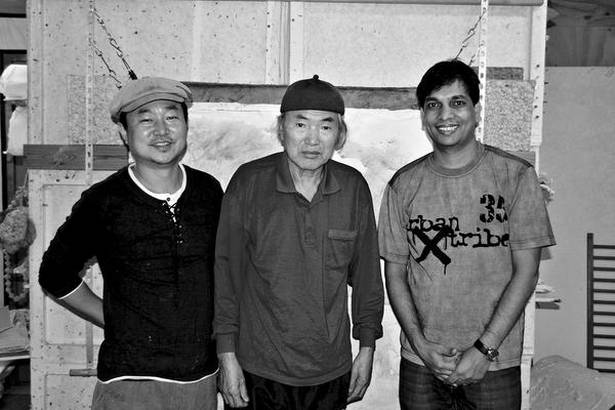
That wasn’t enough. After discovering the Hanji Paper during the Korean International Art Fair, Ravi decided to learn the technique. After much research, he zeroed in on a practitioner, Seang Woo residing in a small remote village Jang Ji Bang, located on the border of North Korea. Ravi lived there for a month learning not just to make Hanji but also Washi, the Japanese paper. “Hanji is a special paper out of Mulberry bark and it’s made organically. The sheet making is very different. Like here, I took out the sheet in one go but in Korean technique, you make six different and very thin layers. That becomes one part of the sheet. There are 12 layers in one Hanji sheet. It was quite strange for people there that someone from that far has come to learn papermaking. TV channels came to interview me,” recalls the artist.
Booked for life
Ravi wasn’t aware of the format of artist’s books until he saw it abroad. Today, he participates in artists’ book fairs and triennials across the world and a few of his works have been acquired by important collectors, foundations and museums. He makes his books using his own handmade paper. The books are either sheets bound together or cast in the shape of a book. “In my books, images and text are sometimes drawn; many times a relief image is created in clay and later converted into pulp, casting from a prepared mould and occasionally transferred from a photocopy. In some of my books like ‘Banana and the sword’, I have tried to reinterpret the palm leaf manuscripts format from ancient India. In other works like ‘This is the way the world ends’ I have adopted the accordion format along with a few unconventional approaches to bookmaking, but most of my artists’ books retain the form of a book.”
In a book done in the watermark technique, he shows two people arguing. Sometimes, they become a victim and at other times, aggressor as they play the game of blaming and defending. His minimalistic artistic books often draw from more intimate aspects of life like human relations. Even Ravi’s book objects, photo-books, relief work arouse philosophical concerns that borrow from punch cards used in the earliest computers; grids, unfocused photos in terms of imagery.
Reclaiming to find newer meanings
There is also a penchant for words. They first appeared diligently in his paintings and remain an integral part of his paper works too. The reason for this is rooted in Ravi’s fondness for literature. The artist makes use of words, phrases, sentences and alters them to find new meanings just like the images he would reclaim from popular culture, particularly in his earlier paintings.
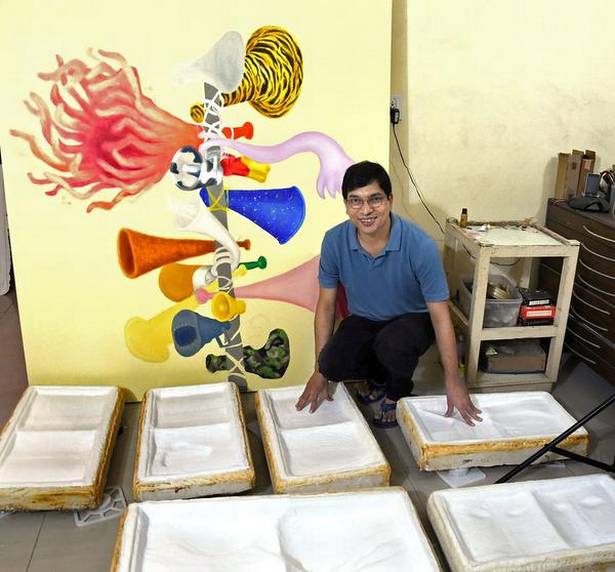
Small glass cabinet, boat, and several other found objects go through the same ritual. The references are made cleverly with metaphors and personal and universal are ensconced in layers. A take on power and aggression is portrayed by painting an array of loudspeakers, big and small, suspended from a ceiling.
“Even if there is political content, it is suggestive. I am not an activist artist in that sense. I respond to my times but the imagery is poetic and suggestive and it is not so direct that the minute the event is over, my work will be irrelevant. Any artwork has to first succeed as an artwork because they have to survive longer cycles.”
Teaching and writing
After art making comes the other two loves of his life teaching and writing. According to the versatile artist, the strands connect to complete the narrative.
After completing his MFA from Baroda, Ravi pursued Masters in English from Mysore University. He is probably the only visual artist to have got a Sahitya Kala Akademi award for his writing. His two books written in Kannada, Anuktaand Kannele were seminal writings on Indian art that won him acclaim. Kannele got fetched him the Karnataka Sahitya Kala Akademi Award in 2015.
His third book “Flexing Muscles”, published by Reliable Copy, is an observation of the culture of flex banners in the city through an essay in Kannada/English and images. It will be released in September.
He has been a visiting faculty at RV College of Architecture where he teaches visual design, and visual creativity. In 2015, he also taught one semester open course in Art Appreciation at Azim Premji university.
Teaching helps him in several ways – firstly, keeping in touch with the younger generation keeps him updated and also supplements his income. “The kind of work I do doesn’t sell much, but I need resources in order to practise. Teaching also helps because when you have to tell someone else you need to be doubly sure. It enriches my art too. Something, I am trying in my studio will go to the classroom and vice-versa.”
source: http://www.thehindu.com / The Hindu / Home> Entertainment> Art / by Shailaja Tripathi / August 29th, 2019
Paul’s lovely sketches of Bengaluru’s Swinging Seventies have been chosen by the Department of Posts for postcards and a special cover
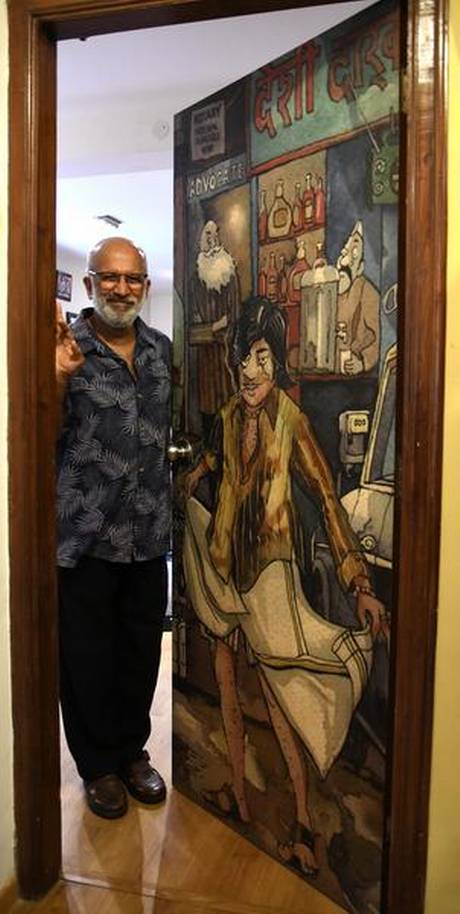
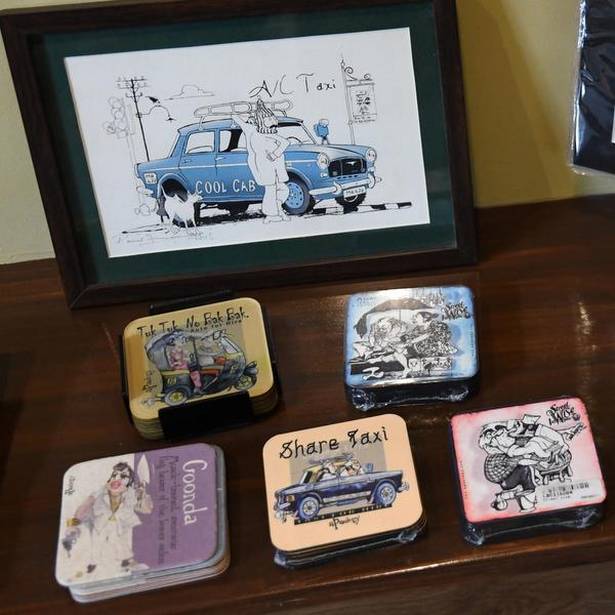
A cartoonist, illustrator or an artist equipped with a brush for story telling? As one walks into Paul Fernandes’ studio and gallery, aPaulogy in Richards Town, one comes across several examples of his talent.
The outer walls has a series tracing Bengaluru’s transition from a pensioner’s paradise to the garden city and then the overcrowding thanks to the IT boom. In another corner his art is tucked into old window frames picked up from a junk yard in Shivajinagar. Inside the gallery, one is overwhelmed with the range of Paul’s works displayed on walls, racks and tables. Doors, mugs, coasters and bags sporting prints of his cartoons and illustrations are aesthetically showcased.
A resident of Bengaluru since 1948 when he was born, Paul highlights the city and its life in his works. The artist uses colours to enhance his story telling.
Beyond black and white
“I don’t keep my illustrations in black and white. I use colour and words to strengthen and communicate. My style is an extension of not only art that I studied at the Faculty of Fine Art Baroda but also sensibilities I absorbed from my mentor Peter Colaco, a musician and writer, who chronicled Bengaluru in his book,” says Paul as he takes you through his drawings.
For 71-year-old Paul, showcasing the city through art was more about highlighting the lives of the people who make up Bengaluru. “I work towards a style that can adapt, grow and be refreshing. It is a process where a cartoon looks like a painting. One has to look at the painting longer to enjoy their perspective. This bridging of space makes the cartoon a story-telling exercise,” says Paul whose illustrations are known for their descriptive clarity.
Works of Paul Fernandes | Photo Credit: SAMPATH KUMAR GP
His art works cover the coast of Mangalore and parts of Kerala and Goa too.
There are thousands of illustrations in watercolour that depict not just a languid, sleepy Bengaluru but hangouts in a gentle city – essentially the swinging 70s, unpolluted, dreamy in its outlook, with tree lined roads.
“I want to provoke a happy, heady conversation amongst people. I hope people come up with their own stories after they see my art,” says Paul.
Paul owns a studio in Mumbai too as people’s response to art he says is equally forthcoming there.
“I travelled from Mangalore to Kerala by scooter to observe people in the outskirts. The chemistry in Bengaluru, Mumbai or Goa has its own flavour. Looking to bringing them all out is what makes my illustrations different,” he says.
Paul’s illustration of the old BRV Theatre or the Bangalore Rifle Volunteers Canteen on Cubbon Road has multiple images that collectively bring out the mood of the era. “Ideas have to be drawn into compositional poetry,” he says. In the 1970s Paul found Ulsoor Lake and Vidhana Soudha giving him the required peace and quiet to work. “When you draw Vidhana Soudha, it is good, but when you add ‘built in 1956,’ it gets friendlier.”
Other memorable illustrations include those of MG Road with Chit Chat ice cream parlour and the photo studio, EGK & Sons, a horse-drawn tonga at on South Parade, the bustling Koshy’s of 1952, Plaza Theatre and Victoria Hotel.
“Be it Chor Bazaar in Mumbai or Airlines Hotel in Bengaluru, every space has its ambience. Sometimes I prescribe myself ‘people-less’ days to reflect, recharge and focus,” says Paul.
What defines his art? “Humour that I see in every situation, even in dry buildings,” says Paul explaining that this mood helped him zero-in on the name aPaulogy for his gallery.
source: http://www.thehindu.com / The Hindu / Home> Entertainment> Art / by Ranjani Govind / August 28th, 2019
The event was organised by Shree Vidyaranya Yuvaka Sangha in a bid to promote the use of clay Ganesha idols this year.
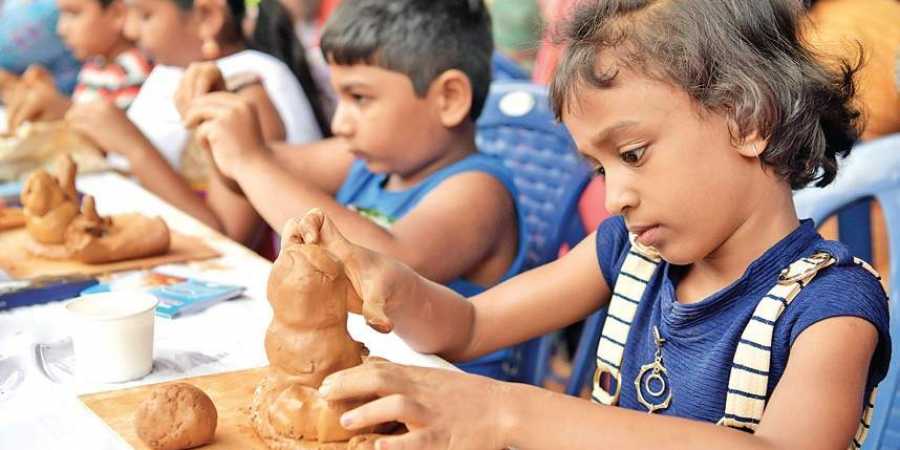
Children try their hand at moulding a Ganesha idol at National College Grounds in Basavanagudi, on Sunday. People from various walks of life and all age groups participated in the event to create a new record of the most number of people sculpting with model clay | Meghana Sastry
Bengaluru :
A new Guinness World Record has been created in Bengaluru. Giving a massive boost to an eco-friendly Ganesha festival, 2,138 people gathered at the National College Grounds to sculpt their own clay Ganesha and created the new record on Sunday. The event was organised by Shree Vidyaranya Yuvaka Sangha in a bid to promote the use of clay Ganesha idols this year.
Adjudicator Swapnil Dangarikar from Guinness World Book of Records, said, “The previous record was of 589 people sculpting with model clay. This event has broken all the records with 2,138 people gathering and the category which it comes under is ‘Most people sculpting with Model Clay’. We have certified the record. This is a great achievement and this initiative should continue as this is the need of the hour.”
People of all age groups from various areas in Bengaluru gathered to make their own clay seed Ganesha idols. Once the immersion of the clay idol is complete, the seeds will germinate and plants will grow out of it.
Seven-year-old Jeevitha Shree from SR Nagar said, “Though it is a Sunday, we came to participate in this because we wanted to make our own clay Ganesha. I will take the idol home and perform pooja on Ganesha Chaturthi.”
Two sculptors taught the participants how to make Ganesha which was streamed on 5 LED screens. There were 50 volunteers from Fine Arts College of Bengaluru, Mysuru and Chikkamagaluru who helped the people in sculpting. About 800 kgs of clay was bought from Pottery Town for the event with 5 kg of Tulsi seeds from Chikkamagaluru.
Chinmayer C from BMS College of Women who has spastic paralysis also participated. “We got to know about this event from our college. I enrolled myself as I wanted to learn how to make clay Ganesha so that every year I can do it myself. We must go eco-friendly on every festival,” Chinmayer said.
Director of Shree Vidyaranya Yuvaka Sangha Nandish S M said, “We have been celebrating Ganesha Utsav from the past 57 years and each year we make sure no plastic is used. I’m so glad we got such huge numbers and that Bengaluru made a record.
Mayor Gangambike
Mallikarjun and Karnataka State Pollution Control Board (KSPCB) Chairman K Sudhakar attended the event and also sculpted an idol. “It is my first time at making a clay Ganesha and I really enjoyed making it. We even start feeling connected to it once we make our own.”
source: http://www.newindianexpress.com / The New Indian Express / Home> Cities> Bengaluru / by Iffath Fathima /Express News Service / August 26th, 2019
Several posts, tweets and blogs were dedicated to the woman who spent almost 36 years of her life in India as a zoo professional, and was an ardent advocate of rational zoo reforms.
Sally Raulston Walker was a part of Mysuru city for many years, and inspired dreams of alternative careers in the wild | Express
Bengaluru :
Dressed in shorts and T-shirt, chatting up lions inside their cage in Mysuru Zoo, she once inspired many young Mysureans to just be Sally Raulston Walker. The zoologist and conservationist who brought wildlife closer home, passed away in her hometown in the United States of America, on Thursday.
Several posts, tweets and blogs were dedicated to the woman who spent almost 36 years of her life in India as a zoo professional, and was an ardent advocate of rational zoo reforms. She was the driving force behind many innovative programmes in not only the Sri Chamarajendra Zoological Gardens, Mysuru, and was also director of Zoo Outreach Organisation (ZOO) in Coimbatore.Sally was a part of Mysuru city for many years, and inspired dreams of alternative careers in the wild.
Sangeetha Rajanath, a retired banker from Mysuru, remembers watching Sally interact with animals in Mysuru Zoo, and her style of working.
She said, “There were days when my friends and I would tell our parents we didn’t want to be doctors or engineers, but wanted to be Sally. She inspired many of us with the way she interacted with animals and how she ensured that we, as children, maintained the plants and trees in the zoo but also knew how not to tease animals but be friends with them.”
Sally was a critic of wild animals in captivity. She was a name to reckon with in zoo circles, and had been a member of the Central Zoo Authority of India. A US citizen, she came down to India in the 1970s to study yoga and Sanskrit with Pattabhi Jois, a Master of Ashtanga Yoga, and Sanskrit Professor in the University of Mysore.
Sally lived in Mysuru for seven years. Her friends say that a visit to Mysuru Zoo and a single meeting with newborn tiger cubs, resulted in many years of dedicated service to zoos and conservation in South Asia.
Ramesh Kumar, who has interacted with her, says, “She was a very inspiring person. There were a few who didn’t agree with her ideology. Her passion for animals and opposition to causing them harm was evident in her talks, and she would gently teach us how to behave with animals.”
Observing the misbehaviour of visitors at Mysuru Zoo, she founded ‘Friends of Mysore Zoo’ in 1981, which is now relaunched as ‘Mysuru Youth Club’ in the zoo. According to her colleagues from ZOO, she had been suffering from Alzheimer’s for the past three years.
source: http://www.newindianexpress.com / The New Indian Express / Home> Good News / by Chetana Belagere / Express News Service / August 24th, 2019
‘Status achieved after a long and cumbersome process that lasted two years’
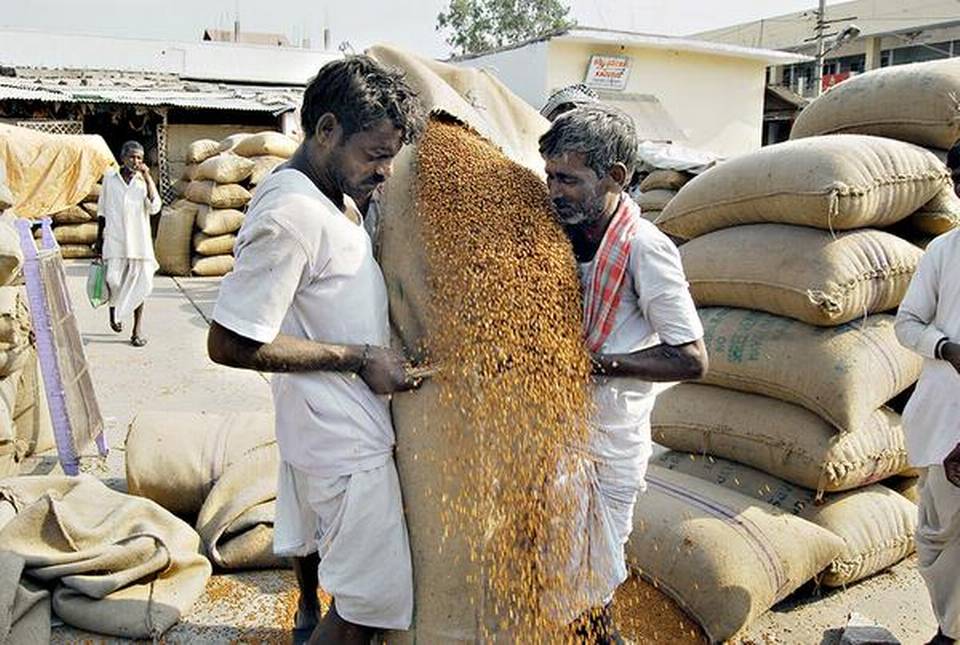
The ‘Gulbarga tur dal’ (Kalaburagi red gram), renowned for its superior quality the world over, received Geographical Indication (GI) tag from the government recently.
Speaking to The Hindu on Friday, Dean of Agriculture College Jayaprakash R. Patil and Muniswamy, agriculture scientist at the Agriculture Research Station in Kalaburagi, said that after a long and cumbersome process which lasted two years, the ‘Gulbarga tur dal’ finally got GI status on August 14.
The application was filed by the University of Agriculture Sciences (UAS) Raichur and the Karnataka Red Gram Development Board, with the help of ICRISAT, Intellectual Property Facilitation Centre (IPFC) Hyderabad with Geographical Indications (GI) Registry, in September 2017.
Dr. Muniswamy said the team of scientists from the research station has redrafted the description with the additional specification of GI product and the special characteristics and quality parameters of the produce to get the product certified with GI tag.
He said the high calcium and potassium content of the soil in Gulbarga tur dal-growing region has been one of the major factors for its suprrior quality. According to soil test reports Kalaburagi soil contains 3.6 g/100g calcium and 0.1 g/100g potassium. Whereas the soil sample in Bengaluru contains 0.135 g/100g calcium and 0.045g/100g potassium.
The other test parameters include volume, grain weight after cooking, leachable solid per cent, texture, appearance, colour, flavour, taste, and smell. The tur dal here has a good taste and aroma compared to that grown elsewhere. It also takes less time to cook.
Now, the research station, in association with the Agriculture Department and the farmers’ forum, should organise awareness programmes across the district to make farmers aware of the benefits of the GI tag, Dr. Muniswamy said, adding that the GI tag helps red gram growers get a premium price. Besides minimum support price, the farmers growing tur dal of GI standard can increase the price by 10%.
Dr. Muniswamy said that initially, GI status may not work wonders for the farmers, but in the long term, it would command a better price and create international demand for the produce.
Red gram is the main kharif crop in the Hyderabad Karnataka region. Of the total 9 lakh hectares of red gram cultivated across the State, around 3.7 lakh hectares of the crop is grown in Kalaburagi district alone.
source: http://www.thehindu.com / The Hindu / Home> News> States> Karnataka / by Praveen B. Para / Kalaburagi – August 25th, 2019
The period between 1900 to 1940, is a golden era of all-round development of Bengaluru as well as Mysore Province, mainly due to the vision and dedicated efforts of the magnificent trio, The Maharaja Krishnaraja Wadiyar IV, Sir M. Visvesvaraya (Sir M.V.) and Sir Mirza Ismail. Under the patronage of the Maharaja, Sir M.V. made Bengaluru a prominent centre for industry, trade and commerce while Sir Mirza made the city beautiful.
Dr. DVG who had seen Sir MV from very close quarters takes us through various incidents and anecdotes painting a competent picture of him, a role model for the subsequent generations, particularly for the administrators. Writer Masti Venkatesha Iyengar, edited an excellent volume on Sir M.V. containing contributions of stalwarts of various walks of life. Both in English and Kannada, there are several books published on the life and achievements of ‘The Father of Modern Mysore State’, ‘The Architect of Neo Bangalore’ and ‘The Mahatma of Industrial India’.
ir MV was born in Muddenahalli, a village about sixty kilometres away from Bangalore. He was brought to the city by his uncle, H. Ramaiah. After completing his early education in Weslyian Mission School, he joined Central College. He was very much liked by the college principal Charles Waters. He had given his personal copy of Webster’s Dictionary appreciating his pupil’s principles.
Recognizing his brilliance, Dewan Rangacharlu sanctioned scholarship to take up engineering course in Poona. After completing the studies, Sir MV joined Mumbai Government as an Assistant Engineer. Various projects entrusted to him were successfully done and he was very widely known for his engineering skills. He became a member of Experts Committee of Mumbai University and also started the Deccan Club in Poona. He had close links with the great national leaders like Gopal Krishna Gokhale, Mahadeva Govinda Ranade, Balagangadhara Tilak, Balakrishna V. Agaskar and others.
After the retirement from his service in Mumbai he went for a study tour of Europe. After coming back, on an invitation from the Nizam of Hyderabad he went there to Control the overflow of the river Musi and also built Hussain Sagar and Himayat Sagar, Two huge and well-known lakes to store water. He also made a comprehensive plan for the systematic development of Hyderabad City.
In 1909, while Sir M.V. was in Hyderabad, Dewan T. Ananada Rao, the Dewan of Mysore, conveyed to him that the Maharaja was eager to avail his services for the progress of the state. Sir MV, accepted offer and he was made the Chief Engineer of the state on November 15, 1909. During his three years tenure the State made a remarkable surge in the fields of Agriculture and Industries. The greatest achievement of Sir MV as Chief Engineer was Krishna Rajasagar Dam across the river Kaveri, near Mysore city.
His sincerity, dedication commitment and systematic style of functioning had impressed the Maharaja so much that soon after the retirement of Dewan T. Ananda Rao, Sir M.V. was made the Dewan of the Province in 1912. He was the first person who, as per the tradition was not drawn from the revenue and executive services of the state. Though, many eyebrows were raised due to this, The Maharaja was firm and his visionary decision paid enormous results.
Between 1912 and 1918, Bangalore witnessed a galore of century celebrations of many prestigious institutions like State Bank of Mysore, Kannada Sahitya Parishat, Agricultural University, Century Club, Government Soap Factory, FKCCI, UVCE. Sir MV has played a major role in starting these and many more such centers in the City. All these institutions have not only pushed the city towards progress, but also have been role models for some other states to take up similar ventures.
The saga of the journey of all these institutions through a century, are full of scintillating anecdotes, incidences and experiences which form an integral part of the history of Bangalore. State Bank of Mysore is one such remarkable financial institution of the city. The Industry and Commerce committee of the Economic Conference organization of Sir M.V. decided to start a Bank under the Patronage of Mysore Government and the Maharaja of Mysore. Thus, started the Bank of Mysore Ltd, Bangalore on October 2, 1913. Sir K.P. Puttanna Chetty was the first president, while W.C. Rose, a well-known name in the Banking Sector, was made the first Manager. The Bank started in a humble shed like structure situated at the junction of Kempegowda Road and Avenue Road. But, within a decade, the bank was too well-known and the quantum of the transactions heavily increased. To accommodate the fast growing institution it was decided in 1921 to have a bigger structure by the side of the older one. The new stone building completed in 1923 is a very interesting two storied heritage stone structure of the City. Its elevation is a mixture of European Classical and Indian elements.
Inside the building is a small shrine with a graceful white idol of Mahalakshmi, the Goddess of Wealth. It is believed that since the time of idol’s installation not only the bank has prospered well, even the surrounding area has become a very rich central business district. The Bank, after successfully running for 25 years celebrated the Silver Jubilee on December 2, 1938.
On March 1, 1960, the Bank was merged with the State Bank of India. The Bank of Mysore Ltd came to be known as State Bank of Mysore.
In 2015 a collection of my articles on the history of SBM was compiled and published under the title State Bank Hejje Gururtugalu by the Kannada Balaga to commemorate its silver anniversary and 90th year of the bank.
To be continued…
sureshmoona@gmail.com
source: http://www.thehindu.com/ The Hindu / Home> News> Cities> Bengaluru – Bringing Back Bengaluru / by Suresh Moona / August 22nd, 2019
A view of the Library at The Indian Institute of World Culture at Basavanagudi in Bengaluru. Sudhakara Jain | Photo Credit: Sudhakara Jain
The Indian Institute of World Culture not just offers a huge library and cultural activities, but an impressive history of committed voluntary work
A huge hall nearly 100 feet in length is stacked with books running into lakhs on wooden racks. Cooled by ceiling fans on the high Madras ceiling, people of all ages are seen reading journals at the adjoining Behanan’s Reference Library. The building retains the old world charm with wide stairs and thick walls. It houses an auditorium on the ground floor where educational and cultural programmes happen throughout the year. The newly-renovated Children’s library is full of children running around and taking their books for interacting in friendly spaces. This is the Indian Institute of World Culture (IIWC), offering free programmes and activities to the public for more than seven decades now. A model institution run by a strong volunteer-base, IIWC, which stepped into its 75th year in August, was founded with a promise of creating an arena for cultural exchange.
August 1945, Bahman Pestonji Wadia, the founder-president of the institute and a well-known Thesophist, was extra jubilant as the inauguration event coincided with the message of the World War II coming to an end. “Under this double joy we flag off the Institute of World Culture and we shall move from darkness to light, illumined by culture and knowledge,” Wadia had said, as he launched one of the biggest institutes at Basavanagudi in South Bengaluru. The road named after Wadia after his death in 1958, is now an INTACH-listed heritage building.
Born in 1881, BP Wadia belonged to the famous Wadia family of shipbuilders from a village near Surat. Inspired by the Theosophical movement, Wadia had envisioned IIWC as a cosmopolitan cultural centre where books, arts and service thrived.
Wadia’s involvement is said to have been so deep that people had often joked, “if North Bengaluru has the Tata Institute (IISc.,) the South has the Wadia Institute,” says Honorary Secretary Arakali Venkatesh. “IIWC regularly had literary giants as DV Gundappa, VK Gokak, Masti Venkatesh Iyengar and MV Krishna Rao as part of their cultural events and the library during the 1950s and 60s. Its rich history is being preserved for people. And we plan to have a year-long programme of events to mark its Platinum jubilee,” adds Venkatesh.
The institute’s huge 4000 sq.ft. public library houses nearly 1.5 lakh books which are lent out free of charge, apart from a reading room called Behanan’s Reference Library (named after Dr. KT Behanan who handed a huge collection of classics in 1963) that extends 400 periodicals in various languages. The auditorium hosts public lectures, art exhibitions, film shows, and music and dance recitals. “We have had 150 programmes in a year without a break almost since the inception,” adds Venkatesh.
Former Justice MN Venkatachalaiah, past president of the IIWC Executive Committee, had wished to update the infrastructure to suit contemporary needs. “He wanted an auditorium that holds nearly 750 people. It is on our cards,” says the present president VJ Prasad adding that IIWC’s first renovation was the Children’s library. “We have ergonomically designed reading stations created for children to enjoy the near 4000 titles we have, apart from reference books and encyclopedias,” adds Prasad.
______________________
All for free
People are welcome to donate books to the IIWC library (080-26678581; www.iiwcindia.org) or become life members by donating ₹5000
The main library of IIWC houses 1.5 lakh books on a variety of subjects
The institute’s journal ‘Bulletin’ distributed free, has articles and event listings
The magazine section has rare collections offering even the first edition of Chandamama of the 1940s; old sets of comics as Tinkle, Champaka, Indrajal and Marvel DC amongst several more.
The reading room offers 400 magazines and 30 newspapers
IIWC has plans to bring in a fully-equipped auditorium and upscale its building and furniture with public funds
_______________________
From the IIWC library that started off in 1947 with 4,200 books and hundreds of people visiting, today the number has increased to nearly 40 times more. Public donations take care of the operating costs. “We have a modest budget of ₹1.5 lakh a month, but work with higher ideals that the founder believed in,” says Venkatesh.
Speaking about the nostalgia the institute is associated with, paediatric surgeon Dr. Vijayalakshmi Balekundri, Vice President of the committee says, from governors and presidents to Nobel laureates as CV Raman, Ralph Bunche and Julian Huxley, nuclear physicist Homi Bhabha, scientist Vikram Sarabhai, Maharishi Mahesh Yogi, and the erstwhile royals Jayachamarajendra Wadiyar and Travancore Marthanda Varma had visited IIWC. “The institute has been an epitome of economical functioning, but is generous in imparting culture,” adds Vijayalakshmi.
Reminiscing about his childhood who spent borrowing books from IIWC children’s library, businessman Ashish Krishnaswamy, a member of the executive committee says, “As a seven-year-old in the 1980’s I had the thrill of borrowing my first book with a library card. From all comics to Ruskin Bond and Jim Corbett’s amazing tales, the library not just offered books but had fun events to offer. We plan to get this going permanently,” says Ashish who has taken a keen interest in contributing funds and having the children’s library renovated.
The influence
BP Wadia joined the Bombay branch of the Theosophical Society in 1904, and shifted to its Madras branch in 1907. Wadia later worked in the Home Rule Movement along with Dr Annie Besant and George Arundale, which led him towards starting the first labour union in Indian history. Apart from attending conferences on trade union movement, he came into contact with United Lodge of Theosophists (ULT) founded by Robert Crosbie at the United States and worked for it. Thereafter he founded several ULTs in India and abroad along with his wife Sophia Wadia. “The institute shall remain a non-sectarian, non-governmental, private voluntary body to mainly promote inter-cultural exchanges,” Wadia had declared.
source: http://www.thehindu.com / The Hindu / Home> Society> History & Culture / by Ranjani Govind / August 21st, 2019
The minutest components of a watch can be seen under a microscope in the ‘Parts of a Watch’ section. | Photo Credit: K. Murali Kumar
‘When former employees come here, they cry’
On the afternoon that I visit the HMT Heritage Centre and Museum in north Bengaluru, I meet Rajendra Rao, a project manager, his wife, daughters, and mother-in-law, who have just finished the tour and are now at the tiny souvenir shop that sells watches and miniature tractors. Rao tells me about his first HMT, passed on to him from his father-in-law — a Swarna limited edition watch with an Indian flag on the dial. “I have 16 watches of various brands, but today I bought my own HMT,” he says. “I wish the government had not shut it down. This was the essence of Make In India.”
Within the nondescript two-storey building — originally the official residence of the HMT chairperson — set in a sprawling four-acre space, lush with a hundred trees, the museum is as much about the story of HMT as it is about the intricate craft of watch-making.
My tour begins in a brightly lit room with pictorial charts on the walls marking milestones from 1953 when HMT (Hindustan Machine Tools Ltd) was incorporated by the government as a machine tool manufacturing company. In 1961, the foundation for the first watch factory was laid in Bangalore and operations began with technical know-how from Japan’s Citizen Watch Company.
Within the next decade, more factories were set up across the country, including in Srinagar and Ranibagh in Uttarakhand. There is a photograph of Jawaharlal Nehru receiving the first hand-wound HMT watch, manufactured in 1962, which he famously christened Janata, a legendary name now.
Up till the 90s, HMT watches enjoyed a golden era, controlling 90% of the market. In 2000, the then Prime Minister Atal Bihari Vajpayee was presented HMT’s 100 millionth watch. But with the arrival of quartz watches, cheap timepieces from China, and stiff competition, the slowdown in sales began, which was never stemmed.
A number of iconic HMT models are showcased across a sprawling four rooms. | Photo Credit: K. Murali Kumar
Losing steam
In 2013 the company reported a loss of a whopping ₹242 crores, and began to lose steam. The watches division was fully phased out by 2016. However, watches are still sold on their website hmtindia.com. There are still some two to three lakh watches on their inventory, and their wind-up watches are still in high demand.
“The demand for HMTs was so great that in the 60s, a pledge was made to set up a new factory every year,” says Jayapalan P., who worked at HMT for 30 years in the after-sales department, and now manages the museum.
I find myself in a room where the watch has been turned inside out. Titled ‘Parts of a Watch’, the display shows every single component that goes into a standard watch: movement pieces, hair springs, screwdrivers, horological jigs, pliers, watchcases, gaskets, dials, even straps.
There are hand-press machines that ‘coined’ the dials of the 60s’ watches, and the powerful eyeglasses used during assemblage. Jayapalan stops at one display that houses minute-hour markers, watch hands and dials. “This may look simple but the task of placing each component on the dial is exacting and tedious,” he says. And there used to be more women than men working in the assembly section, he says.
Interestingly, the museum’s display boxes — in bright yellows, reds and greens — are made from the old doors and windows of the HMT school in Bengaluru, which was shut down two years ago. The factory floor has been recreated as well, complete with all the heavy machinery. You can even insert a card into the punching clock as employees would once have done. In fact, most of the machines too are in working condition. Jayapalan points to an antique printing press manufactured by William Notting in 1760. “When former employees come here, they cry,” he sighs.
Gems and gold biscuits
On the shelves I spot the elegant Sujata (the first HMT ladies watch); Chandana, circa 1990, with a sandalwood dial ring and sold with a bottle of sandalwood oil to smear on it when worn); Kanchan (apparently every groom had to have this); the Tareeq series (the only one with a date interface); the Gem Utsav series (silver studded with semiprecious stones); and the ‘gold biscuit’ watches (with a gram of gold on the dial). HMT had Braille watches (1970) that came with a Braille handbook — “no one else did this in India” — and ‘nurse watches’ with just a dial that could be pinned to the uniform blouse.
Photo: K. Murali Kumar
There are watches commissioned by PSUs and government departments, watches with pictures of gurus, politicians and freedom fighters. Jayapalan shows off his 25-year-old Suraj watch, fully automatic and with no battery. “It works on the movement of my hand,” he says.
Jayapalan remembers standing in line at 5 a.m. to buy his Janata in 1970. And he spends no more than ₹20 each year to replace the glass casing. “Nothing goes wrong with it,” he says. “Maybe that’s why the factory closed; once you bought an HMT, there was no reason to replace it.”
Outside, children are taking joy rides on the HMT tractor or buying tiny tractor models. But Shivanand Patil, 24, the young tractor driver, doesn’t wear a watch. “I have my phone,” he says.
The freelance writer believes that everything has a story waiting to be told
source: http://www.thehindu.com / The Hindu / Home> Society / by Jayanthi Madhukar / August 17th, 2019