The Catapult network has decided to focus on Bengaluru to enhance the progress already made in air quality and electric vehicle transition in Bengaluru.
Bengaluru :
British Deputy High Commissioner Dominic McAllister on Wednesday launched a two-year India-UK joint initiative in Bengaluru that would provide a unique air quality measurement system by integrating satellite and sensor data and support India’s transition to Electric Vehicles (EVs). The initiative – Innovating for Clean Air (IfCA) will identify innovations having potential to improve air quality and contribute to a more detailed localised map of the air quality of Bengaluru through the unique combination of satellite and sensor data, including both on-the-ground and mobile data.
The programme will identify relevant challenges around EV-charging infrastructure, grid management and integrating renewable energy to ensure a sufficient, reliable and clean source of power. It will also facilitate opportunities for Indian and UK innovators to collaborate in developing long-lasting relationships to address these challenges.
The programme is led by Innovate UK — part of UK Research and Innovation (UKRI) — and is funded by the Newton Fund with matched resources from various key partners in Karnataka and India, like Indian Institute of Science, Enzen, Project Lithium, Confederation of Indian Industries, C40 Cities and Clean Air Platform.
Other partners include Citizens for Sustainability, World Resources Institute, Indian Institute for Information Technology Bangalore (IIIT-B), Shakti Foundation, Shell Technology Centre, Global Business Inroads and India Smart Grid Forum. A current UK partner, Earthsense is working in collaboration with the UK Catapults.
The Catapult network has decided to focus on Bengaluru to enhance the progress already made in air quality and electric vehicle transition in Bengaluru.
UK Research and Innovation India (UKRI) Director Rebecca Fairbairn said, “UKRI has been working with India for over a decade, focussing on research that makes a difference to society and to our economies but this is the first time the UK Catapult network, which drives innovation in highly targeted industries has been implemented here and it demonstrates the creativity possible through India-UK partnership.”
British Deputy High Commissioner Mc Allister said, “Such collaborative initiatives are an example of how the UK and India can work as a joint force for good on innovative solutions, and can bring the best of our research communities, academia and businesses together to address shared challenges, such as clean air.”
source: http://www.newindianexpress.com / The New Indian Express / Home> Cities> Bengaluru / by Express News Service / August 01st, 2019
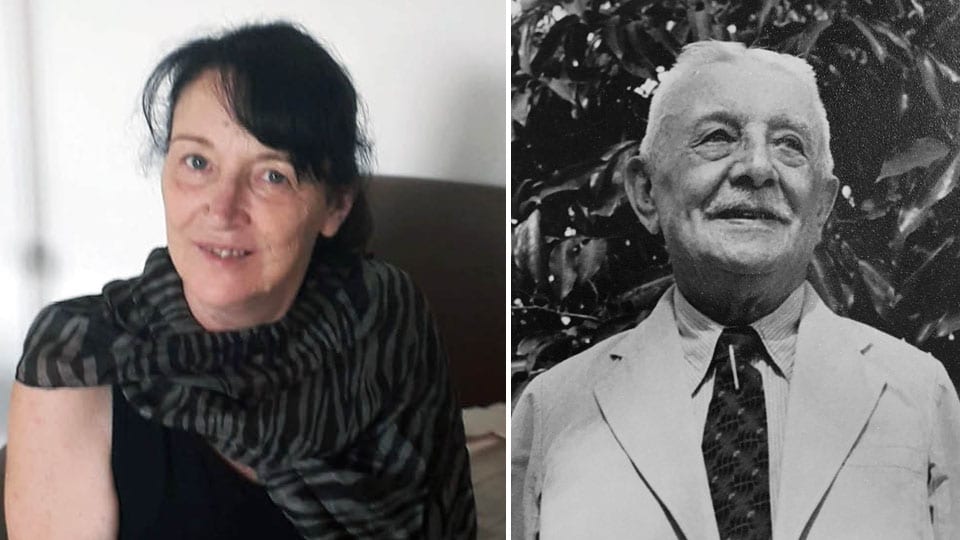
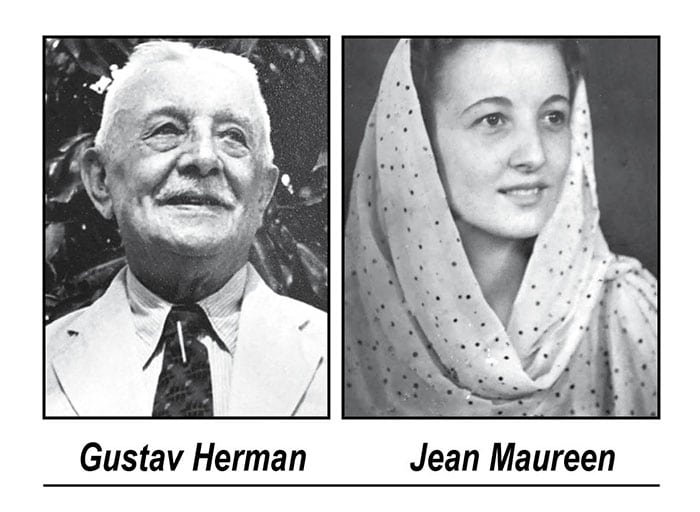
Brindavan Gardens’ designer Gustav Herman Krumbiegel’s great-granddaughter Alyia Phelps Gardiner Krumbiegel is on a visit to the city.
She is visiting Mysuru and Bengaluru on a purpose and that is to immerse the ashes of her mother Jean Maureen Phelps Gardiner, who had passed away in Jan. 2018 in England.
Speaking to Star of Mysore here this morning, Alyia said that she had brought her mother’s ashes to India to immerse it in the rivers here, as she (Jean Maureen) always felt that her home was in India.
“My mother passed away on Jan. 18. 2018 and I was very clear that her body had to be cremated and not buried. Hence, I had to wait for nearly three weeks as I had to book the slot for her cremation in advance. Finally, the slot that was available was Feb.5, 2018 and it was then she was cremated. She had told me that her heart was always in India and hence to respect her last wishes I have brought her ashes to the country she always loved,” said Alyia.
Alyia has already immersed a part of the ashes in Waynad, Kerala and she has plans to immerse it in River Cauvery in Srirangapatna shortly, she said.
She will also be visiting the Mysuru Zoo with a letter to the Executive Director requesting him to display a plaque of her great-grandfather Krumbiegel who had also planned the Gardens in Sri Chamarajendra Zoological Gardens.
Alyia will also be visiting the Brindavan Gardens to see for the first time the work of her great-grandfather which all these days she had only heard about.
She had cycled to Mysuru all the way from Bengaluru a couple of years ago and she had time only to visit the Mysore Palace where she had met Pramoda Devi Wadiyar, she recalled.
Alyia will later go to Bengaluru and plans to participate in the Independence Day Flower Show at Lalbagh. In this year’s flower show, there will be a floral tribute to Sri Jayachamaraja Wadiyar, the last Maharaja of the erstwhile State of Mysore, to mark his birth centenary celebrations.
“My great-grandfather had a big role in designing the Gardens at Lalbagh and I am so happy that this year floral tributes are being paid to Maharaja Jayachamaraja Wadiyar for whom Krumbiegel had worked,” she said.
source: http://www.starofmysore.com / Star of Mysore / Home> News / July 30th, 2019
They used a bioinformatics approach to design protein
Researchers at the Indian Institute of Science (IISc.) have designed an anti-microbial peptide (AMP) that, researchers say, can effectively and quickly kill a notorious multidrug-resistant bacterium called Acinetobacter baumannii.
According to a press release by IISc., the bacterium tops the WHO’s list of threats that urgently need new antibiotics because it is “remarkably adept at developing drug resistance”. The release also stated that it is among the six species responsible for most infections in hospitals and health care centres.
In a new study published in Science Advances, IISc. researchers used a bioinformatics approach to design a new short protein (peptide) called Omega76 that can kill A. baumannii by breaking down its cell membrane.
Infected mice treated with Omega76 had much better survival rates. The team also found that high doses of Omega76 given for prolonged periods did not produce any toxic effects. Since it is safe and effective, it is a promising candidate for developing new antibiotics, the researchers say.
Dipshikha Chakravortty, Professor at the Department of Microbiology and Cell Biology, who was part of this research, was quoted as saying, “The significance of A. baumannii infection was not sufficiently understood earlier… It was regarded as just another bug in the environment. It has now become a major threat, especially in the intensive care units.”
The release stated that antibiotics for such infections may soon become ineffective, as resistance to even last-resort drugs such as carbapenems is on the rise.
“They are not entirely safe either; a drug called colistin, which is considered the last hope for multidrug-resistant infections, has been found to cause severe kidney damage,” said postdoctoral fellow Deepesh Nagarajan.
While standard drugs act by “blocking specific pathways or processes in bacterial cells,” bacteria can evolve to gain resistance against such drugs. Nagasuma Chandra, Professor at the Department of Biochemistry, said, “On the other hand, anti-microbial peptides (AMPs) actually punch holes in the bacterial cell membrane. The chances of drug resistance are much lower because they act by multiple ways and cause actual physical damage.”
The researchers plan to improve its design further, and explore clinical uses.
source: http://www.thehindu.com / The Hindu / Home> News> Cities> Bengaluru / by Staff Reporter / Bengaluru – July 30th, 2019
Setty was likely unique in having the audacity to ignore financial worries and get involved in what was still a new and experimental field as an engineering student in Britain.
An Avro 504. Credit: TSRL/Wikimedia Commons, CC BY-SA 3.0
This wide-ranging column will take as its basis a discussion of a book every month on the history of science and technology, and relate it to a theme of current relevance. Read the other articles here.
On a recent visit to Manchester’s Museum of Science and Industry, a friend pointed out a small printed display next to a wooden model of an early Avro plane. It showed a man in suit and tie, sporting a drooping moustache and a white turban. The caption identified him as S.V. Setty (1879-1918), an “apprentice and unpaid draughtsman” at A.V. Roe and Company in 1912. It went on to declare: “India regards him as its first aircraft engineer”. This was intriguing; to the best of my knowledge Setty is not a household name in India. I set out to find out more.
Newspapers, websites and online forums have occasionally featured discussions on Setty, but the most detailed account we have of his life is contained in Kashi Viswanatha Setty’s slim volume, The First Indian Aviator: S.V. Setty, published by the Karnataka Arya Vysya Maha Sabha in 1984. Translated from the Kannada, the book gives a timeline of Setty’s life and includes some of his letters in an appendix.
Srirama Venkatasubba Setty (also known as Setti or Chetty) was born in Mysore in 1879 and earned a B.A. from the Maharaja’s College before enrolling in the Engineering College at Guindy, Madras. From Guindy, he transferred to the Thomason College, Roorkee, where he completed his engineering degree with high honours, but missed out on a prized appointment in the Indian Public Works Department (PWD) because he was above the age limit. He did get a job with the Mysore PWD, however. He served until 1909 before going on leave, having won from the Mysore government a scholarship to Faraday House, London, where he studied for a diploma in electrical engineering. This was a sandwich course , and Setty was soon gaining experience at firms in Rugby, Wolverhampton and London. During this time he also became an associate member of the Institution of Electrical Engineers.
Setty clearly had an appetite for learning. In England, he was attracted to flying and aeroplane design, which were newly in vogue (in the United States, the Wright brothers had made their first successful powered flight in 1903). Extending his leave and procuring loans from some wealthy patrons at home, he joined Avro in 1911 as a trainee pilot and draughtsman at the company’s Brooklands airfield in Surrey. The company, which was among the first aeroplane-makers in Britain, had only been a year old at this point.
At Brooklands, Setty regularly flew in various Avro planes, earning several mentions in Flight , the journal of the Aero Club in Britain. This was an experience few Indians would have had until the end of World War I. Flying took off in India in the 1910s but was mainly the preserve of wealthy princes. Setty was by no means alone in being an Indian engineering student in Britain – but he was probably unique in having the audacity to ignore financial worries and get involved in what was still a new and experimental field, offering little by way of career options in India. It couldn’t have been easy. For one thing, flying in the early days involved mortal danger. For another, he would have stuck out like a sore thumb at Brooklands. On one occasion, when he veered off course, Flight reported, “After two or three straight lines he turned off and ran into the sewage farm. He is a vegetarian, and it is thought that he may possibly have had some irresistible attraction for the cabbages which grow that way.” This may well have been good-natured ribbing but it would not be surprising if it felt like a barb at some level.
In addition to flying, Setty was involved in preparing drawings for various planes being designed at Avro in 1911-12. It is difficult to establish with certainty the exact nature of Setty’s contribution. Documentary evidence from his time at Brooklands is scarce, and Avro’s early records perished in a fire in the 1950s. (Setty’s great-grandson has collected some documents and a medallion awarded to his ancestor, though I have not had the opportunity to look at these in the original.) The most reasonable assessment I have found so far is in a note on Setty prepared by the Museum of Science and Industry, Manchester, and kindly made available to me by them. Considering various sources carefully, the note concludes that Setty “definitely worked on general arrangement drawings for the Avro Type F” (the first plane with an enclosed cockpit), and possibly “worked on drawings for the original [Avro] Type E”, a biplane – having wings in a double-decker arrangement – that formed the basis for the Avro 500 series. The Avro 504 would play a major part in World War I.
Having received a handsome certificate from Avro, Setty went back to his job in Mysore, leaving England in June 1912. There he was deputed as superintendent of the Mechanical Engineering School in Bangalore. He continued to have an interest in aviation, and with his year-long experience with Avro he was confident that he could build an aeroplane in India. He sought permission from the Mysore government and requested Rs 15,000 in funding. From the estimate of expenses that he enclosed with his request, it appears that he aimed to construct a biplane along the lines of the ones he had worked on in England. The dream was short-lived, however, as World War I broke out and the Government of India disallowed the flying of aircraft in its territory.
Why is Setty not better known? In his lifetime he was not shy of publicity. He was eulogised by the Calcutta-based Modern Review, sent photographs of himself with an Avro biplane to a professional journal and, upon his return to India in 1912, was honoured at gatherings in Erode, Bangalore, Madras, Coimbatore and Kollegal. But what fame he enjoyed was tied to his career in aviation, which had lasted all of one year, and which he had no way of continuing. Still, had Setty lived a long life, his reputation might have grown. But he was denied that privilege: the influenza pandemic of 1918 claimed him before he was forty.
Perhaps it is a mistake to focus exclusively on Setty’s exploits in the air, for he became a prominent citizen of Bangalore and continued to make an impact in other fields. He set up scholarships in his parents’ names; experimented with building a Kannada typewriter; was almost certainly a member of the Freemason Lodge in Bangalore; and was acting professor in the city’s engineering college (he was confirmed in the post shortly before his death).
Trying to identify firsts in the history of technology is often an unrewarding exercise – nor is it particularly useful to invoke individual genius in explaining technological developments. Personal courage, determination and imagination are by no means unimportant – and S.V. Setty had them in good measure – but we would do him a disservice if we saw him in isolation from the world in which he worked. A number of interesting questions beckon.
How did this Roorkee graduate develop an interest in electrical engineering, still a novel subject in the 1900s? In what circles did he move as a student in London, and how did aviation catch his fancy? To what extent did the munificence of the Mysore government and his acquaintances influence the direction of his career? Did Setty’s efforts have a long-term impact on aviation in India? It may have been a coincidence, but when aircraft manufacture eventually took root in India in the 1940s, it did so in Bangalore and with the support of the Mysore government. But that is a story for another day.
Aparajith Ramnath is a historian of modern science, technology and business.
source: http://www.thewire.in / The Wire / Home> History / by Aparajith Ramnath / May 15th, 2017
These students devote three-four hours every day after college and now their work has come to fruition as they have raised `1 crore from sponsors and finally built a pod and a 40-metre test track.
Bengaluru :
At an event hosted by Atria Institute of Technology on Tuesday, aerospace engineering student from IIT Madras, Sai Madhav, presented his team’s prototype pod for the SpaceX Hyperloop Pod competition to his audience.
Avikshar Hyperloop is one of the 22 teams out of the 1,600 teams worldwide and also the only team from Asia that has qualified to the finals. It is a group of about 30 students from inter-disciplinary backgrounds who have been working on creating their own pod since September 2017. These students devote three-four hours every day after college and now their work has come to fruition as they have raised `1 crore from sponsors and finally built a pod and a 40-metre test track.
SAE India, a member-driven organisation which acts as a knowledge partner for students and faculty in automotive and aerospace engineering, hosted its second event in its lecture series that deals with aerospace engineering. It also functions as a think-tank and a policy maker. The second lecture was specifically about the Hyperloop, an almost too-good-to-be-true transportation service proposed by Elon Musk, CEO of SpaceX and Tesla. The Hyperloop, if installed, seeks to reduce travel time drastically. It is supposed to be a land-based transportation service where pods, that house passengers, can levitate and zoom through tunnels by having the air pumped out of them in order to create a near-perfect vacuum for greater speed. It boasts of a travel time of just 30 minutes from Bengaluru to Chennai.
Being the main speaker at the event, Madhav’s presentation and video of the only Indian team to qualify for this competition impressed a mixture of faculty, students and heads of the SAE group. He also talked about how the plan for building their pod looked solid on paper but when it came to the actuality of making it, they faced a lot of discrepancies. Being in the stability team, he deals with a lot of mechanical aspects of the pod. During the question-and-answer session, the question of the safety of the passengers was raised as the Hyperloop project has bragged about reaching speeds up to 500-600 km/hour. “Yes, passengers will feel major deceleration effects. All this is new and I can only hope that newer research yields positive results,” he said. J Munirathnam, who is on the Board of SAE India for aerospace, also said the project will have to be built after taking into consideration the degree of g-force that the human body can withstand.
“This is completely new. We have the freedom to explore it. If you look at building a car, parameters have already been established for it. That is not the case here,” Madhav said.
The hype about hyperloop
The Hyperloop, if installed, seeks to reduce travel time drastically. It is supposed to be a land-based transportation service where pods, that house passengers, can levitate and zoom through tunnels by having the air pumped out of them in order to create a near-perfect vacuum for greater speed.
source: http://www.newindianexpress.com / The New Indian Express / Home> Cities> Bengaluru / by Chinmay Manoj / Express News Service / July 11th, 2019
BookASmile, the charity initiative of BookMyShow, will be sponsoring Satish’s all-expense paid trip.
20-year-old Satish Kumar
Bengaluru :
When Satish Kumar failed his SSLC exams a few years ago, he was so dejected at the thought of not knowing what life had in store for him. But a few years down the line, the 20-year-old, who chose to give his everything to football, has managed to make a name for himself. About a month-and-a-half ago, Kumar “couldn’t believe” that he had been selected to play in the Homeless World Cup in Brute Park, Cardiff, UK, an annual football tournament organised by the Homeless World Cup Foundation, a social organisation that advocates the end of homelessness through the sport.
Currently in Nagpur to undergo the second round of training before he leaves for Cardiff in mid-August, Kumar will be going on an all-expense paid trip sponsored by BookASmile, the charity initiative of BookMyShow, which has partnered with Slum Soccer to take 16 beneficiaries to Cardiff to attend this week-long football festival.
“I had lost my motivation after failing my 10th standard board examination. When I didn’t pass my exams, people suggested that I should take up a job. But since I had been playing football since I was in Class 6, I decided I should give it a try. But my family wasn’t convinced thinking that there was no life in this. But I wanted one chance to prove myself. And that required a lot of hard work. Reaching where I am today, despite family apprehensions, has been a big achievement,” says Kumar, who recalls having requested a coach in his area to teach him the sport.
Every once in a while, Kumar– whose father works as a painter, which helps takes care of only their basic expenses – takes up a handyman job of washing tiles which gives him Rs 300 a day. And with his earnings, he purchases gear – boots and stockings from locals stores –for himself. He’s been lucky to have got shoes from a well-wisher. “The turning point in my life came when I played the Bangalore league A division and qualified for the Bangalore Super Division in 2018,” he says.
Kumar’s gone from one achievement to the next, including playing the Slum Soccer’s National Inclusion Cup where he showed his talent and got selected to attend trials for the upcoming Homeless World Cup and has been finally selected as one of the representatives.
A typical day now includes two-and-a-half hours of practice in the morning and evening, which has intensified ahead of his departure. “We were told that the courts in foreign countries are different from the ones here,” he says, adding that at home he teaches underprivileged kids the game twice a week. “I want to show them how I reached where I have and what I did to be here,” he says.
source: http://www.newindianexpress.com / The New Indian Express / Home> Sports> Football / by Vidya Sagar / Express News Service / July 08th, 2019
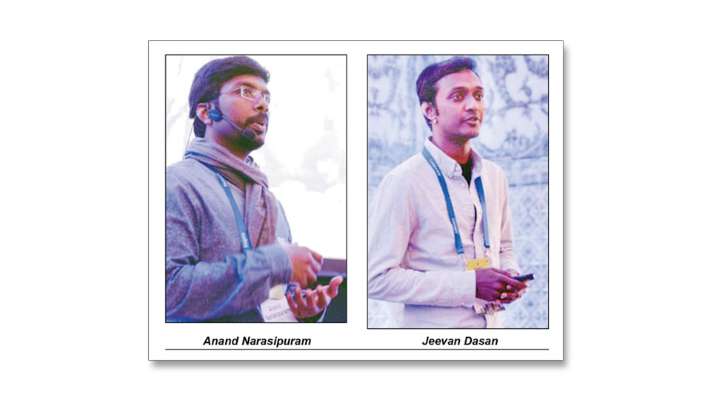
‘Smartivate,’ a Start-Up co-founded by two Indians — Anand Narasipuram and Jeevan Dasan — alumni of Karlsruhe Institute of Technology, Germany and the EIT Innoenergy Master School, located in Karlsruhe, Germany, has won the prestigious ‘Smart-Home Deutschland Award’ for the year 2019. The Award was given to the Start-Up for its product, ‘Configurator for plug and play smart home devices.’
Incidentally, Jeevan Dasan, an alumnus of the National Institute of Engineering (NIE), Mysuru, is the son of Dr. A.S. Dasan, Professor of English and Director, Shukrodaya’s Academy for HRD, Alanahalli Layout, Mysuru and Prof. Nalini Dasan.
‘Smartivate’ was one of the top three nominations shortlisted out of a large number of contestants from across Germany for the Award. The award ceremony, held last month in the historic ‘City Hall of Berlin,’ was hosted by ‘Smart-home Initiative, Germany eV’, a cross-industry federal association based in Berlin. Since 2012, the Association has been recognising commitment to technological excellence and quality of smart home products of companies, start-ups and student projects from across Europe.
‘Smartivate,’ a fine team-venture, actively involved in building a web-platform as one-stop-shop for smart home solutions, was launched one-and-a-half-years ago with a business start-up grant awarded by the Government of Germany.
source: http://www.starofmysore.com / Star of Mysore / Home> News / July 06th, 2019
Shalini’s struggles began after she travelled to Cambodia with her husband on her fourth wedding anniversary in 2012. She came down with a mild fever, which was wrongly diagnosed as dengue at the time.
Shalini Saraswathi
Bengaluru :
Shalini Saraswathi cherishes her life too much now. “When you have come too close to losing your life, you realise not to take things for granted,” says the 40-year-old para-athlete.
The blade runner, a quadruple amputee, won the bronze medal at the national-level parathletics held last year, and is now aiming for the 100-metre and 200-metre sprints in 2020. She will also be inaugurating Mercy Drops, a community resource centre that will promote the culture of sharing, on June 7.
“I never considered myself to be an athlete at all,” says Saraswathi, who was diagnosed with acute Rickettsial – a rare bacterial infection – in 2012.
“After two years of bed rest and trying to figure out how to go about my life, I met coach B P Aiyappa, who then trained me. During the first year of getting my life back on track in 2014, I would walk around Kanteerava Stadium to get a grip on my prosthetics. By the second year, I had got my blades and started running for 90 minutes daily,” recalls Shalini, who also participated in TCS 10K marathon.
She now practises every morning, before heading off to work at a BPO.
Shalini’s struggles began after she travelled to Cambodia with her husband on her fourth wedding anniversary in 2012. She came down with a mild fever, which was wrongly diagnosed as dengue at the time.
The Bengaluru resident, who originally belongs to Kollam district in Kerala, finally got the right diagnosis and her treatment began, but she was forced to undergo amputation.
During the course of treatment, Shalini also lost her baby, which affected her physically and mentally. As gangrene attacked her, she suffered multiple organ failures.
“Initially I hated myself for the person I had become. It was a journey to be okay with who I am,” recounts Shalini.
Her husband, family and friends have been her support throughout her journey.
Explaining that the challenge for her earlier was to accept the person she had become, she adds that she still struggles with wearing her prosthetics every day, or coming to terms with the fact she cannot drive a car anymore.
“To overcome it, I sometimes write dark poetry and verbalise what I am going through,” she says. “I often cry. Mourning is the best way to overcome your losses.”
source: http://www.newindianexpress.com / The New Indian Express / Home> Cities> Bengaluru / by Preeja Prasad / Express News Service / June 01st, 2019
Hema Divakar is spearheading a healthcare initiative for the overall well-being of women, with affordable and quality treatment.
Bengaluru-based medical doctor Hema Divakar (Photo | Hema Divakar Facebook)
Bengaluru :
Bengaluru-based medical doctor Hema Divakar was honoured with the ‘Global Asian of the Year 2018-19’ award in Dubai recently for her yeomen services and contributions to the women’s healthcare ecosystem, in India, said its organiser ‘Asia One’ magazine’s publisher on Tuesday.
Hema received the award at the Asian Business & Social Forum 2019 under the ‘In Service of the Society and the Nation’ category from UAE’s Trade Promotion Director Mohammed Naser Hamdan Al Zaabi.
“The award is conferred on those who stand out for vision, action and ingenuity and represent contemporary ideas to make global impact,” said the pan-Asian business and news publication in a statement here.
Hema is also spearheading a healthcare initiative for the overall well-being of women, with affordable and quality treatment.
“To be recognised with other achievers of Asia thrusts on me a greater responsibility and ownership to reform the women’s healthcare ecosystem in an innovative and impactful manner,” said Hema on the occasion.
source: http://www.newindianexpress.com / The New Indian Express / Home> Cities> Bengaluru / by IANS / May 22nd, 2019
The Old Boys, as they are known, relish a history of sending their own to the armed forces to defend the country.
Martyrs’ family members | shriram BN
Bengaluru :
Wreaths were laid, The Last Post played, followed by traditional memorial band tunes, as they called to rest upon four of their own martyrs. The Old Boys Association of St Joseph’s Boys’ High School, which is one of the oldest alumni associations in the city, marked their 100 years of existence by honouring the post-independence martyrs who were part of their association.
The Old Boys, as they are known, relish a history of sending their own to the armed forces to defend the country. It started with the First World War, until recent battles in independent India. The numbers tally to 360 old boys, who served in various battlefields across the world, some being just teenagers. They recalled the association with pride about their alumna.
On Saturday, on one of their last events for their centenary year, the association inaugurated two plaques in the St Joseph’s Boys’ High School. One at the war memorial, and another in the school, with names of four Indian Alumni – Capt John A Dalby, from 5 field regiment, who was martyred on November 18, 1962 at Jaswanth Garh, during the Sino-Indian War; Major Uday Shankar Ghosh, 13 Sikh Light Infantry, martyred on June 26, 1989 in The Indian Peace Keeping Force in Sri Lanka; Major Palecanda Atul Deviah, 6 Field Regiment, in operation Meghdoot at Siachen Glacier; and Major Sylvester Rajesh Rathnam, 21 JAT, martyred on August 2, 2002, in operation Parakrama in Kupwara, Jammu and Kashmir.
Families of the martyrs gathered with the Old Boys and friends at the Memorial Service that was celebrated by the archbishop of Bengaluru, Peter Machado, before paying their respects to the martyrs at the school campus. While the pipe band from the Madras Engineering Group and Centre played Slow March. Families and friends mourned their beloved as the Sappers played the Last Post and the Rouse at the memorial.
Families of martyrs find closure in Old Boys’ ceremony
“It has been a long and heartbreaking journey for me. As John’s oldest daughter I will be eternally grateful to all of you for assisting me to find closure after 58 years,” said Cheryl Dalby, daughter of late Captain John Albert Dalby, SM, 5 Field Regiment.
He was martyred on November 18, 1962, at The Jaswant Garh – Sela Sector in NEFA during the Sino-Indian war. She was addressing the Old Boys Association, St Joseph’s Boys’ High School, honouring four Old Boy martyrs on Saturday, at the school campus. To Cheryl, like the families of other martyrs of the institute, the traditional memorial service was a means of getting closure.
source: http://www.newindianexpress.com / The New Indian Express / Home> Cities> Bengaluru / by Pearl Marial D’Souza / Express News Service / May 26th, 2019