Category Archives: World Opinion

Bengaluru Tech Summit: Pune man wins drone race

The second and third place went to Bengalureans

A first of its kind ‘Night Drone Racing’ contest was conducted at the Bengaluru Tech Summit on Friday night. Over 26 drone pilots aged from 12 to 28 years, from across the country, competed in the race.

Ritvik Suneel Nesargi from Pune emerged the winner in the racing competition and was awarded a cash prize of ₹1 lakh.

Aaradhya Kulshrestha and Pravesh T.M., both from Bengaluru, won second and third spots in the contest. Aaradhya was awarded a cash prize of ₹50,000 and Pravesh ₹25,000.

The contest took place in the specially-built arena at the Bengaluru Palace grounds. The event was organised by the State government in association with Indian Drone Racing League.

Each unmanned aerial vehicle weighed about 300 gram and required a special licence from the aviation regulator — Directorate General of Civil Aviation (DGCA) — to fly. Each drone had its own unique identification number.

Officials at the summit said that drone technology is getting popular among racing and tech enthusiasts, and it is finding many uses in the mainstream as well as for recording events or making movies.

source: http://www.thehindu.com / The Hindu / Home> News> Cities> Bengaluru / by Special Correspondent / December 01st, 2018

Bengaluru Tech Summit: Netherlands keen to collaborate on cyber security

A visitor looks at one of the exhibits, on the second day of Bengaluru Tech Summit at Palace Grounds in Bengaluru on Friday. | Photo Credit: V Sreenivasa Murthy

Dutch companies have been very active in India

The Netherlands is partnering with the government of Karnataka to bring in Dutch expertise in cyber security, IT and healthcare, said Gert Heijkoop, Consul-General of the kingdom of the Netherlands, at the Bengaluru Tech Summit.

“We value our partnership with Karnataka in the area of cybersecurity,” he said. The Netherlands said both the countries are working together on reducing the increasing number of cyber attacks and assessing their impact on economies. Dutch companies, including Fox-IT and Group2000, have been very active in India. Indian companies, including E2Labs, Skillcube, Cloud4c and KrypC Technologies, have established a concrete presence in the Netherlands.

“We look forward to collaborating with the Netherlands and strengthen our partnership for a safe and secure cyber presence,” said Gaurav Gupta, Principal Secretary, Department of Commerce and Industries and Department of IT, BT and Science & Technology.

Healthcare

At the summit, Netherlands pitched healthcare projects to stakeholders from academic institutes, hospitals, IT and med-tech companies and startups for partnerships. This includes ‘point of care tool’ for fast diagnosis of conditions such as urinary tract infection and development of ‘generic toolbox’ to create health literacy application for use in both countries.

The other project is a framework for identification of biomarkers for mass screening of population at risk of development of neurodegenerative disorders.

After the memorandum of understanding was signed between The Hague and the State of Karnataka in 2016, Mr. Heijkoop said the two sides have worked diligently over the last few years in building partnerships for societal impact. He said ‘Living Lab’ is one such example, which will result in creating affordable solutions for sustainable healthcare in both India as well as the Netherlands.

source: http://www.thehindu.com / The Hindu / Home> News> Cities> Bengaluru / by Special Corespondent / November 30th, 2018

A journey from NASA to acting for Rupa Sridhar

RupaBF30nov2018

Meet Rupa Sridhar, who worked with NASA, and is now making her debut as an actor in Mataash

Rupa Sridhar describes herself as “an out and out IT professional” with 24 years experience. She has “worked in the US for many years at NASA. I was a software scientist, into research and enjoyed my work.

After having worked abroad for years, we decided to return for personal reasons,” says Rupa, who adds that she was at the peak of technology while working “amidst geeks and interesting people in the US”.

After 17 years with NASA, Rupa started working in Bengaluru, till she decided to take a break. “Working 16 hours a day in different time zones takes its toll on your health and mind.”

Hence, she started her own software company. “In spite of all this, I felt there was a tiny creative aspect hiding in a corner of my heart. Even in the US, I was a part of theatre. There I took it up as a hobby.”

Rupa also acted in an American short film, “which never was released I think,” she says with a laugh. It was chance meeting with director SD Arvind, that landed her in a role in his film Mataash, which will release in the first week of December.

“We had an audition and I was selected for the role. We were also given a short workshop where we were taught the nuances of acting and before I knew it, we had completed the shoot of Mataash.” Rupa plays a modern mother in the film and says she felt comfortable in the role as she could identify with it. She is also all praise for the director.

“Arvind stands out as a true professional. When I met him, I felt he is a brilliant combination of education and creativity and will surely go far ahead.”

Any initial jitters facing the camera? “I was awkward the first few minutes, but Arvind made it look like a piece of cake. Soon, we were all comfortable in front of the camera.”

If Rupa was offered a film and an invitation to return to NASA, which would she choose? She laughs and says, “I better zip my mouth. Actually, a second stint at NASA is always welcome; but if films also come up, I am open to that too.”

source: http://www.thehindu.com / The Hindu / Home> Entertainment> Movies / by Shilpa Sebastian / November 27th, 2018

Azim Premji conferred highest French civilian award

Wipro Limited Chairman Azim Premji receives the highest French civilian distinction, Chevalier de la Legion d'Honneur (Knight of the Legion of Honour), from Ambassador of France to India Alexandre Ziegler, in Bengaluru on Thursday.
Wipro Limited Chairman Azim Premji receives the highest French civilian distinction, Chevalier de la Legion d’Honneur (Knight of the Legion of Honour), from Ambassador of France to India Alexandre Ziegler, in Bengaluru on Thursday.

Azim Premji, philanthropist and Chairman of Wipro Limited, on Wednesday received the highest French civilian distinction, Chevalier de la Legion d’Honneur (Knight of the Legion of Honour) from Ambassador of France to India Alexandre Ziegler.

Speaking on the occasion at the Wipro campus, Ziegler said the award was bestowed on Azim Premji for his outstanding contribution to developing the information technology industry in India.

“Also, for his economic outreach in France, and his laudable contribution to society as a philanthropist through the Azim Premji Foundation and Azim Premji University,” he said.

TheLegion d’Honneur , instituted in 1802 by Napoleon Bonaparte, is the highest civilian award given by the French Republic for outstanding service to France, regardless of the nationality of the recipients.

The President of the French Republic is the Grand Master of the Order of the Legion of Honour.

In his acceptance speech, Premji said he is extremely honoured by the award bestowed on me. “The vibrancy of the French democracy and its diversity is an inspiration to all across the world,” he said.

Wipro’s association with France spans over 15 years and the company enjoys a close relationship with several French organizations. Nearly 65% of Wipro’s employees in France are locals.

France is a key market for Wipro and the company is committed to continues investments there. Large French digital companies already have a strong footprint in India, employing over 1.3 lakh people at their R&D centres and facilities.

source: http://www.deccanherald.com / Deccan Herald / Home> Business> Business News / by N.V. Vijayakumar / DH News Service, Bengaluru / November 28th, 2018

Kolar boy’s long and successful search for bone marrow exposes its less number in the country

Sam, a 10-year-old boy from Kolar was recently evaluated for bleeding from the nose and gums.

Now 18 years old, Tarun (left) underwent a bone marrow transplant in 2004 as a four-year-old; Master Sam received bone marrow from a German donor last month | Express

Bengaluru :

A month ago, a 10-year-old boy, Sam, got a life-saving bone marrow transplant from a German donor after his parents had to scour the Indian bone marrow registry with no luck in finding a match. The number of donors on the Indian bone marrow registry is just three lakh compared to the German registry, which has 75 lakh, and the US, which has one crore donors registered. Due to such shortcomings, parents look up to their child’s siblings to donate or doctors resort to half-match donors where the parents themselves donate but are only a 50 per cent match.

Sam, a 10-year-old boy from Kolar was recently evaluated for bleeding from the nose and gums. Upon examining his bone marrow, doctors confirmed that he had aplastic anaemia and his only chance of survival was a bone marrow transplant. He did not have a matching donor available and he continued to have recurrent bleeding and fever.

Doctors frantically searched for a donor in all the Indian registries and finally found a donor in the German registry. This donor was willing to donate bone marrow (taken from the blood in the hip) rather than peripheral blood stem cells (taken from the vein of the forearm). Four weeks later the boy fully recovered and was discharged.

Suresh B, Sam’s father, a daily wager at Bharat Earth Movers Limited (BEML), a Kolar PSU, told The New Indian Express, “We have an ESI card and hence we could pay the bill worth `10 lakh. My wife is a homemaker and I am the sole breadwinner. Sam’s brother is only seven years old and is not a match. We would get Sam platelet infusions every week. According to the rules, after a year, we will be able to contact this German donor and thank him.”

source: http://www.newindianexpress.com / The New Indian Express / Home> States> Karnataka / by Express News Service / November 22nd, 2018

EURAXESS Science Slam India award for Bengaluru-based researcher

Prabahan Chakraborty is a graduate student of the National Centre for Biological Sciences in Benglauru. | Photo Credit: the hindu

Won contest for communicating science through theatre

Neuroscience is a complex subject, but Prabahan Chakraborty, a graduate student from National Centre for Biological Sciences in Bengaluru, has an entertaining and simple method to get his message across: musical theatre. The 28-year-old uses this art form to help people understand his research.

For this unique fusion of art and science, Mr. Chakraborty won the EURAXESS Science Slam India competition held in the city recently. The contest — organised in collaboration with the embassy of France, Alliance Francaise Bengaluru, India Bioscience, Global Innovation and Technology Alliance and Indo-German Science and Technology Centre — offers a platform for young researchers to showcase their work outside their labs in a way that can be easily understood by everyone. He competed with five other researchers from across the country in the finals.

As part of his PhD, Mr. Chakraborty has been researching the effects of stress on the brain. “My thesis is on what happens to the amygdala and hippocampus when a person is stressed. My research shows that during times of stress, the amygdala, which regulates anxiety and fear, becomes stronger. The hippocampus, which processes and stores short-term memory, becomes weaker. As a result, a person suffers from mental health issues, including depression and memory impairment. But, communicating this to everyone is not that easy,” he said

When he got to know about the contest, he saw a perfect opportunity to combine two of his passions. “It is a challenge to communicate science in a fun way. But, theatre is an effective tool. My presentation on stress and ways to combat it was in the form of multiple songs and enactments,” he said.

He enacted a scene involving a patient suffering with clinical depression caused due to stress. As he told the audience about his condition, his anxieties and memory loss, he broke into a song to explain what was happening in his brain — in the amygdala and hippocampus. He then went back to dialogue form to talk about solutions. “I presented the topic in a musicial theatre format, which combines words, music and movement,” he said.

As part of winning the contest, Mr. Chakraborty will be going on a trip to Europe, where he will interact with other researchers in top institutes.

source: http://www.thehindu.com / The Hindu / Home> News> Cities> Bengaluru / by Staff Reporter / Bengaluru – November 22nd, 2018

Bengaluru boy beats the world to win science prize, Rs 2.9 cr

Samay Godika.
Samay Godika.

Bengaluru boy Samay Godika (in picture) has emerged as the winner of the Breakthrough Junior Challenge with $400,000 (over Rs 2.9 crore) as the prize money.

While Samay, 16, a student of National Public School-Koramangala, will receive a $250,000 (over Rs 1.8 crore) college scholarship, his ninth and tenth grade science teacher, Pramila Menon, who encouraged his interest in life sciences and tutored him after school to encourage his curiosity about scientific ideas, will win a $50,000 (over Rs 36 lakh) prize.

In addition, his school will receive a state-of-the-art science lab valued at $100,000 (over Rs 72 lakh).

The Breakthrough Junior Challenge is a global science video competition designed to inspire creative thinking about fundamental concepts in the life sciences, physics, and mathematics. Students between 13 and 18 years are invited to create original videos (up to three minutes) that illustrate a concept or theory in the physical or life sciences. The submissions are evaluated on the students’ ability to communicate complex scientific ideas in the most engaging, illuminating, and imaginative ways. Samay’s video, submitted in the life sciences category, focused on circadian rhythms, the 24-hour biological processes that can affect simple daily experiences such as waking up for school or jet lag.

As he has family members who suffer from Parkinson’s and other neurological diseases, Samay is particularly interested in the correlation between circadian rhythms and the effectiveness of medical treatments.

Samay was, on Sunday, recognised alongside some of the world’s top scientists and mathematicians Speaking to Bangalore Mirror, Samay said, “It feels amazing and unbelievable. I’m very happy to be among these great scientists. Our school is very science-centric and laid the foundation right from the beginning, shaping and guiding me to be the person I am today.”

“Participating in and now winning the Breakthrough Junior Challenge is life-changing, thrilling and such an honour. I’m so grateful for this opportunity to be recognised. I thank my teachers and family, and my little sister Sia, for shaping me,” he added.

Nikhiya Shamsher, 16, a student of Greenwood High school won this year’s Popular Vote. Her video on space-time and gravity garnered more than 25,000 likes, shares and positive reactions on the Breakthrough Facebook page. She received automatic entry into the final round of judging. Last year, Samay had won the Popular Vote contest. “I didn’t win last year, but I came back this year, and I am fortunate to be here,” he said, crediting sheer perseverance for his success.

source: http://www.bangaloremirror.indiatimes.com / Bangalore Mirror / Home> Bangalore> Others / by Bangalore Mirror Bureau / November 05th, 2018

Sanjana gets a big boost

Sanjana Ramesh...set for bigger things.
Sanjana Ramesh…set for bigger things.

She was named the MVP of girls’ division at Basketball Without Borders Asia

Indian teenager Sanjana Ramesh has signed for the Northern Arizona University women’s team, becoming the second India-born female player to receive a North American Division I college basketball scholarship.

Sanjana, 17, will be an incoming freshmen for the 2019-20 season. The Bengaluru player captained the Indian team in the 2017 FIBA U-16 Asia Cup. Averaging 6.5 points and seven rebounds per game in the tournament, Sanjana helped India win Division ‘B’ and earn promotion to Division ‘A’.

Sanjana caught the eye of college recruiters when she was named the Most Valuable Player of the girls‘ division at Basketball Without Borders Asia. The three-day development camp had featured top male and female prospects from Asia.

“Everything is managed professionally in U.S. colleges. Every day there will be training with the Indian senior team. The competition is very tough, so this will help improve my game. The aim is to get a WNBA professional contract, and to also represent India at the highest level,” Sanjana said.

Improvement

A 12th standard student of Delhi Public School (South) here, Sanjana said her game has improved considerably in the last couple of years.

“The 2017 u-18 Nationals was the turning point for me. I played well for Karnataka, which gave me great confidence. Before that, I was not part of the starting five,” she said.

Northern Arizona University women’s basketball coach Loree Payne said: “Sanjana is an athlete who has international and national experience. We’re trying to get our foot in the door of the international recruiting scene. So for us, Sanjana is everything we’re looking for. Her potential is limitless.”

In 2017, Chhattisgarh hoopster Kavita Akula enrolled at Grand Canyon University, and became the first India-born female basketballer to receive a full scholarship from a Division 1 college.

source: http://www.thehindu.com / The Hindu / Home> Sport> Other Sports / by Ashwin Achal / Bengaluru – November 15th, 2018

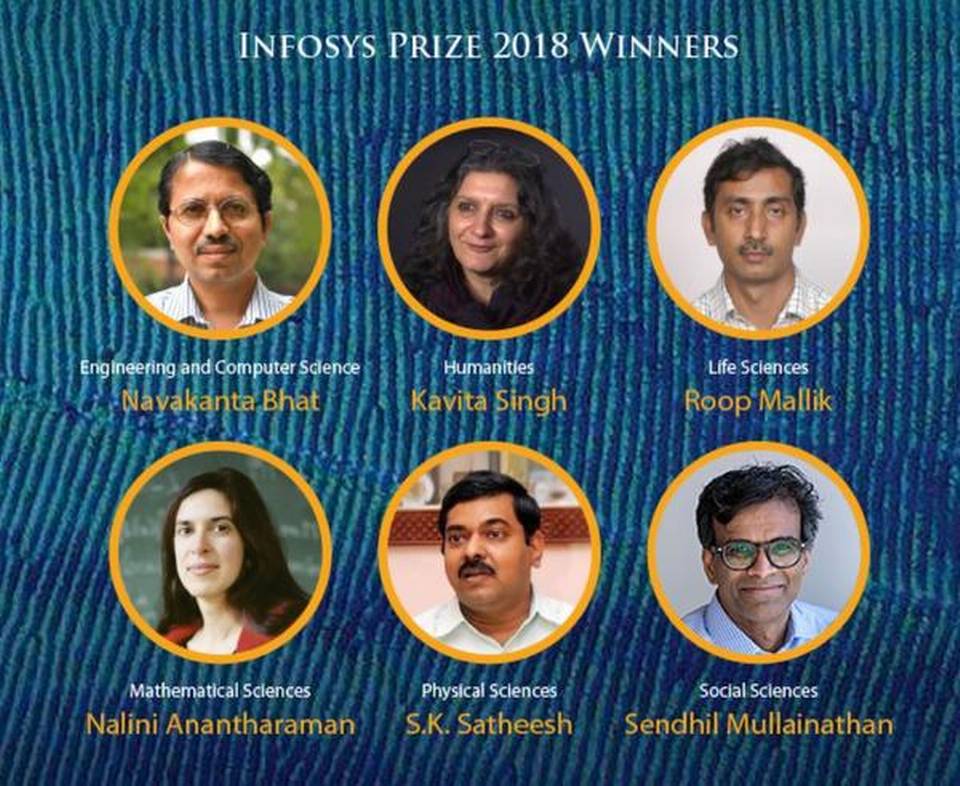
Six professors win Infosys Prize 2018 for science and research

InfosysPrizesBF13nov2018

Navakanta Bhat, Kavita Singh, Roop Mallik, Nalini Anantharaman, S.K. Satheesh and Sendhil Mullainathan are the winners out of the 244 nominations received in six categories

Six eminent professors have been awarded the Infosys Prize 2018 across different categories of science and research the software major’s science foundation announced on Tuesday.

The annual award includes a pure gold medal, a citation and a prize purse worth $100,000 (or its equivalent in Indian rupees), the Infosys Science Foundation (ISF) said in a statement.

“India needs to cement its place as a hub for innovations across various fields of science,” said Narayana Murthy, Trustee ISF and Founder, Infosys.

“The Infosys Prize seeks to honour the efforts of some of the brightest scientists and researchers and highlight the country’s ongoing quest for science excellence,” Mr. Murthy said.

A six-member jury of renowned scientists and professors selected the winners from 244 nominations received in six categories, ISF said.

By recognising these researchers and celebrating their achievements, the Infosys Prize aims to inspire young minds to explore science as a career option and advance innovation in the country, the foundation said.

“With improving synergies between the scientific community and industry we are poised for cutting-edge science and research innovation. The science of today is, after all, the technology of tomorrow,” said K. Dinesh, President of ISF.

Engineering and Computer Science

In the field of Engineering and Computer Science, Navakanta Bhat, Professor, Indian Institute of Science, Bangalore was awarded for his work on the design of novel biosensors based on his research in biochemistry and gaseous sensors that push the performance limits of existing metal-oxide sensors.

Mr. Bhat has devised gas sensors with ultra-precise detection accuracies necessary for space and environmental monitoring, especially useful for India’s growing space, atomic energy and security programmes, ISF said.

Humanities

In the Humanities category, Kavita Singh, Professor and Dean, School of Arts & Aesthetics, Jawaharlal Nehru University, New Delhi was awarded for her study of Mughal, Rajput and Deccan art.

Ms. Singh’s work shows the significance of museums in highlighting the social impact of art, and thereby relates visual culture to large contemporary questions of secularity, modernity, and political conflict, the foundation said.

Life Sciences

The prize for Life Sciences was awarded to Roop Mallik, Associate Professor, Department of Biological Sciences, Tata Institute of Fundamental Research, Mumbai for his work on molecular motor proteins, which are crucial for the functioning of living cells.

Mr. Mallik has identified and measured forces needed to transport large particles inside cells, and demonstrated their role in fundamental processes such as targeting pathogens for their destruction and moving lipid droplets for fatty acid regulation in the liver.

Mathematical Sciences

Nalini Anantharaman, Professor and Chair of Mathematics, Institute for Advanced Study, University of Strasbourg, France was awarded the prize in Mathematical Sciences for her work related to “Quantum Chaos”.

The quantum world is the one of the deepest secrets of the universe and mathematics is the language that helps us understand this world, ISF said.

Mathematicians and physicists have been trying for decades to unravel the mysteries of this subatomic world.

Physical Sciences

In the field of Physical Sciences, S.K. Satheesh, Professor, Centre for Atmospheric & Oceanic Sciences, Indian Institute of Science, Bangalore, was awarded for his pioneering scientific work in the field of climate change.

His studies on black carbon aerosols, the dark, light absorbing, microscopic particles in air which greatly influence the energy balance of the atmosphere over the Indian subcontinent, have enabled a better understanding of the role of these particles on climate change, precipitation, and, human health in the Indian subcontinent.

Social Sciences

The Infosys Prize 2018 for Social Sciences is awarded to Sendhil Mullainathan, Professor of Computation and Behavioral Science, the University of Chicago in the U.S. for his path-breaking work in behavioural economics, ISF said.

Mr. Mullainathan’s research has had substantial impact on diverse fields such as development, public finance, corporate governance and policy design.

A significant part of this work is relevant to India, ISF said.

“We hope the work of all our winners bears fruit and helps improve societies and economies across the world,” said Mr. Dinesh.

source: http://www.thehindu.com / The Hindu / Home> Science / by PTI / Bengaluru – November 13th, 2018

The word Karnataka has existed since 1336, say historians

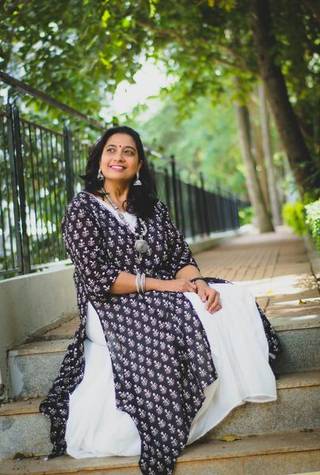
Historian and iconographist Vasundhara Filliozat at her residence in Mysuru. | Photo Credit: Special Arrangement

While former Chief Minister D. Devaraj Urs is credited with renaming the Mysore State as Karnataka  on November 1, 1973, according to historians, usage of the word ‘Karnataka’ was in vogue some six centuries ago. They say all of southern India was united under one banner called Karnataka at that time.

They are arguing with empirical evidence that what is referred to as the Vijayanagara empire (1336) was actually called Karnataka Samrajya (empire), with Vijayanagara only being the capital.

Underlining the need to reconstruct post-colonial history, they say there is a tendency to blindly follow Robert Sewell’s (1845-1925) A Forgotten Empire, Vijayanagar, despite Sewell actually mentioning that the empire was called Karnataka.

Jnanpith recipient and playwright Girish Karnad refers to the Vijayanagara region as “Karnataka desha” in his recent play ‘Rakshasa-Tangadi’, which is based on A Social History of the Deccan1300-1761 by Richard M. Eaton of the University of Arizona. “Vijayanagara was not in vogue at that time; the region was referred to as Karnataka,” says Mr. Karnad in no uncertain terms.

Historian, epigraphist and iconographist Vasundhara Filliozat, who has a few significant historical works to her credit, including VijayanagarAlidulida Hampe, and Hampi-Vijayanagar: The Temple of Vithala, says the empire was given its present nomenclature by Sewell and Kannada historians such as B.A. Saletore and P.B. Desai only to placate Telugu scholars.

She says inscriptions show that the Karnataka empire was founded in 1336, with scholar Vidyateertha — the teacher of Vidyaranya — instrumental in it. Inscriptions also reveal that Vidyaranya did not exist at the time. The last great Hoysala ruler, Ballala III (1292-1342), started attempting to bring all of south India together, and the move yielded results in the time of Harihara I. “My historical conclusions are based on inscriptions and iconography I studied for nearly a decade. I don’t know why colonial historians glossed over the fact that the region was known as Karnataka and why post-Independence historians blindly followed Sewell. None of them is ready to take the truth head-on,” Ms. Filliozat says.

Srinivas Ritti, another historian, says the empire was never called Vijayanagara. According to him, historians chose the name as it was better known. He, however, believes that historians and scholars in the days to come should think of using the correct names — Karnataka for the empire and Vijayanagara for the capital.

Tipu’s role

Ms. Filliozat also says that Tipu Sultan should be given due credit during Hampi Utsav, which is celebrated yearly by the State government. She says the Nizam of Hyderabad was eyeing Hampi, which was in his dominion, but Tipu wanted Hampi to remain in Karnataka. Because of monetary help extended by Tipu, the Maharaja of Anegundi, who was surviving on a meagre revenue, stayed in Karnataka. “Hampi is now in Karnataka because of Tipu. The Karnataka government has to remember Tipu for what he did during Hampi Utsav.”

source: http://www.thehindu.com / The Hindu / Home> News> States> Karnataka / by Muralidhara Khajane / Bengaluru – November 10th, 2018