Category Archives: World Opinion

Bengaluru students volunteer at refugee camp in France

Having heard the plight of refugees after their camps were burnt down, Amrutamshu Iyengar could relate to the conditions in which they survived.

This student also had an opportunity to contribute his bit to help a group of refugees in Calais, in the northern tip of France.

Amrutamshu was among 12 other students from Trio World Academy in Bengaluru who visited France as part of an educational trip. While these students were denied direct access to refugee camps as they were below the age of 18, these school students could work with voluntary organisations that help improve the living conditions for the refugees.

“We had the opportunity to work at a warehouse for four days. It was here that we understood the condition of refugees. Some of them live in shacks, some have nothing but sleeping bags and a few others live on the streets. These are people who have been displaced from home due to various factors and it is sad to see their conditions,” said Amrutamshu.

The students worked at the warehouse sorting the materials that were received as a donation. Amrutamshu said this gave them exposure to some of the conditions under which the refugees lived.

“We would sort clothes that could either be reused or be recycled through our stay here,” he explained.

The activity was part of an educational trip co-ordinated by one of the teachers, Chandniee. “We left on March 19 and returned on April 4. It was a 12-member group which had children between the ages 16 and 19. It was part of a Research Bound Outreach programme,” she said.

Chandniee explained that having the children volunteer for the refugees to get them hands-on experience involved a lot of effort.

“We tried reaching out to voluntary organisations who work there. One of them obliged and we took that forward,” she said.

“The volunteering work would begin early in the morning with a briefing session by their floor managers, and end by evening. Trio students also attended a Field Training Course organised by Utopia 56 on how to work on the field for the betterment of refugees getting educated on the dos and don’ts while interacting with them,” Chandniee added.

She later clarified that the volunteers they worked with said that this was the first time that students from India participated in such activities.

“It’s a great feeling to be indirectly helping the refugees though we don’t get to see who these clothes will go to because we know that we have helped them keep warm from the cold,” said Tushara, another student of Year 1 IB Diploma.

“It is a matter of immense pride. We wish to give any kind of support that they need to realize their dreams and would love to witness more such participation in the days to come,” said Naveen K M, managing director, Trio World Academy.

source: http://www.deccanherald.com / Deccan Herald / Home> City / DH News Service / Bengaluru – April 13th, 2018

Udupi girl spins her way to Guinness fame

Tanushree performing full-body revolutions maintaining a chest stand position in Udupi on Saturday. | Photo Credit: Special Arrangement

Tanushree (9) performed 42 full-body revolutions in one minute on Saturday.

A nine-year-old girl from Udyavar near Udupi has set the Guinness record for most full-body revolutions maintaining a chest stand position. Tanushree performed 42 full-body revolutions in one minute on Saturday.

At the Ammanni Ramanna Shetty Hall, Swapnil Dangirkar, official adjudicator of the Guinness World Records, confirmed the feat. The performance was also recorded. The record used to be held by 13-year-old Mohammed Alsheikh of Palestine, who performed 38 revolutions in a minute on February 8, 2017.

Mr. Dangarikar said: “I am happy to announce that Tanushree has broken the record. She has done so by a huge margin of four revolutions… one has to put in a lot of effort and energy to complete the revolutions. I congratulate her. We at Guinness World Records like to say ‘she is officially amazing’.”

She is delighted

Tanushree, a class 4 student of St. Cecily’s Higher Primary School, Udupi, said she was delighted to create a Guinness record. She learned to perform body revolutions by watching videos on YouTube. “I used to practice the revolutions in the morning, evening and night. My father Uday Kumar and my mother Sandhya Kumar encouraged me,” she said.

She also learns Bharatnatyam and likes doing yoga. “I want to practise yoga and participate in competitions. I dedicate my Guinness record to my country,” she said.

Mr. Uday Kumar, an electrical contractor, said Tanushree practised body revolutions daily for the past four months. “I and my wife were very happy with our daughter’s achievement as it has brought fame to our place (Udyavar), our district and our country. In the future, we would like her to represent our country in yoga,” he said.

source: http://www.thehindu.com / The Hindu / Home> News> States> Karnataka / by Special Correspondent / Udupi – April 07th, 2018

NCBS team wins award from American Society of Naturalists

First Asians to win the Presidential Award of the society

A team of evolutionary biologists from city-based National Centre for Biological Sciences (NCBS) have been awarded the 2018 Presidential Award from the American Society of Naturalists (ASN). This is the first time researchers in Asia have been presented with the award. The award is given to an outstanding research article published in the society’s journal, The American Naturalist. Jahnavi Joshi, Anupama Prakash and lead author Krushnamegh Kunte from NCBS had, in a research paper published in the journal in April 2017, probed how evolutionary processes shape the formation of ecological communities in diverse tropical ecosystems.

While the ASN was founded in 1883 to study evolution, ecology and animal behaviour, the presidential award was started in 1984. “It’s a terrific recognition for my research group, and a great personal honour,” said Prof. Kunte in a release.

Their research paper looked at evolutionary convergence (when different species evolve the same mechanisms to deal with evolutionary pressures) among the groups of ‘palatable’ — that is, non-toxic — butterflies who mimic the colours and patterns of toxic butterflies that are avoided by predators. The team focused on butterfly species in the Western Ghats, and on these ecological communities called ‘Mimicry rings’.

The research paper challenged some previously believed thoughts around evolution. For instance, contrary to the assumption that mimicry rings are formed from convergent evolution between highly dissimilar butterflies, the NCBS team discovered that toxic butterfly species in the mimicry rings are indeed closely-related, sharing their ancestral, warning-wing colour patterns even when new species are formed. The mimics join the mimicry rings after remarkable bouts of convergent evolution, sometimes separated by tens of millions of years.

source: http://www.thehindu.com / The Hindu / Home> News> Cities> Bengaluru / by Staff Reporter / April 07th, 2018

Gururaja claims silver, opens India’s CWG medal account

Gururaja shows his silver medal and mascot Borbi after winning the Men's 56kg Weightlifting final during Commonwealth Games in Gold Coast on Thursday. | Photo Credit: AP
Gururaja shows his silver medal and mascot Borbi after winning the Men’s 56kg Weightlifting final during Commonwealth Games in Gold Coast on Thursday. | Photo Credit: AP

Gururaja was third after snatch, pulling off a best of 111kg after two good lifts before surviving a few nervy moments in clean and jerk.

Weightlifter P Gururaja opened India’s medal account on the first competition day of the 21st Commonwealth Gamesclaiming a silver in the men’s 56kg category in Gold Coast on Thursday.

The 25-year-old Gururaja equalled his personal best of 249kg (111+138) to finish second in a field where Malaysia’s three-time Commonwealth Championships medallist Muhammad Izhar Ahmed (117+144) broke the Games record for snatch and overall lift.

Gururaja was third after snatch, pulling off a best of 111kg after two good lifts before surviving a few nervy moments in clean and jerk. The Indian failed in his first two attempts before managing a good lift off his last chance to zoom to the top half of the table.

Ahmed, meanwhile, bettered his compatriot Hamizan Amirul Ibrahim’s snatch record of 116kg, created in 2010 Delhi Commonwealth Games. He then broke the overall Games record, which was also in the name of Ibrahim.

The third position was taken by Sri Lanka’s Lakmal Chaturanga (114+134).

Gururaja, a low-ranking Indian Air Force employee, is a quintessential Indian sports story of immense hardships and just a tiny bit of luck.

Son of a truck driver, Gururaja had aspired to be a wrestler for the longest time before being pushed into weightlifting by a watchful coach who saw potential in him.

source: http://www.thehindu.com / The Hindu / Home> Sport> Other Sports / PTI / Gold Coast – April 05th, 2018

Google Doodle celebrates activist and pioneer of the arts Kamaladevi Chattopadhyay

Google Doodle: Kamaladevi Chattopadhyay | Photo Credit: Google Doodle

Kamaladevi participated in the freedom movement

On Tuesday, Google celebrated the 115th birth anniversary of the multi-faceted freedom fighter, activist and promoter of the arts, Kamaladevi Chattopadhyay, with a doodle.

Kamaladevi, who bagged the Padma Vibhushan in 1987 (a year before her death), was a woman of many firsts. She was an active participant in the freedom movement, championed women’s rights, founded the All-India Womens Conference (AIWC), led the renaissance of Indian handicrafts and handlooms, and worked for the development of the performing arts in India.

Born in Mangalore in 1903, Kamaladevi was widowed at 16. She married Harindranath Chattopadhyay when she was 20 and then headed to London where she graduated with a diploma in Sociology. She joined the freedom movement when she returned to India and she eventually became the first woman to run for a legislative seat in India, when she ran for the Madras Provincial Legislative Assembly.

She then founded the AIWC, which did a lot of work for social reform. She was credited for persuading Mahatma Gandhi to encourage more women to march with him during the freedom struggle. In 1930, Kamaladevi was part of Gandhi’s salt satyagraha team and she was later arrested for entering the Bombay Stock Exchange to sell packets of contraband salt.

Post independence, she worked for the rehabilitation of refugees. She then dedicated her life to the promotion of Indian indigenous arts and crafts and theatre. Thanks to her work behind the scenes, several renowned institutions, including the National School of Drama, Central Cottage Industries Emporium, and the Crafts Council of India, came into existence. She later headed the Sangeet Natak Akademi and in 1974 was awarded the Sangeet Natak Akademi Fellowship.

The doodle, created by Finland-based artist Parvati Pillai, salutes Kamaladevi’s contribution to the creative fields. It depicts the various fields she promoted, including the sitar, sarangi, Karthak dance, embroidery and basket weaving.

source: http://www.thehindu.com / The Hindu / Home> News> National / by The Hindu Net Desk / April 03rd, 2018

The village of boiled beans: How Bengaluru came to be

An aerial view Greenline Metro from Sampige Road to Yelachenahalli on the first day of its operation for public in Bengaluru on Sunday  2017.  Anantha Subramanyam K.  Credits: Mirror, BCCL, Bengaluru
An aerial view Greenline Metro from Sampige Road to Yelachenahalli on the first day of its operation for public in Bengaluru on Sunday 2017.
Anantha Subramanyam K.
Credits: Mirror, BCCL, Bengaluru

It is strange that the city of Bengaluru which we all accept today as a single city was not a single city at all until recently. Before Bengaluru was welded into a single city under a common corporation in 1949, it existed as a twin city. There were two portions to the city. The civil and the military portions were separate entities with a separate municipality and a separate collector. The job of the collector was to look after the revenue and the law and order problems of the city. He was functioning under the Resident. The Collector was also the Municipal President. The Bangalore city agglomeration had a population of 29,21,751 and the corporation area had a population of 24,76,355 in 1981. The city’s population recorded a growth of over 70% between 1971 and 1981.

The site of the present city had many prehistoric settlements. Neolithic tools have been located at the race course and Jalahalli. Byrasandra was also a prehistoric site. Dr Shikaripura Ranganatha Rao, an eminent archaeologist feels that the attractive site of the bugle rock at Basavangudi could have been a prehistoric habitat. Roman coins have been unearthed at Yeshwantpur and Jalahalli.

The name Bangalore is as old as the ninth century and the name is found in a Kannada inscription found near the Begur temple. A long record of circa 890 AD and the name appears to have a floral origin, derived from the tree Benga (Venga or Pterocarpus marsupium or the Indian Kino).

The explanation that the name was derived from Benda kala ooru, or the village of boiled beans as described by the Hoysala King Ballala when he was hungry during his visit to the place (when he was hunting) becomes irrelevant as the above name was much older that King Ballala of the Hoysala dynasty. Benda kala ooru or the place full of granite rocks is another explanation to a place name but granite is neither Bangalore’s exclusive speciality nor the old form, thousand years, found in the record indicates the place name being anyway connected to Benachu kallu. The place mentioned as Bengaluru in the Ganga record is originally a hamlet, even now called as Hale Bengaluru near Kodigehalli, not far away from Hebbal. It is said that Kempe Gowda I when he built the new capital town in 1537 called it Bangalore as his mother and wife belonged to the hamlet Bangalore, now Hale Bengaluru. In literary works, Bangalore is also called Kalyana Nagare or the ‘City Auspicious’. Though the fort built by Kempe Gowda then has totally vanished, the spots like the Yelahanka Bagalu (Mysore Bank Square) and Halsur Bagalu still exist. Halsur Bagalu or gate, now a police station is named after it. The gate proper even now remains hidden. The old remains of the ramparts and the moats were completely demolished during the nineteenth century. The town was conquered by the Bijapur sultans in 1638 and Shaji Bhonsle secured the town and its surroundings as a Jagir in 1638. The testimony to 50 years of Maratha rule is in the form of an inscription of Ekoji, Shaji’s son near the Kadu Malleshwara temple. Bangalore was conquered by the Mughals in 1686. The mosque at Taramandalpet is a notable vestige of Mughal rule. The city was leased to the Mysore ruler, Chikkadeva Wodeyar by the Mughals in 1689 and Chikkadeva Wodeyar expanded the fort to the south and built the Venkatramana temple in this fort area. This new fort in granite was strengthened by Haider Ali who secured Bangalore as a Jagir in1759. The British conquered the city in 1799 after defeating Tipu Sultan.

The original Bangalore city was clustered around the fort and city market and covered the area until the present Mysore bank square. Today, there is a bus stop at the place where the Dharmabudi tank existed earlier. The old city had areas like Cottonpet, Sunkalpet, Kumbharpet and the Balepet areas. The medieval character of the city’s old settlements typical of any old village is indicated by the names of these areas.

Every community or professional caste had its own street or streets in every village or town of ancient times. Sigebeli is the settlements of Brahmins, reminiscent of old Agrahara or Brahmapuri. Kempapura Agrahara was another settlement of the Brahmins created by Kempe Gowda II towards the Magadi road area beyond the Brahmabudi tank. Parts of Gandhi Nagar area appear to have been reclaimed from the Dharmabudi tank during the early part of the nineteenth century.

The Cantonment area grew as a separate township after the British shifted their troops to the place in 1806 and the first camp was located at the present Air Force Hospital in 1808. The present cantonment also consists of many old villages like Halasur, Blackpally, Doddakunte and Akkithimmanahalli. It was no part of the old Bangalore pettahs. At Domlur on the periphery of the old cantonment, the Chokkanatha temple built by the Cholas still remains. At Blackpally or Shivaji Nagar, there existed a Catholic church which later took some shape of the 18th century and now its is the St Marys Basilica. The cantonment area also saw the construction of some of the beautiful buildings of the European Renaissance style. Both churches and secular buildings which were mostly government offices during the 19th century.

New extensions were added to the town in Chamrajpet and Seshadripuram. Chamrajpet was named after Chamraja Wodeyar in 1892, the latter named after Dewan Seshadri Iyer. The visit of a plague in 1898 caused the creation of two bigger extensions in 1898. These were Basavangudi named after Basaveshwara temple or the Bull Temple in Sukenahalli village and Malleshwaram named after the Kadu Malleshwara temple in old Mallapura village. The area in both the places was full of fields.

The next time you think of Bengaluru as the city of Bengaluru, you would do well to remember its origins. There are several people alive today who remember the two distinct facets to the city; the pettahs and the cantonment. These portions were welded and expanded to make the beautiful city we live in.

source: http://www.bangaloremirror.indiatimes.com / Bangalore Mirror / by Siddharth Moorchung & Nikhil Moorchung / Bangalore Mirror Bureau / April 02nd, 2018

Mangaluru professor Dr Anurag Bhargava makes app for TB patients

A professor from Mangaluru has developed a first-of-its-kind mobile application for tuberculosis patients ahead of World Tuberculosis Day on Saturday (March 24).

An Android-based application ‘N-TB’ was developed by Dr Anurag Bhargava, professor of medicine, Yenepoya Deemed to be University, Mangaluru in collaboration with McGill International TB Centre, Canada, to calculate the body mass index (BMI) of patients with tuberculosis.

According to doctors, TB often results in significant weight loss, which can exacerbate under-nutrition. Under-nutrition in TB patients points toward a consistent risk factor. Such patients are also at a higher risk of side-effects of drugs, poor absorption of drugs, reduced ability to return to work, and recurrence of the disease.

The application will tell the users their BMI and will counsel them on an appropriate diet regime which includes daily caloric and protein intake based on their BMI.

“The application is currently intended to help healthcare providers to quickly assess the body mass index of patients with TB and how severely undernourished the patient is so that they can be guided accordingly,” said Dr Bhargava.

He added that the TB cards currently record the weight alone and not the height to assess the nutritional status of the person, whereas the new application assesses the height and weight to calculate the BMI of the person.

He said the new N-TB mobile application specifies the weight and height and raises a red alert if it is below the desired weight.

The application was launched on Thursday (March 22) and is yet to be rolled out. It can currently be downloaded from Playstore free of cost.

“Certain aspects for the application such as analysing nutrition component, counselling are to be improvised,” said Dr Bhargava.

The application, endorsed by Revised National Tuberculosis Control Programme (RNTCP) and World Health Organisation (WHO), was included in the new initiatives unveiled by Prime Minister Narendra Modi, during the Delhi End TB Summit on March 13, 2018.

“We are glad that such as application was developed, but we are yet to receive information on the use and implementation of the application,” said Dr Ramachandra Bairy, Joint director, TB, Department of Health and Family Welfare, Karnataka.

source: http://www.deccanherald.com / Deccan Herald / Home> States / DH News Service, Bengaluru- Mangaluru / March 24th, 2018

Mahadevappa Pattan passes away at 107

Mahadevappa Shivabasappa Pattan and his wife Sharadamma M. Pattan in Bangalore. (FILE) Photo: Bhagya Prakash K.

The freedom-fighter was active in the tax-denial Satyagraha against the British

Freedom fighter and former MLA Mahadevappa Pattan died in Ramdurg in Belagavi district in the early hours of Friday. He was 107.

He is survived by his wife and former MLA Sharadamma M. Pattan and his son Ashok Pattan, who is the Congress MLA from Ramdurg and the Congress chief whip in the Assembly, and daughter Mrunalini Siddaramappa.

Role in tax-denial Satyagraha

Mr. Mahadevappa was active in the tax-denial Satyagraha against the British. He also led an uprising against King Rao Saheb Bhave in 1939. The Ramdurg administration issued shoot-at-sight orders against Mahadevappa. He went underground for nearly 10 years only to return to launch another Satyagraha against the kingdom. He was jailed for some time.

He founded the Lok Seva Sangh for Sarvodaya movement. He served as the Ramdurg MLA, by defeating the Congress nominee in 1957. He joined the Congress later. He retired from politics in the early 1970s to engage in Khadi and other social activities.

The Pattans are one of the only two families in Karnataka where the father, mother and son have been MLAs from the same district. The other is of that of Allum Veerabhadrappa who represented Kurgod constituency in Ballari four times in the past.

source: http://www.thehindu.com / The Hindu / Home> News> States> Karnataka / by Special Correspondent / Bengaluru – March 24th, 2018

Karnataka : Manipal Professor’s tryst with Antartica

ManipalProfessorBF23mar2018

Balakrishna spent 95 days there as part of a research expedition

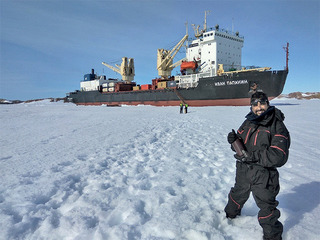
AManipal professor is back from Antarctica — what he calls a lifetime experience — where he spent 95 days at various Indian research bases such as Bharati and Maitri. Dr K Balakrishna, professor, Dept of Civil Engineering, was part of the 37th Indian Scientific Expedition to the coldest continent along with 40 other scientists from IMD, GSI, IIG, BARC, BSI, ISRO, NCAOR and logistics personnel from Army, Border Roads Organization and others.

He was the only scientist from a deemed private University for the expedition, organized by the National Centre for Antarctica and Ocean Research (NCAOR), a research institute of Ministry of Earth Sciences and based in Goa.

“The selection procedure was tough as it demanded not only research work but also physical fitness, including two weeks of snow acclimatization at the Mountain-eering and Skiing Institute of Indo-Tibetian Border Police in Auli, Uttarakhand. Acclimatization included mountaineering, trekking across the Himalayan terrains and rock-climbing,” Dr K Balakrishna said.

Describing the entire experience as thrilling and most unforgettable, Prof Balakrishna said, “It was a rewarding experience for me both professionally and personally. Though it was tough initially with temperature dipping -10 degrees, I acclimatized quickly and got down to my research.

The research was on obtaining a baseline of micro-pollutants like pharmaceuticals, personal care products and other naturally occurring metals in the seawater, sea-ice, lakes, sediments and soil of the region. He collected over 100 samples at different locations within a radius of 20 km from the Bharati station.

The samples are being analyzed at Manipal College of Pharmaceutical Sciences lab here.

Prof Krishnamurthy Bhat is the co-investigator of the project. The sampling was done by travelling across the region through skidoo (snow scooter) and helicopter. Bharati station has 24×7 broadband internet access with comfortable rooms, , library, Indian food and so on. The Indian expedition also used MV Ivan Papanin, an Indian ship chartered exclusively for the Antarctica expedition.

His study: Effect of micro-pollutants

The professor is measuring the level of micro-pollutants in seawater, sea-ice, lakes, sediments and soil of the region. Talking about the experiment, he said, “The environment in Antarctica is pristine with minimal pollution. However, in that region there are three stations – India, Russia and China.

Whenever we go on field trips, we use sunscreen lotions and other personal care products to prevent us from UV radiation. In the stations, we use several other products like soaps/detergents. All these contents have low amount of antibiotics. There are chances that these products including medicines we eat, may go in low doses to the sea water and may affect the sensitive eco-system. The fauna may not die, but there could be side-effects.

I am trying to get the current status of the micro-pollutants- pharmaceuticals. They may be in very low concentration, but this can affect the sensitive fauna. I am measuring the level of micro-pollutants in seawater or lakes and so on.”

source: http://www.bangaloremirror.indiatimes.com / Bangalore Mirror / Home> News> States / March 22nd, 2018

Dravidian language family is 4,500 years old: study

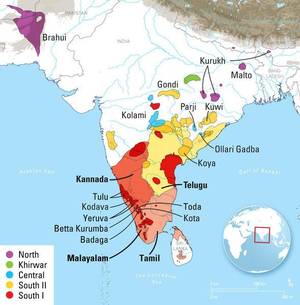
The Dravidian language family’s four largest languages — Kannada, Malayalam, Tamil and Telugu — have literary traditions spanning centuries, of which Tamil reaches back the furthest, researchers said.

DravidianFamilyCF21mar2018

The Dravidian language family, consisting of 80 varieties spoken by nearly 220 million people across southern and central India, originated about 4,500 years ago, a study has found.

This estimate is based on new linguistic analyses by an international team, including researchers from the Max Planck Institute for the Science of Human History in Germany, and the Wildlife Institute of India in Dehradun.

The researchers used data collected first-hand from native speakers representing all previously reported Dravidian subgroups. The findings, published in the journal Royal Society Open Science, match with earlier linguistic and archaeological studies.

South Asia, reaching from Afghanistan in the west and Bangladesh in the east, is home to at least six hundred languages belonging to six large language families, including Dravidian, Indo-European and Sino-Tibetan.

The Dravidian language family, consisting of about 80 language varieties (both languages and dialects) is today spoken by about 220 million people, mostly in southern and central India, and surrounding countries.

The Dravidian language family’s four largest languages — Kannada, MalayalamTamil and Telugu — have literary traditions spanning centuries, of which Tamil reaches back the furthest, researchers said.

Along with SanskritTamil is one of the world’s classical languages, but unlike Sanskrit, there is continuity between its classical and modern forms documented in inscriptions, poems, and secular and religious texts and songs, they said.

“The study of the Dravidian languages is crucial for understanding prehistory in Eurasia, as they played a significant role in influencing other language groups,” said Annemarie Verkerk of the Max Planck Institute for the Science of Human History.

Neither the geographical origin of the Dravidian language nor its exact dispersal through time is known with certainty.

The consensus of the research community is that the Dravidians are natives of the Indian subcontinent and were present prior to the arrival of the Indo-Aryans (Indo-European speakers) in India around 3,500 years ago.

Researchers said that it is likely that the Dravidian languages were much more widespread to the west in the past than they are today.

In order to examine questions about when and where the Dravidian languages developed, they made a detailed investigation of the historical relationships of 20 Dravidian varieties.

Study author Vishnupriya Kolipakam of the Wildlife Institute of India collected contemporary first-hand data from native speakers of a diverse sample of Dravidian languages, representing all the previously reported subgroups of Dravidian.

The researchers used advanced statistical methods to infer the age and sub-grouping of the Dravidian language family at about 4,000-4,500 years old.

This estimate, while in line with suggestions from previous linguistic studies, is a more robust result because it was found consistently in the majority of the different statistical models of evolution tested in this study.

This age also matches well with inferences from archaeologywhich have previously placed the diversification of Dravidian into North, Central, and South branches at exactly this age, coinciding with the beginnings of cultural developments evident in the archaeological record.

source: http://www.thehindu.com / The Hindu / Home> Science / by PTI / Berlin – March 21st, 2018