Hindustan Aeronautics Ltd. flew its Light Combat Helicopter that is under development for 20 minutes on Wednesday using its own Automatic Flight Control System for the first time.
The indigenous AFCS is also the first to be designed and made in the country.
HAL said: “The maiden flight of LCH (Technology Demonstrator-2) was flawless with the engagement of the system throughout.” The LCH got its initial operational clearance on August 26 last year.
The Defence enterprise has funded the development of the hardware, software of the AFCS, which will replace the expensive imported system, said T. Suvarna Raju, HAL’s CMD.
HAL’s research and development centres — the Rotary Wing R&D Centre and the MCSRDC at Bengaluru, SLRDC at Hyderabad and Korwa Division — are involved in its development.
The digital, four-axis flight control system is capable of performing control and stability augmentation functions and auto pilot modes of helicopters.
source: http://www.thehindu.com / The Hindu / Home> News> States> Karnataka / by Special Correspondent / Bengaluru – January 31st, 2018
As many as 4,850 students from 23 degree colleges wearing the same badge sing Vande Mataram to enter the Golden Book of World Records on Malpe beach in Udupi on Saturday.
They all wear the same badge and sing Vande Mataram on Malpe beach
A new record of the “Largest congregation of people wearing the same badge” was created and entered into the Golden Book of World Records on the Malpe beach here on Saturday.
This record was created by 4,850 students from 23 degree colleges, who wore the same badge with the slogan “Save nature for the future” and sang the full version of the national song, Vande Mataram.
Vivekananda birth anniversary
As many as 23 singers also joined the students in singing the full version of Vande Mataram. The event, organised by a voluntary organization, Samvedana Foundation, aimed at creating awareness for saving nature.
This event was organised to mark the 155th birth anniversary of Swami Vivekananda.
Certificate
After the students wearing the badges sang Vande Mataram, the representative of Golden Book of World Records, Santhosh Agarwal, handed over the certificate of “Largest congregation of people wearing the same badge” to Prakash Malpe, coordinator of the programme and the head of Samvedana Foundation.
The certificate was handed over in the presence of Pramod Madhwaraj, Minister for Fisheries, Youth Empowerment and Sports.
Earlier, the students brought a 1,750-ft long and nine-feet wide national flag in a procession from the Gandhi Shatabdi Grounds to the beach here.
Meenakshi Bannanje, president of the Udupi City Municipal Council, Dinakar Babu, president of the Udupi Zilla Panchayat, Raghupati Bhat, former MLA, and G. Shankar, philanthropist, were present.
Speaking to presspersons here, Mr. Santhosh Agarwal said that the record of “Largest congregation of people wearing the same badge” was a new one which was created here.
source: http://www.thehindu.com / The Hindu / Home> News> Cities> Mangaluru / by Special Correspondent / Udupi – January 13th, 2018
The Mysuru chapter of the Indian Speech and Hearing Association (MyISHA) is set to host the golden jubilee conference of the Indian Speech and Hearing Association (ISHA) in Mysuru. The conference will be attended by over 2,000 audiologists and speech language pathologists from India and aboard.
The 50th annual convention of the Indian Speech and Hearing Association will be held from Friday to Sunday at the All-India Institute of Speech and Hearing (ISHACON) — the birthplace and headquarters of the association. Governor Vajubhai Vala will inaugurate the 50th ISHACON at AIISH Gymkhana campus here at 6.15 p.m. on Friday. Yaduveer Krishnadatta Chamaraja Wadiyar, the scion of the Mysuru royal family, will be the guest of honour.
The scientific session of the conference will start with homage to the founders of the ISHA. Dr. N. Rathna, Prof. Ramesh Oza, and Dr. Shailaja Nikam, signatories of the memorandum of association of ISHA in 1967, will talk about its golden era. Other senior members of the association. Dr. N.P. Nataraja, Dr. M. Jayaram, and Dr. Shivashankar N. will be addressing the delegates during the session, a release stated here.
The deliberations and discussions at the conference will add a wealth of knowledge to the participants who will learn about the state-of-the-art techniques in diagnosis and rehabilitation of communication problems.
Experts in the field will deliver lectures on diverse topics such as language recovery in aphasia, paediatric feeding disorders, and intervention, professional voice management, motor speech disorders in neuro-developmental syndromes, dead regions of the cochlea, clinical applications of OAE, cross check principles of diagnostic audiology, certification of disability, and funding opportunities for aid and appliances, the release added. In addition, around 220 research papers will be presented by students and professionals at the conference.
Prior to the conference, six workshops will be held on Thursday to enable delegates to get in-depth hands-on training on specific issues. More than 50 stalls will be put up by different companies related to speech and hearing exhibiting their products and recent technical advances. The vision document that will be released as part of the conference will give directions to the members of the association to enhance the clinical and research activities. The document will also emphasise on the ethics to be practised by its members and directions to establish a speech and hearing council.
For more details, visit www.ishacon.com.
source: http://www.thehindu.com / The Hindu / Home> News> States> Karnataka / by Special Correspondent / Mysuru – January 04th, 2018
The Vallombrosan Benedictine Confederation supplies its products to many five-star hotels and restaurants.
Vallombrosa Cheese/Facebook
Pray and work.” That’s the driving tenet of the Vallombrosan Benedictine Confederation , or as they put it in Latin, “Ora et Labora”. Thirteen years ago, the Bangalore chapter of this order of Roman Catholic monks hit upon a rather unique way to pursue their goal of making a sustainable living: they decided to manufacture cheese. Today, their little factory, nestled in the leafy confines of Gualbert Bhavan in TC Palya, churns out cheese so divine that is has amassed a loyal clientele in five-star hotels and restaurants not just in Bangalore but across India.
“Taj, Oberoi, Trident, Marriot, Hyatt, Park…they all take cheese from us,” said Father KL Michael, the head of the order’s Bangalore chapter. The monks currently produce ten varieties of cheese, including buffalo mozzarella, ricotta, burrata (a hot favourite with the hotels at present) and parmesan. They are sold under the brand name Vallombrosa.
Vallombrosa’s USP, said Michael, is that the monks don’t use any preservatives. “Buffalo milk is very tasty in itself and we use the full cream version which adds to the taste,” he said. It is the freshness and taste, he believes, that convinces outstation chefs to pay a premium for flight charges to procure the cheese, allowing Vallombrosa Cheese to hold its own against much larger players such as Impero and Dairy Craft. Nothing gladdens Micheal more than hearing chefs telling him his cheese “is as good as Italian cheese”.
Burrata’s uniqueness lies in its soft buttery centre, made from fresh cream and shredded mozzarella. Photo credit: Vallombrosa Cheese/Facebook
In 2000, when Michael was appointed to take charge of Gualbert Bhavan, where young men preparing for the priesthood study, he began to think about an economic activity they could undertake to finance themselves. Cheese-making wasn’t something that had crossed his mind until it was suggested by a Italian businessman, a friend of the monastery, who had business connections in India: “He said since there was no buffalo mozzarella in India, it was something we could produce.” Michael went to a cheese factory in Naples, Italy, and spent a week there, learning and writing down everything about the cheese-making process.
In India, though, the situation was totally different. “We struggled to get good buffalo milk,” said Michael. “The milk we got was watered down and was not good for making cheese.” They finally chanced upon a society in Hoskote, whose buffalo milk made the cut. The small factory with its asbestos roofing and three second-hand machines imported from Italy was also ready. With a supply of 20-30 litres of milk per day, Michael started making small quantities of mozzarella cheese in 2004.
Finding clients was the next challenge. Michael turned to the internet. Searching for “Italian restaurants in Bangalore”, he came upon Herbs and Spices in Indiranagar, one of the city’s most popular Italian restaurants at the time, headed by Chef Manjit Singh. A cold call was made, a sample of mozzarella sent, and within a week, Vallombrosa Cheese had received its first order.
Father KL Michael learned cheese-making in Naples. Photo credit: Vallombrosa Cheese/Facebook
Today, the monks produce 100 kg of cheese every day, using 400 litres of milk. Work begins at around 8.30 am everyday and goes on till around 3 pm. One of the most crucial aspects of the process is checking the temperature of the milk. “The cheese sets faster in the summer and takes longer in the cold weather, so we have to be careful about all this,” said Michael. Once the purity of the milk is checked, it is gradually heated to the perfect temperature. Then bacterial cultures and rennet are added to curdle it. After the curd forms, it is cut, drained, cured and shaped while still hot. The initial process is done manually, but the cutting and shaping is done by machines. The cooled cheese is packed in light brine and sent out for delivery.
The soft cheeses, such as mozzarella and ricotta, can be stored for up to 15 days in temperatures of 1-4 degrees Celsius. The hard cheeses such as parmesan and pecorino, actually improve with age.
The soft cheese retails at Rs 800 per kg, the hard cheese is Rs 1,500 per kg while the goat’s milk cheese sells for Rs 2,000 per kg. Currently, the factory uses three machines. Michael and four other monks are involved in the entire process. He also has two drivers, one to get the supplies and the other for delivery.
He plans to eventually build a larger, more sophisticated factory. “Our production will increase and the factory will be a lot more modernised, Italian style,” he said with a smile.
Pecorino is a hard and salty Italian cheese made from sheep’s milk. Photo credit: Vallombrosa Cheese/Facebook
Michael returned to Italy last year to learn more about cheese-making and plans to go there again in 2019 to get more ideas. “When I was there in 2016, I learnt how to make Italian butter,” he said. “It is very different from the butter you get here. I plan to start making that once the new factory is ready and sell that to Italian restaurants.” His cheese expertise is in demand now, with college catering departments approaching him to deliver lectures on the challenges of making cheese.
The monks don’t eat cheese everyday at the seminary though. “We serve it only twice a week, on Tuesdays and Thursdays when we have chapati and porotta for dinner,” said Michael with a laugh. His favourite cheese is bocconcini. But the joy his products bring clients is incidental to the enterprise. Said Michael: “The important thing is that this has allowed us to become self-sufficient and we are no longer dependent on the Italian order for any money.”
Nik Gugger, who was sworn in as member of Nationalrat in Bern, still cherishes his Kerala connection
His is a journey from Thalassery to the Swiss Parliament and he still maintains his connection with the town where he grew up till he was four.
Nik Gugger was sworn in as member of Nationalrat (Swiss Parliament) in Bern around 7.30 p.m. Indian time on Monday. The 47-year-old father of three children has been elected to Swiss Parliament as a candidate of the EVP (Evangelical Party in Switzerland). An Indian by birth, he was adopted by a Swiss couple and he still cherishes his association with people and institutions at Thalassery. Though he was born at the Basel Mission Hospital at Udupi, he had grown up as an orphan in what is now the Nettur Technical Training Foundation (NTTF) campus at Illikkunnu at Thalassery till his adoption by his Swiss parents. The NTTF itself is a symbol of the Indo-Swiss cooperation aimed at promoting technical education among the youth of this country.
Likely to visit Thalassery
“I am proud to be in between the two cultures, the Swiss and Indian culture,” Mr. Gugger told The Hindu over the phone. Recalling his association with the late Murkot Ramunni and the Gundert Foundation School the latter had founded, he said he would probably visit Thalassery in March next year when the 70th anniversary of Indo-Swiss friendship would be celebrated. Mr. Gugger started his political career as a councillor in the town parliament of Winterthur, the sixth biggest town in Switzerland, and as a member in the Cantonal Council. He is one of the youngest members in Swiss Parliament. He recalls that his foster father was an experienced social worker who had played an important role in shaping him as a social worker. His social work had given him an opportunity to work in Colombia as a youth worker. He studied at the Center for Agogics in Basel, the University of Amsterdam and also at the Zurich University of Applied Sciences.
Helped in fund-raising
“I still keep in touch with Mr. Gugger,” said Raghunatha Kurup, a native of Thalassery, who had retired from the NTTF. Mr. Gugger was part of the delegates from the Volkart Foundation, Switzerland, who had visited the Gundert Foundation School at Thalalssery in 2006, he recalled. Mr. Gugger had also helped the school by collecting funds for it, he said.
source: http://www.thehindu.com / The Hindu / Home> News> States> Kerala / by Mohamed Nazeer / Kannur – November 27th, 2017
In 1837, this anger turned to action for freedom and the British suffered a temporary defeat, says N.S. Deviprasad Sampaje, Writer.
The Jangama Kalyanaswamy’s flag used during the Sullia rebellion was hoisted by Guddera (Guddemane) Appaiah against the British in 1837 was later adopted as the Kodagu Gowda coat of arms. They are also called Arebhashe Gowdas
Mangaluru:
It was the first armed uprising against the British, which took place 20 years before the First War of Indian Independence in 1857. The men who laid down their lives in this uprising of 1837 in Mangaluru are not forgotten.
The Tulunadu Rakshana Vedike and several others organisations marked the 179th anniversary of the uprising on Tuesday at Bavutagudda, where the rebels hoisted the Indian flag to mark their victory over the British on April 5, 1837.
“The people of Kodagu and Canara (coastal Karnataka) were unhappy with the British for various reasons. In 1837 this anger turned to action for freedom and the British suffered a temporary defeat,” recalls writer, N.S. Deviprasad Sampaje.
Mr Sampage , who wrote the book ‘Amara Sulliyada Swatantrya Sangrama,’ detailing this early struggle for freedom, says it was a mass movement and not restricted to some villages or caste.
“It received unprecedented support from the people of Dakshina Kannada. However there were efforts to tone it down by labelling it ‘Kalyanappa na Katakayi, or ‘loot of Kalyanappa’.
But in reality it was a major movement for freedom in the region, which scared the British. The reports of the then Collector of Dakshina Kannada, Leven, reveals this,” he says.
The rebellion was led in Kodagu by leaders such as Aparampara, Kalyanappa and Putta Basappa and continued in Sullia, Puttur before culminating in Mangaluru, the seat of the British Collector.
It is said the rebels held control of the city for 13 days before British reinforcements arrived in Mangaluru and recaptured it.
But it took two months more for the British to arrest the rebels and hang them in public to silence the movement.
“The government must do a proper study of the entire movement so people get to know its importance,” emphasises Mr Sampaje.
source: http://www.deccanchronicle.com / Deccan Chronicle / Home> Nation>Current Affairs / by Gururaj A. Paniyadi, Deccan Chronicle / April 06th, 2016
Dean of the Agriculture College, Kalaburagi, Jayaprakash R. Patil addressing A press conference in Kalaburagi on Wednesday.
The Kalaburagi red gram, “Gulbarga Tur Dal”, which is known internationally for its superior quality, will soon be added to the list of Karnataka producers with the Geographical Indication (GI) tag.
Dean of Agriculture College Jayaprakash R. Patil and senior agriculture scientist Raju Teggalli, addressing presspersons at the Agriculture Research Station in Kalaburagi on Wednesday, said that the University of Agriculture Sciences (UAS) Raichur and the Karnataka Red Gram Development Board, with the help of ICRISAT, Intellectual Property Facilitation Centre (IPFC), Hyderabad, filed an application with the Geographical Indications (GI) Registry in September 2017. Geographical Indication (GI) tag for “Gulbarga Tur Dal” will be awarded within a month from now.
Dr. Patil said that the red gram grown here has distinctive features having to do with this region’s unique soil and climatic conditions. The prominent characteristics of the crop grown in Kalaburagi district are good taste and aroma compared to those grown elsewhere. It consumes less time to cook when compared to tur dal grown in other regions.
Dr. Teggalli added that initially conferring of GI status may not work wonders for the farmers of the district, but in the long run, farmers and manufactures will be able to get better price for the brand in the market.
Red gram is considered to be the main kharif crop in the region. Of the total 9 lakh hectares of red gram cultivated across the State, 3.7 lakh hectares under red gram is in Kalaburagi district.
Farm scientist Muniswamy said that securing GI for the product will help farmers in getting premium price and creating international demand for produces. “The ultimate beneficiaries of this whole process are farmers,” he added.
source: http://www.thehindu.com / The Hindu / Home> News> States> Karnataka / by Staff Reporter / Kalaburagi – January 10th, 2018
Students sing Vande Mataram on the shores of Malpe beach in Udupi on Saturday. DH photo/Umesh Marpalli.
As many as 4,580 students from 23 colleges sung ‘Vande Mataram’ on the shore of Malpe beach in the backdrop of the rhythmic tune provided by the jingles of waves on Saturday.
The programme by Samvedana Foundation, Malpe, organised to create a world record by reciting Vande Mataram, indeed spread the fervour of patriotism all over the surrounding. Although the aim was to achieve a Golden Book of World Record, the major goal was to create patriotic fervour among the students.
Singers, like Sangeetha Ravindranath, Malini Keshav, Suhana Sayeed and others joined the group of students. A 200 metre-long national flag was carried in a grand procession from Gandhi Shathabdhi Maidan in Malpe to the beach before the programme. More than 5,000 people, excluding students, were mute spectators to the mega event.
The uniqueness of the event was that it was held to mark the birth anniversary celebrations of Swami Vivekananda.
The record was created for the green initiative is already being considered at Udupi by the foundation which enabled the students to wear the badges carrying the slogan of saving nature for future. The students were trained for a couple of days to join the chorus of patriotism.
Speaking on the occasion, District In-charge Minister Pramod Madhwaraj said that youths should strive for building the country following the ideals of the greate visionaries like Swami Vivekananda.
The message of patriotism imbibed among the youths should send the unique message of oneness and brotherhood, he added.
Singer Suhana Sayeed said that event is an outstanding and memorable one.
It is a special experience that thousands of students joined hands to sing Vande Mataram, she added.
Golden Book of World Record, Delhi, chief organiser Santhosh Agarwal said that Udupi has created a world record wherein a large congregation has come together to sing the national song.
“This is for the first time that the maximum number of people gathered at one place and wore the badges. This is a new world record,” he added.
source: http://www.deccanherald.com / Deccan Herald / Home> District / DH News Service, Udupi / January 13th, 2018
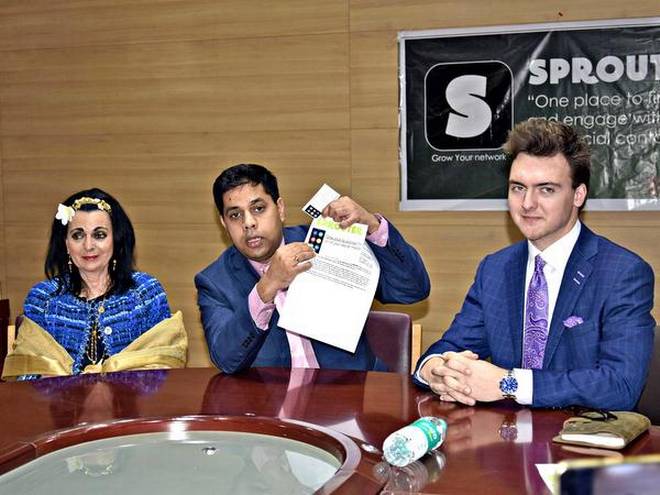
Manoj Patil, director of operations of Sprouter, and Daniel Everist, developer of the app, at a press meet in Hubballi on Friday.
‘Sprouter’, developed by U.S. student, to be launched in Bengaluru
A new mobile application that might change the way people connect to their social media accounts has been developed by an American student of University of St. Thomas, Minnesota, U.S., Daniel Everist, and is all set to be launched in Bengaluru.
The app, ‘Sprouter’, helps one connect to various social media accounts with just one touch. Twenty-year old Everist was in Hubballi on Friday, along with his one-time teacher Manoj Patil, who is now a teacher as well as entrepreneur, to give details of the app that is already being used by thousands in the U.S.
You can access FB, Instagram etc.
Mr. Patil, a native of Hubballi, director of operations of Sprouter, told presspersons that through the new mobile app one can access Facebook, Instagram, Twitter, Snapchat, LinkedIn, Spotify, Pinterest and VSCO. “We are also in talks with other social media platform providers like WhatsApp, and want to help users log into their social media accounts with one touch,” he said. Explaining how the app works, Mr. Everist said users can synchronise their accounts with Sprouter, create one username, and on meeting someone new, they can share their Sprouter username and give access to multiple accounts.
The idea first came to Mr. Everist while in a dorm room, when as a fresher at the university, he was introduced to others. Soon each one started adding the other on social media giving the different usernames. Mr. Everist then wondered if there could be an easier way to log into all accounts at once. “The idea took an year to take shape and that’s how Sprouter was born,” Mr. Everist said.
The Android and iOS versions of the app are available on the app stores, or can be downloaded by visiting getsprouter.com.
Mr. Patil said their plan is to add at least one new feature every month and get as many social media under Sprouter as possible. After the formal launch for India in Bengaluru, the plan is to get it launched in the United Kingdom, he said.
source: http://www.thehindu.com / The Hindu / Home> News> States> Karnataka / by Special Correspondent / Hubballi – January 13th, 2018
The new building of the Stella Maris Church, which resembles a boat and has a bell tower in the shape of a lighthouse, was inaugurated in the presence of three bishops, several priests and a large number of devotees here on Saturday.
This is the first boat-shaped church building in the State. It has been constructed in place of the old church.
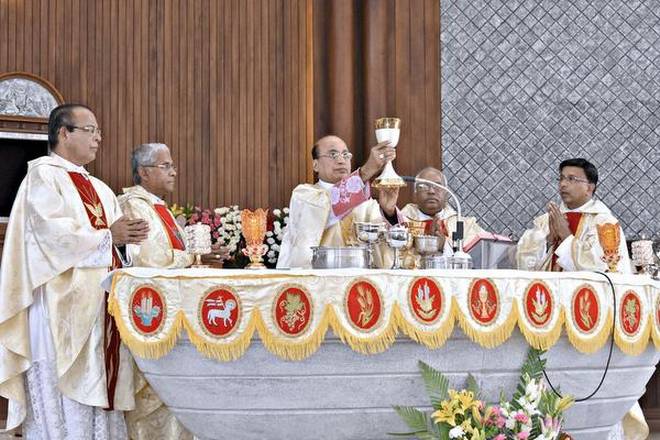
Gerald Lobo, Bishop of the Udupi Diocese, along with Francis Serrao, Bishop of Shivamogga, and Robert Miranda, Bishop of Kalaburagi, inaugurated the church. Dr. Lobo blessed and sanctified the water that was used to bless the people and the structure of the church. The solemn inaugural mass was concelebrated by bishops and priests, with Dr. Lobo taking the role of chief celebrant.
In his homily, Dr. Serrao traced the history of building of the ‘House of God’ from the Old Testament. He emphasised the significance of the church and spoke about how it was closely associated with the lives of devotees.
After the homily, the Litany of Saints was recited. Then Dr. Lobo anointed the main altar with Chrism oil and sanctified it while Dr. Miranda anointed the walls of the church at four main points. Dr. Lobo then recited the prayer of dedication of the church. He handed over the lighted candle to Fr. Alban D’Souza, parish priest of Stella Maris Church, who in turn lighted the candles on the newly blessed altar. Meanwhile, all the lights within the church were switched on and the solemn mass continued.
At the end, after the distribution of Holy Communion, the Tabernacle was blessed and sanctified and the ciborium containing the Holy Eucharist was placed reverently inside the Tabernacle.
Later, a public felicitation function was held on the church premises. Pramod Madhwaraj, Minister for Fisheries, Youth Empowerment and Sports, said Stella Maris Church has always promoted harmonious relations among all people. Oscar Fernandes, MP, Ivan D’Souza, MLC, and Meenakshi Bannanje, president of Udupi City Municipal Council, were among those present.
source: http://www.thehindu.com / The Hindu / Home> News> States> Karnataka / by Special Correspondent / Udupi – January 06th, 2018