Sankalp wins the award third time in a row as the Highest Exporter in ITES – Hubbali Region
Bengaluru :
Sankalp Semiconductor, a design service company offering comprehensive digital & mixed signal SoC services and solutions, today received an award from Software Technology Parks of India (STPI) for being the Highest Exporter – ITES in the Hubballi Region award. Sankalp Semiconductor has consecutively third time won the award. According to STPI, the state of Karnataka has touched Rs 1,41,846 Cr worth of exports from STPI member units during 2016-17. Karnataka contributes 40% of the total software export from the country.
“The award is validation of our contribution to the worldwide customers in the technology semiconductor domain. We thank STPI for recognizing our contribution and achievements for more than 12 years. We very excited since Sankalp Hubbali is a great success story for creating and scaling excellent semiconductor talent from tier-II cities. Our model has been successful due to our ability to build teams grounds up by leveraging well-planned technical and soft skill in-house training.” said Nagaraj Azhakesan, COO, Sankalp Semiconductor.
Sankalp Semiconductor was founded from Hubbali in 2005, with a focus to serve the semiconductor companies primarily offering analog & mixed signal design services. Today, Sankalp with a team of 650+ engineering professionals has design centers in Hubli, Bengaluru, Kolkata and Ottawa, Canada. The company provides unique advantage to its semiconductor customers by enabling them at any point of semiconductor services life cycle with the ability to provide end-to-end solutions.
source: http://www.design-reuse.com / Design & Reuse / Home / Bengaluru – November 16th, 2017
Over 300 products have received the GI certification in India, including Meerut scissors and Chamba handkerchief.
As a debate rages across state borders and on Twitter about the true origins of the rosogulla and Mysore pak, a long-drawn bureaucratic process of stamping state ownership over a commodity has become an unlikely talking point.
Over the past 13 years, as many as 28 Indian states and seven countries have registered for a Geographical Indication tag with the Indian Patent Office, the government agency that recognises the origin of a product. This status allows a state or a geographical region to lay an exclusive claim over a product, gives an assurance of quality, and is often an alibi for producers to command a higher price in the market.
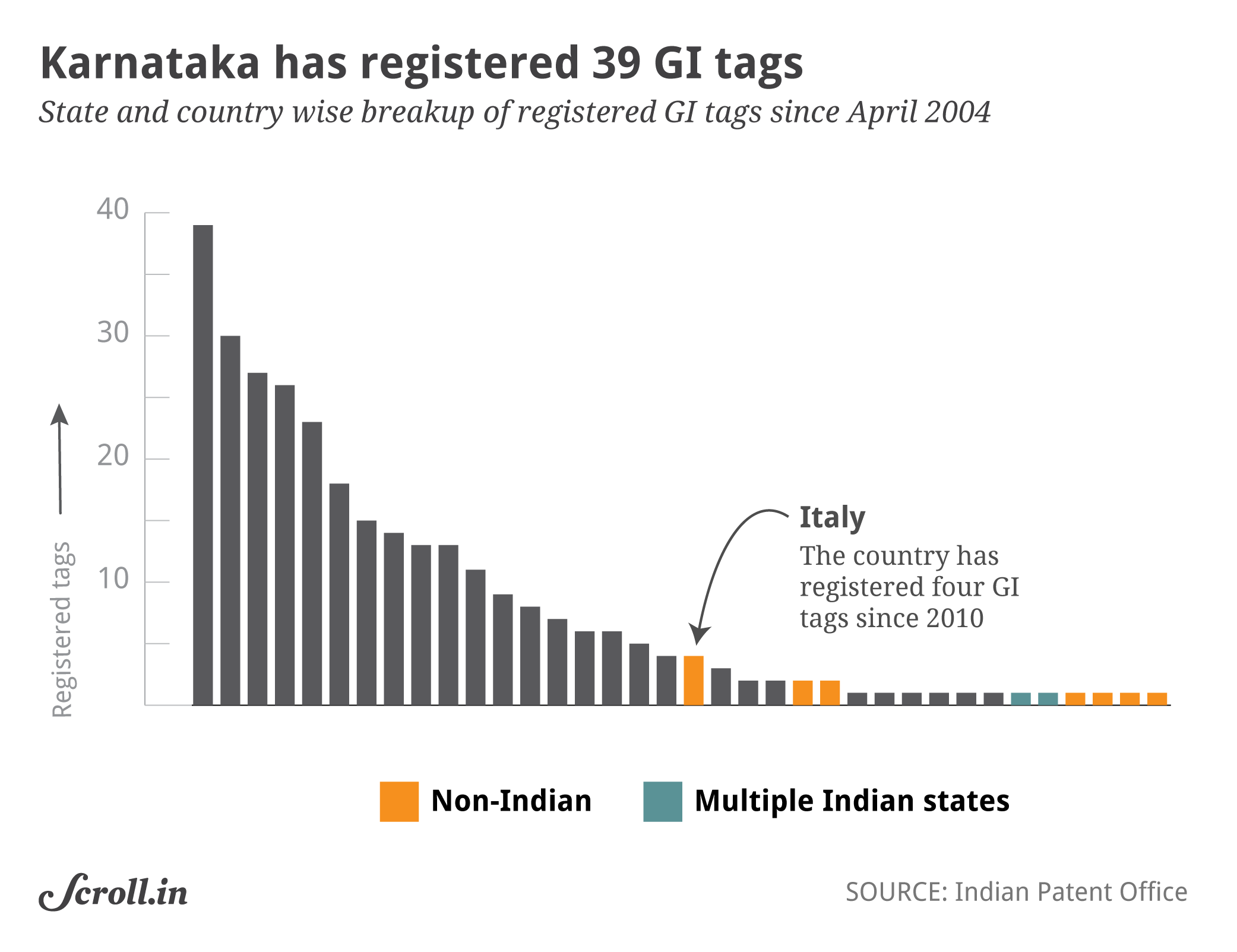
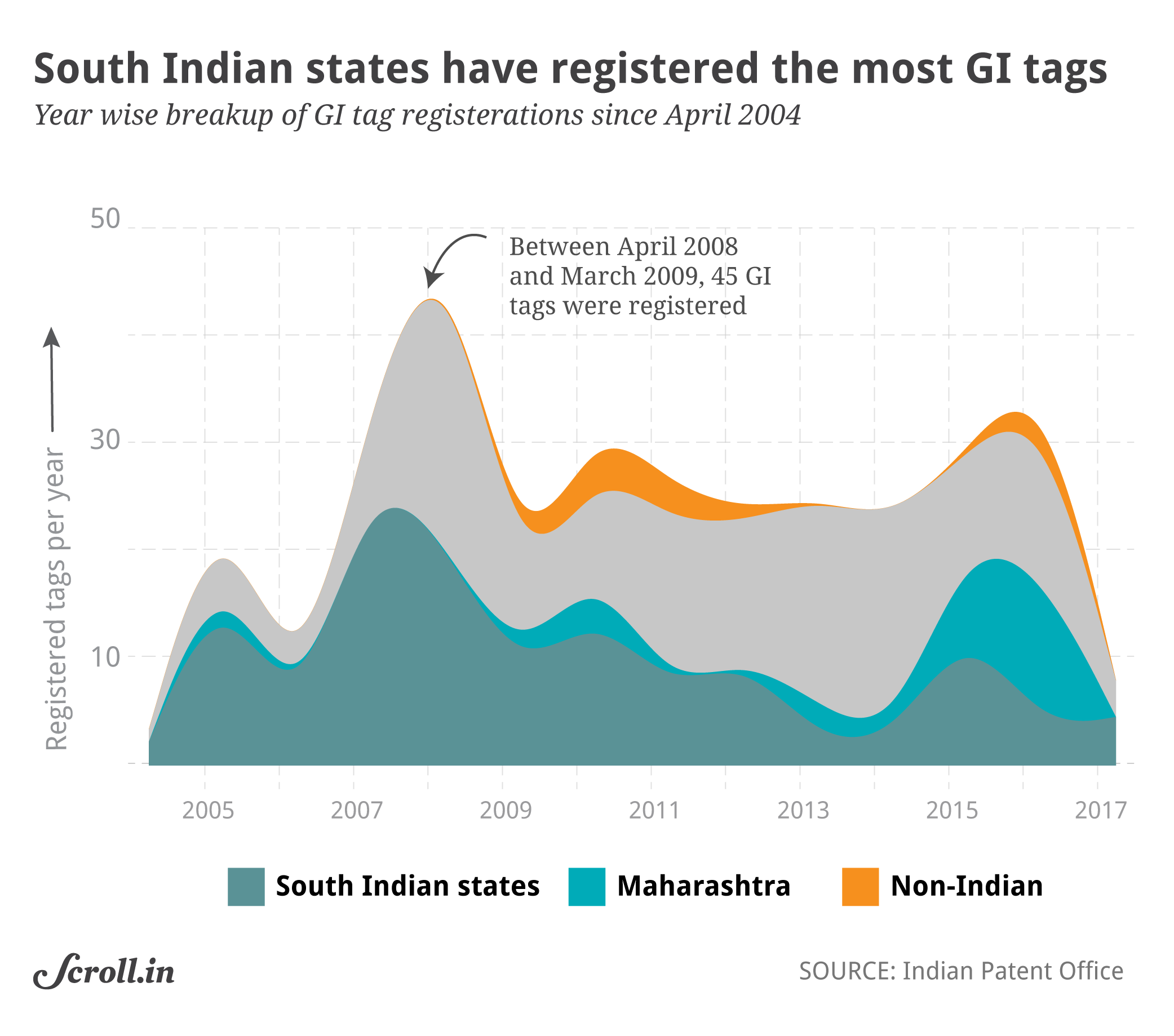
So far, 301 products have been registered with the Indian Patent Office since April 2004. The list – typically made up of agricultural, manufactured or natural goods – is broad, varied and dominated by South Indian states.
Karnataka has successfully applied for GI certification at least 11 of the past 12 years, and notched 39 GI tags for everything from Mysore Sandal Soap to Udupi Sarees. Jharkhand is the only Indian state that doesn’t have a GI-tagged product against its name.
Though handicrafts dominate nearly 60% of the list, there is no dearth of agricultural products on it, especially rice. Thirteen variations of rice have been granted the tag, five of which belong to Kerala. In the case of Basmati rice, seven states share the certification. Eight varieties of mangoes, six kinds of banana and five types of chillies have made it to the list, just over the past 10 years.
Last year, over 33 products were granted GI status, notable among which were three products from Italy – Prosecco wine, and Parmesan and Asiago cheeses. Italy, in fact, has been the most active among foreign nations in getting the exclusive status – most others, such as Peru, France, United States, United Kingdom, Portugal and Italy, have gained Indian GI tags for their respective alcohols.
Here are some lesser-known Indian products that enjoy GI certification:
Solapur terry towel
Photo credit: SolapurChaddarsTowel/Facebook
Made with cotton yarn, the towel is manufactured in the Solapur district of Maharashtra. Its application for GI certification said: “Solapur is historically well known and owns unbeatable reputation for its uniqueness in terry towels allied product of Jacquard Chaddar. The fabric used for manufacturing terry towels…with its unique characteristics has created a demand in global market… (sic).”
Chamba rumal
Photo credit: Wikimedia Commons [Public Domain]The embroidered handicraft from Chamba in Himachal Pradesh has a long history. It is believed that Guru Nanak’s elder sister Bebe Nanaki made one in the 16th century. The Victoria and Albert Museum in London has in its collection a Chamba rumal from the 18th century that depicts “Hindu god Krishna in a variety of poses – playing his flute or talking to the female cow-herds (gopis)”. The handicraft lost its royal patronage after Independence, although it’s still a common item of gift at weddings.
Meerut scissors
Photo credit: MeerutScissors/Facebook
These scissors from Meerut in Uttar Pradesh are made entirely with metal scrap – according to a report in The Hindu, the blades are fashioned from carbon steel sourced from metal found in automobiles and the handles are made of alloys and plastics recycled from old utensils.
We welcome your comments at letters@scroll.in
source: http://www.scroll.in / Scroll.in / Home> Magazine> Royal Brand / by Anand Katakam / November 23rd, 2017
The popularity of the fruit can be attributed to its perceived health benefits for diabetics and cancer patients. | Photo Credit: G R N SOMASHEKAR
Caters to demand in Europe, Middle East and South East Asia
Pomegranates are all the rage in many European countries — thanks to its perceived health benefits for diabetics and cancer patients — and the fruit is reaching there from farms around Bengaluru.
At least a tonne of freshly peeled pomegranates from areas around Bengaluru has been reaching European countries every day over the last few months.
“During our interaction with exporters and importers, we were informed about the increasing demand due to the fruit’s perceived health benefits,” said Venkata Reddy, Chief Executive Officer of Menzies Aviation Bobba (Bangalore), which is among the two cargo handlers at Kempegowda International Airport.
Among other destinations for peeled pomegranates from Bengaluru are the West Asia and South East Asia.
“One of the exporters is procuring pomegranates from nearby areas, bringing them to the cargo village in KIA where they are peeled and packed in small containers before being put in cold storage,” said an official of Bangalore International Airport Ltd. (BIAL), which operates KIA.
According to horticulture expert and former horticulture additional director S.V. Hittalmani, export of peeled pomegranate has increased since it does not have to undergo strict phytosanitary measures while it also gives better value to exporters. He said that big consignments were exported from Karnataka till 2004 when bacterial blight started destroying the crop in north Karnataka.
“The trend of cultivating pomegranates around Bengaluru is fairly new,” he said, adding that the fruit is now grown in about 3,000 hectares in Bengaluru Rural, Kolar, Shidlaghatta, Gowribidanur and Chikkaballapura besides Ananthpur, Cuddapah and Madanpalli in Andhra Pradesh.
source: http://www.thehindu.com / The Hindu / Home> News> Cities> Bengaluru / by Special Correspondent / November 23rd, 2017
Triumphed over 300 other teams from around the world
With a new device to measure the growth of microbes as well as a novel method to purify proteins, a team of undergraduates from the Indian Institute of Science (IISc) took home the gold medal at the International Genetically Engineered Machine (iGEM) competition held in Boston, U.S.A. from November 9-13.
The team triumphed over 300 others from around the world who participated in the competition, which encourages students to build genetically-engineered biological systems.
The six-member core team from IISc. developed a new method to purify recombinant proteins — that is, a protein enclosed in a gene — by using naturally-occurring gas vesicles isolated from Halobacterial species of bacteria, which thrives in salt-rich environments. In liquids, gas vesicles help bacteria float to the surface, and using biotechnology and gene cloning, the team was able to purify protein by tagging them to these vesicles.
Similarly, the team designed a device, Growth Curve and Optical Density Device (GCODe), to ascertain microbial growth through real-time optical density measurements that can even be read through a smartphone. The device, said IISc., is less than a fourth of the price of a commercially-available spectrophotometer.
The team — comprising Raj Magesh, Sai Padma Priya, Kunal Helambe, Rajas Poorna, Sharath K. Menon and Rohith K.M.S. — worked on the projects for over six months. They were mentored by Dipshikha Chakravortty, Utpal Nath from Department of Microbiology & Cell Biology, and Akshay Datey from Biosystems Science & Engineering at IISc.
source: http://www.thehindu.com / The Hindu / Home> News> Cities> Bengaluru / by Staff Reporter / November 16th, 2017
Alyia Phelps-Gardiner Krumbiegel | Photo Credit: Bhagya Prakash K
Following a report in The Hindu about the crumbling state of Krumbiegel Hall, Alyia Phelps-Gardiner Krumbiegel, Gustav Hermann Krumbiegel’s great granddaughter, expresses her displeasure over the neglect of the historical structure.
In her letter to The Hindu, Ms. Krumbiegel writes about how her forefather realised that he had found home when he first touched Indian soil at the age of 26. Excerpts from the letter:
My great grandfather was a master at economic botany, encouraging the exchange of plants and seeds. He continued this at Lalbagh Botanical Garden. His very last planning assignment for the Indian government when he was 90-years-old was to plan the Rajghat memorial gardens (New Delhi). Royalty protected him when the British saw an enemy in every German. He gave Karnataka so much.
The lecture hall which he spent so much time in was renamed Krumbiegel Hall in his honour. Which now brings me to the sad state of how Lalbagh (authorities) have treated a building named in honour of one of the five superintendents who made substantial differences to Lalbagh and Bangalore.
Was Krumbiegel Hall a heritage building or was is it not a heritage building? In 2013, it seemed to be a heritage building.
I really have heard it all ….. assurance that it was under restoration. Broken promises.
‘Whatever he touched he adorned’ is written on his tombstone. But, a man who gave so much to the country he found a home in – he always wanted independence for India and was never afraid to voice these views while he lived and breathed India — his life’s work is slowly being wiped away to be memories in the wind.
Krumbiegel Hall runs deep in my veins. I’m very hopeful that the department will recognise that Krumbiegel Hall needs to be rebuilt with the original frontage restored and reinstated once again.
source: http://www.thehindu.com / The Hindu / Home> News> Cities> Bengaluru / November 16th, 2017
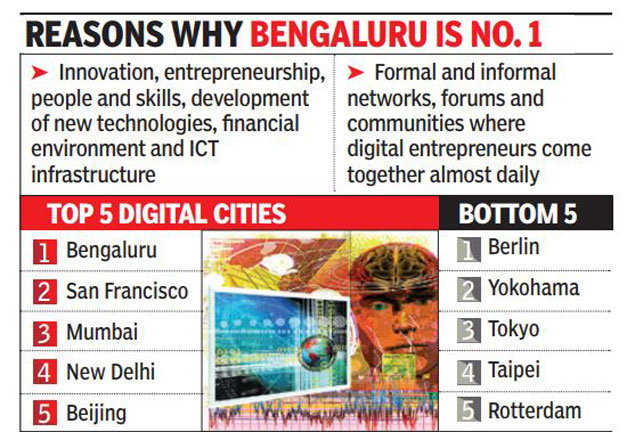
Bengaluru has been ranked first, ahead of San Francisco, for the confidence of businesses in their ability to do digital transformations.
Business leaders in Bengaluru expressed the highest confidence in their digital environment based on innovation and entrepreneurship.
_______________________________________
Bengaluru :
India’s Silicon Valley – Bengaluru -has been ranked first, ahead of San Francisco, for the confidence of businesses in their ability to do digital transformations based on the skills and infrastructure available in their immediate environment.
According to a study by The Economist Intelligence Unit, three Indian cities bagged top 4 ranks. San Francisco is ranked at No. 2, followed by Mumbai and New Delhi. Business leaders in Bengaluru expressed the highest confidence in their digital environment based on innovation and entrepreneurship, people and skills, development of new technologies, financial environment, and ICT infrastructure. In each of these categories, the city ranked No. 1.
“Indian cities may suffer more from infrastructure deficits, pollution, poverty and other ills, but when it comes to the environment for digital transformation, their executives are remarkably optimistic. This is particularly true of Bengaluru, where business leaders express the highest levels of confidence in their digital environment than in any other city in the study,” the report authored by Denis McCauley says.
It goes on to say: “Their compatriots in Mumbai and New Delhi are only slightly less bullish, and they are not alone in the emerging world: seven of the 10 highest confidence levels in the survey are recorded in emerging Asian cities. Among rich-world cities, only San Francisco (2nd) registers in the top five and two others (London, 9th, and Madrid, 10th) made it to top 10. By contrast, developed cities account for eight of the 10 lowest readings in the barometer, with executives in Berlin, Yokohama, Tokyo and Taipei the least confident of all.”
The report notes that across geographies and industries, businesses are embarking on, or preparing for, a mission to put digital technology at the heart of everything they do, an exercise that has come to be known as digital transformation. It can be an enormously difficult and complex un dertaking, requiring not just the deployment of advanced technologies but also the overhauling of business processes and a large degree of cultural change.In most cases, firms’ existing internal resources will not be enough to pull transformation off, and they need to look outside their own four walls for additional support,” the report says.
For this reason, EIU decided to check which cities provide the best environment for their businesses.The analysis in the report is based on a survey of 2,620 executives in 45 cities conducted in June and July this year.
Almost half of surveyed executives (48%) say their firm has considered relocating operations to a city with a more favourable external environment.
Alpesh Shah, senior partner in Boston Consulting Group India, is quoted as saying he is only slightly surprised at the bullishness that executives in Bengaluru, Mumbai and New Delhi display toward their local digital environments.
He notes that these cities’ educational institutions consistently churn out large numbers of quality technology graduates. The report says the three cities also boast a multitude of formal and informal networks, forums and communities where digital entrepreneurs, technology managers and others come together almost daily.
Shah, the report says, reserves particular enthusiasm for Bengaluru’s digital entrepreneurship environment. It is the “closest thing to Silicon Valley” in Asia, he is quoted as saying.
source: http://www.timesofindia.indiatimes.com / The Times of India / News> City News> Bangalore News / TNN / November 09th, 2017
Bengaluru schoolboy Ruhaan Alva, supported by Italian manufacturer Birel Art, will be making his debut in the World Rotax Max Challenge Grand Finals which starts here on Monday.
The event will see 360 competitors representing 60 countries vie for titles in various age-group categories.
Ruhaan, who finished third overall in the recently-concluded Easykart series in Italy, has entered in the 125 Micro Max category which has a grid of 36 drivers who have qualified from their respective National Rotax Max championships or international Rotax Max series.
After completing formalities over the weekend, the competitors will have two days of practice sessions on November 6 and 7.
The qualifying sessions will commence on November 8, leading up to the three rounds of heats (November 9) and pre-finals (November 10) before the finals on November 11.
Looking ahead to his maiden participation in the Grand Finals, Ruhaan, who is also supported by Play Factory and Sona Miller, said he would put to good use his experience in the recent Eastkart championship in Italy and hoped to deliver a strong result.
“I had a good season in Italy though it was very tough because I switched to a higher and more competitive Easykart 60 category after the first round in the Mini class which I won,” the 11-year-old from Bengaluru said.
–IANS
ajb/bg
(This story has not been edited by Business Standard staff and is auto-generated from a syndicated feed.)
source: http://www.business-standard.com / Business Standard / Home> News-IANS> Sports / IANS – Portimao(Portugal) / November 05th, 2017
“Some people refused to go to plague camps because they would then have to mingle with other castes,” said Meera Iyer, co-convenor, Indian National Trust for Art and Cultural Heritage (INTACH). (Image source:Wikipedia)
In a way, Bengaluru owes its expansion to the plague. It was the outbreak in the late 1800s that egged people -until then averse to relocation -to settle in newly-created extensions like Basavanagudi and Malleswaram. A famous incident involving trader-philanthropist BP Annaswamy Mudaliar took place at a plague inoculation camp in the city . The crowd at the camp was leery about inoculations when Mudaliar, a progressive thinker, lectured them about the benefits, folded his sleeve and got himself vaccinated. While this crowd cooperated with the administration’s efforts to curtail the disease, widespread public resistance towards certain control measures culminated in what came to be known as the plague riots. The violence was also a mirror to the caste and cultural identity conflicts prevalent among people .
“Some people refused to go to plague camps because they would then have to mingle with other castes,” said Meera Iyer, co-convenor, Indian National Trust for Art and Cultural Heritage (INTACH), explaining that people hid in relatives’ or neighbours’ houses to avoid being forcefully segregated. Apparently , dead bodies were simply abandoned. “Caste was a big factor that hindered plague prevention and treatment. There was also strong opposition to bodies being examined for plague because the last rites would be delayed.
In their book Health and Medicine in the Indian Princely States: 1850-1950, Waltraud Ernst, Biswamoy Patil and TV Sekher state how hospitals were looked upon as jails and slaughterhouses, and how people stopped using public water taps because they believed that the purified drinking water supplied to them would actually poison them. “As an expression of hostility towards administrative measures to curtail the plague, the public set fire to plague sheds. The Health Officer of Bangalore City , Achyut Rao, had stones thrown at him by youth who disapproved of inoculation,” according to the book.
The culmination of these events came to be known as the ‘Ganjam Riots’ (Ganjam is near Srirangapatna). It started with two weavers from Bengaluru dying of the plague within a week of their arrival in Ganjam on November 02, 1898. Locals refused to cremate the second body , stating that the victim was poisoned.People threw stones at officers. The police, with full emergency powers, raided the village and arrested 55 people for the violence.Villagers retaliated with sticks, swords and guns. The police opened fire to control the mob, resulting in death and injuries.
M Jamuna, professor, department of history , Bangalore University, said that this crisis of confidence compelled the administration to focus on sanitation measures instead. “Between 1900-01, 13,223 homes were disinfected with chemicals while 47,801 were disinfected by exposure to sun, air and whitewash. In Bengaluru, 71 homes were demolished. The administration planned to remove congestion and improve drainage systems. Budget provisions were made for plague-relief and surplus revenue was also also spent for the cause.” This resulted in restoration of public confidence and greater co-operation with authorities.
source: http://www.economictimes.indiatimes.com / The Economic Times / Home> News> Politics and Nation / by Divya Shekhar, ET Bureau / November 02nd, 2017
Ganesh Devy undertook 300 journeys in 18 months to explore India’s languages / ANUSHREE FADNAVIS/INDUS IMAGES
When Ganesh Devy, a former professor of English, embarked on a search for India’s languages, he expected to walk into a graveyard, littered with dead and dying mother tongues.
Instead, he says, he walked into a “dense forest of voices”, a noisy Tower of Babel in one of the world’s most populous nations.
He discovered that some 16 languages spoken in the Himalayan state of Himachal Pradesh have 200 words for snow alone – some of them ornately descriptive like “flakes falling on water”, or “falling when the moon is up”.
He found that the nomadic communities in the desert state of Rajasthan used a large number of words to describe the barren landscape, including ones for how man and animal separately experience the sandy nothingness. And that nomads – who were once branded “criminal tribes” by British rulers and now hawk maps for a living at Delhi’s traffic crossings – spoke a “secret” language because of the stigma attached to their community.
In a dozen villages on the western coast of Maharashtra, not far from the state capital Mumbai, he discovered people speaking an “outdated” form of Portuguese. A group of residents in the far-flung eastern archipelago of Andaman and Nicobar spoke in Karen, an ethnic language of Myanmar. And some Indians living in Gujarat even spoke in Japanese. Indians, he found, spoke some 125 foreign languages as their mother tongue.
Dr Devy, an untrained linguist, is a soft-spoken and fiercely determined man. He taught English at a university in Gujarat for 16 years before moving to a remote village to start working with local tribespeople. He helped them access credit, run seed banks and healthcare projects. More importantly, he also published a journal in 11 tribal languages
Languages of India
The 1961 census counted 1,652 Indian languages
The People’s Linguistic Survey of India (PLSI) counted 780 Indian languages in 2010
197 of these are endangered, 42 of them critically so, according to UNESCO
Arunachal Pradesh and Assam in the northeast, Maharashtra and Gujarat in the west, Orissa and Bengal in the east, and Rajasthan in the north have the most languages
India has 68 living scripts
The country publishes newspapers in 35 languages
Hindi is India’s most used language, spoken by 40% of Indians. This is followed by Bengali (8.0%), Telugu (7.1%), Marathi (6.9%), and Tamil (5.9%)
The state-run All India Radio (AIR) broadcasts programmes in 120 languages
Only 4% of languages are represented in India’s parliament
Sources: Census of India, 2001, 1962, UNESCO, People’s Linguistic Survey of India 2010.
It was around this time Dr Devy had an epiphany about the power of language.
In 1998, he carried 700 copies of his journal written in the local language to a dirt-poor tribal village. He left a basket for any villager who wanted to or could afford to pay 10 rupees (£0.11; $0.15) for a copy. At the end of the day, all the copies were gone.
When he checked the basket, he found a large of number of currency notes – “grimy, crumpled, soggy” – left behind by the tribal villagers who had paid whatever they could afford from their paltry daily wages.
Dr Devy and his team have recorded India’s many sign languages / ANUSHREE FADNAVIS/INDUS IMAGESA story written in Spiti language, spoken in the northern state of Himachal Pradesh / ANUSHREE FADNAVIS/INDUS IMAGES
“This must have been the first printed material they saw in their life in their own language. These were unlettered daily wage workers who had paid for something they could not even read. I realised this primordial pride and power of the language,” Dr Devy told me.
Seven years ago, he launched his ambitious People’s Linguistic Survey of India (PLSI), which he called a “right-based movement for carrying out a nation-wide survey of Indian languages as people perceive them”.
As the indefatigable language hunter turned 60, he undertook 300 journeys in 18 months across the length and breadth of India to search for more languages. He paid for his trips using money he earned by delivering lectures in universities and colleges. He travelled night and day, revisiting some states nearly 10 times, and religiously kept a diary.
Dr Devy also forged a voluntary network of some 3,500 scholars, teachers, activists, bus drivers and nomads, who travelled to the remotest parts of the country. Among them was a driver of a bureaucrat’s car in the eastern state of Orissa who kept a diary of the new words he heard during his extensive travels. The volunteers interviewed people and chronicled the history and geography of languages. They also asked locals to “draw their own maps” on the reach of their language.
The script of a language called Sakal spoken in Maharashtra / ANUSHREE FADNAVIS/INDUS IMAGESThe PLSI has already published 39 books on Indian languages / ANUSHREE FADNAVIS/INDUS IMAGES
“People drew maps shaped like flowers, triangles, circles. These were maps of their imagination on the reach of their language,” says Dr Devy.
By 2011, the PLSI had recorded 780 languages, down from the 1,652 languages counted by the government in 1961. Thirty-nine of a planned 100 books carrying the findings of the organisation’s survey have already been published; and some 35,000 pages of typed manuscripts are being vetted for publication.
India has lost a few hundred languages because of lack of government patronage, dwindling number of speakers, poor primary education in local languages, and migration of tribespeople from their native villages. The death of a language is always a cultural tragedy, and marks the withering away of wisdom, fables, stories, games and music.
‘Linguistic democracy’
Dr Devy says there are more pressing anxieties. He worries about the ruling Hindu nationalist BJP’s efforts to impose Hindi all over India, which he calls a “direct attack on our linguistic plurality”. He wonders how India’s melting-pot megacities will deal with linguistic diversity in the face of chauvinistic politics.
Dr Devy is now planning to check the health of the world’s 6,500 languages / ANUSHREE FADNAVIS/INDUS IMAGES/
“I feel sad every time a language dies. But we have suffered heavier losses in other diversities – like varieties of fish and rice,” he says, sitting in his home in Dharwad, a sleepy, historic town in Karnataka state.
“Our languages have survived tenaciously. We are truly a linguistic democracy. To keep our democracy alive, we have to keep our languages alive.”
source: http://www.bbc.com / BBC News / Home> News> Asia> India / by Soutik Biswas, India Correspondent / October 27th, 2017
The cenotaph was demolished with official sanction on Oct 28, 1964.
Bengaluru has had a long history of renaming its roads and landmarks. This story is about a landmark which was completely destroyed because of its link to the city’s colonial history.It happened on October 28, 1964. A cenotaph dedicated to soldiers who died in the 1791 Siege of Bangalore was demolished.
“A group of Kannada activists led by Vatal Nagaraj wanted to demolish structures and statues that they considered as symbols of colonial victory over Indians,” said Mansoor Ali, founder, Bengaluru By Foot.
While statues of Queen Victoria, King Edward and Mark Cubbon were also on their radar, they zeroed in on the cenotaph as it was in the city centre (Hudson Circle).The call to pull down the cenotaph goes back to the late 1940s but it was in October 1964 that a resolution was passed by the city corporation under mounting pressure from Kannada activists. Today ,a statue of Kempe Gowda, the city’s founder, stands in its place.
The 35-feet-tall cenotaph pillar was constructed in the memory of the 50-odd soldiers and commanders who died in the 1791 Siege of Bangalore and other Anglo-Mysore wars. It had stone plaques and ceremonial urns on all four sides, similar to the one constructed in Tipu Sultan’s capital Srirangapatna.According to Ali, the cenotaph included names of not only British soldiers, but also of Indians who fought as part of the Madras Engineering Group (MEG).
During the siege, the British first captured the pete (which housed residential and commercial areas) on March 7, 1791, and then captured the stone military fort on March 21.The event put Bangalore on the British map. Subsequently , the British used the Bangalore fort as a base for the Siege of Seringapatam in 1792, which forced Tipu to concede defeat.
Initially, officers who died during the Siege of Bangalore were buried in the Fort’s Cemetery .Robert Home’s book `Select Views in Mysore, the country of Tipoo Sultan’ illustrates graves of soldiers and indicates that the land was filled with cypress trees, rose bushes and flowers. In the early 1910s, the records of these officers were transferred to the Cenotaph that was raised in the British cantonment.
After the demolition, the stones from the cenotaph were thrown away . One remnant was a bench in the corporation office until recently , while a some others were at the nearby Abbas Khan College.The Cenotaph Road on which the structure stood was renamed Nrupathunga Road. “Instead of eliminating a heritage structure that marked a turning point in the history of Bengaluru, we could have constructed another monument of Mysoreans who lost their lives in war. Both could have coexisted,” said Ali.
source: http://www.economictimes.indiatimes.com / The Economic Times / ET Home> Magazines> Panache / by Divya Shekhar, ET Bureau / October 26th, 2017

![Photo credit: Wikimedia Commons [Public Domain]](http://www.bangalorefirst.in/wp-content/uploads/2017/11/GI05BF25nov2017-300x199.jpg)