Category Archives: World Opinion

In her shoes

Special Arrangement / The Hindu

The fascinating story of Anu Vaidyanathan, the first Asian woman to compete in Ultraman Canada.

As someone who goes to bed praying the morning papers will publish findings that pizza is good for weight loss, two questions popped up when I read Anywhere but Home: Adventures in Endurance, written by Anu Vaidyanathan, “the first Asian female to have competed in Ultraman Canada”. It sounds suspiciously like auditioning for a superhero movie set in Nova Scotia, but what is it really? The answer is easy enough, as it exists in the finite and definable realms of sport and mathematics: a 10-km swim, a 420-km bike ride, and an 84.4 km run. (Four weeks later, again in Canada, Vaidyanathan switched her allegiance to a different superhero: Ironman. This time, a 3.8 km swim, a 180-km bike ride, a 42.2 km run.) I then asked the tougher question, the answer to which lies in the diffuse dimensions of metaphysics: Why?

I get why people climb the Everest. It sounds like something you’d want on your obituary note, or at least your Facebook post. But what glories can swimming, running and biking bring? As it turns out, Vaidyanathan is searching for a “why” too.

Despite the broad motivational-poster nature of the narrative (sample quote: “If it were easy, it wouldn’t be worth doing”), Anywhere but Homeis also an intimate portrait of a single woman in India — “a quintessential Tamilian Brahmin — five times a year at least, during Pongal, Nombu, Ganapathi Chaturthi, Krishna Jayanti and Deepavali” — brushing off the “when are you going to settle down?” question, training on bad roads, without much money for equipment, putting her body through unimaginable stress, all because… Because… The answer, finally, comes from writer and Holocaust survivor Victor Frankl. What athletes do with their goal-setting “frees them up from commerce or the meaningless pursuit of goals that depend on other people’s validation.” The other reason: “the grand challenges of survival were absent because we were children of luxury.” Hence the transformation of life into a hurdle race with a series of self-imposed challenges.

Vaidyanathan writes like a runner — breathlessly, without getting sidetracked. The pages seem to pant. The prose is observant (“watching dark grey clouds tease the distance between them and my rear-view mirror”), if sometimes too cute (a chapter is titled “An Inheritance O’Floss”). And often very funny, in the way everything circles back to running, even romance. About an early boyfriend, she writes, “I think I was in love. You would have to be, with a boy who took you on a 13-km run through the woods on a first date.” Later, she writes about dating a tall, soft-spoken German boy who did not understand why a ride was so much more exciting than a movie. “Miffed with his lack of understanding, I took off on a long run.”

I must say I saw the German boyfriend’s point. Vaidyanathan is quite a character, someone whose idea of a memorable Thursday includes a 3.5-km swim, a two-hour run, an hour of commuting on the bike, and 30 minutes of upper-body weights. (One can only imagine what her idea of a perfect Valentine’s Day is.) She never seems to rest. If she’s not working towards a PhD in Electrical Engineering, she is at home in Bangalore plunging into a start-up.

Anywhere but Home is mostly the story of a solitary pursuit but filled with family and friends. We meet the people Vaidyanathan leaves behind when she goes off on her runs and bikes and swims, the people she yearns to be with while living out of suitcases. We get to know her roommates and boyfriends (though we never seem to know when the relationships ended). We meet members of the running community, people who seem to think nothing of scrounging up enough money to fly off to exotic locations (Brazil! China!) for endurance events. And everyone is so giving. During a run, when Vaidyanathan was suffering from dehydration, sleeplessness and worries about an unsupportive crew, “Lena held my hand for nearly two kilometres, running alongside me, reminding me to never give up.”

The last chapter deals with another sort of hand-holder, finding “someone crazy enough to marry me”. And we sense a calming down, especially after the birth of Vaidyanathan’s son. “Giving birth brought with it a moment of great clarity. There was magic beyond what any class in engineering, science or objective observation had taught me. However, to sustain that magic past the endorphin rush of birth would involve a great deal of humility… Overnight, I went from being someone’s daughter to being someone’s mother.”

The epiphany lasted about six weeks. Soon, Vaidyanathan was back on the road, participating in a 10 km race. It wasn’t easy, but she finished, “just for the pleasure of having my son know that his mother embraced life’s challenges.”

Anywhere But Home: Adventures in Endurance; Anu Vaidyanathan, Harper Sport, Rs. 350.

source: http://www.thehindu.com / The Hindu / Home> Books> Literary Review / by Baradwaj Ranjan / July 23rd, 2016
All-girl team bags tech award in San Francisco

ChangEDbf19jul2016

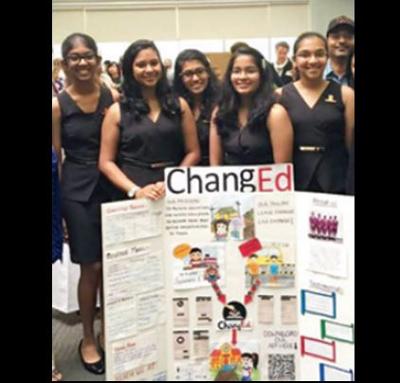
Age is no barrier for Nidhi Nair, Aanchal Agarwal, Suchrithaa Rajkumar, Vidhi Kothari and Anushka P Nair. The 14-year-olds won the People’s Choice Award across all categories and bagged second place in the middle-school category at the coveted Technovation Challenge 2016 in San Francisco, USA.

This was not the first feather in their cap. The girls were also in the team that earned Prime Minister Narendra Modi’s appreciation in the Digital India and Save the Girl Child initiatives.

For the People’s Choice Award, the 9th graders of New Horizon Public School (NHPS), Indiranagar, competed with 400 teams from across the globe to devise an Android app they call ChangEd, that stood for Change for Education through Donation. Through this app, NGOs working in the education sector could sign up and have their projects funded through donations. The product enabled users to donate even small change using payment gateways like Paytm.

ChangEd used its inbuilt intelligence to route the donations to NGOs, based on factors like urgency of the demand and amount required.

Suchrithaa Rajkumar said: “It was great exposure for us. It taught me how to deal with unexpected situations.” Teammate Vidhi Kothari agreed: “It was great to meet so many worshippers of technology .” The team started preparing a model of the app when they were in the 8th grade and submitted their idea in 2016.

They received the award on July 14 at the competition organized by Adobe Foundation, CA Technologies, Google, Verizon, Intel, Oracle, Dropbox, United Nations Women, UNESCO and MIT Media Lab.

“This is not just any achievement. It signifies a triumph of girl power and teamwork… These are the precise values we try to inculcate in students at NHPS,” said Sandhya Raman, principal.

source: http://www.timesofindia.indiatimes.com / The Times of India / News Home> City> Banglaore / TNN / July 19th, 2016

Bengaluru biker becomes first Indian to compelete the Trans Am Bike Race in US

Bengaluru biker becomes first Indian to compelete the Trans Am Bike Race in US

A practice that began as an 18-kilometre cycle ride to school every day in the suburbs of Manipur’s Thoubal district has culminated into Thoudam Opendro Singh becoming the first Indian to complete the Trans Am Bike Race (TABR) in the US, covering a distance of 4,400 miles in less than 25 days. A resident of Bengaluru for nearly two decades, Opendro is an avid cyclist , who has been regularly taking part in long-distance biking tours in and around Karnataka as well as in Maharashtra and Tamil Nadu.

Describing his recent feat as a fantastic experience, the 38-year-old technical professional says, “TABR is an annual self-supported, ultra-distance cycling race across the US that follows a specific trail, covering 10 states. I rode from the north-west coast to south-east coast of the country with a group of bikers. The race started at Astoria in Oregon and went on to Idaho, Montana and Wyoming in the north, Colorado, Kansas and Missouri in the central part and Illinois, Kentucky and Virginia in the east. Yorktown in Virginia was the finish point.”

From idyllic countryside to hilly terrains as high as 11,500 feet from the sea level, this race packs quite an adventurous trip, according to Opendro. “During the initial days of the journey, we either camped at a particular location or tucked ourselves into sleeping bags outside petrol pumps or other public places. But later, when the weather started becoming colder at high altitudes, we halted at motels overnight and then hit the road in the morning,” he adds.

So, do you think resorting to bicycles can be a solution to Bengaluru’s growing traffic and pollution? “Although Bengaluru is expanding in area, when it comes to commuting space, the city is rapidly shrinking. We have a lot of cycling enthusiasts in the city, and clubs and groups supporting them. But to make cycling a regular mode of transport, more constructive efforts need to be made and common people made me aware of the benefits of the cycling,” he sums up.

www.timesofindia.indiatimes.com / The Times of India / News Home> City> Bangalore / Reema Gowalla / July 16th, 2016

A Home in Malgudi …

Writer R.K. Narayan’s house in Yadavgiri, Mysuru, which is being developed into a memorial on the lines of Shakespeare’s house in Stratford-on-Avon in England.

by June Gaur

Brand Mysore is set to get a fillip with the restoration of R.K. Narayan’s Yadavagiri bungalow opening up exciting possibilities not just for tourism but also for scholarship, part of the city’s raison d’ etre. Ironically, this comes at a time when Mysureans are locked in a battle to save Chamundi Hill, foremost among “the really worthwhile things” in the city as listed by R.K. Narayan (RKN).

One Vijayadashami, prodded by his grandmother, RKN pulled out a brand new notebook and wrote down the first sentence about his town. ‘It was a Monday and the train had just arrived at Malgudi station.’ India’s best-known fictional town was born.

From this home in Lakshmipuram, he sallied forth every day without fail into “the loved and shabby streets” (Graham Greene) of Malgudi (Mysore). The city of talkers yielded rich material for his characters. His destination was the town centre at K.R. Circle and Srinivasa Stores, from where he got a special kind of lavanga without which he couldn’t write, and M. Krishnaswamy & Sons on Sayyaji Rao Road, who supplied him with the tools of his craft. He made several stops along the way, antennae on the alert for stories. There was always time for stimulating conversation with the people he met. Indeed, as he notes in his 1974 memoir, My Days, many pressing issues of the day, “were settled on the promenades of Mysore.”

A backbencher at the Maharaja’s College from where he graduated, Narayan honed his writing skills and powers of observation working as a stringer for a Madras newspaper, The Justice. The joint family he lived in shored him up financially. When he decided he wanted to be a full-time writer of fiction in English, Narayan knew he was opting for a vocation that had not been heard of in India. In the 1930s, there was no literary tradition he could fall back on; no publisher or audience waiting to receive his first novel, Swami and Friends.

For years the manuscript sat on various publishers’ desks in England. A despondent Narayan gave up hope of ever finding a home for his “ugly orphan” as he called it. Yet somebody other than his grandmother believed in him. That was Kittu Purna, a friend from Mysore studying at Exeter College, Oxford. Purna disregarded Narayan’s entreaty that he “weight the manuscript with a stone and drown it in the Thames.” He did go to London however, and, with a phenomenal heave of the imagination, landed the manuscript, not in the Thames but at the door of one of England’s great writers: Graham Greene. Charmed out of his skin by the sheer theatre of Narayan’s little provincial town and its delightful people, Greene saw to it that Swami and Friends was published in England.

A series of wonderful novels, 14 to be exact, and scores of Narayan’s short stories written over a period of 60 years, are set in Malgudi. For many, the town, nestling somewhere between the forested Mempi Hills and the Sarayu River, is the real hero in his fiction. In its creator’s lifetime, speculation about Malgudi’s exact location fuelled an industry of research and never failed to amuse him. A New York researcher even went so far as to compile a map of Malgudi, a cartographic fiction of course, which pleased the author and was published in his 1981 collection, Malgudi Days.

Did Mysore inspire Malgudi? Most of Narayan’s contemporaries, among them Dr. M.N. Srinivas and H.Y. Sharada Prasad, thought so. Ramchandra Guha thinks it’s the town of Nanjangud while former ambassador A. Madhavan sees typical Mysore signposts of the 1960s in the Boardless Hotel, a popular eating joint of those times, and the ubiquitous jutkas, then the undisputed kings of the road.

While the exercise of matching up Malgudi with Mysore continues to draw the nerds, RKN himself was always non-committal on the subject. Though he did take a BBC crew around Mysore to familiar landmarks such as the Chamarajapuram Railway Station, where his story apparently began, he insisted that Malgudi existed only in his imagination and, therefore, he was free from the constraints that chronicling an actual place would impose. “I wanted to be able to put in whatever I liked and wherever I liked – a little street or school or a temple or a bungalow or even a slum, a railway line, at any spot, a minor despot in a little world. …..I began to be fascinated by its possibilities; its river, market-place, and the far-off mountain roads and forests.”

Despite the ambivalence here, there can be little doubt that many of RKN’s memorable characters were inspired by the real life people he met in Mysore. Syd Harrex, the Australian poet and Narayan scholar, once told me he’d met Cheluva Iyengar, undoubtedly the model for Mr. Sampath, at the writer’s Yadavagiri house for an interview recorded in 1972. Syd recalled that RKN had gifted Cheluva Iyengar a copy of Mr. Sampath – the Printer of Malgudi and had inscribed it so – ‘To Sampath the original.’

Cut to the present and the mammoth task confronting the authorities with regard to converting RKN’s home in Yadavagiri into a fitting memorial for the writer. Ten years ago, when the Sahitya Akademi held a seminar in Mysore to mark Narayan’s birth centenary, scholars visited this intriguing double-storied, cream-coloured house. In the semi-circular first floor study with its eight windows and criss-cross grills, they lingered to let imagination take wing, picturing the bird-like figure of the writer hard at work spinning the Malgudi magic that brings the world to Mysore’s doorstep.

The recent centenary celebrations have reinforced Mysore’s reputation as a University town. No doubt the decision to involve the University in establishing a Research Centre for archival and scholarly materials pertaining to R.K. Narayan will also involve Dhvanyaloka, the Centre for Literature and the Arts set up by the late Prof. C.D. Narasimhaiah (CDN). R.K. Narayan, scholars from India and around the world have always homed onto Dhvanyaloka where Prof. CDN guided countless numbers painstakingly through their research. The tradition has continued with CDN’s family, all English teachers, and CDN’s pupils from the University of Mysore who pioneered research into Indian Writing in English, having picked up the baton.

Among the resources which should be available here are T.S. Satyan’s priceless photographs of the writer, including one of him playing cricket in the compound of his Lakshmipuram house. A Trust run by Satyan’s family now takes care of all his work. However, one hurdle which will somehow have to be circumvented is the fact that all the writer’s manuscripts are with the Boston University Library, preserved in air-conditioned lockers. Only recently, in an expression of goodwill, the US has returned precious artefacts to India. Surely, Boston University can be persuaded to part with at least a fraction of the Malgudi man’s work from their archives. And hopefully, we’ll be able to take good care of this gift.

However, Mysureans looking to perpetuate RKN’s legacy please be a

source: http://www.starofmysore.com / Star of Mysore / Home> Feature Articles / July 13th, 2016

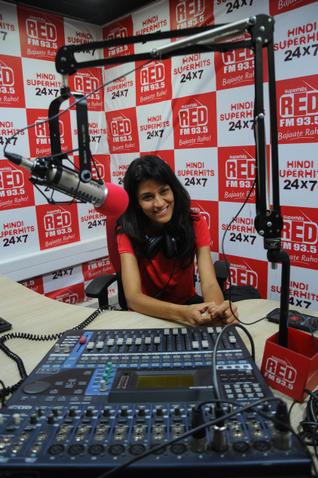
The voice that wakes Bengaluru up

Spotlight On RJ Disha’s Morning No. 1 Photo: Sudhakara Jain

Radio Jockey Disha Oberoi tunes in with Morning No. 1 and sums up the latest laurel her show has received, thanks to Namma Bengalureans

Each one of us would jump at the opportunity to represent our city and country in any way possible. That’s exactly what Radio Jockey Disha Oberoi did at the recent New York Festival for World’s Best TV & Films. The host of Red FM Bengaluru’s morning show Morning No.1, Disha brought home accolades and a medal for the country and city, with the show’s recent social initiative ‘Bengaluru’s Most Wanted’.

Bagging the bronze medal under the Best Human Interest Story category, the show was an endeavour to felicitate the people of Bengaluru who have been doing selfless work for the city behind the scenes.

Elaborating on the award, Disha says it happens every year in Manhattan with over 30 countries participating from across the globe. “The kick here is as a kid, I’ve always wanted to wear the Indian jersey and play a sport or be a bomber pilot for the Indian Air Force. But I couldn’t do either. So this was the closest I could come to wearing an Indian jersey, putting my country out there and represent.” She adds that this was also a way for people to realise that this is very progressive radio from India. “It’s a bigger playing field. And we have scope to grow.”

For the award, they sent three entries. “One was about a gentleman called Mahadev whose job is to dispose unclaimed dead bodies. The interesting thing is he had his sense of humour intact. He said he’s not scared of dead bodies, but rather scared of the ones who are alive! He was a funny man and he made me feel grateful for my life.” The second was a real-life personal account of a lady who was on the same flight as Neerja Bhanot, the flight crew member who saved hundreds of lives in the Pan Am Flight 73 hijacking in 1986. “The narration by the survivor was of personal interest to me since I was flight crew too,” Disha says. The third was an interview with Air Marshal K.C. Cariappa, the son of Field Marshal General K. M. Cariappa, the first Indian Army Commander-in-Chief.

“K.C. Cariappa was a prisoner of war in the 1965 Indo-Pakistan War. The head of Pakistan had served under his father. So he called the father and asked if he can send his son back. The General said all the PoWs are his sons and he wanted them all back. He brought out the spirit of our Army. These are all moving stories with strong emotions,” she adds.

Moving on to talking about the show, an animated Disha says: “When people get on radio, they get excited that they have a couple of minutes on air. A good conversation and a good laugh can change your day.” She adds: “Radio is the only medium that is truly and wholly live. It’s as live as you can keep it. The show is exclusive to Bengaluru – we talk primarily about the city. And it’s for everyone. After all you can’t define a typical Bengalurean today. The city has people from everywhere. It comes with the weather, food and the easy life. Bangalore is cosmo and so is the show.”

How much do you let loose on the show? “I am not allowed to be myself a 100 per cent,” replies Disha with a glint of naughtiness in her eyes. “Most of it is me. Only when the listener comes on and I don’t know what they are talking about, I let them take the lead.”

“A lot of my personality gets enhanced by the people I speak to. I’m a sucker for good conversations. And the people who call are fascinating. For instance, a barber who opens his shop at 7 a.m. and his first customer hasn’t yet come, so he calls to say hello. For me, somebody is Hosur in a small dingy shop is connecting with me. Or even a guy in a car who’s upset about potholes and traffic. I get to talk to so many people, I consider myself very lucky.”

When asked to tell her story, Disha gets nostalgic and says she never really planned to be where she is now. “I was flying for an airline as cabin crew. A friend complimented my announcements and said I should give radio a shot. I was on a six-month sabbatical, travelling, so I walked into a radio station and asked if I could do some ads. They agreed and led me to voiceover artiste Niladri Bose. It was an audition for an RJ. He put me in front of a mike and told me to talk about whatever I wanted. So I went nuts. I was surprised when I came out and he said I can take the job. It happened so naturally, I didn’t plan it.” Having moved from Chennai to Bengaluru six years ago and having dabbled in everything from journalism to flight crew and triathlon to squash, the RJ says the show is just like her. “I don’t have a plan for a future, and that’s what’s worked for me and the show.”

“I have the power to give people some of the sweetest memories of their life. Radio is the most personal medium. When a person is listening to me, I am talking to him or her directly – that can be any of the 18 lakh people in the city.”

source: http://www.thehindu.com / The Hindu / Home> Features> Metroplus / by Allan Moses Rodricks / Bengaluru – July 11th, 2016

Two Bengaluru based researchers bag Gandhi Award in London

 ResearchersBF11jul2016

_____________________________________

Highlights

  1. Dr Ratnavalli Ellajosyula and Nidhi Dev get the prestigious Gandhi International Fellowship Award.
  2. The CNC has been working on research projects in the fields of dementia.
  3. The Gandhi Fellowship Award was set up by a UK based neuropsychologist Dr Narinder Kapur

________________________________________

Bengaluru :

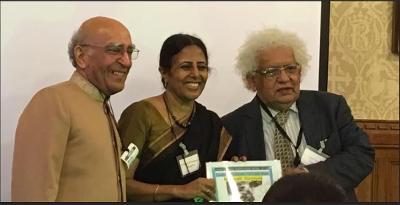
Two researchers from Bengaluru have been awarded with the prestigious Gandhi International Fellowship Award by Lord Meghnad Desai in the House of Lords, London, recently.

Dr Ratnavalli Ellajosyula, founder, Cognitive Neurology Clinic (CNC), and Nidhi Dev, Neuropsychologist, CNC, were among the ten doctors and researchers who were honoured. The team was awarded this fellowship for their outstanding research in the fields of dementia.

The CNC has been working on research projects in the fields of dementia that was presented at the mid-year Meeting of the International Neuropsychological Society in London.

Dr Ratnavalli Ellajosyula, a senior consultant neurologist, did her medical and neurological training in New Delhi. She was faculty, Department of Neurology at the National Institute of Mental Health & Neurosciences (NIMHANS), Bangalore for a decade. She started the behavioural neurology clinic there. She has a fellowship in Cognitive Neurology from the University of Cambridge, UK. She was also a research fellow at the University of North Carolina, Chapel hill. Currently, she heads the Memory Clinic at Manipal hospital.

She has more than a decade’s worth experience in cognitive neurology and neuropsychology. Her clinical interests are stroke, neuroinfections and dementia. Her research interests are multilingualism and dementia, breakdown of memory and mechanisms and neural substrates of language. She has several research projects and has published in the area of stroke and cognitive neurology.
Nidhi Dev is a Consultant Neuropsychologist at CNC with her areas of interest being epilepsy, dementia and children with neurological disorders. Her core research emphasis has been on epilepsy in children and in adults.
Dr Ratnavalli and her team study patients with stroke, dementia, head injuries, and encephalitis as well as healthy adults. Their research focuses on the neural underpinnings and mechanisms of cognitive functions like memory, language, and executive functions. Their work primarily involves doing detailed clinical and neuropsychological assessments that aid in accurate diagnosis of neurological conditions, treatment and designing of rehabilitation plans.
The Gandhi Fellowship Award was set up by a UK based neuropsychologist Dr Narinder Kapur in the memory and spirit of Mahatma Gandhi, to promote neuropsychology in India. Dr Kapur is currently visiting Professor of Neuropsychology at University College London.

source: http://www.timesofindia.indiatimes.com / The Times of India / News Home> City> Bangalore / by Sunitha Rao R / TNN / July 08th, 2016

Campco to export areca nut to China

Mangaluru:

With China increasingly looking towards India to meet growing demand for areca nut back home, the Central Arecanut and Cocoa Marketing and Processing Cooperative (Campco) Ltd will export two metric tonnes of tender areca nut in the first week of August.

The husk of tender nut is used widely in China to make mouth freshener and other edible items after due processing there.

As per a memorandum of understanding between Campco management and Kou Wei Wang (King of Taste), the Chinese company will depute its experts to the Puttur unit of the multi-state cooperative in the second week of July. The experts will impart training on processing and standardization of products of their requirement, said Konkodi Padmanabha, former president of Campco, who was part of a three-member delegation that visited China last week.

Padmanabha said as per a Campco study, areca nut is grown to the tune of 1.22 lakh tonnes in Hunan province of China annually. “There are around 20 manufacturers of areca nut mouth fresheners across China. Nine out of 26 states in China use mouth fresheners made out of tender areca nut, and the agreement (with Kou Wei Wang) could well open the doors for more imports of the raw material there,” he said.

Noting that the Hunan-based company has capacity to supply only to nine states and is unable to give to the rest due to the lack of raw material, he said the company is producing high-standard value added products compared to other companies that produce areca nut products of different standard. “We will collect data on (other) companies and also meet their demand for all varieties of areca nut grown in India at a future date as and when they raise a demand,” he added.

Suresh Bhandary, managing director, said Kou Wei Wang has indicated its preference for the first quality areca nut for their needs and have indicated a price of Rs 350-400/kg. This will be a good rate for the growers and also provide them financial back up in the eventuality of courts in India banning supari and gutka completely, he said. Further exports depends on how the first consignment due for exports in August is received there.

S R Satish Chandra, president, the Campco Ltd, said, “Demand for areca nut far outweighs domestic production in China. In future, Chinese companies may set up their mouth freshener producing units in India itself.”

Suresh Bhandary, MD, the Campco Ltd, said, “Tender areca nut is boiled for one hour and then dried. Chinese companies have the machines needed for the process. If Kou Wei Wang wants some modification to the machine we have, Campco will do so.”

source: http://www.timesofindia.indiatimes.com / The Times of India / News Home> City> Mangalore / Jaideep Shenoy / TNN / June 22nd, 2016

David and the bean stalk

David Belo /  Photo: Shaju John /  The Hindu
David Belo / Photo: Shaju John / The Hindu

We dine with the founder of Earth Loaf and decode what goes into this Indian-grown artisanal chocolate

After a whiskey chocolate dinner and an interview with David Bello, Earth Loaf’s founder, I’m trying to gather my thoughts, but the bar of chocolate is distracting. Wrapped in candy pink bearing a peacock motif, it’s anything but candy. Deep dark chocolate of Kerala origin, made with palmyra sugar and locally-sourced ingredients, 72 per cent is wood fermented in cedar boxes. The chocolate is dark and slightly bitter, has a fruity finish and a woody earthiness that comes from the cedar wood boxes — a first in many ways.

For the socially conscious consumer, Earth Loaf ticks all the right boxes. The cocoa is single origin, sourced from either Karnataka or Kerala — there’ll be one from Tamil Nadu soon — the sweetener used is local palmyra, the farmers are closely involved in the production and it’s all hand-made. From ‘bean to bar’, as David is fond of saying, it’s a local Indian product — but it took a Londoner with Greek roots to make it.

Earth Loaf, originally, was the name of a bakery in London that David started, and after moving to Mysore with his partner Angelika in 2012, he used the name for the small chocolate-making endeavour that took off. What started as 3-4 kg of chocolate made by hand for friends and family became a registered company that works with cocoa farmers in Karnataka, to create a sustainable, Indian chocolate brand. A one-man show today, Earth Loaf is David’s baby, as he calls it, and he does everything from sourcing cocoa beans to web-designing for the site and even creating the lovely packaging that features a peacock motif from the Chittara art of the Malnad region. Today, David calls Mysore home, and having grown up in South Africa, took to Indian climes like a fish to water. “I love the heat! I thrive in it,” he grins.

Artisan, vegan, raw — there are many labels that Earth Loaf identifies with, but that’s not what its selling point is. For David, it’s simply his vision, translated through fine chocolate. Which is why the bars are specific in their flavours; they aren’t trying to cater to a variety of palettes. “There have been people who tried our chocolate, disliked it or found it too bitter. But they came back, to try another flavour. A second, third, even a fourth time. They are willing to experiment and they keep coming back,” he says. Well aware of the Indian sweet tooth, David is just putting out into the market something he enjoys himself — dark chocolate with some unusual pairings. And there’s also the story behind each bar. David knows the farmers personally, he’s even learnt Kannada to converse with them, and he prices his products a bit on the higher side, because he believes that the farmer should get his fair share. The bars are all processed by hand, from the grinding of the beans to the final packing.

His 72-per cent bars of single-origin raw chocolate are paired with unusual ingredients like gondhoraj– a lemon that’s somewhere between the Italian lemons used to make limoncello and an African kaffir lime found only in parts of Bengal and Assam — smoked salt, dried apricots, nuts and more. David’s background as a mixologist is reflected in how he pairs his flavours, often reworking an idea for months at a time, until he gets it right. “Even when I was bartending back in London, I’d work on a single cocktail, like a Martinez, for about six months till I got it right,” he says. And it’s the same with his fruit pairings. Recently, he’s been trying to infuse a jamun-like fruit native to Karnataka into his chocolate, without much success.  “The chocolate keeps overpowering it, so I’m trying different things. I’ve been trying to squeeze the essence out of the rind of the fruit, like how you would a bergamot, but it didn’t work, so now I’m trying to dry the rind, powder it and see if that will work better.”

For a country that’s quite a prolific producer of cocoa, India seems to be relatively new when it comes to the bean-to-bar variety of chocolate. “Cocoa was originally brought to India from Indonesia in 1798, by the East India Company,” he explains, “and India has had varieties of cocoa growing, but it wasn’t until the 1950s that Cadbury decided to push cocoa farming in India and that’s when it took off.”

Much like the coffee culture that came from the West to show us the amazing varieties we have in India, there’s a wave of chocolate appreciation that’s slowly gaining ground. A far cry from the sugared candy bars you see at grocery stores, today’s artisanal chocolate is locally sourced, handmade, has tasting notes that range from woody and fruity to acidic, is affected by the terroir, and lends itself to all kinds of pairings from food to wine and whisky. And this chocolate evangelist from Mysore, is more than happy to introduce the country to its own hidden chocolate treasures.

(A menu pairing Earth Loaf chocolates and Jameson whiskey is available at On The Rocks, Crowne Plaza Chennai Adyar Park till June 26. It is priced at Rs. 2,999 per person.)

source: http://www.thehindu.com / The Hindu / Home> Features> Metroplus> Society / by Elizabeth Mathew / Chennai – June 21st, 2016

University of Texas acquires Raja Rao’s archive

Raja Rao. / Photo: The Hindu Archive

Renowned Indian-American author and philosopher Raja Rao’s archive that includes a broad range of materials from unpublished works to manuscripts of his well-known novels has been acquired by the University of Texas for advancing the study of arts and humanities.

Rao’s estate donated the archive to the Harry Ransom Center, a humanities research library and museum at the University of Texas in Austin.

According to the centre, “It’s a notable acquisition in part because Rao is widely considered to have been one of India’s most noted authors, having received the Neustadt International Prize for Literature and other honours.”

The Harry Ransom Center specialise in the collection of literary and cultural artefacts from the U.S. and Europe for the purpose of advancing the study of the arts and humanities.

Rao (1908-2006), considered one of India’s earliest and most outstanding English-language novelists, was the author of numerous works of fiction, short stories, poetry, talks, essays and The Great Indian Way: A Life of Mahatma Gandhi (1998), about Gandhi’s time in South Africa.

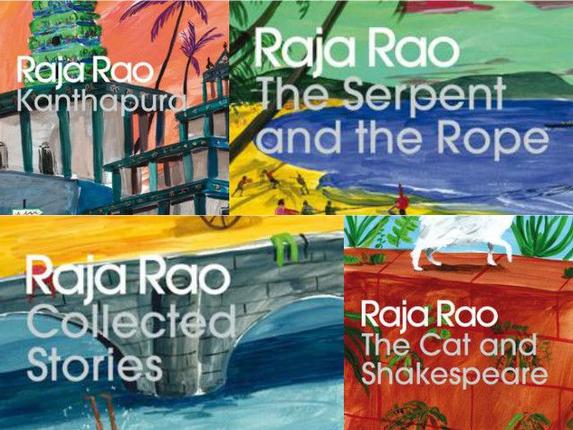
Rao’s archive includes manuscripts of his well-known novels Kanthapura (1938), The Serpent and the Rope (1960) and The Chessmaster and his Moves (1988).

Screenshot of the Harry Ransom Center site shows a photo of renowned writer Raja Rao's 1969 passport.
Screenshot of the Harry Ransom Center site shows a photo of renowned writer Raja Rao’s 1969 passport.

“Departing boldly from the European tradition of the novel, Raja Rao has indigenised it in the process of assimilating material from the Indian literary tradition,” said R. Parthasarathy, professor emeritus of English at Skidmore College.

Educated at the Aligarh Muslim University and the University of Madras and other foreign universities, Rao was already an internationally known author when he was recruited by former University of Texas president John Silber to teach Indian philosophy and Buddhism in Austin.

His archive contains materials in several of the languages that Rao spoke, including English, French, Sankskrit and his native Kannada.

Rao won the Sahitya Akademi Award in 1964 for the philosophical novel The Serpent and the Rope. In 1969, he was the recipient of the Padma Bhushan and in 2007 he was posthumously awarded the Padma Vibhushan.

RajaRao03BF23jun2016

Alongside the archives by Rao at the Ransom Center are manuscript collections of prominent international writers including J.M. Coetzee, Anita Desai, Doris Lessing, Gabriel Garcia Marquez and Amos Tutuola.

source: http://www.thehindu.com / The Hindu / Home> Books> Authors / PTI / Houston – June 16t, 2016

Mary Pierce Indian Ocean series ITF Women’s Tennis: Dhruthi, Kyra duo clinch title

Dhruthi T. Venugopal (left) and Kyra Shroff who won the women's doubles title in the Mary Pierce Indian Ocean Series ITF Women's Tennis Tournament at Mauritius, seen with the winners' trophy.
Dhruthi T. Venugopal (left) and Kyra Shroff who won the women’s doubles title in the Mary Pierce Indian Ocean Series ITF Women’s Tennis Tournament at Mauritius, seen with the winners’ trophy.

Mauritius :

Mysuru-based Dhruthi T. Venugopal teaming up with Kyra Shroff representing India in the Mary Pierce Indian Ocean Series $10,000 ITF Women’s Tennis Tournament at Mauritius which concluded on Sunday, won the women’s doubles title.

In the final, second seeded Dhruthi and Kyra combined well to score an upset win over top-seeds Chayenne Ewijk and Rosale van Der Hoek of Netherlands 6-1, 6-1 to clinch the title.

source: http://www.starofmysore.com / Star of Mysore / Home> Sports News / June 21st, 2016