Category Archives: World Opinion

Satellites, space and bonds of friendship

France and India, according to Consul General of France, Dr Marjorie Vanbaelinghem, have had an intense and fruitful strategic partnership in space programmes since the ’60s.

Bengaluru :

Then Indian Prime Minister Indira Gandhi with then French President Francois Mitterrand in 1981

France and India, according to Consul General of France, Dr Marjorie Vanbaelinghem, have had an intense and fruitful strategic partnership in space programmes since the ’60s. And now, an online exhibition on Indo-French partnership in space will highlight the major joint breakthroughs. Hosted by Centre National d’Études Spatiales (CNES), it is being showcased at the International Space Conference and Exhibition from Sept. 15 to Oct. 10 and will be available on the virtual stand of CNES/France.

Vanbaelinghem points out, “It is a lesser-known part of our bilateral relationship and common history. The exhibition, which features beautiful photos, is in itself an illustration of this bond of friendship as it is a collaboration between the Alliance Francaise Hyderabad, the CNES bureau of Bangalore and the Space Museum in Hyderabad, whose curator, Pranav Sharma, gives a fascinating account of the more humane side of this enterprise.” For instance, the Ariane Passenger PayLoad Experiment (APPLE) – the experimental communication satellite successfully launched by Ariane-1 – from Kourou, French Guiana, on June 19, 1981, marked an important milestone in India’s space programme.

APPLE was designed and built as a sandwich passenger-carrying Meteosat on top and Capsule Ariane Technologique. VIKRAM engine was developed by India by learning from liquid propulsion technology developed by CNES and shared with India after Societe Europeenne de Propulsion (SEP)-ISRO Agreement signed in 1974. 

According to Sharma, who has curated India’s first interdisciplinary Space Museum in Hyderabad and is passionate about sharing the Indian history of science, the exhibition is an attempt to explore friendship between the two countries. “This exhibition is an extension to its predecessor that was hosted at WINGS-India 2020 in Hyderabad as a travelling exhibition.

This version brings interesting insights and personal memoirs of people and their families involved during the transfer of liquid propulsion technology,” he says, adding that it’s meant for anyone, but may particularly be of interest to students and those interested in the history of science.

source: http://www.newindianexpress.com / The New Indian Express / Home> Cities> Bengaluru / by Express News Service / September 13th, 2020

BIAL opens India’s first on-Airport Public Bonded Warehouse

KIA has the largest air cargo terminal in south India, with a handling capacity of 570,000 MT and an average travel time of nine hours from major manufacturing clusters across south India.   | Photo Credit: K_MURALI_KUMAR

The facility will help re-export of goods, long-term storage of bonded cargo, assist in partial clearances and allow value-added services

With an aim to make Kempegowda International Airport (KAI) a cargo hub, Bangalore International Airport Limited (BIAL) recently opened what is said to be India’s first on-Airport Public Bonded Warehouse, which is expected to reduce supply chain costs and facilitate trade in and around Bengaluru.

According to BIAL, the facility will help re-export of goods, long-term storage of bonded cargo, assist in partial clearances and allow value-added services such as labelling, packing and re-packing services.

The 10,000 sq.ft. warehouse facility will be operated by Cargo Service Centre (CSC) and fall under the jurisdiction of the City Commissionerate, Bengaluru Customs.

A BIAL spokesperson said that KIA was the third busiest cargo airport in the country and the busiest in south India. “The new facility will play a significant role in boosting the economy of the region by improving trade and connecting markets around the world,” the spokesperson said.

KIA processed 99,154 MT of cargo between April and August 2020, recording a 92% growth in Cargo Air Traffic Movements. KIA has the largest air cargo terminal in south India, with a handling capacity of 570,000 MT and an average travel time of nine hours from major manufacturing clusters across south India.

To bring further efficiencies into cargo operations, BIAL has announced implementation of the Air Cargo Community System to streamline the air logistics supply chain.

source: http://www.thehindu.com / The Hindu / Home> News> Cities> Bengaluru / by Staff Reporter / September 11th, 2020

Bridging The Past And The Present !

Picking up the thread of my last week’s narration about the historic Lushington Bridge at Shivanasamudra and my dismay at its botched up restoration in the present era, I would like to take you back by two centuries and give you some refreshingly different and very interesting information from its glorious past. 

You may recall that I had said last week that I had written about this bridge once before some years ago. Yes I had and very soon after I wrote about it I received a phone call from Mrs. Tara Ravikumar, a seventh generation descendant of Ramaswami Mudaliar, an officer under the British Government who nearly two centuries ago had almost rebuilt and restored the bridge across the Cauvery River with the expertise and skills of the local stone masons. She had called up to say that her family still had in its possession the Sanad or endowment document that gave Ramaswami Mudaliar a large Jagir or permanent endowment of many villages and vast stretches of land as a reward for the good act of public service that he did in his time, now making him a Jagirdar. She had added that she also had in her possession a medal of honour given on behalf of the then British Governor General. 

Although I had told her that I was most eager to see these two extremely valuable artefacts, I somehow never got around to doing it. Though the two of us would occasionally meet each other at functions like weddings and book releases and she would always remind me about my pending visit to her place, my visit itself had never materialised. That was until last Thursday when it had to materialise if I had to write about the bridge the next day! So my wife and I hurriedly dropped in on her to see the two objects which have been preserved remarkably, in mint condition even as they have travelled through six generations! 

1. The inscription on the obverse of the medal. 2. The image of the bridge engraved on the face of the medal. 3. The idols of Ramaswami Mudaliar and his wife at Sri Ranganathaswamy Temple.

The Sanad written in a most beautiful and flawless longhand, without a single correction whatsoever is an imposingly large scroll of crisp parchment which I was scared to touch or handle for fear of spoiling its pristine condition, although Tara most graciously asked me to go ahead and take a closer look! But I did not have the courage and decided that I would just quickly click a few photographs of it while she and my wife carefully held it open. 

It places on record not only the grant of the absolute rights and the title of the Jagir granted to Ramaswami Mudaliar by the Governor General at Madras but it also extensively lists in great detail the names and locations of the villages and the extents of the lands around them with their survey numbers! 

The document is authenticated by an impressive wax seal of authority which although naturally a little cracked by the passage of the two centuries it has silently seen, is still completely intact! Just to safeguard the two of her most priceless possessions I told Tara to desist from showing them to the many eager people who may naturally approach her for the favour after reading my article about them. I only hope she will be able to do it!   

The golden medal too is no less impressive, being a large and heavy nugget, hand crafted and hand engraved painstakingly, with a synopsis on one side of what the document says in much greater detail. On its other side it has an engraving of the curved bridge itself with the towers of the two temples that still stand with it even to this day. 

The curve is crucial here because the Journal of the Royal Asiatic Society places on record the fact that Ramaswami while writing to his superiors about the design of the bridge has made a mention of it as a feature he has incorporated in its design to enable it to better resist and withstand the onslaught of floodwaters during the peak of the monsoon. A really marvellous incorporation indeed in a bygone era of an engineering technique that we now find in almost every one of our dams built in the modern era which happen to be invariably curved rather than straight! 

The inscription on the medal reads: “Political Department, Bangalore, 9th, October, 1834. His Excellency the Rt Honourable Govr GENERAL of India in council Being desirous of testifying his sense of the public spirit manifested by Ramasawmy Moodelliar at having at a great Expense restored the ancient Bridges across the Cauvery River at Siva Samoodram has been pleased to resolve that the Individual & his lineal descendants shall be permitted to be eligible to affix to their names the TITLE of “Iunapacara Curtas” signifying One who Confers a Benefit on the public. In COMMEMORATION of which this Medal has been struck and is presented to RAMASAWMY MOODELLIAR by his sincere friend John Sullivan during whose official charge of the province of Coimbatoor these useful works were undertaken.” 

Now my friends, that is not all. This was what an appreciative and grateful administration did to recognise and place on record the services of a sincere and hard-working officer for going beyond the call of his duty and doing much good to his people. But I feel that the way in which the humble inhabitants of the Island of Shivanasamudra to whom he provided some much needed connectivity with the rest of the world, went a step further and honoured the man merits a mention here.

They made him a demi-God and placed him alongside their principal presiding deity, whom they all worshipped, day in and day out. That is why if you happen to visit the imposing Ranganathaswamy Temple at Shivanasamudra you will still find the images of Ramaswami Mudaliar and his wife, both carved from a single stone, standing there, draped in silken attire. The villagers adorn them with fragrant flowers and worship them too, even to this day, just like they have been worshipping their God over the centuries, with bowed heads, trembling lips and folded hands! That is the kind of simple and humble gratitude that dwells unchanged over the centuries in our rustic souls!

e-mail: kjnmysore@rediffmail.com

source: http://www.starofmysore.com / Star of Mysore / Home> Columns – Over A Cup of Evening Tea / by Dr. K. Javeed Nayeem M.D. / August 28th, 2020

NIT-K ranked fourth globally in Google Summer Code 2020

The National Institute of Technology – Karnataka (NIT-K), Surathkal, has been ranked fourth globally in the list of universities with the most accepted students for Google Summer Code (GSoC) – 2020.

The GSoC is a global programme organised by Google Open Source team with an aim to introduce students to open source software development. The students are paired with mentors from open source organisations to work on a programming-intensive project. This year, the programme is running from June – August 2020, the institute said in a release.

It said that 23 students from NITK got selected for GSoC 2020 in some of the best open source organisations across the world. A total of 1,198 students from 550 universities globally are participating in GSoC 2020.

Over the past three years, there has been a voluntary and organised effort led by Mohit P. Tahiliani, Assistant Professor, Department of Computer Science and Engineering, and interested students from various departments of NIT-K to structurally plan out open source activities in the institute. The first batch which was a part of the effort resulted in seven selections in GSoC and the number has increased in the past two years, thereby showing the growth of NITK in the field of open source contributions, the release said.

source: http://www.thehindu.com / The Hindu / Home> News> States> Karnataka / Mangaluru – August 21st, 2020

When Bengaluru shouted ‘Quit India’

The city has a long history of revolts and expressions of resentment against the British

Remembering them: A memorial at Mysore Bank Circle in Bengaluru to commemorate some of those who died in the freedom struggle.   | Photo Credit: Special Arrangement

Mysore Bank Square, August 17, 1942. For the ninth consecutive day, thousands of Bengalureans came out to protest peacefully in response to Gandhiji’s Quit India call. People surged and flowed along Avenue Road and slogans suffused with hope and anger rented the air: “Quit India!”, “Inquilab Zindabad!”

But that Monday, some protesters set fire to a post office at Aralepete; others broke into a police station and tried to attack the post office at Chickpet. When the police issued warnings, defiant protesters barricaded the road with carts and boulders and then hurled soda bottles at the policemen, while others threw stones from their rooftops.

The police opened fire, six people died and more than 30 were injured. Bengaluru has a long history of revolts and expressions of resentment against the British. Even in 1800, people were arrested for singing songs against the British and in praise of Tipu Sultan.

Attempted mutiny

Twenty-five years before the First War of Independence swept through India, there was an attempted mutiny in Bengaluru by soldiers who dreamt of overthrowing the British here and then inciting mutiny all over India; their plan was thwarted by a snitch.

From the late 1800s, like the rest of the country, Bengaluru too was gripped with nationalistic fervour. This was fanned by the activities of organisations such as the Vokkaligara Sangha, established in 1906, which did much to raise awareness and education in the community, and the Theosophical Society, which established a branch here in 1886.

Big stimulus

A big stimulus to the still-nascent freedom movement was the return of Mahatma Gandhi from South Africa in January 1915. His first visit to Bengaluru was in May 1915. His second visit in 1920 ushered in a movement for spinning khadi. Khadi sales were frequently held, as were other gatherings — to celebrate Gandhiji’s ending a fast, to mourn the passing of C.R. Das, or protest against a water tax. Such meetings usually began with Gandhians speaking about non-cooperation, Hindu-Muslim unity, against untouchability, and against alcohol.

Hundreds attended these gatherings which were held in the so-called Gandhi Maidan opposite Minto Hospital, Doddanna Hall, which was opposite Bengaluru Fort, and sometimes, even Tipu Palace. Many such meetings had an attendee whose job was to report on them to the Mysore administration: one such report by a spy in 1925 records the speeches made and then dutifully notes that khadi worth Re. 1 and 2 annas was sold.

Except for when he was here to recuperate from illness, Gandhiji’s visits had him criss-crossing the city, holding meetings at Mahila Seva Samaja, the RBANMs school and grounds, a home on Lalbagh Road, a shop at Commercial Street, and so on. Thousands thronged to listen to him speak passionately about non-violence and the evils of untouchability. A meeting in a house on Victoria Road, for example, drew 2,000 people, at National High School, 25,000 people. Many people who attended these meetings donated generously to the cause, sometimes even giving away their jewellery.

But not everyone was so moved: some people held meetings where they denounced Gandhiji’s anti-caste stand as “subversive of Hindu dharma”. The 1920s and 1930s also saw frequent student rallies, boycott of classes, and picketing of shops selling foreign cloth. In that pre-WhatsApp and social media era, when even telephones were uncommon, how did organisers get the word out about upcoming meetings? Enter the cheap flyer. Hundreds of these indispensable handbills were churned out at several small presses around the city and were then distributed door to door, in markets, and stuck on strategic lamp posts.

Turning point

A turning point in the freedom struggle in Bengaluru came in 1937 when K.F. Nariman, president of the Bombay Congress Committee, was invited to speak here. The Mysore government had banned him from addressing gatherings because of his earlier “incendiary” speeches. On October 24, at Banappa Park, as soon as Nariman came on to the stage to address a crowd comprising mainly students, he was arrested. The next day, when students gathered to protest his arrest, police opened fire on the unarmed protesters. One person was killed and 73 people were injured that day.

Little-known memorials at Banappa Park and at Mysore Bank Circle commemorate some of those who died in the 1937 and 1942 incidents.

(Meera Iyer is the author of ‘Discovering Bengaluru’ and the convenor of INTACH Bengaluru Chapter)

source: http://www.thehindu.com / The Hindu / Home> Opinion> Columns / by Meera Iyer / August 14th, 2020

Toast to a new experience

As a student and young professional, Saveen Hegde always assumed that oration is an inherent skill.

Saveen Hegde

Bengaluru : 

As a student and young professional, Saveen Hegde always assumed that oration is an inherent skill. That was until he was one of two persons to represent India at the 86th Annual International Convention which was held at Vancouver, Canada in August 2017. Now on August 27, Hegde will address a gathering from around the world at the International Convention of Toastmasters’ first-ever Virtual Convention, where he will talk about design thinking in the 30-minute slot. The 34-year old is the only person to represent South Asia and South East Asia region (Singapore, Cambodia, Laos, Mynamar, Bhutan, Vietnam and Malaysia). While it was supposed to be held in Paris, the pandemic has led to the summit going virtual. 

In his upcoming talk, Hegde, who has a certification from Harvard Business School, will delve into design thinking as a way of life. “It’s important to incorporate creativity and flexibility in the work space. Design thinking combines creative and critical thinking that allows information and ideas to be organised, decisions to be made and situations to be improved. It’s about looking at a business from an artist’s point of view,” says Hegde, who decided to start his own firm, unboxexperience.com, after leaving an automobile design company in 2011.

Around the same time, Hegde felt the need to hone his public speaking skills. “I then came across Toastmasters’ clubs and felt that a platform where feedback is provided would help,” he says. Hegde is also an improvisational theatre artiste who performed over 300 live performances in four countries for over 2,00,000 people. He is the founder of the Indian Improv Tribe and learned improv theatre at the UCB Theatre in New York, and has played a cameo in two South Indian movies – Humble Politician Nograj and the upcoming Ten. 

While he previously feared acceptance, especially on a global forum, regular participation in Toastmasters’ programmes have rid those. “This summit is different from the World Championship, which I previously participated in. This is not a competition but instead it has 14 select educational speakers from across the world. Some years ago, a non-native English speaker won the World Championship, which broke the glass ceiling about how anyone can do it,” he says.  

The takeaways from the session, Hedge points out, will be learning why design thinking is effective for leaders in today’s changing world; using it to develop an open, flexible mindset; and applying it to better organise ideas and improve situations. 

source: http://www.newindianexpress.com / The New Indian Express / Home> Cities> Bengaluru / by Vidya Iyengar / Express News Service / August 19th, 2020

Forgotten In India – A Hero In Japan Justice Radhabinod Pal

JusticePal01BF12aug2020

The United States dropped an uranium atomic bomb on the city of Hiroshima on 6th August 1945. Nearly a lakh of civilians died instantly or were severely injured. Another plutonium atomic bomb was detonated over the city of Nagasaki on 9th August 1945 with a similar devastating effect. This resulted in Japan’s announcement of an unconditional surrender to the US Forces, on 15th August 1945. The supreme commander of the allied forces, Gen. Douglas MacArthur, received the formal instrument of surrender on 2nd September 1945 on the US naval ship Missouri, and he continued as the military administrator of Japan. The General arrested all the main decision-makers like the Prime Minister, Chief of Military and a number of others and imprisoned them. One of the main accused was General Hideki Tojo, Prime Minister of Japan (1941-44).

The US and the allied powers were keen to punish the top decision-makers in the Government and the military who started the war.  They called them the war criminals. They constituted the International War Tribunal for the Far East, on the lines of the Nuremberg Trials of Germany. The Tribunal had eleven Judges drawn all over the Western world and British Commonwealth. The Judges came from England, France, New Zealand, United States, Philippines, India etc.  Popularly known as the “Tokyo Trials”, the trials started on 14th May 1946 and lasted for two-and- a-half years. The final judgement was delivered in November 1948. The defendants included former Prime Ministers, Foreign Ministers and prominent military Generals who were involved in the decision- making to wage and continue the war.

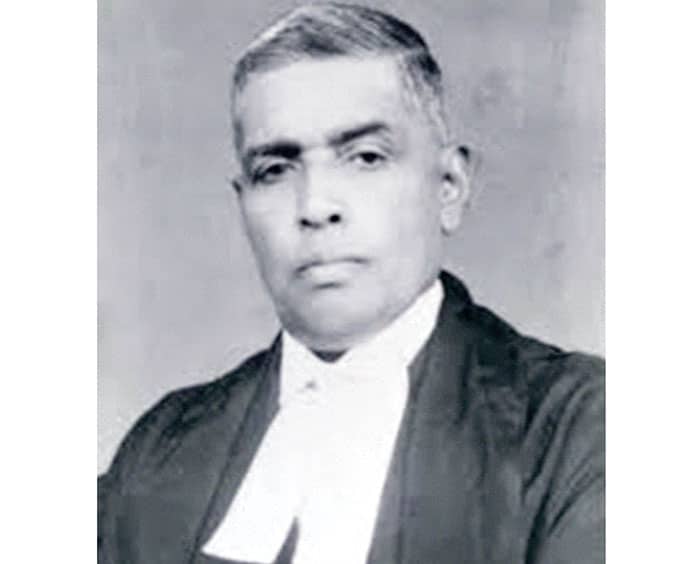
The Tokyo War Trials were long and went on for more than two years. The trials had 816 sessions, more than 4,000 witnesses and 48,412 pages of transcripts.  The sentences were pronounced in November 1948.  Slowly each of the Judges pronounced the defendants to be guilty. The 11th Judge thundered “NOT GUILTY” and stunned ten other brother Judges and the whole Courtroom.  The man who gave the dissent and exonerated all the accused was “Justice Radhabinod Pal” from India.

JusticePal02BF12aug2020

Justice Pal was born in a small village in present day Bangladesh and educated in Calcutta.  He worked as a Professor of Law, retired as a Judge of Calcutta High Court and later was appointed as the Vice-Chancellor of Calcutta University. He was known for his legal erudition and expertise in international law. He was nominated as a Judge on the Tokyo War Tribunal by the then British Government of India in 1946.  Justice Pal wrote a lengthy dissenting judgement of 1,250 pages. It seems that Jurist Pal rarely went out of his hotel room in Tokyo and personally typed his lone lengthy dissenting judgement. He felt that the trials themselves were illegal. He opined that like the European countries who had Colonies, Japan too was entitled to acquire its own Colonies. He pointed out that Japan cannot be tried for crimes against humanity.  He felt that the large devastation and deaths inflicted by the American atom bombs were as much, if not greater, crime against humanity.

He gave a number of arguments terming the Tokyo War Trials as irregular and illegal.  Justice Pal’s dissenting opinion was severely criticised all over the western countries. Pal’s view was “aggressive war was reasonable because it is about National Sovereignty”.  He pointed out that the Western countries acquired their Colonies by brutal wars and hence did not have a moral right to stand in judgement.  He was of the opinion that conquerors should not pass judgement on the conquered and the Tokyo trials were more of a victor’s revenge. In his judgement, Pal was very severe towards Japan too, but his criticism of the US was very serious.

The War Tribunal and the Western Governments did not like the dissenting opinion of Justice Pal and decided not to publish his 1,250-page-long judgement.  Japan signed a Peace Treaty with the United States in 1952, and the military administration of Gen. Douglas MacArthur ended, and Japan was once again a sovereign free nation.  Soon afterwards the Japanese Government published the 1,250-page-long dissenting judgement of Justice Pal.

Pal’s opinion that Japan was not legally culpable, was accepted and hailed by a large section and particularly the upper  classes of the country. The Japanese society appreciated the courage and passion of Justice Pal.  It is said thus Justice Pal’s opinion highly mitigated the shame and remorse felt by the Japanese people and particularly the ruling elite.

A group photo of the Judges of the Tokyo War Trials.

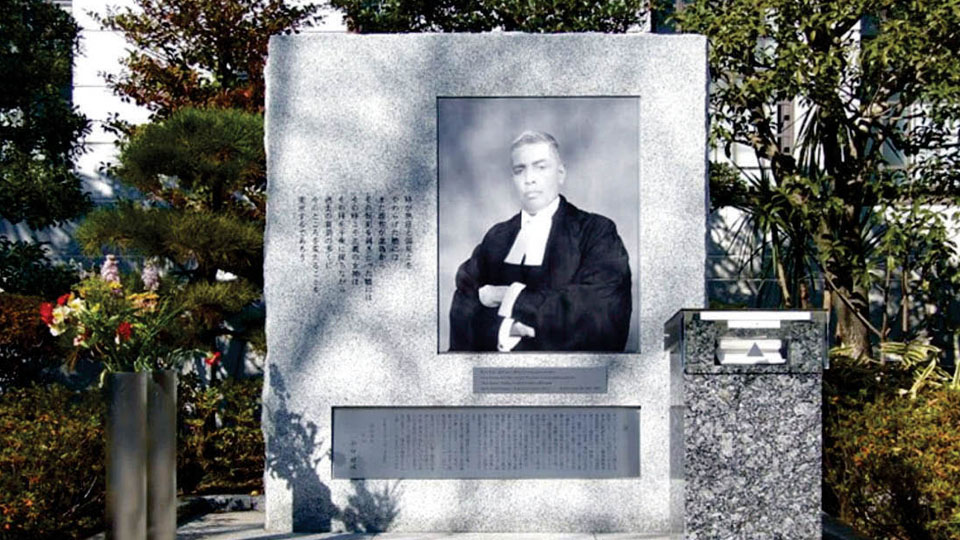
After the Tokyo Trials, Pal was elected to the UN International Law Commission, where he served illustriously from 1952 to 1966. Japan felt very grateful to Justice Pal.  The Emperor bestowed on him the nation’s highest honour “Order of the Sacred Treasure” in 1966.  He was invited twice more to Japan for lectures. The Government of India honoured him with the title “Padma Vibhushan.”  After his death, the Japanese Government erected a memorial for Justice Pal in “YASUKUNI SHRINE”,  which is a memorial for the National and War   Heroes of Japan.  When Prime Minister Abe visited India, he went to Calcutta to meet the son and family members of late Justice Pal.

For his dissenting judgement exonerating Japan, Jurist Pal was highly criticised and vilified all over the Western world.  But Justice Pal had the courage of conviction to go against the opinion of all the ten of his fellow Judges and the wishes of the allied powers of the United Kingdom, United States and Russia. This  Indian Judge showed exemplary courage in telling the world that in a war, there is no ‘good side’. Justice Radhabinod Pal is almost forgotten in India but remains a greatly admired and adored hero in Japan.

source: http://www.starofmysore.com / Star of Mysore / Home> Feature Articles / by Dr.C.D. Sreenivasa Murthy /August 03rd, 2020

Free online film festival, organised by The Federation Of Film Societies of India

OnlineFilmsBF07aug2020

The Federation Of Film Societies of India (FFSI) has organised an online film festival, Retrospective Of Girish Kasaravalli Films. The festival, which started on July 27 will be on till August 2.

The film festival is free and you can just click on the links to either watch the films or participate in the discussion. The film chosen for the festival are Ghatashraddha (which won the President’s Golden Lotus Award as the Best Indian Film of 1976, https://vimeo.com/441814975), Thayi Saheba (also won the President’s Golden Lotus award as the Best Indian Film of 1997, https://vimeo.com/441815434 ) and Kanasembo Kudureyaneri – Riding The Stallion Of Dreams- (This film won the President’s Silver Lotus Award as the Best Kannada Film of 2010, Netpac Award, Rome, Italy, https://vimeo.com/441815905)

That is not all. The Federation has also organised a live session with the director who will talk about the about the three film on July 31 at 5 pm. Girish will be joined by National Award winning film critic Professor N Manu Chakravarthy on https://event.webinarjam.com/register/45/ox82kcwl

OnlineFilms02BF07aug2020

Girish talks to MetroPlus about his films and the virtual world. Edited excerpts

Could you comment on the choice of films for the festival?

FFSI chose these films. I was keen that Koormavatara be chosen as it is also the 150 years of Gandhiji. I would have also loved it if my other films were chosen, but I am happy with this choice too. I don’t think many have watched Thayi Saheba or Kanasembo… As far as festivals go, I have observed that Ghatashraddha is a popular choice.

How do you think the online film festival will work?

It is an advantage for us. While the film industry is almost at a standstill because of the pandemic, there seems to be no space to screen old films. Every film festival looks for new films. Earlier the film society would promote films and send them to every festival, hence my works like Tabarana Kathe reached many. But gradually people started looking for the latest films and we lose the opportunity to reach out to a larger audience. This is a great platform for my work to reach out to people, especially Thayi Saheba, which is not available on DVD or on any streaming platform.

We just click on the links and watch the film?

Yes, it as simple as that.

On July 31 you will go live…

Yes, we will be discussing the three films in detail. The event will be moderated by the organisers and there will be a Q&A session too.

As everything is now virtual, do you feel there should be a pattern change when it comes to a director’s or an actor’s perspective?

I don’t think so. I feel this trend will last only as long as the pandemic. Cinema on screen is a different experience when compared to watching a film on your laptop or mobile. Especially those who watch mainstream cinema, will always prefer the theatrical experience as they do not go in for the content. So cinema on the big screen will never die. It may not get the reach of the virtual platforms, but it will not die out. It is just that the pattern has changed. Earlier films would run for 100 or 200 days. Today they run in theatres for a short time and are then released online. With the virtual releases I feel directors like me get affected. Those who make small budget films struggle to recover our investments. Now, with the pandemic, these issues have become acute that is all.

Tell us about your latest film, Illiralare Allige Hogalare 

The film is stuck due to this pandemic. It is sad as not many festivals are happening. And I wonder if the organisations that have postponed their festivals to next year will take this film as it will be an old film by 2021. Will they consider this film as a new one because of the pandemic? That is yet to be seen.

What has been the hardest for you to deal with during this pandemic as a director?

For film makers and actors, not having contact with the outside world can be frustrating. We lose the touch with the real world. All we get to know is through the news, which also sometimes can be manufactured. It makes the line between the real and concocted very thin. So all we do is read books, watch news or films, but how much can one do these? It is not good for anyone as we lose social connections and may lose the sense of what is right and wrong, what is happening and what is not.

source: http://www.thehindu.com / The Hindu / Home> Entertainment> Movies / by SSR / Bengaluru – July 28th, 2020

IISc-Bengaluru, IIT-Madras top HRD ministry rankings

The Indian Institute of Science at Bengaluru in Karnataka is the No.1 higher educational institute in the country as per NIRF rankings.

Bengaluru's IISc has also been ranked as the top university in India, as per the second edition of India Rankings under the National Institutional Ranking Framework (NIRF) released on Monday. | Express File Photo
Bengaluru’s IISc has also been ranked as the top university in India, as per the second edition of India Rankings under the National Institutional Ranking Framework (NIRF) released on Monday. | Express File Photo

New Delhi :

The Indian Institute of Science (IISc), Bangalore, the first Indian institution to make it to the top 10 in a global ranking, has been ranked at the top in the annual national rankings released by the HRD ministry.

Seven Indian Institutes of Technology (IITs) have also made it to the list of the top 10 educational institutions released under the National Institutional Ranking Framework (NIRF), the other two being Banaras Hindu University (BHU) and Jawaharlal Nehru University (JNU).

The results of the second edition of the domestic ranking were announced by HRD Minister Prakash Javadekar here today.

Unlike last year, this time the ranking was released under five categories — Overall, Colleges, Universities, Management and Engineering.

IISc figured at the top in ‘Overall’ and ‘Universities’ categories.

JNU, which was at third position in the last ranking, has been ranked second this year in ‘Universities’ category.

In the ‘Overall’ ranking, the university, which has been at the centre of controversies for over a year, has been placed at the sixth position.

Last month, IISc was ranked eighth in the Times Higher Education or THE Rankings, 2017 in the “best small universities” category, joining the elite list that includes California Institute of Technology (Caltech) from the US, Ecole Normale Superieure from France and Pohang University of Science and Technology, South Korea.

The NIRF outlines a methodology to rank institutions across the country. The methodology draws from the overall recommendations and broad understanding arrived at by a core committee set up by the ministry, to identify the broad parameters for ranking various universities and institutions.

The parameters broadly cover ‘Teaching, Learning and Resources’, ‘Research and Professional Practices’, ‘Graduation Outcomes’, ‘Outreach and Inclusivity’ and ‘Perception’.

source: http://www.newindianexpress.com / The New Indian Express / Home> Cities> Bengaluru / by PTI / April 03rd, 2017

The write way

Software by city-based brothers looks at helping screenwriters, with options to pen their work in regional languages.

Prashanth and Praveen Udupa

Bengaluru :

When Covid-19 struck India, Bengaluru-based brothers Prashanth and Praveen Udupa knew it would be a long time before their venture would be allowed to open doors again. The two are co-founders of a mini theatre called TERIFLIX, which is currently shut due to safety concerns. But instead of rueing the situation, they decided to look at the other end of the spectrum, and shifted their focus from exhibiting films to helping those involved with writing them instead.

This gave birth to Scrite – a screenplay writing software that allows screenwriters to write in Hindi, Kannada, Sanskrit, Odiya, Tamil and more. So far, they have seen 500 unique installations, including from users in France, UK and USA.Prashanth, who has written the code, says the idea came from his passion of reading and writing screenplays. “When I was trying to write a screenplay, I remember thinking how I wish the app would have responded better to me. Most tools let you write in a linear format but I wanted something that would let me visually capturing the structure of the story,” explains the 38-year-old.

While one would think that all you need to write a screenplay is a blank writing document, Prashanth explains how a screenwriting software doesn’t just provide you a canvas to pen down your story, but also gives you tools that help planning the production and pre-production stages of a project. “For example, we have tools like character report – which when chosen for a particular actor, compiles all the scenes he or she appears in, while highlighting the particular dialogues for them,” adds Prashanth.

Other features that Scrite, for which filmmaker Surya Vasishta contributed towards UI/UX, offers: Location reports (that compiles the number of day and night scenes in a particular setting, which could help in scheduling), character screen matrix reports (which chart out all the characters present in a particular scene) and more.

Currently in beta phase, the duo is seeking feedback for the open source code software, which was developed in three weeks during the first lockdown. New features are currently in the works, including one that allows for more collaboration. “Sometimes, the people who write the dialogues are not the same as the person who writes the screenplay. Multiple writers can be involved with a script so the new feature will look at making it easier for them,” he says.

The tool offers samples of screenplays of Bhinna, animated film Punyakoti, The Matrix and more, so as to help students as well. “The idea was never about making a revenue. We just want to add value to different aspects of filmmaking – be it writing or exhibiting,” says Praveen. Currently, the software (available on Scrite.io) is free to run.

source: http://www.newindianexpress.com / The New Indian Express / Home> Cities> Bengaluru / by Simran Ahuja / Express News Service / July 30th, 2020