Category Archives: World Opinion

Giving Voice to the Voiceless

Dr. Vishal Rao | Pushkar V

Losing one’s voice after an operation is very traumatic, and for patients with throat cancer, it becomes an added burden. India witnesses about 25,000-30,000 throat cancer cases each year, out of which at least 5,000 patients stand to lose their voice box due to the advanced stages of the disease.

Thanks to Dr. Vishal Rao, head and neck surgeon at Bengaluru-based HCG Hospital who has come up with a simple and affordable voice box prosthesis, patients can ‘speak’ again and swallow food.

According to Rao, one of the major disadvantages for throat cancer patients is the loss of their voice box when they undergo laryngectomy, the surgical removal of larynx. This is a hollow muscular organ forming an air passage to the lungs and holds the vocal cords.

Rao, a visiting scholar to the Pittsburgh School of Medicine in the US, says, “The larynx houses the vocal cords through which sound is produced. It also lets air travel from the lungs to the mouth. During laryngectomy, when the trachea (windpipe) and esophagus (food pipe) are separated from each other, an opening is created between them which is called the tracheo-esophageal puncture. The device is placed in this opening. Though the patients can eat through their mouths but they cannot speak due to the absence of the voice box.” Once he saw a villager who couldn’t speak for 16 years because he could not afford the imported device. Rao thought, speech and communication are not only the basic tenet to life force but a right to freedom, peace, dignity and justice. “These poor patients were bereft of this essential means of communication owing to costs only,” he says.

Rao realised there was a need for an improved device with a one-way valve enabling laryngectomy patients to speak. In 2013, he started researching on this problem. He and his industrialist friend Shashank Mahesh came up with a technical plan to develop such a device. After working for two years with engineers, physicists, biomedical and material experts, the voice box was built.

Explaining his innovation, the 37-year-old doctor adds, “Regaining one’s voice is much like a rebirth. We have named the artificial voice box as Aum device, because that sound first resonated across the universe. If air passes through the food pipe into the lungs, it will vibrate and create noise, which can be converted into intelligent speech, with coordination from the brain. As food or water should not fall into the lungs, it is a one-way valve device. It weighs about 25 grams and is 2.5 cm long.”

An imported prosthesis is available for Rs 20,000-45,000 and needs to be changed once in six months. “As 80 per cent of patients belong to the poor socio-economic strata, a majority of them are unable to afford the western prosthesis. Our innovation comes as a boon to them. We have priced it at Rs 50, which is less than a dollar at the moment. Presently, there is a clinical study going on at HCG, after which we will take it to other cities, especially to the regional cancer centres where there is a need for such device,” says Rao.

He has used the device on a few patients. Ramakrishna, a 55-year-old watchman from Bengaluru needed to change his imported prosthesis but could not afford it. “When my voice box was removed,  I was given an imported machine, which  I used for two years. I had trouble eating as the food leaked through the device. I am doing better after using the Indian device,” says Ramakrishna.

With more than 20 national and international publications to his credit, Rao has also received many global awards.

source: http://www.newindianexpress.com / The New Indian Express / Home> LifeStyle> Health / by Meera Bharadwaj / March 26th, 2016

Glorious memory

Dilip Gurumurthy (extreme right)

Basketball player Dilip Gurumurthy, the only player from Karnataka on the Indian team that went to the 1980 Moscow Olympics, gets nostalgic over the experience

There were whispers among those present at the Shyama Prasad Mukherjee Indoor Stadium, at Bambolim. “Did an Indian basketball team really make it to the Olympics?” they asked.

This wonder was evoked during the Federation Cup Basketball Tournament recently, where the cagers who represented the country at the 1980 Moscow Olympics were felicitated by the Basketball Federation of India (BFI).

On the podium, the players exchanged stories from their heyday. Among the many other topics covered in their conversation, one stood out. How did our national side gain a spot in the most coveted of sporting events?

Led by then U.S. President Jimmy Carter, 65 countries boycotted the Games, in protest of Soviet Union’s invasion of Afghanistan. This left gaping holes in the entry list, across disciplines.

India – ranked fifth in Asia – suddenly found itself in the main draw, after Japan, South Korea and Philippines (all ranked above India) withdrew. In a twist of fate, the rank outsiders took the court against Brazil, Soviet Union and Czechoslovakia in the main draw. Unable to keep up with their vastly-superior opponents, India was blown away by over 60 points in all three group stage fixtures. In the placement encounters, the hoopsters once again fell short, this time to Senegal, Sweden and Australia.

The results may have been a downer, but overall, there was an undeniable feeling of euphoria among the members of the squad. India had made its debut on the Olympic basketball court, and this feat has not been repeated since.

Centre Dilip Gurumurthy, the only player from Karnataka on that team, speaks about the experience with pride. He says that staying at the Olympic Village felt like heaven, even if the other athletes did not speak the same language. The Vijaya Bank stalwart, however, stated that the nation has a long way to go before dreams of reaching another mega-event can be realised. Excerpts:

Talk us through the Olympic qualification process.

We were fortunate to gain a spot. On the political level, India and the Soviet Union had a very good relationship, so that helped. The National Basketball Federation and the government pushed our case, and it worked. The Indian Volleyball Team was also slated to travel to Moscow, but somehow we got the nod. Of course, all of this was possible only because so many countries withdrew from the Games. After receiving news of the entry confirmation, we had only three weeks to get ready. The team selection was done during the Inter-Zonal Tournament in Calcutta.

What was it like to stay at the Olympic village?

It was like heaven. World-class athletes, from all over the world, interacted with one another in a friendly manner. We would exchange medals, badges and jerseys. There was a lot of security, as those were the days of the Communist regime. Our basketball team followed the fortunes of our countrymen with great interest. If you had the correct ID card, you could enter any stadium and watch any event. Language was never a problem, and we would use sign language to convey our thoughts. The facilities were unbelievable. I saw the marathon guys train even past midnight. I felt like I was living in a dream.

Who were the biggest stars that you wanted to meet?

Sebastian Coe (British middle-distance runner, who won the 1,500m gold at Moscow) and his countryman (track and field legend) Edwin Moses. Unfortunately, we could not meet them as security was too strict. I also saw Cuban boxer Teofilo Stevenson (one of the greatest amateurs in boxing history. He is best known for refusing to defect to the USA in order to fight pro heavyweight champ Muhammad Ali, despite being offered one million dollars to do so).

On the floor, the Indian basketball team could not compete against its rivals. We were able to score about 60 points in each match, but that was never going to be enough. The other teams were superior is many aspects – physique, skill and strategy. A side like Senegal which was supposed to be the lowest-ranked Africa unit, was tough to guard. We just could not match their physique. In fact, the average height for a player in any team was around 6’6”. And not only were they big, they were athletic as well. We could do well only till half-time, and after that, they would take over.

How did life change after the Olympics?

I came back with a strong desire to prove myself as a good player. I was supposed to get selected for the 1982 Asian Games, but somehow, that did not happen. So I decided to give up my international dreams. In 1983, I had an ACL injury which required surgery. Those days, even techniques like orthoscopy did not exist. The surgery was done and though, I was supposed to rest for six months, I returned to action in three months. I went on to play regularly for several more years. Towards the end of my career, I helped the Vijaya Bank side by being a player-coach. I retired from my service at Vijaya Bank only last year. They have supported me well for many years.

You are here to watch the best in the country compete in the Federation Cup. How would you compare your generation to the current generation?

We never had these facilities. It makes me cherish all the hardships we went through. Travelling in unreserved tickets to tournaments, eating whatever we could – all for the sake of basketball.

I was known for my defence and asked to mark the toughest man. I’m not boasting, but I was never taken out of the game for not doing my job. See these current players. After their match, they should sit in the venue and analyse other matches. But they never do that. Doing your homework is important. Somehow I feel that current players have no real fighting qualities in them. Players may be taller now, but where are the results? That drive to succeed is not there. Coaching wise, the emphasis should be on defence. My take is that if you stop two points on defence and then score on the counter, you are up by four points.

I don’t know, these guys seem casual in their approach. If a team is winning by 20 points, they want to try fancy passes and dunks. At the national level, players should remain serious and composed, with a sharp focus on being productive.

source: http://www.thehindu.com / The Hindu / Home> Features> MetroPlus / by Ashwin Achal / Bangalore – March 28th, 2016

Bengaluru gears up for a new vintage car museum

Car collector Dr Ravi Prakash promises to pull the wraps off over 900 classic beauties

Classic car lovers may soon be spotted wheeling down the state highway more frequently than ever before. Giving the finishing touch to his glossies, doctor-turned-vintage-car-collector Ravi Prakash is almost ready to steer open the doors of a nine lakh square feet property on the fringes of Bengaluru that will house a covetable collection of more than 900 classic cars, together with a range of time-honoured motorbikes and carriages.

Describing it as an ‘auto-history museum’, Dr Ravi says, “More than a treasure trove of vintage automotives, I hope to create an aural-visual and educative experience that every vehicle enthusiast and historian would want to have. The museum will illustrate the evolution of motor vehicles through its exhibits. But more importantly, it will replicate the bygone era, complete with the classic favourites, road networks as well as the people and attire of old times.”

From the Bentleys, Aston Martins and Rolls-Royces to the Mini Coopers, the museum will showcase a diverse collection of glistening steel beauties that could make even the most hard-nosed cynic quiver with excitement. Located on a farmland near Rajarajeshwari Nagar along the Mysore Road, the museum will not just line up the cars in an array. “Expected to be one of the 10 largest vintage car museums in the world, this state-of-the-art venue will promote awareness about old-style vehicles. The property will also comprise an automotive mall, serving as a platform for buyers and sellers,” adds the collector, who himself was a national rallying and racing champion between 1981 and 1984, and is a die-hard fan of the Mercedes Benz classics.

It’s not just this cardiothoracic surgeon who likes to travel back in time. His daughter Rupali also takes interest in old cars. “She is into vintage car merchandising and is quite passionate about it,” sums up Dr Ravi, who dreams to make this museum a major tourist hub in the coming years.

Zooming facts

The museum will be equipped with advanced technology, wherein each car will be displayed under individual sheds.

Among the lot will be a car driven by Motilal Nehru.

Visitors will have access to an enviable collection of 18,000 books and journals on automobiles, apart from other antiques.

Typically, the restoration and modification process for every car takes around six to nine months, while it may also vary between three to four years, depending on the amount of work required on the vehicle.

The restoration of the vehicles is a done by a team of 15 motor experts at a special workshop.

A restaurant featuring car-themed design and decor will be the star attraction of the auto-mall.

A charitable foundation will run the museum, the proceeds of which will be primarily spent for the treatment of road accident victims, while the rest of the money will be used for the acquisition and restoration of cars.

source: http://www.timesofindia.indiatimes.com / The Times of India / News Home> City> Bangalore / by  Reema Gowalla / TNN / March 28th, 2016

In a first, Korean mastiff worth Rs 1 crore comes to India

KoreanMastiff02BF24mar2016


Bengaluru :

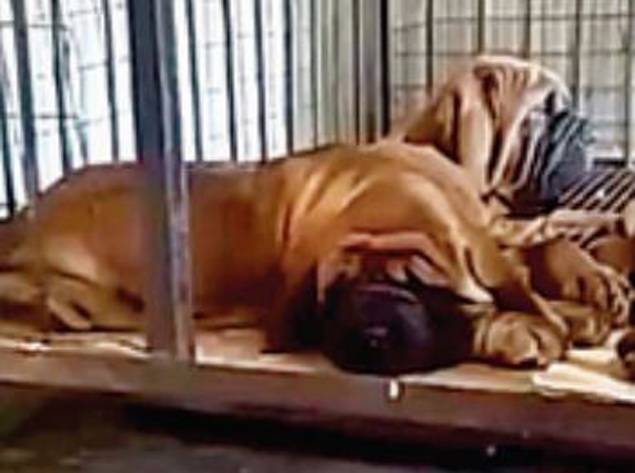
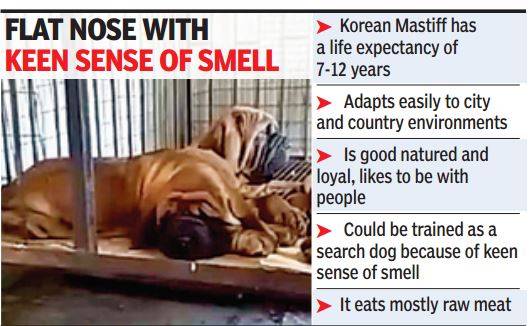
The Korean Dosa mastiff has a heavy wrinkled skin, hanging jowls and a blunt nose, but it is entitled to put it up in the air. For this rare bundle costs an eye-popping Rs 1 crore-as much as a good-sized villa. And the nose may be flat, but it smells sharp.

Bengalurean Satish S, who is importing this exotic breed, is set to become the first owner of the Korean breed in India. Satish, breeder and president of Indian Dog Breeders’ Association, said two two-month-old pups, each costing Rs 1 crore, are flying in from China. This is the first time the breed is entering India, he claimed.

“This is a dream come true, I wanted this dog for over 20 years,” said Satish, who has over 150 dogs, a combination of rare and big breeds, at his farmhouse in Kumbalgodu, and has been in the business for over 25 years. “After a long and exhausting search, I finally got good news. I was in touch with a breeder in China whose Korean mastiff littered recently. I’m importing one female and one male pup,” he said.

“It is one of the rarest breeds, known for its heavily wrinkled body. The body is so wrinkly that even its eyes are barely visible,” he said.

The pups are on their way to Bengaluru, with a day’s rest to break their long and strenuous journey. They were put on a plane from Beijing to Bangkok, where they rested on Monday, and will arrive on Wednesday.

Satish is rolling out the red carpet for the two pups-one will be picked up in a Rolls Royce and another will travel in a Range Rover from the airport to his house in Banashankari II Stage. “I’ve rented a Rolls Royce for a day. The Range Rover belongs to a friend,” he said.
“They are coming from a cooler place, so I will keep them in an air-conditioned room till they adjust a bit to the heat here,” said Satish.

KoreanMastiffBF24mar2016

The most expensive dog Satish has imported till date is the Tibetan mastiff, for which he paid Rs 65 lakh. “But the Korean mastiff will be my most expensive buy now,” he said.

source: http://www.timesofindia.indiatimes.com / The Times of India / News Home> City> Bangalore / by Aditi Sequeira, TNN / March 22nd, 2016

Uber opens first engineering centre In Asia in Bengaluru

Mumbai :

Uber, the technology company that seamlessly connects riders with drivers at the push of a button, has today inaugurated Asia’s first Engineering Center in Bangalore.

Today, Uber celebrated its engineers and together with Thuan Pham, Uber’s chief technology officer, officially opened the doors of Asia’s first Engineering Center in Bengaluru.

After hosting his first chai pe charcha with members of the press as part of the inauguration, Thuan Phamsaid, “The talent we see in India and the sheer passion and eagerness of these Engineers to build world class products and services to improve the lives of people and cities around the world is remarkable,”

The Engineering Center in Bangalore will hire the best-in-class software engineers who will focus on developing customized solutions to better serve our rider and driver partners in India, in collaboration with on-the-ground operations teams as well as global Engineering and Product teams.

Thuan Phama added, “Launching Asia’s first Engineering Center in Bengaluru is a testament to our commitment to investing in India, and I can’t wait to see the innovations that will come from this team as they work to support the phenomenal growth of our business in cities across the country.”

source: http://www.timesofindia.indiatimes.com / The Times of India / News Home> City> Banglore / by Hemali Chhapia / TNN / March 10th, 2016

Chennabhairadevi, The Pepper Queen of India Who Ruled for 54 Years

Front view of Chaturmukha Basadi; (right) Gerusoppa is very close to Jog Falls

Bengaluru :

Stories of kings and queens always attract the young and the old alike. Indian history is abundant with interesting tales of brave queens. In India, where women strive to emulate Sita, and are often docile and meekly submit without resisting , there were valiant women taking up arms against enemies and often succeeded in their attempts. One such brave ruler was Rani Chennabhairadevi, the queen of Gerusoppa, who ruled for 54 years — the longest reign by any Indian woman ruler.

Gerusoppa, situated on the banks of the river Sharavathi in Uttara Kannada, was under the control of the Vijayanagara kings. In the decentralised Vijayanagara empire, various regions were ruled by royal families known as Mahamandaleshwaras. By the early 1550s, Chennabhairadevi, who belonged to the Saluva dynasty, became the queen. As per the inscriptions, her kingdom extended from south of Goa to Uttara Kannada, Dakshina Kannada and Malabar. This region is known not only for harbours like Bhatkala, Honnavar, Mirjan, Ankola and Baindur but also for pepper.

A brass idol of Chennabhairadevi

Honnavar and Bhatkala served as internal and international, flourishing trading centres. Arabian horses and weapons were imported from the West. Pepper, betel nut and nutmeg were exported to European and Arab countries. Chennabhairadevi found herself at confrontation with the neighbouring rival kingdoms as well as the Portuguese. The attempts of the Keladi kings and Bilgi chieftains to pull the queen down proved futile.

The queen had to resist the Portuguese who tried to grab the ports and take over the trade. She was at war with the Portuguese in 1559 and again in 1570. She crushed the Portuguese army with her intelligent battle strategy. One of the Portuguese chronicles states that during the war of 1570, the Portuguese attacked Honnavar and burnt it to the ground. After the decline of Vijayanagar, Chennabhairadevi dealt with the Portuguese diplomatically, who nicknamed her ‘Raina de Pimenta’ — the Pepper Queen.

A letter sheds more light on the importance of pepper trade with the Portuguese. Affonso Mexia, the Portuguese Captain of Cochin, writes to the King of Portugal: “Between Baticala and Goa there are certain places called Onor, Mergen and Ancola, from which I hear 5,000 crusados worth of pepper are annually shipped… These places are under the dominion of Queen of Guarcopa… This pepper is larger than that in Cochin, but is lighter and not so hot. It appears to me that we ought to secure…”

Queen Chennabhairadvi was a Jain. The Chaturmukha Basadi of Gerusoppa is attributed to her. She gave grants to Shaiva and Vaishnava temples too. Saraswath Brahmin businessmen and skilled Konkani craftsmen took shelter in her kingdom to escape Portuguese persecution. Jain scholars Akalanka and Bhattakalaka were under the Queen’s patronage. She is credited with building the Mirjan Fort and is believed to have lived there for several years.

The Keladi and Bilgi chiefs adopted ‘Unity is Strength’ formula. Matrimonial alliances brought these two families together. The combined forces of Keladi and Bilgi attacked Gerusoppa, finally defeating the Queen. Gerusoppa came under the control of Keladi. The ageing queen was taken prisoner to Keladi and she breathed her last in prison. If the strategy of unity was adopted against the foreign intruders, India’s history could have been different.

Queen Chennabhairadevi projects herself as a powerful woman, when other women stayed indoors under submission. She was the contemporary of the Queen Elizabeth I of England and succeeded in ruling for the longest period against all odds.

(Lakshmi Murthy is  the principal of J V Vidyapeetha, Bengaluru. Ravi Hegde is a researcher in the field of biological sciences from NIMHANS. They are working as a team in conserving archaeological, cultural and natural heritage of Uttara Kannada district.)

source: http://www.newindianexpress.com / The New Indian Express / Home> Cities> Bengaluru / by Lakshmi Murthy & Ravi Hegde / March 07th, 2016

It was an event to feel, savour and be Japanese

Japan Habba

JapanHabbaBF22feb2016

An array of Japanese cultural events and stalls offering delicacies from that nation were some of the highlights of the 12th edition of Japan Habba that was held at the Jnana Jyothi Auditorium on the Central College campus in the City on Sunday.

Jyunichi Kawaue, Consul and Head of the Consulate, Consulate of Japan, Bengaluru, inaugurated the annual festival that is held with the aim of promoting Indo-Japanese relations and creating an opportunity for people to know more about Japanese culture.

The theme of the day-long event this year was ‘Chouchin’- the traditional Japanese lantern which embodies festival in Japan- and these were also available for sale at the venue. The main attraction of the cultural programme was the song and dance of ‘Sawara Bayashi’ (festival song and dance of the city Sawara in Chiba prefecture near Tokyo) performed by both Japanese and Indian enthusiasts using the ‘Chouchin’.

Japanese expatriate Kazumasa Kuboki’s performance of the Kannada song ‘Prema Chandrama’ stole the show. Other highlights included a Bollywood dance by Japanese women and children, performances of Japanese songs and dances by Indians and Japanese and performances of traditional Indian classical and folk dance.

Several interesting events in the gallery also kept many visitors engaged. There was a tea ceremony demonstration where visitors could see how a traditional Japanese tea ceremony (sado) is performed and try out ‘ocha’ (green tea) and sweets. A large area was also dedicated to the ‘Yukata’ trial where people could wear the Japanese summer kimono (garment) called ‘yukata’ and take pictures.

Many were also seen writing Japanese letters (kanji) in calligraphy style. Other popular attractions included a traditional Japanese toy corner and display of crafts like ‘origami’, ‘kirigami’ and ‘Ikebana’.

There were a few food and refreshment stalls as well where people were seen savouring some authentic Japanese cuisine set out by restaurants in the City, besides Indian snacks. In all, the event offered a good insight into Japanese culture and traditions and an enjoyable day out.

The event was organised by the recently formed Japan Habba Trust. Prof K N Ninge Gowda, Registrar (Evaluation), Bangalore University, presided over the programme. The guests of honour on the occasion were Yoichi Yasui, chairman, Japanese Association of Bangalore and P N Karanth, honorary secretary, Indo-Japanese Chamber of Commerce and Industry-Karnataka.

source: http://www.deccanherald.com / Deccan Herald / Home> City / DHNS – Bengaluru, February 22nd, 2016

London-based Bengaluru girl gets highest score in Mensa test

Saanya Verma, 11, the youngest to get the maximum possible score of 162 in Mensa IQ test, with parents

Bengaluru:

When Saanya Verma took the Mensa IQ challenge, her aim was to win a bet of 10 pounds with her father. The 11-year-old from Bengaluru went on to crack the toughest test and bag the maximum score of 162.

 People of all age groups participate in this IQ competition; it can be taken by people over the age of 10 and half years.
Her mother Sunita Verma said Saanya has always been eager to take part in competitive exams. She had challenged her father Sunil Verma of cracking the Mensa IQ test to get 10 pounds, she recalled.

Saanya, who was born in Bengaluru, is a class VII student in London. Sunita, an HR professional, and Sunil, a banker, shifted to London a decade ago. “I want to participate in as many competitions as possible,” said an elated Saanya.

“Saanya has won public speaking, robotics and many other competitions at the school level. She is gearing up for a regional-level French spelling competition in London. I think very few children have cracked the test in the world,” Sunita added.

source: http://www.timesofindia.indiatimes.com / The Times of India / News Home> City> Bangalore / Pavan M V,  TNN / February 19th, 2016

MobileOne app bags gold at summit

Bengaluru:

Karnataka on Wednesday took India’s ‘Digital India’ campaign one step ahead, bagging gold prize for its MobileOne service at the World Government Summit in Dubai.

MobileOne was adjudged the best m-government service in the world at the fourth edition of the summit attended by 125 countries. The other shortlisted nominees were ‘UK.Gov’ and ‘Kazakhstan.gov.’ MobileOne was selected through online voting and the jury comprised experts from the United Nations, World Economic Forum and World Bank.

“I still don’t know who nominated us. No government (state or country) can nominate its own services. We received a communication last week that our service has been nominated and shortlisted,” e-governance secretary Srivatsa Krishna told TOI.

The app, launched in December 2014, provides integrated services to the public. It got over 1.5 crore hits with two lakh downloads.

“There are over one lakh hits and downloads every day. It works via a unique nationally available, across all telecos, all circles number 161. The app, for the first time in India, facilitates citizens to pay all their utility bills, including income tax,” Krishna said.

MobileOne was presented to the United Nations leadership in New York during Prime Minister Narendra Modi’s visit there and was much appreciated. “We think the app got noticed at the presentation and got selected for this award,” sources said.

source: http://www.timesofindia.indiatimes.com / The Times of India / News Home> Chennai> Bangalore / TNN / February 11th, 2016

‘We wanted to create a warm film that was full of life’

Thithi will be in cinemas this summer, says Raam Reddy

“We tried to create a balance between realism and the creation of a particular cinematic world,” said director Raam Reddy about his experience of working on Thithi , which won the best film award in the Asian Films category at the recently concluded Bengaluru International Film Festival.

He was speaking to The Hindu ’s readers in a live web chat on Saturday. “Our initial intention was to create a warm, humorous film that was full of life,” he said.

To a question, Mr. Reddy replied that the decision to work with villagers who were not professional actors was taken to make the film more authentic. “Once you are able to get them to relax in front of the camera and to understand their roles, they can create magically honest performances,” he said.

On his inspiration for Thithi , he said, “My starting point for Thithi was with the location: I decided that I wanted to make a film in a particular place. I then explored the place with my writer Ere Gowda, and the story happened organically out of that exploration.”

Thithi has secured distribution rights in India and will be in cinemas this summer.

He advised aspiring filmmakers to make original short films and explore the medium of cinema thoroughly. He urged them to watch famous international films and deconstruct them carefully. “From personal experience, I learnt a lot more from watching well-regarded films from all over the world than from film school,” Mr. Reddy said.

On genre definitions in films, he said, “I am quite keen on attempting to break genre definitions in films. What I think is more important is the initial intention. My team and I decided to stay true to our creative impulses and did the best we could. Thithi came out of this simplicity.”

source: http://www.thehindu.com / The Hindu / Home> News>Cities> Bengaluru / by Staff Reporter / Bengaluru – February 07th, 2016