Wrestlers Shankar Chakravarthy (left) and Vinod are seen with the copy of the book ‘Beyond the Body’ presented to them.
Mysuru:
Mysuru’s famous wrestler Shankar Charavarthy (Dasara Kesari, Darasara Kanteerava and Dasara Kumar a award winners and currently employed with CARP, Mysuru) and Vinod (a former University of Mysore wrestler and an M.PEd student at the Department of Physical Education and Sports Sciences, have appeared in the front cover of world famous photographer Tomasz Gudzowaty’s photo book ‘Beyond the Body’ which released in Europe last month. Both the wrestlers are the products of well known wrestling coach L. Manjappa.
Tomasz Gudzowaty shot the wrestling sequences at the Goapalaswamy Awara Garadi in Nala Beedi in city during 2006 and also in 2008. The project was co-ordinated by C.K. Muralidharan, city’s freelance sports journalists. A total sequence of 12 photos were shot in Mysuru for a story on “Nada Kusti” which won the third prize in the World Press Photo contest in Amsterdam held in 2006.
The book ‘Beyond the Body’ has been edited by Nan Goldin a famous American photojournalist and the book has black and white photographs of Tomasz Gudwowaty’s works in India (five projects- Nada Kusti-Mysuru, Kalaripayattu & Women’s Boxing- Kerala, Yoga (with Mysuru Yoga artists shot in Varnasi), Urban Golf in India (shot with caddies in Mumbai) and abroad in China, Mexico, Mongolia, USA & Japan).
source: http://www.starofmysore.com / Star of Mysore / Home> Sports News / Saturday – February 06th, 2016
Dr C. Ganesh Pai, Professor and Head of the Department of Gastroenterology and Hepatology, Kasturba Medical College and Hospital, Manipal has been awarded a research grant of Rs 49.92 lakh for the project titled: “Thiopurine Therapy in Inflammatory Bowel Diseases: Optimizing Existing Strategies”.
The research is funded by the Department of Science and Technology, Government of India. Inflammatory bowel diseases (IBD) are a group of incurable chronic intestinal diseases that contribute to a lot of suffering.
Currently available treatment options work well at best in half the patients suffering from these conditions leaving thereby a large unmet need.
The project is expected to identify ways of improving the proportions of patients who benefit from currently available, affordable drugs belonging to the class of thiopurines and also decrease the adverse events from these drugs. The research will also lay the groundwork for designing newer drugs related to thiopurine compounds which are more effective in IBD.
Medical Superintendent and COO of Kasturba Hospital Manipal Dr M Dayananda said: This type of funding is available only for established research leaders to pursue ground-breaking, high-in-tensity projects that open new directions and advancements in their respective research fields. Selection of Gastroenterology and Hepatology Department at Kasturba Hospital depicts the advanced treatment modalities and quality of care for patients provided here.
Dr. Krishnamurthy Bhat, Head of Pharmaceutical Quality Assurance, Manipal College of Pharmaceutical Sciences, Manipal University is a co-investigator on the project, which runs for three years.
source: http://www.timesofindia.indiatimes.com / The Times of India / News Home> City> Mangalore / by Stanley Pinto, TNN / January 22nd, 2016
Art historian Gail Levin on the influence of Indian art and culture on American art and artists
Swami Vivekananda was probably one of the earliest and most notable influences on American artists, who garnered several admirers after his landmark address at the Parliament of the World’s Religions. Coincidentally, it is a globally renowned Indian artist, Jitish Kallat, who commemorated the 108th anniversary of the famous speech by lighting up the steps of the venue which is now the ‘Art Institute of Chicago’ with the text of the speech in his famous ‘Public Notice’.
That’s how Gail Levin, art historian and distinguished professor of 20th Century art and contemporary art at the City University of New York, began her lecture on “An overview of the Influence of Indian Art and Culture on American Artists from the World’s Colombian Exposition to Contemporary Art” at the National Gallery of Modern Art (NGMA).
The exposition she refers to is the same Parliament of the World’s Religions which was part of a world fair.
“One of them is Marson Hardley whose work I have studied extensively. He has emblems or symbols that refer to India in some of his paintings from 1913,” says Gail, who is in India as a Fulbright scholar.
Some of other influences on American art are Raja Ravi Varma, and Rabindranath Tagore who is linked to the Japanese curator Okakura Kakuzo and Isabella Stewart Gardner.
“My project was to study the mutual culture of Indian American artists, how they influence each other and how their culture influenced art,” she explains.
“For a long time I wanted to see Indian art so I can teach better. Every time I looked at a book on Asian American artists it was always about the Far East and there is little on South East Asia, especially because India is a such a huge country and there are so many Indians in America.”
After having written several books on artist Edward Hopper and studying feminist artists like Judy Chicago, Gail wants to devote the end of her career studying and writing about Asian art influences.
“My lecture outlines the book that I am planning to write on India. I never fully understood the symbolical references to Indian art. It is only when you get to know people that you learn about culture. I have been staying in Kerala the past few months and I learnt a lot, yet, feel I learnt so little compared to what there is to know.”
But then her trip took an unexpected turn when she met Kerela-based, Cholamandal-groomed artist Sajitha Shankar, whose work drew parallels with the work of Judy Chicago, notable for her ‘Dinner Table’ installation at the Feminist Art Centre in Brooklyn, New York. She has now completed the draft of a book on Sajitha and plans to organise an exhibition of her works.
“At first I thought she may be influenced by Judy because both their works feature the triangular ‘Kali Yantra’ symbol. But I know that she was not,” explains Gail.
What Gail also discovered was while American art was notably influenced by Indian culture, there wasn’t much American influence on Indian art. “American art wasn’t well known outside America until the second half of the 20th Century.” Gail talks about how artists like Maurice Stern, Theresa Bernstein, Roy Lichtenstein have been influenced by various aspects of Indian culture, often spiritual.
“The Sarabhai family of Gujarat invited several American artists to India including Charles and Ray Eames who helped found the National Institute of Design. Jackson Pollock and his contemporary Philip Guston were deeply influenced by the teachings of the Indian spiritual teacher J. Krishnamurti.”
source: http://www.thehindu.com / The Hindu / Home> Features> MetroPlus / by Harshini Vakkalanka / Bengaluru – January 22nd, 2016
New Mangalore Port Trust (NMPT) has given fillip to industrialization in Karnataka by means of offering most comparative rates as compared to other major ports. The port has given all facilities to encourage coastal movement of traffic and now is the first Indian port to start the Ro-Ro service from Mangaluru to Hazira port, noted P C Parida, chairman, NMPT at the Republic Day celebration organized by the port at Dr B R Ambedkar Stadium, Panambur here.
Port has registered growth of 15% in container traffic. Based on Boston Consultant Groups report, port has taken steps to increase container traffic further and further develop container terminal by outsourcing container handling. Port has taken up upgradation of fire-fighting facilities to handle VLGCs and it shall be operational by September. NMPT is planning to have LNG terminal which shall be operational in 2017. This will facilitate citizens get clean fuel at cost effective rates.
To encourage agro products, port has already commissioned two warehouses and one is under construction. Under the green city project, the process of commissioning a 350-kW roof-top solar power plant is under progress which will meet the power requirement of administrative building, hospital building and guest house and street light. Port has planned to commission 5-mW solar power plant by November 2016 which will meet power requirement of the port.
Long pending demand of locals for fisheries harbor is in planning stage and work may commence from last quarter of this year. Under corporate social responsibility scheme, port has contributed Rs 98.5 lakh for providing LED street lights on the national highway from KIOCL junction to Bykampady. A similar project from KIOCL to Thannirbavi village too is under consideration, Parida said, thanking the employees for their participation in Swachh Bharat Abhiyan.
source: http://www.timesofindia.indiatimes.com / The Times of India / News Home> City> Mangalore / by Jaideep Shenoy, TNN / January 26th, 2016
More than 900 students of Mount Carmel College created a Guinness world record for opening the most number of softdrink cans simultaneously at their annual ‘Cul-Ah 2016’ fest on Friday.
They broke the previous record created by Ltd CidoGrupa (Latvia) in Ligatne, Latvia, on August 2, 2014, involving 689 people. Representatives of the Guinness World Records, who were present on the occasion, validated the new world record and an official certificate will be issued in a week, said a release.
Niveditha Umesh, general secretary, Students’ Union, Mount Carmel College, said, “We at Mount Carmel College always look for something different in whatever we do and that has been our key differentiator. We are happy to partner with TWISS to set this new record. We hope to become the first college in India to take away this kind of Guinness World Record honour. Cul-Ah, our annual cultural fest, is the right platform for this.”
source: http://www.deccanherald.com / Deccan Herald / Home> City / DHNS – Bengaluru – January 23rd, 2016
At the Bengaluru chapter. Photo: K. Bhagya Prakash / The Hindu
The day to reveal the largest crochet blanket in the world stitched by Indian women is fast approaching. Karnataka too has contributed to this cause.
There’s a movement happening as you read this. The protagonists are women and children from age eight to 85.
Since August 2015, the group Mother India’s Crochet Queens, spearheaded by Subashri Natarajan in Chennai, comprising nearly 1,000 Indian women from India and other countries, including the USA, the Gulf, Europe, and Australia, have been busy with their hooks and yarn to beat the current record of the biggest crochet blanket in the world, that stands at 3,377 square meters set by South Africa in April 2015. But the intention is not just to create a world record, but to donate the blankets to the needy.
Subashri, who has been crocheting since she was 10 years old, says the idea for making the world’s largest crochet blanket was to make it a nationwide movement.
“I first approached my friends and relatives who know crocheting, but then the movement grew with people joining the Facebook group, and through word of mouth. Every thing these days is made out of machines. But crocheting is all hand work.”
She adds that crocheting isn’t a dying art, considering the number of women who are passionate about it. “Even children are participating. Our youngest participant is an eight-year-old girl. There are even young boys. There are schools in Kerala who have participated. It’s not true that children are only interested in technology and video games.”
Women from Karnataka have contributed to the event too. In Bengaluru, at Cubbon Park earlier this month, on a pleasant Saturday afternoon, colourful blankets were laid out, with women engaged in crocheting blankets. Padma Srinivasan, 75, and her friend Thiru Rajan sat together chatting and laughing as they nimbly crafted blankets. “Crochet has been a hobby since ten years for me,” says Padma. “I came to know about this event from a friend of mine in Chennai in December. I completed eight blankets in one month.” Thiru adds: “I have completed two blankets.”
Padma and Thiru are glad that they are contributing to a noble cause. “Through the thread—this mission binds women to bring love, peace and harmony. It is similar to the Swadeshi Movement, when it was the charkha and the thread that brought people together,” says a passionate Padma. Thiru adds: “Doing this for others is a great honour for me.”
A vibrant Varalakshmi S. had a number of blankets laid out in front of her. “I have stitched 67 blankets since August 2015. I learnt crocheting from my neighbour, from 1997 to 2002. I got to know of this event from Facebook.” What appeals to her is the passion behind the cause and that the blankets will go to charity. “Over the weekends I would decide colour combinations, and would crochet one blanket per day during weekdays.” For Mughda Manasa too, it is the cause that matters. “What interested me is that this is going to charity, and that this event has brought Indian women together from across the world.”
Poornima Kannan also says that she joined because it brought people from diverse backgrounds together. Dina Sengupta says blankets have been crocheted in Mangaluru, Hubli and Mysuru. “We had about five meets in the city. And subdivided groups according to area.”
Through Facebook and Whatsapp, crochet meets were organised. Technology, Subashri says, has been a boon. “We realised that Facebook alone wasn’t enough to get everyone together. So we created Whatsapp groups. We have co-ordinators and associate co-ordinator to help organise meet ups.”
Though the event was mostly self-funded, Subashri adds they received support from Knit Pro and Ganga wool manufacturing company in Noida. “Harish Mehta, secretary of MNM Jain Engineering College in Chennai, has also been very supportive,” says Subashri.
The initial target was to join 5,000 blankets together, but Subashri says they have even exceeded that. The final event will be held on January 31 at MNM Jain Engineering College, Chennai.
source: http://www.thehindu.com / The Hindu / Home> Features> MetroPlus / by Sravasti Datta / Bengaluru – January 20th, 2016
The clinicians and researchers at Kasturba Medical College (KMC), Manipal University, Manipal and Center for DNA Fingerprinting and Diagnostics, Hyderabad in collaboration with scientists of University of Hamburg, Germany have discovered a new genetic condition and the likely genetic defect that causes it. The work was published in the online edition of the European Journal of Human Genetics.
Giving details of the discovery, team leader Dr Girish Katta, professor and head, department of Clinical Genetics Kasturba Hospital, Manipal said that the patients with this condition have joint dislocations at birth and have a generalized bone disease. “It was about six years ago that Dr Hitesh Shah and I came across two brothers with the disease. There are very few conditions with such severe dislocation of joints at birth. In addition, both had lax joints,” he said.
“Ever since seeing the two, we realized that brothers had some unknown disorder and so kept working to identify genetic basis,” he added. “Shared genes were first identified by chromosomal microarray and then we performed whole exome sequencing to identify shared genetic defect. German collaborators performed bioinformatic analysis. Proof of causation of disease by EXOC6B gene will require reporting of more patients with similar condition, he added.
Meanwhile, surgical team lead by Dr Hitesh Shah operated on the brothers and they are now mobile and even go to school. The team’s focus was to detect genetic cause of rare disorders. Dr Hitesh is specialized in correcting pediatric bone deformities. Other members of research team are – Dr Ashwin Dalal and Dr Kerstin Kutsche, both adjunct visiting professors of KMC, Manipal.
Vinod Bhat, VC, Manipal University said, “This is one of the very few new genes discovered by Indians. As of today, we have diseases identified for less than quarter of known genes”. Manipal University has a MoU with University of Hamburg on research collaboration for past two years, said Poornima Baliga, Dean KMC, Manipal. Indian Council of Medical Research funded the work. To facilitate research, KMC has established a Central Research Laboratory, she added.
source: http://www.timesofindia.indiatimes.com / The Times of India /News Home> City> Mangalore / by Jaideep Shenoy, TNN / January 12th, 2016
Adding yet another feather to its cap, the Windflower Resorts and Spa, Mysuru, was recognised by the World Travel Brands at the Travel Brands Award held in New Delhi recently.
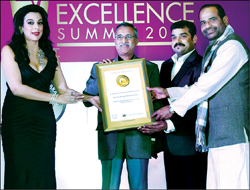
The award of recognition was received by Achuta Rao, Senior Vice-President (Operations), Windflower Resorts and Spa, Mysuru, from celebrity Pooja Bedi at a function held at The Vivanta Taj in New Delhi which was attended by Prahlad Kakkar, Shashi Tharoor, Anupam Kher and MP Bidhuri of South Delhi.
World Travel Brands is a premium status offered exclusively on an invitation basis to brands from the Travel, Tourism and Hospitality industries in countries such as India, USA, UK, UAE, Australia, New Zealand, France, Canada, and Singapore.
source: http://www.starofmysore.com / Star of Mysore / Home> General News / Sunday – January 10th, 2016
The Bengaluru solution – Triaminopyrimidine (TAP) comes with many advantages over existing drugs
Bengaluru :
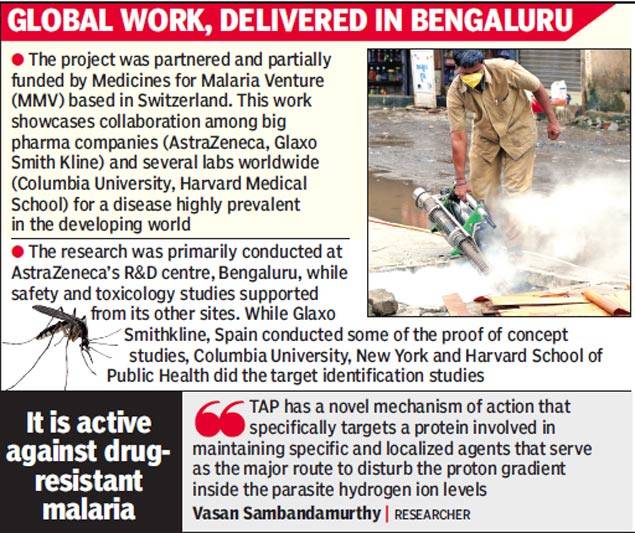
Three scientists from Bengaluru, who led a team of global reserchers looking for an antimalarial drug, have found a fast-killing solution. After completing some tests, it’ll go in for clinical trials on humans. That this drug has the potential to cure the dreaded disease in one dose makes it more attractive to healthcare providers.
The Bengaluru solution — Triaminopyrimidine (TAP) — comes with many advantages over existing drugs. Vasan Sambandamurthy, one of the senior authors of the research paper, said: “It’s a fast-killing and long-acting antimalarial clinical candidate. TAP acts exclusively on the blood stage of Plasmodium falciparum (the stage responsible for clinical symptoms) in a relevant mouse model. This candidate is equally active against causative agent Plasmodium vivax.”
He added, “The compound has shown good safety margins in guinea pigs and rats. With a predicted half-life of 36 hours in humans, TAP offers potential for a single dose combination.”
The rapid spread of Plasmodium falciparum, the parasite which causes malaria in humans, has left nations battling it with a weakened arsenal and coping with thousands of deaths every year. This parasite has gradually become resistant to available medication.
The World Health Organisation (WHO) estimates that 3.2 billion people in 97 countries, including India, are at risk of being infected with malaria. In 2013, WHO reported an estimated 198 million cases and the disease was responsible for an estimated 5.84 lakh deaths, including 4.53 lakh children less than five years old.
Every person infected with malaria has to deal with millions of parasites and existing drugs have a limited effect in humans. “The half-life, which isn’t more than 2 hours, means it allows parasites to bounce back. Existing drugs are not fast-killing, which means that not only does a human need more doses but each dose is capable of only killing a few parasites,” he said.
Besides, a potential side-effect of existing drugs is liver damage. “This doesn’t happen all the time, but the possibility does exist. Also, the parasites have become resistant to these drugs. With TAP, there are now known side-effects and the parasites are unable to develop resistance at the same pace as they do for existing drugs,” he said.
TAP was discovered by a team at pharmaceutical company AstraZeneca. “The main research happened in its R&D centre in Bengaluru between 2011 and 2014, which has since been shut down. It took us three years of rigorous work by teams across the globe. Today, we confidently nominate TAPs as a clinical candidate to treat drug-resistant malaria,” Vasan said. Shahul Hameed and Suresh Solapure were the two other team leaders.
Times View
The discovery of a malaria drug, yet again, highlights Bengaluru’s leadership in scientific research. The promise that the new medicine can kill the virus in a single stroke and act for a long time is good news for malaria patients. While the scientists deserve compliments on working towards a remedy free of side-effects, the companies that will eventually massproduce the drug should look at making it affordable to the aam aadmi. For their part, public health administrators must renew their battle to prevent vector-borne diseases, which cause untold suffering.
source: http://www.timesofindia.indiatimes.com / The Times of India / Home> City> Bangalore / by Chetan Kumar, TNN / April 01st, 2015
Liver team at Pandorum Technologies: Dr. Abdullah Chand, senior scientist (left); Arun Chandru, co-founder and managing director (centre); and Dr. Sivarajan T., senior scientist / @ABHINAV_MAURYA
Pandorum Technologies, a Bengaluru-based biotech startup, has developed an artificial tissue that performs the functions of the human liver.
Pandorum said these 3D printed living tissues made of human cells would enable affordable medical research with reduced dependence on animal and human trials. It will also eventually lead to full scale transplantable organs.
Arun Chandru, 30-year-old co-founder of Pandorum, said liver toxicity and drug metabolism are the key hurdles, and contributors to failed human trials.
Pandorum’s 3D bio-printed mini-livers that mimic the human liver will serve as test platforms for discovery and development of drugs and vaccines. The firm said these drugs would have better efficacy, less side-effects and be developed at lower costs.
“We developed everything here in India,” said Mr. Chandru. “We can grow thousands of these tissues in the laboratory and test the efficacy of drugs on them for diseases including cancer.”
He said large pharma companies on an average spend about $10 billion (Rs. 66,290 crore) and 10 years on research and development to get a single new drug to the market.
Tuhin Bhowmick (34), another co-founder of Pandorum, said development of artificial organs has numerous clinical uses. The cell-based miniature organs can be used to develop bio-artificial liver support systems for preserving life in patients who have developed liver failure.
“In the near future, such bio-printed organs will address the acute shortage of human organs available for surgical transplantation,” said Dr. Bhowmick, who holds a Ph.D. from the Indian Institute of Science.
Pandorum was founded by a group of friends in 2011 who were pursuing their higher studies at IISc. They came together to work on the development of artificial human organs after winning a business competition.
Surviving initially on money from friends and family, the team approached the Department of Biotechnology with their vision. The company was awarded funding support by the Biotechnology Industry Research Assistance Council in 2012. The same year, the company got incubated by the Centre for Cellular and Molecular Platforms in Bengaluru.
Mr. Chandru said they created the innovation with a funding of about Rs. 1 crore, more than half of which came from the government.
Scientists and startups across the globe are growing artificial organs made of human cells to better study diseases and help test drugs. A team of researchers led by Hebrew University professor Eduardo Mitrani is growing pancreas in a petri dish to better regulate blood sugar in diabetic patients.
The global artificial organ and bionics market is expected to reach $38.75 billion (Rs 2.5 lakh crore) by 2020 at an estimated CAGR of 9.3% from 2014 to 2020, according to a study by Grand View Research.
Pandorum’s ultimate aim is to make personalised human organs such as lungs, liver, kidney and pancreas on demand, according to Mr. Chandru.
Pandorum’s innovation takes the area of making artificial organs to the next level. Bengaluru-based bioinformatics firm Strand Life Sciences founded by IISc. professors had earlier developed a virtual liver that mimics the functions of liver through software simulation. It is a predictive method that integrates data and insights for deeper understanding of the impact of a drug on the liver. The platform can predict the toxicity of several known drugs and toxins and explain the mechanism.
source: http://www.thehindu.com / The Hindu / Home> Sci-Tech / by Peerzada Abrar / Bengaluru – December 23rd, 2015