Category Archives: World Opinion

Udupi company’s MasterChef game earns $5 million

Bengaluru :

Want to be aggressive like Gordon James Ramsay, the Scottish-born British chef and restaurateur. Or would you like to be the likeable and lovable judges of MasterChef Australia, George Calombaris, Matt Preston or Gary Mehigan?

Star Chef, a mobile game developed by Udupi-based 99Games, is making waves on the iPhone. Revenue from the app has just crossed $5 million on Apple’s App Store, giving an indication of its popularity among people trying to becoming a MasterChef in the virtual world.

Anila Andrade, associate vicepresident-operations, says: Star Chef is a lovingly crafted cooking and restaurant management game where players progress from chefs to five-star chefs, and expand their restaurant business in the process.

“The game mainly targets women aged 20-55 and those who love cooking-related apps and games.When players begin, they start off as an amateur chef and are given a small restaurant space with one cooking appliance. Customers start dropping in, requesting different items from the menu. While the menu catalogue is limited during the initial phases, newer recipes are unlocked as the game progresses,” Anila says.

There are eight to 10 cuisines – American, French, Korean, Italian, et al – and over 100 recipes to unlock as the game evolves. The player can purchase ingredients for the menu from in-game supermarkets. Eventually, the backyard is opened up, where they can farm and produce their own organic veggies.

The game has several fun social features, including an option to trade their produce with other realtime players via a Food Truck.

Star Chef was launched worldwide on the iOS platform in August 2014. The game is free to download and players can spend on the game eventually to buy upgrades like cook ing appliances, restaurant decor and other ingredients and goodies.

Star Chef is available in English, French, German, Spanish, Italian, Russian, Korean, Simplified and Traditional Chinese. “The game is showing strong potential when it comes to numbers. Where the most popular cooking TV show, Master Chef has a run time of 40 minutes, Star Chef has an average game time per day of 42 minutes including different sessions,” notes Anila.

“While it took us around six months to reach our first $500,000, it took us about nine months to get to $5 million,” she notes. The game is growing 20-25% month on month in revenue. 99Games has 16 games in their catalogue so far. Star Chef is their 15th game. She attributes success of Star Chef to a great combination of a good concept that has a universal theme (cooking), art, technology , analytics and well-targeted user acquisition. All these play a very important role in defining a great game with good monetization capabilities, she adds.

An Android version is already in development. The pilot launch will be done in Canada and Australia next week.

source: http://www.timesofindia.indiatimes.com / The Times of India / News Home> City> Mangalore / by Stanley Pinto, TNN / December 23rd, 2016

Dancers set Guinness Record

Kuchipudi dancer Roopa Rajesh’s accomplishment of performing an eight-minute Kuchipudi Tarangam piece with 1,054 dancers from her Noopura Fine Arts Academy, performed in 2013, has bagged a place in the Guinness World Records.

“The process of verification by Guinness authorities took a long time. This year, we received the Certificate from Guinness World Records,” says Ms. Roopa who trained, directed and guided the entire dance capsule.

The academy will distribute the Guinness World Record certificate to the participants at its annual fest at NMKRV College on December 5 at 10.30 a.m.

source: http://www.thehindu.com / The Hindu / Home> News> Cities> Bengaluru / by Ranjani Govind / Bengaluru – December 05th, 2015

PSLV bags two more US launch orders

To lift weather company PlanetiQ’s first two satellites next year.

Two more U.S. satellite launch contracts have come the way of ISRO’s PSLV rocket, this time from commercial weather satellite company PlanetiQ.

A couple of space industry observers noted this as an inevitable trickle of business, if not a flow yet, from a top space market such as the U.S. to the now proven Indian player.

PlanetiQ, the Colorado-based commercial weather satellites operator, recently signed a deal with Antrix Corporation, ISRO’s marketing arm, for launching its first two weather satellites. Its final fleet totally will have 12 to 18 satellites.

Secondary passengers

The two spacecraft, just 10 kg each and carrying a special sensor to glean weather data globally, are planned to be put in space in the last quarter of 2016 as secondary passengers of a PSLV, according to the company.

PlanetiQ quoted its Chairman and CEO Chris McCormick mentioning “the stellar track record of the PSLV” in its Thursday night’s announcement of the contract.

The global launch market scene for small satellites and PlanetiQ’s keenness for the Indian launcher may well bring its remaining weather fleet also to the PSLV, said ISRO Chairman A.S. Kiran Kumar on Friday.

Antrix has bagged nine such U.S. launch orders for 2015-16.

The PlanetiQ satellites are small bites for the PSLV, which can launch up to 1,200 kg to medium distances (36,000 km) and 1800-kg satellites to low-Earth (below 2,000 km) orbits.

Until about a year ago, U.S. satellite operators could not conceive of launching from India because of a longstanding U.S. policy bar. In recent years, established U.S. launch companies have moved on to lifting far heavier satellites [ten tonnes and beyond], leaving a demand for launchers that can put smaller satellites in space.

In September, US operator Spire Global became the PSLV’s first US customer by getting four 4-kg-each Lemur satellites from Sriharikota. Antrix, which has won around 55 foreign launch orders to date, a bulk of them small ones, prefers to get bigger foreign satellites to launch from here.

Lobbying works

Susmita Mohanty, co-founder and CEO of Earth2Orbit, the country’s first space start-up, who is familiar with the Indian and U.S. space industry scenes, said: “[US] companies can benefit tremendously now that PSLV has been added to their portfolio of international launch options. This has been made possible by the companies themselves lobbying for access to the PSLV, the export control reforms introduced by the Obama administration and the efforts of “NewSpace companies” such as hers.

Russia’s converted missile launcher, Dnepr, Soyuz and the newer European vehicle Vega are in the same category as the PSLV.

Space industry tracking agency Euroconsult estimated in February this year that by 2020, governments and private operators would launch a total of 510 small satellites. The biggest number of small satellites is foreseen to come from the U.S. in the next five years. That country has also launched almost half of 600-plus smallsats in the last decade, the report says.

This article earlier mentioned PlanetiQ as a Maryland-based company. It is a Colorado-based firm.

source: http://www.thehindu.com / The Hindu / Home> National / by Madhumathi D.S. / Bengaluru – December 06th, 2016

V.S. Malimath dead

Justice V.S. Malimath, Chairman of the Karnataka Border Protection Commission and former Chief Justice of Karnataka and Kerala High Courts, breathed his last at Manipal Hospital in Bengaluru at about 11 p.m. on Tuesday. He was 86 years old and survived by wife Prema Devi V. Malimath, a son and four daughters.

Family members told The Hindu that Malimath was admitted to the hospital following viral bacterial infection about a week ago. The last rituals would be held at Chamarajpet graveyard in Bengaluru on Thursday morning at about 10-30 a.m.

According to official information, V.S. Malimath, born on June 12, 1929, secured the first rank in LL.B. and a postgraduate Diploma in Public International Law from the University of London in 1952. He began practising in the High Court of Bombay in 1952 and shifted to Bengaluru in late 1956. He was appointed as Advocate General in 1968 and as Judge of the Karnataka High Court in March, 1970. He was appointed as Chief Justice of Karnataka High Court on February 2, 1984. He was transferred to Kerala in same position in 1985. Post-retirement he was appointed as Chairman of the Central Administrative Tribunal and later as Member of the National Human Rights Commission. Malimath also headed the Committee on Reform of Criminal Justice System in India and was the United Nations Representative to monitor human rights enforcement in Nigeria and Sri Lanka. He also served as an International Observer to oversee the referendum in Sri Lanka. During his service, he represented India in several international conferences.

In recognition of his yeoman services, he was conferred with the National Citizen’s Award by the President of India, Karnataka Rajyotsava Award by the Government of Karnataka and Honorary Doctorate of Law by Karnataka University.

He was appointed as chairman of the Karnataka Border Protection Force by the Karnataka Gvernment in June this year to provide legal counselling on the boundary dispute with Maharashtra and also to look into the issues and problems of the people living in boundary areas of Karnataka, particularly in north Karnataka.

Belagavi District Kannada Organisation Action Committee President Ashok Chandargi and veteran leaders including former Mayor Siddangouda Patil and Raghavendra Joshi have expressed their condolences and decided to hold a public condolence meeting in the city on Sunday.

source: http://www.thehindu.com / The Hindu / Home> National> Karnataka / by Special Correspondent / Belagavi – December 23rd, 2015

The Bengaluru connection

Photographs depicting the Madras Sappers, who designed the Bangalore Torpedo were part of an exhibition exploring India’s role in the First World War

Over a million Indian soldiers fought in World War I of which 60,000 were killed in the fighting.

First encounter, Bangalore Digging deep, Crossing far

Elke Falat and Julia Tieke put together Digging deep, Crossing far, a series of workshops and exhibitions to throw light on hitherto unexplored aspects of the war.

“The objective is to start a discussion on topics in the first World World that are often neglected in the writing of history, such as the German perspective on the prisoner of war camps or how the non-European world was involved,” says Julia. “This is the first part of a long-term project we will continue in other countries. Through questions and archives, we will get into conversation with artists and through them, the audience on topics like war, nation building, propaganda and recognition.”

First encounter, Bangalore Digging deep, Crossing far

Their stopover in Bengaluru, titled ‘First encounter, Bangalore’, was on display at the Max Mueller Bhavan and the Bangalore Literature Festival.

They will also be taking their work to Pakistan, Morocco Tunisia, Algeria, the village of Wunsdorf and Berlin.

“It is not as though we are revealing something new. Everybody knows what we are talking about, but it is not in their collective consciousness,” says Elke.

One of the focal points of the exhibition is the German Prisoner of War camps near Berlin, on which Julia was conducting research for a radio programme.

“I stumbled upon the image of a postcard showing the first mosque built in Germany which was in the camp. Then I found articles by academic institutions which were involved in research on the type and history of sound archives in the prisoner of war camps,” she recalls.

“I thought it was a contemporary topic, it can relate to so many things like the German call for jihad or the relationship between the so-called Western world and Islam. The idea was to involve artists so they would work with the material in different ways and try to get into conversation about what it means.”

These camps, explains Elke, hosted a constellation of Colonial soldiers from North Africa and British India, even Bangalore. And so the exhibition in Bangalore featured four artists who each explored different perspectives of the war in the context of India.

Surekha, a Bangalore-based artist, explored the city’s connection with the war through ‘Black Pepper & Red Pepper’, a series of photographs depicting the role of the Madras Sappers, who designed the Bangalore Torpedo war weapon and the Mysore Imperial Army. The artist captured the bravery and skill of the Indian soldiers; the socio-political context of the war, through the code words ‘Red pepper’ for British soldiers and ‘Black pepper’ for the Indian soldiers; and depictions of the Indian soldiers in the war.

“The photographs printed on aluminium are quite uncanny. They are clear yet capture the passage of time. The people in the photographs appear like ghosts. Viewers will be able to understand what happened just by looking at the photographs, it is almost like a history lesson,” says Elke.

The exhibition featured yet another Bengaluru-based artist, Ayisha Abraham, whose grandfather fought in the war. Through a deconstructed photograph, Ayisha explored the consequences of a self-transformation of identity on his heritage.

Artist-author Sarnath Banerjee offered a national perspective through his notice boards titled The reduced history of the First World War, 2015. Through his series of black and white drawings, he captured scenes from the war featuring the Indian independence as well as the racial contexts.

While Gilles Aubry, a Berlin-based Swiss artist, known for his research on the history of sound, explored the Indian prisoners’ recordings in the German prisoner of war camps. He presented two tuning forks, of the note ‘A’ and the sound ‘Om’ which play in between the recording of a Hindi song sung by an Indian prisoner. He also presented the recording of a voice reciting a translated list of words recorded in the camps.

“His work is a reflection on what these techniques of recording tell us about science, the grammar of power and the knowledge of Colonial practices. He presents a link between Berlin and India,” explains Elke.

source: http://www.thehindu.com / The Hindu / Home> Features> MetroPlus / by Harshini Vakkalanka / Bengaluru – December 07th, 2015

Mastering the king of instruments

Jyoti Hegde. Photo: Special Arrangement

Jyoti Hegde, India’s only woman rudraveena artist, talks to Sowjanya Peddi about conquering the unconventional rudraveena and storming a male bastion

On a quiet farm away from the glitz of the urban art world, in a village near Sirsi about 125 km from Dharwad in Northern Karnataka, lives a young woman with her husband. Her name is Jyoti Hegde and she might not be splashed on newspapers but she is the first woman performing artist of the rudraveena in India. Rudraveena is a world heritage instrument, protected and promoted by the UNESCO. Jyoti follows the Khandarbani school of Dhrupad and her guru is the illustrious Ustad Asad Ali Khan.

Jyoti Hegde with Ustad Asad Ali Khan. Photo: Special Arrangement

In the rustic peace and unpretentious but generous hospitality of her home, she talks about her life and her views on Dhrupad and the rudraveena with Sowjanya Peddi. Here are the translated excerpts.

I was born in Dharwad, Karnataka, where my father was a range forest officer. I grew up in Belgaum and Sirsi. I liked dance and was particularly talented in drawing. I might have become a painter if a chance encounter with the rudraveena had not transformed my life. I was learning the sitar from my first guru Dr. Bindu Madhav Pathak and in a lec-dem one day, he played the rudraveena. The sound of the instrument haunted me. The gambhirta (sonorous resonant sound) of its tones was very different from the chanchalata (playfulness) of the sitar. I requested Pathakji to teach me, but he refused, saying it is not a woman’s domain. I persisted. I told my father about my wish. Initially, Pathakji refused my father too, but later he relented and said that “playing the rudraveena is not a woman’s forte but since she is so insistent, let us give her an old rudraveena that is lying at my house. Once she plays it for a while, she will give up the idea of her own accord”. This was like a secret pact between my father and him, unknown to me. But when Pathakji saw my commitment and determination, he eventually advised my father to get me a new rudraveena, at the age of 16, which I continue to play even today. I would go to Pathakji’s house by 7 a.m so that he could set me an exercise for the day.

He would return at 5.30 p.m. The entire day I would practise the single phrase he had taught me that morningI was so focussed that he once said I had gained the expertise of 10 years within a year. Within a year I won the first prize for rudraveena in the Akhil Bharatiya Akashvani Sangeeth Spardha in 1981-82. I was also enrolled as a regular artist at All India Radio. I also won the first prize in the Karnataka Youth Festival for three consecutive years from 1981 to 1983.

My gurus chronicle my journey from Khayal to Dhrupad. I learnt from Pathakji in the Khayal tradition. He used to compliment me, saying “she knows how to get knowledge from me”. Now after many years of teaching, I understand this was the biggest compliment. An early review commented that “the artist did not spare enough time for bandish rendition with sat sangat (jointly) on pakhawaj”. I felt the most prominent attribute of the rudraveena is its capability for nadopasana through alap. Playing with the accompanist is less important. I understood then that this instrument is not best supported by the Khayal. I discovered a book on Dhrupad by Thomas Marcotti titled The Way-Music: How to conjure with sounds? The book had a 90-minute music cassette attached to it. I was transfixed by the depth and richness of the notes and its emphasis on slow measured movement. I was drawn to Dhrupad from then on. Whenever an artist performs in the Dhrupad ang, whether sitar, surbahar or rudraveena, it will entail more emphasis on alap than on bandish.

I studied with Pt. Indudhar Nirodi for three years, who gave me a deeper understanding of Dhrupad through vocal training and taught me the subtleties of Dhrupad. After he left Dharwad, I approached Ustad Asad Ali Khan where I learnt for five years.

RurdraveenaBF26nov2015

Rudraveena is known as the king of instruments. All string instruments are shaped after it. According to Hindu mythology, Shiva is said to have taken inspiration from Parvati’s form and created this instrument. Shiva was the first to play this instrument and he taught it to Parvati who in turn taught it to Saraswati. It was restricted initially to the dev loka and was used for aradhana (devotion) alone. Later, Narad learnt it from Saraswati and brought it down to earth. In earlier times, it was used as accompaniment for veda mantra pathan (vedic recital) and with the yaga yagna (vedic rituals) of the rishi munis (sages). It held a place of reverence equivalent to that of the shank (conch) or jagate (circular plate/gong used in temples) that produce sounds during worship rituals but are not specifically used for producing music. It was treated with the same sanctity accorded to the sacred idol. Only select people were allowed to touch it and that only after purifying themselves.

Rudraveena is considered a measure to weigh the principles and grammar of the Dhrupad style of music. As Dhrupad evolved out of Sama veda chanting, the rudraveena also came to be considered the instrument to accompany Dhrupad. The shift must have been sharp and swift, as the music left temples and entered the Mughal courts. This brought a change in lyrics, tempo and style of playing. Dhrupad lyrics were chiefly based on the varnanas (description) of deities following the earlier devotional context. In the new context, more preference was given to prakriti varnana (nature description), shringar ras (romantic feelings) and songs praising the emperor/royalty. Both the rudraveena and Dhrupad rose to popularity from the 8th to the 15th and 16th centuries. This is the golden period for rudraveena, which produced artists such as Swami Haridas, Miya Tansen, Baiju Bawra, Gopal Nayak, Nayak Bakshu and Nayak Charju among others.

In Akbar’s times the instrument was very popular and prevalent. The rise of Khayal can be seen as a development of the above context. With Khayal, the sitar emerged as a more apt accompanying instrument its playful and rapid explorations. The rudraveena receded from the scene.

The rudraveena is a large and heavy instrument. Its strings are thick and plucking them requires strength. In addition, the original posture requires keeping the instrument on the body, which means carrying 3.5 kg to 5 kg for two or three hours in one sitting. Also, the sacred context of the instrument conventionally permitted only select classes of men to play or even touch it. It was a superstition that if women played it they will not be able to conceive children. One reason could be that the Vajrasan posture might have been considered harmful for the uterus. When my mother heard this she asked me to stop playing, but I was already so much in love with it that I could not think of leaving it. Eventually I got married and conceived a son. But some controversies persist. I could not play in the Vajrasan posture during my pregnancy and adopted the Sukhasan posture. After delivery, I continue to play in Sukhasan. I don’t believe earlier restrictions on women are valid in present times. The measure of what is sacred and pure is redefined in every era. We should interpret cultural norms and injunctions as indicative of demanding inner purity from the artist.

We live a quiet life on our farm. I get much support from my husband, son and daughter- in-law who help me with modern technology to take my art forward. I relish the peace and rhythm of farm life; it brings depth and anubhav (experience) to my music.

Dhrupad is the foundation for Hindustani classical music. Unless young people take it up, it will be lost to us. The rudraveena is also disappearing because no new generation is passionate enough to learn this demanding skill. They find it difficult to support themselves [financially]…. they look for quick fame. But the foundation of our newness should be based on our own culture. If we just rush into modernity that is not our own, it will be meaningless.

The instrument

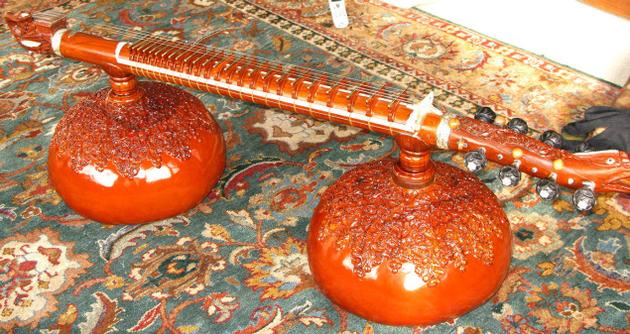
The rudraveena cannot be bought off the shelf. Its making is unique, as it is connected to the player’s body. For instance, its length should be 11 times the hand span of the player. The tuning can be completed only after it is placed on the body. The playing is connected to the player’s breathing rhythm. Traditionally, it was played only in the vajrasan pose.

One tumba (gourd) is kept on the right thigh and one on the shoulder, the right hand plucks the strings going over the right tumba and the left holds the strings with the left ear touching the left tumba. Khanji used to associate this posture with the sacred Swastika.

The instrument’s centre falls between the navel and the heart. The vibrations circulate in our inner body with the sound of ‘om’ entering the left ear from the left tumba. The right tumba’s vibrations go through the lower body through the right thigh. These vibrations produce inner well-being and tune us to the universal nada (sound). The instrument is itself a tool of pranayam and yoga. For those who have not mastered breathing, it is a difficult instrument to learn.

source: http://www.thehindu.com / The Hindu / Home> Features> Friday Review> Music / Sowjanya Peddi / November 26th, 2015

Deepak Ravindran: A dropout who is now his college’s biggest hirer

If high-adrenaline action is the surest sign of transmitting a message, Deepak Ravindran is sending out one loud and clear. His Bengaluru-based startup Lookup, which has Twitter co-founder Biz Stone and Infosys’s Kris Gopalakrishnan as investors, is in the final stages of closing its latest round of funding. And the CEO and founder of the hyperlocal messaging app, that allows businesses to connect with local consumers, reveals the announcement can be expected within a week.

Inspiration for Lookup struck Ravindran while visiting his hometown of Kasargod, Kerala. “I saw my mom chatting with her grocer over WhatsApp and placing her order. That was an eye opener about the way people use chat,” Ravindran says, in a telephonic interview from Bengaluru.

With WhatsApp, he noticed one needs to save the number for ease of communication. Once that is done, you can see each other’s frequently changed display pictures, which may create privacy issues. He addressed those with Lookup, ensuring consumers do not have to worry about chatting with storekeepers they’ve never met before.

 The messaging industry has been this 30-year-old serial entrepreneur’s core strength, with this being his third venture in the space. Keeping an eye on the shifting tech landscape, he has morphed the form to suit changing needs. His 2007-launch student startup Innoz for example, was an SMS-based search engine. “It was a time when mobile phones were becoming popular. But internet was still not so common. We saw the potential for an offline search engine,” says Ravindran.

But by 2014, with data lording over voice, Ravindran realised the rules had changed again. To meet the challenge, he decided to merge the two big trends of messaging (chats) and apps. Lookup was born out of this union.

Meet Lookup's Deepak Ravindran, a CEOentrepreneur who chose funding over finishing college and got his competition (no less than Twitter co-founder Biz Stone) to invest in his venture.
Meet Lookup’s Deepak Ravindran, a CEOentrepreneur who chose funding over finishing college and got his competition (no less than Twitter co-founder Biz Stone) to invest in his venture.

Fashioned after Steve Jobs

Ravindran’s story at 18 wasn’t typical of the average Indian science student. He took his medical and engineering entrance exams, securing ranks in both. He liked computer science, so he picked engineering.

He had discovered the internet just a few years before at 15. Logging on via a dial-up connection, he was fascinated by the worldwide web. He says, “I started looking for inspiring stories and read about Steve Jobs and a few others. I read how he started a company at a very young age and that idea stuck.”

By the time he entered Lal Bahadur Shastri Col lege of Engineering in Kasargod in 2005, Ravindran had decided that he would use it as a fertile ground to found his own company. He did so in 2007, with three classmates. When his startup was picked by IIM-A’s iAccelerator program that promised funding of Rs 3-5 lakh, things came to a head. The founders had to shift base to Ahmedabad, which meant a choice between college and the accelerator.

The quartet made their choice. They dropped out of college. “Dropping out is a fad now. But it was extremely risky back then. The only reason we did it was because we were getting funded for the first time,” says Ravindran, disclosing that they did worry about getting good placements if things didn’t work out.

 For a month, the families of Ravindran and his friends believed they had quit college to pursue an MBA at IIM. “It sounded all fancy,” he said. It eventually worked out, as from dropouts, they went to being the largest recruiter at their erstwhile engineering college, taking on over 100 students within a couple of years — first at Innoz and later at Lookup.

From competitors to partners

Twitter co-founder Biz Stone was Ravindran’s competition at one point. After Innoz plateaued in 2013 and the team failed to sell it off, Ravindran decided to move to US for an MIT incubator program. He founded a Q&A platform Quest, that competed with Quora and Stone’s Jelly.

Stone was interested in acquiring Quest for a possible expansion into the Asian market. But Ravindran managed to raise just $50,000 over a year, falling way short of the $500,000 target. That’s when he decided to wind Quest down and return to India

Incidentally, Stone’s Jelly failed too. In an interview with Mashable, he even admitted that today, a small group of dedicated users is the only thing keeping the app alive. But a previous failure didn’t hamper Ravindran’s prospects according to Stone, who came on board Lookup after a San Francisco meeting in April.

 Undoubtedly, things are looking up for Ravindran at Lookup.

source: http://www.economictimes.indiatimes.com / The Economic Times / ET Home> Magazines> Panache / by Masoom Gupte, ET Bureau / September 03rd, 2015

Sydney pathway named after Indian victim

Bengaluru  :

About 9,000 km away, Bengalurean Arun Kumar helplessly heard his wife Prabha, 41, crying for help on the phone when she was being stabbed inside the Paramatta Park, Sydney , on March 7.

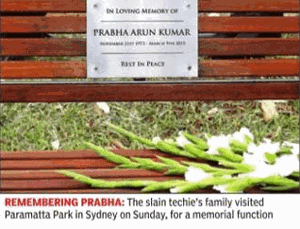
Eight months on, Arun, his 11-year-old daughter Meghana and in-laws visited the park on Sunday as the pathway was named after the 41-year-old techie who was killed when she was walking through it. It was an emotional moment for the family of the Bengalu ru techie to witness the nction where memorial function where plaque was unveiled in the memory of Prabha. The New South Wales (NSW) government had made arrangements to fly Prabha’s family members to attend the ceremony . “This shouldn’t happen to anyone else and it shouldn’t have happened to my wife either,” said Arun Kumar, in his address to the media.

SydneyPrabhaBF25oct2015

Prabha would have turned 42 on Saturday. The pathway links Argyle Street and Amos Street. Prabha’s killer is still at large. Arun Kumar made an appeal to people to come forward and share information with the investigating authorities.”She was very caring; she sa crificed many things, especially by staying away from family , for us. But we are happy that she will be remembered here,” he added.

When asked how their daughter was coping with loss, Arun said: “She is moody but we are taking care of her.”

The investigation into the case has not yielded any result so far. NSW police have not been able to ascertain the motive behind the murder. According to them, the case is open and all angles are still being probed.

“We are happy that the lane way has been named after Prabha and a plaque has been installed at the site where she was senselessly murdered, but our community is disappointed that culprit(s) have not yet been found. We urge NSW police to put every effort in finding out the perpetrators and bringing them to justice. Our true tribute to Prabha will only be fulfilled when perpetrators are arrested and charged,” said Dr Yadu Singh President, Federation of Indian Associations of NSW.

source: http://www.timesofindia.indiatimes.com / The Times of India / News Home> City> Bengaluru / TNN / November 24th, 2015

Compassion for a cause

Udaan, a skit to create awareness on special children will be staged this Saturday at Orion Mall

Child empowerment is the underlying message of Udaan says Sujatha

Udaan, directed by Sujatha Balakrishnan and written by Rebecca Ananya Mathias, an engineering student from MSRIT, is an awareness skit on special children. Udaan, in Hindi, means to fly, but also stands for undoubtedly differently-abled amazing nebulae.

The skit is an awareness initiative by Soroptimist International of Bangalore, a global organisation of women in diverse walks of life working on the upliftment of women and children from less privileged backgrounds.

Sujatha, a former teacher and counsellor for children with learning disabilities, joined SI, Bangalore in 2004 and is their Immediate Past President. “We focus on the three Es: educate, empower and enable. Women’s empowerment is the core vision.” She speaks with passion about the skit and the cause for special children. “I am an advocate of inclusive education. I go every year to the U.S., where my daughter lives, and volunteer in public schools there. There children are accepted as they are. You don’t label them.”

The multi-faceted Sujatha, who has done a lot of theatre, says the art form is a powerful medium of expression. “Theatre done for a social cause is not just for entertainment, but goes beyond that. Working on this play has been a dream of mine. The children and parents were so enthusiastic. I got an overwhelming response from them.”

Sujatha says the script is very powerful. “The protagonist is Tara, she’s autistic. Eighty per cent of the characters are real. The teacher in the play has a theatre connection too. She is the primary caregiver for her sister who has Down’s syndrome sister. A teenage boy plays Tara in scenes three and four. His brother goes to Spastics Society.” Another highlight of the play is a rap song written by Sujatha. “Special children are a delight, in their own right. Show them that you are there, whenever they need your care”….goes the first line, followed by rhyming gems of compassion. “I just sat down one day to write and the song just flowed. We plan to showcase this with the children coming with placards with each line written on them.” Sujatha concludes with a quote by anonymous: “Children with special needs aren’t sent to special parents. They make parents special”.

Udaan will be staged at Orion mall amphitheatre on November 21 at 6 p.m. Entry is free.

source: http://www.thehindu.com / The Hindi / Home> Features> MetroPlus / by Sravasti Datta / Bangalore – November 18th, 2015

City scientist among Infy Prize winners

Bengaluru :

The Infosys Science Foundation, on Monday, announced the winners of the 2015 Infosys Prize. Each prize carries a cash award of Rs 65 lakh and a gold medallion.

Bengaluru-based scientist Umesh Waghmare of the Jawaharlal Nehru Centre for Advanced Scientific Research (JNCASR) has won the prize in engineering and computer science, while five others won in categories like humanities, life sciences, mathematical sciences, physical sciences and social sciences (see list).

From a monk to an ex-army officer, the award winners are a mix of people. Even their works cover a good range from analytical Indian philosophy to the atomic structure of the killer malaria parasite and India’s foreign and security policies to geometric group theory. But no woman has made the cut this time.

The winners were selected by six jury committees headed by experts in their fields. The jury chairs are Prof Pradeep K. Khosla (University of California, San Diego) for Engineering and Computer Science; Prof Amartya Sen (Harvard University) for Humanities; Inder Verma (Salk Institute of Biological Sciences) for Life Sciences; Prof Srinivasa S R Varadhan (New York University) for Mathematical Sciences; Prof Shrinivas Kulkarni (California Institute of Technology) for Physical Sciences; and Prof Kaushik Basu (The World Bank) for Social Sciences.

The six winners were selected from 206 nominations -44 in engineering; 32 in humanities; 42 in life sciences; 27 in mathematical sciences; 40 in physical sciences and 20 in social sciences.

S D Shibulal, president, Board of Trustees, Infosys Science Foundation, said, “We set up the Infosys Science Foundation and instituted the Infosys Prize to restore the romance of research. As we move into our seventh year, the Infosys Science Foundation continues to foster a culture of scientific thinking through various initiatives.”

Infosys founder NR Narayana Murthy said: “Today, Infosys Prize is the prize for science and research. There is a lot of influence that this lends and we are happy to be encouraging people to do better. Some of the people who were recognised first by us have gone on to win international awards.Manjul Bhargava, for example, went on to win the Fields Medal.”

The awards will be handed over on February 13, 2016, at a function in New Delhi.

THE IGNITED MINDS

PROF UMESH WAGHMARE | Engineering

and Computer Science A professor at the Theoretical Sciences unit of JNCASR, Umesh Waghmare has been researching on designing new materials, among other things. He has been awarded for his innovative use of theories and models in probing microscopic mechanisms responsible for the way materials like topological insulators ferroelectrics, multiferroics and graphene behave. The materials are then suitably designed for better use.

AMIT SHARMA | Life Sciences

He is a Group Leader, Structural and Computational Biology Group, International Centre for Genetic Engineering and Biotechnology (ICGEB), New Delhi. Amit Sharma has been awarded for his pioneering contributions towards deciphering the molecular structure, at the atomic level, of key proteins involved in the biology of pathogenesis of the deadly malarial parasite.

PROF MAHAN MAHARAJ | Mathematical Sciences

Mahan Maharaj, monk and Associate Professor of Mathematics at the Ramakrishna Mission Vivekananda University, Belur Math, Howrah, has been honoured for his contributions to geometric group theory, low dimensional topology and complex geometry. He established a central conjecture in the Thurston programme to study hyperbolic 3-manifolds and introduced important new tools to study fundamental groups of complex manifolds.

PROF JONARDON GANERI | Humanities

A Global Network Visiting Professor of Philosophy, New York University, and Recurrent Visiting Professor at the Department of Philosophy, King’s College London, Jonardon Ganeri has been honoured for his outstanding scholarship and originality in interpreting and scrutinizing analytical Indian Philosophy. His efforts in shedding light on shared ground as well as the dichotomy between Indian and Greek traditions of philosophical reasoning have been acknowledged as well.

PROF G RAVINDRA KUMAR | Physical Sciences

Ravindra Kumar, professor in the Department of Nuclear and Atomic Physics (DNAP), Tata Institute of Fundamental Research (TIFR), Mumbai, has been awarded for his pioneering experimental contributions to the physics of high intensity laser matter interactions.

SRINATH RAGHAVAN | Social Sciences

Srinath Raghavan is an ex-army officer and Senior Fellow, Centre for Policy Research, New Delhi.

He has bagged the award for outstanding research that synthesizes military history, international politics and strategic analysis into powerful and imaginative perspectives on India in global context. He has written three books focusing on foreign policy and military history in South Asia.

source: http://www.timesofindia.indiatimes.com / The Times of India / News Home> City> Bengaluru / TNN / November 17th, 2015