Until six years ago, Rajan Srinivasan, the 47-year-old vice-president of British Telecom, didn’t know how to swim. On Wednesday evening, as he stood at the White Cliffs of Dover, he felt a deep sense of accomplishment. It wasn’t without reason. Srinivasan was part of a team from Bengaluru that crossed the English Channel.
The Swimlife Seagulls, an eight-member team led by coach M Satish Kumar, crossed the 63km distance (they took the longer route because of high tide) in 14 hours and six minutes. What sets the team apart from other swimmers is the diversity. Homemaker Suman Singhi was the lone woman in the team, entrepreneur Tejas M Sati was the youngest at 34 and 67-year-old Mohan Sawkar, a lawyer practising at the Karnataka High Court, was the oldest.
It was Srikaanth Viswanathan, an engineer, who mooted the idea in July last year. And the team began its training soon.
Preparations took them to Kodi Beach in Kundapur and Calangute in Goa. In March this year, they did a trial swim, crossing the 40-km stretch from Khanderi to Gateway of India, Mumbai. The team, which landed in Dover on August 28, initially planned to cross the Channel on September 11, but when the window to accomplish their mission came up on Wednesday, they took up the challenge after three days of practice. They began their arduous journey at 2 am.
“It’s a great feeling to have crossed the Channel,” Satish told TOI from Dover. “It’s special because most of the members initially started swimming for health reasons and to overcome their fears. But through the past year, our goal was crossing the English Channel. We had to overcome many challenges, sea sickness being the biggest. We were not used to the temperature, 14 degrees Celsius. Each of us feels we have accomplished something.”
While the actual distance is 32km, the Seagulls had to cover 63km because of high tide. Each person swam for an hour at a stretch before the next one took over. “It is an over-the-moon feeling,” said an elated Suman. “I began to swim to battle high blood sugar and cholesterol. I never thought I would conquer the Channel and my ailments.”
Still in celebratory mode, the team is game for the challenge one more time.
source: http://www.timesofindia.indiatimes.com / The Times of India / News Home> City> Bengaluru / by Manuja Veerappa, TNN / September 04th, 2015
by Prof. A.V. Narasimha Murthy, former Head, Department of Ancient History & Archaeology, University of Mysore
India and China had cultural relations with each other in the early centuries Before Christ (BC). In fact, the name China or Cheena is a Sanskrit form of a dynasty named Tsin, which ruled in China. Thus China owes its modern name to India and this is a great Indian contribution.
India and China had political and cultural relations around third century BC. According to traditional stories, King Ashoka is said to have sent 18 Buddhist monks to China for the propagation of Buddhism there. One such group reached China in 218 BC. The story of Bodhisattva was quite popular in China around the second century BC. By about third century, the Hanas invaded China and the Chinese King requested help from many countries including India. During that period, he saw cotton cloth which the Indian merchants had brought for trade, and they liked the cotton cloth and traded in them. In fact, China was famous for silk (Chinambara) which is mentioned in our epics and puranas.
During the rule of Ming dynasty, the Buddhist monks, Dharmaraksha and Kasyapa Matanga were taken to China and they translated many Buddhist works into Chinese language. Those Buddhist monks passed through Bamiyan, Kashgar, Kuchi, Karashahar and they became great Buddhist centres.
People from India used to go to China through two routes which were full of risks. More than 500 years later, devotees used to go through Nepal and Tibet and it became quite popular. Special mention should be made of great saints like Dharmaraksha, Kumarajiva, Vimalaksha, Punyatrata etc. In fact, many great Buddhist scholars of Nalanda went to China to get better recognition there. The celebrated travellers Fahien and Huentsang made everlasting contributions towards Buddhism in China. The latter stated that he is unwilling to go back to China leaving the sacred land of Buddhism. Gradually, Buddhism declined in China and Tao and Confucian leaders became more important and began giving trouble to Buddhists. Sacred Buddhists texts like Vinayapitaka, Sutrapitaka, Abhidamma- pitaka were translated into Chinese language. In fact, some of these are not available in India and Buddhists had to depend upon Chinese texts. This glorious period came to an end in early medieval period. It never saw such a glory again.
Under this background, a Chinese inscription found in Karnataka may be examined. There is an inscribed stone in the Shantika Parameshvari Temple in Kumta, North Canara district of Karnataka. It contained letters which were neither Brahmi, Nagari or Kannada and created a furore among the local people. But the people were helpless and even the traditional epigraphists were of no avail. Today people do not know how this stone came to the local temple. At that juncture, a photograph and a estampage were taken and they were sent to Prof. Noboru Karashima of Tokyo University, who was studying Indian inscriptions. In fact, Tokyo University had a course of study on Indian epigraphy under Dr. Karashima. The latter conducted an international conference on Indian epigraphy at Tokyo, which I had the good fortune to attend.
After getting the estampage of the inscribed stone, Karashima deciphered it and read it as ‘Guong Dong Kaiyi Kasshong Ven Veng Jhima.’ It means that this is the Samadhi (tomb) of Guong Dong Ven Veng who established this township. Further Guong Dong is a town in Southern China. He established this in honour of the great God. This information is not sufficient to write more about the saint whose tomb was established here. Obviously, it was meant for worship in those days but it lost its significance and importance in course of time. Suryanath Kamath had published a note in a newspaper.
Further research on this problem yielded some more interesting information. By about 1850, the British were scary of the Chinese individuals who were known to be robbers and were deported to an Island as life sentence. By about 1833 roughly, fifteen men and ten women were freed. Among them some were Buddhists while others were Christians. The Christians married Goan girls or boys and began working as labourers in tea estates, some took up basketry. However, they continued to do thefts and hence local Police kept a strict eye on them and their movements. It is said that most of these people, both men and women, went and settled in Karwar. The bamboo and basketry work done by these people was famous till recently.
Now, we may come back to the saint whose Samadhi has been described above. Hence, it is quite likely that the Samadhi stone which was set up there might have been brought to Kumta where it is now lying.
According to the local people, some of the Chinese merchants who were moving from place to place for the purpose of trade noticed a Chinese inscription and out of respect for the saint brought it to Kumta. It was lying somewhere in the town. In India, local people play an important role in the preservation of our ancient relics in general and inscriptions in particular. As there were no museums in those days, inscribed stones used to be brought to the local temples and kept in a corner. The same thing should have happened to this stone also. In the early days the Chinese merchants used to visit Kumta and had a temporary settlement there.
In other words, this confirms that the Chinese merchants used to visit Kumta for the purpose of trade. They used to be in good numbers and spread themselves in different parts. Thus Kumta became an important centre for the Chinese merchants.
The North Karnataka gazetteer prepared over a hundred years ago, quotes many elders of Kumta who had seen Chinese merchants staying there. In fact, they used to develop friendship with young and beautiful local girls and paid them heavily to be with them. This also made the local Chinese merchants closer to the local people, for their generosity in paying money. This normally happens with foreign visitors. Having come to India and settled down here, the Chinese elevated their saint to greater heights and began worshipping them. In fact, they must have converted them to the level of Gods. In that way, this Chinese inscription though short, is significant and adds a page in the cultural history of Karnataka. The tradition continued till recently is a point of importance, in spite of the present political scenario. Let us bow to saint Guong Dong.
source: http://www.starofmysore.com / Star of Mysore / Home> Feature Articles / Saturday – August 29th, 2015
The historically significant war memorial ‘French Rocks’ at Harohalli in Pandavapura of Mandya district is in a pathetic condition.
Officials start evicting encroachers of the area
Evicting the encroachers from the historical war memorial at Harohalli in Pandavapura taluk of Mandya district has finally begun.
The memorial, known as ‘French Rocks’, was set up in memory of French soldiers, who had come to Pandavapura to help Tipu Sultan during his battles against the British. Tipu Sultan had granted a plot to the French army for establishing a burial ground for soldiers.
The war memorial once had at least 65 graves of different styles and structure.
As the graves were architecturally significant and contained the details of names of deceased soldiers, age and their ranks and file etched in marble plaques.
Nevertheless, the local people had encroached a major portion of the graveyard by demolishing several graves.
Historians had been requesting the district administration to protect the memorials by evicting the encroachers.
A team of revenue officials, led by Assistant Commissioner of Pandavapura (Revenue) H.L. Nagaraju and tahsildar B. Shankaraiah visited the war memorial on Wednesday and cleared the encroachments. The team had destroyed various crops cultivated at the graveyard. Mr. Nagaraju said the taluk administration would initiate steps to facelift the memorial soon.
“We will first remove the weeds and then protect the graves,” he said.
source: http://www.thehindu.com / The Hindu / Home> National> Karnataka / by M.T. Shiva Kumar / Mandya – August 27th, 2015
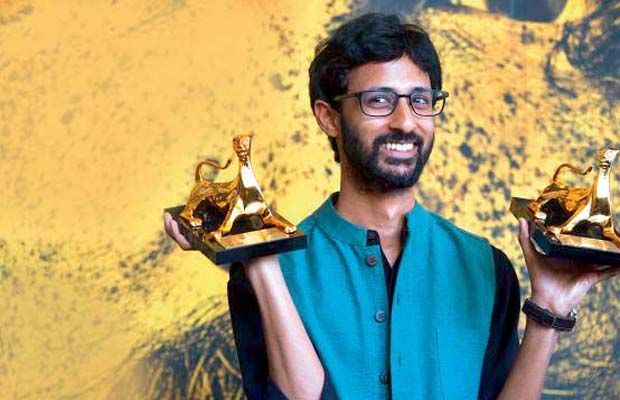
Raam Reddy with his awards at the Locarno Film Festival in Switzerland
Just weeks after Neeraj Ghaywan’s Masaan won laurels at the Cannes film festival, another Indian film has won two awards at the Locarno Film Festival in Switzerland. Thithi, directed by Bengaluru-based Raam Reddy bagged the Concorso Cineasti del Presente and the Swatch Award for Best First Feature.
The film, in Kannada, features actors previously unheard of and was shot in Karnataka’s Mandya district. It tells the story of how three generations of sons react to the death of their grandfather, Century Gowda. The film then leads up to the thithi ceremony that is held eleven days after the death.
Raam, from St. Stephen’s College, New Delhi, is a 25-year-old filmmaker who has previously directed short fiction films, including a Telugu short called Ika. He studied direction at the Prague Film School and has also published a novel.
In a press statement, Raam said that capturing “India’s soul on film” was something he had always dreamt of. “Some of the characters in the film have become symbols to me — of how life can be lived simply, unequivocally, with grace — and I feel blessed to have had the chance to immortalise them,” he said.
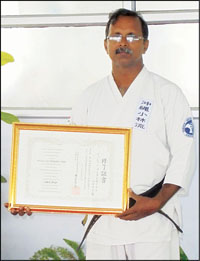
City’s Karate Master Renshi Johnson became the first Karate Master from city to be trained and evaluated by 32 grandmasters (Red Belts) of four major Okinawa Karate Schools; Goju-Ryu, Isshin-Ryu, Shorin-Ryu and Uechi-Ryu, assigned by the Japan Government and successfully completed the Okinawa Traditional Karate and Kobudo Worldwide Seminar in Naha, Okinawa (Japan).
Governor of Okinawa Prefecture Takeshi Onaga certified Renshi Johnson, felicitated and awarded the certificate on July 18, 2015.
This is the first time a Karate instructor from Mysuru was selected and invited by the Okinawan Governor himself to take part in a worldwide Karate and Kobudo event and was evaluated by the living legends (grandmasters) of Okinawan Karate.
Renshi Johnson, a resident of Roopa Nagar, Bogadi in city, is a 5th Dan Black Belt in Karate and 2nd Dan Black Belt in Kobudo.
source: http://www.starofmysore.com / Star of Mysore / Home> Sports News / Sunday – August 09th, 2015
The Golden Jubilee celebrations of All India Institute of Speech and Hearing (AIISH), Mysuru, will be held at AIISH Gymkhana auditorium in Manasagangotri on Aug.9 at 10.30 am. Dr. P.Satishchandra, Senior Professor of Neurology and former Vice-Chancellor, National Institute of Mental Health & Neuro Sciences (NIMHANS), Dr. H.A. Ranganath, former Director-NAAC and Dr. Ramachandra Bhat, Vice-Chancellor, Swami Vivekananda Yoga Research Foundation, Bengaluru, will be the guests at the inaugural function.
Dr. Harsh Vardhan Batra, Director, Defence Food Research Laboratory (DFRL), Mysuru and Dr. V. Sivaprasad, Director, Central Sericultural Research & Training Institute (CSRTI), Mysuru, will be the guests for the cultural programme at 6.30 pm on the same day. Prof. S.R. Savithri, Director, AIISH, will preside. On the occasion, a Golden Jubilee video, online system for hearing screening, new-born hearing screening centres, research publications, clinical tests and tools will be released. The event also includes felicitation to Ph.D awardees, meritorious students, retired employees and AIISHian of the year award.
The All India Institute of Speech and Hearing (AIISH), Mysuru, established in 1965, for human resource development, research, clinical services, and public education in the field of communication disorders, will complete 50th year of its journey on 9th August, 2015.
On the invitation of Government of India, Dr. Martin F. Palmer, Director, Institute of Logopedics, Wichita, Kansas, USA, visited India in 1963 and recommended for setting up an institute of Logopedics in India at Mysuru.
On 9th August 1965, All India Institute of Logopedics started functioning in Rama Mandira (a rented building) with Dr. N. Rathna as the first employee. Dr. B.M. Rao was appointed as the first Director later.
On 25th July 1966, Dr. S. Radhakrishnan, the then President of India, laid the foundation stone for the institute building in the 22-acre campus presented by the Maharaja of Mysore. On 2nd October 1966, M.Sc. programme in Speech and Hearing, the first-of-its kind in the country, was initiated by the institute with affiliation to University of Mysore. On 10th October 1966, the institute got registered with the name “All India Institute of Speech and Hearing.” What started as a small institution in 1965 has today blossomed into one of the premier establishments across South Asia in the field of communication disorders.
Over the last 50 years, growth of the institute has been phenomenal on all four fronts: Academic, research, clinical services and advocacy. The institute, which started with one PG programme, now offers 16 academic programmes. In addition, it offers two Ph.D. programmes and Post doctoral fellowship. The institute has been recognised as a Centre of Excellence in the area of Deafness by WHO, as a Centre for advanced Research by UGC, as a Science and Technology Institute by DST, as a Centre of Excellence by the Ministry of Health and Family Welfare and is accredited by NAAC with highest A grade.
Nodal Centre
The institute has been also recognised as a Nodal Centre for the implementation of National Programme for Prevention and Control of Deafness and Rashtriya Bal Swasthya Karyakram (RBSK) of Ministry of Health and Family Welfare, Government of India.
The institute, which started with one Department of Logopedics, now has 11 Departments with state-of-the-art facilities to provide best available clinical services in the entire Asia. The complete diagnostic and therapeutic services focussed on holistic rehabilitation of persons with communication disorders are provided under one roof at a nominal cost by the most experienced professionals in the field.
AIISH also runs 8 centres at RML Hospital, New Delhi; AIIPMR, Mumbai; JLMNC, Ajmer; SCBMC, Cuttack; CSMMU, Lucknow; IGMC, Shimla; RIMS, Ranchi and JNMC, Bhagalpur for Diploma in Hearing, Language and Speech programme. The institute conducts this diploma in virtual mode through video conferencing in these centres and also provide clinical services.
Further, the institute provides mentoring to RIMS, Imphal; JIPMER, Puducherry and NSBMC Jabalpur for BASLP programme. It also provides tele-rehabilitation and tele-diagnosis services at these centres. The institute has 4 outreach centres to extend its services to the masses at Akkihebbalu, Hullahalli, Gumballi and Sagar Taluk in Karnataka.
source: http://www.starofmysore.com / Star of Mysore / Home> Feature Articles / Saturday – August 08th, 2015
A girl, who first started solving Sudoku with her grandfather and father last year, has bagged the silver medal at the inaugural Qianán Water City Cup 2015 World Junior Sudoku Championship held at Beijing, China, recently.
Aditi Sheshadri, a student of Delhi Public School (Bangalore North), says that her interest grew during the school rounds of the Sudoku Champs. “It was a pleasant experience to win the Bengaluru round and get selected for the Indian Under-18 team for the World Junior Sudoku Championship in Beijing,” she says.
Apart from Aditi, the team comprised Shristi Kejriwal (Mahadevi Birla World Academy, Kolkata) and S. Pranav Kamesh (Maharishi Vidya Mandir).
The team won the silver medal while Aditi finished ninth in the individual U-18 category. She was also part of a record-breaking event for the largest multi-Sudoku puzzle consisting of 200 standard grids achieved by Beijing Sudoku Association (China), in which 200 participants from 10 countries took part. She received a certificate of participation from the Guinness World Records in the Officially Amazing category.
source: http://www.thehindu.com / The Hindu / Home> News> Cities> Bengaluru / Sudhindra A.B. / Bengaluru – August 11th, 2015
Here we publish the full text of the convocation address delivered by Dr. A.P.J. Abdul Kalam, the then Scientific Adviser to Raksha Mantri and Secretary, Department of Defence, Research & Development, at the 75th Convocation of University of Mysore on Feb. 25, 1995. — Ed.
Dr. A.P.J Abdul Kalam (second from right) seen with the then Governor-Chancellor Khurshed Alam Khan, the then Higher Education Minister and Pro-Chancellor D. Manjunath and the then Vice-Chancellor Prof. M. Madaiah during the 75th Convocation of University of Mysore on Feb.25, 1995.
by Dr. A.P.J Abdul Kalam
Dare to Dream: I am indeed delighted and honoured to participate in this 75th Convocation of University of Mysore. I have been thinking about what to share with you on this important occasion when you are entering the most eventful phase of your life after years of learning. I know that for the past twenty-years or so you have been continuously taught various aspects by teachers. I am, therefore, not going to extend this process. Instead, I would like to share with you a few of my experiences, one at a place very close to you and others at Trivandrum and Hyderabad.
These are the experiences where people have dared to dream and met with success. Of course, we have to recognise that success is always the result of sweat of individuals and also coupled with many failures. The place close to you is the site of pilgrimage not only for me but for every one who practices rocketry in our country. Let me first tell you something about this.
First War Rocket: When I was studying in school and college, Srirangapatna interested me for two reasons — the place was the scene of battle against foreign rule and also there was a reference to a new weapon introduced. In 1960, when I visited Srirangapatna with my friends, we were thrilled to walk around this historical town. We searched for the Turukhan-hally Fort built during Hyder Ali – Tipu Sultan times and used for making rockets, way back in 1794. I had a tremendous disappointment when I did not see any permanent evidence or historical recordings in Srirangapatna regarding creation or development of first war rocket in the world.
Later, in 1963, I was at Wallop’s Island, the rocket launch facility of NASA in USA, in connection with a collaborative programme of launching of sounding meteorological rockets for research of upper atmosphere. In the lobby of their command-control centre, I saw a prominently displayed picture. The war dress and the colour of the soldiers’ skin attracted my attention. Some dark complexioned soldiers were firing rockets on their white skinned opponents. The label on the painting read, “The world’s first war rocket.” It was indeed a great pleasure to see an Indian feat acknowledged on the other side of the planet. I felt excited with happiness.
I started reading the history of rockets. I had a dream I must see Tipu’s rockets. Time continued to pass. Rocket technology engulfed me and India’s first Satellite Launch Vehicle SLV-3 was launched. In 1980, we had an opportunity to visit London. There, I saw two of the war rockets captured by British at Srirangapatna, displayed at Museum of Artillery at Woolwich in London with the heading “India’s War Rocket.” Probably, Europe learnt rocketry from our Srirangapatna rocket in the eighteenth century! It was a great thrill to see an Indian innovation on a foreign soil, well-preserved and with facts not distorted.
I got the performance of these 2 kg rockets, 50 mm in dia. and about 250 mm in length analysed by our designers. What a simple and elegant design, effectively used in war ! Surely, Hyder – Tipu Sultan would have had talented men who could look at propulsion, material, ignition and build rockets and fly them for war operations. In fact, when we look back to eighteenth century ambience, it is a technology marvel.
I would like to declare today that this land is the birth place of war rockets in the world and offer it my reverence and respect. The tradition continues.
Prof. Vikram Sarabhai – Man of Vision: Nations advance along the course charted by great dreamers. Let me narrate to you an incidence which occurred in 1968. We were working on the configuration of India’s satellite launch vehicle in Thumba. One day, Prof. Vikram Sarabhai, the then Chairman, Indian Space Research Organisation (ISRO), brought Prof. Curien, President, CNES, France, to our laboratory. France was developing Diamont satellite launch vehicles at that time. After focussing on our planned efforts, as an almost spontaneous reaction, Prof. Sarabhai proposed that we should fly India’s fourth stage of SLV-3 as the Diamont’s fourth stage. We had not flown even a meteorological rocket by that time, but Prof. Sarabhai was aware of the possibilities and trusted the capabilities of his team. His dream of SLV-3 fourth stage getting into a French launch vehicle finally came true in the form of apogee boost motor for APPLE satellite, flown by ARI
ANE, the European launch vehicle. This is the vision ! He gave us a 15-year jump in our efforts. With three experimental Indian Remote Sensing (IRS) Satellites in orbit and their images being received in the USA, Satellite Ground Stations with Indian Satellite Launch Vehicle PSLV launching our own satellite from our own land, his dream visualised in 1965 has taken form through the people born at different times. Nations are thus built by men of vision who dream and prepare ground for the coming generations.
Super Computer and Parallel Processing: In 1986, Dr. V.S. Arunachalam and myself went to US to buy a Super Computer with 400 mega flop speed. The Deputy Secretary in the Department of Defence at Pentagon first put us into long series of technical discussions and then regretted the sale on the pretext that we will use it to develop long range missiles detrimental to the security interests of the world. Travelling back disappointed, Dr. Arunachalam said, “Let us make our own Super Computer.” Today, India has a 32 node 1000 M Flops PACE SPARC 10 machine available for other countries to buy. Once we decide, we work and realise even tough dreams. That is what India expects from you.
A team of young scientists and engineers under the leadership of Dr.G.Venkataraman formed ANURAG, that is, Advanced Numerical Research and Analysis Group, to develop a parallel processing computer specially for aircraft design. At that time, AGNI also was taking shape. The payload of AGNI would re-enter the atmosphere at 15 times the speed of sound. Even at this speed, we had to keep the vehicle under control and while the payload outer temperature goes to 3000 degrees centigrade, inside of payload the ambient has to be less than 30 degrees centigrade. We have in India supersonic wind tunnel. We needed hypersonic wind tunnel for designing the AGNI payload. Various wind tunnel data could provide the loads experienced during the re-entry phase of the system. There were tunnels abroad but once they knew the application, they were refused.
This time our high-tech academic institutions rose to the occasion. Prof. S.M. Deshpande of Indian Institute of Science (IISc.) with five young bright fresh scientists from DRDL with background of mathematics and fluid dynamics, developed Computational Fluid Dynamics Software for Hypersonic Regimes in just six months. This software is the original contribution with minimum computational facility available in the world. No country would have given us this type of software. But it was done through optimum partitioning, sequencing and paralleling the task. This software solution has established that brain-power excels man-made machines, even super-computers.
I have seen that India can build her own super-computer; India can fly its own rocket system within and outside the country. Both the dreams have come out of visions. This convocation ambience, where hundreds of young graduates are entering their professional lives, is ideal for thinking about the need of visions for the next two decades. What could they be?
Vision for the Nation: With the growing population, increasing unemployment, unaffordable medical care and changing value system, our society is going through certain turbulent situation. The society looks forward to prosperity. In a decade or two, prosperity and good life is possible if the nation has the vision. Vision generates progress. As an example, we can study the period between 1857 and 1947; it was the vision of freedom which not only got us independence but during the same period in India, vision of independence generated many leaders of excellence in politics, philosophy, history, science and technology and industry. Again, can we dream for a vision to make this nation great — a nation with prosperity and peace?
Enlightened Citizens: The vision of “Enlightened Citizens” calls for a mission of integrating education, occupation and health care as one single entity. For development of self, society and nation, it is essential that hundreds of clusters of villages are divided into multiple blocks of 20,000 families. And each block can be considered as a progress group with certain number of hospitals, schools and agriculture farms which could be growing cash crops, aromatic plants or fish farms.
The experience in Kerala and Tamil Nadu indicates that integration of education and occupation resulted in small families, in addition to promoting self- sustained good life. This enlightened citizen package can be extended to the whole country.
Networking of Major Rivers: We recently conducted a workshop on the subject based on Dr. K.L. Rao’s report “National Water Grid” and Capt. Dastur’s proposal of “Garland Canal.” This has all the dimensions of becoming an important vision for the nation. Nation can aim at linking multiple rivers resulting in water distribution, flood and drought control, navigation and power generation.
Above all, this will bring together the country as it happened during the independence movement, with potential revolution in agricultural output and employment generation. Experts have indicated that this is the right time to take this as a major programme as technology exists today and the country has the capability to finance such a programme.
Today we have: satellite mapping of water resources and river flow aspects; capability to use nuclear energy for large tunnelling in mountains to direct the river flows and technological strength in mechanical, civil and communication engineering. It may be a 20-year programme for the nation.
Energy Everywhere: Similarly, the third area is “Energy Everywhere.” We believe by year 2000-plus, we will have to generate almost 50% more power. Probably, we will have to look for environment clean power. In addition to hydro and thermal energy, the non-conventional energy and nuclear energy has to contribute to power generation for which technological innovation is essential. Even hydro and thermal energy would need newer technologies so that they can provide affordable electrical energy.
Conclusion: Friends! Vision for the nation is in front of you. These dreams are bigger than the individual or group of people. Great things do not just occur; you have to dream about them and work to realise them. You can be a partner to the visions for the country and begin to experience dreams coming true. What you are is God’s gift to you. What you make out of yourself will be your gift to God. I wish you a challenging profession in your respective fields and recall the famous lines:
“The chances have just begun
The best jobs haven’t been started,
the best work hasn’t been done.”
source: http://www.starofmysore.com / Star of Mysore / Home> Feature Articles / Saturday – August 01st, 2015
Omar Kaiser jokes that had he not been married, he would have been in the Andamans now with his prized possessions — three classic Land Rovers. Hailing from Bengaluru, Omar runs an adventure tourism company, owns lounges and recently started a garden store in the City. “My plan is to go back to adventure tourism where these vehicles play an important role. It was with this intention that I started collecting these Land Rovers. These vehicles have a rich history due to their capability and reliability. More than speed, it’s the capability of the vehicle that is important and the Land Rovers are the best when it comes to being reliable even in the most difficult conditions,” he says.
He remembers his father as an adventurous person, who was not only a mountaineer, horse rider and badminton player, but also a two-wheeler and four-wheeler rallyist.
“At a young age, I was introduced to the outdoors. I took part in various rallys and activities like camping and now, I make sure that my children are also exposed to them,” he says.
Ask him about how he developed a passion for vintage and classic cars and he says, “In 2007, my friend Narayan introduced me to the Land Rovers. Those days, they were not expensive and people did not value them much. So I thought it was a great opportunity to collect them. I bought three for myself and picked up four more for my friend.”
The classics, according to Omar, are tough and not meant to be driven fast. All the three vehicles he owns came to India as ambulances or health care vans, either donated by the WHO or individuals.
The rarest among them is the 1966 Land Rover, an open-top vehicle that belongs to the II A series. It had come from Kulu Manali Mission Hospital as an ambulance. “The surprising part about this Land Rover is that it still has the original engine and gearbox. Razak, the previous owner, had taken a lot of effort to maintain it,” he adds.
The second in the collection is a green Land Rover from Kerala, which belongs to series III 109. It is a 1973 model that belonged to Caritus India, an NGO in Thrissur and was used as an ambulance. The third one in the collection is the white 110 petrol Land Rover, which belonged to the National Tuberculosis Institute, Bengaluru and was used to transport X-ray machines. “All the three vehicles I own are 4×4’s. I also bought a Willys jeep two years ago, which belonged to the Indian Army in 1981.” He adds, “Finding a Willys with a trailer is very rare and I was lucky to have found this one in a small village in Thirthahalli on the outskirts of Bengaluru.”
Omar and his children consider these vehicles as family and like to call them by the names that they have given to each one of them.
Omar explains, “It was the 1966 model that made me start collecting Land Rovers. The effect that she had on me was so magical that I named her Maya. I call the one from Kerala — Kairali. She was used as a school bus, ambulance and civil bus before she came to me. Incidently, I found her without a gearbox and an engine and restored her. The last one in the collection is a petrol vehicle and I like to call her Laaila — she is the fastest and most efficient. We call the Willys — Billy, the goat.”
On how he maintains his collection, he says, “I understand vehicles and have been maintaining them for a long time. So I do all the work myself. I source parts from Mumbai and Siliguri and have not imported a single part. Till date, I have never towed any of them to the garage. I have always driven them as they have been in a working condition.”
He adds, “These cars are built to last — the Land Rovers have aluminium bodies and their chassis are made of galvanised steel. This vehicles will live longer than everybody alive today. It is said that 70 per cent of the Land Rovers, that have been manufactured since 1947, are still running.”
Speaking of his love for these vehicles, he says, “After my family, I love my cars the most! I personally want to go to the Andamans. I tell my wife a lot of times that if I was not married, I would have been in the Andamans with Maya, Laaila and Kairali and would have never come back,” he laughs. For details, call 9845581829.
source: http://www.deccanherald.com / Deccan Herald / Home> Supplements> MetroLife / by Surupasree Sarmmah , DHNS / August 04th, 2015
The humble jowar roti — the North Karnataka staple — is now crossing the seas to reach homesick Kannadigas yearning for its chewy wholesome goodness.
Growing demand from Australia, England, West Asia and the US has spawned a small-scale industry in Hubballi, a busy commercial hub 400km north of Bengaluru, with dealers and agents spread across the region. Exported in its kadak (crisp) avatar, the jowar roti has a shelf life of 6-9 months.
Poorva Food Products, run by the Patil family, discovered this niche global market and has now gone online.
Lingangowda Patil, who runs the family unit with wife Pushpa and son Girish, says they realized the demand for the roti was going up, as more people migrated from this tier-2 city to other parts of the country and world.
Started in a mess with a paying guest facility in Vidyanagar in 2011, Poorva Food Products has swiftly expanded from 2-3 women making 500-600 rotis, to around 35 women patting out 10,000-12,000 pieces a day. With sales touching 1.5 lakh to 2 lakh rotis a month, the monthly turnover of the 3,800-sqft unit, set up in the city’s industrial area, is pegged at Rs 6-8 lakh.
“We started with an investment of Rs 15-20 lakh. Now, we’ve installed a flourmill, grain-cleaning machine, and other infrastructure,” Patil says.
Business is channeled through dealers who buy rotis in bulk to sell at their own outlets and to customers spread across Karnataka, India and abroad. Like Arun Torgal, who exports rotis to Australia every three months. “Last week, I exported 16,000 rotis. Natives of North Karnataka form a major market in Australia. With the rotis, I also export flax (alasi) seed and niger seed (ramtil) chutney,” he says.
Pushpa Lingangowda Patil takes care of the quality and supplies. “We need 30-40 quintals of jowar every month to meet the demand. We also sell sajji (bajra) roti, ragi roti, half-baked chapatti, senga (groundnut) chutney, flax seed and niger seed chutney. But the demand is highest for kadak jowar roti.”
“There are many who have jumped into this business today, but they often mix other grains with jowar, which changes the taste. We use only jowar,” Pushpa Patil says.
Each roti costs Rs 3.50. About 10-12 rotis are packed into a food grade packet and placed into boxes to be exported without breakage — with three layers of packing for transport within India, and seven layers for export. “Packing and transport cost extra. Our packing ensures the nutrition value of the roti is retained,” she says.
The highest demand is from Bengaluru, Bidar, Kalaburagi and Vijapayapura in Karnataka, besides Gurgaon, Mumbai, Hyderabad, Surat and the states of Himachal Pradesh and Gujarat. Demand peaks during festivals like Sankranti and the marriage season, touching 3-4 lakh rotis a month. Online booking and payment are pushing up sales, with orders being sent to the customer’s doorstep.
“We export to Dubai, Muscat and some parts of America, besides Australia and England. A few days ago, we sold 600-800 rotis to families leaving for England and the US,” says Lingangowda Patil.
Poorva does not have an export licence yet, and is exporting through its agents. Patil has applied for one and is putting in place norms laid down by the Food Safety and Standards Authority of India. “Gloves, caps and uniforms are a must for workers. The unit must be equipped with filtered water facility and have high hygiene standards. We are adopting all these norms. Once we get the licence, exports will be more regular,” Patil says.
SS Reddy of Tirumala Foods, Bidar, buys 40,000 to 45,000 rotis from Hubballi every month. “Every day, we export 200 rotis to America and 200 to England. We send rotis to Hyderabad and Tandur in Telangana, and Latur in Maharashtra, by air.”
source: http://www.timesofindia.indiatimes.com / The Times of India / News Home> City> Bengaluru / by Basavaraj Kattimani, TNN / August 01st, 2015