Category Archives: World Opinion

‘IISc. mobile labs will be handed over to Karnataka govt. shortly’

The mobile RT-PCR testing laboratory created by IISc. | Photo Credit: Special Arrangement

The first set of mobile laboratories designed by a team at the Indian Institute of Science (IISc.) is ready to be deployed and will be handed over to the State government shortly.

Speaking to The Hindu days after being appointed, IISc. director Govindan Rangarajan said the faculty members were engaged in many areas of research on COVID-19. “One of our labs is working on an indigenous vaccine in collaboration with an IISc.-incubated startup. We are also developing test kits that are less expensive and yield faster results. A research team has designed mobile labs for RT-PCR testing that can be dispatched to remote areas, and these are ready to be deployed and will be handed over to the State government shortly. A COVID-19 test centre has also been set up on campus. Our researchers have built prototypes of low-cost scalable ventilators made with locally available components,” he said.

The team developing the mobile labs said one sample collection, sample processing, and sample testing lab each was being handed over to the State government this week. Together, these three labs will enable the processing of up to 200 samples a day — from collection to final RT-PCR test report. “With the flexibility of deployment anywhere in the State, MITR Labs enable a critical tool in the COVID-19 response in the State by reducing the turnaround time for test results. Depending on where the Health Department sees the most need for testing and the longest delay in getting test results, MITR Labs can be deployed near that location,” said Sai Siva Gorthi, associate professor, Instrumentation and Applied Physics, IISc.

The team at ShanMukha Innovations, a company incubated at the Society for Innovation and Development, IISc., is geared up to produce additional units of MITR Labs through their network of vehicle, fabrication, and equipment suppliers. It has started working with the State government to share the benefits of the solution and generate demand to drive the scale-up plans.

Predictions

Prof. Rangarajan also said that another important line of research being carried out was predicting the future course of this pandemic and the effects of various containment measures, which could be of immediate use to policymakers and public health experts. An app that can help identify people who may have crossed paths with COVID-19 patients is also being deployed, he said.

Stressing the need for institutions and governments to learn to work together during these unprecedented times, he said the pandemic was a reminder of the importance of coming together to work on scientific and technological solutions to society’s most pressing problems. “We will continue working on such solutions and will engage with industry and government agencies to ensure that they are rapidly deployed to tackle this crisis,” he added.

Asked about the challenges ahead administratively and academically, the IISc. director said the first priority was ensuring the safety of students, faculty and staff as they start working towards resuming normal teaching and research activities. “The other pressing need is to ensure the mental well-being of our students and to help them navigate through these difficult times. We are currently making plans for the next academic year and are discussing issues related to providing further support for COVID-19 research.”

For the coming academic year, admission interviews were conducted online. “We will also have to do the same for comprehensive exams and thesis defence. Discussions are on about how to hold classes, although they are also likely to be conducted remotely. The same is true for placement interviews,” he said.

source: http://www.thehindu.com / The Hindu / Home> News> Cities> Bengaluru / by K.C.Deepika / Bengaluru – July 26th, 2020

The Eugen Sandow of Bengaluru

KV Iyer was the first person to set up and successfully run a vyayama shaala in Bangalore

Since the time of Kempegowda, Bengaluru is known for its Garadi Mane, the traditional wrestler training centres. Even today there are a few such akhadas in old city where many young men practice this sport, exercise and tone their bodies. Becoming a wrestler is not everyone’s cup of tea. Many young men like to build their body and tone their muscles, both for looks and strength.

Now, all over the city, there are a number of such centres popularly known as gymnasiums, offering varied types of traditional and modern methods of body building. However, during the first half of 20th century there were hardly any such places in the city to shape a sound mind in a sound body. The credit of running such a vyayamashala successfully, goes to KV Iyer. He is remembered even today for exploring a systematic method of physical culture.

A few years ago I met Dr. KV Karna and his wife Vasanta Karna, son and daughter-in-law of KV Iyer, to know of his contribution. Prof. K V Iyer Smarane’ is a memoir brought out by V.Si. Sampada in which the author KG Nadiger gives a vivid picture of K V Iyer’s life, his Vyayamashala and the gymnastic achievements. “Ordinary feet, extraordinary feat” is an apt tribute given to this master of body building by Dr.Veena Bharati in her book of the same title.

Kolar Venkatesh Iyer was born on January 8, 1898 in the village of Devarayasamudra in Kolar district. He lost his mother at the young age. His father came down to Bangalore and started a a small eatery to eke out a livelihood. Iyer could not continue studies after his intermediate due to financial constraints. But he was very much interested in body building.

He learnt the basics of the art of physique from his guru Venkatakrishnaiah. After taking a course of Charles Atlas, who was an Italian-American body builder best remembered as the developer of a body building method and its associated exercise programme, KV Iyer began developing his own system of body building harmoniously, blending the Indian system of Hatha Yoga and Western style of aerobics. His first training centre, Hercules Gymnasium was established in Tipu Sultan’s Palace in Bangalore in 1922.

Once, T P Kailasam, a versatile genius and a household name in Kannada literary circle, came to his class. They had met earlier in another occasion near Kolar. Kailasam explained to him about the salient features of Maxalding system. Maxalding is an exercise system of muscle control using a form of isometrics. Books and pamphlets teaching the system were first published in 1909 and continued until Maxalding ceased to trade in the late 1970s. When Kailasam had gone abroad he had met Eugen Sandow. He also shared his experiences of his meeting Eugen Sandow, a legend of physical culture. He also asked whether K V Iyer had read about Lady Windermere’s Fan, A Play About a Good Woman, a four-act comedy by Oscar Wilde. KV Iyer promptly replied that he had no time to read any books other than literature on physical culture. The playwright replied “Oh my! You are only into body-building, what about your brain? The general opinion about physical culture is All brawn and no brain. You should prove to the world that brawn and brain can go together.” This dictum of his well-wisher had a long lasting effect on the young body builder. He changed his thinking, style of functioning and imparting the training to this pupils.

He rented a bigger house in Chamarajapet fifth main which was located right in front or the residence of the well-known Dr. B. Nanjappa, and established a full-fledged gymnasium which later came to be known as K V Iyer’s Vyayamashala.

For young K V Iyer, Eugen Sandow, the German body builder of early nineteenth century, also considered as “Father of Modern Body Building” was the role model. Earlier, the body builders simply displayed their well-developed physique as part of strength demonstration or wrestling matches. But Eugen Sandow was so successful at flexing and posing his physique that audiences were thrilled and enjoyed viewing his “muscle display performances”. He later created several businesses around his fame, and was among the first to market products branded with his name. He was credited with inventing and selling the first exercise equipment for the masses like machined dumbbells, spring pulleys and tension bands. Even his image was sold by the thousands in ‘cabinet cards’ and other prints. He also authored a few books and journals on the subject. Sandow visited India in 1905, at which time he was already a cultural hero and had the most influence on modern yoga as exercise.

KV Iyer too, like his role model, presented the sequence of yoga asanas in Surya Namaskara, as a practical, modern, stretching exercise rather than as something only spiritual. He toured India doing lecture-demonstrations, accompanied by the yoga guru Seetharaman Sundaram.

Like Sandow, he vigorously promoted himself, appearing in magazines such as Health and Strength and The Superman. He wrote several books on physical culture including Perfect Physique, Muscle Cult, Physique and Figure, Suya Namasakar and Chemical Changes in Physical Exercise.

To be continued….

Email: sureeshmoona@gmail.com

source: http://www.thehindu.com / The Hindu / Home> Entertainment / by Suresh Moona / July 24th, 2020

Here’s why TweenCraft is taking the meme Internet corner by storm

A sample of animated works from Tweencraft | Photo Credit: Tweencraft

This India-made animation app is easy to use and has struck a chord with netizens during the lockdown

The lockdown made almost everyone turn to their smartphones for entertainment. That, in turn, made a lot of content creators try out Indian-made TweenCraft, which has gone viral for its use of basic animation and voice modulation enabling users to create short dialogue-driven comic animation — most of which are memes.

A sample of animated works from Tweencraft | Photo Credit: Tweencraft

Using TweenCraft, one can create animation story with basic learning about the edit features. Moreover it becomes a platform to create personal stories to share on social media. Stories can be created from scratch or simply picked from any story shared created earlier and re-edited to create a new one. The app allows editing rigs (bones) of the characters for performance of specific actions.

Mostly popular as forwards on WhatsApp and reposts on Instagram, TweenCraft’s most-discussed animation series are the ones that involve a mother’s sarcastic comments on exam results, lockdown preparation and bragging of boyfriends. Regional clips do well.

Dinesh Sen and Soni Sahu, of KalpKriti Inc., the company that developed Tweencraft

Bengaluru-based duo of KalpKriti Inc, Soni Sahu and Dinesh Sen has been working on this app over the last four years. Soni says, “Our story is as crazy as the TweenCraft app. We quit our jobs at Intel four-and-a-half years ago. Since then we are working full-time to build this app.” Working without any funding, the two says they have been “following a Buddhist monk’s lifestyle.”

“We are getting some business now,” explains Dinesh, “The last four months have been pretty good for us, giving us the much-needed morale boost. We grew from 300 daily active users to 15,000 without a marketing budget.”

A sample of animated works from Tweencraft, with the logo above | Photo Credit: Tweencraft

With so many apps available, the duo was not sure about the response for the product. “We are satisfied with the outcome. People are loving it,” says Soni. “Creating the app on a limited budget was also a challenge. We were not in a position to hire experts. We did most of the coding and hired interns and freelancers to help us,” explains Dinesh, adding that the app started to gain traction around February 2020.

Reaching the masses

“During February 2020 we used to get around 200 new downloads every day. The magic of numbers actually started happening in May during the lockdown, when RJ Praveen (RedFM) tried our app. In a day our views jumped to 3,87,386 with 17,000 likes,” recalls Soni. The app, which used to get about 2,000 downloads a day in April saw over 6,000 downloads daily in May. The team says the app is currently free, but they plan to have some in-app ads for revenue. TweenCraft also have had businesses contact them to create ads.

A screenshot of a Tweencraft animation, taken on Facebook | Photo Credit: Tweencraft

TweenCraft user Mridusmita Chakraborty, a copywriter with a FM radio channel, says she chanced upon the comic animations while randomly scrolling through YouTube. Mridusmita, a Mass Communications student in Guwahati, Assam, specialising in Animation, instantly liked the comics. She says “I scrolled through the various videos but couldn’t find anything in Assamese. As a copy writer, I have a lot of thoughts and scripts which I can’t really use for radio. I downloaded [TweenCraft] and tried a few.”

Mridusmita adds, “I wrote about a conversation between a girl and her boyfriend. It got me a good number of likes and shares. The comments mostly said they relate to the mindless conversations and the girl’s thought blurbs. The sarcastic mother giving the girl a roasting about her exam results or the show she is watching is also popular. In Assam, Matric results are a big thing. Friends and family actually keep a track of those who appeared for the exams and do not miss making calls to enquire about results on D-Day.”

Most TweenCraft users love to portray family drama through the app — from kitchen conversations to arguments between parents or the discussions of where to eat out. Namrata Kumari and her sister, who both use the app to portray their conversations with their dad about their spending habits, have earned many laughs. “The app is easy to use if you are creative in your dialogues,” says Namrata. “All we do is repeat what our dad says about going shopping or making online purchases. There are many who relate to our content and also offer suggestions on what we could feature.” Those unfamiliar with how to create their own videos can check out tutorial videos on the TweenCraft Desi channel on YouTube.

TweenCraft is available to Android users via the Play Store.

source: http://www.thehindu.com / The Hindu / Home> Sci-Tech> Tech / by Prabalika M Borah / Hyderabad – July 13th, 2020

Zoom to set up new tech centre in Bengaluru after it sees 6700% growth; hiring across various verticals to begin soon

Zoom will also expand its existent Mumbai office, to almost triple its size, an official statement said.

A billboard of Zoom app. (Photo| AP)

Popular video conferencing app, Zoom which counts tech giants like Google, Microsoft and Jio as its rivals, will soon set up its first tech centre in Bengaluru to aid India and global operations, Velchamy Sankarlingam, President of Product and Engineering for Zoom said.

The video conferencing platform will immediately begin hiring DevOps engineers, IT, Security, and Business Operations for its Bengaluru tech centre the video conferencing service saw a 6700 per cent growth in the country from January to April, 2020 during the COVID pandemic.

“Paid user base has increased by 4 times in India from January-April,” Sankarlingam added.

Zoom will also expand its existent Mumbai office, to almost triple its size, an official statement said. California headquartered firm has also data centres in Mumbai and Hyderabad. Without revealing the current employee strength, Zoom has in India, the company’s top management said that all the employees will continue to work from home.

“India is a strategically important country for Zoom and we expect to see continued growth and investment here. We are proud to provide our services for free to over 2,300 educational institutions in India during the COVID-19 pandemic, and look forward to continuing to work with the people and government of India hand-in-hand,” Eric S. Yuan, CEO of Zoom said.

“We plan to hire key employees for the technology center over the next few years, pulling from India’s highly-educated engineering talent pool. This facility will play a critical role in Zoom’s continued growth,” he added.

Zoom to focus on safety/ privacy issues in India

Delving on the security concerns raised by Indian government and activist groups while using Zoom app, the company’s Chief Operating Officer (COO), Aparna Bawa said that the platform is working to ensure end-to-end encryption for all its users in India  and that following the advisories issued by MHA and cybersecurity regulator, Computer Emergency Response Team of India( CERT_ on May 29, Zoom has enhanced its security features. “ We are providing the ‘control your own data routing’ features wherein all our paid customers have the option to completely safeguard the data.”

CERT had earlier pointed out that meeting apps like Zoom, Microsoft Team, Cisco Webex are vulnerable to cyber attacks which may allow criminals to have an easy acess to sensitive information shared on these platforms.

Zoom’s top executives said that the advisories are a routine feature in a COVID pandemic environment where work from home has become a norm and hence the governments are advising on enhanced security features.

Founded in 2011, in San Jose, California, Zoom has been able to scale up its services to overseas markets besides US. The company’s Q1 revenues for the quarter ended April 30, 2020 saw a growth by 169% at $328.2 million and the number of daily active users jumped to 300 million in April from 10 million in January.

source: http://www.newindianexpress.com / The New Indian Express / Home> Business / by Bismah Malik / Express News Service / July 21st, 2020

Megalithic antiques said to date back to 1,000 BC discovered near Kollur

A menhir discovered by a team of archaeologists near Kollur in Udupi district recently. | Photo Credit: Special Arrangement

A team of archaeologists led by T. Murugeshi recently discovered a menhir, a cupule, a well cut in round shape in hard laterite, and pottery of the megalithic period on the foothills of Mookasura Betta, near Kollur, in Udupi district.

Prof. Murugeshi, an associate professor of Ancient History and Archaeology with Mulki Sundar Ram Shetty Memorial College, Shirva, in Udupi district, said the exploration site where the menhir (a tall upright stone of the kind erected in the prehistoric era) was discovered was very close to Kollur Mookambika Temple. In a statement, he said the menhir was similar to the ones discovered in the adjacent Malnad region.

He said Mookasura Betta has a fort-like structure constructed using undressed stones. Locals call it “Mookasurana Kote”. According to Indian mythology, Mookasura was a demon king who was killed by Devi in Kollur to restore dharma, and hence came the name Mookambika.

The menhir found at Mookasura Betta was about 2.1 metres tall, 55 cm thick, 65 cm wide at the bottom, and 55 cm at the top. It was lying on the ground and originally seemed to be oriented towards the east. About 40 such menhirs were reported by researchers at several places, namely Baise, Nilskar, and Heragal in the adjacent Hosanagar taluk of Shivamogga district, Prof. Murugeshi recalled.

Quoting former director of State Archaeology A. Sundara, Prof. Murugeshi said the name Baise was a vernacular version of the Sanskrit word Mahisha. Dr. Sundara had dated the megalithic menhir culture of Nilskar, Baise and Hergal to c. 1200-1000 B.C., he said, adding that the discoveries at Kollur too could be dated back to 1000 B.C. or much earlier. Prof. Murugeshi has already reported menhirs at Kurkal, Adkadakatte, and Buddhanajeddu of Udupi district. The menhir found at Kollur could be from the beginning of the megalithic culture, he added.

Menhirs were locally known as Anekallu, Dibbanadakallu, Nilskallu, Barbiniyarakallu, etc. Prof. Murugeshi thanked Muralidhara Hegde, Ramesh Anagalli, U.B. Chandr Guddemane, Raghavendra Aithal, Janardhana Achari, and Bhaskari Nuksal of Kollur for their help in the exploration.

source: http://www.thehindu.com / The Hindu / Home> News> States> Karnataka / by Special Correspondent / Mangaluru – July 19th, 2020

Eminent scholar U.P. Upadhyaya passes away near Udupi

Uliyar Padmanabha Upadhyaya | Photo Credit: Special Arrangement

His book – The Tulu Lexicon, comprising six volumes, was a major contribution to the linguistics

Noted scholar and the Chief Editor of monumental linguistic work, The Tulu Lexicon, Uliyar Padmanabha Upadhyaya, passed away near Udupi on Friday night. He was 88 and is survived by a son and a daughter.

Sources said that he passed away at a hospital in Manipal at about 11:30 p.m. on July 17.

His wife Susheela who was also an eminent Tulu scholar and who had compiled The Tulu Lexicon with him had passed away on January 14, 2014 at the age of 77 years.

Mr. Upadhyaya was born in a priestly scholar family on April 10, 1932 at Uliyar in Majur Village near Kaup in Udupi district. His father, Sitaram Upadhyaya was a reputed scholar in the court of the Raja of Travancore.

The Tulu Lexicon, with six volumes, was a major contribution to the linguistics by the Upadhyaya couple. Its first volume was published in 1988 and the last volume in 1997. The Lexicon has been published by Rashtrakavi Govinda Pai Samshodana Kendra at Udupi.

Playwright K. Mahalinga Bhat, Associate Professor in Kannada, St. Aloysius Evening College, Mangaluru told The Hindu that his Tulu lexicon project was a major work in Indian languages. The couple had followed the dictionary science and methodology in compiling it and it is of international standard.

The Upadhyayas did serious research work in linguistics and folk culture and produced a number of books-some of them jointly, some individually and some in collaboration with others, he said.

Some of the significant books and articles of Mr. Upadhyaya included Nanjanagudu Kannada (Vokkaliga Dialect), Coorg KannadaKuruba – A Dravidian LanguageKannada – A Phonetic LanguageMalayalam Language and Literature (with Ms. Susheela), Effect of Bilingualism on Bidar KannadaCoimbatore TamilKannada as Spoken by Different Population Groups in Mysore CityDravidian and Negro African: Ethno Linguistic Study (with Ms. Susheela), Conversational KannadaCoastal Karnataka and Bhuta Worship: Aspects of a Ritualistic Theatre (with Ms. Susheela).

He had acquired three Post Graduate (MA) degrees in Sanskrit, Kannada and Linguistics from Madras, Kerala and Pune Universities, Vidwan in Hindi and PhD in Linguistics from the Pune University for his thesis titled “A Comparative Study of Kannada Dialects”. He had command over Hindi, Kannada, Tulu, Malayalam, Tamil, English, French and Olof, the language of Senegal in Africa.

He was a visiting Professor at the Universities of London and Paris.

Noted critic Muralidhar Upadhya Hiriyadkka said that in addition to Tulu, the couple had made significant contribution to folklore research.

source: http://www.thehindu.com / The Hindu / Home> News> States> Karnataka / by Special Correspondent / Mangaluru – July 18th, 2020

CM launches purifier for airborne viruses

The product uses metal nano particles with coated reusable membranes and liquid nanofluids.

Chief Minister B S Yediyurappa inaugurates the Nano Corona Air Purifier-Cum-Steriliser at his official residence Krishna in Bengaluru on Friday

Bengaluru :

A city-based start-up, incubated by Indian Institute of Science (IISc), Nutan Labs has developed Nano Corona Air Purifier Cum Steriliser which purifies indoor air by killing Covid-19 virus and other pollutants. CM BS Yediyurappa, while launching the product at his home office ‘Krishna’, said: “This kind of technology will be useful to help combat the virus. In a first, we are using nano-material in liquid form for absorption of pollutant gases and pathogens.”

The product uses metal nano particles with coated reusable membranes and liquid nanofluids. “In the first stage of nano filtration, we have coated noble metal nanoparticles of 10-20 nanometre each on sandwiched membranes or non-woven fibres. The nanoparticles eliminate the virus by disrupting the outer coating and damaging the genetic material (of 30-140 nanometre each) and ruptures it,” said Nuthan H S, CEO, Nutan Labs.

Jayadeva Institute of Cardiovascular Sciences & Research permitted the start-up to conduct real-time studies with COVID19 positive patients at the hospital’s isolation wards . It is claimed that the instrument purifies, sterilises and recirculates clean and sterile air in a rapid way without using much energy. Recently ‘Nutan Labs ‘ got the ‘Elevate Call 2 Award’ by Start-up Karnataka, Dept of IT- BT, Science and technology, Government of Karnataka.

source: http://www.newindianexpress.com / The New Indian Express / Home> Cities> Bengaluru / by Express News Service / July 18th, 2020

How Bengaluru was bought for Rs 3 lakh 333 years ago

(Clockwise) A painting of Chikkadevaraja Wadiyar; the Kote Venkataramanaswamy Temple was commissioned by Chikkadevaraja after he took over the city; earliest known painting of Bengaluru from 1792 by an anonymous British painter. This was a century af...
(Clockwise) A painting of Chikkadevaraja Wadiyar; the Kote Venkataramanaswamy Temple was commissioned by Chikkadevaraja after he took over the city; earliest known painting of Bengaluru from 1792 by an anonymous British painter. This was a century af…

This story has all the hallmarks of a contemporary property dispute: an owner making a distress sale, relatives trying their best to take over the property, the eager buyer rushing in to take possession and a land shark stepping in to occupy the land illegally. The only catch is that this incident occurred exactly 333 years ago, on July 10, 1687, and the property in question was the city of Bengaluru.

The principal characters in this dispute are historical figures we are familiar with: the seller was Ekoji (Venokji), the half-brother of Maratha King Shivaji. The relative was Sambhaji, Shivaji’s son. The buyer was Chikkadevaraja Wadiyar, the ruler  of Mysore and the land shark was Kasim Khan, the Mughal general sent by the Mughal Emperor Aurangzeb.

Chikkadevaraja
Chikkadevaraja

The entire ‘property deal’, so to speak, took place for Rs 3,00,000. But how did this come to be?

Chikkadevaraja ascended the throne of Mysore in 1673 and is credited with expanding the frontiers of the kingdom to its largest extent. Three of his military exploits stand out.

The first was his defeat of Sri Ranga VI, who was propped up by the rulers of Ikkeri, Bijapur and Golkonda under the pretense of re-establishing the erstwhile Vijayanagara empire.

His victory against Chokkanatha Nayaka of Madurai extended Mysuru’s influence till Tiruchirapalli in the south.

His other big success was stopping Shivaji at Srirangapatna, when the latter was mopping up old Bijapur possessions during a campaign in South India. In April 1682, Chikkadevaraja won multiple battles against the Marathas, even defeating the combined forces of Basappa Nayaka of Ikkeri, Qutb Shah of Golkonda and Shivaji’s son Sambhaji at Banavara, in present-day Hassan.

So when the Mysore forces came face-to-face with the Mughal army at the gates of Bengaluru on July 10, 1687, they were no pushovers.

The Maratha connection

Shahaji (Shivaji’s father), who was a general in the Bijapur army, was given Bengaluru as a jagir by an Adil Shahi ruler. This was passed on to his son Ekoji.

In 1674, when Ekoji was dispatched by Adil Shah to sort out a succession dispute of the local ruler in Thanjavur, he did one better. Ekoji eventually crowned himself the king of Thanjavur.

However, Ekoji now faced a family dispute over the jagir of Bengaluru. Both Shivaji, and later his son Sambhaji — not always on cordial terms with Ekoji — coveted it. Ekoji held on to Bengaluru and Thanjavur.

After their conquest of Bijapur in 1686, the Mughals rapidly pushed towards the south.

Aurangzeb’s expansion of the Mughal empire culminated with the fall of Bijapur (1686) and Golkonda (1687). The gates to south India, then known as Karnata Empire (the official name of the Vijayanagara empire), now lay open to them. Led by Kasim Khan,the Mughal army’s run through the South began in Penukonda, in the present-day Anantapur district of Andhra Pradesh.

Chikkadevaraja managed to keep Tumakuru out of Mughal hands. Ekoji, now faced with the prospect of losing his jagir to the Mughals, made the offer to sell Bengaluru to Chikkadevaraja, for a very reasonable price of three lakh rupees. Contemporary accounts suggest that the amount was paid by Chikkadevaraja even before his troops were sent to take possession of the city.

On his part, Sambhaji sensed an opportunity to settle an old family dispute and dispatched his generals, Santaji and Kesava Triyambak Pant as well as Haraji, the governor of Gingee, to take control of the city before Chikkadevaraja reached there.

The Mughal general Kasim Khan reached Bengaluru before either of the two. When the Marathas reached the city, they found the Mughal flag fluttering over the ramparts and turned back without a fight.

Chikkadevaraja, having already made the purchase, was not willing to give up so easily. He went into battle with the momentum of his victory over the Mughal forces a few months earlier, in Tumakuru. The hostilities lasted four days.

The Apratima Vira Charitam, a contemporary work written by Tirumalaraya, during the life of Chikkadevaraja, records the result of this battle, ‘Mogalr savari sade badidu, manidar Mogalar, odida Mogalara padeyam, Mogala Maratarganjuva perarayar rayaraltu, avaram jayisirpa Chikadevarayane Rayan.’ (He overcame the Mughal forces.The Mughals were defeated. The Mughal forces fled. Those afraid of the Mughals and Marathas are not kings. Chikkadevaraja who defeated them both is the real king.)

Historian Ravikumar Navalgund explains the significance of the king taking over Bengaluru. “Till that point, Mysuru was one of the petty kingdoms trying to build on the ruins of the Vijayanagara Empire and the Bijapur sultanate. With this victory, the Bengaluru region firmly became part of Mysore and even today is considered part of the ‘Old Mysore’ region. Mysuru, for the first time fought and defeated the Mughals, making them recognise Mysore Kingdom as a force to reckon with. From this point onwards, the kingdom continued to expand for nearly 100 years,” he says.

On July 14, 1687 Kasim Khan concluded an agreement with the king, securing for the Mughal’s a transit through Benglauru to Sira, in Tumakuru, where the Mughals established their regional government.

source: http://www.deccanherald.com / Deccan Herald / Home> Spectrum> Spectrum Top Stories / by S Shyam Prasad / July 11th, 2020

With 10,100 beds, BIEC centre will be India’s biggest Covid-19 facility

The Covid Care Centre at the sprawling Bangalore International Exhibition Centre (BIEC) campus on Tumakuru Road. DH PHOTO/B H SHIVAKUMAR r
The Covid Care Centre at the sprawling Bangalore International Exhibition Centre (BIEC) campus on Tumakuru Road. DH PHOTO/B H SHIVAKUMAR

The BBMP is preparing to open a massive Covid Care Centre (CCC) on the sprawling Bangalore International Exhibition Centre (BIEC) campus on Tumakuru Road to combat the spiralling coronavirus cases.

Civic officials said the 10,100-bedded facility will be the country’s largest. New Delhi’s Sardar Patel Covid Care Centre currently holds the honour of being the world’s largest Covid care facility with 10,000 beds. The BIEC facility will accommodate asymptomatic Covid-19 patients or those with mild symptoms.

Initially, the BBMP planned to arrange 5,000 to 7,000 beds in BIEC’s five halls with two-metre distance between the beds. “But the latest standard operating procedure released by the Centre says one-metre distance between the beds is sufficient. So, we scaled up the capacity to 10,100 beds across five halls,” explained Sarfaraz Khan, joint commissioner (SWM), BBMP.

BBMP commissioner B H Anil Kumar said the centre is well-ventilated with enough toilets, nursing stations, kitchens, and other facilities necessary to attend to asymptomatic patients.

“We have decided to set up 10-bedded ICUs at every Covid Care Centre,” Deputy Chief Minister C N Ashwath Narayan, who visited the facility, said. “In BIEC alone, a 100-bedded ICU will be set up with all medical facilities, including oxygen supply. By Monday, 7,000 beds will be ready to occupy and the remaining 3,000 beds will be added in a week.”

The civic body has put up LED screens to beam entertainment programmes, especially for children and the elderly to help them overcome boredom. Good quality food has also been organised for patients with separate bins to dispose of the plates.

A bio-medical waste agency has been given the tender to clean the facility. The centre will have separate cabins with 40 beds and televisions sets in each cabin.

“High-tech toilets and washroom facilities have been provided at all the halls. Separate oxygen chambers have also been set up,” K Narasimhamurthy, joint commissioner, Dasarahalli Zone, explained.

Narayan said patients will be diverted to BIEC by the end of the week. “All medical staff have been relieved from their non-medical duty and directed to these clinical services. Additional trained staffers will also be deployed at these Covid centres. If there are any more complaints about the quality of food, the suppliers will lose the contract without notice,” the deputy chief minister cautioned.

source: http://www.deccanherald.com / Deccan Herald / Home> City / DHNS / July 06th, 2020

Meet 22-year-old Prathap from Mandya, who has built over 600 drones, and is known as the Drone Scientist

We talk to Prathap NM from Mandya, popularly known as the Drone Scientist of India. He talks about his journey so far and the instances when his drones helped people in dire need.

Prathap N M with his drone during one of the expo

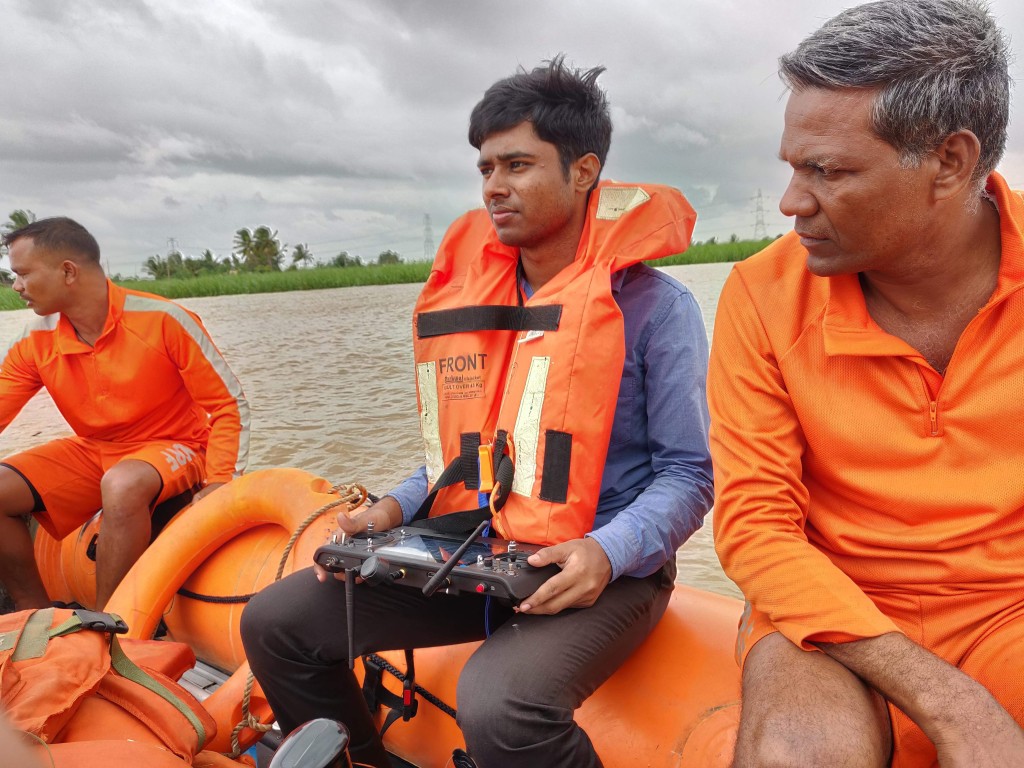
Recently, when floods ravaged major parts of North Karnataka and people were stranded in different places, Prathap NM used the drone he made to provide food and relief materials to several affected areas. From Hipparagi Barrage to Janwada, a nearby village — he used his drone to help many. Thousands of people gathered to watch if this drone could really reach the right place. And when it did, both police personnel and the public cheered loudly for the 22-year-old. Originally from the Mandya district, Prathap is a BSc graduate from JSS College of Arts, Science and Commerce in Mysuru.

He is popularly known as the Drone Scientist or the Youngest Scientist in India. A fitting name, we think, considering he thought about building drones when he was just 14 years old. When he was 16, he already had a drone in his hand ready to fly. “Have you seen an eagle, whose eyes are sharp and flight precise? It was this bird that inspired me to build a drone. The late Dr APJ Abdul Kalam also served as an inspiration as he achieved a lot in his lifetime. The first drone that I built was a basic one which could simply fly and capture some images. As I learnt more about technology and how drones can be helpful, I built bigger drones. To date, I have built around 600 drones,” he says.

In 2017, Prathap was recognised on several national as well as international platforms for his work. “I exhibited one of my drones at Skills India and won second place. I exhibited a self-made project called Drones in Cryptography. The Germans used cryptography to send coded messages about bombings, especially during the time of Adolf Hitler, the dictator. Usually, radar signals can trace drones, but if you send messages or signals through cryptography, you can neither detect them nor decode the encrypted message,” he explains. This young scientist has been invited to over 87 countries to showcase the different drones he has built.

When we ask him about the funding required to fuel his passion, he says, “I use very little money and a lot of e-waste to make my drones. Whenever I win competitions, I am awarded money which I save for the future. And as far as e-waste goes, a lot of it is generated and I get it from electrical shops in Mysuru, Visakhapatnam, Mumbai and a few other cities. For example, if there is a mixer-grinder that is defunct, I can remove the motor and use it in my drone. Similarly, I make use of chips and resistors from broken televisions to build my drones. It doesn’t matter what the prototype looks like. Proving the technical points of the drone is all that matters.”

DronePratap02BF05jul2020

Prathap used his drone to deliver food to people in the flood-hit North Karnataka region

Prathap has won young scientist awards from Japan and France and gold medals for his research on drones from Germany and the USA. among others. But he had to face several challenges before he could earn these recognitions. Being the son of a farmer, Prathap comes from a poor family and could hardly afford to buy good clothes for himself. “When I travelled to France for the first time, people were shocked and judged me for travelling in business class. However, this did not matter to me. One of the companies in France offered me an opportunity to work on their research project. I earned some money there and contributed to the improvement of my family’s financial condition. Currently, the drones I am building now are funded by the money that I earned in France,” he says happily.

Eagle 2.8, the saviour 
Prathap feels happy that his creation saved the life of a little girl in Africa. Narrating the series of events, he says, “Africa is home to many indigenous people and species. There is a dangerously poisonous snake called the black mamba in this country. In one year, around 22,000 people in a particular tribal area had died due to this snake’s bite. When I was in Sudan for a research project, an eight-year-old girl was bitten by this snake and needed urgent medical assistance. Usually, a person can survive for only 15 minutes after being bitten by this snake. I used a drone to send the antivenom to the place where she was, a place so remote that you won’t even be able to find its location on Google Maps. The place was 10 hours by road from where I was, so I used my Eagle 2.8 drone, which can cover 280 km per hour. The antivenom was delivered within eight and a half minutes. It was a very challenging task for me. Later, the child and her mother came all the way to Sudan to meet me and thanked me for saving her life. I was very happy that I could help.”

DronePratap03BF05jul2020

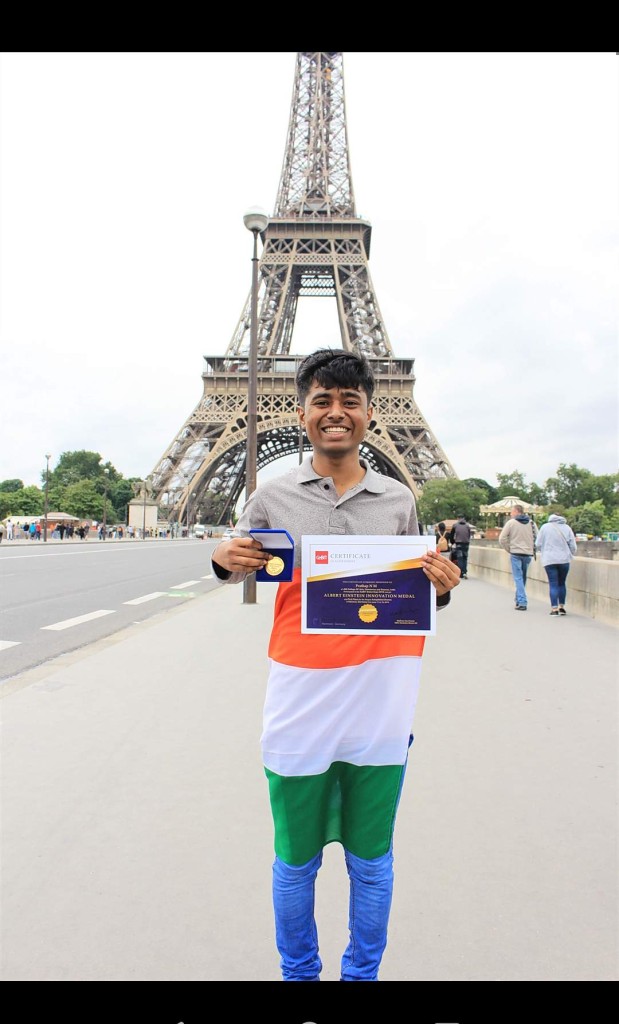
Prathap was given the Albert Einstein Innovation Medal from CeBIT in 2018 and secured the first place for his project Autopiloted drones

Prathap has also delivered a few lectures at IIT Bombay and IISc on how drones can be used in time-sensitive situations like transferring of organs during organ donation, blood transfer and other such purposes. Prathap says, “When my lecture was held in these institutes for the first time, only three or four people attended. But these few people told the others about me and my talks, so when the lectures were organised again, the hall was jam-packed.” Currently, Prathap is working to establish his own start-up that can involve youngsters to build drones or any other devices. According to him, there are several people out there who have the talent, but don’t have the degree. “I will employ such talents and bring out many innovative devices that can help the nation during disasters and wars and in the fields of defence, aviation and beyond. The aim is very simple, it is to use technology in the interest of our nation.”

source: http://www.edexlive.com / The New Indian Express edex live / Home> People> Drone / by Rashmi Patil, Edex Live / December 23rd, 2019