Category Archives: World Opinion

The last Yezdi man

Yezdi01BF06nov2014

In the late 1960s, a high-ranking technician from the Jawa motorcycle company in the then-Czechoslovakia came to India. His brief was to train and guide staffers at the Mysore-based Ideal Jawa. The Czech company had a technological collaboration with the Indian firm, which manufactured its motorcycles, including the Yezdi Roadking. In Mysore, the technician, despite the barriers of language, struck up a friendship with BS Shinde, the factory foreman. One cool evening, as young motorcycle-loving men are wont to do, they debated about how fast the Roadking could actually go. The Czech technician was certain that the Roadking would struggle to breach 90kph. He knew the motorcycle inside out, he said, and had been building Jawas for the last decade or so. Shinde didn’t quite agree. He told his blond friend that he, too, had been around and among Jawas since he was a teenager, and that he had ridden it at around 120 a few times.

“He, I think his name was Vesely, couldn’t believe it,” says Shinde. “He immediately got out his stopwatch and laid a bet. If I could do 120 on the bike, he would, he said, give me a bottle of scotch. I accepted the challenge.” The two men, along with a couple of other fellow employees, rode into town. Shinde had to ride from Chamundi Hill to a certain point on the Lalith Mahal Road in a certain number of minutes, and he was to be timed by his sceptical friend. “Mysore was a lovely place to ride in those days; no traffic, very few people. I rode as fast as I could that day, and got that bottle of whisky,” says Shinde, with a mischievous twinkle in his eyes, which are clouded by cataracts.

Yezdi02BF06nov2014

Shinde, a spry 84-year-old, is not fibbing. He doesn’t need to. He has accomplished greater, and, possibly, more fulfilling tasks than riding a Yezdi at great speed. He was among Ideal Jawa’s first employees, and, when the company finally shut down in the mid-1990s, he was, perhaps, the last to accept the inevitable.

To many readers of this magazine, Jawas and Yezdis might be nothing more than a rumour, a motorcycle their fathers rode, the ones that sounded too loud for the modern age. But, back in the day, and we are talking of the 1960s and ‘70s here, Jawas and Yezdis were trending in India. They were cool, quick and easy to maintain. The actor Jeetendra corralled villains on a Jawa in Humjoli (1970); Amitabh Bachchan rode a Jawa 250 in Parvarish (1977); and Farooq Shaikh romanced Deepti Naval on one in Chashme Buddoor (1981). And, the Jawas and Yezdis young men rode back in those days were probably put together, at least initially, by Shinde.

Ideal Jawa was founded by Mumbai-based motorcycle dealers and enthusiasts Rustom and Farrokh Irani in 1960. It started out by selling Jawa and CZ motorcycles, and later moved to manufacturing the motorcycles under the brand name Yezdi. (The Indian-made motorcycles were named after Yazd, in Iran, where the Iranis hail from.)  Shinde’s association with the Iranis started when he moved to Mumbai from Phaltan, near Satara, as a teenager and started working as a mechanic at their dealership, which sold Jawas, Sunbeams and BMWs. “I didn’t like the British motorcycles much, they were four-stroke, but the Jawas could really go. Two-stroke makes such a difference,” says Shinde, twisting an imaginary accelerator.

Yezdi03BF06nov2014 When the Iranis decided to scale their business and move to Karnataka – they were invited to set up shop by Jayachamarajendra Wadiyar Bahadur, the then maharaja of Mysore – Shinde was assigned the task of setting up the facility. “When I came to Mysore in the early 1960s, there was nothing. Just some barren land and me. Even the watchmen came later,” he says, pointing in the direction of the location of the erstwhile factory, which is about 3km from his home, in the Baimantap Extension, in Mysore, and which today hosts a residential complex.

For the next half a decade or so, Shinde put it all together, crank case by crank case. He was there when the first CKD consignments arrived from Czechoslovakia; he was there when the Iranis started making motorcycles under the Yezdi brand name, and he watched Ideal Jawa grow from a rudimentary assembly setup into a company that sold as many as 5,000 motorcycles a month. He was part of the Ideal Jawa factory team that raced at Sholavaram and won some hard fought victories, and he travelled the world, learning more about two-strokers. In many ways, the former mechanic was, to a bunch of Yezdi enthusiasts in 1970s Mysore, Mr Yezdi himself, and even today, his name crops up in Yezdi forums; he is “a stalwart” every Yezdi-head wants to meet.
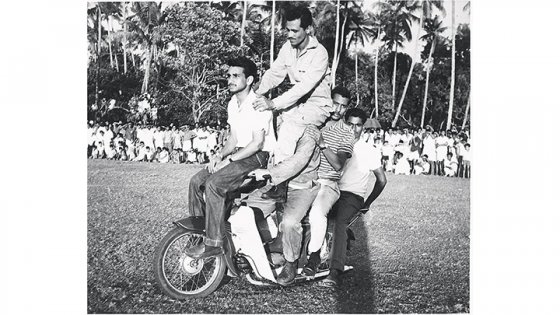
Yezdi04BF06nov2014 “My motorcycle was the 61st bike made by the company. I rode it in the rains and in the sun, I raced, I put together motorcycles. I was so obsessed with Yezdis that if one of them passed me by on the road and didn’t sound right, I would have this urge to adjust the air screw,” he says, cupping his ear with his gnarly fingers.

Shinde’s obsessive, blind loyalty to his employer, probably, made him miss the writing on the wall. When Ideal Jawa shut down in 1996, putting around 2,000 people out of their jobs, he was on an official visit to Tanzania, and learnt about the closure, he says, only after he returned to Mysore.

Raian Irani lives in a charming bungalow in the heart of Mysore. A Great Dane and a Dalmatian lope leisurely on its lawns; the living room has period furniture, and there are portraits of horses and framed butterfly displays on its walls. Die-hard Jawa and Yezdi enthusiasts of a certain vintage, especially in sleepy Mysore, regard Irani with a certain ambivalence. They still maintain that Ideal Jawa could have been better run and more prepared for the Japanese invasion of the 1980s, and accuse the Iranis of being lackadaisical in their approach. Raian Irani is a big-built man, with a fondness for single malt and big bikes. He also owns three Yezdis, though he doesn’t ride these days. Irani, who helmed Yezdi for a brief while in the late 1980s, tells me that there was complacency both on part of the owners and the employees. “When the Japanese entered India, the scenario changed completely. It was not just about two-strokes giving way to four-strokes, they introduced this new dimension of fuel efficiency, which had gained ground after the oil crisis in the late 1970s. ‘Kitna deti hai?’ started from there.

Yezdi05BF06nov2014

Could Yezdi have been saved? Would a tie-up with a Honda or a Suzuki have worked? Irani doesn’t think so. The odds, he says, were heavily stacked against the little Indian company. The Japanese ran streamlined, technology-driven operations in comparison to Ideal Jawa, which struggled with rising labour costs and the then government’s socialist policies. “A tie-up would never have worked. They needed scale, we simply didn’t have it.” The employees of Ideal Jawa, says Irani, especially those who stayed on till the end and turned down the VRS, imprudently hoped that things would get back to normal one day. The shutdown of Ideal Jawa was unfortunate, but it, says Irani, had to be done.

The Yezdi has made a comeback of sorts, especially in the last half a decade. Nearly every city in the country has a Jawa/Yezdi club, and July 13th, International Jawa Day, resonates rortily in India as well. And everyone seems to be in search of a ‘good Jawa or Yezdi’, from hipsters to software professionals. A Yezdi even featured in the recent movie Ishaqzaade, which starred Arjun Kapoor. After the closure of Ideal Jawa, Shinde, who was left with no savings of any kind, headed back home to Phaltan, and along with his brother, he started a lodge, which helped him and his family keep their heads above water. Shinde doesn’t have much to do with motorcycles these days. He mostly spends his time in Phaltan, and occasionally visits his grandson, in Mysore. But there are times, though, he tells me, when he hears that all too familiar exhaust note, and when that happens, he looks up, and looks back.

(Words: Murali K Menon, Photos: Shashank MB)

source: http://www.topgear.com / BBC Top Gear India / Home> Car-News / by Murali K. Menon, Photo: Shashank MB / November 2014
Trademark war: ‘Khadi’ registered in Germany, Spain

Within the country there are around 90 trademarks which have been registered by several entities which includes brands and labels such as ‘Khadi’, ‘Khadi Gramudyog’ and ‘Khadi Bharat

New Delhi :

The government’s efforts to promote ‘khadi’ are facing a trademark hurdle with the brand having been registered abroad, in countries such as Germany, as well as in India.

After haldi and basmati, this is the latest instance of infringement of intellectual property rights, which is essentially traditional knowledge. What makes the task more difficult for the government is that ‘khaddar’ and ‘khadi’ are common across the Indian sub-continent — from Bangladesh to Pakistan.

While the micro, small and medium enterprises (MSME) ministry has noticed ‘khadi’ being registered in Germany, sources said registrations have taken place in Spain and Hungary too. In fact, some of the ‘khadi’ products manufactured abroad, such as aamla shampoos and heena, can be purchased online too.

Within the country there are around 90 trademarks which have been registered by several entities which includes brands and labels such as ‘Khadi’, ‘Khadi Gramudyog’ and ‘Khadi Bharat’.

Khadi2BF04nov2014 

The government is contemplating future course of action, including taking up the issue with the European authorities. “We have noticed that there have been some IPR infringements and that is why we are trying to have our own trademark,” said a senior MSME ministry official, adding that the khadi logo is a step in that direction.

The development comes at a time when Prime Minister Narendra Modi is pushing khadi and on Sunday said that sales have more than doubled since he made his first radio address last month.

While experts are still worried over India’s ability to get its IPR rights back, the MSME ministry official said that khadi is not just a way of life in India for centuries but also enjoys legal backing under the Khadi & Village Industries Commission (KVIC) Act, at least since 1956.

The official, however, ruled out seeking Geographical Indication registration like Darjeeling tea of champagne, which is based on the specific characteristics of a product and is linked to a particular part of the world where it comes from.

The department of industrial policy and promotion has suggested that KVIC should seek an international trademark under the World Intellectual Property Organization’s Madrid Protocol. But for that KVIC and the government need to ensure that the brand is not registered elsewhere.

source: http://www.timesofindia.indiatimes.com / The Times of India / Home> Business> India Business / by Sidhartha, TNN / November 04th, 2014

Israeli tech whets once-barren farm

Dry farming techniques gave a new twist to organic farming on this land

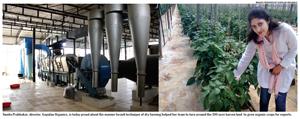
Sunita Prabhakar, director, Gopalan Organics, is today proud about the manner Israeli technique of dry farming helped her team to turn around the 100-acre barren land to grow organic crops for exports

Away from the hustle and bustle of Bangalore city areas, in Uttari and surrounding villages, falling under Kagalipura post, a silent socio-agronomics revolution, inspired and propelled by Israeli farming techniques, is slowly gaining momentum. Spearheading the campaign from a 100-acre organic farm is one young entrepreneur, a graduate in environmental science and in her 30s, determined to make organic a mass movement.

Every morning before the crack of dawn a vehicle leaves the organic farm and reaches out to the adjacent villages to pick up enterprising men and women for training in production of organically grown vegetables and high-value export quality herbs like basil, chives, sage, tarragon, rosemary, parsley, thyme, mint etc. at the sprawling organic farm located in the foothills of the nearby Uttari Hills.

“After training in organic farming, many of them have begun growing organic vegetables. We purchase their produce after ascertaining their quality. Some of these organic vegetables are sold at our Gopalan Organics outlet at Old Madras Road in Bangalore. A portion of the produce makes it to the export markets in Dubai and European markets after stringent quality checks”, says Sunita Prabhakar, the brain behind the grassroots organic farming movement. “My mission is to remove the elitist tag off organic vegetables and make them available to common households at affordable rates. After all everyone is entitled to organically grown, healthy, chemical fertilizer and pesticides free farm produce,” explains Director of Gopalan Organics, Sunita Prabhakar, who started her organic unit in 2003, in what was then a barren land, bought by her real estate developer husband’s family in Bangalore heading the ‘Gopalan Enterprises’.

However, although today the organic vegetables and culinary herbs company exports dry, natural herbs and fresh vegetables to a large number of markets in Western Europe and Dubai respectively and employs over 200 workforce including farmers, agronomists and agricultural scientists, 10 years ago when Sunita threw the idea of starting her organic venture on the rocky, godforsaken land, many did not take her seriously.

She had seen for herself how Israelis mastered the art of dry agriculture with minimal use of water. She was determined to bring the technology to India.

The conviction and determination paid off.

In the summer of 2000 a group of Israeli dry farming experts from Netafim Irrigation System landed at the barren, undulated rocky piece of land.

They examined the prospect of turning it into fertile land for growing organically produced vegetables, herbs and fruits. A mammoth and uphill task awaited them as for the next six months they devoted their time in preparing, planning and executing the organic farm project.

It took another year for the first crop to grow at the newly developed farm.

Alongside Israeli advanced farm management expertise in water conserving irrigation, desalination, and compost enriching the farm, Sunita also adopted biodynamic farming methods pioneered by Australian thinker Rudolf Steiner to grow crops both inside temperature-control green houses and in the open fields, applying scientific soil testing methods for optimum yield per acre.

A network of drip irrigation pipes and sprinklers were laid both inside the green houses and in the open farm land.

The farm land was bifurcated for growing crops under controlled climatic conditions inside the green-houses, and tunnels in the open. “Those days very few people were doing organic farming. There was hardly any infrastructural or technical support available in the country to do dry organic farming. The greatest challenge was to export the basic infrastructure from Israel and then transport them to this remote village from Bangalore Airport. But we managed it all,” says Sunita.

The organic farm today produces 800 to 900 Metric Tonnes of vegetables and fresh and dry culinary herbs under the brand name of ‘Naturale’.

“Of the total volume, we exports 300 to 400 MT of mainly fresh and dry herbs to Germany, Amsterdam, Vienna, Munich, Frankfurt, Belgium, etc. places. To ensure strict adherence to European quality control norms, the vegetables and fresh herbs undergo tests at all levels- from farmland to packaging table-at the analytical lab.

Scientific soil analysis and preparation, soil-enriching using organic manure, plant analysis, bio-degradable poly packaging, processing and storing to retain temperature levels are undertaken,” says K Babu, the agricultural scientist at the farm. Babu further said for the protection of crop bio agents and other Integrated Pest Management (IPM) practices were being followed as against indiscriminate use of harmful chemical pesticides. Each consignment can also be tracked back right down to the date and green house in which it was grown.

Sunita explains: “To ensure freshness of the produce till they are handed over to customers in Germany and other European countries an uninterrupted cold chain from farm to the customer is maintained. The produce is subjected to pre-cooling treatment that increases the shelf life and reduces break down of the nutrients. The air-conditioned pack houses are equipped with all necessary equipment and facilities in consonance with international standards.”

Sunita, who has visited organic farms in Europe, feels the government must support adoption of automation and IT to streamline and modernise organic farming.

​DRY FARMING

It is a type of farming practised in arid areas without irrigation or with drip irrigation and maintaining a fine surface tilth or mulch that protects the natural moisture of the soil from evaporation. Dryland farming involves quite a struggle to set the crop cycle going.

HOW AND WHERE IT ORIGINATED

Dry farming originated in the 19th century in the Great Plains of USA to accelerate production of certain crops, most notably wheat. It should be practised in areas where rainfall averages less than twenty inches a year. Hardy Webster Campbell, a South Dakota homesteader, invented a subsoil packer circa 1890 and thereafter operated demonstration farms for railroads. By the end of the century dry farming was championed as the solution to the agricultural problems of the Great Plains.
(Source: Encyclopaedia of Oklahama History and Culture)

source: http://www.bangaloremirror.com / Bangalore Mirror / Home> Others> Sci-Tech / Agencies / by Dipankar Chakraborty / October 29th, 2014

Kush Maini becomes first Indian to win a World Series Karting race

New Delhi :

Kush Maini created history when he became the first Indian driver ever to win a WSK ( World Series Karting) race at the La Conca international Circuit in Muro Lecce in the southern Part of Italy on Sunday the 3rd Feb 2013.

Kush who drives for Team Baby Race was third overall in qualifying out of over 41 entries in the 60 Mini category. All the participants were divided into 4 groups for the elimination heats as once 34 would Race in the Finals.

Kush was in Group C and won two of the heats while coming second in one of them. This entitled him to the Pole Position for the Start of the prefinal Race which was once again the first time for an Indian to start on Pole Position.

The Prefinal which was run over 8 laps of the 1.25 km circuit was extremely well fought with the top 4 drivers. Kush struggled a bit on the pace and finished third in the Prefinal. The Finals started with Kush in the third Place and on the very first Corner Kush moved into second Place behind Martinez.

Martinez pulled off an early lead and Kush was maintaining a distance of about 6 kart lengths as both were lapping at the same Lap times. Meanwhile Pagano who was in third showed extremely fast pace and was catching up to Kush. Soon Pagano overtook Kush and was on his way to catch up with Martinez. Kush played the waiting game and followed Pagano as both of them started to close on Martinez.

On the Eight lap Pagano overtook Martinez and on the 9th lap, Martinex took the lead again except that all the three drivers were driving like a train with no gap in between.

The three of them had broken away from the Pack and it was a very close and exciting race. On the very last Corner Pagano tried to make a move on Martinez and they both touched slowing down Martinez momentarily and also forcing Pagano off the track. Kush who was right behind Seized the opportunity and made a brilliant Pass on martinez which went all the way to the chequered flag where Kush finished just a mere.019 seconds ahead of Martinez in the most exciting nail biting finish of the weekend.

Kush was extremely happy with the win and was continuously punching the Air to celebrate his victory.

On the Podium Kush was looking up again and again to make sure that he saw the Indian Flag that was rising behind him at the Podium Ceremony.

Kush with the three other European Champions for the other 3 events were then invited for a Press Conference to share their experience for the day.

Kush was very happy and said “I have been driving Karts from the age of 5 and started racing at the age of 7. I spent last year racing in Italy which was a great learning experience for me as I also got several podium finishes in many of the races. However WSK is the biggest race for me and to win here is fulfilling the start of a Dream to become one of the best Drivers. I am now looking forward to the balance three races of the Master Series as well as the two races of the Euro Series.”

Kush was very happy to share the same platform as Max Verstappen, Bocallachi and Alesio Lorandi.

Kush’s Elder brother Arjun Maini did not have a good start to the event as some Kart issues prevented him from Qualifying in the front. He had a bad crash on the first Heat and followed it with a top 10 position in the second. However he has to be content starting the prefinal A in 23rd Position.

Earlier in the day Arjun was 3rd fastest and this gave him some hope to fight his way from the back of the grid. He drove brilliantly to make 10 positions and finally finish 13th in the KFJ category. This meant that he would be starting in 25th position in the finals that was run over 16 laps. Once again he had an excellent drive and finished 14th.

Still in pain from the crash on Saturday Arjun said, “It was a very tough weekend as I had a very bad start on Friday and Saturday but was very happy with the way I drove on Sunday to finish 14th from over 60 of the world’s best drivers. I will work hard to come in the top 5 for the races to follow.”

source: http://www.timesofindia.indiatimes.com / The Times of India / Home> Sports> Racing / by Arani Basu, TNN / February 09th, 2013

KA Hospitality to open Yauatcha Dim Sum restaurant in Bangalore

KA Hospitality which has pioneered introducing international luxury dining restaurants in the country is to open Yauatcha in Bangalore.

The company in short span has brought Hakkasan and Yauatcha, the Michelin Starred restaurant from London in to India. The first restaurant opened in Mumbai, a couple of years ago and now company has ventured into Bangalore. “Yauatcha is a Michelin-starred Dim Sum restaurant from London and the uniqueness of the restaurant is the very concept of being a tea and dim sum house with a modern interpretation of the traditional Chinese teahouse,” Nitin Motwani, CEO, KA hospitality told Business Line.

The restaurants specialises in offering over 50 different types of dim sums, special vegetarian delights and an array of desserts. Motwani said “The uniqueness of the restaurant is the very concept of being a tea and dim sum house with a modern interpretation of the traditional Chinese teahouse which offers over 50 different types of dim sums, special vegetarian delights and an array of desserts. Yauatcha a 150 seat restaurant offers an all-day dining with dim sums, wok preparations, macaroons and petit gateaux. The restaurant is located at 1 MG Road Mall, MG Road.

anil.u@thehindu.co.in

source: http://www.thehindubusinessline.com / Business Line / Home> News> National / by  Anil Urs / Bangalore – September 15th, 2014

Many facets of a child prodigy

We have all heard and known that if kids are encouraged towards doing a certain thing, they will go on to learn and implement the same to the best of their abilities. And a few kids are lucky enough to even get encouraged extensively towards achieving great goals in life.

NihalBF30oct2014

One such fortunate child is 9-year-old P.N. Nihal, whose parents are ready to go to any extent towards encouraging their multifaceted son for the little one turns to be an achiever in everything that he tried his hands on. At nine, the kid is already a karate champion, a melodious singer, dancer and a good artist as well.

The kid has already won quite a few State-level awards for different categories given away by various organisations in recognition of his talent. A few of them include awards like the Balashree award given away by the Mysore Sahitya Mattu Samskrutika Pratisthana; Kalachitra award by Bharatiya Lalithakala Academy, Bangalore; Kannadashree award given by Sirigannada Vedike, Mysore; Mysoru Ratna by Sneha Sinchana, Mysore and Ganashree given away by Gana Mandara Trust, Bangalore. He has also taken part in several drawing, colouring and handwriting competitions for which he has been awarded with the first place constantly.

What’s more, while the prodigy was selected to present a 14-minute talk on Akashavani even when he was just a LKG student. Academically too, Nihal is a bright student. He has also won gold ranking in the International Mathematics Olympiad and National Science Olympiad for the year 2014.

A student of Rainbow Public School in city, he receives good encouragement at his school as well, says his mother Rashmi. “While we encourage him towards doing things of his interest, his school staff is equally encouraging too. They encourage him to partake in various contests and events, which is of great help for us,” she says.

And having seen him show so much interest in all these extracurricular activities winning numerous prizes and awards, parents Naveen Kumar and Rashmi have made the child’s goal their own goals too.

Says the proud mother: “It feels wonderful to see him having turned out be such an achiever at such a young age. In a month or so, he will soon be getting awarded with the black belt in Karate which he is learning from trainer K.P. Johnson at the Okinawa Shorin Ryu Shori-Kan Karate-Do and Kobudo Association. He was awarded 6 belts in just 1.4 years of time which is an achievement in itself. Hence, seeing his enthusiasm, I have made his aims my goal for life. I never go anywhere and not even to family functions several times, just to stay by his side and support him in achieving whatever he wants to. As he is an achiever in many areas, he still not too sure what exactly he aims to be but whatever he wishes to do, we will be by his side. Be it academics, cultural or sports, we will let him make it big in the field he chooses.” —AN

source: http://www.starofmysore.com / Star of Mysore / Home> Feature Articles  / Saturday ,  October 25th, 2014

Prof. Shivaram Malavalli is ISBA Vice-President

ProfShivramBF26oct2014

Mysore :

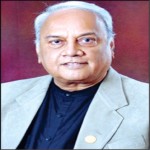
Prof. Shivaram Malavalli has been unanimously elected as Vice-President of The Indian STEP and Business Incubator Association (ISBA) in the recently concluded AGM of ISBA at Bangalore.

He is the Resident Chairman of the San Francisco – Bangalore Sister City Initiative and Chairman & Managing Director of eHealth Technology Business Incubator Bangalore.

He was honoured with Special Award consisting of a Citation and a Medal by WASME (World Association of Small & Medium Enterprises), for his contribution to the establishment/sustenance/growth of SMEs in the Region and his contribution Internationally at China.

He was instrumental in spreading the concept of Science & Technology Entrepreneurs Park in Malaysia, Thailand and he was Advisor to the University Technology Malaysia. He has chaired and presented more than twenty-five papers in international and National Seminars and Workshops.

The Indian STEP and Business Incubator Association (ISBA) was set up in 2004 as a registered professional body to promote business incubation activities in the country through exchange of information, sharing of experience and other networking assistance among Indian Business Incubators, Science and Technology Entrepreneurs Parks (STEPs) and other related organisations engaged in the promotion of start-up enterprises.

source: http://www.starofmysore.com / Star of Mysore / Home> General News  / Monday ,  October 20th, 2014

IIMB joins edX, to offer MOOCs

Will leverage new technologies and deliver education via MOOCs (massive open online courses) as IIMBx

The Indian Institute of Management Bangalore (IIMB) is India’s first B-school to join edX as a new contributing member. As IIMBx, the B-school will leverage new technologies and deliver education via MOOCs (massive open online courses) to a larger population of learners from around the world.

EdX, a Cambridge, Massachusetts-based non-profit enterprise created by founding partners Harvard varsity and MIT, offers interactive online classes from the world’s best varsities. It was created for students and institutions that seek to transform themselves through cutting-edge technologies, innovative pedagogy, and rigorous courses.

“We’re gearing up to create the capability to teach differently and edX is a great platform to extend IIM Bangalore’s educational impact across the globe,” said IIMB director Sushil Vachani. “We are honoured to welcome IIM Bangalore to edX,” said Anant Agarwal, CEO, edX. “IIMB will deliver high-quality courses and new perspectives to the edX learning community and reach learners around the world,” Agarwal added.

“This is a tremendous opportunity for IIMB. In addition to delivering top-quality management education on campus to small classes of students chosen through our highly competitive admissions process, as we have done since the institute’s inception, we will use technology to provide selected management courses to a much larger population in India and the world over,” said Vachani.

Vachani, who took over as director of IIMB on July 1 reiterated that IIMB will embrace and leverage technology to create a social impact. “At IIMB,” he added, “we recognise that the way in which education will be delivered will be radically different in future thanks to technology”.

source: http://www.business-standard.com / Business Standard / Home> Management> News> B-School / by BS Reporter / Bangalore – August 04th, 2014

Kannada music album gets a Czech-up

For the first time ever, a foreign orchestra has scored for a Kannada music album. And that too for a song glorifying Kannada and Karnataka.

The Czech Symphony Orchestra in Prague has worked on the album, Ananya Aalaapana, which is the second album by the group, Techies for Kannada, and KChords. The album with seven songs will be released on November 2.

The music is composed by Karthik Somanath, a technical architect at a major IT firm in Bangalore. The lyrics were penned by Karthik and Paawana Poonacha, a content architect. Poonacha, said, “The album is targeted at Kannada professionals living outside Karnataka. These people are exposed to a lot of different kinds and flavours of music. We also wanted to enhance Kannada music with a foreign orchestra,” explaining the need for the Czech Symphony Orchestra.

The Kannada patriotic song, Jagadalli Yelle Hodaru Moodada Mohaka Anubhava, is one of seven songs in the album. This is the only song in the album that will also be filmed as a video which will be released along with the album.

“Our first album had romantic songs. The idea is to show that life is beautiful.”and portray the different flavours of beauty. There are songs about nature, music, peace and brotherhood, love and friendship.”

“It was not easy to get a European orchestra. “The album is self-funded and we are looking for sponsors. The Czech orchestra came down a little on the money front. But is was still quite a bit for us to go there and get the music scored. We wanted the ‘first-of-its-kind’ element to be there and theefore went to great lengths,” said Poonacha.

The KChords team comprises IT and medical professionals translating their passion for music and Kannada into compassion for under-privileged schoolchildren in Karnataka. The proceeds from the album will go to the KChords Trust which will introduce music for under-privileged school children.

source: http://www.bangaloremirror.com / Bangalore Mirror /  Home> Bangalore> Others / by Shyam Prasad S,  Bangalore Mirror Bureau / October 24th, 2014

Farman Basha wins bronze at Incheon Para Asian Games

A file photo of weightlifters Farman Basha and Sakina Khatum in Scotland.

‘I owe a lot to my physio, Dr. Rajkumar Amaravathi’

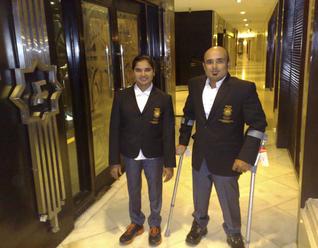
Farman Basha did India proud at the Asian Para Games in South Korea on Sunday by winning a bronze medal in power-lifting in the men’s 49kg category. Basha, a resident of T.C. Palya in the city, lifted 155-kg weight to finish behind Vietnam’s Le van Cong and Iraq’s Mustafa Salman Radhi.

“The competition was very tough. I hadn’t expected a medal. I owe a lot to my physio, Dr. Rajkumar Amaravathi,” he said from Incheon. The 40-year-old made up for the disappointment of Commonwealth Games held in August, when he failed to complete all his lifts. “I was heartbroken after what happened at Glasgow. My shoulder was injured then. But I am better now,” he said.

At the previous edition of the Para Asian Games at Guangzhou four years ago, Mr. Basha had won a bronze medal — later upgraded to silver — in the men’s 48-kg category. “We have only one person as support staff – Mohd. Jawahir Rahi. He too deserves many thanks,” he said.

source: http://www.thehindu.com / The Hindu / Home> National> Karnataka / by Sports Teporter / Bangalore – October 20th, 2014