Category Archives: World Opinion

International powerlifter from Udupi digs well for water needs

Akshatha’s brothers Arun, Ashok and Aravind started digging the well. Akshatha’s job was to remove the soil from the pit.

Akshatha Poojary hard at work digging a well in Karkala taluk | Express

Udupi :

She isn’t well-versed in it: of digging a well. But this 33-year-old achiever dug a 25-foot deep well along with her brothers and nephews and ensured that there will be no scarcity of water during this summer for her family.

For international powerlifter Akshatha Poojary Bola in Karkala taluk, who has won several gold medals in international championships, the lockdown turned into an occasion to work out to maintain her fitness.
Akshatha used to trek for about 10 minutes to bring water from a nearby site during the peak summer months.

Akshatha Poojary (not in pic) was helped by her brothers and nephews to dig the well in Udupi

Her nephew Sumith, who is in 9th standard, triggered the project to dig a well near their house by drawing a circle and motivated the family to take up the task. Akshatha’s brothers Arun, Ashok and Aravind started digging the well. Akshatha’s job was to remove the soil from the pit. This work began on April 18 and the water sprung in the well on April 24 evening.

We dug for 10 hrs every day: Udupi’s powerlifter 

As Akshatha Poojary could not continue her practice at Veeramaruthi Vyayama Shaale, Kinnigoli, due to lockdown, this work involving manual labour made her happy. Akshatha told TNIE that they engaged in digging the well from 7.30 am to 5.30 pm with half an hour lunch break. ‘’There was a tree which gave us some shade, so we did not get too tired. My nephew, 20-year-old Sushanth, also joined our venture and finally we have a well of our own now,’’ she said.

After completing her post-graduation in Human Resource Development (MHRD) from Alva’s College, Moodbidri, in 2010, her dream of getting a job in Indian Railways (under sports quota) did not materialise. However, she managed to get a job as a data entry operator (on contract basis) at NMPT, Mangaluru.
Akshatha said that the well will be dug a little deeper next week as soft mud has collapsed a bit.

“We have decided to contract the job of placing pre-cast concrete rings in the well to an outsider, so that this well will continue to help us in the future,’’ she said. Akshatha, has been investing all her time in powerlifting since 2008, is waiting to participate in the state-level powerlifting championship scheduled to be held in August.

GOLDEN GIRL

  • Ekalavya award in 2014
  • 8 gold medals at London Commonwealth Games in 2011
  • 2 gold medals in International Open Power Lifting Championship in the US in 2014
  • 2 gold medals in the Asian Bench Press Championships in Dubai in 2018

source: http://www.newindianexpress.com / The New Indian Express / by Prakash Samaga / Express News Service / May 02nd, 2020

Bengaluru-based doc invited to help UK manage corona crisis

An MBBS graduate from Bangalore Medical College, she went to the UK in 2002 for her post-graduate degree and has lived there for 15 years.

DrRoopaBF01may2020

Bengaluru :

A Bengaluru-based doctor is getting ready to leave for the UK after the government of that country gave a call for doctors to help the nation manage the COVID crisis and also sent a personal email to her. Dr Roopa Venkatesh, who has a UK residence permit and the licence to practice as a general practitioner there, is making plans to leave for the UK with her 13-year-old son Skanda, who wants to work there as a volunteer.

The Regional Passport Office is viewing this as a special case and is renewing her passport in a very short period. She will travel via any of the special flights that the UK government is organising. Roopa has been living in Bengaluru since July 2016 and has plans to open her own clinic. She lives in Rajarajeshwari Nagar with her husband Venkatesh, also a doctor with a license to practise in the UK. The couple has another son who is eight years old and a three-year-old daughter.

An MBBS graduate from Bangalore Medical College, she went to the UK in 2002 for her post-graduate degree and has lived there for 15 years. “With my years of experience as a frontline staffer in UK hospitals, I really think I can contribute much right now. So I have taken this tough decision to leave. I will not be recklessly risking myself though.

There is a huge demand for experienced staff on the teleconsultation front too and I have decided to opt for that role. It will not involve face to face meeting with patients,” Dr Roopa told The New Indian Express.
She has treated countless swine flu patients as well as victims of chemical warfare during the Iran-Iraq war in the UK. The UK wants her to work there until September at least.

Regional Passport Officer Bharat Kumar Kuthati said, “Her passport was to expire in July. She submitted her completed application on Monday. Though we are not dealing with public requests, we are doing it for her as a special case bearing in mind the emergency involved in her trip. It will be given to her in a day or two.”

source: http://www.newindianexpress.com / The New Indian Express / Home> Cities> Bengaluru / by S Lalitha / Express News Service / May 01st, 2020

Passion at work

Once the youngest CEO in the world, Bengaluru boy Suhas Gopinath tells CE how he’s had to be “shamelessly aggressive” to reach where he has.

SuhasSainathBF30apr2020

Bengaluru :

If you believe in something, chase it. That’ what Suhas Gopinath believes in. The 33-year-old is the CEO and chairman of Globals Inc., an IT multinational that is into development of mobile and cloud-based applications, and cybersecurity products. He became a part of the corporate world at the age of 14, three years after which he became the CEO of the company he set up, thereby getting the moniker of being the ‘world’s youngest CEO’.

Putting his belief into practice, Gopinath recalls running after Bill Gates at the World Economic Forum in Davos in 2010. “I saw him heading towards the restroom and realised that an encounter there would be my only chance to meet him. He gave me a piece of advice that I often go back to today as well: The past is a thief, if you allow it, it will steal your present and future,” he says. Other instances include an orchestrated appointment with an IAS officer, by requesting their PA for the officer’s flight number, which he then booked a ticket for as well. “As introverted as I am in my personal life, that’s how ‘shamelessly aggressive’ I am in my professional endeavours,” he admits.

His age has always been a talking point, raising eyebrows even to this day. Remarks about a boy who didn’t even have a moustache but was running his own company was something he often heard. “Even when I was in my mid-20s  and would meet policy makers, they would want to meet the CEO. And when I’d tell them it was me, they would ask to meet my father,” he says, adding that the whole start-up ecosystem and the idea of entrepreneurship is changing now. “Entrepreneurship wasn’t considered cool back in the day, unlike the way it is now,” he says.

Gopinath’s interest in the world of technology started as a young boy who would accompany his brother to the cyber cafe. While peers would often be seen playing games and understanding the concept of e-mails, Gopinath wondered why he couldn’t develop “something like Hotmail,” and would wonder why he couldn’t be a contributor instead of a consumer.

So he’d spend time on groups for developers (something along the lines of Yahoo chat groups) where he would discuss the nuances of technology with people from around the world. “One of those times, a person in the US asked if I would join his company and he  was quite taken aback that so far, he had been in conversation with someone who was barely in high school,” he recalls, adding that parents of his friends would often advise his parents that their son should concentrate on school work rather than his “hobby club”.

But he firmly felt he had to do what he had to do, and has no regrets for the way his life has panned out. But realising that he missed a part of his growing years – learning an instrument, playing a sport – he has taken to picking up those skills now. “And whenever time permits, I watch cartoons like Popeye, Mickey Mouse, Lion King and Aladdin, all of which I now realise have so many underlying meanings,” he says, adding that the lockdown has taught him cooking and cocktail making as well.

source: http://www.newindianexpress.com / The New Indian Express / Home> Cities> Bengaluru / by Vidya Iyengar / Express News Services / April 30th, 2020

COVID-19 app by Mysuru man wins laurels in US

Apollo, an iPhone app for COVID-19 testing and research, has been developed by a company headed by a native of Mysuru, Siddarth Satish.

CEO of Gauss Surgical, Siddarth Satish

CEO of Gauss Surgical, Siddarth Satish, is the grandson of Mysuru-based industrialist and art patron K V Murthy. He is the son of Padma (second daughter of Murthy) and M N Satish, who have settled in the USA. Siddarth resides in California.

Dr Prathibha Pereira, his aunt, said that Siddarth studied up to second standard at St Joseph’s School in Jayalakshmipuram. He is an alumnus of the University of California, Berkeley (BS in Chemical Engineering); the University of California, San Francisco (MS in Bioengineering); and Stanford University (SIMDesign Fellow).

Siddarth founded Gauss Surgical in 2011 and served as CTO and chairman initially. He then served as an Entrepreneur In Residence at StartX, Stanford’s Startup Accelerator, and as a SIMdesign Fellow at the Stanford University School of Medicine. He has over 50 issued or pending patents on medical technologies and has raised $50 million in venture capital funding.

As leaders in the healthcare artificial intelligence (AI) space, Siddarth and his team wanted to help during the COVID-19 crisis and quickly began collaborating with researchers at Stanford and observing COVID-19 testing facilities in the Bay Area.

After spending time embedded at a testing facility, Siddarth said, he found the current testing process to be heavily paper-based and observed that it exposed testers to potential risks as they interacted closely with patients.

“An iPhone-based testing solution could reduce the exposure to risk at testing centers and make the overall process much faster. The app optimises the existing testing procedures by eliminating paperwork, reducing the need for direct contact between patients and staff. This also helps to reduce the use of precious PPE resources,” he said.

Design Award  

Gauss Surgical’s life-saving Triton App, which monitors surgical bleeding using iPhones, had earlier won the Apple Design Award, which reflects the best in design, innovation, and technology on Apple platforms.

“We embarked on Apollo, as we felt that our expertise in clinical-grade digital decision-support tools enables us to build a tool for screening and triage of Covid-19. We teamed up with Evive Care, a national database of COVID-19 test centers to  develop the app, which includes Stanford Medicine’s Apollo Covid-19 Screening Survey (Apollo Study),” said Siddarth.

Gauss is among a large group of Stanford alumni, scientists, and physicians participating in the StartX Med COVID-19  Task Force.

Apollo integrates tools that work across the current testing process. It is designed so that a person can analyse one’s symptoms and if necessary, drive to the closest testing centre. A tool locates one’s closest available testing centre on a map. It has tools for communication between the tester and tested.

The self-diagnostic checks whether the potential patient has already transacted and then send the report via the app to the testing agent, reducing duplication of the same process. The data is available in the form of a QR code (the ‘Apollo Pass’) on the screen of the patient’s iPhone, which is read by the equivalent app on the tester’s smartphone. The patients can share their information while the car windows remain shut, minimising contact time with the tester.

Once the patient sample is collected, the tester adds the kit to Apollo and sends the sample to test. Results can be quickly shared, once the procedure is completed.  Apollo COVID-19 is available in 10 languages, most commonly spoken in the United States. The app can be downloaded for free on the Apple App Store or at https://covid19.gauss.com.

source: http://www.deccanherald.com / Deccan Herald / Home> State> Mysuru / by T R Satish Kumar, DHNS, Mysuru / April 27th, 2020

Mysuru-Educated Innovator Creates Respiration Rate Monitor For COVID-19 Patients

(from left) Sanchi Poovaya, Ranjana Nair and Aardra Kannan Ambili)

Mysore/Mysuru:

Unique among many medical solutions offered to combat COVID-19 is the new breathing monitor for Coronavirus patients developed by a Bengaluru-based start-up RayIoT and it is a matter of pride that a Kodagu-born and Mysuru-educated innovator is behind the device.

She is Ammanichanda Sanchi Poovaya, a young but experienced engineer, innovator and entrepreneur. She co-founded healthcare start-up RayIoT Solutions Inc. and is the Chief Operating Officer of the start-up that has already made a mark in innovative healthcare products.

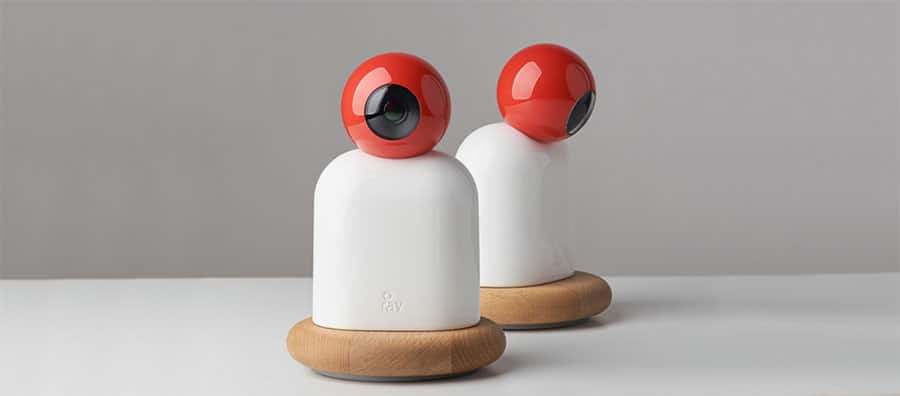
Her start-up creates innovative healthcare and baby-tech products using Artificial Intelligence (AI) and Internet-of-Things (IoT) technologies. Very recently, Sanchi Poovaya and her other two co-founders Aardra Kannan Ambili (Chief Technology Officer) and Ranjana Nair (Co-founder and CEO) built a remote respiration monitoring system for COVID-19 patients that allows doctors to remotely monitor less critical patients while seriously ill ones get more attention.

Connected workflow sends alerts to the doctor in case of any abnormal variations in the patient’s vitals. With the high effectiveness of using respiration rate as a predictive vital, early detection especially among at-risk caregivers is a possibility.

CodavaCovidInnovator02KF27apr2020

“It is a non-contact, Wi-Fi enabled, affordable respiration rate monitor for Coronavirus patients that can run as mini ICU units. In its current form, RayIoT will work as a mini ICU monitoring unit. The algorithms of Artificial Intelligence will allow doctors and other health professionals to track the respiration rate of multiple patients through an app from anywhere in the world,” Sanchi Poovaya said.

In a pandemic like COVID-19 where doctors are falling ill with excessive patient inflow, and the management of quarantined patients have become difficult, the device wirelessly tracks patient’s respiration rate, heart rate, blood pressure and temperature.

Since all the devices can be connected to one central database, using RayIoT, healthcare professionals can monitor more than one lakh patients at a time continuously. By just tracking respiration rate, they will be able to intelligently categorise quarantined patients into mild, severe, and critical cases, she said.

“The idea of a remote respiration monitoring system came to us when a celebrity, who was converting his 14-room sprawling bungalow into a quarantine facility, reached out to us. His problem was remote access to doctors, nurses and medical equipment to fully equip his quarantine facility.”

The team had to come up with a low-cost solution that could monitor the vitals of hundreds of patients at any given point of time and connect to doctors through video when the patients are moving into a severe or critical stage. “The solution also helped Government Task Forces who are monitoring huge swathes of population by providing them a single source of truth with our quarantine database,” Sanchi reveals.

RayIoT has been created by same team that is behind Raybaby (the world’s first non-contact sleep and breathing monitor for babies. This product has won many awards and was mentioned in CNN as one of the must have home gadgets.

Ammanichanda Sanchi Poovaya completed her schooling at Good Shepherd, Ammathi in Kodagu, and JSS Public School, Mysuru. She completed her Mechanical Engineering at the National Institute of Engineering (NIE), Mysuru and MS in Mechanical Engineering from Cornell University, New York.

Sanchi Poovaya is the daughter of Ammanichanda Sunil Poovaya (ex-Merchant Navy) and Shiela Poovaya (Pattada, Betoli). They live in Hosur, Bengaluru.

source: http://www.starofmysore.com / Star of Mysore / Home> Covid News / April 26th, 2020

Bengaluru redux: books about our past

Three books help you rediscover the city’s fascinating past

BooksBF26apr2020

Nothing makes you nostalgic about a city like being told that you can’t go there. The irony of the current raging pandemic is that inhabitants are shut out from a city that they are living in. So, Metrolife scrambled through its library to send you on a nostalgia trip. We found three pieces of writing that illuminate Bengaluru from a time far gone. All the pieces refer to the city come from the time when the city was still officially called ‘Bangalore’ and not ‘Bengaluru’.

Bangalore: the explorer’s sourcebook

One book that we found is Sourcebook Publishing Company’s ‘Bangalore: the explorer’s sourcebook’. Published in 1995, the book, which is a guide for the uninitiated tourist, has been cornily subtitled ‘Breathtaking Bangalore’ and ‘The Heart of South India’.

For a tourist book, the book catches you off guard by getting too personal at times. You can feel the lump in the throat when the publisher says, “Used to writing long notes, this once, I am short of words”.

Being a relic, we are separated from the milieu of this book by 25 years, and the fonts and advertisements are not ones you have seen in decades. As a book that lists out suggestions for people, it may be vastly outdated, but that is what makes it such a great document to understand what the city used to be.

Readers today may feel alienated by instructions about catching an auto, such as “The minimum charge is Rs 4.60 and the drivers have charge charts which give the corresponding charges to those on the meter”. Another shock: “One can also hire an auto for a whole day for approximately Rs 120”.

Being a book for the outsider, ‘The explorer’s sourcebook’ celebrates the city’s impressive multiculturalism.

It is pleasing to hear the book talk about different languages and ethnicities living together in harmony. While it is always simplistic to think of any era as a utopia, it is still a sparkling vision.

Bangalored: the expat story

If the explorer’s sourcebook was our window into the 90s, ‘Bangalored: the expat story’ is a window to the decade that came after. But what sets Eshwar Sundaresan’s book apart from the tourist guide, among other things, is the excellent prose and sense of humour.

For instance, the writer, in the acknowledgments page, thanks BESCOM “for their delightful inefficiency. Had it not been for their erratic power supply, I would have met all my deadlines and life would have been a drab.”

Published in 2006, the book is an attempt to unpack the newly minted term ‘Bangalored’. It had gained prominence during the 2004 US presidential election and came with a lot of anger because it denoted that people in the US were losing jobs as they were outsourced to Bengaluru.

Sundaresan’s intention is to take the word, borne out of hate and fear, and make it “rounder”. So, he interviews the expatriates themselves. “In other words,” he says, “I believe the expatriates can teach Indians something about India.”

Despite the heaviness of the subject, the writer is very indulgent about the city. His introduction, for instance, starts, “A light fog envelops the calm of the November morning. Inside the Indiranagar park, joggers and walkers of all ages are  beginning their workouts. A couple of college students are holding hands in silence as they occupy seats in the farthest corner of the park. Suddenly, a volley of shrieking laughter pierces the heart of the fog and startles the mynahs into flight. The laughter therapy group, too, has begun its workouts.”

The book says that as of 2006, 12,000 foreigners, that is more than half the expatriate population in the country, live in Bengaluru. The book sought to examine the levels at which they interact with the locals and the impact that they have on the cultural, financial, social, political and educational spheres.

“Most of the expatriates featured in the book are resourceful, some are quirky and eccentric, and a few are stubbornly idealistic, but they are all memorable. What emerges is a whole new perspective on urban India and its ambiguities,” the book’s  blurb reads.

So, for Sundaresan, Bengaluru is about the meeting of the old and the new. A man driving an army truck, to him, is emblematic of Bengaluru’s cantonment past.

A 20-something IT professional tying the knot of his tie while waiting for his company bus, is emblematic of the city’s present. When they look at each other, representing two different eras, yet brought together in time, it is a waltz of history.

But reading the book fourteen years later, we see a very different Bangalore. The vision of a city covered in chrome in long gone. There are no longer pizza parlours whose advertisement taglines read “gigabytes of taste”. In 2020, in the era of Donald Trump and his ‘America First’ policy, all this may be retro or even kitsch.

But reading certain parts of the book, we realise that some things about the city will never change. In the introduction, Sundaresan writes, “Turning into Old Madras Road, I find the traffic gliding along as if on autopilot. In an hour’s time, this stretch would mutate beyond recognition. People will be conversing in the language of honks and expletives”.

‘Mysore and Ramrajya’

While writings on the city are not scarce, there is one that is hardly mentioned. Written by M K Gandhi, the article, originally written as a speech, has been titled ‘Mysore and Ramrajya’ and published in a NIAS compilation. He was recovering from an illness in 1927 and had stayed near Bangalore and near Nandi Hills. He used to hold prayer meetings under a peepal tree at this time.

In the piece, Gandhi spoke about the then Mysore state, expressed appreciation for the work of Krishnaraja Wadiyar IV and outlined what had to be done to make princely Mysore “Ramarajya”. The editors of the book in which this speech was included say  Mahatma’s vision did not survive, “but it is worth remembering that, if nothing else, it tells us that there was a time when Bangalore was not always preoccupied with modernism”.

Gandhi had delivered the speech in English, but he didn’t seem too happy about it. He says that he wished all his listeners in Mysore understood Hindi, but adds “I do not know when that time is going to come”. While praising M Visvesvaraya’s works such as Krishna Raja Sagar Dam and Bhadravati Iron Works, he makes an appeal to the state of Mysore to use the charkha so that the economic situation of the peasantry will go up.

He urges Mysoreans to give up drink and beef, and deplores many Sanskrit scholars in the state who refuse to teach the language to ‘Adi Karnataka’, that is the lower caste people of the state.

source: http://www.deccanherald.com / Deccan Herald / Home> Metrolife> Metrolife on the move / by Roshan H Nair, Bengaluru / March 22nd, 2020

When the 1918 Spanish flu reached Bengaluru

The Spanish Flu's name comes from the fact that even as wartime censorship in the United States and most of Europe suppressed news of the influenza, the media in neutral Spain reported on it extensively. Photo: Wiki Commons
The Spanish Flu’s name comes from the fact that even as wartime censorship in the United States and most of Europe suppressed news of the influenza, the media in neutral Spain reported on it extensively. Photo: Wiki Commons

June 1918. A debilitating disease suddenly swept through Mumbai. Thousands fell ill, complaining of debilitating fever and cough, sometimes with intestinal problems.

For hundreds of unfortunates, their lungs filled with fluids and they died as their body was starved of oxygen. This was the Spanish influenza pandemic of 1918-19, which killed an astounding 50 million worldwide. Recent estimates put the death toll in India at a staggering 12 million.

Scientists refer to Spanish influenza as the ‘mother of all influenza pandemics’, since it is the common ancestor of human and swine flu viruses. The disease is inextricably associated with World War I.

The name comes from the fact that even as wartime censorship in the United States and most of Europe suppressed news of the influenza, the media in neutral Spain reported on it extensively, including when their king Alfonso XIII fell ill with it.

Spanish influenza’s first wave reached Mumbai when soldiers returned from Europe, carrying the virus with them. An even more lethal second wave hit in September.

When the pandemic reached Mysore State, it hit it hard. The State had still not shaken off the plague. Wartime shortages had pushed up the prices of food and other essentials. To make matters worse, the monsoon failed that year.

The disease first passed through Bengaluru in late June without causing much harm. The second wave in mid-September was deadlier. Suddenly, entire families fell ill.

Higher fatality

Dispensaries, clinics and hospitals were overcrowded. Doctors, nurses and compounders were completely overwhelmed. Corpses piled up. Unlike COVID-19, Spanish influenza had a far higher fatality among the young and able-bodied than the old.

Offices emptied as people across all professions and classes fell ill, among others, the health officer in Bengaluru and the then Chief Secretary of Mysore State.

In early October, Bengaluru’s City Municipal Council, under the leadership of the President KP Puttanna Chetty, took several quick, creative and effective steps to deal with the health crisis. Temporary dispensaries were opened, some housed in municipal schools that were closed at the time.

Mobile dispensaries were set up to ensure medicines reached everyone. All dispensaries were directed to stay open for longer hours and to stock enough of the medicines required, including thymol, which was prescribed a preventative.

Since hospitals were filled beyond their capacity, temporary tents and sheds were set up to accommodate the sick. Retired medical staff and medical students were brought in to help with the workload. Health officers went around neighbourhoods to see if there were any infected people and to persuade them to move to the hospitals or the camps to prevent the disease from spreading.

Leaflets in Kannada and English were distributed, which explained the symptoms of influenza, how it spread, and how it was important to ‘separate the sick from the healthy,’ and to avoid ‘the entire family congregating in the sick room.’

People were advised to ‘tie a clean handkerchief on which a teaspoon of eucalyptus oil is sprinkled, across the nose and mouth’ when entering the sick room, to provide a certain extent of protection. They were also strongly urged to avoid crowded places.

A striking feature of the response to the influenza pandemic was the voluntary effort in providing relief. Much like today, when several people are working, often with the police and the BBMP, to ensure the poor are not forgotten during the lockdown, in 1918 too, volunteers helped ensure relief supplies reached the poor and families where there was no one left to tend to the sick.

In Bengaluru, the relief operation was coordinated by Chief Officer R Subba Rao. He divided the city into several blocks with a relief party in charge of each. Supplies included medicines, milk and kanji, a lot of which was prepared at a government facility and then distributed by car, carts and even lorries.

Municipal councillors and volunteers who worked ceaselessly included Father Briand, Ramachandra Rao Scindia, Rev D A Rees, B Usman Khan, B Chinnaswami Setty, Ghulam Dastangir, B K Garudachar, R Gopalaswami Iyer and many, many others.

Assisting them were the Social Service League, Young Men’s Christian Association, students of the Wesleyan, London Mission and National High Schools, and many others. Puttanna Chetty toured the city himself to assist the relief works and ensure they went on smoothly.

By the end of November, the disease was finally under control. More than 1,95,000 people died in Mysore State, 40,000 in Bengaluru alone. With the compounding problems of agrarian distress, rural areas were affected much worse.

source: http://www.deccanherald.com / Deccan Herald / Home> Spectrum> Spectrum Top Stories / by Meera Iyer / April 08th, 2020

Mysuru-Origin US Doctor Gets A Brilliant 100-Car Salute

DrUmaBF22apr2020

Mysore/Mysuru:

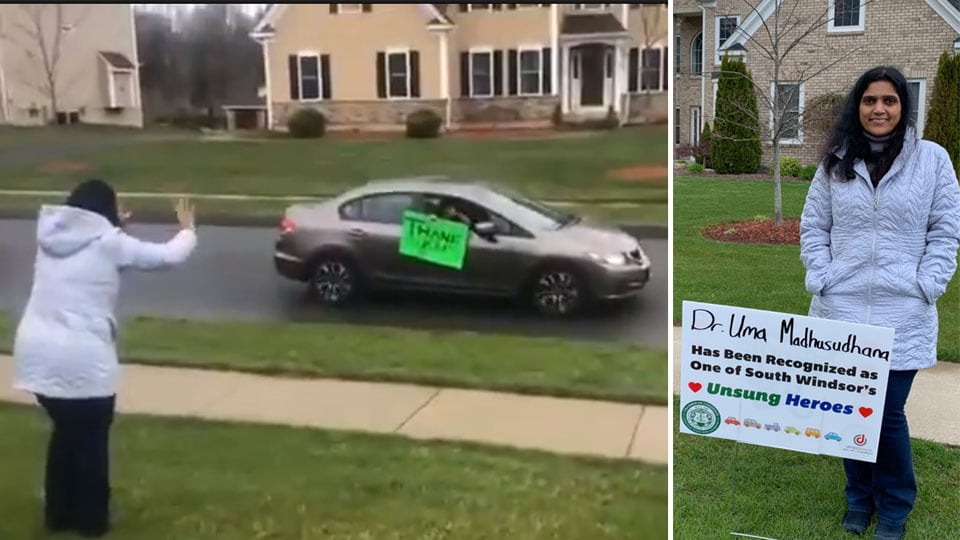
It was a proud moment for Mysuru as a city-based doctor living in the United States received a unique ‘Drive of Honour’, a heart-warming gesture to appreciate her efforts in fighting the global Coronavirus pandemic.

The ‘Drive of Honour’ was performed in front of the house of Dr. Uma Madhusudan, a Mysuru-based doctor who is treating COVID-19 patients in South Windsor Hospital in the USA.

The local neighbourhood in the USA honoured her and the video of the ‘Drive of Honour’ has gone viral. In the video, several Police vehicles, fire brigade trucks and private vehicles can be seen going past through her house with sirens and honks blowing. A convoy of at least 100 vehicles drove past Dr. Madhusudan’s house stopping by for a few seconds and thanking her.

As the global coronavirus crisis deepens, doctors across the world are being hailed as heroes and saviours, putting their own lives at risk to protect that of others. Dr. Uma Madhusudan is a 1990 batch graduate from JSS Medical College, a constituent college of JSS Academy of Higher Education and Research, Mysuru. Dr. Uma works at South Windsor Hospital.

The ‘Drive of Honour’ video has been shared by Karnataka Medical education Minister Dr. Sudhakar on Twitter. The video shows Dr. Uma standing at her lawn while a string of vehicles pass her by with the drivers waving at her, honking and cheering.

“Happy to share a video of Uma Madhusudhan, Mysuru origin Doctor in US being honoured in front of her house by grateful patients,” Sudhakar wrote. “It’s a beautiful sight of cars, police vehicles, and fire trucks lining up in gratitude, waving and honking to say Thank you Dr. Uma!”

The tweet has since been going viral and even the teachers and friends from JSS Medical College have sent their greetings and appreciation.

source: http://www.starofmysore.com / Star of Mysore / Home> Covid 19 News / April 21st, 2020

This doctor from Karnataka working in US has successfully treated five coronavirus patient

Dr Arun Ranganath says the best supportive care on a ventilator with the pulmonologist, anaesthetist and intensive intervention is the key for early recovery.

Dr Arun Ranganath
Dr Arun Ranganath

Tumakuru :

“No one has died from COVID-19 under my care. One patient had cancer and he died of cancer,” asserted Dr Arun Ranganath, who has been treating the intubated patients in the ICU of Maine General Medical Centre, Augusta, USA.

The physician who hails from here has treated five patients aged between 63-80 successfully and they have been discharged with one more person still getting treatment under his supervision

The expert doctor, who has had stints at hospitals in the UK, at Safdarjang in New Delhi, has been in Maine Centre for eleven years. For four years, he has been the director of the ICU and is triple board-certified in internal medicine, pulmonary and critical care.

Speaking with The New Indian Express, the shy doctor shared his experience as he has been working for over 14 hours daily at the 200-bed hospital. The young doctor says the best supportive care on a ventilator – with the pulmonologist, anaesthetist and intensive intervening at the right time – will make a difference as the rate of patient recovery will be high.

“We have also treated with some steroids, hydroxychloroquine, and azithromycin but I am not sure if it made a huge difference. I am not sure about their efficacy but at least they don’t hurt as some of the studies done in France show a mortality benefit,” he explained.

Interestingly, the doctor’s wife Nagaveni Thimmappa also works as a data analyst with the hospital as his colleague and the couple have risked their lives, leaving their little daughters aged twelve and seven years under the care of a nanny.

Hailing from Sira town, which witnessed a death due to COVID-19 and a positive case, Arun did his MBBS at Mysuru Medical College. Sadly, he lost both his parents Ranganath and Shivakumari in his childhood.

“My aunt, father’s sister, Dr Jayalakshmi, working at the government hospital at Challakere in Chitradurga district motivated me to become a doctor. My paternal uncle Panduranga educated me,” he informed.

He suggested that the shared responsibility is the need of the hour as the entire community including the doctors, the staff at the hospital and the public, in general, are at the risk of contracting the virus.

“There are definitely risks involved in the process. I can’t imagine any other better person than the physician to take that risk. On the same note, they have to protect themselves with appropriate masks and hand hygiene. They have to take care of themselves first to take care of others but that doesn’t mean that they should shy away from the responsibilities,” he advised.

He also suggested that in a country like India, the general duty doctors at the hospital should also be trained in handling critical care including the ICU as soon as possible.

“India can just not relax as the cases detected are less but should keep in mind that there might be ten times more asymptomatic carriers and the latter should be subjected to diagnosis and kept in quarantine. Early detection is the key,” he warned.

source: http://www.newindianexpress.com / The New Indian Express / Home> Good News  / by Devaraj B. Hirehalli / Express News Service / April 15th, 2020

Bengaluru firm launches non-invasive ventilation system for use in ICU with COVID-19 patients

Designed, engineered, and manufactured in India, the country’s first NIV system, Saans Pro, can be used to treat patients with worsening hypoxemia – low level of oxygen in blood.

Image for representation.

Mumbai :

Bengaluru-based InnAccel Technologies on Wednesday announced the launch of a non-invasive ventilation (NIV) system for use in the ICU with COVID-19 patients.

Designed, engineered, and manufactured in India, the country’s first NIV system, Saans Pro, can be used to treat patients with worsening hypoxemia – low level of oxygen in blood – who are not distressed and have no other organ failure, the company claimed in a statement here.

It can also serve as a backup ventilation system when a ventilator or trained staff for intubation is not immediately available, it added.

InnAccel is a product innovation platform with a diverse portfolio of globally certified medical devices.

With over 14 lakh cases worldwide, there is a dire need for adequate respiratory support, such as invasive and non-invasive ventilation systems that can provide breathing assistance to critically-ill COVID-19 patients, the release said.

As COVID-19 cases continue to increase in India, InnAccel’s infrastructure-independent NIV system can prove to be an essential tool to support the country’s fight against this deadly virus, the company noted.

NIV ventilation systems are being recommended in countries like the US, the UK, Italy and China, it added.

source: http://www.newindianexpress.com / The New Indian Express / Home> Cities> Bengaluru / by PTI / April 10th, 2020