Category Archives: World Opinion

South Korean youth delegation in city

India-South Korea Youth Exchange programme

Mysore, June 28

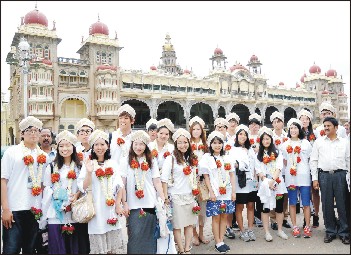
A South Korean Youth Delegation of 20 members including 10 women visited the Amba Vilas Palace here this morning.

The visit is as part of the ‘India-South Korea Youth Exchange Programme-2012’ organised by the Union Ministry of Sports and Youth Affairs in association with District Nehru Yuva Kendra (NYK).

The delegation was accorded a warm reception at the Palace Board office. They were presented with Mysooru Peta and white T-shirts with the insignia ‘Welcome to Mysore’.

Deputy Commissioner P.S. Vastrad, Mysore City Corporation Commissioner Dr. M.R. Ravi, City Police Commissioner K.L. Sudheer, Palace Board Deputy Director T.S. Subramanya, NYK Delhi Convenor Prakash Vaidya and District NYK Co-ordinator M.N. Nataraj were present.

Briefing the delegation on places to visit in and around city, Vastrad pointed out that such youth exchange programmes would strengthen cordial relationship between the two countries. He lauded the city as a cultural capital of State with a lot of greenery and innumerable heritage tourist spots to visit. He disclosed that the city was usually chosen as a pilot for several national projects.

The delegation members were shown paintings of Dasara festival and those depicting the days of the Maharajas. The members also enjoyed riding on bicycles in the premises of the Palace.

Lok Sabha member R. Dhruvanarayan greeted the delegation and left. Former Corporator D. Nagabhushan and Mysore Chamber of Commerce and Industry President S. Sudhakar Shetty were also present.

The delegation members later left on a trip to visit Chamundi Hill, Srirangapatna and Brindavan Gardens at KRS.

source: http://www.StarofMysore.com / General News / June 28th, 2012

Minister for Education launches Ireland India Institute at DCU

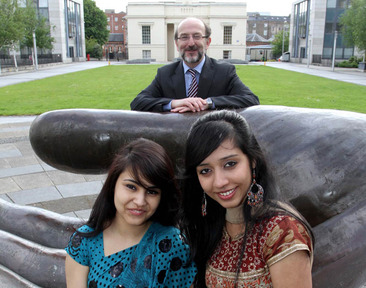
The Minister for Education and Skills, Ruairí Quinn TD, has launched the Ireland India Institute, a new national centre at Dublin City University to drive enterprise, research and academic collaboration between Ireland and India.

Professor Brian MacCraith, President of DCU with DCU students, Rachita Singh and Abina Philip at launch of DCU’s Ireland India Institute

Through a series of targeted initiatives, the Institute aims to practically support strategic partnerships in business, education and research between the two countries. The initiatives will include:

  • An Ireland-India Research Fund, which will help fund research into the grand challenges affecting both states in areas such as sustainable technologies, health and multiculturalism
  • The provision of Ireland India Institute Scholarships to support Indian scholars and researchers in their studies in Ireland
  • An Ireland India Institute Seminar Series which will bring some of the most significant thinkers and business leaders on contemporary India to Ireland
  • In addition, the Institute will provide a suite of academic and extra-mural programmes in areas relevant to contemporary India.

In a key development, Ms Kiran Mazumdar-Shaw, Indian entrepreneur and founder, chairman and managing director of Biocon, one of the world’s largest biotechnology companies, has agreed to become patron of the Institute.

Commenting on the launch of the Institute, Mazumdar-Shaw stated: “I am delighted to be patron of this important Ireland-India initiative.

Contemporary Ireland and India face the same global challenges, issues such as healthcare, ageing and sustainability. The Institute will help focus our joint efforts in achieving common solutions to these challenges. It will become a focal point for the study of contemporary India and a meeting place for all friends of India.  I welcome DCU’s continued strategic focus on my country which is based on academic and research excellence.”

Minister for Education and Skills, Ruairí Quinn, who formally launched the Institute, commented: “Dublin City University’s strategic focus on contemporary India has resulted, already, in a series of research collaborations with the sub-continent’s most prestigious Institutions, particularly in the areas of science and technology. The establishment of the Ireland India Institute will see DCU build on that record to host a national centre for the study of contemporary India. As Minister I have sought to drive the international agenda in our higher education institutions. I am delighted with this response to that drive.”

Professor Brian MacCraith, President of Dublin City University, stressed the importance of engagement with India as part of his overall vision for DCU: “On becoming President of DCU I made engagement with contemporary India a strategic priority for the University. Our faculty and researchers have, since that time, made great strides in developing active research projects with our Indian partners in Institutions such as IIT Madras, IISC Bangalore, JNU and IIT Delhi and others. That unprecedented degree of collaboration will be developed and fostered in the coming years through the Ireland India Institute which will become the hub for all those in Irish enterprise and academia who seek to develop our common goal of deeper Ireland India collaboration.”

The Ireland India Institute is hosted at Dublin City University and at www.irelandindiainstitute.ie.

source: http://www.businessandleadership.com / Home> Exporting / by Bernice Barrington / June 18th, 2012

Bitten by the B’lore bug

LEGENDARY CONNECTION

It was in Bangalore that Ronald Ross first became interested in mosquitoes. Ross would go on to make the crucial discovery of plasmodium, the malarial parasite, in a mosquito, and win the Nobel too. Bangaloreans can truthfully say that the seeds of that great discovery were sown in our City, writes Meera Iyer

In September 1883, a British doctor named Ronald Ross was appointed the Acting Garrison Surgeon in the Bangalore Civil and Military Station. The doctor initially stayed in a bungalow close to today’s MG Road. He records in his memoirs that this was when he first became interested in mosquitoes. “They devoured me,” he writes, “until I discovered that they were breeding in a tub just outside my window.” Ross got rid of the wee beasties by the simple expedient of tipping the tub. So began a series of experiments and observations on mosquitoes that eventually led to a Nobel Prize for Physiology and Medicine in 1902.

Ronald Ross was born in Almora, Uttarakhand, on May 13, 1857, three days after the Indian Mutiny or the First War of Independence began. He grew up in Almora, Nainital and Benares and was sent to England for his education when he was eight.

The future scientist and Nobel Prize winner displayed no interest whatsoever in science but took wholeheartedly to painting, literature and the arts. He wrote poetry while still at school and at 17, decided he wanted to be a writer. But his father wanted him to join the Indian Medical Service, and so Ross resignedly joined St Bartholomew’s Hospital Medical School in London to study medicine. Ross wrote more poetry and even some short plays while at St Bartholomew’s but remained quite indifferent to medicine. He failed a qualifying exam for the Indian Medical Service, cleared it a year later on his second attempt, and then joined the Service. Ross came to India in 1882, stayed in Madras briefly and then had the first of many stints in Bangalore when he was given medical charge of a unit of the Madras Infantry for a few weeks.

Like many others before and after him, Ross loved Bangalore. He describes how he used to go for long walks every day among “rocky crests of mountains, fir woods, dells with beautiful little trickles of streamlets”. The sun and the breeze, he says, “were those not of earth but of heaven.” In a complaint that sounds all too familiar to us today, Ross says that when he looked for these same places ten years later, he found they had all been swallowed by development.

Over the next few years, Ross returned to Bangalore several times and also served in Quetta, Burma and the Andamans. He churned out more plays, novels and dramas, became very interested in mathematics, played a lot of tennis, whist and golf, but remained a completely ordinary doctor. It was only when he was on leave in England in 1888 that something ignited a spark in him: “I determined now to interest myself much more in my profession,” he writes, and he returned to India with renewed vigour.

Back to Bangalore

Ross was posted in Bangalore once again in 1890, as Staff Surgeon of the Civil and Military Station. Now married, he and his family lived in High Grounds, “in a delightful house facing the golf ground, called Uplands”. (Incidentally, this very house was where Sir M Visvesvaraya stayed for a time after his retirement in 1908). According to his Nobel lecture, it was during this 1890-1893 period in Bangalore that Ross made his first studies of malaria.

He also wrote his first research papers on the disease, including some that rejected the ‘bad air’ theory but speculated (wrongly, of course) that malaria might have an intestinal cause.

In the 1890s, scientists had begun to realise that parasites in blood caused malaria, but no one had any idea how these parasites moved from sick people to healthy people. In 1894, while on leave in England, Ross sought out Patrick Manson, a tropical disease expert who had recently discovered that mosquitoes spread the disease filariasis.

Manson told Ross he believed mosquitoes also spread malaria. This was the beginning of a long association between the two scientists.

Ross returned to India, and plunged into research, determined to prove Manson’s ‘Grand Induction’ as he called it.

Within a few months, Ross became an expert on dissecting mosquitoes, identifying parasites and diagnosing malaria. In his memoirs, Ross states that from April 1895 to February 1899, he wrote 110 letters to Manson about his research, “containing almost exactly 1,000 words each, or about one word to every ten people killed by malaria in India alone every year.”

At West End

But another disease also killed hundreds in India in those days. In 1895, Ross was called to Bangalore on special sanitary duty to contain the frequent cholera outbreaks here, especially in Shivajinagar, Ulsoor and parts of the pete.

Ross took up residence in a tent on the grounds of the (now Taj) West End Hotel. Over the next two years, he organised an overhaul of refuse-cleaning systems, suggested improvements in drainage, mapped the locations of wells and had them disinfected, and posted hospital assistants at stations to detect cases. He also frequently accompanied scavengers in their early morning work. “These experiences are not easily forgotten,” he writes.

Of the scavengers, “the poor men themselves, the last pariahs and outcasts of society, toiling while others slept,” says Ross, “None shall know of your labour, no one shall thank you, you shall die forgotten,” and yet, “the civilisation of the thronged cities was based upon their labour.” Though occupied by his sanitary work, Ross still eked out time for malaria. Until then, both he and Manson had thought that when malarial mosquitoes died, they somehow infected the water they bred in, which when ingested, caused malaria in humans. It was in Bangalore that Ross came up with another hypothesis that later proved correct: In May 1896, he wrote to Manson, “…the belief is growing on me that the disease is communicated by the bite of the mosquito. She always injects a small quantity of fluid with her bite — what if the parasites get into the system in this manner.”

Ross set out to test this hypothesis by the decidedly questionable method of getting mosquitoes to bite volunteers, mostly ‘natives’ of course, including the Assistant Surgeon of the Bowring Civil Hospital.

But as Ross had yet to discover that only the Anopheles mosquito carried the malarial parasite, his results remained negative. It wasn’t until 20 August 1897 (now commemorated as World Mosquito Day), when Ross was posted in Secunderabad, that he made the crucial discovery of a Plasmodium, the malarial parasite, in a mosquito. He came back to Bangalore on short leave a month later, staying at the West End once again (in a room this time, and not a tent!), and wrote up his exciting discovery. The paper, “On some Peculiar Pigmented Cells found in two Mosquitoes fed on Malarial Blood,” appeared in the British Medical Journal in December 1897.

In Secunderabad, the building where Ronald Ross made his landmark discovery is now called the Sir Ronald Ross Institute, and bears a plaque in appreciation of Ross’s work. But Bangaloreans can truthfully say that the seeds of that great discovery were sown in our City.

ROSS, THE POET

* Ronald Ross was known to be a poet, novelist and painter.
* His collection of poems include: ‘psychologies’, ‘Poems’, and ‘Fables and Satires’. He composed this verse about his first impressions of malaria that killed millions:

In this, O Nature, yield I pray to me.I pace and pace, and think and think, and takeThe fever’d hands, and note down all I see,That some dim distant light may haply break.The painful faces ask, can we not cure?We answer, No, not yet; we seek the laws.O God, reveal thro’ all this thing obscureThe unseen, small, but million-murdering cause.

(Courtesy: malariasite.com)

source: http://www.DeccanHerald.com / Home> Supplements> Spectrum / by Meera Iyer / May 07th, 2012
Mysore Dasara to get World Heritage tag soon


Caption: K.R. Ramakrishna, Commissioner, Department of Archaeology, Museums and Heritage.


Mysore, Apr. 20

The historic Mysore Dasara will be included in the list of World Heritage, said the newly-appointed Commissioner of the Department of Archaeology, Museums and Heritage, K.R. Ramakrishna.

Visiting the city for the first time after assuming office, Ramakrishna, in a tete-a-tete with SOM on Wednesday, recalled that though the State government had attempted to get the Mysore Dasara listed under the UNESCO, it had failed to effectively portray the festival as of having heritage value.

“Dasara does not mean the present day Yuva Dasara, Mane Mane Dasara, Rangoli Dasara, Yoga Dasara etc. Accept it or not, it is a legacy of the erstwhile rulers of Mysore kingdom, the traditional grandeur of which has been retained and followed to this day in the form of Dasara celebration. This aspect should have been impressed upon the UNESCO delegation. We have prepared a list of drawbacks and will make attempts to eliminate them. Then we will portray Dasara in its original form before the UNESCO,” said Ramakrishna and expressed confidence that it would be accepted.

Asked if preparations were on for it, Ramakrishna said that the matter had already been discussed with the DC. Though the Republic Day is celebrated on a large scale, it cannot be termed as traditional. It portrays the achievements of the Government and the Defence forces. But Mysore Dasara portrays the royal grandeur of the yore and historical significance.

“We have Police and other security personnel with modern equipment and modern uniform. But at the Palace, we will try to create the ambience of royalty, with security personnel and other staff clad in regalia, giving the Palace a heritage touch,” he said, adding that discussions were held with the Principal Secretary of the State government, who also is the Chairman of the Palace Board.

Regarding the conservation of heritage monuments in Mysore, Ramakrishna said that Mysore has been declared as a Heritage City, along with Srirangapatna, Kittur, Bijapur, Gulbarga and Bidar.

“A total of 269 monuments have been listed as heritage structures in Mysore. They will be conserved as new guide-lines. Some buildings owned by private persons that were erected close to the heritage monuments have been demolished,” he said and added that the Bidaram Krishnappa Rama Mandira on Narayana Shastri road will be conserved as a heritage monument.

source: http://www.StarofMysore.com / General News / April 20th, 2012

Fast-Track Boot Camp to Produce Skilled Software Engineers For Metro Detroit Region

Detroit, March 5, 2012  /PRNewswire/

A new IT boot-camp aimed at producing entry-level software engineers for the growing tech sector in metro Detroit will kick off March 12 at the Wayne County Community College District University Center, in Harper Woods.

The 18-week program is the result of a unique partnership between WCCCD and global IT consultancy, Infosys, Ltd.  Ranked by Forbes Magazine as one of the most innovative companies in the world, Infosys Ltd. serves Fortune 500 clients through a global network of 64 offices and 68 development centers in the U.S., India, China and across the globe.

WCCCD is the largest urban community college district in Michigan, with more than 70,000 students enrolled at its five campuses.

“This partnership is an opportunity to build strong career pathways in an important and growing sector of Wayne County’s economy,” said WCCCD Chancellor, Dr. Curtis L. Ivery.  “We’re excited about partnering with a global IT leader such as Infosys to help direct more people into rewarding information technology careers.”

The boot camp program will use methods developed at the Infosys Leadership Institute, Education and Training Center to train more than 14,000 entry level software engineers in Mysore, India. This will be the first time such a program has been offered in the United States. With Detroit as an emerging Information Technology hub, Infosys selected Wayne County Community College District as its educational partner to launch training in southeast Michigan.

Those interested in participating in the Boot Camp must call 313-496-2704 to register for one of two Infosys orientation sessions on Wednesday, March 7, 2012 or Tuesday, March 13, 2012 at WCCCD’s University Center, located at 19305 Vernier Road in Harper Woods, Michigan. Seats for this pilot program are limited and all participants must pass an aptitude assessment.

“This program not only provides a pathway to a better life for those that participate in it, but provides highly skilled and capable workers to a growing sector of our regional economy,” Ivery said. “Win-wins like this are a fundamental part of our mission, and we’re proud to participate in such a vital program with Infosys.”

About WCCCD: WCCCD , the largest urban community college in Michigan is a multi-campus district with five campus locations, University Center and the Michigan Institute for Public Safety Education (MIPSE), serving 32 cities and townships, spanning more than 500 square miles.  WCCCD is committed to the continued development of new programs, hosting community-based training sessions, improving student facilities and services.  For more information visit:  www.wccd.edu

source: http://www.Bradenton.com / Bradenton Herald / PR Newswire / by WCCCD / March 05th, 2012

Having a wheel of a time

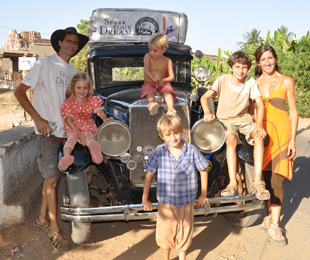
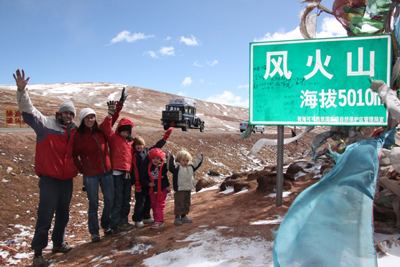
Candellaria and Herman Zapp have been travelling in a vintage car for the past 12 years. They have criss-crossed 37 countries and there have been four births along the way. Right now, they are parked at Hampi

Each of the Zapp children was born in a different country. They’ve never been to school, but life has taught them wonderful lessons

For once, Hampi in itself was not the attraction but a vintage car that trundled in, carrying a family of six. One look and people know that this is no ordinary car and no ordinary family.

Herman and Candellaria Zapp from Argentina started out 12 years ago in their 1928 Graham-Paige that’s not just a means of transport, but their very home. They’ve criss-crossed 37 countries since, covering almost the distance to the moon, as they put it. What started as a six-month trip from Argentina to Alaska stretched into more than 40 months and the trip is not yet over.
“I hope it will continue for another three-four years. However, we don’t have any plans yet. We will continue as long as we can,” said Herman Zapp, 40.
The Zapps, for whom life is an adventure, is the only known family touring the world in a vintage car. They’ve covered countries as diverse as Sri Lanka, Cambodia, Japan and Peru and are now in Hampi for three days.
A truly global family

During their never-ending journey, the couple has had four kids  and yes, each of them was born in a different country. Pampa, eight, was born in Greensboro, North Carolina, Tehue, five, was born in Argentina, Paloma, three, is a native of Vancouver Island and little Wallaby, two, was born in Australia. The four have never been to school and are taught to look on life as their teacher.
“It’s challenging,” said Zapp. “We don’t stay in any lodges or hotels. This vintage car is everything for us.”
It was given to him by his grandfather and Zapp has to stick to the 40 mile per hour speed  limit that the 84-year old car is restricted to.
“It’s like adventure trekking across the world and we plan to write many more books on our experiences in the days ahead,” said Zapp. They’ve already published a best-seller based on their experiences. Atrapa Tu Sueno was printed during their trip to Alaska. It was later translated into English as Spark your Dream and was the best-selling book at the International Book Fair of Costa Rica. It’s their bread-winner.  The travelogues are well received by readers across the globe, said 35-year-old Candellaria.
The couple is uncertain about what lies ahead but they’ve sparked their dream and there’s no turning back.
Each night,  the six Zapps either sleep in or around a tent set up next to their car, but more often than not they find a friendly local who will put them up for the night.
“This isn’t just a feat by my wife and my young family,” said Herman. “This has a roll call of 12,000 people who have helped my family over the past 11 years.”
And that thought powers them on.
source: http://www.BangaloreMirror.com / Home> News> City> Story / by Chetan R / Monday, March 05th, 2012


A toast to the French taste

One literally has to crane one’s neck out of the car window to spot the ‘home of Mariannick’ or Chez Mariannick. Located in Siddapura, off Varthur Road, Chez Mariannick is housed in a brick-and-mortar shack with fields on one side, and signs of concretization on the other. This quaint and rustic French creperie-boulangerie, was first started as a bakery by French-born Mariannick Halai and her husband of Indian origin, Shashi, four years ago.

The home of Mariannick started off as a bakery, in a 10- feet-by-10-feet stone structure located in the middle of a field which the couple had rented from a farmer at Rs 1,100 a month.

“I built our first wood-fire oven in that small plot. My wife and I would carry trays with baguettes and croissants for a kilometre from our apartment. After the baguettes and croissants were baked we would then set off on our scooter and sell our produce to whoever wished to buy them,” recalls Shashi, who worked as a carpenter besides dabbling in other artisan works along with Mariannick in London, before shifting to Bangalore.

Today Chez Mariannick has grown to be a 60-seater restaurant that dishes out a lunch and dinner menu six-days a week, with Sundays off. On Fridays and Saturdays the restaurant serves crepes, while on other days wood-fired pizzas are a staple as are baguettes, croissants and few French desserts. Fresh salad and breads are served to diners “just the way it’s done in France,” Shashi says.

And then comes a straightforward admission: “Nothing comes for free. Call it complimentary and put the price up on the food or just say that’s the meal deal, that’s the combo.” Pizzas come for Rs 350-450, bakery products start at Rs 50.

The couple delivers over 100 croissants and close to 80 baguettes a day to the posh residences in an around Whitefield such as Prestige Ozone and Palm Meadows. They also deliver to Bangalore’s Beverly Hills address, Epsilon, and other high-end gated communities such as Adarsh Palm Vista.

On the difficulties in running an authentic French restaurant Shashi says, “I have only been able to train one person who’s been with us for three years. It’s impossible to get someone who’s committed. You get them, they learn and they move on.” He adds, “Our flavours are what you’ll find in a very good French bakery. And that’s because of Mariannick’s hands. One must understand that in India things always change. Each bag of wheat that you’re going to open will be different from the one opened before. That’s just India.”

source: http;//www.articles.timesofindia.indiatimes.com / City> Bangalore / by Anshul Dhamija / TNN/ March 04th, 2012


An Artist from Iran who portrays ‘Moods of Life’ on Canvas

People take up art for various reasons. For some it is a life-long passion, for others it is just a hobby and for yet others, it is the only way to express their views, feelings and ideas to transform the world.

Tala Afshin, a young artist from Iran, has been a resident of Mysore city since six years. Hailing from Mashhad city in Iran, the 30-year-old bubbling Tala is fond of painting in sombre colours.

With a passion for painting since teenage, Tala took up Graphic Design in high school itself, followed by an Advanced Diploma in Painting from the University of Applied Science and Technology in Iran.

Tala came to Mysore in 2006 and joined Bachelor of Fine Arts (BFA) course in Chamarajendra Academy of Visual Arts (CAVA). She later completed MFA in Sri Allamaprabhu Lalithakala Academy.

She has displayed her paintings in various exhibitions including a group show in Mashhad city (2004), a group show in Whitefield, Bangalore (2007) and in Sublime Gallery of UB City in Bangalore (November, 2011).

Apart from painting, Tala’s hobbies include interior designing, which she learnt while working with her brothers and father who are architects.

She says when she came to Mysore in 2006, she immediately fell in love with the city and this country. Hence she joined CAVA to continue her fine art course as she wanted to stay here and enjoy the hospitality and culture of the people.

Tala says nature is her best teacher in painting which reveals itself to her in its myriad forms. She loves to draw abstract art as abstraction differs greatly than most traditional styles of art because it is more focused on the use of imagination or ideas expressed through emotion.

When asked how she defines art, Tala opines that art is a creative way of expressing a modified view of the world and its objects by simplifying or complicating the use of colour, shape and form.

She says there is a real power in terms of making a connection with people, if the artist applies discipline and works from an authentic form of creativity and expression, whether it be through the use of colour, a mixed media form, figure or shape manipulation…

Art, she adds, is creativity; therefore no single form of art could really be more creative than another form of art.

Tala Afshin has a wonderful imagination, diving into colours to signify her innermost feelings and the moods of life. Her passion to paint is immensely inspired by a person’s adaptation to the changing circumstances in one’s journey of life.

Her paintings portraying women are seductive, revealing the inner thoughts of the character with an alluring body language and facial expression.

Tala, meaning ‘Gold’ in Persian, has been embodied into her art with vibrant hues of colour adding glimmer and richness like gold.

Tala Afshin is not the only person in her family who loves Mysore. Her sister Mona is studying BDS in JSS Dental College in the city.

source: http://www.StarofMysore.com / Feature Articles / by Shwetha Halambi  / January 22nd, 2012

Med school first step in Shetty project

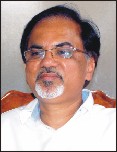
Dr. Shetty

Cardiologist Dr. Devi Shetty plans to partner with a local educational institution to open a medical school this year in Cayman as part of his medical facility.

Dr. Shetty, who was in Cayman for four days this week to meet government officials and local partners, also revealed that the first phase of the hospital project was expected to break ground in August this year.

“It is our plan to work with a current local institution to get [the medical school] going quicker… In the [initial] plan, the medical school was not supposed to start till the third or fourth year. We decided to expedite that,” explained local partner Gene Thompson.

The medical school will be based within an existing building at a local institution. Dr. Shetty declined to identify which local institution he was partnering with, saying the deal had not yet been “tied down”.

Dr. A. Raghuvanshi, managing director of Narayana Hrudayalaya Hospitals, the group behind the proposed project, said: “By the end of this year, the coming academic year, we should start a medical school that will take about 100 students.”

Dr. Shetty said about 700 students graduated in Cayman every year, only one or two of whom opt to take medical courses after leaving school. He said that if there were a medical school on the island where they could train as doctors, nurses or technicians, one in seven graduates would go into the medical field,

“Healthcare jobs are the only recession-proof jobs,” he said, adding that in recent years, the only industry that created jobs was the healthcare sector. “Currently there is a shortage of three to four million jobs in the healthcare sector,” he said.

“No country should depend on foreign medical specialists to look after healthcare in their country. It is very important that the Cayman government and Cayman people train adequate numbers of doctors, nurses and technicians to look after their own healthcare,” Dr. Shetty added.

The hospital project, officially called the Narayana Cayman University Medical Centre, is slated to be built at the High Rock area of East End, where the Shetty group has bought 200 acres of a 600-acre site. The hospital, its associated assisted living facility and research centre will be built on the 200 acres, while related infrastructure, such as a hotel, will be built by Joseph Imparato, who sold the land to the Shetty group and who still owns the adjacent 400 acres.

The initial phase of the project involves the establishment of a 140-bed hospital, which if all going to schedule, should start accepting its first patients in August 2013, Dr. Shetty told reporters at a briefing Friday, 6 January, shortly before flying off island.

source: http://www.CompassCayman.com / by Norma Conolly,  norma@cfg.ky / January 06th, 2012

Make Chai Not War :U.S sponsored NRI comedy team to spread religious harmony in India

Ohio, Jan 1 (TruthDive):

A trio of Indian origin comedians – Rajiv Satyal, Hari Kondabolu and Azhar Osman will be on an US sponsored Indian tour in an effort to strengthen ties and spread religious harmony. The state department officially announced the trip.

Victoria Nuland, a State Department official said, “We are, indeed, sending an Indian-American comedy group,” adding, “I believe the full tour costs about $100,000. The U.S. Embassy in New Delhi is supporting them with a grant of $88,000.”

The tour named “Make Chai, Not War” will be on from January 4th to 17th and will perform in seven Indian cities: Chennai, Bangalore, Hyderabad, Patna, Kolkata, Durgapur and Mumbai. Nuland cited it as “part of our regular global cultural exchange program that we do around the world,” explaining, “The reason we decided to support this tour is because among the things that they are known for is their talk about religious tolerance, about the importance of breaking down prejudices, and about the positive experiences they had growing up as Indian-Americans in the United States.”

“In addition to doing shows, they’ll also be holding audience discussions on these issues of religious tolerance and doing workshops and having some interviews with the press,” added Nuland.

Rajiv Satyal, who is best known as “The Funny Indian” said, “I’m pretty much going to do my act. But the tone changes, if I do a lot of Indian jokes with an Indian audience, it’s a ‘you guys know what I’m talking about’ thing, whereas, if I’m in Alabama, it’s more explanatory.”

“It’s cool to be able to go to India because that’s where a lot of religious strife has been happening,” he said. “We’re not even really religious on stage. We might do some religious jokes, but it’s more just bringing people together,” he added.

Usman, who is a Muslim is known for his religious swipes. “I never make religion the butt of my jokes,” he said, adding, “I target stupidity, human foibles and fundamentalism.”

source: http://www.truthdive.com / posted by Mohan Ramraj / January 12th, 2012