The idea came to fruition when Dr Omkar interacted with farmers and was told about the difficulty in identifying crop disease.
A farmer works in his sugarcane field (File | Reuters)
Bengaluru :
With just a click, sugarcane growers will be able to identify as many as five diseases in their crop using the app ‘Safal Fasal’.
The app is being developed by Dr SN Omkar, chief research scientist, Department of Aerospace Engineering, Indian Institute of Science (IISc), Bengaluru, who has finished programming the algorithm that identifies diseases. A database of remedial measures is also being put in place, in case a disease is detected.
The idea came to fruition when Dr Omkar interacted with farmers and was told about the difficulty in identifying crop disease.
While many farmers would be adept at assessing the health of their crops, newcomers in the sector would benefit the most from this app.
“There are young agriculturalists, who may not be acquainted with crops and diseases. This will help them immensely. Also, since a few farmers whose crops have been affected by diseases, could visually inspect their crops because of experience, there are many farmers who would benefit immensely by the democratisation of this information. This can even prevent the large scale loss of crops due to disease,” Omkar told The New Indian Express.
Experts, including those from the biotechnology sector, have helped pick five popular diseases prevalent in the region and ways to identify them with certain characteristics. This has helped in programming the apps’ algorithm that analyses pictures through image processing in the cloud. With just five pictures of the yield, one can know the state of the sugarcane. The app will provide health reports as well.
At present, the team is working on increasing the precision of identifying diseases through pictures. “We are trying to get a larger database of pictures of more healthy and unhealthy crops. Currently, the precision of the app is at 86%,” said Dr Omkar.
source: http://www.newindianexpress.com / The New Indian Express / Home> Good News / by Pearl Maria D’Souza / Express News Service / December 10th, 2019
Four students from a Bengaluru school have bagged topped spots in the Cambridge Assessment International Examinations (CAIE). Their performance was based on tests conducted in the November 2018 and June 2019 Cambridge examination series, the results of which were announced on Friday.
There was celebrations at Inventure Academy as two of their students received ‘Top in the World’ awards for mathematics while two others received ‘Top in the Country’ awards in a range of subjects, including computer science, design and technology, geography, and global perspective and research.
School captain Divij Gupta has topped the world in mathematics for three consecutive years. He is a member of Inventure’s round square youth parliament and football, athletics and music teams. He aspires to pursue theoretical physics at one of the world’s leading universities. “It is a surreal feeling to have bagged three top of the world ranks. It reaffirms my interest in math and motivates me to work harder in the same stream going forward. I am grateful to my teachers, my school and my parents for their continuous support,” he said.
Omkar Ashutosh Kerkar has topped the world in AS-level mathematics. Abhishek Jain topped the country in A-level computer science and received the high achievement award in AS-level design and technology while Indika Kandwal received the high achievement award in A level geography and AS level global perspectives and research.
source: http://www.thehindu.com / The Hindu / Home> News> Cities> Bengaluru / by Staff Reporter / November 22nd, 2019
Dr Aditya Bharadwaj inserted a heart pumping device and a stent through the axillary artery in the shoulder instead of the femoral artery in the groin.
Cardiologist Dr Aditya Bharadwaj with his 70-year-old patient
Bengaluru :
In a path-breaking move, an interventional cardiologist from Bengaluru, Dr Aditya Bharadwaj, has opened new options for stent surgery and other cardiac procedures.
He inserted a heart pumping device and a stent through the axillary artery in the shoulder. Traditionally, a heart pumping device is inserted through the femoral artery in the groin and a stent through a separate artery. Dr Bharadwaj has opened up an optional access point to the affected parts of the heart for cardiologists across the world. Axillary artery is a much closer access point to the heart than the femoral artery, which is through the groin.
The procedure was carried out at Loma Linda University and Heart Institute in California, on a 70-year-old Vietnam war veteran who had recently suffered a cardiac arrest. Doctors found that he had severe coronary artery calcification, a condition where there is a build-up of calcium in the arteries causing blood vessels to shrink, leading to heart diseases.
A press statement by the university stated that surgeons were unable to insert interventions in the vascular entry points because of calcification. Due to the patient’s condition, there were no viable traditional arterial access points. With no options left, Dr Bharadwaj, a medical graduate from Bangalore Medical College and Research Institute, used the axillary artery to insert the stent and the pumping device. This, however, came with risks as working with arteries near the neck could lead to stroke.
However, Dr Bharadwaj carried on with the procedure and the patient was up and walking a few hours after the surgery. He was discharged two days later. “The success of this procedure opens the door for patients to have more viable cardiovascular intervention surgeries. Physicians have conducted single-access procedures through the femoral artery near the groin but never through the axillary artery,” Dr Bharadwaj said.
source: http://www.newindianexpress.com / The New Indian Express / Home> Cities> Bengaluru / by Express News Service / November 18th, 2019
While she’s often asked about work-life balance, the mother of two – who relocated to Bengaluru after spending 18 years in Germany – feels that it is “so last century.
Sindhu Gangadharan
Bengaluru :
When Sindhu Gangadharan walks into a meeting room, she is used to the audience anticipating the entry of a man. “There’s initial apprehension conveyed through their body language, but they soon realise she knows what she’s saying,” says Gangadharan, managing director of SAP Labs India, the first woman at the top of the German tech giant, leading an 8,000-plus team.
Despite that distinction, Gangadharan, who took charge in September, feels it’s what you bring to the table, articulating what you know, and bringing your best self to work that takes you to the top, gender not being a consideration. While there have been times she has been overlooked, she chooses to move on without dwelling upon it. “People in Germany used to ask if it was any different for me, growing up in India, and I always said it wasn’t. Growing up in Bengaluru, my mother had the same expectations from me that she had of my two brothers. Women are evolving away from compartmentalisation. Our focus is on achieving a flow between all aspects of our lives,” says Gangadharan, who studied in Bangalore University and started her career with SAP Labs India in 1999 when it was located in ITPL.
While she’s often asked about work-life balance, the mother of two – who relocated to Bengaluru after spending 18 years in Germany – feels that it is “so last century.” For her, it’s about enjoying every part of the journey and learning from it. “These were often discussions on this in Germany, and I always felt there’s nothing like work-life balance. Work is also a significant part of one’s life,” says Gangadharan, adding that as a young girl on the debating team in school, she learned skills that she uses every day in her current product management role, making innovations easily understandable for people.
A lesson she learnt early on in her career is something she holds close. In 2001, when she moved to Germany, she would always enter discussions with a clear idea that everyone would speak English. “When I was on my maternity break, I came across many who would make an effort to speak in English. At that point I realised that when others were making an effort to make me feel comfortable, I should also be doing the same.
When I made that mental switch, it was like embracing the culture,” she says. She soon realised how it could break barriers and create a sense of inclusion. “It’s about overcoming inhibitions within yourself,” says Gangadharan, whose focus is on collaboration with a customer-centric approach, thought leadership and building a culture of inclusion.
Gangadharan is often spotted with a diary in hand, capturing her thoughts. With work keeping her busy, she admits that she doesn’t get as much time as she would like to for writing, which she eventually hopes to pursue soon.
source: http://www.newindianexpress.com / The New Indian Express / Home> Good News / by Vidya Iyengar / Express News Service / October 31st, 2019
Balkrishna Doshi speaks exclusively to Metrolife about why great Indian architecture hasn’t percolated down to our dwellings, and how technology is robbing us of our intuition.
Doshi has set up a foundation to promote affordable housing in India.
The Indian Institute of Management in Bengaluru celebrated its 46th Foundation on Monday, and unveiled a plaque in honour of its architect Dr Balkrishna Doshi. The legendary Doshi has worked closely with master architects such as Le Corbusier and Louis Kahn. His iconic design for the IIM-B campus is hailed across the world.
During his visit to Bengaluru, Doshi, 92, delivered a lecture titled ‘Between Encounters and Dreams’ at IIM-B.
The Padma Shri awardee and Pritzker Laureate has been instrumental in establishing the Vastu Shilpa Foundation for research in environmental design. The foundation has done pioneering work in low-cost housing and city planning. Metrolife caught up with him for a chat just before the celebrations.
Why do you think Bengaluru has not been able to retain its architectural charm?
Very simply, we are charmed by other cultures and technology and pursue personal interests. We don’t want to bother about environment or society. It is not just in Bengaluru but all over. When you use technology and tools, the personal rapport is reducing. When everybody is busy in their own world, then naturally the real world is not there. How many hours of the day we are using mobile phones and other technology… we really have no time to chat. We don’t talk casually. A few years ago, we would meet friends and talk about things we felt were important to us and then you carried the conversation home. But today, that world doesn’t exist. We have now found alternatives which may be technology and not human and that has become an essential part of our lives. The human values and concerns, ecological concerns, where are they? All the time we are busy.
What are your suggestions to make Bengaluru a better place in an architectural sense?
Why just architecturally, I think it should overall be a better place! How do we improve ourselves if we cut the trees, if we take the foliage, if we don’t go to the gardens and if we don’t have the time to reflect on our natural wealth but widen the roads and move around in cars? In fact, we have never taught people from childhood the real meaning of virtues like togetherness, or ponder over something that is nourishing. Why do people still go to temples? Because it is where they think there is some connection. Now we go to the temple, but our mind is not there. The trees are cut, roads are widened and landscapes are changed; are we gaining anything or losing?
Karnataka has a record of great architecture, right from Badami to Belur – with temples that are beautifully structured. Why didn’t this sense of architecture come down to ordinary folks? Why do you think our cities and homes are so miserably designed ?
When we look at a temple, it is the intangible, an inner calling that we look at. One tries to connect from the inside. Now there is a disconnect. Today, we have become materialistic and technologically oriented. Technology has taken over our spiritual content – the intangible one – where there was reverence, inquiry and an attitude to do things. What is our focus today, what are we searching for and what would it be that would make us the happiest? These are things we don’t want to ask now. We want to do greater and faster production but what about our villages and towns that are gradually shrinking? Ecologically, the natural resources also have depleted, where is the place to remain ourselves? We think it is progress but we are forgetting that progress is connected to something higher and not just restricted to material progress. This is a major problem in planning and architecture.
Which city do you think is architecturally the most pleasing?
Well, the cities in the south are better. Of course, Varanasi is there, but that’s also dying. I did a project there, so I visited it often. Suddenly, there is a wedding procession and the public is still; then after some time, in some other place, the procession of a dead body is making its way and people stop and give way. I have always wondered how Varanasi never had a problem. That city has an underlying meaning to it.
His design vision for IIM-B
‘One of the things that I tried to do at IIM-B was to reverse the order. The IIM campus talks about nature, leisure, casual walks and one’s relationship with nature and the cosmos all the time.’
Quick takes
On what cities are losing:
One of the essentials we had was the gift of intuition, thinking about reverence, togetherness, humility and concern for others… I don’t think they are there anymore.
On being celebrated in films like ‘Ok Kanmani’:
That was by chance (laughs). It was Mani Ratnam who did this and it had nothing to do with me. The more time passes the more reflective you become, so I wonder.
But what I try to do is to find a way to look at time as one of the major elements and energy as another. So, if I can find a way to fuse time and energy and look at production as a meaningful thing, then those projects become important. So, everywhere, I would like to save, recycle, readjust.
source: http://www.deccanherald.com / Deccan Herald / Home> MetroLife / by Surupasree Sarmmah / DH News Service / Bengaluru – October 29th, 2019
The statue of Sir Mark Cubbon, Commissioner of Mysore in the mid-19th century, is on the move again. Its new home will be Cubbon Park, which is named after him.
The Lord Cubbon statue outside the High Court | NAGARAJA GADEKAL
Bengaluru :
The statue of Sir Mark Cubbon, Commissioner of Mysore in the mid-19th century, is on the move again. Its new home will be Cubbon Park, which is named after him. The statue, located near the back gate of the Karnataka High Court for some years now, will be shifted in front of the bandstand in Cubbon Park within two months.
According to Rajendra Kumar Kataria, principal secretary, horticulture department, there was a long-time request from the High Court to shift the statue, and ever since, the department had been searching for the right place to relocate the statue sans damage. “We needed to decide on the place and also required a group of experts to have it shifted without any damage. The work has been allotted to the Public Works Department (PWD), and we have also given a letter stating that there should be no damage to the park property while carrying out work,” said Kataria.
This is not the first time Sir Cubbon is being moved — the statue was first installed in the Parade Ground in 1866, then moved to the front of Attara Kacheri, and later behind it.
Kusuma G, Deputy Director of Cubbon Park, said that about 20 days ago, they had received orders to have the statue moved. “The orders had come from the High Court and the horticulture department identified the spot in front of the bandstand. The PWD started work a week ago and we were told that it will take about two months for work to be completed. An expert team has been called upon to move the statue.”
Meanwhile, the battle over the relevance of the Cubbon statue continues. Members of the Cubbon Park Walkers’ Association (CPWA) have been celebrating the birth anniversary of Sir Mark Cubbon every year since 2012, by visiting the High Court and garlanding the statue. Now, they are more than happy with the statue being moved.
But a set of protesters which doesn’t wish to see statues of British officers, is demanding the removal of Cubbon’s statue. “Most of the people didn’t know that Mark Cubbon’s statue is located near the back gate of the High Court, where no one was allowed, and now with it being shifted, everyone will know about it. Lord Cubbon’s contribution to the city is immense,” said Umesh Kumar, advocate and CPWA president.
source: http://www.newindianexpress.com / The New Indian Express / Home> Cities> Bengaluru / by Iffath Fathima / Express News Service / October 29th, 2019
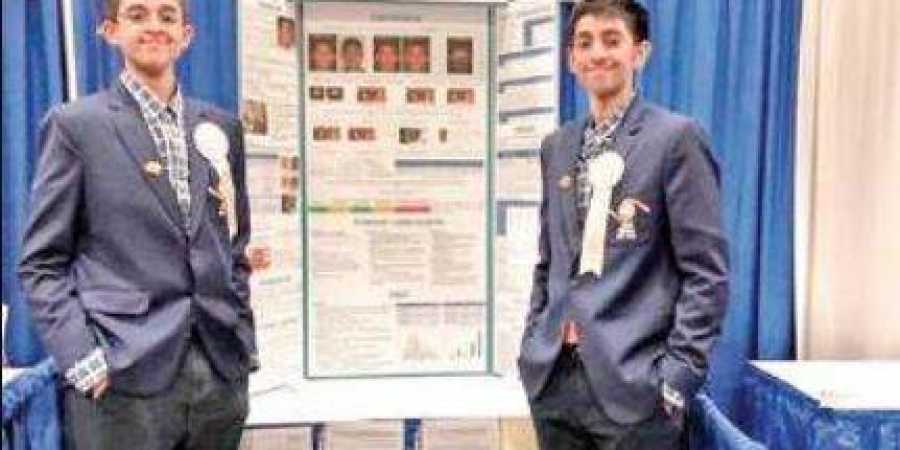
In a bid to detect amblyobia faster in children, 16-year-old Vrishab Krishna and his 18-year-old brother, Biswesh Krishna from Bengaluru, have come out with an app called Kanna.
Bengaluru :
In a bid to detect amblyobia faster in children, 16-year-old Vrishab Krishna and his 18-year-old brother, Biswesh Krishna from Bengaluru, have come out with an app called Kanna. Amblyopia, also known as lazy eye, is a visual development disorder where a person slowly loses vision leading to partial blindness. It affects almost 16 million children in India and over 103 million children from all over the world.
Vrishab used to suffer amblyopia as a child, and would have difficulty while climbing down stairs. Even while playing, he would have difficulty catching the ball. But Vrishab was lucky since his mother noticed his problem when he was four years old and got him tested. The diagnosis revealed his lazy eye condition. Having received treatment in time, Vrishab has been able to see perfectly with both his eyes.
A year ago, the duo decided to study amblyopia and come up with a solution. As they worked on the project, they came up with an app wherein a child affected with the condition will just have to click two images and upload it onto the app to determine whether they have a lazy eye or not. “We wanted an accessible way to help people figure out if they have the condition. And what better than a smart phone which everyone uses,” said Vrishab.
Using patent pending image processing and machine learning algorithms, they calculate one’s risk of having a lazy eye. “After testing, we found that our algorithm to calculate amblyopia is accurate. The child will have to click one image in low light and the other in ambient light. After uploading the images, the results will be out immediately,” said Vrishab.
The duo even reached out to Sankara Eye Hospital and performed a pilot test, and the hospital is now using the device. “Three years ago, we had carried out a survey on amblyopia in Bengaluru and it showed that six percent of children in the city were at a risk. Detecting amblyopia during the critical period – that is before the age of eight – is crucial as complete treatment can be done. After that, it gets difficult as they don’t respond to visual acuity tests,” said Dr Kaushik Murali, Medical President, Quality & Education, Sankara Eye Hospital.
He added with this app will be useful for many. “Since this technique only requires access to a smartphone camera, it can be used both in rural and urban areas, and even allows for screening by untrained people,” Dr Murali added.The app is under clinical validation at Sankara Eye Hospital.
What is amblyopia?
Amblyopia, also known as lazy eye, is a visual development disorder where a person slowly loses vision leading to partial blindness. It affects almost 16 million children in India and over 103 million children all over the world.
source: http://www.newindianexpress.com / The New Indian Express / Home> Cities> Bengaluru / by Iffath Fathima / Express News Service / October 02nd, 2019
Proposals for restoration of the Memorial was submitted at the 101st Haifa Day Celebrations
For entrepreneur Uday Birje and financial analyst Praveen Maney, The 1918 Battle of Haifa is much more than just another historical event. They are the descendants of the soldiers of Mysore Lancers, who won a decisive victory over the Ottoman Turks and the Germans. “My great grandfather Raghunath Rao Birje was part of the Mysore Lancers. Mysuru Maharaja Nalvaji Krishnaraja Wadiyar sent his best soldiers—the Mysore, Jodhpur, and the Hyderabad Lancers— on the promise of Independence by the British,” says Uday.
In fact, the Mysuru Maharaja sent his brother-in-law Colonel J Desaraj Urs, and relatives Risaldar BP Krishne Urs and Captain A Lingaraj Urs to Haifa in Israel.
Praveen says four of his ancestors fought in the Battle. “They were Venkata Rao Maney, Limbaji Pawar, Rajoji Kesarkar and Bhim Rao Talekar. Venkata Rao Maney passed away in the Battle of Allepo and his remains didn’t come to India. His body was buried in Israel and his name is written on the Haifa memorial in Delhi and Bengaluru. The other three descendants returned. One of the medals Limbaji Pawar won was the Indian Distinguished Services Medal for the bravery he displayed in the Battle of Haifa.”
Though much of the memorabilia has been lost, the families have maintained some of them, including medals and swords. “After the War, many people didn’t return, while some did. Those who did spread out to other villages. Some settled within Bengaluru in places around the Mysore Lancers cantonment in Munnireddy Palya (present JC Nagar), Ganga Nagar, Malleswaram, etc.,” says Uday
Uday has a replica of the honour roll by King George, which was given to his great grandmother while Praveen’s family is in possession of a medal, and a sword taken from a German soldier.
The Ottoman Turks and Germans had superior weapons such as machine guns whereas the Mysore Lancers possessed only swords and lancers. It was sheer courage and excellent battle strategy that led to the victory of the Mysore Lancers.
Once the soldiers returned, their contributions were recognised and rewarded by Nalvaji Krishnaraja Wadiyar. It was not until last year that the Battle of Haifa received national recognition. 100 years of the Battle was celebrated last year. The consequence was the renaming of Teen Murti Marg in Delhi—where there is a Haifa Memorial—to Teen Murti Haifa Marg.
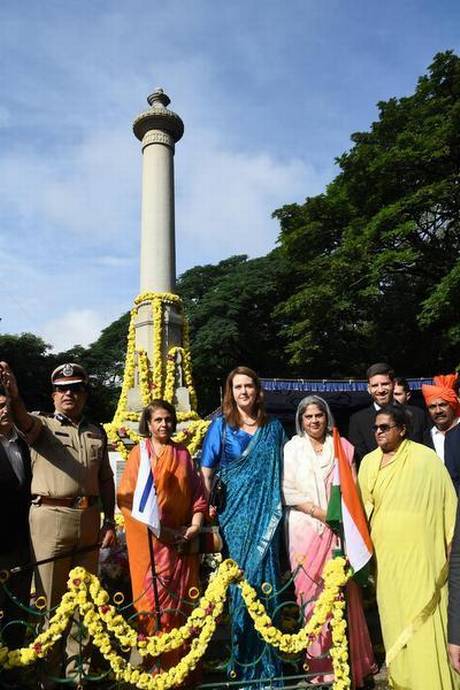
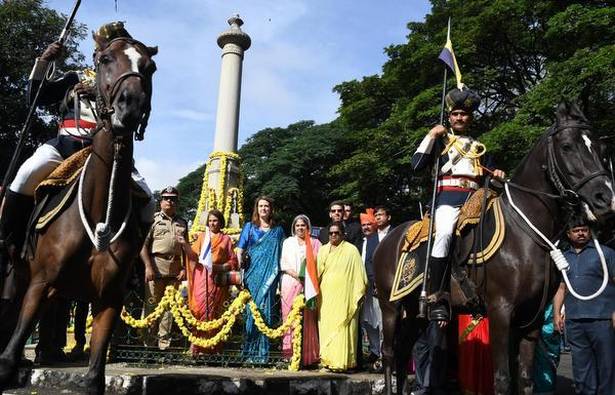
At the 101st celebration held at Mysore Lancers Memorial, JC Nagar, on September 23, a formal proposal was submitted by Yashaswini Sharma, urban historian and architect, to Commissioner of Police Bhaskar Rao and corporator of JC Nagar Ganesh Rao Maney.
“The World War I memorial, which is part of the city’s tangible heritage and sets the context for the neighbourhood, is now in need of urgent attention,” says Yashaswini.
“One step of the base stands embedded inside the road, and the circle with grill barricade is too small. We have submitted a proposal for two granite plaques with the names of all the soldiers of the Mysore Lancers around an equestrian statue; and an enlargement of the Memorial circle and redesign of the grill work.
The proposed design of the grill work is inspired by the decorations of the Mysore Lancers, which includes the Mysore Royal emblem of Gandabherunda. There is bit of paint on the pillar which needs to be cleaned out—the families of the martyrs and some NGOs had earlier cleaned the Memorial, but it requires periodic maintenance. The proposed equestrian statue — Mysore Lancer soldier astride a horse — will be in metal, and we hope this can be placed in the circle right behind the War Memorial and that both the statue and the circle could be connected by a cobbled pathway. This equestrian statue will be set on a pedestal that resembles the design of the World War I Memorial and will be encircled by stone benches so that the families of martyrs can find peace and spend some time there while they pay their respects,” adds Yashaswini.
source: http://www.thehindu.com / The Hindu / Home> Society> History & Culture / by Sravasti Datta / September 30th, 2019
Plasmonic tweezers are limited by the fact that they are fixed in space and can therefore only trap objects that come close to them.
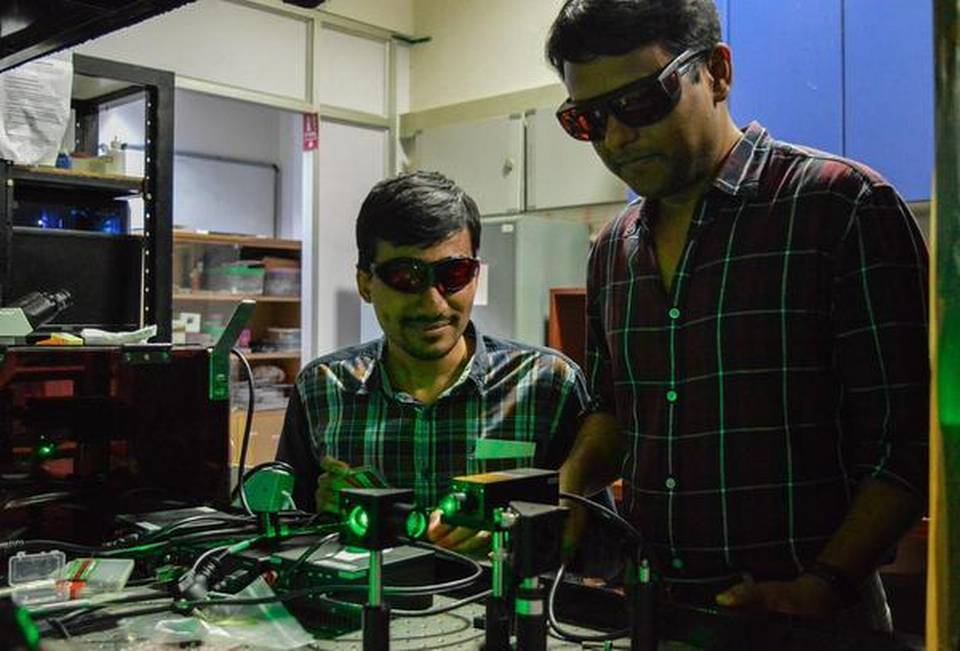
Researchers at the Centre for Nano Science and Engineering at the Indian Institute of Science (IISc), Bengaluru, have developed a technique to trap and move tiny objects in the nanoscale using optical “tweezers” employing light. This is a tool that can be used to pick and move small suspended particles even including cells. This research has been published in Nature Communications.
Optical tweezers have been known for about thirty years now and are used in biology to hold and manipulate particles; however, they have a limitation when it comes to nanosized particles. This was partly solved with the development of “plasmonic tweezer” which works on the principle that when a disc of noble metal, like gold, is illuminated with light, it creates an electromagnetic field around the disc. This field can attract and hold on to tiny particles.
Plasmonic tweezers are limited by the fact that they are fixed in space and can therefore only trap objects that come close to them. Though the team, in an earlier work, showed that such plasmonic tweezers could be manoeuvred with a combination of light and magnetic fields, they could not apply the technique to some types of colloids.
Tweezer-in-a-tweezer
In the present work, they overcome this limitation by developing a method that uses only optical force. They integrate a silver nanodisc with a microrod made of glass and the combination can be manipulated using laser beams alone. This “tweezer-in-a-tweezer” approach can trap objects of about 40 nanometres in size, using a single laser beam. This is the typical size of a virus or DNA. “The optical tweezer holds the plasmonic tweezer and the plasmonic tweezers trap our target nanoparticles, therefore tweezer (plasmonic) in tweezer (optical),” says Souvik Ghosh, first author of the paper.
As the size of any colloidal particle decreases, for instance from micro-scale to nano-scale, the movement due to Brownian motion or random fluctuation increases. “Therefore, holding a single silver nanodisc with a focused laser beam (the optical tweezer) is challenging and needs high laser intensity to generate enough force to overcome the fluctuations,” explains Ghosh. If, in order to reduce the required laser intensity, the size of the disc were reduced, the plasmonic properties would be lost. Therefore, the team attached a dielectric microrod made of glass which while preserving the plasmonic property, reduces the thermal fluctuations by an order of magnitude. “The intensity required is about 100 times lower that what a regular optical tweezer typically uses to hold an object of similar dimensions,” he explains.
“The technique is ready for real world applications,” says Prof. Ambarish Ghosh, in whose lab the research was carried out. “Simplicity and ease of implementation are the biggest USPs for this device. It is patented and we are already in discussion with a company for licensing.”
source: http://www.thehindu.com / The Hindu / Home> Sci-Tech> Science / by Shubashree Desikan / September 28th, 2019
50 Vintage beauties will start from Raj Bhavan tomorrow; will be in city till Oct. 2
Mysuru:
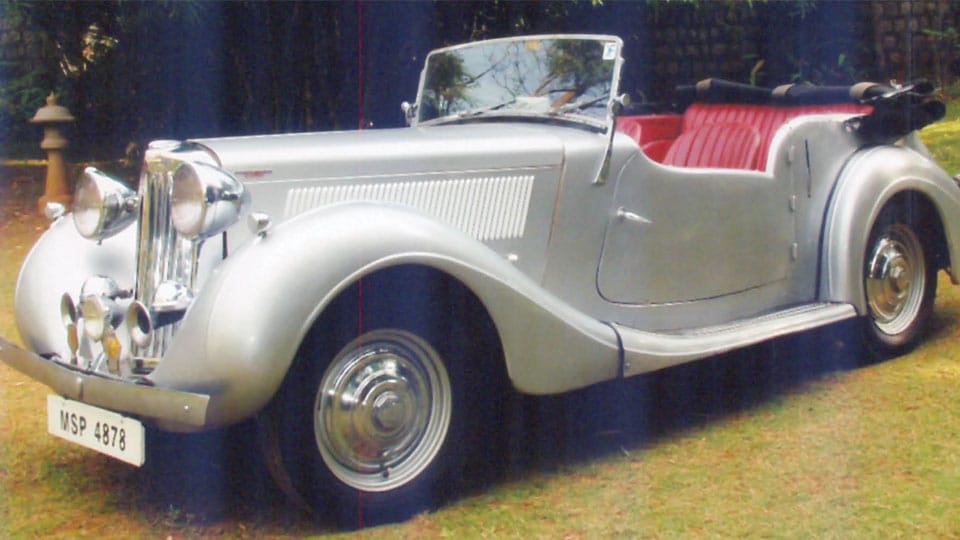
A two-litre 1937 Sunbeam Talbot, the only car in India previously owned by Lord Mountbatten, the last Viceroy of India, will be displayed during the Vintage Car Rally organised as part of Dasara celebrations.
The car is currently owned by Sabena Prakash and the Vintage beauty will be brought from Bengaluru on Sept. 29 (tomorrow). Along with Lord Mountbatten’s car, 49 other vintage beauties will take a tour of the city for three days.
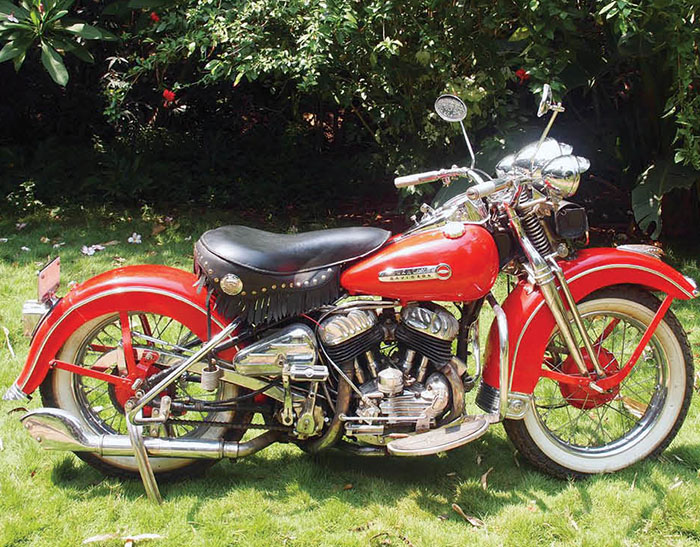
Mysureans will have an opportunity to see these classic cars in the event organised by Federation of Historic Vehicles of India (FHVI) from Sept. 29 to Oct. 2. The Federation will bring over 50 vintage and classic cars and motorcycles and the rally will be flagged off from Raj Bhavan in Bengaluru by Governor Vajubhai Vala at 9 am tomorrow.
A rare picture of the last Governor General of India, Earl Mountbatten with his wife and Pandit Nehru, near Kufri (Himachal Pradesh) heading to Narkanda in the 1940s.
The rally will arrive in the city and pass through Mysuru’s historic monuments tomorrow evening, after which the vehicles will be parked in front of the Mysore Palace. Prominent personalities from royal families and well-known industrialists from business houses in India and Sri Lanka will be part of this rally.
It is FHVI’s second edition and it is the only all India Federation of Vintage and Classic Cars associated with the International body of Historic Vehicles FIVA, official partner of UNESCO. It has at present nearly 2,000 members and about 10,000 Vintage and Classic Cars, Bikes and Utilitarian Vehicles.
The FHVI has taken part in Dasara procession for several years and now it has made it an annual event from last year with the help of Government of Karnataka, Department of Tourism and Department of Forests.
Vintage cars from the 1920s to 1980s like Sunbeam, Mercedes, MG’s, Jaguars, Fords, Dodge-Brothers, Buicks, Chevrolet’s, Morris’s, Austin’s, Alfa Romeo’s, Triumph and Lincoln will be part of this vintage car rally. A Mercedes 170 V Tourer, owned by Bri Ponnambalan, Studebaker Commander Tourer owned by Clive, Buick Super 8 owned by Rohan Fernando, Mercedes Ponton 180 owned by Naresha Subramanyam and MG GT owned by Megara Alwsi are some of the cars being showcased.
Dr. Ravi Prakash, President of FHVI, said, “A total of 50 entrants are coming from overseas and across India and Karnataka. There would be 125 participants. This year the prominent car will be 1937 Sunbeam Talbot, 2-litre, the only car in India previously owned by Lord Mountbatten.”
Historic motorcycles will be in the lead. The vehicles have to move in the city between 30kmph and 40kmph and on the outskirts between 60kmph and 70kmph, he added.
Participants will stay at the Lalitha Mahal Palace Hotel and other private hotels in Mysuru till Oct. 2. On Monday, Sept. 30, participants will be driving to Chamundi Hills for the Darshan of Goddess Chamundeshwari and later will be visiting Bandipur Tiger Reserve. On Oct. 1, participants will have a ‘Pagal Gymkhana’ at the Lalitha Mahal Grounds after which they will be driving to the Krishna Raja Sagar Dam and return to Bengaluru in the evening.
source: http://www.starofmysore.com / Star of Mysore / Home> News / September 28th, 2019