A look at the iconic 56-year-old Thomsons Bakery in Cox Town, where wood-fired ovens run through the day.
Tradition runs deep with this modest bakery owned by CT Abraham, popularly known as Thomsons Bakery. Founded in 1962 by the late C I Thomas and wife Anita, who moved to Bengaluru in 1943.
Business started small, in a nook tucked away in a street next to St Peter’s Church, Cox Town. Although the bakery is small, it has made its mark in Bengaluru and attracts the local population and has connected with its customers over the years. As you enter the bakery, a mouth watering aroma of freshly baked bread greets you and lures you in. The bakery is stacked with goodies rows of rich brown plum-cake, crispy samosas and light, flaky macaroons.
The Thomases initially started supplying bread and other bakery goods in bulk to industrial canteens like ITI and MICO, besides the Army and Air Force canteens as their quality and reasonable prices made them popular.
“When World War II broke out, Dad came down from Kerala to look for a job, as a lad of 25. He worked in various places and after picking up experience in business, decided that it was a good idea to get into the food business because bakery products were always in demand and there were no established bakeries in east Bengaluru,” says son C T Abraham, a chartered accountant.
Thomsons Bakery has, over the years, gained popularity for its plum cakes. The secret, says Abraham, is the wood fire technique. “It give the plum cake a unique flavour which is hard to get in any other oven. Even our bread and other products have a distinctive flavour because of this,” he says.
The fireboard is set aflame every day at 9:30 am. The wood is burned for an hour, after which the ashes are removed and the baking process begins, going on for about 45 minutes or so, and voilà, a fragrant batch of 150 loaves is out. The concept of using a fireboard and following tradition is quite crucial as they believe that using it adds a woody flavour to the bread. “It is indeed a big responsibility to maintain quality day in day out and especially in a food business. Support of family members is crucial”, added Abraham.
Just as son Abraham took over the bakery, loyal customers have extended to new generations too. The bakery has seen a number of weddings, having supplied plum cakes and other goodies too. Their products are bought by customers to gift to friends and family abroad.
Abraham says, “Business blooms in the wedding season as well as during Christmas, when over 6000kg of plum cake is produced.” Their recipe goes back generations, with roots in English tradition. A lengthy process is followed, involving the fermenting of fruits for six months. The cakes last for two to three months at least.
The bakery has a menu with 45 to 50 varied items that range from apple cake, cream cookies, chocolate pastries and jam roll to chicken puffs, samosas and vegetable cutlets. The 56-year-old bakery does quite well, while remaining on the quieter side with its advertising and promotion, and reaching out to retail customers. They have no plans of expanding as they prefer to stay that way such that quality can be maintained.
“It takes a lot of commitment, hard work and constant supervision to produce a few tons of quality plum cakes every year to satisfy our customer base and reputation,” included Abraham.
Big brands and bakery chains have left a dent in Thomsons business, but Abraham knows that no mechanized bakery can beat their plum cakes.
The bakery produces most of its products in its own small factory located down the road from the bakery. Nine employees work within the humble ambience of the bakery and factory. Even with the steady pace of business, the future of the bakery is uncertain because of the probable absence of someone to take over the enterprise in future.
—Pariza Khan
source: http://www.timesofindia.indiatimes.com / The Times of India / News> City News> Bangalore News / TNN / May 26th, 2018
Photo journalist Keshav Vitla passed away here on Monday. He was 56 and was suffering from renal problem.
Born in Vitla in Dakshina Kannada district, he began his career with the Kannada daily Mungaru. Later he joined the Indian Express group. Recently he was into freelance photography.
The funeral will be conducted at Vitla this afternoon.
source: http://www.thehindu.com / The Hindu / Home> News> States> Karnataka / by Special Correspondent / Mangaluru – May 28th, 2018
Maharshi Sanket set out from Bengaluru on May 21. | Photo Credit: The Hindu
The student wants to raise awareness about abuse, bullying
A song asking the perpetrator of abuse to think from the perspective of the victim; paintings that depict the theme of bullying; a cycle tour from Bengaluru to Mumbai to spread awareness — this is what a 15-year-old has embarked on to get people to ‘Speak out’ against bullying and sexual abuse.
Maharshi Sanket, a student of Treamis World School, launched the campaign to break the silence around abuse.
“We keep hearing news about rape and abuse every day, so much so that people have become used to it. I have seen many of my friends who have silently endured abuse, unable to speak about the trauma. All of this is disturbing. I wanted to do something about it,” said Sanket.
To spread awareness among people in rural and urban areas, he decided to go on a cycle tour from Bengaluru to Mumbai, covering towns and cities along the way. “I chose to cycle because unlike travelling by a car, this ensures there are no barriers and brings you closer to people,” the young campaigner said.
He started from Cubbon Park on May 21 and will bicycle through Tumakuru, Sira, Chitradurga, Davangere, Haveri, Dharwad, Belagavi, Kolhapur, Satara, Pune and Lonavala. He expects to reach Navi Mumbai and Mumbai by June 2. He is accompanied by art director Sukant Panigrahy, and a social activist to speak on the cause.
The idea occurred to him during his board exams. Once he was done with the exams, he started planning the campaign.
He always found art to be an effective medium for expression. Before venturing out on his cycle, he launched the campaign with an event displaying his paintings on the theme of abuse and its effect on the victims. He also released an anthem, which was produced and composed by Chris Avinash, penned by Sadhu Nityanand and sung by Ankita Kundu.
“Bullying is still not part of the mainstream discourse and victims are asked to ignore the issue. When boys try to talk about it, their masculinity is questioned. Such abuse can have long-term effects. Hopefully, my campaign will encourage people to open up and talk about the issue, without shame or taboo,” said Sanket.
source: http://www.thehindu.com / The Hindu / Home> News> Cities> Bengaluru / by Staff Reporter / May 23rd, 2018
TG Lingappa composed some of Kannada’s masterpieces. His sense of music was impeccable and he infused it with a rich theatricality
When you listen to the music of TG Lingappa, you hear the rich textures of the leg harmonium. The grand instrument gets its evocativeness from a combination of pumping that is deep and shallow, quick and slow — weaving a luxuriant tapestry of sounds. The crescendos and diminuendos that a leg harmonium achieves gives it a high mimetic character, in fact, the company dramas of yesteryear gave this instrument centre stage.
His father’s music certainly made a huge impact on TG Lingappa. Govindarajulu Naidu, Lingappa’s father, played the leg harmonium in company dramas. Story goes that the actor-singer MK Thyagaraja Bhagavathar was Naidu’s good friend and often visited their residence and had several singing sessions. KB Sundarambal, who was also a theatre artiste and later made it big in Tamil cinema, was Naidu’s disciple. Lingappa’s father sold musical instruments and the astute young boy could play almost every instrument that he set his eyes on. When the family moved from Tiruchi to Madras, the young Lingappa looked for opportunities in cinema. Theatre did become a thing of the past, a world that they had left behind, but it remained the eternal conscience of his musical expression.
Music in a theatre production has a specific purpose: at the cost of under-theorising it, one could say it heightens the mood. But more than seeing music as redolent or suggestive, it is important to understand what a piece of music does. If cinema can be seen as an extension of theatre, for Lingappa music was a piece of theatre too. So, he not merely made music for cinema, but also created a complementary cinematic narrative through music. An extremely gifted musician, Lingappa could play several instruments and made a living from orchestra in his early days. This perhaps gave him a clear picture of the music that each of these instruments could generate and as one sees in his film music orchestration, Lingappa does a phenomenal job of layering of sound.
This can be illustrated through some of his works. Let’s take “Yaaru Tiliyaru Ninna Bhujabalada Parakrama” from the film Babruvahana (1977). The song is a dialogue, a verbal contest to begin with. Lingappa sets it to the highly dramatic, traditional kanda padya rendering style, but with the sharp, instrumental interludes he prepares you for the conquest that is to come after this exchange of words. To emphasize on his theatre influence, throughout this song (for that matter any song of Lingappa), not once are the words overshadowed by music: in fact, you can see how there are points where the song lets go of the tune and articulates it in the spoken word style as emphatically as music. This song is a wonderful coming together of two artistes from theatre background – Lingappa and Rajkumar. It requires enormous courage for a playback singer to sing just to the drone of the tanpura, and Rajkumar produces a masterpiece. Of course, PB Sreenivos who is Rajkumar’s co-singer, isn’t far behind. There is yet another short piece in the film, “Barasidilu badidante” which is also rendered in a similar style. The song opens with stunning violin passages that are akin to those in a symphonic orchestra. In both these songs, you can see Lingappa’s signature style, that is to change the raga or melodic harmony to heighten the drama. In “Aradhisuve Madanari” from the same film, all musical tools like raga portrayal, swara prasthara, konnakol, and tani avarthanam, become dramatic techniques.
Let’s consider three songs that would perhaps be broadly classified as devotional: “Shiva Shiva Endare” (Bhaktha Siriyala, 1980), “Jaya Jaya Samba Sadashiva Shankara” (Guru Shishyaru, 1981) and “Yaarige Yaaruntu” (Gaali Gopura, 1962). He interprets all the three differently – the first two are eulogies with upbeat tunes and an elaborate orchestra. In fact, in “Jaya Jaya” he uses instruments like chande and cymbals to give Lord Shiva his many dimensions. The third is a Purandara Dasa composition and Lingappa gives it a mellow narration without violating the philosophical core. It is clear that Lingappa was not thinking merely about the melodic composition: words, intent and the context formed the marrow of his work.
Lingappa was a versatile composer. He composed songs of different kinds, making it hard to believe that he composed them all. He made extensive use of sitar, veena and violins. Listen to “Ninna Neenu Maretarenu” (Devara Kannu, 1975) – he blends both schemes of Indian music, despite the violin passages which have a western orientation. “Entha Sogasu” (Taayige Takka Maga) is a stylish composition with an RD Burman kind of orchestration. The slow and soothing lullaby “Pavadisu Paalaksha” (Sati Shakti, 1963) in Malkauns is surely the best. “Jaari biddiye O Jaana” in Kedar is a brilliant composition: it works completely on syncopation like the verses in a qawwali. Janaki’s rendition is liltingly memorable. Of course, “Maatege migilada devarilla” is everyone’s hummable favourite.
Lingappa’s time also had other brilliant composers like MV Raju, GK Venkatesh, Vijay Bhaskar and others. But each of these musicians brought an amazing variety and authenticity to film music. Though all of them came from different backgrounds, they not only knew Indian music, but had studied Western music as well. But they way their music embodied all these different musical idioms is a fascinating study in itself. To understand TG Lingappa through the dramatic element is therefore, just one of the ways of looking at this superb musician. There can be several other perspectives. Lingappa’s music, like that of the leg harmonium, fills the ears, and the heart too. This is but a cursory look.
Inner Voice is a fortnightly column on film music.
source: http://www.thehindu.com / The Hindu / Home> Entertainment> Inner Voice – Movies / by Deepa Ganesh / May 22nd, 2018
Consulate General, embassy of the Kingdom of the Netherlands, Jaap Werner presenting the trophy of Bicycle Mayor to Satya Shankaran in Bengaluru on Monday. | Photo Credit: G_P_Sampath Kumar
Satya Shankaran was announced the winner from among 19 applicants
Bengaluru got its first ‘Bicycle Mayor’ on Monday as 42-year-old civic activist Satya Shankaran was announced the winner from among 19 applicants, six of who were shortlisted for the post.
The selection panel included civic activists Ashwin Mahesh, V. Ravichander and Srinivas Alavalli, and urban transport experts Pawan Mulukutla and Prof. Ashish Verma.
The city is the third in India to have a Bicycle Mayor after Vadodara in Gujarat and Guwahati in Assam.
The Bicycle Mayor is an honorary two-year position, part of a global programme envisioned by Amsterdam-based NGO ByCS, which aims to ensure that 50% of the transport in cities is made up of bicycles by 2030.
In India, the project is being implemented in coordination with the NGO Evangelical Social Action Forum (ESAF).
Mr. Shankaran is the co-founder of the NGO Prajaa, which has been focusing on civic interventions in Bengaluru, and the founder of Citizens for Sustainability (Cifos), focusing on technology and infrastructure. He has been actively involved in projects concerning non-motorised transport.
He plans to focus on bringing together experts and cycling enthusiasts. To begin with, he would reach out to all the contestants and encourage their participation in the movement. That apart, he would focus on creating awareness among school students. The idea is to approach schools and teach students subjects such as physics, health and civics through cycling, he said.
Parking hubs
On the occasion, the Department of Urban Land Transport (DULT) announced that the city will soon get 400 parking hubs for bicycles and 125 km of cycle lanes under a project executed by the Bruhat Bengaluru Mahanagara Palike.
N. Murali Krishna, Special Officer, DULT said of the 125 km cycling lanes, about 50 km will be developed in sub-arterial routes. “This is likely to be ready within the next six months. For the rest, planning has to be done,” he added.
source: http://www.thehindu.com / The Hindu / Home> News> Cities> Bengaluru / by Staff Reporter / May 21st, 2018
The film documents the memories of about 25 families living in these areas. | Photo Credit: K Gopinathan
INTACH to screen ‘Towns of Our City – People, Stories and Life in the old cantonment towns of Bengaluru’ on Sunday
Gulnaz Khan was born in Fraser Town. Her grandfather served in the British Indian Army. Though she now lives in Richards Town, Ms. Khan has very fond memories of Fraser Town.
“Every morning, when we would head to school, the entire street would resemble a carpet of flowers. We would hop and jump over them,” she says, remembering the tree canopy, something she greatly misses now.
This and many such memories of long-time residents of the old cantonment towns will be part of a one-hour long film to be screened by the Indian National Trust for Art and Cultural Heritage (INTACH) on May 20.
Speaking about the making of the film, Meera Iyer, co-convenor of INTACH, said, “The film is a result of the exhibition ‘Towns of City’ that was conducted last year to showcase the heritage and culture of Fraser Town, Cooke Town, Richards Town, Benson Town and Cox Town through walks, photographs and talks. We had spoken to numerous long timers, who gave anecdotes of the places. We recorded them and felt that sharing them with the public will make them know the neighbourhood better and also feel more connected to it.”
The film documents the memories of about 25 families living in these areas. “Most of them are descendants of original settlers,” she added.
Some narrators will also share their ideas for the future of these towns and how to preserve what remains of their heritage. “It is important for these stories to be told to preserve and promote the cultural and architectural heritage of these towns,” Ms. Iyer said.
source: http://www.thehindu.com / The Hindu / Home> News> Cities> Bengaluru / by Staff Reporter / May 16th, 2018
Within the Mysore court in the late 1800s, the Royal Carnatic Orchestra served as an important cultural cross-breeding ground between Indian and Western classical music. Today, it faces an uncertain future
A file photo of the Royal Carnatic Orchestra band marching past the Mysore Palace. Photo: Courtesy Mysuru Police Band
In 2015, neuroscientist and classical musician Deepti Navaratna was exploring intercultural encounters while studying at the New England Conservatory, Boston. As she engaged with chamber ensembles and jazz trios, she realized that there was a deep history of such musical hybridity in Mysuru, right next to her hometown of Bengaluru—the Royal Carnatic Orchestra of the Mysore court had served as a site for one of the first encounters between Western classical music and the Carnatic repertoire more than 100 years ago.
“This was one of the first East-meets-West experiments in the country, the legacy of which is being carried forward even today by the Mysuru Police Band, under the official banner of the Mysuru Government Orchestra,” Navaratna says.
When Navaratna shifted to Bengaluru, nearly a year and a half ago, to take up the post of regional director of the Indira Gandhi National Centre for the Arts, she decided to seek out present and erstwhile musicians of the police band. In the past couple of months, she has conducted extensive interviews, poring over records and documents related to the band and hearing private recordings, as well as those in the palace archives and the Karnataka state archives, to trace the history of this orchestra.
“At one point of time, Carnatic composers were writing and orchestrating exclusively for the orchestra. They had a unique repertoire, which could be grouped under Carnatic chamber style of music, with exotic instruments such as the trombone and xylophone being played,” says Navaratna. “I wanted to know more about why, from being a trendsetter, the orchestra is now excluded from mainstream Carnatic music practice and discourse.” Her quest for information has now taken the shape of a project—one which seeks to rekindle a conversation about the Mysuru Police Band and its legacy. In the course of time, Navaratna hopes to publish a book and release a DVD containing old recordings and vintage performances of the erstwhile Royal Carnatic Orchestra.
The Royal Carnatic Orchestra at the Mounted Police Ground, Mysuru. Photo: Anurag Basavaraj/Mint
“The endeavour is also to explore newer performance contexts for the band, so that this unique repertoire is not lost,” she says.
Navaratna’s research sheds light on the multicultural nature of the Mysore court. For instance, during the reign of Nalwadi Krishna Raja Wadiyar IV, from 1894-1940, the court had several Western musicians in residence who spent their entire lives there, composing, teaching and participating in various activities of the orchestra. There were pianists from London and a stream of instrumentalists from Eastern Europe. The Carnatic musicians, who came from diverse class and caste backgrounds, learnt the piano, while the pianists learnt the ragas. “They all thrived in this cross-pollinating environment. And the interesting part is that these musical encounters were very sustained, unlike the symptomatic ones today, when musicians meet to make a series of concerts together and that’s it,” she says.
Unlike the modern idea of experimentation, where Indian classical meets jazz in a mainstream imagination of fusion, this was a meeting of the most sophisticated forms of classical music—where Western art music engaged with its Indian art counterpart, or the court music of southern India. One example is the cultural syncretism in the Mysore state anthem, KayauSri Gowri, composed by the court poet Basavappa Shastry (1843-91). The song, an ode to the tutelary deity of the royal family of Mysore, was written in chaste Kannada but was set to a duplex meter waltz and composed to a simple harmony on the Ionian scale. It was tuned and orchestrated with a Western flavour for a Carnatic ensemble of strings, brass and percussion.
The Royal Carnatic Orchestra band performing at the palace. Photo: Courtesy Mysuru Police Band
The cultural amnesia around the orchestra is also a reflection on the sociopolitical transformation in southern India. “It shows how the cultural histories of Carnatic music, post-independence, have strategically forgotten to document the presence of these European composers and local musicians. More importantly, this reflects on what value was, and still is, placed on purity versus hybridity as a culture,” says Navaratna. Today, the orchestra, which boasted of 150 members in its heyday, has been relegated to the status of a state band with 30 members. Conversation with the musicians is never centred on the present—it is either about the uncertain future looming ahead or the splendid past, when their grandfathers and great-grandfathers performed for royalty. For instance, the grandfather of the current band leader, H. Tandavamurthy, played for Nalwadi Krishna Raja Wadiyar IV. Today, they reclaim some of that legacy when they don their finery for the Republic Day parade or during the Mysuru Dasara.
They wonder why, at a time when Carnatic music is being celebrated with such enthusiasm, they have been forgotten. “Our music is not considered classical enough. We have many exotic instruments from the Middle and the Far East, but there are no players. Many posts in the band are thus lying vacant,” says a multi-percussionist from the band who didn’t want to be named. Incidentally, he is one of the few remaining xylophone players in the country.
Many, like Tandavamurthy, an accomplished violinist, get opportunities as soloists or accompanists for Carnatic classical performances. “But there are very few platforms for us to perform together as a band. We are only called for state and official formalities, where the music we play is not adored as an ‘art’,” he says.
Meanwhile, Navaratna hopes that her efforts will create a new dialogue around these musicians, with people wanting to hear more of this repertoire. Who knows, the Royal Carnatic Orchestra just might play again, in all its splendour.
source: http://www.livemint.com / Livemint / Home> Leisure / by Avantika Bhuyan / May 11th, 2018
Noted critic, poet, and teacher Giraddi Govindraj died of a massive heart attack at his residence in Dharwad on Friday. He was 79.
Prof. Govindraj is survived by wife Saroja, two sons, and two daughters. Prof. Govindraj was alone at home when he reportedly suffered a heart attack. When his wife who had gone to market in the evening returned, she found Prof. Govindraj was not responding. Immediately he was taken to a private nursing home and doctors declared him brought dead.
Recipient of several awards, including the Karnataka State Rajyotsava Award (2002), Lifetime Award of the Karnataka Sahitya Academy (1992), Prof. Govindraj was born in an agricultural family in 1939 at Abbigeri in Ron taluk of Gadag district. He also served as Chairman of the Karnataka Sahitya Academy and played an active role in organising Dharwad Sahitya Sambhrama in the recent years. Prof. Govindraj began writing poems from his college days, and wrote poems, critical essays, and short stories and edited several volumes in both Kannada and English. Considered a serious man, he was also known for expressing his views boldly, some of which also courted controversy.
Family members said his mortal remains would be kept at his residence at Nirmal Nagar, near Karnatak University, till 11 a.m. on Saturday and then taken to Abbigeri village for the final rites.
source: http://www.thehindu.com / The Hindu / Home> News> States / by Special Correspondent / Hubballi – May 12th, 2018
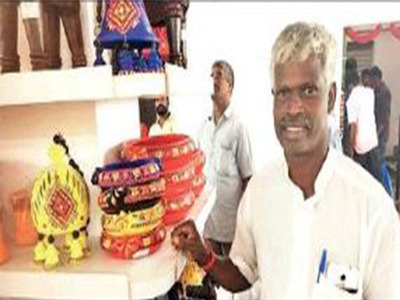
The city has got a unique store which endorses some of the Geographical Indication (GI) products such as Channapatna toys and Devanahalli pomelo among others. This is also said to be the first GI-based products store in the country.
Located in HSR Layout, the store has been started by a group of GI product enthusiasts and will display unique items from artists and agriculturalists. The GI tag that is given to products that possess special features corresponding to a particular geographical location. This tag can be used for agricultural, natural and manufactured goods, emphasizing the heritage of each location.
Around the world, 10,000 products have GI tag, out of which 350 are from India with Karnataka leading it with 36. The products include Mysore silk, Mysore agarbatti, Bidriware, Channapatna toys and dolls, Nanjangud bananas, Byadagi chilli, Devanahalli pomelo among others.
“It feels nice to set up a store for all GI products because this showcases the culture of the country,” said S J Tejas, owner of the store, which was started under the banner of Geographical Indications Tagged World Premium Products Limited (GITWPL).
The famous Villianur Terracotta works with huge statues of horses and elephants caught the eyes of many visitors at the shop on the first day. “We’ve been practising this artwork for many years now but after the GI tag was given to us, it gave more confidence and pride,” said artist V K Munuswamy. Because of the GI tag, he could take his art to Geneva, he added.
Ravi Kumar, an industrialist, said: “This is a unique store with products ranging from fruits to ornaments.”
source: http://www.timesofindia.indiatimes.com / The Times of India / Home> News> City News> Bangalore News / TNN / May 11th, 2018
From suave bags fashioned from tetra paks, denim and other textile wastes to fancy tea coasters made using motherboards and vinyl records, Rimagined’s range of upcycled products is indeed a revelation.
India produces 1,00,000 metric tonnes of solid waste on a daily basis, and this amount is higher than the combined solid waste generated by many other countries.
While one can argue that the demographic and area-population ratio perspectives are skewed and debatable while comparing such statistics, it is high time that we admit that the country has failed to manage the insurmountable waste generated by an increasingly burgeoning population, and is in the throes of a crisis.
Therefore, instead of routing the waste to overflowing landfills and putting together half-baked and clumsy measures that are hazardous to the environment, we have to start looking for solutions that are sustainable and can reduce our waste burden.
India’s waste burden. Source: Flickr.
Come to think of it, before materials like plastic and styrofoam entered the country, what exactly were our grandparents or great-grandparents using in place of every synthetically generated item that we have become habituated to?
It wasn’t as though they weren’t practising waste management. On the contrary, their traditional way of life incorporated upcycling even before coinage of the term, and our forefathers truly believed in and practised zero wastage to perfection.
Upcycling is once again becoming popular in India but is currently an option for a limited few. This could be attributed to our age-old aversion towards garbage, and the offensive idea of using products that are made out of somebody else’s waste.
However, some ventures are making a mark with their range of upcycled products in recent times, and we bet that most people wouldn’t be able to distinguish from regular products if not enlightened beforehand.
Rimagined is one such entrepreneurial venture founded by Bengaluru resident Shailaja Rangarajan in 2016, which not only provides supercool and interesting upcycled products in diverse categories such as furniture, jewellery, clothes, and home décor but also employs women from underprivileged sections of the society to offer them a dignified source of livelihood.
With 15 years of experience as a business consultant in the IT sector, Shailaja’s tryst with waste management began when the local residents association began actively practising waste segregation and in-house composting.
The brains behind the venture, Shailaja Rangarajan.
This paved the way for her to begin volunteering with two NGOs—Whitefield Rising and subsequently, Solid Waste Management (SWM)—for about three-and-a-half years.
“This period was a great eye-opener for me, given the massive mounds of waste generated in Bengaluru on a daily basis. Looking at my little daughter, I often wondered what kind of world were we leaving for our children that was overflowing with garbage and extremely depleted of resources. During this volunteering period, I noticed that a large percentage of waste could be put to better use instead of being cast away to landfills. Recycling was an available alternative, but I felt that alone wasn’t enough,” says Shailaja to The Better India.
At that point, she knew many people who were already practising upcycling but in a restricted manner. For them, their customer base was confined to their friends’ circle, and their ventures weren’t about making money or profit.
Understanding that the waste crisis was man’s own creation, she decided to step down into the field herself and spent the next seven to eight months conducting extensive research on upcycling and meeting people associated with waste management in every possible scope.
This would eventually lead her to conceptualise and give wings to Rimagined.
She quit her job and in April 2016, she placed Rimagined on an online marketplace with 10 vendors and 60 products. To gain a greater reach and better visibility, she also put up stalls with these products at local events hosted in Bengaluru.
“The whole purpose of taking this forward was to drive upcycling as a movement rather than just selling products. Also, this was an opportunity to push for conscious consumption in an otherwise consumerism-driven population. Because our products were skilfully crafted with a trendy finish, it took our customers by complete surprise when they came to know these were upcycled products. The wow factor and word-of-mouth together helped in gradually taking Rimagined to greater heights,” Shailaja remembers.
Seven months later, she launched Rimagined as a label.
This happened thanks to an intervention from Devika Krishnan, a well-known designer in Bengaluru, which led to a collaboration, with Rimagined becoming the retail face for Joy@Work.
Devika Krishnan (behind, left) along with the womenfolk of Bengaluru unit. Courtesy: Rimagined.
With a production unit comprising a group of women artisans from a low-income background, Rimagined now envisioned to provide them sustainable livelihoods through upcycling.
“This also proved to be a great learning curve as now I got to witness every stage first-hand in a social entrepreneurial venture—right from waste procurement to the end sales. With a growing customer base and greater demand of products, Rimagined finally had its retail outlet set up in Whitefield in July last year, which is more on the lines of a prototype store,” she says.
In November, Shailaja visited her friend, Debopriya Biswas in Kolkata, who was a teacher at a special needs school for children hailing from underprivileged sections of the society.
“What I had noticed here was that many mothers spent close to 4-5 hours waiting for their children in the school premises. These were impoverished women whose financial state was in shambles due to the lack of opportunities, and we decided to change that,” she mentions.
Shailaja decided to expand the scope of Rimagined’s workforce. Following a discussion with the women who readily showcased interest, she chalked down a training period of three months.
“They surpassed my expectations, and within a month, production-ready pieces with quality finish were laid before my eyes. Now, we have a production unit in Kolkata with around 45 women, and another batch of 35 women are waiting to be trained. There is another team of 15 women in Odisha which will shortly materialise to reality as another production unit,” she proudly adds.
While the implementation of upcycling to this extent in itself is a noteworthy factor, what makes Rimagined’s undertaking even more significant is how the venture is helping women from financially strapped households to take control of their lives with dignity and pride.
“These talented women have proved that if they are given right opportunities, they too can shine. Through this venture, we want the women to rise over their financial circumstances and feel empowered through their capabilities and skills,” Shailaja clarifies.
From suave bags fashioned from tetra paks, denim and other textile wastes to fancy tea coasters made using motherboards and vinyl records, Rimagined’s range of upcycled products is indeed a revelation for even the most cynics.
The best part is that these are not too expensive when compared to other upcycled products in the market, thus giving an opportunity to people from all walks of life to consider purchasing upcycled products and become conscious and responsible consumers.
Also, each product that you see on Rimagined’s website has an assigned score based on the decomposition rate of its content materials and its contribution to overall waste.
Optimal utilisation of Tetra packs, broken glass pieces and fabric wastes to make new products. Courtesy: Rimagined.Stools made of fabric waste and bed sheets fashioned out of denims. Courtesy: Rimagined.
“This will give one an insight over the quantity of waste materials that he or she just pulled away from a landfill by purchasing any one of our products,” she explains.
Having upcycled approximately 60-70 tonnes of varying categories of waste until now, Shailaja hopes to take the concept of upcycling across the country as a movement and bring back the traditional way of living practised by our ancestors, besides helping the country manage its waste in a creative and sustainable manner.
Folks in Bengaluru can reach out to Rimagined if they wish to contribute old denim, fabric waste, e-waste and any segregated solid waste that they think can power their vision.
Rimagined will shortly flag off operations in Indiranagar, one of Bengaluru’s busiest zones, from a new retail unit and we wish the team a great and successful journey ahead.
To check Rimagined’s awesome range of upcycled products, click here. You can reach out to the team at contactus@rimagined.com.
(Edited by Gayatri Mishra)
source: http://www.thebetterindia.com / The Better India / Home> Bengaluru / by Lekshmi Priya S / May 04th, 2018