Category Archives: Arts, Culture & Entertainment

‘Daggers’ drawn at seventeen

This teenage author, who hails from Belgaum talks about her debut novel and her love for murder mysteries.

Malvika Misra
Malvika Misra

“I started writing The Seven Daggers when I was 12 years old. I have always been very fond of reading and writing, and once I had the story in my head, it evolved as I kept writing,” says the 17-year old author, Malvika Misra who was born in Belgaum, and now lives in New Delhi.

Malvika has always enjoyed adventure and mystery stories, so she was very keen on writing an adventure novel ever since she was a little girl, which is the reason why she based the main characters in her books around that age group too. “It helped me understand how to create characters and their respective behaviour, actions and reactions,” she says.

But apart from her own book, this voracious reader can’t make up her mind about her favourite list! She says her favourites are, The Book Thief, Murder On The Orient Express, Malory Towers and To Kill a Mockingbird. “One thing they all have in common is that they are all fiction, whether it is adventure, crime, or comedy. Fiction gives the writer the power to do anything,” explains Malvika.

The Seven Daggers -Book Cover

Most of all, she adores Agatha Christie! She says, “I love her style of writing. If I met her, I would have loved to ask her, ‘What do you think are the ingredients to make the perfect plot for a mystery novel?’ Because there is nothing more exciting than gripping suspense and mystery in a great novel.”

Her father’s transferrable job was quite overwhelming as they hopped from one city to another but she feels, “Each place offered me new experiences but the best part was making more friends along the way.” She has lived in numerous cities, and just moved to Delhi a couple of years ago, and it has been a good experience.

The 17-year-old also is quite good at golf and likes to play the sport whenever she gets the time. Asking her about what she has been up to lately, she adds, “I’m learning Kuchipudi at the moment. Although, nowadays, I don’t have much time to pursue it as I’ve been busy studying for my board exams.” Studies have got her more than occupied these days!

Back to her book, she describes why Peter Thomas is her favourite character, “I find him very humorous and mysterious. He becomes someone who the other characters can depend on and trust. Another fictional character that I like would be Mary Poppins. She has always been a favourite as she is fun and peculiar!”

In the future, she plans to write a sequel to The Seven Daggers and also try her hand at other genres for different age groups. She also hopes to get recognition for her writing and would also like to trek around the country with her friends, “As there is a lot to explore, see and learn,” Malvika concludes.

source: http://www.deccanchronicle.com / Deccan Chronicle / Home> Lifestyle> Books and Art / by Cathline Chen, Deccan Chronicle / March 07th, 2018

Music festivals keep alive an old tradition in Mysuru

Bidaram Krishnappa’s Sri Prasanna Sitarama Mandira has a 102-year history of conducting music concerts.File Photo

City sees many music concerts during Ramanavami season

The city’s cultural scene reaches a zenith during Dasara and it’s universally acknowledged, given its royal pedigree and government patronage since the 1970s.

But there is another facet to the cultural scene of Mysuru – of organisations and individuals keeping alive the musical heritage and it comes to the fore during the Ramanavami season.

A purely voluntary initiative with individual contributions and devoid of any government patronage, the city plays host to scores of classical music concerts.

The princely state of Mysuru under the Wadiyars was a patron of classical music and great composers and artistes thrived and flourished here thanks to their encouragement.

A majority of them were court musicians of whom Mysore Sadashivarao, a composter who lived during the rein of Mummadi Krishnaraja Wadiyar (1831 to 1868), started the Ramothsava celebrations in Mysuru, according to the Mysore Gazetteer.

Among the cultural organisations, Bidaram Krishnappa’s Sri Prasanna Sitarama Mandira has a 102-year history and tradition of conducting music concerts and hence is a heritage site given its association with cultural personalities. The venue is also an important repository of classical paintings and has a rich collection of 45 works of art in the traditional Mysuru stule, Thanjavur style among others.

Its hallowed precincts has played host to legendary musicians who constitute the who’s who of Indian classical music. Built by Bidaram Krishnappa, (1866-1931), a great exponent of Carnatic music and who adorned the court of Krishnaraja Wadiyar 1V, the festival this year features 11 concerts including by Mysore M Nagaraj and Mysore M Manjunath, Malladi Brothers, R.K.Padmanabhan, Pandit Hafiz Khan among others. The Aralikatte Sri Ramamandira on the Jayalakshmi Vilas Road too has a similar pedigree but over the years, the classical music concert has paved the way for devotional singing by various bhajana mandalis of the city. This year, the cultural programmes, which began on Sunday, will be held till April 11.

Sree Ramabhyudaya Sanha, established in 1890, is one of the oldest institutions and has lined up a series of musicians for the Ramanavami music festival. To be held at the Allamma Choultry Srirampet, the line-up includes Pandit Venkatesh Kumar, Malladi Brotehrs, Ganesh and Kumaresh to name a few. The festival which commenced on Sunday, will conclude on April 4.

These apart, Sri Ramaseva Charitable Trust, whose concert series commenced on March 18 will conclude on March 27. The Krishnamurthypuram Sri Ramamandira is conducting the Ramanavami for the 89th year and its programme line-up includes both devotional renderings and classical music concerts – which commenced on March 18 – will conclude on March 29.

Sri Ramaseva Mandali established in 1954, Sri Sitarama Temple Trust at Railway Colony, Sri Rama temple, Jayanagar (52nd year) are among other places to which devotees and music aficionados will flock to satiate their appetite.

source: http://www.thehindu.com / The Hindu / Home> National> Karnataka / by R. Krishnakumar / Mysuru – March 28th, 2018

Winkle Mathias, the apostle of plants

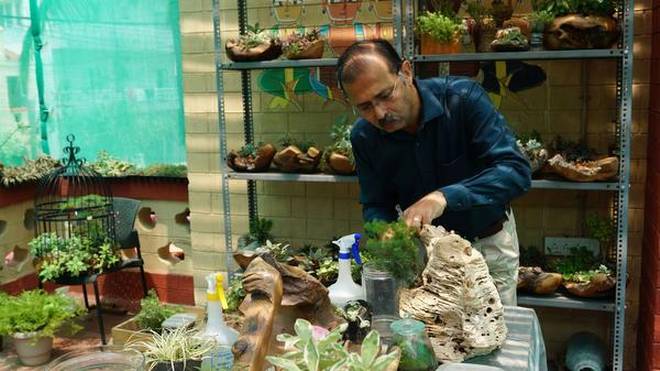
Winkle Mathias : The green warrior at work

Meet Winkle Mathias who goes that extra mile to give your home a green make over

Winkle Mathias always nurtured a soft spot for trees and plants. Originally, hailing from Mangaluru, the tree lover was brought up in Mumbai and took to carpentry for a living. It was a chance visit to Bengaluru 19 years ago that swept the man off his feet and he continued to stay on here. “I fell in love with this city at first glance. It was brimming with greenery. Today, it looks more like concrete jungle,” laments the man.

“People are selfish, they don’t realise the pain they are causing for themselves and the next generation. They are collecting logs by destroying nature and it gets burnt by somebody with a match stick. Unfortunately, it is not they who will suffer, but the next generation,” observes Winkle, who gives complete credit to his grandparents for instilling the love of nature in him at a very young age.

Winkle02BF28mar2018

“They would go into the forest foraging for food and collect mushrooms and greens. I would accompany them and would be in total awe of the greenery around me. It was fun to collect wild flowers. Little did I know those memories would trigger such passion in me one day,” recalls Winkle. He then started the Down To Earth company, in HBR Layout, Kalyan Nagar, which aims at using eco-friendly material that is easily available and is into landscaping and terrariums using plants and moss of every kind.

“Did you know that if we don’t protect the touch-me-not-plants they may soon go extinct? They are considered weeds and people are weeding them out,” states Winkle, who now cultivates these plants and talks to children about them and their benefits. “I talk to them about plants having feelings too and this plant expresses it the best. It closes its leaves and bows down when touched. What pains me most is when children and adults just pluck out a branch while playing or walking. I would love to give them a touch-me-not and tell them that it hurts the plant. None of us would like our hair to be pulled, right?”

Winkle believes we can sensitise children by exposing them to nature. “It is better to get them addicted to nature rather than gadgets,” he says. To propagate his love for nature he bought some barren land in Nelamangala 16 years ago and set out to create a green space on a two-and-half acre of rocky patch. “I picked up a few chickens and ducks and started visiting gujaris to buy a bath tub for the ducks. It was placed it in such a way that they could enter it easily. The land turned greener by the day and slowly I added a shed and planted a few trees following the sun’s patterns, so that the movement of the sun would create enough shade for the animals through the day,” beams the green warrior.

Winkle03BF28mar2018

Earthy office

Even his office is earthy. It is made from natural material such as bamboos, cane, earthen pots and jute to name a few. The terrace is dotted with terrariums of every size and even miniature landscaping. “I blend with nature and most of the projects I undertake are done with natural materials. The only problem is that these are so easily available that we have taken them for granted,” observes the man, who adds he can create anything green even if you give him stones, sand, moss or even waste.

Winkle loves to travel and observe nature, “especially the way a rock hangs out of a mountain or the manner in which water flows between rocks. These are the images that are captured in my heart and recreated in bottles and miniature landscaping in pots and bowls.”

Winkle04BF28mar2018

Landscaping is a huge part of his achievement. When he started it, he noticed that people “build their homes more for their neighbours than themselves. I want to change that notion. We will give you easy plants that will not shed leaves nor die out. And, even if it dies out, I will take it and nurture it back to life and give you a healthy plant,” assures Winkle, who has given quite a few gardens and balconies a facelift using natural light, plenty of plants and trees. “I believe a home can look gorgeous with greenery and natural material.”

Winkle plans to conduct classes with the “focus on how to use discarded pots, pans, ladles and even books to grow plants.” Winkle would also like to educate people on how to water plants. “We think we have to give a plant a head and a body bath. It is not necessary. You have to understand which plants need more water and which do not. Once you get your hands dirty, you sure are going to get hooked on to gardening.”

Call 40923565/ 9341247516 / www.d2e.ind.in

source: http://www.thehindu.com / The Hindu / Home> Life & Style / by Shilpa Sebastian R / March 27th, 2018

Spastics Society director is ‘Bengalurean of the Year’

Namma Bengaluru Foundation presents awards for 2018

Rukmini Krishnaswamy, director of Spastics Society of Karnataka, has won the ‘Namma Bengalurean of the Year’ award given by the Namma Bengaluru Foundation, which is founded by Rajeev Chandrasekhar.

Sanjeev V. Dyamannanavar, an urban transport activist and one of the founders of Prajaa Raag, has been recognised as citizen of the year’, Rasheed Kappan, a senior journalist with Deccan Herald, as the mediaperson of the year, Dipika Bajpai, DCF, Bengaluru Urban, as government official of the year, Prashanth S.B., chairman of Nayonika Eye Care Charitable Trust, as social entrepreneur of the year, and Vidya Y., co-founder and trustee, Vision Empower, for her work to make education accessible to the visually impaired, as rising star of the year. These awards carry a purse of ₹2 lakh.

Citizen groups

The NBF also felicitated four citizen groups as ‘Champions of Namma Bengaluru – 2018’ for their work towards “reclaiming Bengaluru”, the theme of the awards this year. Friends of Lakes, a coalition of lake activists across the city, Save Pattandur Agrahara Lake and Save Kaggadasapura Lake, both local residents’ groups fighting to save and rejuvenate the lakes in their locality, and Project Vruksha Foundation, for its work on tree census, were the four citizen groups awarded on Sunday.

source: http://www.thehindu.com / The Hindu / Home> News> Cities> Bengaluru / by Staff Reporter / Bengaluru – March 26th, 2018

For slums, by its dwellers: A paper’s rebirth

A six-member team, led by editor Isaac Arul Selva, brings out ‘Slum Jagatthu’. | Photo Credit: Bhagya Prakash K.

20-page black-and-white magazine that was relaunched in April 2017 is slowly making waves

In a city where class divisions remain ingrained in the landscape, it perhaps did not come as much of a surprise when a Bengaluru magazine — produced for and by slum dwellers — died quietly. In 2013, Slum Jagatthu (Slum World), a monthly magazine in Kannada, ended its seemingly miraculous 13-year-run of over 135 issues.

For its editor, Isaac Arul Selva, 47, a Class IV dropout who has fought against an indifferent bureaucracy for over three decades, resilience is a virtue that is never far away. Egged on by friends in academic circles, he re-launched the 20-page black-and-white magazine in April 2017 out of a small room on the fringes of posh Koramangala. Here, glitzy pubs and towering malls are within a walking distance on the one side, while on the other is the site that once hosted the city’s largest slum, which has since been levelled to make way for a mall.

By February 2018, the reborn Slum Jagatthu with a cover price of ₹10 had a paid circulation of 300 readers — a far cry from the 2,500 it had reached earlier in this decade. “But we add more than 50 subscribers every month,” says Mr. Selva. A free online edition is put up on their blog and circulated through social media to slum leaders across the State.

A six-member team churns out the edition with a few laptops and some mainstream newspaper articles on slum dwellers stuck on the walls. Mr. Selva and Balamma K., who manages the office, are the only team members who have stuck through since the first Slum Jagatthu was published in 2000. What is constant, though, is that those working in the paper are slum dwellers.

For Hariprasad Anandpur, who works full-time with little guarantee of assured monthly pay, the magazine has allowed him to live a lifelong dream amid words and thoughts. The 34-year-old, who comes from a nomadic tribal community, was working as a helper for a wedding caterer until he attended a four-day workshop on media conducted by Mr. Selva. For over 10 years, after he had cleaned up lavish dinners in wedding halls, he jotted down his thoughts as poetry.

“When I was younger, my books were burnt to make me focus on work. Now, writing is my work and these new thought processes are my motivation,” he says, adding rather glumly, “I wasted more than 12 years of my life working mindlessly in the catering firm.”

Archiving slum history

Mr. Selva realised during the four-year break in publishing Slum Jagatthu that the larger society lacked a consistent archive cataloguing the thoughts of the urban poor. The renewed avatar of the magazine deviates from its previous form, which primarily disseminated information on slum schemes, infrastructure issues in slums, and new slum policies. It now focuses on the living history of slums, building a record of the lives and aspirations of slum dwellers, and critiques of policies such as the Smart City scheme that excludes slum dwellers.

“It isn’t enough to write that a slum doesn’t have basic amenities while neighbouring areas have developed. It is important to ask ‘why?’. Slums in cities are the products of the discriminatory thinking that sees Dalit colonies in villages remain a few centuries behind their neighbours. It is important for slum dwellers to start questioning these discriminatory practices,” says Mr. Selva.

Vision

Mr. Selva is never short of dreams. He wants the magazine to reach at least 4,500 registered slums and around 11,000 public libraries.

At an annual subscription of ₹100 — any more and it would be out of reach of slum dwellers — there is no viable business model yet for the small newspaper. Instead, it runs on ingenuity and idealism, raising funds through fellowships and consultancies.

The team dismisses the idea of approaching private enterprises for advertisements as the language of marketing would run contrary to the voice of the paper.

As a registered newspaper, Slum Jagatthu even refuses to carry ₹1,500-worth government ads it is entitled to every month. “Why waste a page on the government’s voice and sacrifice a slum dweller’s voice?” asks Mr. Selva.

source: http://www.thehindu.com / The Hindu / Home> News> Cities> Bengaluru / by Mohit M. Rao / Bengaluru – March 26th, 2018

75 years on, Mankuthimmanna Kagga lives on

It is considered one of Kannada literary world’s masterpieces

“What is the use of you eating so much? The body gets nourished from whatever is assimilated by the stomach; remainder is expelled as waste. You may earn how much ever, but what is it that you acquire? A fistful of flour, isn’t it?”

These lines — a translated version by a music company — may sound familiar to some, new to some others, but largely make sense to both categories.

DVG’s (D.V. Gundappa) ‘Mankuthimmanna Kagga’, considered one of Kannada literary world’s masterpieces, lives on even in 2018, reinventing itself in more modern avatars as well. From an app dedicated to what is referred to as the ‘Bhagavad Gita in Kannada’ to animated videos explaining the content, the popularity of the classic has not diminished even 75 years after it was first published.

Animated musical

A city-based music studio has created videos, some in animated form, some others as a motion picture, introducing the kaggas (collection of verses) to newer audiences. Up on YouTube, one of the renditions is a peppy number with English subtitles (cited above).

M. K. Ramanujan, the music composer, whose Musicloud Studio and Technology in Sahakarnagar has made the videos, said he was a DVG fan from his school days. “Becoming a music composer was a childhood dream. I composed music for a Tamil film in 2010. But I have always felt closer to Kannada language and literature, and wanted to bring out something similar to Malgudi Days. That is why I decided to bring out musical stories for Mankuthimmanna Kagga, which has a lot of relevance to today’s life,” he said.

The team has composed an animated music video for one kagga, and one has been translated into English. “Another one has been made into a motion picture using stop footage,” he added, explaining that the intention was to keep the kaggas like a jingle to keep the audience engages as the verses are all about reading between the lines.

Dedicated apps

There have been other attempts at making the magnum opus readily available. Dedicated apps offering Mankuthimmanna Kagga have been well received by literary connoisseurs. Venugopal. M.N., the creator of one such app which has over 28,000 downloads, is a corporate engineer who has developed over 50 apps as a hobby. Only two among them are of books — DVG’s work and the Bhagavad Gita. “Mankuthimmanna Kagga is considered the main Bible for humanity. It contains truths about life and every kagga tells how one can lead life,” he said.

Kagga yatre

Admirers of the magnum opus have an event to look forward to this year. On October 16, which is the death anniversary of DGV, ‘Samanvita’, a cultural organisation, will take out a ‘Kagga Amruta Yatre’ from Devanahalli (‘D’ in DVG stands for Devanahalli) to DVG Road, which will see the organisers set up platforms at places on the way with programmes to honour the book.

Radhakrishna K.V. from Samanvita, who is also from the Department of Kannada and Culture, said the kaggas resonate with people even today just like the vachanas as they speak of an ‘ideal society and norms and summarise the principles of life’.

Pointing to the government’s efforts in keeping the popularity of the book alive by introducing ‘Kaggarasadhaare’ on Kanaja, the knowledge portal, in text and audio format with interpretations last year, he said there were parallel efforts by others too.

source: http://www.thehindu.com / The Hindu / Home> News> Cities> Bengaluru / by Staff Reporter / March 23rd, 2018

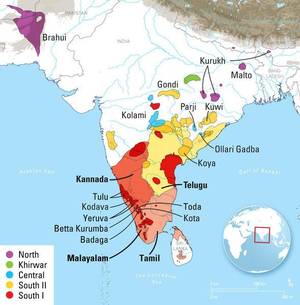
Dravidian language family is 4,500 years old: study

The Dravidian language family’s four largest languages — Kannada, Malayalam, Tamil and Telugu — have literary traditions spanning centuries, of which Tamil reaches back the furthest, researchers said.

DravidianFamilyCF21mar2018

The Dravidian language family, consisting of 80 varieties spoken by nearly 220 million people across southern and central India, originated about 4,500 years ago, a study has found.

This estimate is based on new linguistic analyses by an international team, including researchers from the Max Planck Institute for the Science of Human History in Germany, and the Wildlife Institute of India in Dehradun.

The researchers used data collected first-hand from native speakers representing all previously reported Dravidian subgroups. The findings, published in the journal Royal Society Open Science, match with earlier linguistic and archaeological studies.

South Asia, reaching from Afghanistan in the west and Bangladesh in the east, is home to at least six hundred languages belonging to six large language families, including Dravidian, Indo-European and Sino-Tibetan.

The Dravidian language family, consisting of about 80 language varieties (both languages and dialects) is today spoken by about 220 million people, mostly in southern and central India, and surrounding countries.

The Dravidian language family’s four largest languages — Kannada, MalayalamTamil and Telugu — have literary traditions spanning centuries, of which Tamil reaches back the furthest, researchers said.

Along with SanskritTamil is one of the world’s classical languages, but unlike Sanskrit, there is continuity between its classical and modern forms documented in inscriptions, poems, and secular and religious texts and songs, they said.

“The study of the Dravidian languages is crucial for understanding prehistory in Eurasia, as they played a significant role in influencing other language groups,” said Annemarie Verkerk of the Max Planck Institute for the Science of Human History.

Neither the geographical origin of the Dravidian language nor its exact dispersal through time is known with certainty.

The consensus of the research community is that the Dravidians are natives of the Indian subcontinent and were present prior to the arrival of the Indo-Aryans (Indo-European speakers) in India around 3,500 years ago.

Researchers said that it is likely that the Dravidian languages were much more widespread to the west in the past than they are today.

In order to examine questions about when and where the Dravidian languages developed, they made a detailed investigation of the historical relationships of 20 Dravidian varieties.

Study author Vishnupriya Kolipakam of the Wildlife Institute of India collected contemporary first-hand data from native speakers of a diverse sample of Dravidian languages, representing all the previously reported subgroups of Dravidian.

The researchers used advanced statistical methods to infer the age and sub-grouping of the Dravidian language family at about 4,000-4,500 years old.

This estimate, while in line with suggestions from previous linguistic studies, is a more robust result because it was found consistently in the majority of the different statistical models of evolution tested in this study.

This age also matches well with inferences from archaeologywhich have previously placed the diversification of Dravidian into North, Central, and South branches at exactly this age, coinciding with the beginnings of cultural developments evident in the archaeological record.

source: http://www.thehindu.com / The Hindu / Home> Science / by PTI / Berlin – March 21st, 2018

Padma honour for nine from Karnataka

Nine persons from Karnataka figure on the list of those chosen for the prestigious Padma awards for 2018.

Cue sports stalwart Pankaj Advani has been chosen for the Padma Bhushan, the third highest civilian award in the country.

Eight persons have been chosen for Padma Shri. Rudrapatnam Brothers — R.N. Thyagarajan and R.N. Tharanathan, Sufi singer from Bagalkot Ibrahim Sutar and R. Satynarayana have all been selected for the honour in the music category. The others are writer and film lyricist Doddarange Gowda (lyrics), Sitavva Jodatti from Belagavi (social work), midwife from Tumakuru Sulagitti Narasamma (social work), and Siddheshwara Swamiji (spiritualism).

Mr. Advani, 32, an 18-time world champion and 20-time Senior National champion (in both billiards and snooker), said, “I’m honoured and humbled to be named for the Padma Bhushan award. This is motivation for me to continue my pursuit for excellence at the world level in billiards and snooker.”

Ms. Narasamma, 97, who has been hospitalised because of age-related issues, spoke to The Hindufrom her hospital bed and expressed happiness over winning the award. Ms. Narasamma, who has had no formal education, has assisted in conducting 15,000 deliveries.

Mr. Sutar has made a mark for himself by singing vachanas and padas of Sufi saint Shishunala Sharif. He said the award was a welcome recognition of the diverse traditions of the land.

Vocalists Mr. Thyagarajan and Mr. Tharanathan said, “We feel honoured to be receiving this award. We have been on stage for 62 years strictly following the traditional format in Carnatic music, in spite of popular contemporary styles creeping in.”

source: http://www.thehindu.com / The Hindu / Home> News> States> Karnataka / by Staff Reporter / Bengaluru – January 26th, 2018

Parsis set to usher in New Year today

Bengaluru :

Parsi community members here will come together to celebrate their new year, Jamshedi Navroz, on Wednesday.

“It’s a spring festival. For the first time, Anjuman, the association of Parsi community members in the city, has organised a dinner at the Lady Jehangir Kothari Memorial Hall on Queen’s Road. On March 24, there will be a cultural show by the community members,” said Air Chief Marshal (retd) Fali Major, president, Anjuman.

There are over 250 Parsi families in Bengaluru. The Parsi Fire temple near Queen’s Road is getting a makeover. “The New Year begins from Tuesday night, and we are celebrating it on Wednesday. The festivities start with a morning prayer,” said Ervad Fardoon D Karkaria , priest at the temple.

 Parsis describe Jamshedi Navroz as a festival of life and hope, which celebrates victory of good over evil. While Jamshedi Navroz is celebrated as a spring equinox festival throughout Zoroastrian history, in India it is a seasonal and historical festival to commemorate the coronation of King Jamshed after he “saved the world from the great deluge” and established ‘Var-e-Jam-Kard’ (the settlement of Jamshed).

In a traditional Parsi home, seven items are arranged on a decorated table on the occasion. The items could be from milk, wine, sugar, candle, sumac, coin, apple, hyacinth, vegetables, glass, vinegar among others.

Parsi dishes such as faluda and dhandal patiya (rice-dal-fish recipe) will also be prepared, said Silloo Daruwala, a community member.

source: http://www.timesofindia.indiatimes.com / The Times of India / News> City News> Bangalore News / TNN / March 21st, 2018

Here’s the list of Hemmeya Kannadigas who have made Karnataka proud

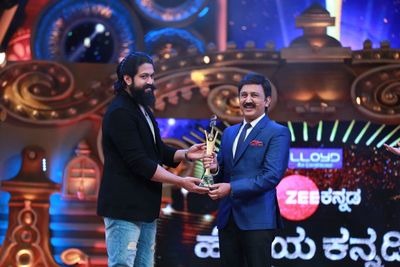
In this weekend, a general Kannada entertainment channel will be honouring proud Kannadigas who have made remarkable achievements from 24 different fields. The star studded event will be aired on Saturday and Sunday at 7:30pm.The event was hosted by Anushree and Ramesh Aravind.

KannadigasBF20mar2018

Sandalwood actors Duniya Vijay, Rangayana Raghu, Shanvi Srivastava, Sriimurali and many other actors have set the stage on fire with their enthralling performances.

Actors YASH, Vijay Raghavendra, Jaggesh, Rashmika Manadanna, Rakshit Shetty, Arjun Janya and Vijay Prakash have graced the occasion.

ACHIEVERS WHO WERE HONOURED ON GLIZY EVENING

Proud literary figure-Prof K S Nissar Ahmed presented by Doddarange Gowda
Proud common man-Harish Nanjappa presented by H R Ranganath
Proud lifetime achiever-Saalumarada Thimmakka presented by Lakshmi
Proud farmer-Narayana Reddy presented by Duniya Vijay
Proud sportsperson-Rajeswari Gaekwad and Veda Krishmurthy presented by Rachita Ram
Proud theatre activist-K V Subbanna presented by Jaggesh
Proud doctor-Dr Shankare Gowda presented by Santhosh Hegde
Proud woman achiever-Roopa IPS presented by Vijay Raghavendra
Proud director-Santhosh Ananddram presented by Bharagava and Bhagawan
Proud film-Raajakumara presented by Rockline Venkatesh
Proud hero-Puneeth Rajkumar presented by Yash
Proud heroine-Rashmika Mandanna presented by Rakshit Shetty
Proud cine legend-Ravichandaran presented by Ravichandaran kids
Proud inspiration-Ramesh Aravind presented by common man achievers
Proud lyricist-V Nagendra Prasad presented by Jogi and Shanvi Srivastav
Proud voice-Vijay Prakash presented by Hamsalekha
Proud musician-Arjun Janya presented by Sriimurali
Proud talent of the year-Raj B Shetty presented by Yogaraj Bhat
Proud icon-Shivakumar Swamiji presented by Channel people
Proud Journalist-Vishwara Bhat presented by Ranganath

source: http://www.timesofindia.indiatimes.com / The Times of India / News> TV> News> Kannada / TNN / March 15th, 2018