Category Archives: Arts, Culture & Entertainment

Journalist dead

Journalist P. Vijay Kumar died in Belagavi on Thursday. He was 86. His real name was Siddanagouda Patil but he was popular by his pen name

P. Vijaykumar. He hailed from Kanabaragi village in Belagavi district.

In the early 70s, he founded the Kannada daily Halliya Sandesha to focus on rural issues. He also edited Seva – a Kannada weekly for a few years. He served in Kannada publications – Kannada Prabha, Prajamatha and Kannadamma.

He has published over 20 books on various subjects.

He is survived by wife and two daughters.

source: http://www.thehindu.com / The Hindu / Home> News> States> Karnataka / Belagavi – March 17th, 2018

Medicine toppers vow to serve in rural areas

Two of the gold medal winners at BMCRI convocation are from north Karnataka

Two gold medal winners at the Bangalore Medical College and Research Institute (BMCRI) convocation held on Thursday said they would serve in their hometowns in north Karnataka.

Dr. V.M. Priya from Kalaburagi, who was awarded four gold medals on Thursday, was interested in engineering, but took up medicine on the advice of her elders. “I not able to express my happiness at winning four gold medals. I want to do my masters in paediatrics and serve the people of Kalaburagi. I also plan to provide free medical aid in my village once a week,” she said.

She plans to attempt the civil service exams for an opportunity to serve people better.

Another medal winner Dr. Prakash also expressed interest in pursuing masters in paediatrics and serving rural areas in Bagalkot district.

Former ISRO chairman A.S. Kiran Kumar, who presided over the convocation, said that students, after getting their medical degrees, often go abroad in search of better opportunities. “But our people must benefit from your education and expertise. Young doctors need to become pro-active in improving the quality of life in the country,” he said.

source: http://www.thehindu.com / The Hindu / Home> News> Cities> Bengaluru / by Staff Reporter / March 15th, 2018

Country’s ‘tallest’ flag unfurled in Belagavi

Proud moment: The 110 m tall monumental flag being inaugurated by district in-charge Ramesh Jarkiholi in Belagavi on Monday.

The 110 m tall flag post at Kote Kere is near the historic Belagavi fort

It was a joyous morning in Belagavi on Monday. Schoolchildren, NGO members, leaders and others gathered at the Kote Kere lake front to witness a unique celebration: the unfurling of what is claimed to be the country’s tallest national flag.

The 9,600 sq.ft flag on a 110 m flag pole was unfurled by Ramesh Jarkiholi, District in-charge Minister.

Religious leaders of Hindu, Muslim, Christian and Sikh institutions were present. MLA Firoz Sait, who has been pushing for the project, was present along with other district officials.

Mr. Jarkiholi said the flag was a testimony to the culture of harmony and togetherness of Belagavi. “BJP is not the sole custodian of nationalism. We are all proud Indians. We respect the principles of unity and harmony enshrined in the Constitution. India is a country of many faiths and all are equal here,” he said.

Mr. Sait observed that various religious and social and cultural groups had flags of different colours, but the national flag symbolised the cultural unity of all. He described this as a historic day and said the people of Belagavi had one more reason to be proud of their city.

Deputy Commissioner S. Ziyaullah, Police Commissioner D.C. Rajappa, ZP CEO R. Ramachandran, City Corporation Commissioner Shashidhar Kurer, Maratha Light Infantry regimental centre officers, and others were present.

The 110 m tall flag post at Kote Kere is near the historic Belagavi fort in the city. It is taller than the post in Pune (107 m) and the one at the Indo-Pak border at Attari (105 m).

“The monumental flag will be flown at all times, and will be well-lit at night. It should be seen by residents of Belagavi from afar and remain visible at all times,” Mr. Sait said.

The flag is made of weatherproof Denier polyester fabric. Two shorter poles with flood lights have been erected around the flag.

Permission granted

Following a judgment of the High Court of Bilaspur in 2010, the Union Home Ministry allows the flying of national flags beyond sunset. However, these flags are considered monumental flags and special permissions are issued on a case by case basis. The Union government has issued a permission for the Belagavi monumental flag.

The Belagavi City Corporation has completed the work under the Chief Minister’s special grant. The flag post is 2 m in diameter at the base and 0.6 m at the top. It has a three horsepower motor to raise the flag to the top.

New park

A park will come up in 1.5 acres around the flag. A committee comprising citizens, district administration, revenue, police and cantonment board officials will be formed to manage the park.

Earlier, the plan was to erect the flag post on an island in the centre of the lake. However, the soil there proved unstable for such a tall structure. Hence, it was shifted to the bank, an officer said.

Five flags

Officers are keeping five flags on standby. “Khadi fabric could not be used for the flag as looms cannot produce a flag of that size and the flag code does not allow stitching of small pieces,” a city corporation engineer working on the project, told The Hindu.

Officials have got Civil Aviation Ministry’s permission to fly the flag that within 25 km of the Sambra airport. A red light is affixed on top of the post to indicate its height to pilots.

source: http://www.thehindu.com / The Hindu / Home> News> States> Karnataka / by Special Correspondent / March 13th, 2018

To UN, on mission menstruation

MenstruationBF14mar2018

City-based 9th graders take discussion of tabooed subject to govt schools, distribute sanitary napkins

For most adolescent girls, menstruation is a hush-hush affair.

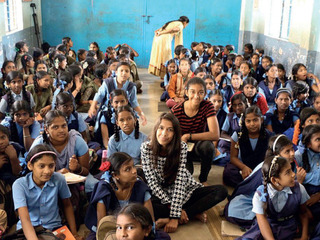
But Nina Reddy and Preethi Subbiah, 9th graders from The International School Bangalore (TISB), want to change this dismal scenario. They have started a project, Svaasthy, to spread awareness on menstruation to girls from underprivileged families. The two girls will also present their work to policy-makers at the UN headquarters in New York.

“We want to educate young girls who are unaware of menstruation because it is a taboo. One of the most integral parts of being a woman is a taboo, and we want to change that. It happens to half the world, why should we hide our feminine nature? What is there to be ashamed of? Being a woman? We think it is necessary to educate girls that menstruation is what makes us women and we need to be able to take care of our menstrual health with the right products and pride,” Reddy said.

“Young girls who cannot possibly ask women in their family about such a tabooed topic, need to know what’s going on inside of them and how to deal with it,” she added. These two girls have found a two-fold solution to the menstrual problem in Indian. “One, is to generate awareness about menstrual health and hygiene via workshops in rural areas as well as to underserved communities and second is to distribute sanitary napkins and the Menstrupedia comic as a guide to girls,” Reddy said.

The girls have been working on implementing their solution and in the last two months they have impacted the lives of 200 girls and handed out over 1,600 sanitary pads with the aid of Apollo Hospitals in three locations in Bengaluru- Government Higher School, Doddakanneli, Namma Mane Orphanage and Samarthanam High School.

They have also created a website (www.svaasthy.net).

About their next project, Subbiah said, “We plan to hold at least two workshops every month in various orphanages and government schools of Bengaluru and distribute more than 5,000 sanitary pads by the end of April, hold fundraisers like bake sales and walkathons and to decrease the overall hesitation around menstruation.”

source: http://www.bangaloremirror.indiatimes.com / Bangalore Mirror / Home> Bengaluru> Others / by Kumaran P, Bangalore Mirror Bureau / March 14th, 2018

Centre’s help may be sought to get Kittur Rani’s sword

Bengaluru :

Running against time in fulfilling politically significant obligations days before announcement of the assembly elections, the government is likely to seek the Centre’s help to bring back 19th century queen Kittur Rani Chennamma’s sword, believed to be kept in the London Museum.
Lingayat community members, especially those from the politically dominant Pachamasali sect which the queen is believed to be from, have been demanding that the sword, reportedly used by Chennamma while fighting the Britishers, be brought back.

Sources said chief minister Siddaramaiah is likely to write to the ministry of external affairs about the sword after the state cabinet meeting scheduled on Wednesday. The meeting is expected to approve the report, recommending separate religion status to the Lingayat community.

The community members met Siddaramaiah at Koodalasangama in Bagalkot district on Monday, and urged him to expedite the process. “The issue will get complicated if the government fails to fulfil the procedural steps before the announcement of elections,” said Shivanand Jamdar, a former bureaucrat and general secretary of Lingayat Mahasabha Vedike.

Demanding initiation of diplomatic consultations between India and Britain in the matter, Jagadguru Jaya Mrutyunajya Swamy, pontiff of Lingayat Panchamasali Mahapeetha of Koodalasangama, said: “We’re ready to fulfil all formalities and mobilise required funds to bring back the sword.”

Earlier in 2012, the BJP government had set up a committee headed by scholar M M Kalburgi to look into the issue. But efforts came to a standstill after he was gunned down by unknown assailants in 2015.

source: http://www.timesofindia.indiatimes.com / The Times of India / News> City News> Bangalore News / by B V Shiva Shankar / TNN / March 13th, 2018

Goshanas unearthed at village near Dharwad

GoshanasBF14mar2018

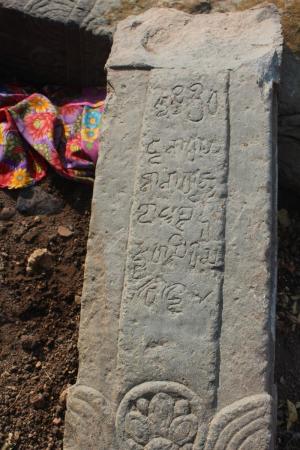
Archaeological evidences from the periods of the Shatavahanas, Rashtrakutas and Kalyana Chalukyas (9th century to 13th century AD) have been unearthed at Yadwad in the taluk.

Goshana inscriptions were found while digging the ground for the construction of a temple in a farm belonging to Vittal Dindalakoppa. Idols of Mahishasura Mardini, Saptha Mathrukas and two Shivalingas have also been unearthed.

Idols had been found here in the past also. R M Shadaksharaiah, retired professor at the archaeology department in Karnatak University, Dharwad, said, “Pots unearthed here are from thue Shatavahana period (2nd century).

Of the four Goshanas, two have been partially damaged and have Halegannada words carved on them. One of the Goshanas is a pillar-like structure with eight faces carved at its top. The objects of archaeological importance found here date back to a 1,000 years and a one-of-its-kind statue of Shivaji on horse back had been unearthed here in the past.

source: http://www.deccanherald.com / Deccan Herald / Home> States / by DH News Service, Dharwad / March 10th, 2018

Soulfood for craftsmen

An artisan weaving a Gomi Teni sari | Photo Credit: Special Arrangement

Hemalatha Jain is reinventing ancient, forgotten weaves from India’s heartlands

The Gomi Teni sari from North Karnataka, was worn by women in the 12th century.

“They haven’t been worn in over 40 years, though their border styles are used in some versions of the Ilkal sari,” says Hemalatha Jain, who is bringing the sari to Bengaluru, after having worked on its revival through her Punarjeevana initiative which seeks to empower the weavers and sustain such crafts.

“The sari’s motifs (especially on the border) evoke the patterns of jowar seeds, a prominent crop in North Karnataka, and are represented by the herringbone stitch. Gomi Teni saris used to be gifted to pregnant women and were worn by married women during the Sankranti festival. The sari is gifted on these occasions because it represents prosperity.”

She has already revived the Patteda Anchu craft, in collaboration with local craftsmen in Karnataka. She began her work in the town of Gajendragarh (Gadag district).

“When I was working in Karnataka on these crafts, I came across historical evidence for seven saris. The Gomi Teni is among them. It is an everyday kind of sari worn by farmers and other locals. It died out because of power looms and the availability of cheaper material. I was able to get a worn out sample of the sari and I decided to stick with cotton for the revival because of the hot weather in these regions,” explains Hemalatha.

“The reason I took this up is that many weavers want to work with art and I wanted to help them increase the number of looms so more artisans can come together and create a prosperous cluster.”

Beginning with one weaver, she now has a team of 45, including over 35 weavers and other artisans associated with ancillary activities around weaving.

Through her intervention in the revival process, she has brought out saris featuring check body with 2/20 s × 2/40s count and a five-inch border with Gomi design. The saris are reversible with two different pallus (there is no right-side or wrong-side to the sari) and two different borders. They have been dyed using eco-friendly dyes.

“The saris were traditionally made in red, brown and yellow because those were the colours that were available there. They didn’t use colours like black. But now we have saris in a range of colours from navy blue to black and pastel shades, apart from red,” explains Hemalatha. “We are also working to use as little water as possible because North Karnataka doesn’t have much water. Our saris are low-maintenance, the colour fastness is good. They can be washed in the machine, they don’t need any starch, they don’t even need to be ironed.”

Hemalatha brought in these characteristics by keeping the yarn count thick, so the sari doesn’t normally wrinkle.

“I am working on more such saris but I don’t want to talk about them just yet because there is a high danger of replication and duplication in this field.”

The Gomi Teni sari will be brought to Bengaluru tomorrow at Kamalini, the craft store by Crafts Council of Karnataka.

The saris will be on display at Sri Bhooma, 17th Cross, Malleshwaram until March 10. For details, call 23567470.

source: http://www.thehindu.com / The Hindu / Home> News> Cities> Bengaluru / by Harshini Vakkalanka / March 08th, 2018

This Anglo-Indian settlement was football’s birthplace in Bengaluru

Austin Town has changed. As in many erstwhile British Cantonment and Anglo-Indian localities, the early settlers have sold off property to migrate elsewhere. Colonial homes with monkey-tops and tiled roofs have made way for more ‘practical’ buildings.

For 50-year-old engineer, Kevin Vieyra, the biggest drawback of these changes is the fragmentation of the community. Vieyra’s grandmother Enid Wilson, an Irish woman was the sergeant of the locality in the 1900s, was one of the earliest residents of the Anglo-Indian quarters. She was the go-to person for anyone with a problem that needed solving. “Even when I was growing up, Austin Town was a close-knit community where it did not really make a difference which home you belonged to,” Vieyra recalled.

Austin Town was built in the early 1920s when the British authorities decided to re-settle workers and lower-income residents in the aftermath of the bubonic plague of 1898. The locality was made up of small cottages. Original settlers included the Anglo-Indian community and a large Tamil population that traced its ancestry to the soldiers and workers brought to the Cantonment by the British after the fall of Tipu Sultan in the Fourth Anglo-Mysore War in 1799.

According to Mansoor Ali, founder of Bengaluru By Foot, “The locality is named after Sir James Austin Bourdillon who was born in Madras in 1848 and was educated at Marlborough, England. He held multiple official posts in Bengal and Patna before becoming the Resident of Mysore between 1903 and 1905.”

The sanitary works in Austin Town were designed by WH Murphy, an engineer in the British cantonment, after whom Murphy Town is named. While James Austin himself enjoyed cricket and rifle shooting, the locality named after him is known to be the birthplace of football in Bengaluru.

 It is said that the Italian prisoners of war, held here during World War II, passed the game on to the locals. Among the first Olympians from India (in the Games of 1948 and 1952) were footballers Anthony, Kanniah, Raman and T Shanmugam — all of who were from Austin Town. So were other football greats Ulaganathan and former India football captain Carlton Chapman.

Even today, the children of the locality practise football with as much fervour as they play cricket. Twenty years ago, the locality was renamed as F Kittel Nagar, after 18th century German missionary Rev Ferdinand Kittel.

source: http://www.economictimes.indiatimes.com / The Economic Times / Home> News> Sports / by Divya Shekhar, ET Bureau / March 01st, 2018

Remembering Gopalakrishna Adiga

Chaduranga
Chaduranga

Chaduranga, a writer and director, was Gopalakrishna Adiga’s close companion. They addressed each other in the singular and had no secrets between them. This is a piece that Chaduranga wrote when Adiga passed away in 1992.

M. Gopalakrishna Adiga and I were friends for over 50 years. It felt like he was a part of my body itself. A companion with whom I shared my inner most feelings. When Devraj Urs (former chief minister of Karnataka) passed away, I was enveloped by the same emptiness as I am now in Adiga’s death.

The days Adiga and I spent in Mysore are fresh in my memory. Even when we were poor, we shared the groundnut and coffee on which we subsisted, wrote together, read and discussed together. Just as we loved each other, we respected each other. With all our differences and individual opinions, we remained intimate.

When Adiga wrote his first novel Akasha Deepa (Sky Light), he read it in Mysore’s Anand Bhavana. I had teased him, “this has gone straight into the sky, not on the earth at all.” Responding to the novel, “The prose is good, it is poetic. But there is no life in it,” I had told him. Adiga didn’t take offence to my blatant criticism. “You are right,” he agreed with me and took the novel home. Then he came with the manuscript of his second novel, “Anathe”. He read this also in Anand Bhavan. This was a novel that gave me happiness. You could see the influence of Shivaram Karanth in it, yet, it retained Adiga’s signature style.

Adiga was a man of enormous self-esteem. I have not met another human being who was like him. Call it arrogance if you please. It is important for a writer to have this quality. But his self pride was not the kind that looked down upon others, it was that which treated everyone like an equal: he had a rare dignity that didn’t treat the self as any different from the other.

Many lines from Adiga’s poetry have been guiding beacons of my life. “Ninage Neene Geleya, Ninage Neene” (You are your own friend, You for yourself) has filled me with so much courage. And the line, “Iruvudellava Bittu Iradudaredege Tudivude Jeevana” (Life is about yearning for all things that you do not have), has conveyed so many things to me!

In those days, “Yaava Mohana Murali Kareyitu” was my favourite poem. I used to constantly hum it in the bathroom. Aa. Na. Kru. would make me sing this and experience a great deal of happiness.

“Where is he now, that friend whose shoulder was the one to lean on.”

November, 1992.

Translated from Kannada by Deepa Ganesh

These essays — Gourish Kaikini, Chaduranga, and Ramachandra Sharma (on Page 11) — have been published in Mohana Murali (2009), a collection of essays on Gopalakrishna Adiga, edited by N. Vidyashankar and M. Jayaram Adiga

source: http://www.thehindu.com / The Hindu / Home> Entertainment / February 15th, 2018

Preservation of statue is in expert hands

GomateshwaraBF28feb2018

ASI has been giving chemical wash and chemical treatment to the statue since Independence

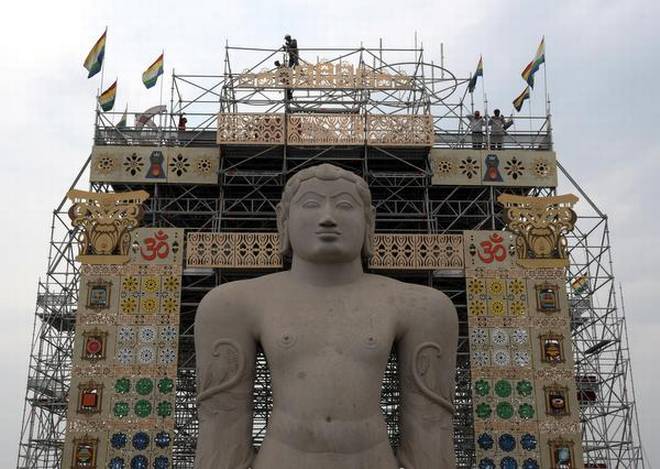
There is a belief that the holy bath of the Gomateshwara statue, using sugarcane juice, sandalwood paste, and milk during the Mahamastakabhishekha is essential to preserve the 58.8-ft monolithic statue at Shravanabelagola. The Archaeological Survey of India (ASI), however, does chemical wash and chemical treatment regularly as part of its conservation efforts.

Experts from the Science Branch of the ASI did chemical treatment of the statue a few days before the scaffolding for the Mahamastakabhishekha was erected. D. Ambethkar, Deputy Superintending Archaeological Chemist, told The Hindu, “We will repeat the treatment once the anointing ceremony is over.”

Alkaline cleaning liquids are used to clean the statue. Once the event is over, experts will wash the statue again and treat it with water repellents. “Water repellents are used to avoid moisture penetration,” he said.

Mr. Ambethkar said that pouring sugarcane juice, coconut water, or sandalwood paste on the statue would not harm it in any way. At best, it would clear the dust deposited on the statue. Further, he said abhisheka of statues or idols is quite common among Hindus and Jains.

The statue was installed in 981 and since then the anointing ceremony has been conducted once in 12 years. This is the 88th ceremony. The ASI has been conducting chemical wash and chemical treatment of the statue whenever the anointing ceremony has been held, since Independence.

source: http://www.thehindu.com / The Hindu / Home> News> States> Karnataka / by Satish G.T. Hassan / February 27th, 2018