Category Archives: Arts, Culture & Entertainment

Celebration of Kannada ‘power’ at BIFFes

Posters of Kannada films at the 10th Bengaluru International Film Festival at Orion Mall in Bengaluru on Monday.   | Photo Credit: Sudhakara Jain
Posters of Kannada films at the 10th Bengaluru International Film Festival at Orion Mall in Bengaluru on Monday. | Photo Credit: Sudhakara Jain

12 films are in the competition section of the Kannada cinema category

The tenth edition of Bengaluru International Film Festival (BIFFes) has become a carnival for the celebration of the eight-decade-old Kannada film industry.

Reservation, directed by Nikhil Manjoo, which bagged the Rajat Kamal for the best Kannada film, and T.S. Nagabharana’s Allama, recipient of best make-up and best music direction national award, are among the 12 films in the competition section in the Kannada cinema category.

Beti (which dispels the myth that gender discrimination has religious sanction and cultural intolerance) by P. Sheshadri, Dr. Sukanya (about female foeticide)by Srinath Vasistha, March 22 (on water conversation) by Koodlu Ramakrishna, Mooka Hakki (on cow slaughter) by N. Manjunath, Mookanayaka (which discusses relationship between art and social life) by Baraguru Ramachandrappa, Moodalaseemeyali (on patriachy) by Shivarudraiah, Neeru Tandavaru (on water and caste system) by Asif Kshatriya and Nemodaya Boolya (a Tulu film set in a village nearly two centuries ago) by Gangadhara Kirodian are competing for the coveted prize.

In a further proof of the celebration of Kannada films, renowned film maker N. Lakshminarayana, who was influenced by directors De Sica and Satyajit Ray, is being honoured with the screening of Bettada HuvuAbachurina Post OfficeNaandi and Uyyale. These movies are milestones in Kannada film and art cinema. Naandi, for instance, was the first ever Kannada film to be screened in an international film festival.

Besides these films, Bhakta KanakadasaMithileya SeetheyaruEdakallu GuddadameleAvale Nanna HendtiChigurida Kanasu and Vijayanagarada Veeraputra are being screened in the homage section to pay tributes to departed artistes Krishna Kumari, B.V. Radha, Edakallu Chandru, Kashinath, Parvathamma Rajkumar and R.N. Sudarshan.

In its attempt to remember classics, BIFFes has chosen Samskara by Pattabhirama Reddy. The path-breaking film is supposed to have pioneered the parallel cinema movement in Kannada. In 50th year of making Samskara, Tom Cowan, the renowned cinematographer from Australia who worked for this film, shares his experience.

Besides these, mainstream Kannada films are being screened in the popular entertainment section.

Tulu film in Asian section

Paddayi, a Tulu film by national award winning director Abhaya Simha, is competing in the Asian Section. This is one among the Indian language contingent including Paathi (The half) by debutant Chandran Narikkod, which arrests the attention with its straightforward presentation, and Ashwathama by Pushpendra Singh, which explores undertones of superstition. Paddayi is a modern day adaptation of the epic drama Macbeth by Shakespeare.

Similarly, Hebbettu Ramakka by N.R. Nanjunde Gowda is the only Kannada film figuring in the Indian cinema section. The film deals with a village woman standing up to the patriarchy and caste systems of her village.

source: http://www.thehindu.com / The Hindu / Home> News> Cities> Bengaluru / by Muralidhara Khajane / February 26th, 2018

Women as game-changers

The 8th International Women’s Conference will host women from all over the world who share the objective of a stress and violence free society

Since its first edition in 2005, the International Women’s Conference (IWC) has hosted over 375 speakers and 5,500 delegates from over 100 countries. This February (23-25) in its eighth edition, it is all set to host 500 women delegates from diverse backgrounds and professions, across the world.

“This year’s theme is ‘Life: A Mystical Journey’. In the past we have dealt with a wide variety of subjects from women in technology to women in leadership, and exploring inner beauty. This time, our chairperson, Bhanumathi Narasimhan, wanted to explore the mystical aspect, through spirituality. We will have sessions on everything from the relationship between science and spirituality to 360 degree views on behaviour patterns,” says Chinky Sen, one of the lead organisers of the conference.

The 2018 edition of the conference will feature a range of speakers from actor Rani Mukherji to environmentalist Vandana Shiva; Mridula Sinha, Governor, Goa; Adriana Marais, theoretical physicist, head of innovation at SAP Africa; Professor Maithree Wickramasinghe, founder director of Center for Gender Studies at the University of Kelaniya to Arundhati Bhattacharya, former chairman, State Bank of India; and Chetna Gala Sinha, Founder-Chairperson Mann Deshi Bank and Mann Deshi Foundation.

“Women are leading peacemakers. They work together towards creating a stress-free, violence-free society. The conference is a message in peace and unity,” says Bhanumathi Narasimhan, Chairperson, IWC.

The goal of the conference, which is hosted at the Art of Living International Centre, is individual development and collective action and to ‘facilitate partnership-building and leadership development among women leaders globally’.

“The sessions at the conference will be engaging and exciting. Among the highlights this year, is an exclusive dialogue with Sri Sri Ravi Shankar (Founder, Art of Living), called ‘Mind Matters’. There are some interesting sessions on topics such as ‘Intuition, Innovation and Creativity’; on life as a game, a play, a war; and the session on 360 degree behaviour patterns will also address how they can be changed through yoga and meditation,” says Sen.

The conference is also associated with the Art of Living’s ‘Gift A Smile’ project, which offers education to over 58,000 students in 435 free schools across 20 Indian states. Girl children comprise 48 per cent of the student demographic and 90 per cent of the students are first-generation learners.

This year the conference will also support the creation of open-defecation free districts in India. The project involves two phases. In the first phase, the organisation will work towards sensitisation and awareness, on the importance of health and hygiene. “We have already reached out to 12 gram panchayats in seven states. We will be presenting the report in the conference. We will then build toilets in the second phase.”

The organisation plans to build over 4000 toilets. In keeping with another social impact tradition, the conference will also include a signature campaign on violence against women and on gender equality.

The IWC in its previous editions, has worked on initiatives such as constructing homes for the underprivileged, creating awareness on environmental care, organising a movement to stop violence against women, and empowering women through skills training. It has also worked with the World Bank Institute to develop empowerment schemes for women in vulnerable nations and expanded vocational training for widows in Iraq.

The 8th International Women’s Conference will take place between February 23 and February 25 at the Art of Living International Centre on Kanakapura Road. For details visit artofliving.org/iwc.

source: http://www.thehindu.com / The Hindu / Home> Society / by Harshini Vakkalanka / February 20th, 2018

Theatre Olympics comes to Bengaluru

24 world-class performances to be staged over 15 days from Tuesday

As the city is gearing up for the weeklong Bengaluru International Film Festival (Biffes) from Thursday, it is all set for a mega theatre event. The 8th Theatre Olympics, organised by the National School of Drama (NSD) along with the Department of Kannada and Culture, will be held for 15 days here from Tuesday.

This is for the first time the country is hosting the largest international theatre festival, and Bengaluru is one of the co-hosts. Plays will be staged at Ravindra Kalakshetra and at Kalagrama, Mallathahalli Road, Jnana Bharati campus, from 7 p.m. till March 6.

The event will provide people of the State a chance to watch 24 stimulating world-class performances, including six specially invited plays from renowned theatre maestros — Kabeer (Shekhar Sen), Esranga Rod (Pranjal Saikia), Madaiah the Cobbler (Ramaswamy Prasanna), Gunamukha (C. Basavalingaiah), Parindey(Satish Anand), Krapp’s Last Tape (Jaroslaw Fret, Poland) — and international productions The Method of National Constellations (Michal Stankiewicz), Women of Passion, Women of Greece (Tatiana Ligari, Greece), and Arrived(Adrian Schvarzstein, Lithuania).

The other plays that will be staged include Kuthirai Muttai (Sanmugaraja), Karnabharam (Chandradasan), Abayab (Nebakumar Banarjee), Allasani Peddana(Akella), Jathegiruvanu Chandra (Hulugappa Kattimani), Actress Are Not Allowed (V. Arumugham), Moment Just Before (Liju Krishna), Laagi Chhute Na(Veena Sharma), Mahabharath (Anurupa Roy), Prof. Kelfa’s Factory (Ranhang Choudhury), Tansen (Govind Singh Yadav), Dhaubar Ratani (Bidyut Kr. Nath), and Antariksha Sanchar (Jayalakshmi Eshwar), Indur O Manushi (Bebashis Biswas), and Naganandam (Kavalam Padmanabhan).

C. Basavalingaiah
C. Basavalingaiah

The 8th edition of Theatre Olympics, according to C. Basavalingaiah, director of NSD Bengaluru chapter, is “a celebration of universal friendship and human values by showcasing theatre traditions of India and the world. It is an attempt to bridge the borders across countries through the call of theatre and engage in creating a global village.”

Over 450 performances

The Theatre Olympics, which opened in Delhi on Saturday, will span 17 Indian cities with over 450 performances, seminars, and youth forums in which 25,000 artistes from 31 countries will participate, said Mr. Basavalingaiah.

The festival, spread over 51 days, will be held in cities including Mumbai, Kolkata, Patna, Imphal, Varanasi, Chandigarh, and Thiruvananthapuram.

source: http://www.thehindu.com / The Hindu / Home> News> Cities> Bengaluru / by Special Correspondent / February 18th, 2018

Railways introduces mobile app for buying unreserved tickets

The number oftickets booked through mobile booking app UTS is steadily increasing. File photo: V. Ganesan

SWR is the only zone of Indian Railways where all stations are covered by utsonmobile

Indian Railways, to make unreserved travel easier, has come out with an app ‘utsonmobile’ to help passengers book an unreserved ticket, without waiting in long queues at railway stations.

Through the app, one can book season tickets and platform tickets too. While the app is available for suburban sections of Southern, Central, Western, Eastern, South Eastern, South Central and non-suburban sections of Northern Railway, it is available for the entire South Western Railway Zone after its launch by Railway Minister Piyush Goyal in Belagavi on February 10.

About 5 lakh people undertake unreserved journey in SWR daily.

The app is available for free on Android and Windows platforms. It offers twin ticketing options: paperless and paper tickets. Upon registration, one can recharge the rail wallet either through UTS counters or through www.utsonmobile.indianrail.gov.in.

One has to be within a 5-km radius of the station from where the journey commences to book a paperless ticket with a GPS-enabled smartphone.

The journey has to commence within three hours of booking and one has to open “show ticket” window to show the ticket to a ticket examiner.

The paperless ticket cannot be cancelled.

On the other hand, a paper ticket can be booked even while inside a station and a printout has to be taken from ATVM after providing mobile phone number and booking number. Paper ticket can be cancelled.

A senior official from SWR told The Hindu that all stations of SWR have been mapped with GPS and tickets can be booked from any station to any other within the SWR network. Booking tickets to or from stations outside SWR zone may be done if the station outside SWR is mapped with GPS, the official said.

The official said utsonmobile would be a boon to season ticket travellers as they need not spend a day to buy or renew the ticket. Others doing unreserved travel too would get benefited, the official added.

source: http://www.thehindu.com / The Hindu / Home> News> Cities> Mangaluru / by Anil Kumar Sastry / Mangaluru – February 14th, 2018

Cake-craft from another era

CakeCraftBF28feb2018

All made-to-order at home, in the hands of an expert who enjoyed what he did

He was a master creator of wedding cakes that enhanced the sweet start to a marriage… Naidu, tall, dignified and gentle with greying hair, hailed from the Austin Town area of Bengaluru. My parents living in Fraser Town engaged his cake-crafting services for each of the four weddings in the family during the 1960s and 1970s.

Mum would purchase the ingredients and ensure the fruits and nuts were washed, cleaned and dried in advance. Embarking on his task, Naidu meticulously hand-chopped the dry fruit/nuts with such speed and aplomb, one feared for the safety of his fingers. The resulting material was generously sprinkled in with dose measures from the rum or brandy bottle and left to soak for a month before he’d actually blend in the other ingredients, such as flour, butter, sugar, eggs, baking powder and vanilla essence along with a few pinches of ground spices for additional flavour. He’d fold in all of it, so seemingly effortlessly, as he used the wide span of his hands and the flexibility of his long fingers to get the mix just right for baking.

No clumps of fruit dare ruin it. The enabling gadgets of today that fluidly spin everything around just did not exist. Caramelising sugar to the right degree of deep colour and consistency was another art.

As a teenager I would watch in awe as he deftly ploughed through the mixing to dissolve lumps or clumps that might leave a blemish in it. The usual wooden stirrer with a rounded head piece used as a cake-mixer or masher in the kitchen was like a toy before this huge quantity. Hence Naidu used his hands. The vessel containing the raw mixture was enormous and he’d have it carted in a cycle-rickshaw to be bakery oven elsewhere.

Once done, he’d return with the layers and props to start on the icing, also prepared to a fine consistency by him. Layering it on the top and the sides of the cake so evenly, he’d confidently complete the job — perhaps with a wide knife to smoothen the finish. There were no spatulas in those days.

Then followed the dainty decorations, like flowers and hearts pierced by an arrow, doves or whatever, plus a lacy edging. Naidu handcrafted the paper icing cones by cutting out the required sizes and shapes from brown paper. Not likely butter paper was available at that time, as baking tins too were papered with cut-to-shape newspaper, dabs of butter applied to avoid burning! Non-stick cookware was unheard of. Naidu’s incredibly artistic skills would work with a flourish and precision as he effectively brought the cakes to life with figurines. The only off-the-shelf product then available, sugared silver-coloured balls, would be affixed here and there to complete the process.

The plywood trick

The base layers were dummies, fashioned from thin plywood and iced over, with just one triangle of real cake inserted in between and carefully marked out by special borders in the lowest layer to be cut into by the wedded couple: woe if they misjudged the spot!

For the next wedding, the icing would be scraped off and fresh icing applied; the decorative bits would of course disappear into the mouths of eager kids attending the wedding, or perhaps be preserved as souvenirs by the newlyweds. Single slices for distribution to guests were cut and wrapped by him in cellophane paper. And finally the taste of the marvellous almond iced fruit cake was to be enjoyed in the eating.

Naidu was a maestro! He extended his endeavours to theme cakes for birthdays and short eats too; it was well worth observing his technique, the way he fashioned the pastry cases for baking, later filled with exotic contents. While a party was on, he’d be busy in the background turning out round after round of dainty hors d’oeuvres like cheese boats, dainty tarts and plenty else that melted away in eager mouths.

An old photograph in my collection made me recall this unique cake-creator of a half century ago…. He worked hard by himself, self-effacing, skilled to the core!

jacolaco7@gmail.com

source: http://www.thehindu.com / The Hindu / Home> Opinion> Open Page / February 11th, 2018

Nadoja honour for sarod maestro Rajiv Taranath

Kannada University Hampi will be conferring the prestigious ‘Nadoja’ title (equivalent to honorary D. Litt degree) on sarod maestro Rajiv Taranath, in recognition of his contribution in the field of classical music.

Governor Vajubhai Vala, who is Chancellor of the university, will be awarding the degree at the 26th Nudi Habba (convocation) to be held on Saturday on the university campus at 5.30 p.m., according to Mallika Ghanti, Vice-Chancellor.

A total of 299 students, including 91 Ph.D., would be conferred degrees.

Meena Chandavarkar, former Vice-Chancellor of Akkamahadvi Women University, will be delivering the convocation address.

Basavaraj Rayaraddi, Minister for Higher Education and Pro-Chancellor, will be present.

source: http://www.thehindu.com / The Hindu / Home> News> States> Karnataka / by Special Correspondent / Hampi – March 08th, 2018

MIT scores hat-trick of wins at IIMB fest

Students of Manipal Institute of Technology who took part in IIM Bangalore’s cultural fest. | Photo Credit: handout_mail

Students of Manipal Institute of Technology (MIT) emerged with flying colours at the just concluded IIM Bangalore cultural fest, Unmaad. A press release issued by the Manipal Academy of Higher Education (MAHE) here on Tuesday said that it was a hat-trick of wins for MIT at the fest, which was held from February 2 to 4.

The students excelled in a number of literary and dramatics events to clinch the overall championship.

The MIT contingent comprised students from first year to the fourth. The performance this year was better than the previous years and what was encouraging was the fact that many first year students prevailed over more seasoned seniors from other colleges.

Aaina Dramatics of MIT managed to clinch the much coveted Curtain Call event, while also bagging the Best Direction and Best Actor awards.

Members of MIT’s Literary, Debate and Quiz Club swept most of the literary events, with Amandeep Singh Kalsi claiming the ‘Best Literary Award’ in addition to his many accolades.

While MIT’s students also shone in the Hindi poetry event, Nishit Singh Chauhan and Vidushee also claimed the elusive titles of Mr. Unmaad and Ms. Unmaad respectively.

source: http://www.thehindu.com / The Hindu / Home> News> Cities> Mangaluru / by Special Correspondent / Manipal – February 07th, 2018

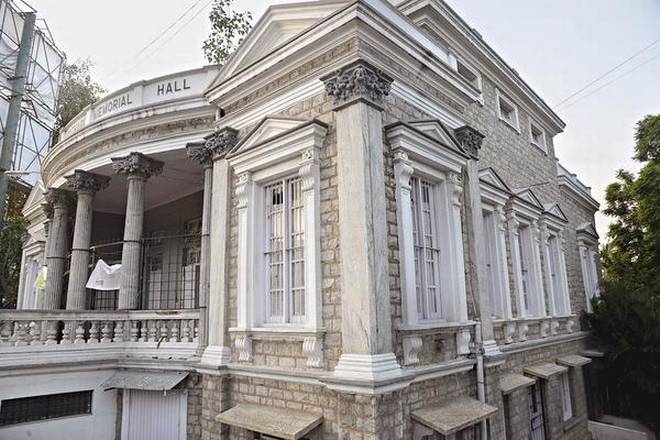
A look at how Bengaluru’s Lady Jehangir Kothari Memorial Hall came to be

LadyJahangirhallBF11apr2018

Most of us have crossed the Indian Express Circle umpteen times and hardly notice the surroundings as we are always in a rush. At times, when you are waiting your turn at the chaotic traffic signal, your eyes may catch a glimpse of an old structure with The Lady Jehangir Kothari Memorial Hall written in bold black letters.

The building is usually locked and sometimes is hidden from view with ugly hoardings or banners screaming out various sales that are conducted in the complex, almost robbing the building off its beauty. Be it books or saris, umpteen exhibitions and sales are conducted here. It is only when you venture into the complex, that you notice the beautiful architecture.

It has a small veranda with tall pillars at the entrance. Once inside, in spite of the huge stacks or rows of products put up for sale, you will see the pretty white interiors. It has a high ceiling with large open windows all around. It also has a tiny room inside and little platform in the main wing. The building is predominantly white – right from the walls, windows, doors and even the pillars – all of which have turned a pale grey over the years due to pollution and dust.

The building, initially, was built by Sir Jehangir in memory of his wife, Lady Goolbai Kothari. According to Parsi history, Jehangir was a globetrotter and came to Bengaluru with his wife who is believed to have fallen ill and died here.

Sir Jehangir built the place not just as a memorial for his late wife, but also as a place where Parsis could get together for parties and also celebrate their events and functions.

It is believed to have been built with a donation of ₹25,000 and started functioning in 1932.

Normally, the hall is given out for parties and events for the Parsi community. But, as the place “does not provide the proper facilities for such grandeur, most Parsis prefer conducting their weddings and functions outside,” says a representative.

“It was started as a Parsi club, initially. And, now is also open to outsiders for fairs. Some Parsi families also celebrate Navroz and Pateti here,” he adds.

So, the next time, you walk into The Lady Jehangir Kothari Hall, remember that you are walking into a slice of Parsi history.

Where we discover hidden and not so hidden nooks and crannies of the city.

source: http://www.thehindu.com / The Hindu / Home> News> Cities> Bengaluru / by Shilpa Sebastian / February 06th, 2018

Two-day Rani Abbakka Utsava from today

The annual two-day Rani Abbakka Utsava will be held at Kolya near Someshwar from February 3. It will be inaugurated by writer Vaidehi.

Chandrahas Rai B., Assistant Director, Kannada and Culture Department, Dakshina Kannada, said the programme will begin with a procession of folk artistes from Bhagavati English Medium School to the Rani Abbakka Utsava Grounds at 3 p.m.

After the inauguration at 5 p.m., there will be a cultural competition. There will also be State-level women wrestling competition and district-level football competition.

On February 4, a seminar on ‘Freedom movement and role of women’ will be inaugurated by journalist R. Poornima at 10.30 a.m. There will be a talk by Meenakshi Ramachandra on ‘Thoughts and war strategies of Rani Abbakka’.

A multilingual poet meet of women will be held at 3 p.m. Writer Sara Aboobacker and actor Vinaya Prasad will receive Rani Abbakka awards, he said.

source: http://www.thehindu.com / The Hindu / Home> News> States / by Special Correspondent / Mangaluru – February 03rd, 2018

Kanaka Durgamma Sidi in Ballari

Thousands of devotees witnessing the Sri Kanaka Durgamma Sidi in Ballari on Tuesday

Tens of thousands of devotees congregated to witness the annual Sri Kanaka Durgamma Sidi here on Tuesday.

Sri Kanaka Durgamma is the principal deity of the city and devotees spread across not only Ballari but also from neighbouring Andhra Pradesh come to witness the event and also worship the goddess.

As has been the practice during the Sidi Bandi festival, an idol, symbolising evil, is hung on a pole with hooks, and tied to a cart pulled by three pairs of bullocks, owned by the Ganiga community, and taken round the temple thrice with the belief that it would protect all from evils.

source: http://www.thehindu.com / The Hindu / Home> News> States> Karnataka / by Special Correspondent / Ballari – February 28th, 2018