Category Archives: Arts, Culture & Entertainment

A festival that brings art and technology under one roof

One of the installations at the festival.

Bengaluru Fantastic 2017 opens at the Rangoli Metro Art Centre

Art and technology share a symbiotic relationship. To bring out this aspect and to showcase how the two can collaborate for sustainable solutions to some of the world’s problems, Bengaluru Fantastic 2017, an international tech-art festival, opened at the Rangoli Metro Art Centre on Friday. The three-day exhibition is being organised by Jaaga, an NGO, in association with the Karnataka Tourism Department.

Archana Prasad, founder,, Jaaga, said the intention behind organising the festival is to introduce Bengaluru to tech-art. “We wanted to bring together the two biggest influences in the city: technology and arts. What has resulted is truly phenomenal with so many artworks and artists coming altogether. We want visitors to see tech-art as an accessible means of expression. Each artwork focuses on an U.N. sustainable development goal and helps us envision a sustainable future for all,” she said.

The festival features 26 artists from across the world who are showcasing their work related to the 17 United Nations Sustainable Development Goals. The event, which is free for all, has on display 30 artworks. The next two days will see many more innovative exhibits and programmes such as 3D printing, unicycling, community drumjam, rainbow-hut, films and more. Talks, workshops and performances will also be organised.

Maskbook

Maskbook, a workshop organised by ‘Art of Change 21,’ is teaching children and adults to make masks out of waste and create awareness about the environment.

“Participants are provided with waste and they are encouraged to make it into an art piece. They will get to take home a photograph with their masks. We are trying to promote sustainable development through innovation,” said Marguerite Courtel, secretary-general, Art of Change 21.

Cubic Mirror

Gene Rogan, a software developer and artist, has created an installation that brings together photography technology and art. People can stand in front of a screen that is attached to a camera. The camera clicks a photograph and converts it into cubic art. The technology makes the otherwise expensive cubic art affordable.

Water testing

Non-profit organisation Meghashala has an installation that checks the quality of water from various parts of the city with water testing strips.

The strips are dipped into the water and grade the water across parameters such as nitrates, nitrites, pH, alkalinity and hardness.

Subham Som, implementation and partner manager, Meghashala, said, “Once the values are taken from the strip, we calculate the result with the help of a Raspberry Pi (portable single-board computer) and an app. We can test the level of water contamination through it.”

Bail Not Jail

Amnesty International India has set up an art installation by artist Ruchi Bakshi Sharma highlighting the problems faced by undertrials in the country.

“The installation specifically focuses on bail reform, which through our research, was found to be unfair. There are many poor people who have got bail, but are not released owing to the lack of money or political networks. Along with this installation we have put up a petition addressed to Law Minister Ravi Shankar Prasad, urging him to reform the bail law. We are requesting our viewers to join the campaign by signing the petition,” said Leah Verghese, senior campaigner, Amnesty International India.

source: http://www.thehindu.com / The Hindu / Home> News> Cities> Bengaluru / by Vinisha Raju / Bengaluru – December 16th, 2017
30 artistes chosen for Janapada academy awards

Thirty senior folk artistes, one from each district, and two folk experts will be presented the Karnataka Janapada Academy awards for 2017. While the artistes will get a purse of ₹25,000 and a citation, the folk experts will get ₹50,000 and a citation.

Announcing the names of award winners here on Monday, academy chairman B. Takappa Kannuru said they had chosen these artistes at the general body meeting on October 30. The awards will be given to them at a two-day district folk convention to be held from December 28 at Sagar in Shivammoga district.

The award winners are Ganganarasamma (Ramanagaram); G. Siddanagowda (Davangere); K.R. Hosalaiah (Tumakuru); H.K. Papanna (Bengaluru city); Akkayyamma (Bengaluru Rural); Maramma (Kolar); Shanthamma (Chickballapur); D. Thimmappa (Chitradurga); K. Vasudevappa (Shivamogga); Hanumavva Walikar (Koppal); Shivamma Burrakathe (Ballari); Shivappa Hebbala (Yadavagiri); Rukmavva (Raichur); Nagappa Kashampura (Bidar); Ismail Sab (Kalaburagi); Veerabhadrappa U. Mullura (Dharwad); Jakkavva Satyappa Madara (Bagalkot); Sabavva Annappa Koli (Belagavi); Jagadeva Golavva Madyala (Vijayapura); Maharudrappa Veerappa Itagi (Haveri); Ramappa Dyamappa Koravara (Gadag); Somayya Sannagonda (Uttara Kannada); Puttaswamy (Mysuru); S.G. Jayanna (Chikkamagaluru); Krishne Gowda (Mandya); Sannashetti (Chamarajanagar); Lakshmamma (Hassan); Leela Shedthi (Dakshina Kannada); Rani Machaiah (Kodagu); and Guruva Dolu (Udupi). The folk experts are N. Huchappa Mastara (Dr. Jee. Sham. Pa. Award) and Shalini Raghunatha (Dr. B.S. Gaddagimath Award).

source: http://www.thehindu.com / The Hindu / Home> News> States> Karnataka / by Staff Reporter / Bengaluru – December 11th, 2017

How Bengaluru’s National Gallery of Modern Art has become a cultural hotspot

NgmaBF12dec2017

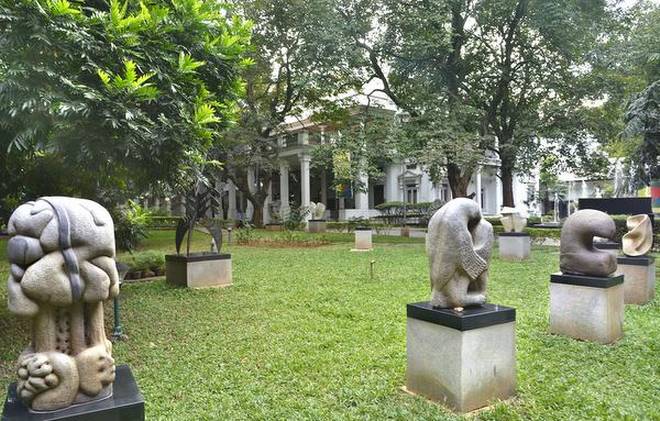
National Gallery of Modern Art (NGMA), the expansive white structure located on Palace Road, exudes a certain kind of warmth that not many government-owned cultural spaces do. It extends an invitation to a passer-by to come and discover its treasure trove of modern art. Bengaluru’s artscape deserved an institution of this stature and it took some effort on the part of cultural fraternity to convince then Chief Minister JH Patel about it. What took longer was the selection of a building. But finally, the sprawling Manikyavelu Mansion was chosen for the task. Architect Naresh Narasmihan restored this colonial style 90 year-old structure, which once belonged to Raja Manikyavelu Mudaliar, a Mysuru royalty and also added a new gallery block in harmony with its existing aesthetics. NGMA Bengaluru opened its doors in 2009 with Sobha Nambisan as its first director.

With all its greenery, the three-and-a-half acre campus is nothing less than an oasis. After you are done with seeing the massive collection on display or an ongoing exhibition, you can sit under its myriad Ashokas, sandalwood, raintrees, banyan to catch a breath of fresh air. Soak in the beauty of the place sitting on stone benches near the mirror pool. For a visitor, there is so much to experience besides the art display.

“I think, it is the best NGMA in the country. Its warm inviting appeal, the kind of events which happen here, make it a beautiful place,” says SG Vasudev, senior artist who was one of the few who rallied for NGMA’s counterparts in Bengaluru. The other two NGMAs are located in Delhi and Mumbai.

NGMA houses a permanent collection of more than 500 art works. Raja Ravi Varma, Amrita Sher-Gil, Rabindranath Tagore, Jamini Roy and other seminal names comprise the collection charting the trajectory of modernism in Indian art.

“I felt intimidated by art till I came here. I thought, I can never understand art and you need to have knowledge about it before you walk into a gallery. But here, it is different. You can get a glimpse of the evolution of Indian art,” feels Sumati R, a banker who lives in Vasanth Nagar. The art reference library, auditorium, cafeteria, sculpture garden and museum shop are other highlights of the structure.

Its permanent collection aside, it regularly hosts exhibitions of the artists from the country and across the world. Walk throughs, workshops, panel discussions, retrospectives and major career surveys of artists are regularly held here. Transforming into a cultural hub, it also hosts film screenings, other performing and cultural arts festivals. One can hope to catch rare documentaries on Rembrandt, or a famous Iranian film by Majid Majidi or just walk into a celebration of any kind.

NGMA is located at 49, Palace Road.

Entry ticket – Rs. 20

For more details visit www.ngmaindia.gov.in.)

source: http://www.thehindu.com / The Hindu / Home> Entertainment> Art / by Shailaja Tripathi / December 11th, 2017

SANAM’s bass guitarist Venky is from Bengaluru

SanamBF11dec2017

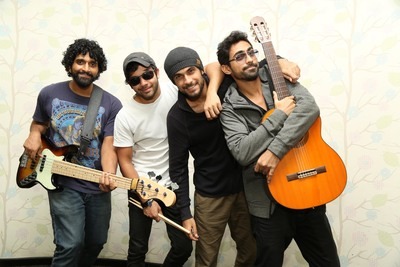
The news that India’s YouTube superstars, pop-rock band SANAM recently performed at the re-launch of an old-time favourite hotspot in Bengaluru has been making the rounds over the past few days. But not many people know that the four-piece ensemble’s bass guitarist Venkat Subramaniyam (aka Venky) was a Josephite, who lived in Bengaluru from 2005-2014. In a casual conversation with Bangalore Times, brothers Sanam and Samar Puri, Keshav Dhanraj and Venky let us in on their momo-eating spree in the city, their favourite artsites from the 90s Indipop genre and the latest #SANAMorginal Itni Door . Excerpts:

Momos in Bengaluru
“We have a strong connect with Bengaluru, as Venky is from this city. It’s always nice to be back here. We have friends in the city, and no matter how much time we get to spend here, we know that it’s going to be a fun experience,” says lead vocalist Sanam. “I had brought Sanam and Samar to Bengaluru many years ago. Back then, we had some fun time taking part in karaoke competitions. The city always has a chilled-out vibe which is appealing,” says Venky, who has studied at St. Joseph’s College of Commerce.

Cut to their latest trip to the city, the ‘foodie’ bandmates were busy sampling different varieties of momos here. “From pan-fried mushroom and corn momos to the ones with chocolate fillings, we tasted some very interesting options here this time,” says Sanam, who has recently turned a vegan. Meanwhile, lead guitarist Samar loved drinking coffee in the city.

Renditions, not remixes
The remix of an old song is often associated with electronic beats, which sometimes sound noisy. “The reason we call our music renditions of old numbers and not remixes is because we try to keep the soul of the song, which is the lyrics and melody, alive throughout. We just style it according to our sound set,” says Sanam. Adding to that, drummer Keshav says, “We work on the instrument paths all over again and recreate the entire song, without changing its original feel and essence.”

Choosing a good song
“We never really discuss among ourselves or within our family that these are the old songs we listen to and that these can be recreated. Our first rendition Lag Ja Gale , for instance, was a song that somehow all of us had heard of, and we knew that it’s a famous and beautiful number. We then tried playing it and singing along, and realized that it’s working for us. It matches the kind of influences we have, the kind of music we listen to and the compositions we make. So, that’s the process. But again, we do filter a lot of songs before finalizing one,” says Sanam.

“Also, most of the old songs are owned by music labels. There can be copyright issues, because we have a channel and things are monetized. There is a method of doing this. It is necessary to get the required permissions ahead of composing the rendition and making a music video with it,” explains Venky, adding, “A lot of thinking also goes into creating song sets while we are touring with our music. In South Africa, for example, people love the songs by Mohd Rafi, so we would add more of that.”

Indipop inspirations
“The songs of Kailasa by Kailash Kher had made a huge influence on me,” says Samar. Meanwhile, the band Junoon and Punjabi songs by Daler Mehndi were Venky’s favourite. The independent music scene of the 90s in India greatly influenced these self-taught artistes, as none of them have received any formal training in music. So, how difficult or easy is it for an artiste to make it big? “It depends on the individual, actually. For me, the level of curiosity and interest is always high when I am learning things on my own. It’s a bigger drive than what I would get sitting in a classroom,” says Samar.

Making music for films

“Currently, we are more focused on our YouTube channel, which has close to three million subscribers, and are not actively pursuing making music for films. A lot of people are following us, and we really want to give our best. The business model for musicians, especially the independent artistes, is changing due to the digital platform. It gives you the freedom to put out your ideas and craft for the audience directly,” says Keshav.

Orginals
“We had started off planning to make originals, but our focus shifted to renditions. With Itni Door just out, viewers are demanding more original tracks. We are currently working on a few, which are likely to be released next year,” Sanam sums up.

source: http://www.timesofindia.indiatimes.com / The Times of India / News> Cities> Bangalore / by Reema Gowalla /  TNN / December 11th, 2017

INTACH opens Mangaluru chapter with exhibition

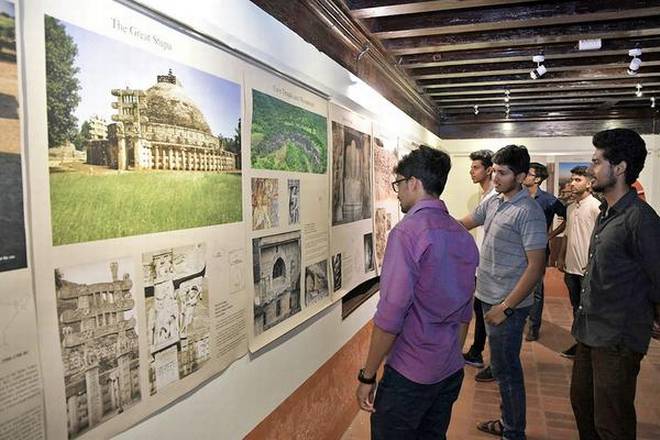
Slice of history: The exhibition will be on till December 17 at Kodial Guthu West in Mangaluru.

It showcases the splendours of Indian architecture

The Indian National Trust for Art and Cultural Heritage (INTACH) launched its Mangaluru chapter by hosting an exhibition on ‘splendours of Indian architecture’ at heritage structure Kodial Guthu West here on Saturday.

The exhibition, which will be on till December 17, begins with a section of India’s achievement in the first millennium A.D. that includes a pre-historic city, ancient cave architecture, forts and abandoned cities.

It then flows into the time of Islamic Encounters. Waves of Islamic forces invaded India from the 7th century onwards. Around the 10th century, Delhi came under Islamic rule. It was a violent encounter but a very fruitful one in the arts. The following centuries saw Islamic buildings in Delhi, Gujarat and the Deccan. Examples of such monuments are included exemplifying the syncretic elements.

The visitor then is led to experience India’s European Encounter.

The final section of the exhibition showcases the Encounter with Modernism. During the 1930s, the Art Deco Style from Europe became very popular in the city of Bombay, now Mumbai, and is apparent in residential buildings and cinema halls. A new style was introduced by Le Corbusier when he designed the city of Chandigarh, an INTACH release said.

People can visit the exhibition between 4 p.m. and 8 p.m., the release added.

source: http://www.thehindu.com / The Hindu / Home> News> States> Karnataka / by Special Correspondent / Mangaluru – December 09th, 2017

Wadiyar heir gives birth to many Firsts

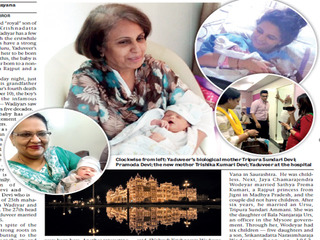
A Wadiyar heir after five decades, the infant is also the first royal born to a non-Ursu queen

WadiyarHeirBF08dec2017

The two-day-old “royal” son of Yaduveer Krishnadatta Chamaraja Wadiyar has a few firsts. Though the erstwhile Mysore rulers have a strong connect with Bengaluru, Yaduveer’s son is the first royal heir to be born in this city. Not just this, the baby is also the first royal heir born to a non-Ursu queen — to a Rajput and a Suryavamshi.

Born on Wednesday night, just four days before his grandfather Srikantadatta Wadiyar’s fourth death anniversary (December 10), the boy’s arrival has ended the infamous Alamelamma curse — Wadiyars saw a heir after more than five decades. The birth of the baby has brought much excitement to the family members.

Yaduveer was anointed as custodian of Wadiyar family in May 2015 after he was legally adopted by late Srikantadatta Wadiyar’s wife Pramoda Devi. Formerly Yaduveer Gopal Raj Urs, he is from Bettada Kote family. He is the son of Tripurasundari Devi and grandson of Gayatri Devi who is the eldest daughter of 25th maharaja Jayachamaraja Wadiyar and Srikantadatta’s sister. The 27th head of Yadu dynasty, Yaduveer married Trishika in June 2016.

Interestingly, in spite of the Wodeyars having strong roots in Bengaluru, contributing to the growth of institutions in the city and developing residential colonies and signature properties (including Bangalore Palace), none of the heirs were born here. Another interesting fact is that the infant is also the first royal heir born to a non-Ursu queen.

A source close to the family said, “Nalvadi Krishnaraja Wodeyar was the first royal to marry a Rajput, Princess Pratapa Kumari, from a small princely family from Vana in Saurashtra. He was childless. Next, Jaya Chamarajendra Wodeyar married Sathya Prema Kumari, a Rajput princess from Jigni in Madhya Pradesh, and the couple did not have children. After six years, he married an Ursu, Tripura Sundari Ammani. She was the daughter of Bala Nanjaraja Urs, an officer in the Mysore government. Through her, Wodeyar had six children — five daughters and a son, Srikantadatta Narasimharaja Wadiyar. Born in 1953, Srikantadatta Narasimharaja Wadiyar succeeded Jaya Chamarajendra Wodeyar.”

source: http://www.bangaloremirror.indiatimes.com / Bangalore Mirror / Home> Bangalore> Others / by Kushala Satyanarayana, Bangalore Mirror Bureau / December 08th, 2017

City Corporation honorary lifetime award for Kadri Gopalnath

Mayor Kavita Sanil addressing a press conference at the Mangaluru City Corporation on Tuesday.

Three more chosen in Yakshagana, Education, Sports categories

A committee of the Mangaluru City Corporation has chosen well-known saxophonist Kadri Gopalnath for the corporation’s first Ullal Srinivas Mallya Memorial Honorary Lifetime Achievement Award.

The award carries a purse of ₹ 1 lakh, a memento and a citation. The award will be presented during the Mangaluru City Corporation Day at the Town Hall here on December 8.

In addition, the committee has chosen three persons for the Ullal Srinivas Mallya Memorial Award for Yakshagana, Education and Sports.

They are Agari Raghurama Bhagavatha (Yakshagana); K.A. Rohini (Education) and M.R. Poovamma (Sports). Each one of them would be given away a purse of ₹ 50,000, a memento and a citation.

Announcing the awards here on Tuesday, Mayor Kavita Sanil said that the corporation has instituted the awards for the first time to recognise the contribution of those who have brought laurels to Mangaluru.

The selection committee comprised B.A. Vivek Rai, former Vice-Chancellor of Kannada University and also Karnataka State Open University; B.A. Abdul Rahman, former Vice-Chancellor, Kannur and Calicut universities, K.N. Tingalaya, former Chairman of Syndicate Bank, Rita Noronha, a social worker, and Manohar Prasad, a journalist. The Mayor is the ex-officio chairperson of the committee.

She said that the corporation would conduct a drawing competition for primary and high school students within the jurisdiction of the corporation in the forenoon on December 8. The topics would be Mangaluru International Airport; New Mangaluru Port; National Institute of Technology, Surathkal; National Highway 66 and Mangaluru-Hassan railway line.

The topics have been selected on the basis of contribution of late Mallya for their development. The venue would be the mini Town Hall. There will be three awards each in primary and high school categories. Students will have to register their names either by sending a message on WhatsApp to 9964160249 or 9113995063 before December 6.

She said that the programmes of the City Corporation Day would be conducted from 2.30 p.m. to 9.30 p.m. The awards would be presented at 6.30 p.m. There would be cultural programmes before and after the award presentation. D. Veerendra Heggade, Dharmadhikari of Shree Kshetra Dharmasthala, would present the awards.

The Mayor would present a karate demonstration after the award presentation.

source: http://www.thehindu.com / The Hindu / Home> News> Cities> Mangaluru / by Special Correspondent / Mangaluru – Decemberj06th, 2017

Bharatavani portal offers digital dictionaries of vanishing Indian languages

BharatvaniBF04dec2017

The online platform hosted by the Central Institute for Indian Languages, Mysuru, publishes content in 121 Indian languages, and is working towards starting online classes.

The word for sunlight or sunshine in Angami — a language spoken by around 130,000 people in the North East — is niakikezie. In the Ao-language of Nagaland, it is anüpu oranüsangwa. And this reporter in far away Bengaluru could look up these words and many more from several Indian languages, thanks to digital dictionaries available on the Bharatavani website.

Most cities in India have infrastructure to teach many foreign languages . But how many look inwards to tap the domestic cultural motherlode of more than 1,500 Indian languages? It is this question that spurred Bharatavani, an online Indian Languages platform hosted by the Central Institute for Indian Languages (CIIL), Mysuru, to not only publish content in 121 Indian languages, but work towards starting online classes.

Searchable resource

What is particularly causing ripples of excitement among linguists and researchers is the compilation of digitised searchable dictionaries. In a little over a year since its inception, the portal offers 262 unilingual and multilingual dictionaries in 50 Indian languages — all of them in a searchable format on android platforms — which can be accessed on Bharatavani’s free Android app.

The number of languages covered will soon cross a hundred, said Beluru Sudarshana, consultant with CIIL. “Bharatavani is not publishing new works, but we are for the first time digitising available dictionaries in smaller languages, to bring it to a wider audience,” he said. Malto-English-Hindi, Odia-Ho, English-Ao and Lepcha-English are some of the dictionaries on offer — most of them available in a searchable format and not as cumbersome PDF files.

Prof. Panchanan Mohanty, Dean, School of Humanities, University of Hyderabad and an expert in Eastern Language research, who is also on the Bharatavani committee, likened Bharatavani to Project Tiger, arguing for conservation of India’s fast-depleting language heritage. But more significantly, the digitised database of dictionaries is a goldmine for linguistic research in the country, he said.

These dictionaries can now be linked to create a large database of words across various languages, using English, Hindi or regional languages as the source words. With over seven lakh source words at present, the potential of the database is immense. For instance, the use of Odia source words will result in an Odia-English-Ho-Munda-Khadia-Kui-Oraon-Saura dictionary, integrating a family of Austroasiatic languages spoken in central-eastern India. The integration of these dictionaries is still a work in progress.

Accessible curricula

Linguist G.N. Devy, who spearheaded the People’s Linguistic Survey of India, believes this resource will help speed up socio-linguistic research and not just along themes of structure and genealogy, thereby ensuring better development planning.

“One serious challenge is that children from communities speaking non-scheduled languages are pushed out of schools leading to development deprivation. For an imaginative user, content on Bharatavani may help in designing a curriculum in these languages,” he said, adding that starting from scheduled languages, Bharatavani has now broadened its scope to smaller languages that have over 10,000 speakers. “But there are several languages with fewer than 10,000 speakers, which Bharatavani needs to work on in its second phase.”

Challenges ahead

This undertaking is not without it challenges. For one, Optical Character Recognition (OCR) is still in a primitive stage even for major Indian languages. Thus constructing digitised databases for smaller languages will be a problem as their script cannot be scanned and converted into text format. Tedious desktop publishing is the only viable option.

Another hurdle is that unicode script input drivers are available in only recognised scripts. Incidentally, the Bharatavani portal will soon provide a virtual keyboard, integrating all available Unicode drivers of India languages for users to search for words by typing in language of their choice.

The bigger problem, however, is proofreading, said Mr. Sudarshana. “Ideally, for a multi-lingual digital dictionary we need to carry out a collaborative online proof-reading process, each expert looking at their language of expertise. In most of these smaller languages, it’s tough to even get language experts. Most are old and not equipped to proofread online. We have opted for assisted online proof reading, where a person reads out the text to the expert and makes suitable changes in the database on the expert’s recommendation, which is time consuming,” he said,

Bharhavani is steering in uncharted terrain, but researchers and linguists on board this project are optimistic that it will unveil India’s landscape of languages to its citizens despite the many challenges.

source: http://www.thehindu.com / The Hindu / Home> Sci-Tech> Tech> Sunday Special / by K.V. Aditya Bharadwaj / December 02nd, 2017

Nokia goes native in Bengaluru

NokiaBasavannaKF03dec2017

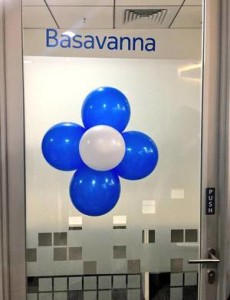
Perhaps for the first time, a multi-national corporation has decided to give itself a desi touch and named its facilities in Bengaluru after two Kannada philosophers. The Finnish telecom network equipment giant Nokia has named its recently inaugurated R&D facilities here after 12th century icons Basavanna and Allama Prabhu.

Nokia, which has presence in more than 170 countries, named its facilities after the philosopher poets “to create awareness of Basavanna and Allama to foreign employees and foreign visitors.” The centre, Nokia’s largest global R&D site, currently employs more than 6,000 engineers.

Speaking to The Hindu on Saturday, Vinayak Andangoudar, Head of Location Development, and Rajesh K, Financial Controller, of Nokia, Bengaluru, said there was “a lot of enthusiasm among employees” about these Kannada philosophers.

“After consultations and discussions with employees, we decided to name facilities after Basavanna and Allama,” said Mr. Andangoudar.

“We have over 6000 employees in our R&D and there are a good number of Kannadigas. Visiting foreign employees inquire about the two philosophers after naming the two halls after Basava and Allama,” said Mr. Rajesh.

Minister for Information and Technology Priyank Kharge inaugurated a new R&D centre at the Manyata Technology Park here.

Appreciating company’s decision, Mr Kharge tweeted: “Kannada philosophers seem to have positively impacted the IT industry with their thoughts. The new Nokia facility have collaborative spaces named after our Philosopher poets Basavanna & Allama.”

source: http://www.thehindu.com / The Hindu / Home> news> States> Karnataka / by Nagesh Prabhu / Bengaluru – December 03rd, 2017

Exhibition of Jain murals from tomorrow

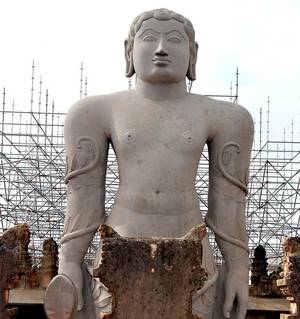
Karnataka Lalithakala Academy chairperson M.J. Kamakshi says there is more to Shravanabelagola than the Gomateshwara monolith. Prakash Hassan

Expo will introduce connoisseurs of art to some rare and finest murals of ancient times.

The Karnataka Lalithakala Academy will hold a seven-day special exhibition of ancient Jain murals, which have been documented by the academy, in Bengaluru in January 2018.

Speaking after receiving felicitations accorded by Kalamandala, Dharwad, here on Wednesday, academy chairperson M.J. Kamalakshi said that this special art exhibition will be organised on the historic occasion of Mahamastakabhisheka to be held in Shravanabelagola. The academy is also contemplating holding a similar exhibition in Shravanabelagola, she added.

This exhibition will introduce connoisseurs of art to some rare and finest murals of ancient times. They were originally painted on the walls of the Jain shrines in Shravanabelagola. Not many are aware that this famous Jain pilgrimage centre, well known for its Gomateshwara monolith, also houses ancient Jain mutts having some of the finest murals giving insight into Jain mythology. Some of these murals were lost in the passage of time. However, they have been copied and preserved by a team of artists in the 1970s. These rare paintings will be exhibited on this occasion, she said.

More to Shravanabelagola

Ms. Kamalakshi added that most of the visitors to Shravanabelagola do not visit any place other than the Gomateshwara monolith. And, this exhibition will introduce the rich heritage of murals of the State to tourists coming from across India and abroad, she added.

Ms. Kamalakshi said that during her tenure, she would plan to focus more on tribal and folk paintings and their documentation. An action plan would be chalked out in consultation with the members of the executive committee who are yet to be appointed by the State government, she said.

Earlier, Kalamandala president Madanmohan Tavarageri, Kumud Tavarageri, artists Madhu Desai, Gayatri Desai and writer Malati Pattanshetti felicitated Ms. Kamalakshi. Several artists from Hubballi-Dharwad were present.

source: http://www.thehindu.com / The Hindu / Home> News>  States> Karnataka / by Staff Reporter / Dharwad – November 30th, 2017