Category Archives: Arts, Culture & Entertainment

Pink Hoysalas are not just a token presence

PinkHoysalaBF29may2017

The Bengaluru patrols don’t merely instil confidence among women, they empower policewomen as well

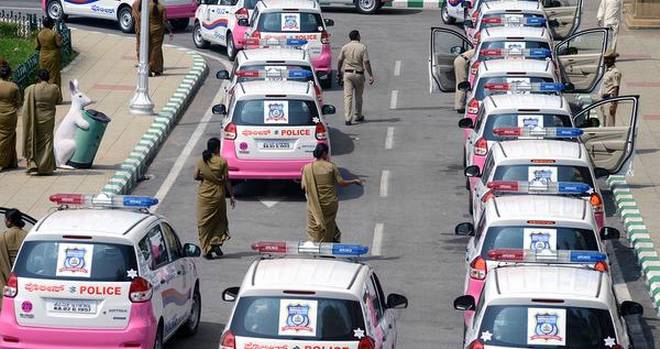
There is at least one woman member in each of Bengaluru’s high-visibility police patrol teams and they stand out in their Pink Hoysala vehicles.

A patrol unit has two or three police personnel, and the vehicles are a familiar sight in areas with a high concentration of women, such as colleges and schools, paying guest complexes and even temples.

The Pink Hoysalas are seen as not merely helping women in the city, but empowering female police personnel too. These staffers now conduct inquiries, question suspects and carry out investigations – tasks normally performed only by male personnel.

So far, the 51 Pink Hoysalas that were added to the 221 regular Hoysala patrols last month to exclusively cater to problems faced by women and children have received 39 distress calls.

These are received through the ‘Suraksha app’ (users can press the power button five times to seek help, sending a signal to the command centre that then directs the nearest Pink Hoysalas as well as the control room number (100).

“The calls include complaints of sexual harassment in public places. This is why we keep these patrols near all-girls colleges and schools, especially at closing time,” said a senior police officer.

Arrest on the move

‘Pink Hoysala 272’ has won attention for arresting a man who was misbehaving with a 29-year-old software engineer, from the bus on which the incident occurred in Whitefield late at night.

In another case, a Pink Hoysala rescue a woman in Basavanagudi who was initially thought to have been attacked with acid.

It was found that the substance was adhesive gum. Based on feedback, the system may be expanded.

source: http://www.thehindu.com / The Hindu / Home> News> Cities> Bengaluru / by K.C.Deepika / Bengaluru – May 26th, 2017

Exhibits at ashram enter Guinness Book of Records

2,649 bonsai trees from various cities are displayed at the ashram in Mysuru

Three exhibits at Sri Ganapathi Sachchidananda Ashram in the city, including the largest collection and display of bonsai trees, entered the Guinness Book of World Records. The certificates of records were conferred and received by Sri Ganapathy Sachchidananda Swami at a function on Friday held to mark his 75th birthday celebrations.

The Guinness record for bonsai reads as ‘Largest Display of Bonsai Trees.’ It was created at the International Bonsai Conference and Exhibition held in December 2016 when international delegates took part, the release said. During the conference, 2,649 bonsai trees brought from Bonsai Clubs of Mumbai, Pune, Bhopal, Jabalpur, Bengaluru, Mysuru and other cities were exhibited which resulted in the creation of the record, the release added

The second record was the Bhagavad Gita, at a height of seven ft and a width of five ft, besides a thickness of one ft. All the verses in the book are written in 18 languages, including nine Indian languages (Sanskrit, Telugu, Kannada, Bengali, Odiya, Gujarati, Gurumukhi, Malayalam and Tamil) and nine foreign languages (English, Greek, Russian-Cyrillic, Armenian, Georgian, Japanese-Katakana, Korean-Hangul, Arabic and Hebrew).A release stated that the Guinness Record reads as ‘Largest Hindu Smriti’ and the printing of the book took 636 hours in all. It was described as the largest book and has been printed using eco-friendly material. Fourteen people worked on it.

The third record pertains to the single largest collection of birds in an aviary at Shuka Vana located in the ashram. There are over 2,000 birds drawn from 475 species. The objective of establishing this aviary was to take care of injured and abandoned birds for which a dedicated hospital has been established, complete with non-invasive investigating apparatus. Bird care is provided by trained volunteers and the practice has been ratified by the Animal Welfare Board as confirming to international standards, the release added.

Visit from Phadnavis

Maharashtra Chief Minister Devendra Phadnavis visited Sri Ganapathi Sacchidananda Ashram on Friday and participated in the 75th birthday celebrations of the seer.

Mr. Phadnavis lauded the spiritual and social work of the seer and his contribution to eradicate discrimination in society. “The swami’s message of compassion is more relevant in the present time than ever,” he said and added that the seer’s knowledge and contribution to the field of music was immense. While other therapies work on the body, music soothes the soul, he said.

Later, speaking to mediaspersons he lauded the works and initiatives of Prime Minister Narendra Modi, who completes three years in office this year, and said that the world has realized the true power of India under him.

source: http://www.thehindu.com / The Hindu / Home> News> States> Karnataka / by Special Correspondent / Mysuru – May 27th, 2017

Bengaluru girl bags Diana Legacy Award

Nikhiya Shamsher, who won the Diana Legacy Award, with Prince William, Duke of Cambridge (R) and Prince Harry

Her crusade for better education , especially for under-privileged children, has won 14-year-old Nikhiya Shamsher from Bengaluru the Diana Legacy Award. The award was given away last week by Prince William, Duke of Cambridge and Prince Harry at the St Jame’s Palace, UK.

In December 2015, Nikhiya realized there are many children who do not have access to basic school supplies.Often entire classrooms of children share a single textbook, and many walk barefoot to school. While more children were attending school, she heard stories of bright young students dropping out because of poor educational foundation.

Yearn to Learn, the project spearheaded by Nikhiya, has, so far, set up 15 science laboratories which are benefiting 3,500 students from various schools. Nikhiya started her e-commerce website – http:www.knicnacs.com -to raise funds for her laboratory projects. Recently , she also funded the education of 25 blind children.

Inspired by Diana’s words -“Carry out a random act of kindness, with no expectation of reward, safe in the knowledge that one day someone might do the same for you” – the award, which marks 20 years since her death, recognizes young students who have socially impacted people through their actions. The award identified 20 winners as legacies of the princess.

Nikhiya was the only Indian among 20 winners rep resenting countries like the United Arab Emirates, UK, US, Canada, Belize, among others. This year, 12,000 social changemakers were nominated for the award. “The award has strengthened my believe in my project, giving me the confidence that I am doing the right thing,” said Nikhiya.”The benefit of this recognition is that a lot more people would now be interested and serious about the cause I’m working towards.”

Asked why she was so keen on bringing about a change in the education space, the teen said: “Because it is the single most important solution to all our issues.” Meeting the royal family was a unique experience for Nikhiya, who wasn’t quite expecting the award.

“The royal family was extremely encouraging and gave us the confidence that we were doing the right thing and keeping alive Princess Diana’s tradition,” she said, adding, “None of this would have been possible without the support of my parents and my school (Greenwood High).”

Her father Dr Shahid Shamsher, a trichologist, said: “We want her to follow the path she desires. She has this innate sense of responsibility and always keeps herself occupied and we know that she’ll go a long way.”

Added Niru Agarwal, trustee, Greenwood High: “At a tender age like hers, to think about the welfare and education of the downtrodden and selflessly work for it is noteworthy . She is a role model to her peers. Her qualities of kindness, compassion and service are truly admirable.”

In addition to the Diana Legacy Award, Nikhiya’s photo with information on her projects and services have been hosted at an exhibition at Althorp House, the final resting place of Princess Diana. Bengaluru

The Global Inclusion Award

Nikhiya was the sole winner from India at the Global Inclusion Awards, held in Berlin on May 3. She was chosen from among other contenders for the Global Winner of the Outstanding Youth Economic Citizenship Award 2017. The event was hosted by Germany’s G20 Presidency and Child and Youth Finance International, Germany.

source: http://www.timesofindia.indiatimes.com / The Times of India / News> City News> Bangalore News / by Deepika Burli / May 25th, 2017

A women-only tour package unveiled

A selfie moment at Agumbe view point in Western Ghats of Karnataka. | Photo Credit: K. Murali Kumar

Karnataka Tourism’s maiden offer includes a tour of Mysuru and Kodagu

In what is being touted as the first of its kind by a State-run tourism corporation in the country, the Karnataka State Tourism Development Corporation (KSTDC) has decided to offer a ‘women’s special’ tour package.

The package, a three-day, two-night tour of Mysuru and Kodagu, promises to be a unique experience for women travellers.

Priced at ₹6,406 (for a 39-seater) and ₹4,596 (for a 31-seater bus), the package provides a bus for women, accommodation at KSTDC properties, and guides to help. “Our itinerary is such that women can enjoy nature, adventure, culture, architecture, and shopping. There is also a visit to a silk factory, and time to relax at coffee and spice plantations,” said an official. The package has been launched on a pilot basis.

Officials said they had received feedback and enquiries from potential travellers though the trip was yet to commence. The tour would become operational when a minimum of 35 passengers signed up.

Although rooms in KSTDC hotels were on a twin-sharing basis, single travellers could be accommodated in single rooms depending on the availability, the officials added. More destinations were likely to be added to the package based on the response to the Mysuru-Kodagu offer.

source: http://www.thehindu.com / The Hindu / Home> News> States> Karnataka / by K.C. Deepika / Bengaluru – May 22nd, 2017

Shooting for the stars

AstroPhotographyBF21may2017

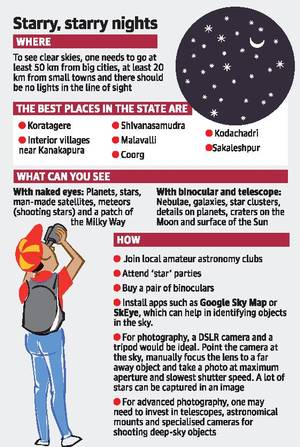
For amateur astronomers who are fascinated by stars, the sky is never the limit. They look beyond it, for galaxies, stars, satellites, meteors and more. While the city’s surrounding areas offer good opportunities for stargazers, of late Bengaluru has been seeing a rise in another kind of space enthusiasm — astrophotography.

Astrophotography is the art and science of photographing objects in space. While an amateur stargazer can only retell his experiences, these photographers capture them in pictures for all to see.

“Astrophotography is picking up fast. We have a Facebook group called Indian Amateur Astrophotographer that has over 3,600 members across India. Many of them are from the city,” says Keerthi Kiran M., a system engineer who is also a member of the Bangalore Astronomical Society (BAS), a Google group with over 3,000 members that promotes astronomy as a hobby.

BAS organises regular workshops on astrophotography and talks by experts. According to Mr. Kiran, many of the group’s members are now trying out astrophotography.

Subhankar Saha, who participated in one the workshops, took up astrophotography six years ago. “Having a basic knowledge in astronomy helped me. The best season for stargazing and astrophotography is between November and May. During this time, I try to head out and photograph deep-sky objects twice a month. I generally travel to Koratagere, near Tumakuru,” he says.

Deep-sky objects include faint objects in the sky such as nebulae and galaxies.

Though Mr. Saha has advanced equipment such as an astronomical mount, a modified DSLR, a specialised camera and three telescopes, he says a beginner can even start with a good mobile phone camera, or a DSLR, and a tripod to take stunning photographs of the night sky. With advanced equipment, one can shoot star trails, the Milky Way and even faint nebulae.

“The astrophotography community is quite vibrant today. A lot of new people are getting into the hobby,” he says.

B.S. Shylaja, director, Jawaharlal Nehru Planetarium, says many students who come for astronomy sessions to the planetarium get into astrophotography. “There is a lot of interest in the subject now.”

Partying with the stars

Karthik Subramanian, who has been an amateur astronomer for about seven years, has been accompanying his friends on regular ‘star parties’ — informal gatherings of amateur astronomers. “Last month, I went on an observing trip along with my friends. We were able to capture the Milky Way through Sagittarius and Scorpius on the camera. For me, the hobby is about appreciating the wonders of nature in the sky.”

Many members of the Association of Bangalore Amateur Astronomers are also astrophotographers. Chandrashekar G., who picked up the hobby 10 years ago, started with a DSLR. Today, he carries over 40 kg of equipment to remote places around Bengaluru to shoot stars and planets.

However, serious astrophotography requires a lot of expertise. “This kind of photography is very challenging. We are trying to photograph objects in the sky which are extremely faint. Autofocus and metering do not work. So, the photographer has to manually focus and set the shutter speed to photograph the night sky. Even then, it needs a very long shutter speed to capture enough light from these faint targets,” Mr. Kiran says.

Astrophotographers use techniques where they shoot many short-exposure images and then combine them to make one image which looks like a long-exposure one. There are a lot of do-it-yourself projects that people can try to track the stars, such as using the barn door tracker, which rotates the camera at the same rate as the Earth’s rotation. And just as light pollution affects the stargazing experience, astrophotography also needs a dark, dry place far away from lights.

It is also an expensive hobby, unlike stargazing, where many objects can be seen with just the naked eye or a simple telescope. “The stars move in the sky. So long exposure can result in streaks. One needs special equipment to track the stars. Normal photographic lens may not suffice for astrophotography. Extremely good quality lenses and telescopes are needed to take good photographs,” Mr. Kiran says.

Some equipment are not available in India and need to be imported. “One requires a lot of passion and a deep purse to pursue this hobby. But, once you get into it, it is very rewarding,” says Mr. Chandrashekar.

source: http://www.thehindu.com / The Hindu / Home> News> Cities> Bengaluru / by Sarumathi K / Bengaluru – May 20th, 2017
How to put a face to history

He had to be clad in white, and look calm and contemplative.

At most, he could hold a brush and a palm leaf manuscript.

That was the brief veteran art ist V T Kale got from the seer of a Chitradurga mutt who was commissioning a portrait of Basavanna, the 12th century poet-reformer. Kale’s research included a careful reading of history books and vachanas (pithy verses) to get the contours of Basavanna’s body and face right. But the challenge was bringing out Basavanna’s multiple identities -statesman of Bijjala, poet-philosopher, and social reformer? “It was difficult,” says the 83-year-old artist.

The painting, completed in 2005, remains one of the most popular images of Basavanna. So popular that when the state government recently decided to put it up along with portraits of Gandhi and Ambedkar in all offices, they initially didn’t bother crediting Kale. Images of public personalities from a bygone era seem to have a life of their own. And artists have a tough time capturing in bronze and acrylic the real and imagined features of Basavanna, Kempe Gowda I, Kittur Chennamma , Sangolli Rayanna and other personalities as envisaged by political parties and identity groups.

For one, there are no photographs to fall back on. “In the 12th century, people were not in the habit of making portraits of themselves. So, I had to imagine Basavanna’s character, his contribution to society and politics,” says Kale. He did at least 10 sketches before the mental picture became clear enough for him to start the painting. B C Shivakumar, whose Kempe Gowda busts and statues gaze down at Bengalureans from Lalbagh, VV Puram and Gavipuram, says the first one took him a year. “I studied the history of Kempe Gowda and the folk songs about him,” says the artist. The first one was commissioned by Kempegowda Nagar residents. At the Gavipuram signal, the city’s founder stands holding an unsheathed sword, one foot firmly on one foot firmly on a rock. By the time the next commission came from Vokkaligara Sangha in VV Puram, the local chieftain who is supposed to have carved out Bengaluru as his capital in 1537, was a swashbuckling figure on horseback.

These statues and portraits are not just about assert ing the identity politics of those who commission the works.

“They align public spaces with histori cal and mythical memories,” says Chandan Gowda, sociology professor at Azim Premji University .

But memories can be tricky. Delhi based sculptor Anil Ram Sutar, who is creating the mam moth Sardar Patel ‘Statue of Unity’ and the costly and controversy ridden Shivaji statue off the Mumbai coast with his father Ram Vanji Sutar, says such projects require a tough balancing act. Patel’s images are available but he had to be the `Iron Man’ when it came to the statue. Shivaji was tougher as he is perceived as a chivalrous king, riding a horse with a sword in hand.”People worship him for those qualities.Eventually, one has to bring to the sculpture what people believe about him and what has been painted until now,” says Sutar.

Public perception often is defined by popular culture. Vishal Kavatekar, an upcoming sculptor and guest faculty at Karnataka Chitrakala Parishath, remembers hearing a senior artist being asked to create the same costume worn by actor Rajkumar for a statue of 16th century emperor Krishnadevaraya. “Rajkumar and Vishnuvardhan have played many historical figures in their movies and people sometimes want to see a resemblance to the actors in the statues,” says Kavatekar.
Apart from looking at existing templates from descriptions in literature to historical movies, some artists take creative liberties. “They might make the skin complexion fairer or the body more sensual or muscular,” says Gowda.

There are times when historical inaccuracies are called out. There is an ongoing debate about how Kempe Gowda’s appearance has been slowly altered to suit changed sensibilities -from a figure with folded hands to one fiercely wielding a sword. Kavatekar says many complained that the founder’s statue in front of the BBMP office at Corporation Circle, one of the oldest in the city, suffers from a `Rajkumar look’ mainly due to the elaborate kurta-pyjama outfit.

Gowda says creative risks are fine but when the images are for public circulation, the motive of art shifts. Bengaluru-based artist N Shivadatta says he made 1,400 sculpture mementos of freedom fighter and queen Kittur Chennamma in a few days to be distributed at the Vishwa Kannada Sammelan in 2011. “The pressure to flatter and not offend the feelings of those from a particular community is very high,” he says.More so because these art works create a public image for a figure who may have just been a name.

Kale is non-committal about such controversies. But he insists that the artist has to study the character of the historical figure, and his life and times. “The artist should meditate on the subject and with sadhana (practice), art will get better,” he says.

source: http://www.timesofindia.indiatimes.com / The Times of India / News> City News> Bangalore News / by Sandhya Soman / TNN / May 21st, 2017

TSR award for Nagesh Hegde

HegdeBF16may2017

Gangadhara Hiregutti to get Mohare Hanumantha Rao award

Noted journalist Nagesh Hegde, who writes extensively on environment and science issues, has been chosen for the prestigious TSR Memorial Award by the government for 2016.

Gangadhara Hiregutti, editor, Munjavu daily, has been selected for the Mohare Hanumantha Rao Memorial Award.

An expert committee, headed by former judge Indrakala, announced the award on Monday. The awards carries a purse of Rs.1 lakh each and a citation. The awards will be conferred on these two journalists at a function to be organised shortly, according to a release.

Mr. Hegde served as Assistant Editor, Prajavani, and was also with Sudha, a weekly magazine. With a master’s degree in environmental sciences from the Jawaharlal University (JNU), he taught Environmental Geo-Science at Kumaon University, Nainital.

Environmental issues

He wrote extensively on environmental issues during his tenure as feature editor at Sudha.

He has delivered lectures on environmental issues in various parts of the world. He has also worked towards popularising science among rural communities.

Mr. Hegde is the recipient of many awards, including the Karnataka Rajyotsava and that of the Karnataka Sahitya Academy. He has written over a dozen books in Kannada on science, environment and development.

Award for U.R. Rao

U.R. Rao, space scientist, has been chosen for the Bhaskaracharya Award, instituted by Sri Channaveera Swamiji Foundation of Saranga Math in Vijayapura district. This was disclosed by Arun Shahpur, MLC, to presspersons here on Monday.

source: http://www.thehindu.com  / The Hindu / Home> News> States> Karnataka / by Special Correspondent / Bengaluru – May 16th, 2017

Shivaji statue arrives in Hubballi

An equestrian statue of Maratha King Shivaji, which was eagerly awaited by the Maratha community of Hubballi-Dharwad, has finally reached Hubballi from the artist’s studio in Indore.

The 12-ft bronze statue of Shivaji Maharaj riding a horse, weighing approximately 2,500 kg, was made by sculptor from Indore Mahendra Kodwani. Mr. Kodwani has earlier made other statues of historical personalities for installation at various junctions in Hubballi.

It took nearly a year for Mr. Kodwani to complete the bronze statue.

It was only after approval from the former Mayor and Municipal Commissioner of Hubballi-Dharwad that the work on the statue began. The Mayor and the Commissioner, who had visited the artist’s studio at Indore, had inspected the clay model and after their approval, Mr. Kodwani began fabrication work.

The statue reached Hubballi on a truck on Monday. It will be kept wrapped till its installation at the Mahatma Gandhi Park.

source: http://www.thehindu.com / The Hindu / Home> News> States> Karnataka / by Special Correspondent / Hubballi – May 09th, 2017

Homage to filmmaker Bennurkar

The Centre for Information Education Development Studies (CIEDS) Collective will soon organise a memorial event to pay tributes to Chalam Bennurkar, a pioneer of documentary film making in Karnataka, who passed away recently.

Film societies are also planning to hold a festival of documentaries made by him. The 62-year-old filmmaker was found dead at a pond in Bagur, Chitradurga district.

He had gone missing for a few days and his wife Kalpana had filed a missing person complaint.

Chalam’s Kutty Japanin Kuzhandaigal (Children of Mini Japan), a Tamil documentary on labour conditions in Sivakashi, had won Golden Dove award at International Leipzig Festival of Documentary and Animation Film (Germany) and Citizen’s Prize and Prize of Encouragement at Yamagata International Documentary Film Festival Japan in in 1991. “Through this documentary Chalam took images of land to different platforms across the world. He brought value to the serious documentary films in Karnataka,” says Kesari Harvoo, filmmaker.

Chalam had taken up various social issues, especially about women, through his films. He was instrumental in organising film festival on women’s issues in Bengaluru Film societies in 70s.

He was also known as the voice of trangenders because of his documentary All About Our Famila.

He also worked with Amitabh Chakraborty for Bishar Blues about Bengali Fakirs which undertakes a journey to understand Marfat, indigenous form of Islam in Sufi tradition.

He also made documentary on Kunde Habba, a unique festival of the tribal people in Kodagu and Naave Yeravara on the Yerava community.

source: http://www.thehindu.com / The Hindu / Home> News> Cities> Bengaluru / by Special Correspondent / Bengaluru – May 08th, 2017

The most heavyweight museum in India

A measure of history: The museum in Davangere has 3,000 varieties of weighing scales and measures.

In the heart of Karnataka, one man’s obsession has resulted in the first collection of weights and measures

The first museum of weights and measures in the country sits in the Chamarajpeth market area of Davangere, Karnataka. Called Tula Bhavan, its exhibits include more than 3,000 varieties of weighing and measuring devices, some dating back at least three centuries.

A visitor can see, for example, wire gauges and a depth-measuring tape made in Germany and folding scales from America and England. The bulk of the collection, though, originates in India, and includes devices from almost every part of the country, including from the times of the Nizams of Hyderabad, the Mysore Wadiyars, the Adil Shahis, and the Keladis. Among the prize pieces are wooden beam scales from Mysore, and weighing stones used during the Adil Shah period.

The museum is the creation of a family which makes its living in the trade.

Chennaveerappa Yalamalli had been in the business of selling weights and measures for 45 years. His son Basavaraj joined the family business in 1982. In 1997, he decided he wanted to set up a museum to create awareness of varieties of measuring devices. He began travelling across the country to collect information and models for his project. In 2006, he had enough to start the museum.

When his father died in 2012, he took over the running of the business; two years later, in 2014, he set up the Chennaveerappa Yalamalli Memorial Trust to run and grow the museum.

The museum entered the Limca Book of Records in 2016, and in January this year, the Department of Posts declared it the ‘first of its kind’ in the country in its in-house magazine.

Mr. Yalamalli told The Hindu that he is sad that he has had little help from local authorities or the government, but he is happy that his son, Sriraj, has joined him, not just in the business but also in the mission of developing the museum.

source: http://www.thehindu.com / The Hindu / Home> News> States> Karnataka / by Pradeepkumar Kadkol / Davangere – May 02nd, 2017