Category Archives: Business & Economy

Award for Mangaluru City Corporation

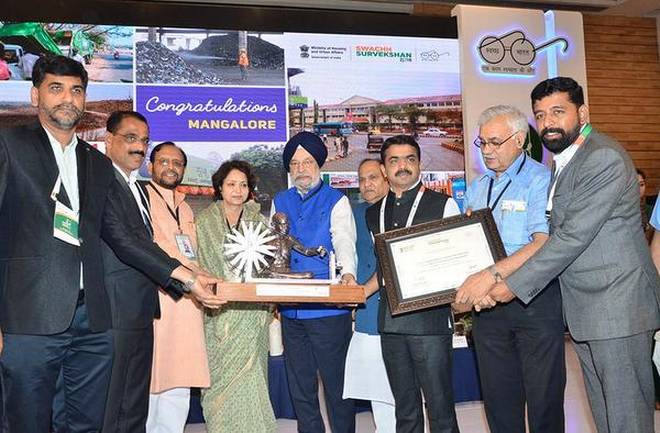
Mangaluru officials receiving the award from Union Minister for Housing and Urban Affairs Hardeep Puri in Indore, Madhya Pradesh, on Saturday. | Photo Credit: Supplied

The Mangaluru City Corporation received ‘India’s best city in solid waste management’ award under the categories of cities having a population between three lakh and 10 lakh under Swachh Survekshan 2018 at Indore, Madhya Pradesh on Saturday.

Union Minister for Housing and Urban Affairs Hardeep Puri presented the award at a function.

Bhaskar K., Mayor, Mohammed Nazir, commissioner of the city corporation, Naveen R. D’Souza, chairman, Standing Committee on Health and Education, and Madhu S. Manohar, Environment Engineer at the corporation, received the award. Mangaluru was among the 23 cities selected in the country for the national award under different categories.

The survey by the Union Ministry of Housing and Urban Affairs assessed 4,203 urban local bodies under the aegis of the Swachh Bharat Mission (Urban) between January 4, 2018 and March 10, 2018. The survey team was in Mangaluru for four days in February, 2018.

The on-field survey for Swach Survekshan had been conducted by an independent agency and the data for ranking the cities were collected through direct observation, citizen feedback and service-level progress..

source: http://www.thehindu.com / The Hindu / Home> News> Cities> Mangaluru / by Special Correspondent / Mangaluru – June 23rd, 2018

Take a step towards sustainability

Go Native Store, Bengaluru | Photo Credit: Vivian Ambrose

Go Native offers almost everything you need to make your life and your home planet-friendly

If you are looking for a one-stop shop to make your home sustainable or switch to a sustainable lifestyle, one of the closest fits would be Bengaluru’s Go Native store in Jaya Nagar.

Though the store is now more patronised for its café, which serves up farm to table, organic, Indian fusion fare, its owner Anvitha Prashanth, is now focusing on generating more footfall in the store.

The store, like the café, is spread across two floors and has everything from toothbrushes to furniture, jewellery, and groceries.

Customers may begin by dropping off their plastic toothbrushes and picking up a biodegradable bamboo toothbrush by Pune-based Bamboo India, which was part of India’s UN Environment Day celebrations in New Delhi. They can then pick up personal care products from Bare Necessities, a zero waste personal care and home care brand. The brand is known for their use of organic, local and ethically sourced ingredients; their products are reportedly non-toxic, non-GMO, and cruelty-free. One could alternatively opt for Soul Tree, which offers Ayurvedic products using organic, natural ingredients as well as Coconess’s coconut-based, natural body care products.

One then comes to the food section of the store which comprises organic staples (including grains and pasta), snacks, oils and preserves.

The ground floor also hosts clothing and accessories, from a range of labels that focus on handloom and handmade products in all kinds of materials from cork to banana fibre and Ilkal fabrics (a North Karnataka weave) by labels such as Arture, Ziveli, Bandhej and Kaisori. There is a small jewellery section featuring rare semi-precious gems including Coral Fossil, Jaspers, Solar Quartz, set in Sterling silver by Flames of the Forest. There are also Channapatna toys by Varnam and a small collection of children’s clothing.

The retail section upstairs is almost entirely devoted to home décor, furniture and some jewellery, largely by labels such as Purple Turtles and Jenny Pinto.

In her tour, Anvitha Prashanth, the store’s founder, points to a set of lights made from cement dust as well as banana fibre. The upstairs section also features an extension of the restaurant, both indoors and outdoors. The indoor section often doubles up as a space for events.

“I wanted to incorporate everything that would help me live a sustainable life. This is a lifestyle store,” says Anvitha, who graduated from the Singapore University of Technology and Design. She was first introduced to the idea of an interconnected ecosystem during an internship in Berlin.

“I come from a very different background. I feel this is an advantage because it gives me the chance to connect to new people.”

Otherwise, she says, it may become too overwhelming or intimidating for them. Anvitha’s objective is to turn Go Native into a neighbourhood resource centre.

She plans to make her store plastic-free by July. As of now, customers can drop off the packaging from the used products (bought at the store) for recycling.

“We also conduct neighbourhood clean-up drives periodically.”

Another aspect of sustainable living she addresses through her store is the local economy.

“Right now, there is a disconnect between producers and consumers. This is why we work with local brands and NGOs that collaborate with artisans,” she says. Fair trade, is an important part of the store’s policy.

Go Native is all set to expand to spaces in Indira Nagar, and Whitefield.

For details, visit Go Native, #64, 10th Main, 5th Block, Jayanagar. Call 26642552.

source: http://www.thehindu.com / The Hindu / Home> News> Cities> Bengaluru / by Harshini Vakkalanka / June 21st, 2018
Bengaluru-based deeptech startups Sensara & Lightmetrics win Cycle 2 of Qualcomm Design in India Challenge 2017

Bengaluru-based deeptech startups Sensara Technologies and Lightmetrics Technologies  have won Cycle 2 of the Qualcomm Design in India Challenge 2017 to take home prize money of $75,000 each

SensaraBF22jun2018

While Sensara is redefining how people interact with television and improving the experience through its AI and ML-powered products, Lightmetrics aims to make driving safer and more efficient by using Computer Vision (CV) and ML.

The second cycle of the Qualcomm Design in India Challenge, launched in August 2017, saw widespread participation from Indian product design and development startups.  Speaking about the winners, Jim Cathey, Senior Vice President and President, Asia Pacific & India, Qualcomm International, said, “In this cycle of the Qualcomm Design in India Challenge 2017, we witnessed creative ideas for innovative products and services across sectors in Smart Cities, Med-Tech, Machine Learning, Fintech and Automotive. The two winners have created cutting-edge technologies and solutions addressing the needs of the present world.”

The two winning startups were among six which were shortlisted and incubated at the Qualcomm Innovation Lab in Bengaluru, and received mentorship and technical support from Qualcomm India, in addition to seed money of $10,000 each.

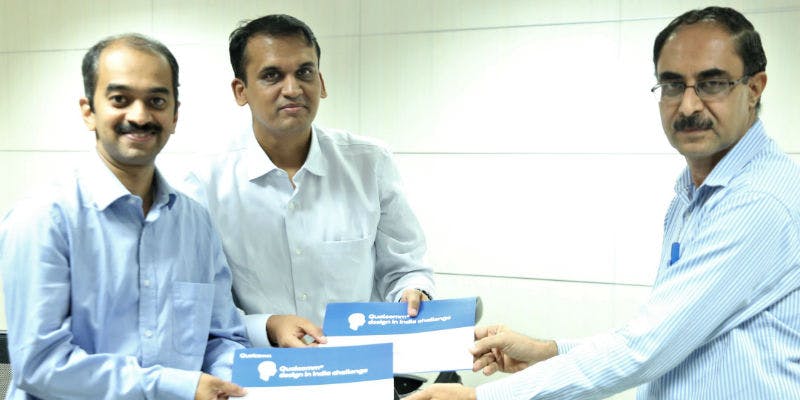
Winners of QDIC 2017 Cycle 2 and finalists for QDIC 2018 after receiving their certificates from Mr Ajay Prakash Sawhney, Secretary, MeitY, in New Delhi on June 20, 2018.

Launched in 2016, so far the accelerated design programme has incubated 24 startups with an overall investment of over USD 8.5 million. The Qualcomm Design in India Challenge supports fast design cycles and time to market, and leverages Qualcomm technologies to help Indian companies design and create products in the IoT space for global markets. Tagbox Solutions Pvt. Ltd. and Steradian Semiconductors Pvt. Ltd won Cycle I of Qualcomm Design in India Challenge 2017.

15 startups selected for 2018

Qualcomm has also announced the top 15 finalists for Qualcomm Design in India Challenge 2018. Three winning startups will be selected from these 15 shortlisted entries in early 2019.

Talking about what to expect in the 2018 programme, Rajen Vagadia, Country Manager, Business Development, Qualcomm India, said, “We are thrilled with the overwhelming response we received for the 2018 chapter, which marks an increased focus on putting startups on an accelerated path towards growth and development. Our shortlisted finalists come from all over India, representing a diverse range of products and applications across different spheres. Augmenting this diversity, we have three of our shortlisted startups run by women entrepreneurs.”

The 2018 programme has some new elements:

Prize money for the winners: At the end of the incubation period, the winner of two runners-up will be awarded with $100,000, $75,000 and $50,000 respectively.

Patent filing incentive: Qualcomm will provide each startup an amount up to $ 5,000 for patent applications, filed with either the US Patent and Trademark Office (PTO) or the Indian Patent Office during the incubation phase of the programme.

Access to accelerator programme services: Qualcomm, through its association with Anthill Ventures, will offer accelerator services to the 15 shortlisted startups at no additional cost, on various parameters such as series A and pre-series A pitch preparation, operations planning, industry connects, competitive landscape analysis, financials and cash flow and product management.

Meet the 15 companies that have been shortlisted for the Qualcomm Design in India Challenge 2018 edition:

  1.  Artificial Learning Systems, Bengaluru: An AI-enabled product that can detect diabetic retinopathy on handheld devices.
  2.  Avantari Technologies, Hyderabad: A wearable platform for keeping track of cardiac parameters combined with remote monitoring capabilities to predict cardiac abnormalities at an early stage.
  3.  Bioscan Research, Ahmedabad: A hand-held brain haemorrhage detector that is non-invasive and fully computerised.
  4.  Chigroo Labs, Bengaluru: A smart cradle, Cradlewise, for baby sleep management and health monitoring.
  5.  Dimension NXG, Thane: A platform that aims to decrease cost, time and errors involved in operations and training, using an Alternate Reality/Virtual Reality headset called ‘AjnaLens’.
  6.  Janitri Innovations, Bengaluru: An affordable, easy-to-use, wearable and portable fetal heart rate and uterine contraction monitoring device.
  7.  Lazy Design, Pune: A behavioural AI-powered smart ring that predicts and displays the right shortcuts for users and enables control with the swipe of a finger.
  8.  mBreath Technologies, Kharagpur: ‘SleepDoc’, the world’s first multi-person AI-driven wireless sleep assistant to non-intrusively monitor vital parameters.
  9.  MobiusWorks, Bengaluru: A smart wearable, ‘Wagr’ and a mobile app that helps keep your pets safe and fit.
  10.  Nearex Technologies, Bengaluru: An affordable 3G/4G payment terminal.
  11.  PiOctave Solutions, Bengaluru: A smart network video recorder (NVR) and gateway for the connected home.
  12.  Sensworx Systems India, Hyderabad: A cellular IOT-based smart water meter, which provides real-time water analytics and alerts on water leakage, health monitoring and performance.
  13.  Shellios Technolabs, New Delhi: A smart helmet that not only protects the head, but reduces the impact of pollution, heat and impaired communications on the rider.
  14.  TestRight Nanosystems, New Delhi: A portable and affordable visible light spectrophotometer to determine the optimum wavelength for study, and concentration and kinetics experiments.
  15.  Turtle Shell Technologies, Bengaluru: A non-contact, non-intrusive device that converts bed time into regular health check-up time for patients with chronic sleep disorders.

source: http://www.yourstory.com / Home> Qualcomm Brand Spotlight / by Team YS / June 22nd, 2018

14-year-old Bengaluru boy designs ‘smart’ chair for techies

A little wonder

A 14-year-old Class IX boy, Manaswith Shankar, has designed a smart chair to help techies suffering from phyical problems arising out of spending long hours before computer. His invention has also won him a prize at the INSEF Regional Science Fair in Rajkot last January.

The ‘smart’ chair

Manaswith’s ‘smart chair’ has a timer, DC motor (vibrator), buzzer and airblower. After two hours of continuous sitting, the buzzer gets on and after one-minute interval, the chair begins to vibrate and if you still refuse to get up, after one minute, the hot air blower is on forcing the person to get up from the seat. Still if the user refuses to get up, the monitor automatically shuts down.

Turbo pot

Manaswith has also developed a turbo pot prototype which fetched him a prize for ‘quick cooking’. Turbo pot is a high quality cookware that heats up twice as fast as regular cookware, saving time and LPG.

Other inventions

At 11, a tractor prototype, his first project, which runs on solar power. He has also developed a ‘armour’ a device for self-defence for women. The device has a GPS unit connected that can be monitored at nearby police station. This hand- held watch consists of retractable plug/knife/metal part which is hidden. It fits well on a wrist strap or in a purse or handbag.

Dangers of sitting long hours

Sitting for excessively long periods of time can even lead to early deaths, suggest many studies. Neck/back pain is a common problem among those who spend long hours sitting before computers. (photo for representation only)

source: http://www.economictimes.indiatimes.com / The Economic Times / Home> Business News> News> Science /  June 20th, 2018

Boeing expands aerospace engineering footprint in Bengaluru

To work on cutting-edge tech that drives aerospace innovation

Bengaluru :

Boeing inaugurated its Boeing India Engineering and Technology Center (BIETC) in Bengaluru. The facility, spread across 150,000 square feet and eight floors, will double Boeing’s existing footprint of 160,000 square feet and will accommodate another 1,000 employees, who will work on cutting-edge technologies that will drive aerospace innovation from India, for India and the world.

While the new facility will incorporate software technologies into design, manufacturing and service offerings, Boeing will continue to scale up its aerospace, R&D and engineering activities at its existing facilities.

BIETC is recruiting and scaling up exponentially. The centre has increased its employee count from just 100 when it was inaugurated in early 2017, to over 1,000. And, as the centre grows over the next few years, it will develop into a team of over 2,500 employees in specialised fields of IT, engineering and R&D.

From an IT perspective, key focus would be on cutting-edge areas such as Product Lifecycle Management, Enterprise Resource Planning, Internet of Things, Blockchain, Data Analytics and Software Design for aerospace. BIETC is also continuing to build teams focused on advanced aerospace research in materials and manufacturing, aircraft structures and airplane health management.

Boeing’s engineering teams continue to excel and innovate in Digital Aviation, electrical, mechanical and systems design and providing support for lab and flight testing for aircraft.

“We see India as a hotbed for path-breaking software solutions that can redefine the way the world designs, operates and manages airplanes,” said Ted Colbert, Boeing’s chief information officer and senior vice president of Information Technology & Data Analytics, while inaugurating the new facility. “The IT talent and capabilities available in India will be an enabler for Boeing’s success across the world.”

The facility will contain an integrated lab for Internet of Things (IoT), Analytics and Mobility, a 3DX lab to develop 3D experiences, a Systems Integration Lab and a Proof of Concepts Lab. Over 25 Collaboration Areas in the facility will further enable teams to work together to develop, scale and deliver aerospace innovations with agility. The new facility will also enable driving strategic initiatives like Digital Transformation.

“We are excited about Boeing’s ever expanding footprint in India. The new engineering facility at BIETC reflects an agile and driven Boeing in India, one that inspires people to collaborate and accelerate step-change innovation,” said Pratyush Kumar, president, Boeing India.

“This centre brings together engineers from the fields of aerospace, computer science and mathematics, who will collaborate to achieve next-gen breakthroughs for aircraft design, manufacturing and maintenance,” he added.

In addition to developing engineering capabilities, Boeing is actively involved in developing skills across the aviation sector by partnering with Indian vocational training institutes and industrial training institutes to train workers for the aerospace industry.

source: http://www.thehindubusinessline.com / Business Line / Home> News> Special / by Anil Urs / Bengaluru – June 15th, 2018

Jallikattu champs, born in Karnataka

Racing bull: A Hori Habba enthusiast displays a Hallikar sporting breed at Tadasanahalli, in Shikaripur taluk. | Photo Credit: Vaidya

Drought-hit farmers rescued by the popularity of their bulls in Tamil Nadu

Vishnuvardhan, Sudeep, Darshan Thoogudeepa, Yash, and Duniya Vijay are not only popular Kannada film stars – all of them are also sturdy bulls from Karnataka that are taking Tamil Nadu’s Jallikattu by storm, with some of them selling for as much as ₹12 lakh, and earning their breeders a neat profit.

The bulls, reared and trained in the semi-arid Shikaripur taluk of Shivamogga district, have acquired a reputation for agility, speed and sturdiness. They are in great demand in Tamil Nadu following the resumption of Jallikattu in the State.

Shikaripur’s racing bulls are fetching almost double the money the farmers invested on purchasing the calf, and rearing and training it.

Trained for local sport

The bulls get trained in the local bull-catching sport, ‘Hori Habba.’ In Shikaripur taluk alone, more than 120 Hori Habba events are held between Deepavali and Sankranthi. The sport involves making bulls of the ‘Amruth Mahal’ and ‘Hallikar’ breeds run in the ring. Whoever succeeds in catching or taming them wins. Mr. Kumaranna, a farmer from Gandhi Nagar village of Shikaripur said that it costs him around ₹12,000 a month to keep the bull fighting fit. Four years ago, he bought a six-month old male Hallikar calf for ₹50,000. Recently, he sold it to a Jallikattu enthusiast from Tamil Nadu’s Vellore district for ₹12 lakh. Another bull reared by Zakir Saab in Narasapura was sold to a buyer from Alanganallur in Madurai district for ₹11 lakh.

Nandan Sommananavar, who is doing research on Hori Habba in Kuvempu University said that in the past six months enthusiasts from Tamil Nadu bought more than 60 bulls from Shikaripur. The bulls are typically named after Kannada films (Mylari, Raja Huli, Tagaru, Hathavadi, Saarathi) and film stars.

source: http://www.thehindu.com / The Hindu / Home> News> National / by Veerandra P.M. / Shivamogga – June 08th, 2018

This 11-year-old CEO heads an initiative that organises drum circles

SB Sharan
SB Sharan

With Drum Circle, the age barrier is lifted and everyone comes together to make music, says SB Sharan

When SB Sharan hands his business card, he does it with the confidence of someone who has done it before. Still, he is not your regular CEO: firstly, he is a grade IV-level drummer at the Trinity School of Music, and secondly, he is all of 11. In January, Sharan started his company Drums Circle, an initiative to build community harmony through percussion.

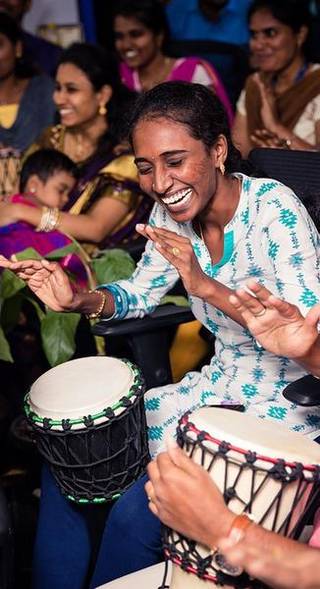
Sharan heads drum circles at corporate team building sessions and other events and parties; he plays — and teaches others how to play — djembes, bongos and shakers. “Playing drums in sync builds a feeling of togetherness and also helps relieve stress and anxiety,” says Sharan.

What does he know about stress and anxiety? “Not much,” he laughs but adds, “Playing drums has helped me develop better concentration and listening.” Most of all, he credits drums with breaking barriers and spreading happiness. “Take any gathering, you’ll see that there are children, elders— all busy among themselves. But with Drum Circle, the age barrier is lifted and everyone comes together to make music.”

DrumCircleBF31may2018

It’s surprising that drums became Sharan’s passion, given how scary his introduction to them was. “The memory of my first private drums class still horrifies me. I was just five. My teacher had long curly hair and I used to think he was a ghost,” he sheepishly admits. He quit soon after, only to join another class when he was eight. This talent for drumming translated into a business through Kidspreneur, a school for helping children run companies. His first event was with 15-20 children his age and his first corporate event was for OptiSol Business Solutions.

“The first time, I felt very shy. Nobody listened to me,” reveals Sharan. “The problem was that everyone was busy playing on their own.” Getting people to drum in sync is a skill that he has mastered over several events. He recalls the latest one he performed at, “I was heading a drum circle in an orphanage in Kolathur. The people there told me that two of those kids would rarely laugh. But while playing the djembes, they did.”

Sharan is serious about his business: with the name of his company already printed on half his clothes. “We are in talks with drummer Sivamani to act as Sharan’s mentor in Mumbai,” says Mohana Lakshmi, founder of Kidspreneur. Sharan started out with buying 10 bongos via crowd-funding. Today, after seven events, his collection has increased to 70 djembes and eight shakers; costing a sum of over ₹2 lakh. Four of those events were ticketed at ₹650 per head.

The invisible hand behind all of this is Sharan’s father, who helped him with the financial aspect when crowd-funding was not enough; Sharan promises to repay him. Sharan’s father has actively gotten contacts and promoted his son on social media because of his work in the event management field. “He is with me every step of the way,” says Sharan, “He’s my best friend and more.”

For details and bookings, log on to www.drumscircle.in or call 9790701816.

source: http://www.thehindu.com / The Hindu / Home> Entertainment> Music / by Sweta Akundi / May 30th, 2018

Wealth from waste! This loom in Bengaluru can turn paper, rubber strips into green products

Bengaluru :

Raahul Khadaliya, 36, founder, Studio ABCD, started the dialogue around reusing waste in 2011. That was when sustainability had yet not become a buzzword. “Clients didn’t want to pay extra for sustainable practices,” says Khadaliya, a NIFT Bengaluru graduate, whose design firm helped businesses with branding and visual communication with a focus on sustainability.

With an idea to launch a project that was sustainable from a social, innovation and environmental impact, Khadaliya, started The Second Life Project in 2012 that was upcycling newspapers using traditional block printing technique to turn discarded paper into gift wrapping paper.

 “Block printers are losing their livelihood to machine printed products. The idea was to think of an alternative livelihood for these craftsmen. It had three purposes — waste management, sustainable livelihoods and to raise consumer awareness on reusing waste,” he adds.

Over time, Khadaliya realised that a large amount of paper was also wasted in printing presses. “There is 5-8% of wastage when brochures and other such things are printed. On a large scale that amounts to a lot. These end up in landfills or waste because there’s no place to store them,” he says.

 It was then that the idea of weaving handloom from waste paper began to take shape. After eight months of research, Khadaliya built a paper weave loom, a redesigned version of the handloom. Made from waste wood, it can weave flat substances into raw material to be used further. “While our current focus is on paper, in future, we have identified waste materials like rubber tube strips and flex banners, which are a great nuisance, to be turned into woven handloom. The loom works completely on renewable human energy and the entire process is green,” he adds.

 While making garment is not possible from this woven handloom, it can be used for panelling in interiors, making removable partitions, linings, wall art, gift wrapping. “We are currently looking at funds to scale this up. In future, we will collaborate with nonprofits to increase production. The final aim is to build a cooperative like the Lijjat Papad and provide meaningful and sustainable livelihoods to artisans and people,” Khadaliya says

According to Sunitha Jayaram, product lead, Saahas Zero Waste, a socio-environmental enterprise that believes in a circular economy, an innovation like this can help raise awareness about not only waste produced by different industries but also how to put that to good use. “Using the waste of one industry as a raw material for another is what circular economy is. Once people see products that come out of waste, it can also help behavioural change towards reduce, reuse and recycle,” Jayaram adds.

source: http://www.economictimes.indiatimes.com / The Economic Times / ET Home> Magazine> Panache / by Ipsita Basu, ET Bureau / May 24th, 2018

Nyamagouda laid to rest in Jamkhandi

Deputy Chief Minister G. Parameshwara and former Chief Minister Siddaramaiah paying tributes to Siddu Nyamagouda, veteran Congress leader, at Jamkhandi in Bagalkot district on Tuesday.

The last rites of Siddu Nyamagouda, Jamkhandi MLA, were performed with full State honours at his native town of Jamkhandi on Tuesday.

The Congress veteran died in a road accident in Bagalkot taluk on Monday.

His body was first kept at Polo Grounds in town for the people to pay their last respects. Later, the body was taken in a procession to Jamkhandi sugar factory premises — of which he was the chairman — where he was buried.

Thousands of people, mainly farmers, participated in the procession and paid tribute to the leader.

Former Chief Minister Siddaramaiah, KPCC president G. Parameshwara, elected representatives of various parties of Bagalkot district, and several seers were present on the occasion.

In his condolence message, Mr. Siddaramaiah remembered Nyamagouda as ‘Barrage Siddu’ a moniker he got when he took the onus of constructing a barrage at Chikkapadasalagi village for the farmers, with public money and support.

In his address, Dr. Parameshwara said the party has lost a true public leader and down-to-earth man.

Chikkapadasalagi barrage

Karnataka Pradesh Campaign Committee chairman D.K. Shivakumar on Tuesday urged Chief Minister H.D. Kumaraswamy to name Chikkapadasalagi barrage after Congress legislator Siddu Nyamagouda. In a letter, he said Siddu Nyamegouda was instrumental in building the barrage across the Krishna through shramdhan and donations received from farmers. Naming the barrage after him and installing his statue would be a befitting honour, he added.

source: http://www.thehindu.com / The Hindu / Home> News> States> Karnataka / by Special Correspondent / Bagalkot – May 29th, 2018

Medlife launches its first diagnostic lab in Bengaluru

Bengaluru (Karnataka) :

Medlife, a fastest growing healthcare company and largest omni-channel pharmacy, has launched its first diagnostic lab in Bengaluru , as part of an aggressive plan to expand its offline footprint in India. The company has started off with Bengaluru  and will gradually ramp up to other metro cities in the country.
As the largest e-pharmacy in India, covering over 80 percent of the country’s pin-code, Medlife offers customers both medicines, diagnostics and other healthcare facilities through its online portal, mobile application and customer care centres.
With scalable technology and deep analytics, Medlife, in a short span, has successfully created a strong distribution network and unparalleled delivery model that has made healthcare simple, accessible and affordable to people across India. It was, thus, time to leverage these capabilities and deep learning and create a world-class offline business that provides its customers with a seamless healthcare experience.
The company expects revenue of INR 200 million by the end of this financial year from the diagnostic vertical. Medlife has already invested INR 6 Million and is planning to invest another 43 Million within the next year, to set up 6 satellite labs in addition to the centralized lab launched in Bengaluru . The lab is undergoing ISO certification and will receive its NABH and NABL certification by FY 19-20. The diagnostic lab will operate under the name ‘Medlife Labs’. Medlife Labs also promises same day report delivery and free home sample collection to all their customers.
Tushar Kumar, CEO, Medlife said, “Our focus is to build a world-class infrastructure for healthcare. We, at Medlife, have constantly endeavoured to ensure quality healthcare services with affordable rates reach the maximum number of people in India. Through our innovative tech-enabled platform, we’re building customer touch points across online and offline platforms that can seamlessly integrate to provide a high-quality healthcare experience for our end-users. The launch of lab services is in line with this commitment and endeavour.”
“Around 70 per cent of treatment decisions in India are based on lab results. Needless to say then, diagnostic services constitute one of the most critical components of medical care in India. It also helps in building a preventive care ecosystem and better diagnosis of health problems. Thus, creating substantial impact on the continuum of care,” added Kumar.
The diagnostic laboratories industry in India is poised for strong growth because of rising demand for healthcare but lack of regulation remains a major concern, considering the risks it poses to patients. The diagnostic laboratories sector in India is highly fragmented with standalone centres accounting for ~ 70 percent of the market and organized ones having ~ 30 percent shares. India has around 100,000 diagnostic laboratories, which include pathology laboratories and radiology centres.
Since its inception as an e-pharmacy company in 2014, Medlife has diversified into 24X7 e-consultation, laboratory services, and app-based healthcare-related services. In a short span of just over two years post-launch, Medlife went on to create a customer base of one million unique customers. The company recently launched its own line of generic drugs in line with the Government of India’s recent efforts to encourage the use of affordable generic drugs in India. Apart from diagnostic labs, Medlife will also be launching offline stores across 50 cities this financial year.
Backed by promoters with credible experience in pharmaceutical and healthcare e-commerce businesses, Medlife is known for its best-in-class quality, 100 percent regulatory compliance and zero-delivery error. With a planned internal investment of $30 million to scale up operations, the company expects to earn revenue of Rs 900-1000 crores by financial year 2019. (Businesswire-India)

source: http://www.aninews.in / ANI / Businesswire India / May 28th, 2018