Category Archives: Business & Economy

US-based Analog Devices opens new facility in Bengaluru

US-based technology company Analog Devices (ADI) on Wednesday unveiled its new state-of-the-art facility for nearly 600 Bengaluru-based staff who are part of ADI India.

Bengaluru:

US-based technology company Analog Devices (ADI) on Wednesday unveiled its new state-of-the-art facility for nearly 600 Bengaluru-based staff who are part of ADI India.

The new facility, which houses one of ADI’s top three global design centres, will focus on developing and selling technologies and solutions for the global automotive, industrial, healthcare, consumer, Internet of Things (IoT), security, communications, and energy markets, the company said in a statement.

“We have been aggressively investing in our global facilities. This investment in ADI India will better position us to accelerate growth and impact for ADI,” said Yusuf Jamal, Senior Vice President of ADI’s Industrial, Healthcare, Consumer, and IoT Solutions and Security Group.

ADI India started as a three-person product development centre in 1995.

Today, ADI India is a global development centre, working collaboratively across ADI businesses at every stage of product development as well as providing the supporting software.

“As we move into this new facility, we plan to expand our university relations programme work with reputed academic institutions, which includes fellowships, sponsorships and internship opportunities, through additional partnerships and talent acquisition from engineering colleges across the country,” said Sai Krishna Mopuri, Managing Director, ADI India.

ADI India plans to hire software, systems engineering, and IC design and development engineers both at the experienced and entry levels.

source: http://www.telecom.economictimes.indiatimes.com / ET Telecom from The Economic Times / Home> Telecom> Latest Telecom News> Industry / by IANS / April 25th, 2018

Tech Incubator Sandbox Startups Provide DST-NIDHI Funding to Three Hubli Based Companies

Central Government-recognized technology startups incubator, Sandbox Startups invests in three of the incubated companies under NIDHI-SSS funding backed by the Department of Science and Technology, Government of India. Funding will enable the startups to graduate to the next level in terms of technology and this will take them to a better position to raise funds for further growth.

NIDHI-SSS (National Initiative for Developing and Harnessing Innovations-Seed Support System) is an umbrella program targeting at startups which aims to nurture knowledge-based and technology-driven ideas into successful startups. They also provide financial assistance to startups whose ideas or products offer promise and are designed to address novel problems. The three startups which received funding under the NIDHI-SSS are: Freshboxx Services Pvt.Ltd., a supply chain e-Commerce startup; Wide Mobility Mechatronics Pvt. Ltd., which offers end-to-end machine vision and inspection designed for different industries; and Microchip Payments Pvt. Ltd., a Hubli-based startup that offers reliable digital payment solutions.

C M Patil, CEO, Sandbox Startups, says, “Most entrepreneurs struggle hard to raise the angel or seed funding during the early stages and this fund from NIDHI-SSS is like a boon for the entrepreneurs in the ecosystem. We at the Sandbox Startups are building an entrepreneurial ecosystem in non-metros. Because of our geographical location, it is more difficult for entrepreneurs here to raise funds. We are thankful to the DST for this fund allocation which would help organizations like our Sandbox Startups, a central government-recognized technology business incubator, to invest against equity and build a self-sustainable model wherein we can co-create entrepreneurial culture in our ecosystem. With this funding mechanism in place, it allows us to invite the investment firms to co-invest in the startups associated with us, which in turn will help more mission-driven entrepreneurs.”

Founded in 2008 by Deshpande Foundation, Sandbox Startups is a Hubli-based global incubator which supports impactful entrepreneurs from tier II and tier III cities with seed funding, mentoring, network support, tech assistance, co-working space. It joined hands with Department of Science and Technology, Government of India in 2015-2016 and they’ve incubated more than 70 startups and aided almost 300 budding entrepreneurs.

Incubated three years ago, Freshboxx is an online fruits and vegetables enterprise that caters to customers in tier II cities and operates in B2B and B2C segments. With a network of over 10,000 farmers, Freshboxx saw an exponential growth rate after the incubation. Rohan Kulkarni, CEO of Freshboxx, says, “We want to enable a unified supply chain from farms to stores and our next focus will be to leverage machine learning, Artificial Intelligence and data analytics for improved decision making in understanding the needs of our customers. We are in talks with potential institutional investors to raise funds.”
In 2016, Sandbox Startups incubated Wide Mobility Mechatronics that delivers digital scanning services to industries like food, automobiles and electronics. It also provides internal inspection of products using X-Rays,cameras and digital radiography. Shekhar Basavanna, CEO of Wide Mobility Mechatronics, comments, “Sandbox, I would say, has first of all brought in an understanding of looking into all aspects of growing a start-up, making us realize that making a product/materializing a concept is just a part of the work done.”
On the other hand, Microchip Payments’ mobile-based payment application and point of sale device helps users to make payments without internet connectivity. The product gained appreciation from Massachusetts Institute of Technology, DCB Bank and others. Speaking about his startup journey, the company’s CEO & CTO, M. Farhanuddin Firaq says, “Post demonetization, we saw that one of the major problems that people faced in making online payments was poor internet connections. We started working on this idea and were supported and incubated at Sandbox startups.” Adding further, he says, “Today, we are proud to say that we are the world’s first company to build a completely non-internet powered digital transaction mobile application and a point of sale device.”

source: http://www.siliconindia.com / SiliconIndia / Home> Top News> Business / by SiliconIndia / April 19th, 2018

The village of boiled beans: How Bengaluru came to be

An aerial view Greenline Metro from Sampige Road to Yelachenahalli on the first day of its operation for public in Bengaluru on Sunday  2017.  Anantha Subramanyam K.  Credits: Mirror, BCCL, Bengaluru
An aerial view Greenline Metro from Sampige Road to Yelachenahalli on the first day of its operation for public in Bengaluru on Sunday 2017.
Anantha Subramanyam K.
Credits: Mirror, BCCL, Bengaluru

It is strange that the city of Bengaluru which we all accept today as a single city was not a single city at all until recently. Before Bengaluru was welded into a single city under a common corporation in 1949, it existed as a twin city. There were two portions to the city. The civil and the military portions were separate entities with a separate municipality and a separate collector. The job of the collector was to look after the revenue and the law and order problems of the city. He was functioning under the Resident. The Collector was also the Municipal President. The Bangalore city agglomeration had a population of 29,21,751 and the corporation area had a population of 24,76,355 in 1981. The city’s population recorded a growth of over 70% between 1971 and 1981.

The site of the present city had many prehistoric settlements. Neolithic tools have been located at the race course and Jalahalli. Byrasandra was also a prehistoric site. Dr Shikaripura Ranganatha Rao, an eminent archaeologist feels that the attractive site of the bugle rock at Basavangudi could have been a prehistoric habitat. Roman coins have been unearthed at Yeshwantpur and Jalahalli.

The name Bangalore is as old as the ninth century and the name is found in a Kannada inscription found near the Begur temple. A long record of circa 890 AD and the name appears to have a floral origin, derived from the tree Benga (Venga or Pterocarpus marsupium or the Indian Kino).

The explanation that the name was derived from Benda kala ooru, or the village of boiled beans as described by the Hoysala King Ballala when he was hungry during his visit to the place (when he was hunting) becomes irrelevant as the above name was much older that King Ballala of the Hoysala dynasty. Benda kala ooru or the place full of granite rocks is another explanation to a place name but granite is neither Bangalore’s exclusive speciality nor the old form, thousand years, found in the record indicates the place name being anyway connected to Benachu kallu. The place mentioned as Bengaluru in the Ganga record is originally a hamlet, even now called as Hale Bengaluru near Kodigehalli, not far away from Hebbal. It is said that Kempe Gowda I when he built the new capital town in 1537 called it Bangalore as his mother and wife belonged to the hamlet Bangalore, now Hale Bengaluru. In literary works, Bangalore is also called Kalyana Nagare or the ‘City Auspicious’. Though the fort built by Kempe Gowda then has totally vanished, the spots like the Yelahanka Bagalu (Mysore Bank Square) and Halsur Bagalu still exist. Halsur Bagalu or gate, now a police station is named after it. The gate proper even now remains hidden. The old remains of the ramparts and the moats were completely demolished during the nineteenth century. The town was conquered by the Bijapur sultans in 1638 and Shaji Bhonsle secured the town and its surroundings as a Jagir in 1638. The testimony to 50 years of Maratha rule is in the form of an inscription of Ekoji, Shaji’s son near the Kadu Malleshwara temple. Bangalore was conquered by the Mughals in 1686. The mosque at Taramandalpet is a notable vestige of Mughal rule. The city was leased to the Mysore ruler, Chikkadeva Wodeyar by the Mughals in 1689 and Chikkadeva Wodeyar expanded the fort to the south and built the Venkatramana temple in this fort area. This new fort in granite was strengthened by Haider Ali who secured Bangalore as a Jagir in1759. The British conquered the city in 1799 after defeating Tipu Sultan.

The original Bangalore city was clustered around the fort and city market and covered the area until the present Mysore bank square. Today, there is a bus stop at the place where the Dharmabudi tank existed earlier. The old city had areas like Cottonpet, Sunkalpet, Kumbharpet and the Balepet areas. The medieval character of the city’s old settlements typical of any old village is indicated by the names of these areas.

Every community or professional caste had its own street or streets in every village or town of ancient times. Sigebeli is the settlements of Brahmins, reminiscent of old Agrahara or Brahmapuri. Kempapura Agrahara was another settlement of the Brahmins created by Kempe Gowda II towards the Magadi road area beyond the Brahmabudi tank. Parts of Gandhi Nagar area appear to have been reclaimed from the Dharmabudi tank during the early part of the nineteenth century.

The Cantonment area grew as a separate township after the British shifted their troops to the place in 1806 and the first camp was located at the present Air Force Hospital in 1808. The present cantonment also consists of many old villages like Halasur, Blackpally, Doddakunte and Akkithimmanahalli. It was no part of the old Bangalore pettahs. At Domlur on the periphery of the old cantonment, the Chokkanatha temple built by the Cholas still remains. At Blackpally or Shivaji Nagar, there existed a Catholic church which later took some shape of the 18th century and now its is the St Marys Basilica. The cantonment area also saw the construction of some of the beautiful buildings of the European Renaissance style. Both churches and secular buildings which were mostly government offices during the 19th century.

New extensions were added to the town in Chamrajpet and Seshadripuram. Chamrajpet was named after Chamraja Wodeyar in 1892, the latter named after Dewan Seshadri Iyer. The visit of a plague in 1898 caused the creation of two bigger extensions in 1898. These were Basavangudi named after Basaveshwara temple or the Bull Temple in Sukenahalli village and Malleshwaram named after the Kadu Malleshwara temple in old Mallapura village. The area in both the places was full of fields.

The next time you think of Bengaluru as the city of Bengaluru, you would do well to remember its origins. There are several people alive today who remember the two distinct facets to the city; the pettahs and the cantonment. These portions were welded and expanded to make the beautiful city we live in.

source: http://www.bangaloremirror.indiatimes.com / Bangalore Mirror / by Siddharth Moorchung & Nikhil Moorchung / Bangalore Mirror Bureau / April 02nd, 2018

E-waste industry comes together to streamline recycling process

Bengaluru generates around 1 lakh metric tonnes of e-waste annually. | Photo Credit: Handout_E_Mail

Very little of the estimated 18 lakh metric tonnes of e-waste that India generates per annum is recycled

Of an estimated 18 lakh metric tonnes of electronic waste (e-waste) that India generates per annum, less than 2 lakh tonnes reach licenced recyclers. The rest is either reaching the unorganised sector (such as scrap dealers), or ending up in landfills. Not only does this mean that potentially recyclable e-waste is being wasted, but also that unscientifically managed e-waste is a hazard that stands exposed.

Now, around 180 recyclers from across the country have joined hands to change the narrative and come together to form the All India e-Waste Recyclers’ Association. To be headquartered in Bengaluru, the association will look at streamlining the dismantling and recycling cycle of e-waste in the country.

Gururaj N., general secretary of the new association, told The Hindu that the dismantling and recycling industry is a nascent one, though e-waste itself is not.

“The e-waste quantum is calculated based on the sales that happened in the previous year, according to which the estimated e-waste generated is 18 lakh metric tonne per annum. Bengaluru generates around 1 lakh metric tonnes. The other big contributors are the National Capital Region, Mumbai, Chennai and now Hyderabad and Pune. Electronics is a component in many things — from laptops and air-conditioners to cars, which has 26% electronic component. The rate of progress in technology is a big key in e-waste,” he said.

In addition to what are called ‘white goods’, such as television, household e-waste that includes fans, lights and other essentials translates into 100 to 150 kg of electronic items in each house at any given point of time, which could eventually end up becoming e-waste. Despite all this, recyclers are running at 40 or 50% capacity as little waste is actually reaching them, said Mr. Gururaj.

Tackling the basics

The association is aiming at tackling the basics first: work with local municipal bodies to set up e-waste collection centres similar to the dry waste collection centres that are now being established in many cities. They also want to ensure that people find it convenient to make their e-waste reach recyclers. For this, they are planning to set up technology-driven drop boxes to enable people to put their waste and be paid back through e-wallets.

“It is not a business where people want to give away items for free. In addition, we want to ensure that the recycling process pushes urban mining, wherein dismantling and recycling brings out raw material such as gold, silver and copper (present in small units in many electronic items). There is already a scarcity of ore, and these metals have higher consumption, but the same production levels, which is why their prices have gone up,” he said.

source: http://www.thehindu.com / The Hindu / Home> News> Cities> Bengaluru / by K.C. Deepika / March 30th, 2018

‘Pesticide-free’ poly-houses are catching on

A farmer in Karnataka grows sensitive broccoli using biotechnologies for the first time in country

At a time when all things “organic” is the buzzword, poly-houses are becoming a cause for concern due to high pesticide residues in the produce following indiscriminate use of chemicals.

In fact, the sustainability of poly-house cultivation is facing a threat as a sizeable number of them have closed due to soil degradation and attack by nematodes — harmful soil bacteria — and fungi, which have resulted in massive devastation of crops.

The Indian Institute of Horticultural Research (IIHR) has now come out with a series of technologies and practices to reduce the use of chemicals in poly-house cultivation.

“The main focus is to turn the high-end poly-house cultivation into a sustainable farm and economic activity,” said M.S. Rao, head of IIHR’s Division of Entomology and Nematology.

“This will result in not only production of pesticide-free produce, but it will go a long way in improving the financial health of poly-houses,” he said, while indicating that closing down poly-houses would result in a loss of ₹900 crore.

What has come as a shot in the arm for the IIHR is that a 24-year-old farmer Raju in Doddaballapur taluk near Bengaluru has used this technology showing it is possible to grow broccoli, a crop highly susceptible to various pests and diseases, without pesticides.

It is the first time in the country that broccoli has been grown in a chemical-free manner in a poly-house.

Of course, the experiment is not completely organic as the farmer has used a certain amount of fertilizers. But, the produce has been selling like hot cakes to exporters at a premium price since it is pesticide-free.

Mr. Raju, who migrated to Karnataka from Andhra Pradesh, took up poly-house cultivation on about one acre of land in Doddaballapur, of which broccoli is grown on half an acre.

What has enthused scientists is that he has trounced the general perception that chemical-free farming and reduction in fertilizers would lead to drop in yield. The farmer’s yield has not only increased by about 30% by using the natural plant growth promoters as well as bio-fertilisers and bio-pesticides of IIHR, but the cost of cultivation too has dropped by about 30% as he has not used chemicals and pesticides. He was able to earn about ₹4.18 lakh in 90 days.

Dr. Rao said the farmer used bio fungicide, bio nematicide, bio bactericide, bio fertilizers, neem and pongamia soaps as well as plant growth promoters developed by the IIHR.

It has helped improve soil fertility and reduce soil-borne pathogens.

If a farmer uses these chemical-free and cost-effective applications for two to three years, there is no need for soil enrichment for the next five years, he said.

Biotechnologist-turned entrepreneur J. Gavaskar, who has taken licences from the IIHR to mass produce and also sell some of its biotechnologies, says the awareness among farmers is slowly increasing about such bioapplications. “Big farmers and some Farmer Producers’ Organisations from Pune, some cities in Andhra Pradesh, Tamil Nadu and Kerala are trying out these chemical-free applications,” he said.

Other successes

Dr. Rao said ICAR-IIHR has demonstrated similar success stories in capsicum, European cucumber, tomato, gerbera, carnations grown under protected conditions in various poly-houses and guava, pomegranate, tomato, okra, brinjal, tuberose grown under open field conditions in Karnataka, Tamil Nadu, Kerala, Andhra Pradesh, Madhya Pradesh, Punjab, Maharashtra, and Bengal.

Farmers can get details on such microbial applications and bio-pesticides from the IIHR by contacting its director or Prof. M. S. Rao Ph: 9480607571; email: msraobio45 @gmail.com s

ource: http://www.thehindu.com / The Hindu / Home> News> States> Karnataka / by B.S. Satish Kumar / Bengaluru – March 28th, 2018

BHEL gets ISRO tech to make Li-ion cells

Indian Space Research Organisation (ISRO) has signed a technology transfer agreement with Bharat Heavy Electricals Ltd. for the manufacture of space grade lithium ion (Li-ion) cells for the space programme and other national requirements.

BHEL said it would set up a facility at its Bengaluru unit to make the cells. It would use the technology developed by ISRO’s rocketry node, Vikram Sarabhai Space Centre, based in Thiruvananthapuram.

Li-ion batteries power various applications on satellites and launch vehicles. An ISRO spokesman said the requirement would go up as the number of space missions is increasing.

Currently, BHEL assembles Li-ion batteries using imported cells. “The technology can also be extended for use in the emerging areas of energy storage and e-mobility,” the public sector major said.

The agreement was signed by S. Somanath, VSSC Director, and S. Biswas, BHEL’s Director (Engg., R&D), at the headquarters of ISRO in Bengaluru last Thursday in the presence of ISRO Chairman K. Sivan and BHEL CMD Atul Sobti.

source: http://www.thehindu.com / The Hindu / Home> News> Cities> Bengaluru / by Special Correspondent / March 27th, 2018

Winkle Mathias, the apostle of plants

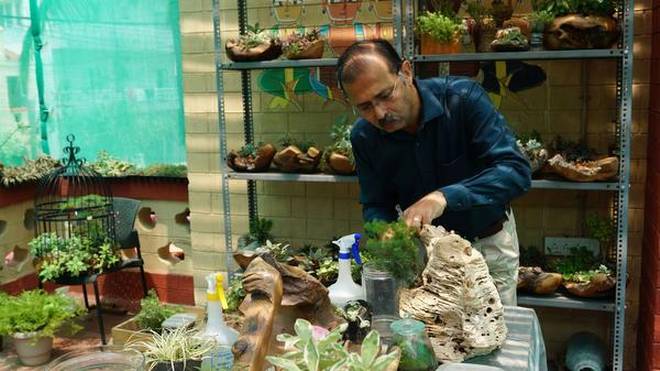
Winkle Mathias : The green warrior at work

Meet Winkle Mathias who goes that extra mile to give your home a green make over

Winkle Mathias always nurtured a soft spot for trees and plants. Originally, hailing from Mangaluru, the tree lover was brought up in Mumbai and took to carpentry for a living. It was a chance visit to Bengaluru 19 years ago that swept the man off his feet and he continued to stay on here. “I fell in love with this city at first glance. It was brimming with greenery. Today, it looks more like concrete jungle,” laments the man.

“People are selfish, they don’t realise the pain they are causing for themselves and the next generation. They are collecting logs by destroying nature and it gets burnt by somebody with a match stick. Unfortunately, it is not they who will suffer, but the next generation,” observes Winkle, who gives complete credit to his grandparents for instilling the love of nature in him at a very young age.

Winkle02BF28mar2018

“They would go into the forest foraging for food and collect mushrooms and greens. I would accompany them and would be in total awe of the greenery around me. It was fun to collect wild flowers. Little did I know those memories would trigger such passion in me one day,” recalls Winkle. He then started the Down To Earth company, in HBR Layout, Kalyan Nagar, which aims at using eco-friendly material that is easily available and is into landscaping and terrariums using plants and moss of every kind.

“Did you know that if we don’t protect the touch-me-not-plants they may soon go extinct? They are considered weeds and people are weeding them out,” states Winkle, who now cultivates these plants and talks to children about them and their benefits. “I talk to them about plants having feelings too and this plant expresses it the best. It closes its leaves and bows down when touched. What pains me most is when children and adults just pluck out a branch while playing or walking. I would love to give them a touch-me-not and tell them that it hurts the plant. None of us would like our hair to be pulled, right?”

Winkle believes we can sensitise children by exposing them to nature. “It is better to get them addicted to nature rather than gadgets,” he says. To propagate his love for nature he bought some barren land in Nelamangala 16 years ago and set out to create a green space on a two-and-half acre of rocky patch. “I picked up a few chickens and ducks and started visiting gujaris to buy a bath tub for the ducks. It was placed it in such a way that they could enter it easily. The land turned greener by the day and slowly I added a shed and planted a few trees following the sun’s patterns, so that the movement of the sun would create enough shade for the animals through the day,” beams the green warrior.

Winkle03BF28mar2018

Earthy office

Even his office is earthy. It is made from natural material such as bamboos, cane, earthen pots and jute to name a few. The terrace is dotted with terrariums of every size and even miniature landscaping. “I blend with nature and most of the projects I undertake are done with natural materials. The only problem is that these are so easily available that we have taken them for granted,” observes the man, who adds he can create anything green even if you give him stones, sand, moss or even waste.

Winkle loves to travel and observe nature, “especially the way a rock hangs out of a mountain or the manner in which water flows between rocks. These are the images that are captured in my heart and recreated in bottles and miniature landscaping in pots and bowls.”

Winkle04BF28mar2018

Landscaping is a huge part of his achievement. When he started it, he noticed that people “build their homes more for their neighbours than themselves. I want to change that notion. We will give you easy plants that will not shed leaves nor die out. And, even if it dies out, I will take it and nurture it back to life and give you a healthy plant,” assures Winkle, who has given quite a few gardens and balconies a facelift using natural light, plenty of plants and trees. “I believe a home can look gorgeous with greenery and natural material.”

Winkle plans to conduct classes with the “focus on how to use discarded pots, pans, ladles and even books to grow plants.” Winkle would also like to educate people on how to water plants. “We think we have to give a plant a head and a body bath. It is not necessary. You have to understand which plants need more water and which do not. Once you get your hands dirty, you sure are going to get hooked on to gardening.”

Call 40923565/ 9341247516 / www.d2e.ind.in

source: http://www.thehindu.com / The Hindu / Home> Life & Style / by Shilpa Sebastian R / March 27th, 2018

Made-in-India dialysis unit undergoes trials in Mysuru

Bengaluru:

A team of city-based researchers have come up with a made-in-India dialysis machine, which is expected to reduce cost of the medical procedure.
Designed by Renalyx Health Systems, the machine, RxT17, started undergoing clinical trials at JSS Medical College Hospital, Mysuru, from March 2. A 40-year-old renal disorder patient was the first to undergo dialysis on the new machine.

Dialysis machines are now imported from Germany, Sweden and China at a cost of 10-11 lakh a piece. A dialysis session costs between 2,500 and 4,000. The new machine is likely to be priced at Rs 4 lakh and it could reduce the cost of dialysis to 1,000.

The machine is cloud-enabled and can be connected to a mobile app, so that nephrologists can monitor its functioning and the patient’s response from anywhere.

” There are only 1,400 nephrologists in India and only 200 in Karnataka. There is a need to bridge the gap between patients and doctors through technological intervention. We can take the new dialysis machine to rural areas too, given its ability to connect seamlessly and its capacity to run on solar power.

Such features are not available in dialysis machines imported from Japan, the US and Germany,” says Shyam Vasudev Rao, an Indian Institute of Science (IISc) alumnus and founder-chairman of Renalyx.

Work on the machine began in 2013, driven by the vision to “create innovative and inclusive solutions for comprehensive renal care.”

Dr Lloyd Vincent, a nephrologist and co-founder of Renalyx, said the objective was to reduce the cost. “We have a project monitoring committee with alumni from Bombay and Delhi IITs as well as AIIMS, Delhi. The clinical trials are going on successfully. The product has been funded by the department of science and technology, New Delhi,” he said

 The company has patents and active collaborations with premier institutions, including IIT Kharagpur, Jawaharlal Nehru Centre for Advanced Scientific Research (JNCASR) and PESIT in Bengaluru.

Given the rising cost of healthcare, any innovation which brings down expenses is a huge relief for patients and their families. The clinical trials of a new dialysis machine are currently under way and once available for wider use, they promise to bring down the cost of treatment by a big margin. Such innovative research should be encouraged by the government through subsidies and tax breaks so that these machines become available in smaller towns and cities too. Innovative low-cost medical equipment is the need of the hour.

source: http://www.timesofindia.indiatimes.com / The Times of India / News> City News> Bangalore News> Civic Issues / by Sunitha Rao R / TNN / March 11th, 2018

Spastics Society director is ‘Bengalurean of the Year’

Namma Bengaluru Foundation presents awards for 2018

Rukmini Krishnaswamy, director of Spastics Society of Karnataka, has won the ‘Namma Bengalurean of the Year’ award given by the Namma Bengaluru Foundation, which is founded by Rajeev Chandrasekhar.

Sanjeev V. Dyamannanavar, an urban transport activist and one of the founders of Prajaa Raag, has been recognised as citizen of the year’, Rasheed Kappan, a senior journalist with Deccan Herald, as the mediaperson of the year, Dipika Bajpai, DCF, Bengaluru Urban, as government official of the year, Prashanth S.B., chairman of Nayonika Eye Care Charitable Trust, as social entrepreneur of the year, and Vidya Y., co-founder and trustee, Vision Empower, for her work to make education accessible to the visually impaired, as rising star of the year. These awards carry a purse of ₹2 lakh.

Citizen groups

The NBF also felicitated four citizen groups as ‘Champions of Namma Bengaluru – 2018’ for their work towards “reclaiming Bengaluru”, the theme of the awards this year. Friends of Lakes, a coalition of lake activists across the city, Save Pattandur Agrahara Lake and Save Kaggadasapura Lake, both local residents’ groups fighting to save and rejuvenate the lakes in their locality, and Project Vruksha Foundation, for its work on tree census, were the four citizen groups awarded on Sunday.

source: http://www.thehindu.com / The Hindu / Home> News> Cities> Bengaluru / by Staff Reporter / Bengaluru – March 26th, 2018

Karnataka’s first 4G tower of BSNL commissioned

Manoj Sinha, Union Minister of State for Communications and Railways, inaugurating Karnataka’s first 4G mobile tower of BSNL in Shivamogga on Saturday.   | Photo Credit: VAIDYA
Manoj Sinha, Union Minister of State for Communications and Railways, inaugurating Karnataka’s first 4G mobile tower of BSNL in Shivamogga on Saturday. | Photo Credit: VAIDYA

The first 4G mobile tower of the State-owned Bharat Sanchar Nigam Ltd. (BSNL) in Karnataka installed in Shivamogga city was commissioned by Manoj Sinha, Union Minister of State for Communications and Railways, at a programme held at Dr. B.R. Ambedkar Bhavan here on Saturday.

Mr. Sinha said that because of the dedicated efforts of its employees, BSNL has posted operational profits in the past three years. BSNL is upgrading its infrastructure and technology to extend quality service and has plans to install 534 more 4G mobile towers in Karnataka shortly, he added.

He said while there was a decline in the number of customers of private telecom companies after the entry of Reliance Jio into the market, there was a steady increase in the number of customers of BSNL.

On the progress achieved in providing high-speed Broadband to rural areas by laying optical fibre network under the BharatNet project, he said the network had been laid in 1.09 lakh gram panchayats by December 2017. The remaining 1.5 lakh GPs will be covered soon, he said, adding that access to Broadband services would bring about a comprehensive transformation in the social and economic life in rural areas, he said.

The Core System Integration (CSI) solution, an IT modernisation initiative, and the Digital Advancement of Rural Post Office for a New India(DARPAN) project for Karnataka circle of the Department of Posts was also rolled out by Mr. Sinha on the occasion. The DARPAN project aims at digitisation of rural post offices to upgrade the quality of services offered there. The CSI will bring all services of the Department of Posts, including mail handling, insurance, banking, retail operations, and administrative operations, on a single platform.

Senior officers of BSNL and the Department of Posts were present on the occasion.

source: http://www.thehindu.com / The Hindu / Home> News> States> Karnataka / by Staff Reporter / March 24th, 2018