Category Archives: Business & Economy

Infosys turns green, proposes 50 MW solar park in Karnataka

Bangalore :

In 2006, soaring hotel costs and traffic snarls led Infosys  to build Le Terrace, a four-star hotel with 500 rooms for its employees and overseas clients in its campus in Bangalore’s Electronics City.

Eight years on, the software industry posterchild is about to embark on generating its own power, in the process saving costs, getting clean reliable power for its operations and fulfilling its broader obligations to society.

(Eight years on, the software…)

Infosys has proposed a 50 mw solar park in Karnataka, becoming the first software company in India to think of generating its own power that will meet a bulk of the electricity needs of its offices in Bangalore, Mysore and Mangalore.

Karnataka’s Energy Minister DK Shivakumar told ET on Monday that Infosys had held one round of talks with the state government in which it had expressed keenness to build the solar power facility. “The company will buy land on its own,” he said.

Infosys confirmed the intent and said it will submit a formal proposal to the government once they finalise the land. “We hope to commission the park in about a year,” said Infosys Executive Vice President Ramadas Kamath told ET. Asked why Infosys is entering captive generation, he said that his company wanted to be self-sufficient in energy.

“We want to promote use of clean energy and reduce carbon emission. Solar is the best option. Several parts of  Karnataka  have good solar intensity. We now have solar technologies wherein you recover your investment in eight years. It has less of maintenance hassle, and easy to build,” said Kamath, who heads facilities, administration, security and sustainability at Infosys.

Kamath said the idea to build a solar park had been mooted a year ago by Infosys’ Head of Green Initiative Rohan Parekh, and had won the support of the company’s board of directors. “Narayana Murthy and the Board have been very keen that we do this,” Kamath said.

The company has already started looking for some 300 acres of land in regions of Karnataka where solar intensity is high. The company expects project cost, including land, to be about Rs 360-380 crore, small change for a company that is sitting on a cash pile of Rs 30,000 crore. Infosys estimates that it would require about five acres of land to generate one megawatt of solar power and excluding land costs, each MW of capacity will require its shell out around Rs 6.5 crore.

All the Infosys offices in Karnataka, which between them have around 65,000 seats, consume about 95 million units a year. The pro- posed 50 MW will generate about 84 million units, nearly 90% of Infosys present energy needs. 1 MW capacity equals 1000 kilowatts or 1.67 million units of energy a year and is enough to light up anywhere between 300 and 350 homes in cities such as Delhi, Mumbai or Bangalore.

“We will buy the balance from the grid,” Kamath said, adding that the company would consider scaling up its generation capacity based on its experience with the 50 MW initially planned.

Grid power presently costs the company, which has managed to halve its per capita consumption of power between 2007 and 2013, about Rs 5.65 per unit, while its own solar power would cost about Rs 3 per unit after factoring in depreciation . Barring a few states, grid power is unreliable in most parts of India, forcing companies to also have diesel-operated generators for back-up power and raising their overall power costs. Companies such as Infosys, which carry out mission-critical operations for mostly overseas clients, need uninterrupted power and its solar experiment, if successful, could lead to other firms to think along similar lines.

source: http://www.articles.economictimes.indiatimes.com / The Economic Times / Home> Tech> ITeS / by K. R. Balasubramanyam, ET Bureau / June 17th, 2014

Chidananada Rajamane is the new President of KASSIA

Mysore KASSIA elected and nominated Council members felicitated the newly elected President and Vice-President of KASSIA recently. Seen in the picture are C.M. Subramanian, Secretary, HIEMA; N.H. Jayantha, President, HIEMA; P. Kumar, Vice-President, HIEMA; Chidananda Rajamane, President, KASSIA; V.K. Dixit, Vice-President, KASSIA; Shreeshaila Ramannavar, Secretary, MCCI; Sadashiva, Member, MIA and Sujatha Sadashiva.

Mysore :

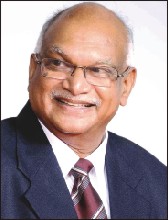
Chidananda Rajamane has been elected as the new President of Karnataka Small Scale Industries Association (KASSIA) at the Annual General Body Meeting (AGM) held on June 14.

The other office-bearers are V.K. Dixit, Vice-President; B.P. Shashidhar, Immediate Past President; Gopinathan, Hon. General Secretary; V. Bhaskaran, Joint Secretary-I; Basavaraj S. Javali, Joint Secretary-II and H.N. Ramakrishnaiah-Treasurer.

From Mysore, N.H. Jayantha, President, Hiema; Shreeshaila Ramannavar, Secretary, MCCI; Suresh Kumar Jain, Secretary, MIA; Manjunath and Sujatha have been elected to the Council of Management, according to a press release.

source: http://www.starofmysore.com / Star of Mysore / Home> General News / June 17th, 2014

Paper Subbanna, a legend in his own rights !

PaperSubbanaBF20jun2014

by  H.P. Naveen Kumar

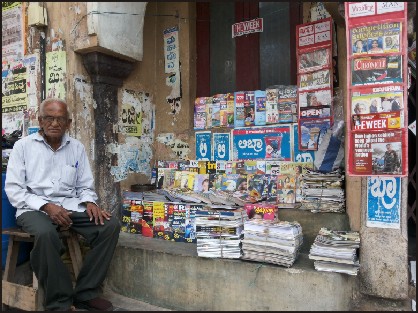
During the days when newspaper sellers are rarely recognised, here is an aging M.R. Subramanya, popularly called by his admirers as ‘Paper Subbanna,’ who is dedicated to journalism in his own kind by selling newspapers for the past five decades in the heritage city, thus justifying the title given to him.

Born in Mysore, Subbanna, who passed SSLC from Dalvoy School in city, took to distribution of newspapers and has been rendering a yeomen service to the field of journalism for the past 50 years.

His tryst with print: After unsuccessfully launching ‘Chitralaya,’ a tabloid devoted to film industry in Bangalore in 1963, Subbanna is now busy distributing newspapers, periodicals and books related to competitive examinations in all languages.

Later, lured by film journalism, Subbanna established an institution named Film Premier Association along with his friends and served as a reporter, critic, publisher and launched many programmes for the development of journalism.

After the collapse of the Lansdowne building, Subbanna now runs a shop opposite Merchants’ Co-operative Bank on Jaganmohan Palace road in city selling newspapers of all languages including Rajasthani, Hindi, Telugu, Tamil, Malayalam, etc.

Subbanna as a Publisher: After failing to achieve the desired results through his tabloid, Subbanna published many novels under the banner of ‘Sahitya Gangotri’ and created awareness on reading Kannada books and also achieved the distinction of publishing ‘Jenugudu’ scripted by celebrated Tamil writer Shantha through which he became a household name after being recognised by the Union Government.

Joined Kannada Chaluvali: Subbanna plunged into Kannada Chaluvali in his fight for propagation of Kannada and played a major role in the agitation against dubbing of Kannada films into other languages in the company of A.N. Krishna Rao, M. Rama Murthy, T.R. Subba Rao, Beechi, Sheshagiri Rao, Veerakesari, Seetharama Shastry among others.

Felicitations: Besides being felicitated for his contributions to Kannada language, Subbanna was honoured by the Dasara Exhibition Committee in 1992, Ambarish Award in 1995 by Ambarish Fans’ Association and also honoured in 2006 by a group of litterateurs from K.R. Nagar Taluk.

Paper Subbanna, who lost all his earnings after trying his luck in the film industry, is still well-known for his generosity towards visitors who come in search of him.

“I am happy with my profession and I am contented in life. The advent of TV has led a steep fall in newspaper readership which is regrettable but reading a newspaper over a cup of tea is itself a different and a wholesome experience,” says Subbanna.

Let us hope that the Government will take note of the contributions of Subbanna to the field of journalism and reward him appropriately.

After the demise of his wife Kamalamma six years ago, Subbanna is being looked after by daughter M.S. Nagashree and son M.S. Nagendra.

source: http://www.starofmysore.com / Star of Mysore / Home> Feature Articles / June 15th, 2014

Pilikula chirps with artificially hatched birds

A Moscovy duck born after being artificially hatched in an incubator at Pilikula Biological Park. — PHOTO: RAVIPRASAD KAMILA / The Hindu

More than 25 birds in Pilikula Biological Park born out of incubators

If you spot jungle fowls Moscovy ducks or yellow and red pheasants chirping in Pilikula Biological Park, they could have been born through artificial hatching of eggs.

The park has gone a step forward after the success of captive breeding of animals. It took up artificial hatching of eggs of some birds under controlled environment a year ago. As a result, more than 25 birds have born in this fashion, according to its director H. Jayaprakash Bhandary.

The park took to artificial hatching as some birds in captivity (in aviary) got disturbed by the movement of visitors and some birds did not sit on eggs for hatching. As a result success rate was less, he told The Hindu.

Thus, some grey and red jungle fowl, Moscovy ducks and yellow and red pheasants have born out of hatching in a controlled environment, he said.

Mr. Bhandary said that eggs were first put in an incubator for the hatching process under a controlled environment. Once the young ones came out of eggs they would be shifted to a brooder for a few days.

Then the young ones would be shifted to a mini cage and once they grew up, they are moved to the aviary. The entire process of artificial hatching would take between 21 days and 24 days.

source: http://www.thehindu.com / The Hindu / Home> News> Cities> Mangalore / by Ramprasad Kamila / Mangalore – June 19th, 2014

When passion swirls to reality …..

ChaiPatheBF19jun2014

Mysore :

You can always trust women to do things unique and differently as women and multi-tasking are two words that have always gone hand-in-hand. Their dynamic ability to juggle between altered roles at a time is one quality that helps them find themselves in great places.

Today, we will take you through the story of two such dynamic ladies who have been successfully juggling between three different interesting roles each of which hold a unique place in their lives.

Meet Nandita Nagaraj and Deepha Chengapa. This energetic duo has chosen three different things do. One for passion, one for soul and another for living.

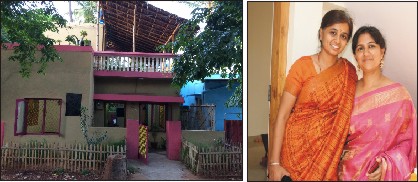
Their passion has given birth to a very uniquely functioning café called Chai Patthe; they teach English to little children at a government school to please their souls and for a living, the ladies are into setting up solar power plants which they have already done for several buildings across the country.

Let’s talk about Chai Patthe. A one-year-plus-old eatery with a very different touch to it for the way it functions. Chai Patthe is Nandita and Deepha’s dream-child, prepared and sold where are a whopping 70 different varieties of Tea along with some very interesting items to munch on. And all that’s available at the place is all the more special, for everything prepared there is made by no cooks but Nandita and Deepha themselves.

Walk into this cosy home with bean bags and cane seats within the rooms, relaxing upon which anyone can relish a simple Maggi to pasta and burgers or sandwich to cookies and brownies, in a very homely atmosphere. What’s more, top them up with some delicious varieties of tea which gets served to you in attractive earthen cutlery, and chances are, you’ll end up spending more than half a day at the place relaxing.

That’s not all. The place has much more than these to keep you at it. Book lovers visiting Chai Patthe can feast reading books from a mini library that’s maintained at the place, with a few but interesting books of varied genres. Those of who love playing games can enjoy playing uno, ludo, chess or crosswords with friends while their food and drink orders are being taken care of by the hosts.

“Our intention of starting Chai Patthe was not just for profit but to provide the visitors a nice and homely atmosphere where they could relax and enjoy a few simple and peaceful moments. Hence, we do not run it like a hotel. All things done and sold here are home-like,” explains Deepha, adding, “We also have a thatched roof seating where people are free to come over and celebrate their special days, read books, paint an art piece, write college records or even do school home works. We are glad we have such visitors too.”

The place which is open between 10.30 am and 7.30 pm daily, remains closed on the days when the ladies are busy with their power plant works for which they tend to travel outside the city. And before 10.30 am each day, Nandita and Deepha are in the Government School, where they teach the children.

“We do not bother if we have to close the cafe at times as our customers who are regular know the way we function. We are very happy working this way and have no plans to expand, as we are into it just out of passion,” says Nandita.

They so prove that they started Chai Patthe for just passion that they have never advertised about the cafe anywhere till date. All the popularity they have gained is by just word of mouth.

Chai Patthe is a non-smoking, wi-fi enabled zone and is one lovely place where any visitor can walk-in directly to the kitchen. “And as our customers, most of whom are acquaintances, know it is just the two of us who cook, they wait patiently until their orders are placed,” says Deepha. “And it is lovely when some of our friends who visit us even help us in the kitchen,” she gushes, who freshly makes the home-baked cakes served at Chai Patthe at her home daily. And all the health conscious ones will love the cooking here as the women use nothing but brown breads and buns and only olive oil to cook dishes and believe in keeping the place plastic-free. Everything here is served in earthen containers, porcelain and glassware. We indeed need to applaud the women for so successfully juggling between so many things at one time. Chai Patthe is located at Jayalakshmipuram [0821-4195033].— AN

source: http://www.starofmysore.com / Star of Mysore / Home> General  News / June 14th, 2014

Former Acting Director of CFTRI Dr. G. Venkateswara Rao passes away

VenkateswaraRaoBF19jun2014

Mysore :

Dr. G. Venkateswara Rao (63), former Acting Director of CFTRI, passed away on June 11 at JSS Hospital in city following a cardiac arrest. A resident of CFTRI Layout in Bogadi, he leaves behind his wife and two sons.

Born on Feb. 19, 1951, Dr. Rao obtained his M.Sc in Chemistry from Andhra University in 1973 and Ph. D in Food Science from University of Mysore in 1983.

Dr. Rao joined Flour Milling Baking and Confectionery Technology, CSIR-Central Food Technological Research Institute (CFTRI) in 1974. He pursued research in the area of wheat science and technology for over 39 years.

He superannuated on February 2013 after holding the position of Acting Director, CFTRI for one-and-half years.

Dr. Venkateswara is a recipient of German Academic Exchange Service Fellowship during 1978 to 1980 and worked at Federal Research Institute for Cereal and Potato Processing, Detmold, Germany. He has visited Sultanate of Oman on the invitation of the Government to conduct study on Food Processing in that country.

source: http://www.starofmysore.com / Star of Mysore / Home> General  News / June 14th, 2014

Amazon India gets FDI battleready


Amazon India has commissioned two warehouses in Karnataka bigger than those in Mumbai and Bangalore.

SUMMARY

Continuing with its rapid expansion plans, Amazon India has commissioned…

________________________________________________________________________

Continuing with its rapid expansion plans, Amazon India has commissioned two warehouses in Karnataka bigger than those in Mumbai and Bangalore.

The two new warehouses, or fulfilment centres as Amazon calls them, are at Tumkur, 70 km from Bangalore, and Hoskote, 30 km from the city. The warehouses are said to be around 200,000 sq ft, bigger than the company’s two existing 150,000 sq ft fulfillment centres.

The warehouses are expected to give a fillip to the Seattle-based Amazon’s operations in India if the Centre allows foreign e-commerce companies to hold their own inventory and sell directly to consumers. At present, foreign companies can engage in business-to-business e-commerce, where 100% FDI is permitted.

Consequently, Amazon is restricted to being a marketplace in the country, providing third-party sellers with a platform to trade their wares.

The Centre is likely to open up the sector to foreign investment as early as next month, which, industry observers believe, might give players like Amazon — with deep pockets and proven infrastructure — an edge over its Indian competitors. The Indian e-commerce industry is valued at $3.1 billion and is expected to cross the $20-billion mark in the next five years.

Amazon declined to comment on the warehouses. A company spokesperson, however, said the company believed that opening up e-commerce to FDI would be good for consumers and businesses.

“We believe that opening up this sector to FDI will be good for consumers and Indian businesses as it would allow us to partner with local manufacturers to source products not carried by other sellers on the marketplace, giving Indian consumers unique and wider choices at lower prices. Allowing FDI will positively impact infrastructure development in the country,” the spokesperson said.

Since its arrival in India last June, Amazon has expanded its portfolio at a rate which has alarmed its rivals in the country. In the last one year, the company has increased its offerings to 15 million products across 28 categories and claims to have the largest selection in 11 segments, including books, movies & TV shows, home and kitchen ware, music and video games. The number of sellers on its platform has also grown 50 times since its launch to 5,000. Amazon has also forayed into the high-margin fashion with the launch of apparel stores for men and women.

According to Ankur Bisen, senior VP, retail, at advisory firm Technopak, “In the US, Amazon’s share is around one-fourth of the $220-billion e-commerce industry. It’s not that Amazon will come and take away everything that domestic players have accrued over the years. We will see some fair competition between the Indian and foreign players,” he said.

source: http://www.financialexpress.com / The Financial Express / Home> Companies / by Sayan Chakraboty / Bangalore – June 12th, 2014

NRDC ready to commercialise UAS’ patent-pending instant Ragi Mudde Mix

The National Research Development Corporation (NRDC) is ready for the  commercialisation of instant ragi mudde mix, a patent-pending product of the University of Agricultural Sciences, Bengaluru’s (UAS-B) Department of Food Science and Nutrition (FSN) of Process Technology.

The department, led by Dr H B Shivaleela, professor and university head, FSN, academic council member and scheme head. She, along with S Meenakumari and Rani Arvind, provided the technical know-how about the product to NRDC, which could be accessed by the small and medium food companies in India.

The instant ragi mudde mix formula has been developed to suit both small-scale and  mechanised processing. It does not involve a tedious process or require advanced processing equipment.

It could simply be blended with a specific amount of water in the desired cups/bowls, and heated in a microwave for four minutes, or steamed for four minutes in a pressure cooker.

“Ragi is known for its phyto-chemicals and calcium and fibre content. Developing an instant ragi mudde mix would now allow consumers easy access to the required daily nutrition intake,” said Dr Shivaleela.

The invention is aimed at developing simple process to prepare the ragi-based dumpling mix, which is a specialty food of Karnataka. The mix has brought stability and enhanced the value addition to cater to the growing demand of the product, particularly by the natives of Karnataka and Andhra Pradesh.

“There is also immense export potential for the instant ragi mix. People from Karnataka and Andhra Pradesh residing overseas can now pick it off supermarket shelves,” said N G Lakshminarayan, manager, business development; coordinator, IPFC, and chief vigilance officer, NRDC.

“A novel feature of the invention is that the mudde mix is a processed flour blend and ready to be used to prepare the Karnataka specialty, which is consumed by all strata of the local population,” said Dr Shivleela.

“In fact, the readymade mix is far more convenient with no lump formation during the predation process in contrast to the conventional process of preparing ragi mudde, which requires skill,” she added.

Therefore, UAS-B viewed it as a nutritionally-improved value-added processed food, saving considerable time vis-a-vis the traditional mode of preparation.

The option of easy preparation and cooking in microwave ovens could attract modern consumers towards instant ragi mixes in an age of ready- to-cook versions of processed foods.

source: http://www.fnbnews.com / FnBnews.com / Home> WideView> Top News / by Nandita Vijay, Bengaluru / Saturday – June 07th, 2014

Kannada cinema going global

Actor Yash (Photo: DC archives)

Bengaluru: 

Kannada cinema’s market has widened up, thanks to the class and hit movies it is producing. After Maanikya creating records, Gajakesari will be releasing in as many as nine countries shortly. The overseas release is being planned with 5 digital prints.

Gajakesari will be screened in the US, Australia, Germany, Ireland, Singapore, Canada, Japan, Hong Kong and the UK in the month of June and July. One of the overseas distributor has disclosed this information.

Yash will be attending the premiere at most of the places.

source: http://www.deccanchronicle.com / Deccan Chronicle / Home> Entertainment> Sandalwood / by DC Correspondent / June 05th, 2014

Maritime Firm Makes Hot Picks at UVCE

Bangalore :

For the first time in its campus placement process, a Nagpur-based company has selected 22 students of University Visvesvaraya College of Engineering (UVCE) with a pay package each of a whopping Rs 18 lakh per year!

A first-time recruiter at UVCE, Phoenix Maritime Sea Services, a ship management company providing services to shipping firms and merchant navy academies, has picked 11 mechanical, three electronics and communication and eight electrical and electronics students for jobs based out of Karnataka.

“A single company making so many offers with such impressive packages has not happened before,” said UVCE Principal K R Venugopal. However, there is a catch, he says. “The company requires students to pay `3-4 lakh towards training as a means to ensure students don’t take it up and leave.”

Vinay P, a mechanical engineering student, who has received the offer, said Phoenix works like a consultancy company to provide further training. “After we are trained, we can join merchant navy companies where our CTC may even increase,” he said.

Thumping Into UVCE

E-commerce giant Amazon selected two computer science students offering `11 lakh per year, investment banker Goldman Sachs selected one mechanical student for `10 lakh, Adobe offered two computer science students `8.3 lakh and Oracle offered seven students `7.5 lakh per year. But it is not the big payers that got students excited this time.

According to Varun K, a third year electrical and electronics student and placement coordinator, the maker of the legendary Bullet motorcycle, Royal Enfield, came to UVCE for the first time offering three mechanical students Rs 3.60 lakh per year.

“More than Phoenix, we were excited with RE coming here, which is the first time they are recruiting outside Chennai,” he said.

In the fag-end of its 2013-14 placement process, the 97-year-old UVCE had 87 companies visiting its campus making 539 offers to 301 students.

With results from six companies awaited, another 20 students could be placed. In 2012-13, there were 699 offers to 362 UVCE students.

Other Maiden Recruiters

First-time recruiters Godrej & Boyce made offers of `3.60 lakh each to seven students and Dell Research and Development also offered `5.50 lakh each to seven computer and information science students.

Other maiden big payers this year were Google, which came with an offer of Rs 13 lakh per annum and Tokyo-based Work Applications, which came with `30 lakh per annum.

However, they did not select any student.

“We have done better than R V College of Engineering, PES Institute of Technology and even M S Ramaiah Institute of Technology. But BMS College of Engineering is competing neck-and-neck with us,” Varun added.

source: http://www.newindianexpress.com / The New Indian Express / Home> Cities> Bangalore / by Bharath Joshi / June 07th, 2014