Category Archives: Business & Economy

Colours of Karnataka!

The designer - Lavanyaa KR.
The designer – Lavanyaa KR.

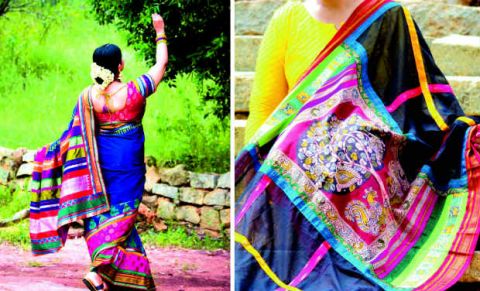
“Clothes are like an extension of one’s personality, so it really shouldn’t matter from which part of the world it comes,” believes Lavanyaa KR, a 30-year-old techie-turned-fashion designer. This Bengalurean is blowing minds away with her vibrant collection of South Indian traditional wear, titled Varnanggall.

“Varnanggall is a Tamil word for ‘colours.’ It’s about an artiste’s dream and vision to paint the world with her colours!” explains a passionate Lavanyaa. She is the light at the end of the tunnel for all those desis stuck abroad desparately planning their wedding.

“Based on my travels to some parts of the globe I sensed that people abroad were missing the online presence of an ‘affordable, unique 24 carat’ Indian traditional wear. I found it difficult to plan my wedding sitting in Boston, USA in spite of the existence of many e-commerce Indian fashion platforms,” she explains.

Her clothing line comprises sarees, dupattas, stoles and langa dhawanis. She also has home décor items. The starting price of a saree during an exhibitions is Rs 3,500.

During October, she held an exhibition called Aalapana in Bengaluru and was stunned with the response. “I will remain forever grateful to all the ladies for trusting and accepting this budding artiste,” she smiles.

saree-collageBF24nov2013

Moving to UK with her husband helped her expand the reach of her products. She has sold her products in India, USA, UK, Dubai, Australia, Finland, Germany, Malayasia, Singapore and Canada. She informs that there is a mad demand for Indian traditional wear all over the world, “Especially the South Indian traditional wear with zari work, traditional temple borders, kalamkari motifs, block prints, vibrant colours and beautiful workmanship,” all of which she offers.

What makes her clothing so accessible is that she operates entirely on Facebook. “With the confined investment in my kitty, it was not feasible and practical to set up a physical store. So I opted to work online,” she says, but she says a new store is “positively in the pipeline.” She has been strongly supported by her family and friends, who model for her brand and help her gain popularity. “My friend Supriya even wrote about me in her blog Aalayam and has helped my customer base know who I really am,” she says, sounding grateful.

Lavanyaa doesn’t just design. She also loves to bake, photograph, visit flea markets and charity shops. “I enjoy collecting artwork, swimming and doing pottery as well. But quality time with my family tops my list,” she concludes.

source: http://www.deccanchronicle.com / Deccan Chronicle / Home> Lifestyle> Fashion-Beauty / by Agencies/DC Online / by Swathi Chatrapathy / November 10th, 2013

Fitness hub comes to namma ‘fit’ Bangalore

Reebok opens its first Fit Hub, a fitness store, in Bangalore to help customers achieve their health goals.

Actress Nargis Fakhri at the Reebok store in Indiranagar to promote the sports apparel company's Fit Hub. - Anantha Subramanyam K/DNA
Actress Nargis Fakhri at the Reebok store in Indiranagar to promote the sports apparel company’s Fit Hub. – Anantha Subramanyam K/DNA

For a leading sportswear brand that thinks Bangalore to be a ‘fit’ city, the launch of Reebok India’s first Fit Hub concept store might appear to have come a bit late in the day. That’s because more than 30 such stores have already been opened across the country in the last four months.

But that contention might miss the point — Reebok has been rolling out these stores in phases, and it is only now that Bangalore’s chance has come. And the size does matter here. Erick Haskell, managing director of Adidas Group India, said, “This is a rather large store compared with the rest of our stores in India. In this country, the stores tend to be a little smaller (than this). It may be marginally smaller than the average store size globally, but it is larger than the average store in India.”

Reebok, which was bought over by Adidas for $3.8 billion in 2006, has plans for Karnataka, according to Haskell. The brand wants to open 10 more stores across the state in the next six months. Incidentally, most winners of a recent competition who will get the chance to work out with another of the brand’s ambassadors, John Abraham, are from Bangalore. The company would want to make the best of the fitness craze here.

Given this backdrop, it could mean the company tested the waters before launching the Fit Hub concept here. “After the tremendous response we have received for our Fit Hub stores across the country, we are extremely excited to launch Karnataka’s first Fit Hub store in Bangalore,” Haskell said.

These Fit Hub stores have been designed to generate greater interaction with customers, and help them find the right products to achieve their fitness goals. The Fit Hub stores in India have been designed on the basis of themes found in fitness studios. These will also have certified fitness instructors during peak seasons to assist customers and provide insights for choosing the right gear as per their fitness regime.

As of now, there are 28 operational Reebok stores in Bangalore and 40 in Karnataka. The brand plans to increase its retail footprint in the market by 15 per cent over the next few months. Its focus would be to strengthen existing stores by making them more consumer-friendly. The brand has recently repositioned to make consumers “fit for life” and also make the business more profitable for their partners.

Reebok’s Indiranagar store was one of the first stores to open in the then-desolate retail destination and soon became a retail hub for most of the other brands to join in. It has been a landmark store for the company and is now being offered in the “fresh form” of a fitness hub serving all fitness and training needs of loyal consumers.

Promoting fitness
Reebok India on Tuesday opened its first “Fit Hub” concept store in Bangalore. It was inaugurated by Bollywood actress and Reebok’s women’s fitness ambassador for their ‘Studio’ category, Nargis Fakhri, at Indiranagar.

Talking about the idea itself, Fakhri said, “The concept of Reebok Fit Hub stores is extremely exciting and designed to motivate people to adopt active and healthier lifestyles. .”

Recently in the news for Madras Cafe, the actress remarked, “I am thrilled to be associated with the brand in this endeavour. Reebok as a brand is focused on fitness, and its unique offerings are a testament to this. An example of this is the Studio category, a unique and innovative line of products focused on dance, aerobics and yoga designed especially for the women consumers. I love everything right from the super comfortable fabrics to bold electric print.”

source: http://www.dnaindia.com / DNA / Home> Bangalore> Report / by Subir Ghosh, Place:Bangalore, Agency:DNA / Wednesday – November 13th, 2013

Biocon sets up CoE; says biotech sector aims $100 b revenue

Bangalore :
Biotechnology major Biocon today announced the setting up of a centre of excellence (CoE) here for advanced learning in applied biosciences and said the biotech sector aims at a revenue of $100 billion by 2025.

The centre — Biocon Academy — would train and develop industry ready talent for India’s biopharma sector and enable global competitiveness, the company said.

“India has a potential of becoming a global innovation hub for biotechnology. The Indian biotech sector is estimated of the size of $11 billion today and it has grown at the CAGR of 20 per cent over last 10 years. The aim of the sector is to realise the revenue of $100 billion by 2025,” Biocon Chairperson and MD, Kiran Mazumdar-Shaw said here.

“If this is the trajectory that we need to aim for, it may call for a very impotent talent pool, and a very large talent pool that enables us to achieve this goal,” she added.

Stating that India has a very large opportunity to aim and achieve its goal of $100 billion by 2025, Mazumdar-Shaw said: “In order to do that we need appropriate talent to get us there.”

She said: “Today as we all know there is a very large gap that exists between the quality of human capital available and the need of the industry. While we have the academic sector in our country graduating a large number of biotech professionals we do believe they are not industry ready.”

“We have today over 725 biotech institutes in India, graduating 40,000 students per annum, but is it the appropriate relevant and rich talent pool we are getting? For which the answer is no, because barely 2,000 students get employed each year,” she added.

Pointing out that the challenge is huge and immense, Mazumdar-Shaw said: “What BT Finishing Schools (Government of Karnataka initiative) and we at Biocon through the academy are planning to do each year, it is very very small scale…. Over the next few years if we were able to actually create or expand the talent pool by 10,000 each year — that will be quite a lot.”

To a question on actual demand from the industry for graduates, she said “it is difficult to answer that — it is bit of a chicken and egg situation. If you had the talent pool you will have industries that will come in. You will have much more entrepreneurial companies being formed because of the right talent.”

“As we don’t have the right talent for now — we don’t have enough industries formulating in the biotech space.”

Adding to that she said “Biocon hires 1,000 new employees each year; we find it very difficult to get the right kind of students — it takes a lot of time to train these students to be industry ready. Out of 1,000 we hire almost 80 per cent are freshers.”

source: http://www.thehindubusinessline.com / Business Line / Home> Companies / by PTI / Bangalore – November 11th, 2013

Dravid to address CBI conference on corruption

New Delhi :

Former India captain Rahul Dravid  will be the star attraction at CBI’s international conference on corruption which will be inaugurated by Prime Minister Manmohan Singh on Monday and have law minister Kapil Sibal , finance minister P Chidambaram and several other dignitaries in attendance.

(CBI is celebrating its golden…)

Dravid will share his thoughts with the country’s premier investigators on corruption in sports in the backdrop of spot-fixing allegations in IPL. The three-day conference will focus on “evolving common strategies to combat corruption and crime”.

CBI is celebrating its golden jubilee and the conference is being organized as part of the celebrations.

With the cricketing world rocked with allegations of betting and spot-fixing, the agency has decided to introduce a special session on ‘Ethics and Integrity in Sports — Need for a Law and Role of CBI’ on Tuesday evening in which Dravid, Chris Eaton, director, International Centre for Sports Security and Ravi Sawani, chief of BCCI’s Anti Corruption and Security Unit (ACSU) will participate.

“The aim of this session is to recognize the root of the problem, evaluate the regulatory mechanism and legal framework in India and to ponder whether the time has come to have a specialized law to tackle corruption in sports,” CBI spokesperson Kanchan Prasad said.

Besides corruption in sports, the conference, to be attended by representatives of 20 countries and anti-corruption bureaus of states, will deliberate on issues such as natural resource management and extent of corruption, transnational human trafficking, crime and asset recovery, crimes related to intellectual property rights, cooperation in investigations in high profile cases, among others.

After the inauguration, Sibal will deliberate on the theme of the conference. Chidambaram will address the gathering on Tuesday morning on ‘Building a Criminal Justice System to Deal with Financial Crisis’.

The conference will also be addressed by national security adviser Shivshankar Menon and minister of state for personnel V Narayansamy who will preside over the valedictory session on Wednesday, and will present police medals for meritorious service to CBI officers.

Wim van Geloven, director of Netherlands Forensic Institute, will make a special presentation for the delegates.

The conference, being held at Vigyan Bhawan, was first organized in 1961 with an aim to provide investigating agencies of the country engaged in fighting corruption a common platform to share information, discuss issues of common interest and evolve strategies to combat corruption. This is the 20th conference in this sequence.

source: http://www.articles.timesofindia.indiatimes.com / The Times of India / Home> Sports> Off the field> CBI / by Neeraj Chauhan, TNN / November 11th, 2013

Bangalore: Not a waste, for sweet drums are made of these

Students of University of Agricultural Sciences displaying compost produced through the drum composting method at Krishi Mela in Bangalore on Thursday. - Mohan Kumar B N/DNA
Students of University of Agricultural Sciences displaying compost produced through the drum composting method at Krishi Mela in Bangalore on Thursday. – Mohan Kumar B N/DNA

Don’t throw out that kitchen waste! It could make money for you!

Scientists from the department of soil science and agricultural chemistry, University of Agricultural Sciences (UAS), Bangalore have devised a method whereby kitchen waste could be turned into compost that could be used to grow plants in your balcony, or be even sold.

Drum composting is the method of collection, digestion and decomposition of wet waste from domestic kitchens, vegetable markets, schools, colleges,offices, agriculture, agro-based industrial wastes, into compost.

“There are two types of drum composting: Drum vermicomposting and drum bio-composting,’’ says HC Prakash, professor, department of soil science and agricultural chemistry at UAS.
According to him, on an average an individual produces about 250-400 gm of wet wastes. “For about Rs5,500-7,000, you can have a solution for your kitchen waste problem,” he says.

“In India, about 1.3lakh tons of garbage is generated daily and, Bangalore city alone about 6,000 tones of it,’’ Prakash said.

Drum dry composting involves storing of wet waste in a plastic drum with its bottom punctured with a large number holes to allow aeration and draining of water. The garbage is stored for three weeks for ‘pre-digestion’ and during the period the temperature in the garbage rises and gradually decreases. When the temperature has declined to a low, half a kg of earthworms are introduced in the drum. The waste has to be sprinkled with water occasionally to enable the earthworms to survive, ingest, digest and excrete vermi casts otherwise known as vermicompost which is rich in nutrients needed by plants. It could also be sold in market.

Things to watch out: The waste should not contain plastic, glass pieces or non-vetegarian waste. He cautions that once the earthworms are introduced into the drum, in order to ensure the growth and development of worms, further waste should be stored in a second, similar drum. In this method, the drum is rotated 15-20 times twice a day. Rotation allows air circulation in the waste, eliminates fetid smell, and aids decomposition of waste.

“Here application of cow dung slurry or bio-culture helps speedier preparation of compost. If cow dung slurry is not available, even mere rotation of drums twice a day is enough for preparation of compost,’’ Prakash says.

DRUMMING UP SOME FACTS
On an average a 200-litre capacity plastic drum produces about 75 kg of compost in about 75 days

The cost of the drum and the composting is about Rs 5,500-6,000 for drum dry composting and Rs 6,000-7000 for drum bio-composting

Simple and easy to operate and can be adopted in household roof tops, gardens and parks

Aerobic microbial composting minimizes flies and mosquitoes in the area

Prevents soil and water pollution

Ecofriendly and maintains a clean environment

Can be a source of livelihood for unemployed youths.

source: http://www.dnaindia.com / DNA / Home> Bangalore> Report / by Y Maheswara Reddy / Place:Bangalore, Agency:DNA / Friday – November 08th, 2013

A chamber of secrets

This museum chronicles the evolution of product packaging from the 1900s. Weave through the mesmerising stories of humble soft drink bottles and wooden radios.

A soft-spoken man of average height and an engaging baritone, Vimal Kedia looks like a regular Marwari businessman. Until you meet him at the imposing Manjushree Heritage Packaging Museum, nestled off Bommasandra in Electronic City. In his element, surrounded by over 200 beloved products in various packages, from Cadbury Fryhocolates to Agfa and Kodak cameras, he turns into a repository of information.

Did you know, for instance, that in the 1950s, Coke bottles were narrow-necked glass items, with a marble in a glass casing within? “When you would tilt the glass bottle to drink, the marble moved up, blocking the gas, thereby retaining the fizz,” he rattles off. “Ceramic bottles were considered a premium and expensive material in the ’50s and ’60s. Ceramic Coca- Cola bottles had a metallic cap, but were heavy and bulky. Later, in 1993, the company began using high-grade plastics that had made an entry into the market. They were lightweight, retained the gas easily and were reusable.”

Nuggets of fascinating information like this emerge from the 1,200 sq ft Museum (launched in 2009), the country’s first and only packaging museum, devoted to the study and showcase of products and their packaging from the 1900s. Kedia, managing director of Manjushree Technopack Ltd, hopes to help FMCG analysts, marketing honchos and brand designers understand how product packaging has evolved over time. To that end, he also published a coffee table book Reflections in January this year, a comprehensive analysis of 50 brands that have evolved over time, and is planning another book in March or April. Dig deeper, though, and you realise that it is a 30-year-old labour of love.

Story of change 
It began after Kedia’s tryst with business at the age of 22, that he was forced to pursue due to financial constraints on his family. He discovered the entrepreneur in him and started his career by selling umbrellas. The Northeast, where he lived, was prone to long and hard spells of rain. The 57-year-old’s sharp instincts and ability to find something profitable in what may otherwise seem ordinary, was born out of dire circumstances.

Today, that has translated into a fascinating repository of items from across country — Nestle tin cans, Ponds talcum powder and Khodays’s rum bottles. An impressive showcase at the entrance displays an array of glass products, in which the Coca Cola bottles take pride of place. Kedia says, “I have a huge network. I search for shops that sell packaged items at throwaway prices — they are considered scrap. Who preserves a Ponds talcum powder case or a Nutrine biscuit box?” These items then find their way into the museum shelves.

Admittedly fascinated by soft drink bottles, he rues missing out on procuring a limited edition collection of Coke bottles, preserved by a man who sold the collection to the company before moving abroad. “I wish I had caught hold of him — it would have added value to my collection.” The evolution of the Coca Cola bottle, spread across six decades, highlights how need-based inventions shape a design sensibility, he believes.

Collectibles galore
A variety of other items populate the Museum — Tipu Sultan’s gun case, a hand-painted 1940s Cypress powder box made in clay, miniature glass liquor bottles and Chanel and Estee Lauder perfumes dating back to the ’60s, painstakingly catalogued and labelled by Kedia. There is a definite progression in style, design, packaging and usage of material, as evidenced by a range of vanity cases used by airhostesses of Indian Airlines in the ’60s. While the first few are heavy, made of wood and rexine, and lined with velvet, the later ones are made of lightweight rexine, and then come plastic cases with metal reinforcements.

“Plastic was considered avant-garde — it was not easy to procure and India didn’t possess the technology to make it. Wood was most common as it was cheap and there were a lot of carpenters. Metal was also hard to work with as one needed a blacksmith to bend and mould metal sheets,” explains an enthusiastic Kedia.

As you walk further in, a range of musical instruments catch your eye, mostly made of rexine, silk casing, wood and cardboard. Metal was too heavy. A real gem here is the first radio made by HMV, in wood. “Radio players would come in wood or cardboard cases, never metal as it would vibrate when music played,” we learn.

A rare Ronson cigarette, and cigar boxes made in moisture-proof metal are next. Another favourite case study is liquor bottles, which, says Kedia, have largely retained their design. Even now, premium liquor is sold in glass. “People like the feel of glass. Even now, the VAT 69 bottle looks the same as it did 40 years ago.”

But preserving history is no mean feat. He stores most aluminium and metal chocolate and biscuit boxes, hairdryers and powder cases in well-illuminated almirahs to keep them dust and moisture-free. Items made of wood, metal and glass are kept on open shelves, and cleaned every week. “I will shift the entire museum to a new factory in Bommasandra soon, where I will have air-conditioners,” he says, explaining that air conditioning helps keep dust at bay. He is also planning to rope in a curator.

Kid in a candy store
Kedia cherishes each item in this space. He puts down his knowledge of the subject to his extensive travels over the years and power of observation. His Rs 360-crore business stands strong, and he continues to be the South Asian leader in packaging, %with a dominating presence on the National Stock Exchange and Bombay Stock Exchange.

With a President’s Award for Outstanding Entrepreneur in 1998, Kedia feels instincts have guided him well thus far, and wants his museum to be a harbinger of valuable lessons for young minds. So far, the global head of Unilever R&D, head of purchase of Coca Cola, purchase and procurement team at PepsiCo among others have paid a visit to his museum and have marvelled at his collection, and he is a proud collector in business circles. “It’s been a cumulative process for me, and each item carries a beautiful story. I doubt I’ll ever stop collecting such items.”

source: http://www.bangaloremirror.com / Bangalore Mirror / Home> Columns> Sunday Read / by Sindhuja Balaji, Bangalore Mirror Bureau / November 17th, 2013

CFTRI’s chapati-maker wins ‘Engineering Marvel’ award

CFTRI Scientist Dr. B. S. Sridhar (right) receiving the Engineering Excellence Award from the guest at a function held in New Delhi recently.

Mysore :

The Continuous Automatic Chapati Machine designed by the Engineers of CSIR-Central Food Technological Research Institute, Mysore was the jury’s choice for the ‘Most Impactful Engineering Marvel’ for the Engineering Excellence Awards (EEA) 2013.

The EEA awards instituted by Engineering Watch Magazine, the prestigious engineering journal, are given in recognition of engineering marvels created by Indian engineers/ scientists/ technologists.

A total of 25 awards were given in different categories at an award function held at New Delh recently.

The machine designed by CFTRI technologists can bake around 800-1,000 chapatis per hour continuously and is in commercial production. The machine has come handy in large scale catering situations and has been used in producing food for calamity relief operations, according to a press release.

source: http://www.starofmysore.com / Star of Mysore / Home> General News / November 07th, 2013

Whyoffashion Introduces India’s First Open Fashion Project to Bring the World of Fashion to the World of Consumers

Bangalore, Karnataka (PRWEB) :

Whyoffashion, based in Bangalore, introduces India’s first open fashion project. The project is aimed to provide consumers with information on fashion, which will allow them to make informed choices while purchasing fashion. Grape5, the digital marketing partner of Whyoffashion, conducted a study, in which it found that only 7.3% of Indian fashion consumers purchase branded fashion. In a market perspective, out of 200,000 Cr per annum revenue of fashion in India, only about 15,000 Cr is branded.

Since the majority of the population of India has no access to information regarding the latest fashion, the average consumers go to non-organized retailers for their fashion needs. Whyoffashion is an open fashion project that brings consumers the latest fashion information. This helps consumers in making informed choices for their fashion needs from retailers across India.

Poulomi Banerjee, the Brand Manager at Grape5, the digital agency of Whyoffashion says, “We studied a lot of the existing fashion content available for consumers. What we found was good information, but lacking simple expression. This sparked the origin of Whyoffashion, to provide users with a portal to fashion in simple expression.” Whyoffashion, keeping the consumer in mind, created this open project, with principles of transparency, simplicity, and diversity.

The inclusiveness approach creates a community where people participate and share their view on style and fashion. Ever since its inception, the Whyoffashion project has gained good appreciation. The team believes that soon the project will be accepted globally.

About Whyoffashion:

Whyoffashion, based in Bangalore, India, is an open fashion project. It brings information on fashion inspirations to consumers, so that they make informed decisions while purchasing their fashion from retailers across India.

To know more about the Whyoffashion, the open fashion project, visit: http://www.whyoffashion.com/

source: http://www.digitaljournal.com / Dijital Journal / Home> Press Release / PRWeb.com Newswire / Bangalore-Karnataka, October 29th, 2013

Biocon No 6 among top 20 global Biotech employers

Bangalore : 

Biotechnology major Biocon today said it has been ranked No 6 on the annual global ‘Top Twenty Employers’ list for the Bio-Pharma sector by the Science magazine.

Science magazine has ranked Biocon at No. 6 on the annual global ‘Top Twenty Employers’ list for the Bio-Pharma sector, a significant jump from No. 19 in 2012, the company in a release said.

(Biotechnology major Biocon…)

According to the 2013 Top Biotech and Pharma employers’ survey, the three key attributes associated with Biocon are socially responsible, clear vision and quality research, it said.

source: http://www.articles.economictimes.indiatimes.com / The Economic Times / Home> News> News by Industry> Healthcare-Biotech / by PTI / October 25th, 2013

Bangalore: Here’s an index to judge real estate sentiments

The Century Real Estate Research Initiative (CRERI) run by Indian Institute of Management Bangalore (IIMB) has developed the first robust leading indicator of real estate sentiments beginning with the Indian residential market.
Research on real estate in India is in its infancy in spite of it being a major asset class estimated to contribute about 6.3% of India’s GDP in 2013 through private residential investment and consumption spending on housing services.

The National Housing Board’s RESIDEX and RBI’s Housing Price Index (HPI) are currently the only available indexes tracking the Indian Real Estate Markets. There is, however, no credible and impassionate tracking of the sentiment of residential real estate players in India currently and IIMB-CRERI aims to fill this gap.

The first pilot survey was carried out in Q2 2013. Below results are a comparison of Q2 and Q3 survey results.

Survey results over the last two quarters indicate that home buyers across the nation expect real estate prices to fall over the next six months. The aggregate Housing Sentiment Index (HSI) dropped to 93 in Q3 2013 from 117 in Q2 2013, a drop of over 20%. Buyers in Bangalore expect prices to marginally increase (HSI 106), while in all the other seven cities surveyed, buyers expect prices to fall with Mumbai having the lowest HSI score of 81. Hyderabad experienced the steepest sentiment drop of 34% Q/Q owing to the Telengana issue.

Sentiment IndexOne is not only influenced by individual capabilities like earning potential and disposable income, but also by external factors like availability of home loans, strength of the job market, government regulations and tax concessions. Hence, gauging the sentiment and moods of buyers will also lead to an understanding of the health of the economy and the role that regional and national governments play.

Since the purpose of the HSI index is to capture leading sentiment, diffusion index has been chosen as the ideal calculation methodology. Diffusion index methodology is used to accurately measure economic turning points. A number above 100 indicates that respondents vote in favour of price increase and a value below 100 indicates price decrease; 100 being the neutral value.
HSI scores from quarter to quarter will hence track buyer sentiment changes across time.

Numbers talk
Research on real estate in India is estimated to contribute about 6.3% of India’s GDP in 2013
The Housing Sentiment Index (HSI) saw a drop of 20% from Q2 to Q3 in 2013.

Hyderabad experienced the steepest sentiment drop of 34%, owing to the Telangana issue.

source: http://www.dnaindia.com / DNA / Home> Bangalore> Report / by DNS Correspondent / Agency:DNA, Place:Bangalore / Thursday – October 24th, 2013