Category Archives: Business & Economy

Rahul Pereira: Torchbearer of the land of spices

Rahul Gomes Pereira, a student of the Oberoi Centre of Learning and Development has been selected to represent India in the cooking skills category at the 42nd WorldSkills global competition which will be held in Leipzig, Germany in July 2013. Rahul is the sole Indian representative and he will be the torch-bearer for India’s cooking skills.

Rahul, a kitchen management associate will be accompanied by his trainer and mentor, Chef Parvinder Singh Bali. He will be competing to demonstrate the best of his culinary prowess against chefs from 52 other countries. The preliminary rounds of the competition were held across India. Rahul impressed the jury with his expertise and was selected to represent India at the cooking finals, held on March 30 and 31.

WorldSkills gives young talent between the ages of 17 to 22 the opportunity to demonstrate their excellence in skilled professions. Winners are awarded medals and certificates of achievement recognising their skills and abilities in their respective fields.

On Rahul’s achievement, Mohit Nirula, Dean, The Oberoi Centre of Learning and Development said, “We are  proud that Rahul will be representing  India in the cooking skills competition at the WorldSkillss competition. We wish him success and hope that he will demonstrate the best of his learning and skills.”

About the competition:

WorldSkills is a skills competition, jobs and careers event held in a member country every two years. It is a competition for youth from 17 to 22 years to demonstrate their excellence in skilled professions. The competition is promoted and managed by WorldSkills International, formerly known as the International Vocation Training Organization (IVTO). As of September 2008, WorldSkills International has 50 member countries. The 42nd Worldskills International competition will be held in Leipzig from  July 2 to July 7.

source: http://www.newindianexpress.com / The New Indian Express / Home> Cities> Bangalore / by Express News Service – Bangalore / May 02nd, 2013

Assistance for Industrialists to participate in International trade fairs

Mysore :

The Government has decided to provide a financial assistance of Rs. 75,000 or 75% of the airfare for industrialists who wish to participate in the International Trade Fairs to be held during June 2013 at Canada, Paris and South Africa to explore their new markets.

Suresh Kumar Jain, General Secretary, Mysore Industries Association (MIA), has requested all industrialists to make use of this opportunity. A high level delegation led by Visvesvaraya Industrial Trade Centre (VITC) is actively participating in South Africa International Trade Exhibition in association with India Trade Promotion Organisation. 0

Interested may SMS business details to Mob: 98443-00427 to send more information by e-mail, according to a press release.

source: http://www.starofmysore.com / Star of Mysore / Home> General News / April 26th, 2013

New fund aims at early stage tech start-ups

So far, about $25 million has been committed towards the fund, which has started processing applications. Photo: Ramesh Pathania/Mint

Fund to process 300 applications every quarter; selected start-ups will receive funds between $150,000-300,000

Bangalore:

A group of investors and venture capitalists led by the private equity fund set up by Manipal Education and Medical Group head Ranjan Pai  and former Infosys director Mohandas Pai  are investing in an accelerator fund for early-stage social media, mobile and cloud computing start-ups.


The Habit Fund will be managed by Silicon Valley venture capitalist and entrepreneur Sunil Bhargava  of mobile start-up incubator Tandem Capital and Rohit Bhagat , former Asia Pacific chairman of Black Rock Inc.,  and aims to raise $75-100 million, according to two people directly familiar with the matter, requesting anonymity.
The accelerator will process about 300 start-up applications every quarter, of which about a dozen will be shortlisted for Series A, or early-stage funding. It will take about another quarter to be fully operational, said one of the people cited above.
Each start-up will receive anywhere between $150,000-300,000 in funding, depending on requirements.
“This fund is going to invest in the intersection of mobile and consumer…and the accelerator will be based in Bangalore,” said the person. So far, about $25 million has been committed towards the fund, which has started processing applications. At least four start-ups have been shortlisted and are close to securing funding.
“There are going to be a few ideas that are going to be global in their outreach and be successful with far less levels of investment than earlier. This entire fund focuses on ideas which touch these three aspects—social, mobile and cloud,” said the second person familiar with the matter.
Neither Bhagat nor Bhargava responded to email requests for comment. A Manipal Education spokesperson declined to comment on the matter.
India’s fledgling start-up ecosystem has witnessed an exodus of talent to other lucrative entrepreneurial destinations such as Silicon Valley and Chile, with entrepreneurs having easier access to customers, funding and mentors.
According to experts and investors, getting Series A funding in India is much tougher than primary seed funding and the country needs an ecosystem of venture capitalists and accelerators that are more willing to hedge their bets on early-stage start-ups.
“The problem has been that a lot of seed-funded companies have not been able to raise a Series A round,” said Deepak Srinath , who leads the technology and emerging sectors practice at  Allegro Advisors Pvt. Ltd , an investment bank.
Most venture capitalists in India are hesitant about investing in early stage start-ups unless they have a robust and sustainable business model.
“Any business model that is not going to generate revenues in the first year or two or is going to take a very long time to break even, will find it more challenging to get funded in this environment,” said Srinath.
Avinash Gupta  , senior director at Deloitte Touche Tohmatsu India Pvt. Ltd  , said, “Getting capital at an early stage (in India) is very difficult. The probability of failure is highest at that level, so people are very, very careful about putting in their money at an early stage.”
source: http://www.livemint.com / Live Mint & Wall Street Journal / Home> Industry / by Anirban Sen / Tuesday, April 16th, 2013

The customer matrix

It is vital for a business to identify would-be consumers who might be looking for services or products it offers, says a new book.

The deceptively simple question, ‘Who is my customer?’ is perhaps the trickiest one as far as business model exploration is concerned. If you decide to own a taxi or an auto in an Indian town, this question may not bother you so much. Anyone on the road who is waving is your customer. Or if you are seasoned enough, you may be able to figure out who among those standing at a bus stop are potentially your customers. But what happens when you decide to run a helicopter taxi business? Who is your customer?

The question becomes even trickier when you know that there is nobody waking up saying, ‘I want to go from Bengaluru to Kabini River Lodges, let me find a helicopter taxi.’ Captain Gopinath, the pioneer of low-cost commercial flights in India and founder of Air Deccan, has narrated the story of how he figured out who the customer for his helicopter service would be in his autobiography Simply Fly.

Several user scenarios came to Gopinath’s mind – VIP visits, surveys for power and gas lines, tourism, surveys for land-use mapping, aerial photography etc. The service was launched after clearing hurdles, such as getting a licence from the government, putting a team together, financing the project, getting a hangar ready, leasing a helicopter etc. Creating a business plan on paper and having a customer willing to hire a helicopter taxi and pay Rs 35,000 per hour are two different things. One event made Captain Gopinath understand the customer better.

The CEO of a large multinational bank was to visit India and the local office of the bank wanted to arrange an outing for his wife during his visit. The programme the Air Deccan team came up with included a visit to the royal palace in Mysore, followed by lunch; then a flight to a game sanctuary nearby; a barbeque on the Kaveri’s banks and then a return flight to Bengaluru before dusk. The India head of the bank liked the proposal but was not so sure about its actual execution.

The bank’s headquarters would not go by just the India head’s approval so one team was flown in to do an audit of Air Deccan’s systems and another one to carry out a security audit. Air Deccan passed both. In the event, the CEO’s wife had a great experience as Jayanth, the Air Deccan pilot, was not only an excellent pilot but a capable tourist guide and conversationalist as well. In this way, over a period, Air Deccan came to understand the needs of global CEOs better. Subsequently, Air Deccan learnt that global CEOs were not the only type of VIP customers they were to get. One of Air Deccan’s customers was Sai Baba of Puttaparthi.

Understanding who will look for the services or products you offer and why they will come to you instead of going to your competitor is an important aspect of the business model exploration. Sometimes you get lucky and a global CEO comes to your doorstep sooner than you expected and that defines who your customer is. As you start serving global CEOs you may end up asking, ‘Why isn’t any survey-related work coming our way?’ And that exploration may lead you to a different customer. For example, within two years of its launch, Air Deccan built a diverse portfolio of contracts like aerial survey, aerial photography, support to oil rigs, geophysical survey for mining, logistics support and medical evacuation apart from, of course, heli-tourism.

What if Captain Gopinath wasn’t so lucky and the global CEO hadn’t turned up so soon? It was quite possible. However, it is important to note that Captain Gopinath had identified at least six different customer categories as possible use cases for his helicopter taxi idea. Thomas Edison did something similar when he invented and built his first prototype of the phonograph in 1877. He wrote ten possible uses of the phonograph in the North American Review in 1878. They were: (i) Letter writing/ dictation (ii) Audio books (speaking to the blind) (iii) Teaching elocution (iv) Music reproduction (v) Family record-sayings from members of the family (vi) Music boxes/toys (vii) Clocks that time everyday activities (viii) Language preservation (ix) Education (x) Connection with telephones. Only one of them – reproduction of music – became a commercially viable business model during the lifetime of Edison.

source: http://www.business-standard.com / Business Standard / Home> Management> Features> B-School / by Ankita Rai / April 15th, 2013

Infosys bags 5-year deal with European company

Bangalore : 

(Infosys has signed a five-year…)

Infosys has signed a five-year agreement with RWE Supply & Trading (RWEST), a leading European energy trading house, to provide technology services to “transform its trading operations to create business efficiencies and drive growth from new markets and commodities”.

Central to the agreement is an ‘innovation and gain-share’ model supported by a joint investment framework to identify and implement innovative business and technology projects that will deliver measurable benefits to RWEST, the Bangalore headquartered IT major said in a statement.

The agreement highlights include consulting and technology services for applications transformation and business platforms, and transition to a managed services model for application management, it said.

Marcus Schaper, Head of IT at RWEST, was quoted as saying: “Infosys was able to offer us a full range of technology services coupled with a strong track record supporting energy and financial trading systems. They brought commercial flexibility and a long-term perspective to create a compelling case for our dynamic business.”

Kush Sharma, Head of Utilities at Infosys in Europe, said: “We are confident that this association with RWEST will enable strategic growth through the transformation of their trading platform. We will help them use savings  generated to make investments  that can drive operational efficiency and, more importantly, competitive advantage”.

source: http://www.articles.timesofindia.indiatimes.com / The Times of India / Home> Tech> Tech News / PTI / April 02nd, 2013

IRB Infra signs contract with NHAI

New Delhi  : 

IRB Infrastructure Developers Ltd today said it has signed an agreement with National Highways Authority of India (NHAI) for four-laning of NH-17 from Goa/ Karnataka Border up to Kundapur, with the project cost estimated at Rs 2,600 crore.

“The Project is to be executed on DBFOT (toll) pattern with a concession period of 28 years… Estimated project cost is approximately Rs 2,600 crore and the construction is to be completed within 910 days from the appointed date,” IRB said in a filing to the BSE.

The agreement has been signed by the company through a wholly-owned subsidiary, IRB Westcoast Tollway Pvt Ltd. The project is being developed under National Highways Development Programme (NHDP) phase IV on design, build, finance, operate and transfer (DBFOT) basis.

The company added that the scope of work for the project involves upgradation of existing section of NH-17 between Goa/Karnataka Border and Kundapur from existing 2 lane highway to 4 lane highway.

The construction is to be completed within 910 days from the appointed date and IRB Infrastructure’s subsidiary will get tolling rights upon completion of construction, it further said.

The company has sought a grant of Rs 536.22 crore from NHAI to execute the project.

Meanwhile, in a separate filing, IRB Infrastructure also said that its promoter Virendra Mhaiskar has marginally increased his stake in the company to 25.11 per cent by buying shares worth Rs 5.87 crore. Before the transaction, Mhaiskar used to hold 24.95 per cent stake in the company.

The company’s scrip ended the day at Rs 113.05 on the BSE, up 1.39 per cent from the previous close.

source: http://www.thehindubusinessline.com / Business Line / Home> Companies / by PTI / New Delhi – March 26th, 2013

Elfa Cleofe appointed as Director of Sales and Marketing for the first Ritz-Carlton Hotel in India, Bangalore

The Ritz-Carlton Hotel Company L.L.C. has announced the appointment of Ms. Elfa Cleofe as the Director of Sales and Marketing for The Ritz-Carlton Bangalore, India.
In her capacity as the Director of Sales and Marketing,  Ms. Cleofe will be heading the Sales, Catering, Revenue,  Public Relations and Marketing divisions  of the hotel.

ElfaBF23apr2013

Scheduled to open in summer of 2013 the Ritz-Carlton, Bangalore is the first internationally branded luxury hotel in Bangalore.  “I could not be more delighted to have such a First Class lady join our Ritz-Carlton team,” said Shane Krige, General Manager of the hotel. “Her in-depth knowledge and worldwide experience in the luxury market will contribute to the successful launch of the first Ritz-Carlton hotel in Bangalore and India.”

A worldly traveler, having been to more than 40  countries, Ms. Cleofe’s  quest for adventure and knowledge led her to Lhasa, Tibet, the most mystical and fascinating destination in the world and now to India.

The first Ritz-Carlton hotel in India – The Ritz-Carlton, Bangalore is a 277-room, five-star luxury hotel, which will offer exquisite restaurants, extensive meeting and flexible events space, The Ritz-Carlton Spa by ESPA, an outdoor swimming pool and high-end retail boutique.  In addition to the spacious guest rooms and suites, the hotel will include The Ritz-Carlton Club, a private floor accessible only by elevator key, offering complimentary 24-hour Food and Beverage service and a dedicated concierge throughout the day.

Ms. Cleofe has been in the hospitality industry for over 20 years. Prior to joining The Ritz-Carlton, Bangalore, she opened The St. Regis Lhasa Resort. Prior that, she worked at the Four Seasons Hotels in Tokyo, New York and Philadelphia and the Ritz-Carlton Hotels in New York and Washington D.C. where she gained extensive experience in international luxury hotel brands.

source: http://www.incentivetravel.co.uk / Home> News> Latest Appointments / Wednesday, April 10th, 2013

India-based Firms Break New Ground in Hiring

Wipro and Tata have found success in recruiting thousands of workers in a short period of time. So how do they do it?

U.S. companies struggling to land top talent outside their home countries could learn a lesson from Wipro  and Tata Consultancy Service . Both companies are huge global technology service providers based in India that recruit thousands of new young employees every year, so their recruiting teams are constantly thinking about how to attract and retain the best people.

In fiscal 2012, Tata recruited 70,400 employees around the world, including 32,263 fresh hires from college campuses, according to its annual report. And the company’s attrition rate was just 12.2 percent. In comparison, corporate India reported an average attrition of  19.3 percent for 2012 , according to Aon Hewitt’s Annual Salary Increase Survey.

The key to successfully hiring so many employees is to look beyond pedigrees, and focus on finding smart people who can be trained to do the job, says Prasad Menon, chairman of Tata Quality Management Services, which provides business excellence training and structure to all Tata companies.

Tata recruits candidates from hundreds of colleges every year, and they are not all “tier one” schools, such as the prestigious Indian Institutes of Technology, Menon says. But that doesn’t matter. “The students at these schools are no less intelligent. They just haven’t received the best training.”

Menon’s attitude speaks to what some call  ” The India Way” of leadership . Wharton School management professor Peter Cappelli and others have noted that India-based firms have traits including a tendency to seek holistic engagement with employees and to improvise amid complex, volatile business conditions.

Tata assumes most recruits will come to the company with skill gaps, so it created a six-month training program that covers everything from engineering and technical skills to teamwork, leadership and other soft skills. “The training enables youngsters from less-privileged background to be as good if not better than those from elite universities,” he says, “and it makes them very loyal to the company.”

THE BENEFITS OF AVERAGE

When companies open themselves up to candidates from lower-ranking schools, they also have a better opportunity to fit employees to the corporate culture, says Abhijit Bhaduri, chief learning officer and head of corporate human resources development for Wipro, the $7.3 billion multinational information technology provider headquartered in Bangalore. Wipro has more than 140,000 employees, and hired 13,000 employees last fiscal year.

“We understand the value of engagement,” Bhaduri says of Wipro’s hiring process. “It doesn’t matter if someone comes from a second-rung college. We look at whether the person will enjoy the type of work we offer and our culture.”

Bhaduri is the author of Don’t Hire the Best: An Essential Guide to Picking the Right Team, which talks about the importance of assessing personality and culture fit along with skills and education when recruiting.

He urges Wipro recruiters to use behavioral interviewing to determine whether candidates will be happy in a role—not just whether they have the right technical qualifications. “IQ and GPA have a limited impact on a person’s success,” he says. “Excellence comes when they enjoy what they do.”

Like Tata, new recruits at Wipro participate in an extensive training program. Wipro puts new hires through an eight-week program called Campus to Corporate. “They all come with different skills and degrees of recall,” he says. “This program gets them all on a common platform.”

Wipro’s training center can accommodate 4,000 people per day, and Bhaduri’s team offers a catalog of voluntary and mandatory training courses employees can take to improve their technical, communication and leadership skills as they move up the corporate ladder. Such access to training and career opportunities helps Wipro keep attrition down, and it transforms candidates with even the most mediocre academic training into valuable, long-term employees. Wipro reported an annual attrition rate of 14.4 percent as of April 2012.

“Global sourcing is a very difficult challenge, Bhaduri says, “but when you look beyond labels, you find the people who will be a good fit for your company, and those are the ones you want to stay.”

However neither company has a perfect record with respect to employees. Tata recently agreed to pay $29.8 million to settle a class-action lawsuit over wage disputes by Indian employees working in the United States. The lawsuit claimed Tata deducted taxes from their India-benchmarked salaries then forced them to turn over their U.S. federal and state tax refunds to the company. The settlement will be shared among 12,800 employees.

Both firms have also been accused of underpaying employees, although Bhaduri says that other aspects of the corporate culture help to attract and retain the best employees. “Salary is always important to everyone … but workplaces cannot compete on salary alone,” he says. He argues that the ability to work with talented people and to take on challenging projects motivates employees as much as salary. “The opportunity to grow one’s skills is an important driver for many.”

Sarah Fister Gale is a writer based in the Chicago area.  Comment below or email editors@workforce.com  

source: http://www.workforce.com / WorkForce / Home> Featured Articles / by Sarah Fister Gale / April 02nd, 2013

Mysore railway workshop : Only one in the country that manufactures train brakes

Railway Workshop's Deputy Chief Manager P.A. Salahuddin (extreme left) is seen explaining about the components of Composite Brake Block while senior Section In-charge Ananth Kumar and Railway Workshop Chief Manager U. Subba Rao (extreme right) look on. Picture right shows Subba Rao pointing at the latest model of Disk-Wheel Brake of a LHB bogie.
Railway Workshop’s Deputy Chief Manager P.A. Salahuddin (extreme left) is seen explaining about the components of Composite Brake Block while senior Section In-charge Ananth Kumar and Railway Workshop Chief Manager U. Subba Rao (extreme right) look on. Picture right shows Subba Rao pointing at the latest model of Disk-Wheel Brake of a LHB bogie.

Among the many feathers in the cap of Mysore city — as the first of its kind in the entire nation — is the Railway Workshop in Ashokapuram where Composite Brake Blocks (CBBs) for trains are being manufactured on a large scale, sufficient to meet the demands of South Western Railways (SWR).

Among the 17 units of the Railways across the country, Mysore Railway Workshop is the only one which manufactures CBB, while the rest outsource them from private companies, said U. Subba Rao, Chief Workshop Manager, in an exclusive interview with Star of Mysore yesterday.

He said that the Railway Workshop in Mysore, established in 1924, took up the initiative of manufacturing the CBB around 12 years ago. However, it got the official clearance from Railway Ministry only last year. Till last year, the workshop had produced 75,000 CBBs while this year, it had touched one lakh, said Rao and added that the Mysore Workshop had won the Railway Minister’s second Best Innovation Award for the year 2012.

“The CBB is lighter in weight compared to the conventional cast-iron tread brakes and is less harsh on the wheels, thus enhancing their longevity. Life span of each brake component is around three months or nearly one lakh kilometers,” said Rao.

Deputy Chief Workshop Manager P.A. Salahuddin and Senior Section In-Charge of the CBB workshop, Ananth Kumar, explained about the CBB manufacturing process.

The Railway Workshop at Mysore was established as a Base Workshop of the erstwhile Mysore State Railway in 1924. With the formation of integrated Southern Railway in 1951, this workshop became part of Southern Railway.

Other activities of the workshop include periodic overhauling of all types of BG coaches, refurbishment of coaches, intermediate overhauling of bogies, manufacturing of toy trains and conversion of coaches.

source: http://www.starofmysore.com / Star of Mysore / Home> General News / by K.M. Chengappa / April 09th, 2013

There’s method to the madness

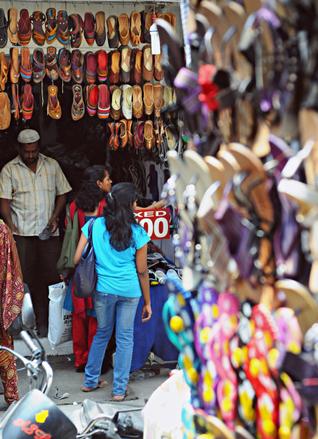
At Commercial Street, the branded comfortably coexists with the unbranded, with the latter dominating the platter. / Photo: Mohan Prasad / The Hindu

It may be the less glitzy cousin of the brand-heavy Brigade Road, but Commercial Street is easily the sworn shopaholics’ most preferred destination.

‘Com Street’ is easily Bangalore’s answer to New Delhi’s legendary Sarojininagar Market, offering everything from dupattas to doorknobs. And though it falls under the radius of the central business district, which includes Brigade Road and M.G. Road, it offers visitors the delightful option of bargaining.

Old timers remember the “quiet elegance” of the place some 40 years ago. “We did not have the bumper-to-bumper parking that we see today. While Brigade Road was for the young, brash shopper, Commercial Street was for the middle-aged,” says N. Krishnakumar.

The heady aroma wafting out of Bhagatram Sweets and lilting music from music shops may have been replaced by the whirr of traffic and the blasts of horns, but that is no deterrent to the loyalist who keeps going back, braving the notoriously potholed and often waterlogged street.

PROUDLY UNBRANDED

The branded comfortably coexists with the unbranded, with the latter dominating the platter. The same goes for food avenues, as mid-range restaurants offer the regular ‘north Indian, south Indian’ fare, while smaller chaat-cum-fast food joints draw true swarms.

An interesting aspect of this bustling area is the accidental, or perhaps intentional, organisation of shops. Take for instance the ‘chappal street’. Perpendicular to the main street, row upon row of shops specialise in footwear from the functional kholapuris and flip-flops,to peep-toes and stilettos in lush satin.

Similarly, ‘duppatta street’, again perpendicular to Commercial Street, promises to be a one-stop solution for all your duppatta needs: tie-dye, printed, plain, cotton, silk, synthetic… take your pick.

INEXPENSIVE

The unbelievably cheap ‘China bazaar’ offering inexpensive handbags that may not last you a lifetime but could give its posh, branded competitors a run for their money; street vendors selling imported fruits on the roadside, a stone’s throw away from sanitary fittings — it is all right here.

In fact, it is here that the real commerce happens.

source: http://www.thehindu.com / The Hindu / Home> News> Cities> Bangalore / by K. C> Deepika / April 04th, 2013