Category Archives: Business & Economy

Mathsya Darshini to tickle taste buds of fish lovers

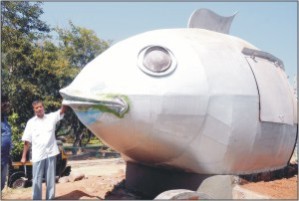
KSFCF President S. Madegowda and artiste Prakash Chikkapalya (extreme left) pose infront of Mathsya Darshini outlet getting ready at Kukkarahalli Lake in city this morning.

Mysore, Jan. 28 :

For the first time in the country the State Government, under the aegis of Karnataka State Fisheries Co-operative Federation (KSFCF), has begun establishing 100 Mathsya Darshinis (outlets for selling fish and its food products) throughout the State.

The new scheme is said to be funded to a tune of 90% by Nati-onal Fisheries Development Board (NFDB) headed by Union Agriculture Minister Sharad Pawar and the rest by State Government. The scheme is floated under the Rastriya Krishi Vikas Yojan. The first such stall is getting readied at the main entrance of Kukkha-rahalli Lake in city and is likely to be inaugurated on Feb. 1.

Interestingly, the stalll is shaped like a giant fish measuring 18×9 with the entrance through the stomach portion, stores at the mouth and kitchen at the tail. The fish is mounted on a huge platform. All varieties of fish and its delicacies will be available at the stall.

Speaking about the mission KSFCF President S. Madegowda told SOM today that each stall would cost Rs. 3 lakh and the scheme would provide employment to graduates to run the stalls with the Federation taking responsibility of supplying fish, raw materials for preparing delicacies and maintaining the infrastructure. He added that 50 such stalls would be established in Bangalore and Mysore with 25 in city not to exclude rural areas.

Design: The design of the fish stall has done by city artiste Prakash Chikkapalya. He told som that it took 8 months to construct the stall in the unique shape.

source: http://www.StarofMysore.com / Home> General News / January 28th, 2013

The biennial Bangalore air show

Aero India has become a B2B hub for interested third world countries.

Once in every two years, in the month of February, the blue, hot skies of Bangalore reverberate with earth shattering decibels of fighter, transport, cargo, trainer and civil planes and helicopters. Come February 6, namma Bengaluru will once again be hosting the ninth edition of this international aero show, Aero India 2013 for a period of five days at the Yelahanka air force station.

The biennial air show and exhibition has been attracting the aviation who’s who from many countries including America, France, Germany, Russia, UK, Sweden, etc especially in the last nine years. Although it made a small beginning in 1996, it was only after 2005 that it grew in size and stature when manufacturers, defence dealers and users gave it the prominence that it slowly emerged as one of the most important and largest military aviation show in this part of the world.

Gaining international recognition and attracting exhibitors like Lockheed Martin, Boeing, Thales, SAAB, Eurocopter, Embraer, Dassault, etc, was not easy for the Bangalore air show as it took nearly a decade where participants finally took a call to extend the same importance as the Farnborough air show, RAF Waddington International Air Show, the Bournemouth Air Festival, the Berlin Air Show or the Miramar Air Show at California.

Over the years, the show has attracted the best of global companies from the aviation sector who have flown their products ranging from Sukhois, Super Hornets, Super Vipers, Rafale, Typhoons, Gripens, MIGs to Hawks, Advanced Light Helicopters, Flying Bulls and C-17 Globemaster  and demonstrated its prowess before a discerning experts and interested clients from many countries. In fact, the event has become a B2B hub for interested third world countries who are on the lookout for the latest advancements in the field of both passenger, transport, defence aircraft and avionics.

But this time, many aviation experts feel the show in the aftermath of the sealing of the `82,000 crore MMRCA (Medium Multi-role Combat Aircraft) deal, may not attract the same attention with India selecting the Rafale from France to upgrade and strengthen the Indian Air Force fleet. Aerobatic display and demonstration of fighter planes especially from Russia, European union and Sweden may take a beating.

However, the ninth edition, exhibitors from 29 countries with 675 companies (380 overseas + 295 domestic) and 47 overseas delegations are participating who will be displaying on a gross exhibition area of 75,000 sqm (including outdoor). According to Defence Ministry sources, Aero India 2013 will be witnessing 57 per cent  more exhibitors compared to 2009. “It will provide a significant platform in bolstering business opportunities in the international aviation sector. Apart from this, it is favourably poised for an exponential growth over the previous edition.  A rapidly growing economy, defence preparedness challenges and opening up of defence production to private sector, has given a major fillip to the defence industry in India. It has also become a hub centre for defence business in the Asia region.”

While on the other hand, some exhibitors who had participated in previous shows say that they are not taking part because of the exorbitant hike in stall prices by FICCI. One exhibitor said, “Last time I had taken a stall space for Rs 2 lakh. But this year, FICCI is charging Rs 4 lakh for the same space. Therefore, many of the previous participants have backed out.”

With all the halls from A to H including the national pavilions, raw stands, chalet area and outdoor display stands already handed over to the respective exhibiting countries, hectic activity is going on at the air force station since January 25. A high security zone, it will be undergoing anti-sabotage and counter terrorist checks after February 3.

For watching the air display and viewing area as well as the exhibition, tickets will be available at Yelahanka air force station, FICCI Bangalore office and selected Axis Bank branches in the city.

The public is allowed only on two days on 9 and 10th and the tickets are priced at Rs 400 (Rs 500 on weekends) for the air display viewing area and Rs 1,000 for exhibition area only.

The general public can also visit the exhibition area between 6-8th February but only using a business visitor’s ticket.

It is mandatory for general public to bring one of the identification proofs like passport, driving license, voter ID, photo ID, or any other government issued identity card. On all days excepting the 6th (when it is 2-5 pm), the visiting hours for public on 9 and 10th is between 10 am to 5 pm. Children below 16 years are not allowed on business days from 6-8 February.

source: http://www.newindianexpress.com / Home> Cities> Bangalore / by Meera Bharadwaj, ENS-Bangalore / February 02nd, 2013

Major food industry to come up in Mulbagal: Legislator

Considering rise in unemployment in the district, a major food industry will be set up at Mulbagal and London-based entrepreneurs have come forward to establish the industry. Measures have been taken to provide them with suitable site for the firm, said Legislator Amaresh.

He was speaking at a job fair organised at the Government PU College premises in the town on Monday. Following depletion in groundwater level, irrigation has severely affected. This has led to rise in unemployment in the district. Setting up such industries here will address unemployment issue to an extent, he added.

He further said that lands have already been identified in the taluk to set up industries and process of transferring lands to these units is already on, he added. At least 4,000 to 5,000 youth will be able to get jobs here, he added.

The job fair organised by Rajiv Gandhi Seva Trust and Rural Development Institute, Mulbagal and district unit of Kannada Sene Karnataka witnessed a good turn out.
State Women Congress wing general secretary Sujatha Ramesh and Taluk Sheep and Wool Development Corporation president Venkatesh Gowda were present

source: http://www.DeccanHerald.com / Home> District / DHNS, Mulbagal / January 29th, 2013

Heart patients can pay through EMIs

Bangalore :

Heart ailments kill about three million Indians every year. Many die because they can’t afford treatment at the right time. Now, there’s a ray of hope for poor heart patients: EMI payment for the treatment in instalments.

Heart care has gone the EMI way in Bangalore and Mysore. In south India, about 20 hospitals are facilitating cardiac treatments through Equated Monthly Installments.

Sagar Hospital, Trinity Hospital and Panacea Hospital in Bangalore have come up with Healthy Heart for All (HHFA) – a programme in association with India Medtronic. manufacturers of stents. Fortis and Vikram Hospital in Mysore too are facilitating this programme which was floated a month ago.

Under HHFA, hospitals provide financial assistance to implant devices such as stents, pacemakers, implantable cardioverter-defibrillator (ICD) and cardiac resynchronization therapy (CRT) in heart patients. Furthermore, cardiac emergencies are almost always life threatening and patients often have a tough time raising the huge sums of money at short notice. To address this issue, HHFA offers loans.

Said Dr K S Kishore, interventional cardiologist, Sagar Hospital: “Heart patients are often rushed to hospital at the 11th hour. It’s difficult for the patient or the relative to arrange for cash immediately. In such situations, the EMI facility comes in handy. Under this programme, a patient can swipe the card and pay the cost of treatment in 6 installments without interest.”

The EMI can also be extended up to seven years on interest rate of 8.25%. The three hospitals in Bangalore are offering treatments like angioplasty and valve replacement.

Instalments for other treatments

Eye surgeries, robotic surgeries for cancer and dental procedures too can be paid in easy installments at a few hospitals in the city. Manipal Hospital offers this payment option for a range of treatments by tying up with two private banks. The EMI facility is available for procedures like bypass, angioplasty, open heart surgeries, robotic surgeries, a few eye surgeries and dental treatments.

Said Dr C G Muthana, vice-president, operations, Manipal Hospitals: “Several treatments are available on EMI payment at our hospital. A patient opting for this has to swipe the credit card of the bank we have partnered with and can pay the cost in three, six or nine installments without interest. The project has just started so there isn’t much awareness about it.”

source: http://www.articles.timesofindia.indiatimes.com / Home> City> Bangalore / by Hetal Vyas, TNN / January 30th, 2013

From Dublin to Bangalore – Science Gallery model goes global

Having made science ‘cool’ at home, Dublin’s Science Gallery has global plans that are taking it as far afield as Bangalore, writes Ann O’Dea.

The highly acclaimed Science Gallery on Dublin’s Pearse Street has been bringing cutting-edge developments in science, technology and the arts to the general public since 2008, through interactive and award-winning exhibits, but the team behind the gallery now plans to replicate that successful model in a further eight countries.

From Dublin to Bangalore – Science Gallery model goes global . Michael John Gorman, founding director of Science Gallery

A donation of €1m from Google in December 2011 was used to set up the Global Science Gallery Network, which plans to open similar galleries in key cities worldwide. India was chosen alongside the UK, Singapore, the United States, Australia and Russia for the first wave of science hubs to be launched.

And it is not difficult to see why the idea is meeting with some success. Here in Dublin, the gallery has become part of the arty tech and science ecosystem, thanks to its quite unique model, says founding director Michael John Gorman.

“When we opened in February 2008, one of the reasons was we felt there was a real need to inspire and engage more 15- to 25-year-old young adults around science, technology and engineering, and to get more people considering courses and careers in these areas,” he says. “Since then, I think there is a mind shift that has happened where now people actively seek out science-related events and entertainment.”

The Brian Cox phenomenon

He does concede this may be partly attributable to the Brian Cox phenomenon – the ultracool British particle physicist and TV celebrity – not to mention figures like Ireland’s own Dara O’Briain, comedian and broadcaster whose background is in mathematics and theoretical physics. Indeed, O’Briain sits on the gallery’s Leonardo Group, 50 ‘creative’ individuals, scientists, technologists, designers and artists who feed ideas into the exhibitions.

“It was a deliberate decision when we were starting out,” says Gorman. “Many science attractions around the world are focused on very young children and families, and on school groups. We made a decision that we would have a more adult engagement with science technology and the arts. There’s this widespread idea that science is for kids and art is for adults. I don’t know why that exists as a perception but it needs to be challenged.

“When we were setting up the gallery at the boundary of the university (Trinity College Dublin) it seemed like there was an opportunity for the gallery to be a porous membrane for the university and its researchers, and for all the exciting stuff going on behind the closed doors of labs, to bring that out to the public, and draw the public into interactions with the university. We were determined that we wouldn’t vandalise the science, we wouldn’t dumb it down. There was nothing out there like that.”

In 2012, 300,000 visitors went through the Science Gallery’s doors. “To put that into perspective, when we’re starting up the gallery back in 2007-2008, our target was 50,000 visitors a year,” says Gorman.

Not only that, but 2012 saw its exhibitions tour to Singapore, Manila, New York and London.

“At the beginning of June, we had three exhibitions opening in three continents in three weeks,” says Gorman. “We also ran Ireland’s largest ever TEdx event in September in the Bord Gáis Energy Theatre, which sold out and had 2,000 people listening to people talking about the future of science and technology. In a strange way science has become cool.”

It was because that concept was quite unique that the gallery felt it could replicate the model as a ‘plug in’ to universities in other key urban centres around the world.

Science Gallery and India

Today, excitement is building in India, where in November the Karnataka State Government signed a memorandum of understanding with Science Gallery, and is launching the feasibility analysis this month. A strong steering committee is already in place, with stakeholders like the Indian Institute of Science, the National Centre for Biological Sciences, and the Srishti School of Art, Design and Technology already involved in the process.

And the Bangalore Science Gallery has other heavyweight backing, with none less than India’s leading businesswoman, self-made entrepreneur Kiran Mazumdar-Shaw a strong supporter of the initiative.

Often cited as India’s richest woman, Mazumdar-Shaw’s $800m business Biocon is one of India’s leading drug companies, with a workforce of some 6,000. She was included in Forbes’ The World’s 100 Most Powerful Women in 2012 and Time magazine’s The World’s Most Influential People in 2010. When I mentioned the Bangalore project on Twitter, to my surprise, she shot off a rapid and enthusiastic response.

Mazumdar-Shaw herself has strong Irish connections. She worked as a trainee manager in a biochemicals company in Cork back in the 1970s, before starting Biocon in the garage of a rented home in Bangalore in 1978, with seed capital of an equivalent $200 in today’s money. In 2001, Ireland’s Minister for Health at the time, Mary Harney, appointed Mazumdar-Shaw to the board of Science Foundation Ireland. Today she is Irish consul general in Bangalore.

She, too, tells me Bangalore was the obvious choice, as a “leading hub of information technology, biotechnology and nanotechnology, not only in India, but in Asia.

“The Science Gallery project is a welcome and timely addition to Bangalore’s growing stature as India’s science and technology capital,” she says. “It provides an ideal platform for interactive and multidisciplinary learning and knowledge creation.”

“Conceptually, the Science Gallery is the perfect format for advancing scientific education that has a mindset of explorative research,” she continues. “As the Irish consul general in Bangalore, I am delighted to see this meaningful and path breaking bond between the two countries being catalysed by Trinity College.”

Science Gallery is funded by a combination of Trinity College Dublin support, Government support, corporate partnerships, foundations, philanthropy and earned income.

“These supporters allow us to keep entrance to Science Gallery free of charge, which was a key principle from the outset,” says Gorman.

The earned or operational revenue has grown to about a quarter of its funding, says Gorman, thanks to the growing success of the café, the retail space, corporate hire and of course the successful touring exhibitions. During the financial year 2010/2011, Science Gallery increased its annual turnover by 20pc from 2010 to €2.2m.

Back in Bangalore, Gorman says the feasibility analysis should be completed in April, and shortly thereafter the gallery should move to the development stage, but the UK is likely to pip them to the post. Closer to home, Science Gallery is in advanced discussions with King’s College, London, regarding the setting up of a Science Gallery on its Guy’s Hospital campus there, scheduled to open in 2015, close to the Tate modern and the Shard building – a suitably edgy location for a very cool concept.

A version of this interview first appeared in The Sunday Times on 27 January

source: http://www.SiliconRepublic.com / Home> Innovation / by Ann O’Dea / January 30th, 2013
Awareness workshop for Women entrepreneurs

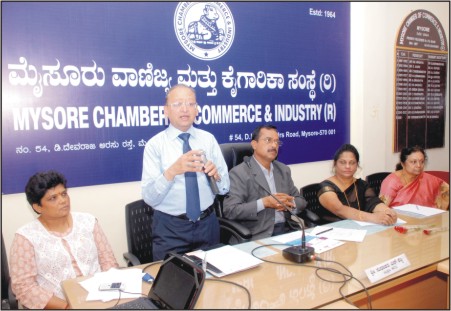
Caption: AIMS Director Ranganath Iyer addressing women entrepreneurs at the MCCI office on Devaraj Urs Road here today as WISE Secretary Rukmini Chandran, MCCI President Sudhakar Shetty, WISE President Gayatri Keshav and Vice-President Vasanthakumari look on. [Pic. by Pragathi Gopalakrishna]

Mysore, Jan. 15

Women in Small Enterprises (WISE), the women’s wing of Mysore Chamber of Commerce and Industry (MCCI), had organised a half-day workshop for women entrepreneurs at MCCI office on Devaraj Urs Road here today.

The workshop was to create an awareness among the women entrepreneurs regarding the ‘10,000 Women Entrepreneurship Development Programme’ to be organised jointly by Iiternationally acclaimed investment bank Goldman Sachs and Business School and the Indian School of Business in association with Acharya Institute of Management and Sciences (AIMS) to be held in Bangalore.

Briefing the gathering of over 50 women entrepreneurs, AIMS Director and Programme Convener Ranganath Iyer said: “The training programme to commence from Feb. 25 will feature 19 days of lectures and interaction with business experts and three months of monitoring by professionals in batches of six days each. The programme will train the women to refine their business modules to face the challenges and complexity in business. To improve communication skills in English, the programme also includes coaching in the language.”

Inaugurating the workshop, MCCI President Sudhakar Shetty pointed out that women entrepreneurs get subsidy up to Rs. 1 crore. He expressed satisfaction that the regional Global Investors Meet held recently in city had evoked good response from women entrepreneurs.

WISE President Gayatri Keshav, Vice-President Vasanthakumari and Secretary Rukmini Chandran were present.

Source: http://www.StarofMysore.com / Home> General News / January 15th, 2013

They are adaptable, good at switching roles

He loves playing golf. She hates it; believes it’s a total waste of time. She loves books and music — often borrows heavy metal and hard rock stuff from her sons. He loves Tamil movies; she can’t stand them. He loves to talk at home; she prefers to do things. He loves to cook. She would rather spruce up the interiors of their home.

There’s one thing that they have in common though – the industry they work for. And this husband and wife head big companies, which make them a rare couple. Akila Krishnakumar is the India head of SunGard, a $5-billion US company that provides software to the education, financial services  and public sector organizations. Krishnakumar Natarajan, or KK as he’s fondly known, is the CEO and MD of IT services firm Mindtree .

Managing extremely demanding global jobs – involving constant inter-continental travel — raising two kids, and supporting their extended families has not been easy for the couple. Ask them about the recipe for peace, happiness and success in life and work, Akila says: “We are sensitive to each other. We treat every day as a fresh day. We do not carry old baggage.”

Akila joined  Wipro  in 1982 as a marketing executive after passing out from BITS Pilani. KK was in Wipro then, heading a marketing function. Theirs was not a love marriage. It came as a surprise to them that their parents were seeking an alliance without realizing that their children were working in the same department at Wipro.

KK quit Wipro in 1999 to co-found Mindtree. He was asked to work out   of  North America , and he had to leave Akila and their sons behind in Bangalore. A decade before that, in 1989, Akila too had taken a similar career decision, when she was posted in London and had to leave her little son in the hands of her in-laws. “I was in a dilemma. But KK’s family was fully supportive,” Akila says.

On one occasion, she had to fly from Delhi to Pune to leave her son with her mother there before she could take a flight for Bhopal  for a customer meet.

Akila quit Wipro to float an entrepreneurial venture in 1993. The firm, Exeter Systems, offered IT solutions for universities. In 1999, Exeter was acquired by Sallie Mae Solutions, which in turn was acquired by SCT Corporation. In 2004, SunGard acquired SCT. “So in a way I have been with the same company since 1993. I have seen it in various phases of growth and change.”

KK says it has been extremely challenging for the family. “But we have been adaptable, creative and been consciously finding ways to resolve every hurdle. We are also good at switching roles,” he says.

KK has been a large pillar of support, says Akila fondly. “He totally lived up to anything he was put into…be it looking after the kids, keeping the home clean or cooking for the family.”

KK and Akila are now busy creating an exclusive family hub. They are relocating both their parents and siblings from Chennai and Pune close to their weekend home on the outskirts of Bangalore. “We love our independence. At the same time we also want to be closer to our families when we grow older,” says Akila.

Travel is a common passion for the family. But aligning their calendars to vacation together is tough. “The last long vacation the four of us had was in 2007 in New Zealand. So instead of waiting and planning, we do quick, short and doable trips like the one we did recently to Chikmagalur,” says KK.

source: http://www.articles.timesofindia.indiatimes.com / Home> City> Bangalore / by Mini Joseph Tejaswi, TNN / January 14th, 2013

Those were the days

Bangalore was once famous for its free spirit and culture. A few loyalists are trying to preserve a slice of the city they knew and love

If you happen to be a newcomer to  Bangalore , and get into conversations with some of its older residents, be careful about showering their city with compliments. If you remark that it is green, they will tell you it used to be greener. Talk about the great weather, and they will tell you it used to be much better. Bangalore, they will tell you (wistfully, angrily or with an air of resignation, depending on who you are talking to), is not the place it used to be. And the nostalgia is not unwarranted. Every so often, there will be an article in a newspaper about an old Bangalore joint going out of business because it can’t afford the escalating rent and of customers rushing to have that last cup of tea or sandwich, or just to shoot the breeze, at their old hangout. Some Bangaloreans, though, are trying to do their bit to preserve a slice of the city they knew, in their own way.


“Bangalore used to be the kind of place where people gathered at parks every evening and someone would invariably take out his guitar, where people would dance at clubs till five in the morning, and where the greatest crime was to go around without a cycle lamp!” says Paul Fernandes , artist and former advertising executive, occasionally referred to as the city’s  Mario Miranda . Fernandes has recaptured that era in a series of 60 evocative watercolours, on display at his recently opened gallery, “aPaulogy,” in Richards Town. Each of the watercolours, set in ’70s Bangalore, has a personal memory or association for the artist. But anyone from those days would have an association with the places he has sketched, he adds.


One shows a boy on a cycle riding away with hand outstretched from a constable whose hat is in the air, titled “Potential visitor at Cubbon Park police station? “Oh we all used to do that — slap their hats off and then speed away and if you were caught, you had to spend the night in the lock-up,” Fernandes says with a laugh. Another shows two young bucks doffing their hat to a pretty young lady emerging from her house. Look carefully and you will espy an old gent with a rifle taking aim at the young men. “I have a very pretty sister and young men from all over the city used to come from all over to see her… and my uncle used to use his rifle to threaten them,” says Fernandes, which he later corrects to “seven pretty sisters”. The rifle is also there, next to the watercolour.


Fernandes thought of doing the sketches when he noticed that whenever he and his friends were talking, the conversations would begin with “Do you remember” and it would invariably turn out to be a happy conversation. The push came when his mother’s house, which his father had bought in 1947 when he returned from England, was sold and demolished. “That’s when I started drawing the old buildings,” he says. Fernandes now plans to bring out a book of the watercolours, titled Bangalore Blue — A 1970s Roundabout.

A different attempt to make sense of the rapid changes that took place in Bangalore and the city’s struggles to come to terms with it, while holding on its familiar aspects, is a film by city-based filmmaker  Sushma Veerappa . TitledWhen Shankar Nag Comes Asking, the film tackles these issues by examining what it would take for two auto drivers, Ramanna and Mahadeva, at Shankar Nag Auto Stand to “belong” in Bangalore today. When asked what she made of the changes in Bangalore, and the loss of old “institutions,” Veerappa says, “Of course there is much nostalgia value to something tangible like buildings. But as a documentary filmmaker, I am more concerned with what replaces those buildings — and I don’t mean just the glass façades. How and where does one carry those memories associated with that demolished old building? How do they translate into the everyday?” The changes that have happened, she says, is less about the “loss” and more about the sense of alienation and how insecurities play out. “The making of the documentary helped me understand the many ways of seeing,” she says.


But not all change is unwelcome. “I’m not depressed (about the changes) at all. Life has become better in many ways as well,” says Fernandes. Yet, on being told that Kohinoor Hotel on Brigade Road, a hangout for many Bangaloreans since the late ‘50s, had downed its shutters while he was abroad, Fernandes can’t keep that note of regret out of his voice when he says he will not be able to visit it for one last of glass of its famous suleimani chai with his old friends…


(aPaulogy, located on 15 Clarke Road, near the entrance of Richards Park, is open from 11 am to 7.30 pm Tuesday to Saturday, and 12 to 7.30 pm on Sunday (closed on Mondays); There will be a series of public screenings of When Shankar Nag Comes Asking in February, the details of which will be posted on the director’s Facebook page(sushma.veerappa/facebook))

______________________________________________________

source: http://www.Business-Standard.com / Home> Life & Leisure / by Indulekha Aravind / Bangalore, January 13th, 2013

Ornaments for all occasions

Shardah Uniyal, Marketing Head, Gitanjali Group, says trust is a key factor in influencing jewellery buying decisions.

Gitanjali is a household name in Bangalore. However, competition in the city is fierce. How do you set yourself apart from the rest?
For the young, tech-savvy, fashion-conscious consumers of India’s Silicon Valley, branded jewellery from a large and trustworthy name like Gitanjali Group has been the solution to all their jewellery needs. Gitanjali has been the name they can trust to deliver quality and purity with modern, contemporary designs that complement their lifestyle. The wide spectrum of brands means that there is something for every consumer, for every type of occasion, across a range of price points. While these factors have given the Gitanjali Group an edge over others, the extensive marketing campaign and strategic associations with events like Bangalore Fashion Week, Max Miss Bangalore, Pantaloons Fresh Face Hunt and many others give brands associated with Gitanjali an obvious edge.

What new changes are taking place in the jewellery industry? Have you noticed any interesting trends?
There has been a huge rise in the popularity of diamond studded jewellery, especially lightweight jewellery for daily wear and work, in recent years. With the huge rise in gold prices over the last two years, diamonds are also relatively more affordable. And since they have a clear aspirational value when compared to gold, and also make more modern style statements, younger consumers are opting for them more. There has also been a trend towards combining diamonds with other stones like emeralds, rubies and even pearls. For festive wear, we have seen a resurgence in demand for stylized interpretations of traditional Indian styles — the rose cut, or polki diamonds, kundan work and jadau jewellery.

Is there more demand for platinum as well?
Consumer interest in platinum jewellery has also grown in the last couple of years, though the white metal addresses the needs of a slightly more niche elite group of buyers. Besides diamonds, other gemstones too are gaining popularity. Yes. The Indian consumer has some eternal favourites like emeralds and rubies, though currently there is popular trend of combining diamonds with these precious gemstones and even with high quality pearls.

What designs are in vogue currently?
For daily wear and work wear, diamond studded lightweight jewellery is popular. Elegant and minimal is the current trend in these categories. When it comes to jewellery for social occasions, larger pieces like chokers and chandeliers are back in fashion for the special days, and even traditional Indian styles like rose-cut diamonds and polki have made a comeback. In the casual evening wear segment, diamonds in combination with emeralds, rubies and pearls are the current fashion statement.

How different is Gitanjali from other jewellery brands?
Trust has always been a key factor influencing jewellery buying decisions, and Gitanjali’s legacy of nearly five decades in the diamond jewellery business is something that sets us apart from other all-India brands. Conversely, Gitanjali sets itself apart from other jewellers who have many decades in the business, due to its all-India and even international presence, and the sheer breadth of choice it is able to offer to the jewellery lover.

source: http://www.dnaindia.com /  Daily News & Analysis / Home> LifeStyle> Interview / by Caroline Diana,  Place: Bangalore, Agency: DNA / Tuesday, January 08th, 2013

SJCE students bags highest paying job

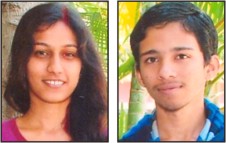
Caption: Nandini, Darshan

Mysore, Jan. 2:

Two final year students of Sri Jayachamarajendra College of Engineering (SJCE) — N.A. Nandini Bhavasar and T.A. Darshan — have bagged the highest paying job offer from Microsoft Corporation, an American Multinational Software Corporation. It has recruited these students SJCE from BE Computer Science and Information Science branch for its Research and Development job profile by paying the highest salary of Rs. 16 lakhs.

College Principal Dr. B.G. Sangameshwara said that Microsoft interviewed over 100 students from various branches and selected Darshan and Nandini after several rounds of interviews and added that the pay package is the highest in the College’s 50-year history.

Placement officer N. Pradeep said that the interview had six rounds spread over three months in which three rounds were held at the campus and the other three rounds were held in the Company’s Bangalore office.

Principal Dr. B.G. Sangameshwara has congratulated the students and lauded the efforts and support from the Management & staff of the College and placement team led by Prof. B. Mahananda, supported by Dr. Srinidhi and Pradeep.

source: http://www.StarofMysore.com / General News / January 02nd, 2013