Category Archives: Business & Economy

Colle Farmers Market Says UAS Organic Technology is “A Step Forward”

On January 1, Colle Farmers Market, an online farmers market community, continues to bring awareness of the organic movement as it spreads at a global rate. Colle recognizes the developing technologies of University of Agricultural Sciences (UAS) an India based organization that is developing organic production technologies for major crops.

According to The Times of India, “To encourage farmers to switch over to organic farming, Institute of Organic Farming of the University of Agricultural Sciences, Dharwad (UAS) has developed organic production technologies for major crops.” The UAS organic technology program focuses on “studying productivity, profitability, suitability, quality and input use efficiency in different crops and cropping system under organic production in comparison with conventional and integrated systems under rain-fed conditions,” reports The Times of India.

The article states that the prof. HB Babalad, Institute of Organic Farming, commented on the UAS making a “significant contribution by standardizing organic farming practices in important crops of north Karnataka region.”

The Times of India further reports that “The organic agriculture captures and store more water than soils under conventional cultivation Production in organic agriculture systems is thus less prone to extreme weather conditions, such as drought, flooding, and water logging.”

Colle Farmers Market believes that the UAS organic technology program is a step forward for a global [organic farmers market. Organic technology is improving and the more institutions that invest in this technology, the more populated our farm lands will become with organic products. Organic farming has become more than a passing phase adds Colle Farmers Market representatives. The farming communities deserve the best in organic technology and this can happen one step at a time.

source: http://www.FoodWorldNews.com  / Home / January 02nd, 2013

A man of CARacter

On one hand, he parties hard, on the other, he is a man of business. A 27-year-old Bharat is a dual-faceted Gemini, heading the operations at Leo Motors. With his immense enthusiasm and dynamic persona, Bharat has become quite a success in what he does– selling Maruti Suzuki cars.

Hardly six months into business, Leo Motors has chalked out an impressive number by selling over 100 cars a month. “Our vision is to offer our customers the ultimate vehicle buying experience by providing the right motoring advice and support. Our focus is simple: To strive for 100% customer service. We provide information, advice and assistance customised to each individual client, whether they are purchasing their first car or upgrading to a bigger car,” he says. With a qualified team of sales and service executives, backed with state-of-the-art facilities and comprehensive stocks of cars, workshops and on-site spare parts warehouses, Leo Motors offers customers an ideal car owner experience.

This success, however, comes with a lot of learning and hardships. Despite hailing from a family of businessmen, selling cars has remained an unexplored territory. “We started off with granite business, and slowly we got into car sales and it’s a whole new ballgame. We made mistakes and we are still learning,” says Bharat, who, unlike many young entrepreneurs, have celebrities as their role models. “My dad is my role model. I have seen him struggle. The troubles and traumas he had to undergo in running a business is the best lesson I have learnt. I wasn’t born with a silver spoon. I had to learn things the hard way,” he admits.

Despite being a thorough businessman, the young car dealer knows how to mix work and play.“While I don’t get much time for hobbies, I ensure that, at least on Saturdays, I am out with friends. I frequent City Bar and Sky Bar at UB City and dance to my heart’s content. I am also actively involved in bike rides and bike races and go on long rides with my friends,” says Bharat.

Although not an avid reader, Bharat does keep himself abreast of the new trends in the auto industry. “My employees are well-versed with the car industry. They share their observations and ideas with me. I think our dealership is a success only because of our employees,” he says. Highlighting the most interesting trend, Bharat says that people are no longer looking for high-end models. “Customers look for simple, affordable cars that can be used for the entire family. The focus today is more on entry and mid-level cars,” he says.

Ask him about his dream car and Bharat says: “I cannot wish for a car that can fly or that can be driven under the sea. But any day, I would love to own a Ferrari. I also love the cars in the James Bond and The Dark Knight series. Batman is my all-time favourite superhero. I wish I could get to drive the Batmobile,” laughs Bharat.

source: http://www.dnaindia.com / Daily News & Analysis / Home> Money> Report / by Caroline Diana, Place: Bangalore, Agency:DNA / Wednesday, December 26th, 2012

Sheraton Bangalore Hotel GM wins General Manager of the year award by Hotelier India

Martin Wuethrich, GM, Sheraton Bangalore Hotel at Brigade Gateway was awarded as the General Manager of the Year-2012, upscale business hotel category at The Hotelier India Awards in Gurgaon, New Delhi. The Hotelier India Awards is a celebration of excellence; that recognizes individuals who have made a remarkable difference in the field of hospitality.

On receiving the award, Martin Wuethrich, GM, Sheraton Bangalore Hotel at Brigade Gateway said “Winning an award is always a very nice feeling. It is always good to know that your effort has been recognized. Our objective at Sheraton is to delight customers; this award re-iterates that we are working towards our strategic objectives.”

Representatives of 100 + hotels participated in the awards ceremony and the winners were chosen according to their contribution to the Hotels performance above and beyond their call of duty.  The judges reviewed stories of integrity, innovation, customer focus, responsibility, accountability and respect when selecting the winner for each category.

source: http://www.voyagersworld.in / Home / Monday, December 24th, 2012

UAS Raichur develops e-SAP tablet to check pest attacks

Bidar :

Scientists at the University of Agriculture Sciences (UAS), Raichur, have developed a unique IT-enabled handheld device that will provide information to farmers  in real time on pest-related problems.

The device, Electronic Solutions Against Agricultaral Pests  (e-SAP), has a web-based application system which facilitates flow of information from the farmer to the farm scientist and back. “The idea behind creating e-SAP  was to help the extension worker, who is not an expert, to collect specimens right from the farmer’s field and send it to the scientists and experts in real time,” Prabhuraj A Associate Professor of Entomology at the College of Agriculture, UAS Raichur told PTI.

e-SAP will make the work of the extension service worker easy, enhance their efficiency and at the same time provide the farmers with solutions right in his field in real time, Prabhuraj, who has this technology, he added. “This technology targets one of the critical requirements of a crop cycle, pest management. e-Sap has features that can bring the farmer, extension worker, scientist and policy maker on the same plane, thereby, helping to find solutions that are more practical and in lesser time,” he said

e-SAP is currently being run on a pilot basis in Raichur district in Karnataka covering 4,000 farmers and about 10,000 hectares in 5 taluks since last year. “The technology is not very costly. We developed about 15 such tablets and the software for Rs 59 lakh. The costs of a single tablet is Rs 25,000, which can come down if it is produced on a mass scale,” Prabhuraj said.

e-SAP is unique in the sense that it has a voice-based application system, which guides the farmer and the extension worker in the local language about how to collect the data and the specimens, he added. That apart, it also allows the extension worker and the farmer to do a survey of the pest attack or related problems right in the field, which is then automatically synthesised in the form of graphs and tables along with the decision support intelligence.

Another highlight of e-SAP is the image-based model, that captures high quality images of pests and their symptoms and then guides the user in identifying the pest. This coupled with audio assistance makes it very easy to handle.

“There is an intuitively built pest specific survey to quantify the damage caused, which is based on images and also utilises the images captured by the extension worker from the affected field. This survey helps the expert is ascertaining the extent of damage and suggest remedies,” Prabhuraj said.

e-SAP devices provide continuous feed to the handheld devices with latest  farm technologies , modifications and recommendations, he added.

source: http://www.economictimes.indiatimes.com / Home> News> Technical> Hardware / PTI / December 25th, 2012

Karnataka tops in online shopping

Bangalore, Dec 20 (TruthDive) :

Karnataka topped the list of users who shopped online.

Google India search results reveal that Karnataka web users spent more time on the web for utilitarian services and the visual web in the country when compared to Delhi, Maharashtra, Tamil Nadu, Andhra Pradesh and West Bengal according to searches conducted in India featured in Google India annual Zeitgeist.

The highest searches show a growing interest by the residents of Karnataka in ‘Flipkart’, ‘online shopping’ and ‘online recharge’ with HQ in Bangalore. Flipkart services are featured in the top three fastest rising keywords in Karnataka.

Tripura, Meghalaya, Jammu & Kashmir, Assam, Pondicherry and Orissa users used the keywords online shopping more despite them having few offline retail stores. Bangalore was pushed back by Bhubhaneswar and Vizag to search for online shopping. It searched ‘online shopping India’, ‘online mobile shopping’, and ‘shoe online shopping’.

Smartphones and tablets are what Bangalore spends searching for most of the highest amount of time online. Dell laptop, iBerry tablets, Nikon and Canon’s digital camera and Samsung TV sold the most.

On eBay it was Sony with 20% of market share across the televisions.

eBay takes 43 minutes to sell a TV but a tablet sells every 11 minutes and a mobile handset sells every two minutes.

Models and budgets provide customers of eBay India’s range of gadgets easy access to the best deals.

Sales have gone up by 27% in this quarter in non-metros where it fills in distribution gaps in their city. E-commerce is said to replace direct selling in coming months. Meanwhile, the Government has put the e-commerce firms under scanner to known about their investors.

E-commerce firms in India are suspected to be acting as retail agents for brands abroad and doing business much before FDI in multi-brand retail was approved. ED has already sent notices to these firms.

source: http://www.truthdive.com / Home> Business> Exclusive> Headlines> News / by Ayyappa Prasad / December 20th, 2012

Dr Devi Shetty recognised as Indian of the Year

Dr Devi Shetty, who runs most economical heart care and healthcare institute, Narayana Hrudayalaya in Jamshedpur, was recognised by CNN-IBN as Indian of the Year 2012. At a star-studded awards ceremony held in New Delhi, winners across politics, sports, entertainment, business and public service categories were announced.

Over years, these awards have achieved prestige and credibility unmatched by awards instituted by other media organisations.  The awards adhere  to a transparent and unique four-tier selection process  that includes the IBN Editorial Board drawing a list of nominees, which are authorised by the Jury, followed by voting by Electoral College and India’s citizens.
http://www.dailypioneer.com / Home> PNS> Jamshedpur / Friday, December 21st, 2012

Infosys HR team wins Zenith 2012 award

A seminar on ‘ Building an engaged workforce’ was held by the National HRD Network (NHRDN) Bhubaneswar Chapter at the Infosys campus here on Friday.

A panel discussion held during the seminar that included a 360 degree view on workforce engagement, in which NHRDN office-bearers including its president Dr Saroj Mohapatra and vice-president Dr Suvendu Das focussed on important issues relating to present-day HRD (human resource development.

The NHRDN members informed about their reward and recognition programme, Zenith, which was organised as part of the seminar to celebrate excellence and reward high performers in the HR fraternity in the State. This year, the HR team of Infosys won the Zenith 2012 while the HR team of JSPL became the runners-up and the PPL HR team got a consolation prize.

Among others, Kalinga Soft CEO Srijat Mishra, National Board member of NHRDN Sourav Daspatnaik, general secretary of NHRDN Dr Isa Mishra and principal consultant of Think Talent India Bhabani Mohanty were present.

source:  http://www. dailypioneer.com / Home> State Editions> Bhubanewsar / Monday, December 17th, 2012

Karnataka plans to set up separate secretariat for SMEs soon

The Karnataka government will create a secretariat  for small and medium enterprises  (SMEs) in the state to facilitate speedy redressal of their grievances, minister for small-scale industries Raju Gowda said.

He said, the cabinet has taken a decision in this regard and the formal notification would be issued soon. The government has also raised the capital limit of  SMEs  from Rs 3 crore to Rs 15 crore and speedy clearance through the single window, he said while addressing the national vendor development seminar at MSME Development Institute here at the weekend.

He also emphasised on the cluster development approach for MSMEs for its development to evolve into a global leader.

Gowda also expressed his desire to provide a rebate on trade licensing, setting up of industrial estates in each district headquarters of Karnataka, like the one in Koppal. He also informed of the developments on the Greater Peenya Project and promised to distribute sites to the entrepreneurs soon.

Emphasising the need for taking up large infrastructure development projects in the state, the minister for large and medium industries Murugesh R Nirani said the government was working on developing high-speed rails connecting various district headquarters with the state capital.

He also spoke of the government’s initiatives in the port development in Mangalore and Karwar to facilitate industrialisation.

The vendor development programme was organised in association with the Department of Industries & Commerce, Government of Karnataka, District Industries Centre, Bangalore (Urban), The National Small Industries Corporation Ltd, Bangalore, Khadi & Village Industries Commission, Coir Board, Small Industries Development Bank of India, Karnataka Small Scale Industries, Bangalore.

Public and private sector undertakings such as BHEL, BEML, BEL, South Western Railway, HMT Ltd, HAL, Toyota Kirloskar Motors Pvt Ltd, Honda Motorcycle & Scooter India Pvt Ltd, Pushpak Products India Pvt Ltd, 3M India Limited, Berger Paints India Limited, DGS&D, KSSIDC, KIADB, Federation of Karnataka Chambers of Commerce & Industries, Peenya Industries Association, Laghu Udyog Bharati, Karnataka, Consortium of Electronics Industries of Karnataka and Association of Women Entrepreneurs of Karnataka participated in the two-day programme.

source: http://www.Business-Standard.com / Home> Economy & Policy /by BS Reporter / Chennai-Bangalore / December 17th, 2012

Scripting success story through dairy farming

Many educated feel that agriculture is meant only for illiterate people. However, here are two brothers who have scripted success story in dairy farming through sheer hard work and dedication.

Deserting the life in Bangalore city, the two brothers  stepped into an unknown field and has achieved success.

Venkata Narasimha and his brother Keshavamurthy in Hanumanahalli have become model for other farmers in the State.

Venkatanarasimha was working as a mechanical engineer in a private firm in Bangalore. However, now he is completely at ease feeding cattle in a cowshed.

Their father late Sooryanarayana Rao used to visit the family deity at Yagati 40 years ago. After the death of Rao, the family shifted to Bangalore. Over the years, they purchased 10 acre land in Yagati.

The family sold their house and land in Mysore and Bangalore and settled down in Hanumanahalli.

At a time when Kadur was reeling under drought situation and farmers were engaged in selling their cattle, Venkata Narasimha purchased H F breed cattle from Doddaballapura and ventured into dairy farming.

“I purchased five cows by paying Rs 40,000 each. On the guidance of Veterinary doctor Dr Kotresh, I purchased 20 more cows.”

“To ensure that there was no shortage of fodder, we started growing fodder in our estate. We were purchasing fodder when we fell short of it,” they said.

Using cow dung and organic wastes available from the estate, we have started preparing compost and has been selling 25 tonne compost once in six months and two tonne vermi compost once in three months.  At present, there are 45 cows in their cow shed. They supply 440 litres milk to Yagati Milk Procuring Centre and has been fetching Rs 1.5 lakh profit per year.

The family members with the help of two labourers clean the cow shed. “If we respond to our needs, then we will not face shortage of labourers.”
The brothers attributes their success to the support they received from their family, particularly wife and children.

source: http://www.DeccanHerald.com / Home> District> DH News Service / Kadur, December 10th, 2012

Azim Premji: Outstanding Philanthropist

For more than a decade, Azim Premji Foundation has been working to improve education. Just like at Wipro, Premji has left it to a professional team to run it
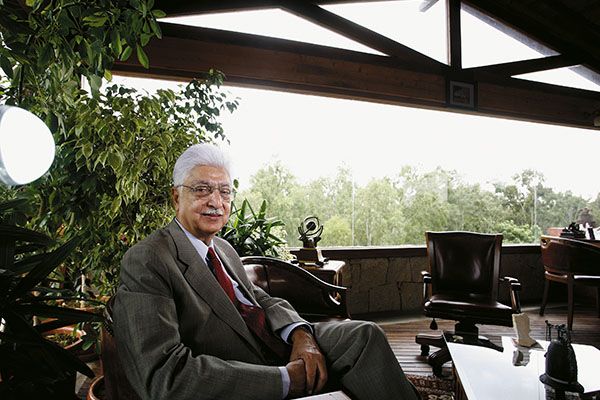
Image: Namas Bhojani for Forbes India

Azim Premji’s work to improve education is one of the largest such programmes backed by individual giving in India

Azim Premji
Award: Outstanding Philanthropist
Age: 67
Why He Won: For making India’s biggest philanthropic contribution for achieving universal quality education.
His Trigger: Was deeply disturbed by growing inequity between haves and have-nots; was afraid growing disparity would threaten society.
His Mission: Improving quality of education; which would improve social and economic conditions.
His Action Plan: Working with government schools, bringing change at the top, improving quality of teachers, increasing capacity of education officers.
His next move: Set up institutions like Azim Premji University, to
produce education professionals, focus on research, set up 200 rural schools to showcase good education.

So when exactly did Azim Hashim Premji, the third richest Indian and ‘Asia’s most generous man’ feel the first tug of philanthropy? Was it when, as a young man studying at Stanford University, he dreamt of joining an international development agency like the World Bank? Or maybe it was when his mother, a doctor, set up a philanthropic children’s hospital in the 1940s. Or was it in the 1950s and ’60s when he was soaking in the spirit of nation building growing up in Nehru’s India? Or did it come much later, when in the late ’90s he watched his millions grow into billions, thanks to the IT boom, all the while becoming aware of the distance between his wealth and the average Indian’s income?

No one knows the answer, not even Premji.

Dileep Ranjekar, who has worked with Premji for close to four decades and started the Azim Premji Foundation (APF), says Premji first started talking about working in the social sector in 1998-99. Ranjekar, who was then head of Wipro’s HR, and Premji were staying in the Wipro guesthouse at Brunton Road, Bangalore. Premji was shifting Wipro’s HQs from Mumbai to Bangalore.

Both of them would sit late in the evenings talking and it was on one such evening that Premji first broached the idea. He had spent the last 30 years building Wipro, which was successful and stable, and now at 54 he felt that he needed to do something more.

After a lot of deliberation he chose to work in education and told Ranjekar to come up with a plan, but with one clear instruction: Whatever area they picked in education, it must have widespread impact.

The conversation that started in that guesthouse has today resulted in one of the largest programmes backed by individual giving in India and perhaps Asia. Premji has pledged close to $2 billion from his personal wealth to APF, which is working to improve elementary education across government schools in India. APF today has 800 employees. Last year the Azim Premji University started three post graduate courses in education and development to beef up capacity in the education sector.

It may take several more years, if not decades, to truly feel the impact of Premji’s efforts, but the work has left a deep impression on him. “As a person I have become more hopeful and optimistic… When you see teachers, government officials, my own colleagues in the Foundation, working in the toughest circumstances possible… it reaffirms faith in the goodness of man,” he says.

Now at 67, he has only one regret. That he waited too long to embark on this journey. “I wish I had started earlier, maybe in 1990, not in 2000,” he told Forbes India in an email interview.

His role as chairman of Wipro takes up most of his time today, but that is set to change. “He is spending more and more time on this [philanthropy]; it will increase going forward,” says older son Rishad who is also on APF’s board. Premji has talked to people about giving away most of his wealth (estimated at about $12 billion) to philanthropy. Rishad says that everyone in his family understands that the wealth does not belong to them. “He’s always told us, ‘I am comfortable giving you something in life but if you want anything above that, you have to earn it for yourself. The rest is meant to be given away, it is an obligation to give it away’,” says Rishad.

Close friend and associate Narayanan Vaghul, former chairman of ICICI Bank who is on the board of both Wipro and APF, says, “Premji is one of those rare people who sincerely believe that philanthropy is not a hobby. Even 20 years ago he was a hardcore businessman, and he is not particularly religious. But this work has changed him spiritually, it has made him a better person.”

Unlike Wipro where he kept his family out for a very long time (Rishad joined in 2007), every member of his family is involved in APF. Wife Yasmeen and Rishad are board members, while younger son Tariq works in APF’s endowment office. Premji says that having the family’s support is crucial in this work. “Your immediate family must resonate with the ideas, the purpose and philosophy. Else, the impact will be much less than it could be,” he says.

After maintaining a laser like focus on education for most of the last decade, he is now thinking of expanding into other areas like health care and livelihoods. “He is deeply worried about the state of governance in the country today,” says Vaghul, and some of his close associates say that he may choose to work in that field next. In January last year he joined 13 eminent citizens in India, such as former RBI governor Bimal Jalan, HDFC Chairman Deepak Parekh, and Godrej & Boyce Chairman Jamshyd Godrej to write an open letter to national leaders on governance deficit and corruption in the country. On November 2, while announcing Wipro’s quarterly results, he exhorted Bangaloreans to protest against non-clearance of tonnes of garbage lying on the streets.

source: http://www.forbesindia.com / Forbes India / Home> Features> Philanthropy Awards 2012 /by Mitu Jayashankar / December 03rd, 2012