Category Archives: Business & Economy

Oncology nursing is need of the hour: Experts

Bangalore :

With increasing prevalence of cancer, the need for oncology nursing is on rise. To address the various issues related to oncology nursing,  HealthCare Global Enterprises Ltd , The Specialist in  Cancer  Care, organized National Conference on Oncology Nursing, in Bangalore.

The objective of this conference is to promote exchange of knowledge in nursing care management of the disease, highest standards of treatment, education at the multi disciplinary level among nurses, clinicians in oncology care. 300 nurses across India, participated in the conference.

Dr G Kasthuri, Dean of Nursing, RGUHS, said, “In developed countries, oncology nursing is seen as area of specialization. The need of the hour in India, for nurses in oncology care is specialized training which will benefit immensely, as nurse’s play a great role in the health care delivery system.”

Dr B S Ajaikumar, Chairman, HCG Group, said, “Nurses play a vital role in the multi disciplinary approach to cancer care patients. Effective specialized training will help them in acquiring necessary skills in oncology care. Improving, standardization and education is important for nurses who are looking who are looking at onco nursing. This will help in optimal safe cancer care treatment to patients.”

“This conference will enable the participants to acquire knowledge on the scope of oncology nursing, get acquainted with emerging trends, improve patient communication skills and the quality of cancer care,” Sino Thomas, Head of Nursing, HCG, said.

source: http://www.timesofindia.indiatimes.com / Home> City> Bangalore / by Hetal Vyas, TNN / December 01st, 2012

Tata Marcopolo to set up bus design centre at Dharwad

Hubli, NOV. 26:

Tata Marcopolo Motors Ltd plans to set up ‘Global Bus Design Centre’ at Dharwad.

Speaking to reporters after inaugurating the wire harness division of Patil Electric Works at Gokul Industrial Area in Hubli, Vinay K Pathak, Chief Executive Officer, Tata Marcopolo Motors, said the plan to set up design centre is to manufacture buses of global standards.

Vinay Pathak, CEO, Tata Marcopolo Motors,  Dharwad / Business Line

GLOBAL STANDARD

Currently, around 80 people are working on the design section of the unit at Belur Industrial Area. “We plan to increase the number to 250 and develop it into a global bus design centre in the coming days,” Pathak said.

At the centre, engineers would be working on improving the designs from Brazil, and the whole process is to benefit both Tatas and Marcopolo resulting in production of global standard buses.

The company so far has invested close to Rs 300 crore for its bus unit at Dharwad. Plans are there to invest another Rs 160 crore for the unit expansion to increase the production capacity.

“Of it, Rs 50 crore is being earmarked for the global bus design centre,” Pathak said.

HIGHER PRODUCTION

To a query, Pathak said the company had plans to increase production from 75 buses per day to 125 buses by June.

“This year, we have set a target of achieving Rs 700 crore turnover,” he said. He added that at present 97 per cent of the workforce at its Dharwad unit was from Karnataka and the company had 1,500 permanent employees.

anil.u@thehindu.co.in

source: http://www.thehindubusinessline.com / Home> Companies / by The Hindu  – Bureau / Hubli, November 26th, 2012

Reminiscences of the intellectual adda

Dharwad:

Manohara Granthamala, a prestigious publishing house in Dharwad, which made a modest beginning in 1933, has now come to occupy a unique position in the literary history of Karnataka and has today become a household name for publishing works of literary excellence in Kannada.

The Granthamala has to its credit more than 450 books. The saga behind the establishment of the publishing house is interesting.

About eighty years ago, winds of nationalism set a new blossoming in some Kannada spirits. Chief among them was poet DR Bendre. He drew some likeminded persons to form “The Friends’ Circle” (Geleyara Gumpu), which provided the base for Kannada activity in an otherwise Marathi infected region.

Even today its associates rank among the foremost Kannada writers. ‘Swadharma’ and ‘Jaya Karnataka’ periodicals were its chief organs. The ‘Nadahabba,’ national festival – owes its revival to “Geleyara Gumpu”. Though as an institution it could not hold together, the idealism it enkindled proved enduring and Manohara Granthamala is the offshoot of the same idealism.

When Jaya Karnataka periodical and the press were in crisis, young members like Prahlad Naregal, Govind Chulaki and Krishnasharma Betgeri tried to revive the publication under SB Joshi’s guidance. Krishnasharma Betgeri (Ananda Kanda)’s first novel ‘Sudarshana’ was their publication brought out on 15th August 1933. The new publication series was named Manohara Granthamala by Krishnasharma Betgeri. GB Joshi, another member of the ‘Geleyara Gumpu’ was their associate and worker. While the paper and other materials were lent to the Granthamala by sympathisers like K R Rayadurg, the books were written free of royalty by  friends  trained in Geleyara Gumpu.

Armed with the band  of literary advisors like DR Bendre, VK  Gokak and RS Mugali, GB Joshi ensured that the trio’s taste and critical vigilance elevated Granthamala to its present status. Keertinath Kurtkoti joined the Granthamala as the adviser just before its silver jubilee volumes.

Granthamala has made several intellectuals take up writing and many of those first published by it have risen to great heights in literary world. Noted among them are Shivaram Karant, DR Bendre, AN Krishna Rao, VK Gokak, RS Mugali, Girish Karnad, UR Ananth Murthy, Na Kasturi and Rao Bahaddur.

New generation of writers are now being introduced by Granthamala and the tradition of organizing informal meetings of writers and literature lovers over the famous “Mirchi, Churmari and Tea’ continues even now. Several writers and literature lovers deem it a privilege to visit the “Atta” (top floor) of MGM.

“Our publication ‘Nadedu Banda Dari’ (Path Traversed), published to mark the Silver Jubilee has been acclaimed as a landmark in Kannada literature,” said Granthamala editor Ramakant Joshi.

Four books released

DHARWAD: Manohar Granthamala, a prestigious publishing house celebrated its 80th birth anniversary by releasing four books on Sunday.

Writer Narahalli Balasubrahmanya released A K Ramanujam’s ‘Ayda Prabandhagalu’, K Satyanarayana’s collection of stories ‘Heggurutu’, Prasanna’s skits ‘Acharya Prahasana Mattu En Huchoori’ and Girish Karnad’s play ‘ Benda Kaalu on toast’ at a function organized at Suvarna cultural complex.

Speaking on the occasion, Narahalli analyzed the books and said all the four books were precious additions to the Kannada literary world.

Hailing A K Ramanujam vision of Indian culture, he said AKR’s works depicted his mastery over both Kannada and English. Narahalli was all praise for K Satyanarayana for his new ways of thinking and depicting the contemporary scenario in his stories.

Author K Satyanarayana said writing stories was a pleasure at a time when the habit of telling and listening stories was waning. Playwright Girish Karnad  said his play was an effort to catch the fast changing Bangalore city and depict its contemporary life.

Critic Giraddi Govindraj presided. Pavanaja spoke on e-library. MGM editor Ramakant Joshi welcomed. H V Kakhandki proposed a vote of thanks.

source: http://www.timesofindia.indiatimes.com  / Home> City> Hubli / by Gururaj  Jamkhandi, TNN / November 26th, 2012

Start up boom: Now, Vinod Khosla sets up incubator in Bangalore

In another fillip to the start up ecosystem in India, veteran Silicon Valley venture capitalist and Sun Microsystems co-founder Vinod Khosla has set up an incubation centre in Bangalore, according to a Business Standard report.

Srikanth Nadhamuni, the head of technology at the Indian government’s Unique Identification Authority of India (UIDAI) will head the incubator as its CEO.

The Business Standard report added that the incubator will help in creating ventures that can solve issues like social inequality, governance issues and public grievances in India.

Picture: Reuters

Firstpost had earlier elaborated  on the problems incubators in India face starting from making technology innovations commercially viable to the lack of acquisitions of these start ups by bigger companies.

The article also questioned the success of some Indian incubators which are run by academicians and not entrepreneurs themselves.

Most entrepreneurs are of the view that incubators set up by entrepreneurs themselves tend to have better success rates because the portfolio companies benefit from the mentors’ business connections, experiences and mistakes. They also tend to have a sound understanding of the market they cater to.

The rising number of incubators including the Start up village in Kochi spearheaded by Infosys’ Kris Gopalakrishnan and Angel Prime, set up by serial Silicon Valley entrepreneur Bala Parthasarathy are seeing a tremendous opportunity in India which has made the Indian entrepreneurs and investors through out the world sit up and take notice of the booming entrepreneurship scene here.

What remains to be seen is if the government will welcome them with investor-friendly regulations and policies.

source: http://www.FirstPost.com / Firstpost> Business / by FPStaff / November 12th, 2012

Country’s first intelligent transport system launched in city

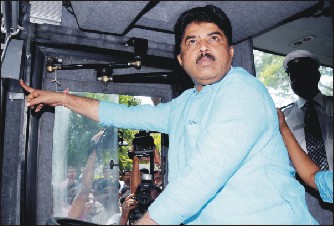
Caption: The Transport Minister R. Ashok is seen switching on the Intelligent Transport System (ITS) in a KSRTC bus in front of Senate Bhavan, Manasagangotri in city this morning.

Mysore, Nov. 17

The Intelligent Transport System (ITS), a first of its kind in the country, was launched by Deputy Chief Minister and Transport Minister R. Ashok here this noon.

Speaking after launching the ITS system at a function held at Sri Nalwadi Krishnaraja Wadiyar auditorium, Senate Bhavan in Manasagangotri, Ashok said that the system is provided at a cost of Rs. 30 crore.

“It will facilitate passengers to get information such as arrival of buses to the stops and details of bus movement from select bus stops by sending SMSes,” he said and added that the ITS system would be extended to other cities in future.

“The State Government is working towards extending transport facilities to every village,” Ashok said and added that plans are on the anvil to introduce intra-city buses in Tumkur, Gulbarga and Mangalore also, in order to prevent people from spending more on private or personal transport.

“The ITS is a game-changer,” said the Minister and added that it will make public transport more efficient and transparent.

Automatic Vehicle Location (AVL) information has been provided to track all city buses in real-time, Passenger Information System (PIS) have been installed at 193 locations, in-bus Display and Automated Voice Announcement System have been provided in all city buses, Central Control Station with Video Wall, Servers, Workstations and Software and MIS reports on fleet management providing performance of the bus system and drivers.

Informaiton can be obtained from the 167 LED display boards and 26 LFD boards at terminals, stops and others strategic locations.

For Interactive Voice Response System (IVRS) — dial 1800 4255220.

SMS 98700-11012 to get bus arrivals and departures in real-time at all bus stops in the city.

Log in to http://mitra.ksrtc.in for real-time bus location map.

Chamaraja MLA H.S. Shankaralingegowda presided over the function.

MLC Siddaraju, Karnataka Zoo Authority Chairman M. Nanjundaswamy, MUDA Chairman L. Nagendra, Karnataka Exhibition Authority Chairman B.P. Manjunath, KSRTC MD Manjunath and others were present on the occasion.

source: http://www.StarofMysore.com / Home> General News / November 17th, 2012

Kiran Mazumdar-Shaw: From motor garage to a $800 mn business

If you don’t know her, you’re oblivious of one of India’s richest women and that too a self-made millionairre.

Kiran Mazumdar-Shaw, who owns the $800million biotech giant, Biocon (one of India’s leading drug companies) didn’t make it to the Forbes Magazine’s 100 ‘Most Powerful Women’ in the world list just like that. But, it took her a lot of her sweat and blood to attain the unprecedented success that she has.

Interestingly, many won’t know that the businesswoman started her humble journey out of a garage in 1978 and that too in less than $200. Well, that’s what a report on CNN has divulged about the entreprenuer.

“I had a lot of foolish courage because when I started up the company I found I had huge credibility challenges to overcome. I was a 25-year-old woman with no business experience, I was trying to pioneer a sector called biotechnology which nobody had heard of. I therefore had huge challenges from getting financial backing to even getting people to work in the organization,” CNN quoted Kiran as saying.

“I was finding it very difficult to get a job as a brew master,” she said.

“It was a chance encounter with a biotech entrepreneur from Ireland that got me started as an entrepreneur in India, because I partnered this Irish company in setting up India’s first biotech company. It has taken me over 30 years to get from a garage to the huge campus that we have today. And it’s been a long journey — it’s been a very exciting journey,” she added.

Interestingly, Kiran was India’s first qualified master brewer, but she turned to setting up her own business after failing to find a job in the brewing sector.

Being a woman, the lady has ensured that she helps fellow women, in fact, she employs around 5,000 scientists, 40 percent are women.

“One of my objectives when I started Biocon was to make sure that I create a company for women scientists to pursue a vocation,” said Mazumdar-Shaw.

Photo courtesy: blog.shankbone.org

source: http://www.DailyBhaskar.com / Home> New Woman / November 16th, 2012

Strides Arcolab Limited : Strides Arcolab Receives US FDA Nod To Commercialize First Liquid Injectable Product From Its New Facility

• First shipments to commence in April 2011

Bangalore:

Strides Arcolab Limited (Strides) today announced that it has received approval from the US FDA to commercialize the first liquid injection sterile product from the Company’s new Sterile Injectable complex in Bangalore. The approved product has been facing prolonged shortage in the USA and approval from the new facility will offer Strides unconstrained capacities to meet the market demand.

With this approval, significant capacity will be released from the existing site enabling

Strides to commercialize additional liquid injectable products.

Strides had earlier announced approval for Vancomycin Injection from its new facility in Bangalore in a lyophilized format and the Company has already started supplies to the US market in March 2011.

Commenting on this development Venkat Iyer, CEO, Agila Specialties, said, “The US FDA approval for the product from the new site will go a long way in ameliorating product shortages in critical therapeutic areas. Two significant product approvals from the new facility augur well for the launch of a series of products in the USA during 2011”

For reasons of confidentiality, the Company is not in a position to disclose the name of the product.

Additional information is available at the company’s website at www.stridesarco.com  www.stridesarco.com.

source: http://www.4-traders.com / Home Page> Shares> National Stock Exchange of India> News / Press Release – Strides – PR Consultancy / November 10th, 2012

Natl. seminar on Info Tech begins

Mysore, Nov.9

“A strong foundation is important to enter into animation world. One has to cultivate research-based attitude to become a good animator and it is important to be a good story-teller,” said Ashish Kulkarni, CEO, Big Animation, Pune, here today.

He was speaking during the inauguration of 2-day National seminar on “Recent Trends in Information Technology and Animation, Visual Effects and Gaming” organi-sed by Centre for Information Science and Technology (CIST), University of Mysore, at Senate Bhavan in Manasagangotri here.

“Animation has been gaining a lot of importance in the present era. India is emerging as one of the best outsourcing centres for animation. Now that we have also started our own production there are plenty of opportunity to flourish. Though, our country missed the bus in 1980s by not realising the importance of animation, we have been able to make a name for ourselves in the world,” Ashish Kulkarni said. “Most of the youngsters today have taken up animation seriously and are striving hard to make a name for themselves,” he said.

“Not many Universities have realised the importance of animation in the country, but the students at the University of Mysore are lucky enough as they have a specialised course for animation which was started around 3 years ago,” he said. Ashish also emphasised the need for encouragement from parents to their wards who wish to take up animation as their career. He said that earlier both parents and teachers did not give importance to fine arts, drawing or any such activities as they did not have any importance academically. As the time has passed people have realised its importance, he said.

source: http://www.StarofMysore.com / Home> General News / November 09th, 2012

Boosting research and development is key to driving the future of the Indian economy

India continues to enjoy the No. 1 position as the leading information technology, business outsourcing and consulting destination of the past two decades. In fact, the other emerging powerhouses of the BRIC nations are all hot destinations for future investments.

But we cannot rest on our laurels. It is imperative that we strive to become the finest research hub the world has ever seen. We can achieve this distinction by investing in our schools – the places where future generations will develop the skills and resources that will drive our country’s economic growth.

The Royal Society’s seminal 2011 report, ‘Knowledge,  Networks and Nations: Global Scientific Collaboration in the 21st Century’, states that even in the difficult economic times we now face, national governments need to maintain investment in their science base “in order to secure economic prosperity, tap into new sources of innovation and growth, and sustain vital connections across the global research landscape.”

Currently, a mere 0.25% of India’s  GDP is spent on research & development. The government proposes to step this up to 2% of GDP, with half of that amount coming from private industry and half from the public sector. While admirable in its intentions, the goal falls short. Israel, for example, spends 6% of its GDP on scientific research. Switzerland and Sweden both spend 4% of their GDPs on research, and even China is approaching 2%.

India is in danger of falling behind other nations in the race to build an advanced, 21th century economy. True, the country has increased its expenditures on education as a percentage of GDP to 4% during the 2011-12 school year from 3.3% in 2004-05. But compared to the other BRIC countries, we need to do more. Brazil, for instance, spends some 5.7% of its GDP on education. Smaller developing nations like Ethiopia spend 4.7%, and even Botswana spends 7.8% of its GDP on education, according to the World Bank.

Make no mistake: India needs a sustainable pipeline of scientific research. To build this pipeline, it is imperative to have strong investments in education. A population grounded in the sciences will strengthen our industries and government. Our nation will have home-grown minds working on the myriad problems facing society and improving the lives of everyone. The responsibility for this task lies not just with government but with private industry, schools, families and individuals.

I encourage young scientists and students to consider careers in research – whether in corporate laboratories or academic institutions. In the private sector, my colleagues and i set up the Infosys Science Foundation (ISF), a not-for-profit trust, to promote scientific research in India. The ISF has set up a series of public lectures by the winners of the Infosys Prize that we hope will kindle a spark of interest in young minds. We hope also to make role models of the Infosys Prize winners – the Sachin Tendulkars of science, if you will – that youngsters will want to follow.

The high point of our year is when we award the Infosys Prize to honour the outstanding achievements of researchers and scientists in the fields of engineering and computer science, humanities, life sciences, mathematics, physical sciences and social sciences. The Infosys Prize highlights the impact research has had on areas important to India’s growth.

One of our recent winners, Professor Kalyanmoy Deb, was honoured for his work in engineering and computer science. His research has led to advances in the areas of non-linear cons-traints, decision uncertainty, programming and numerical methods, computational efficiency of large-scale problems and optimisation algorithms. His work has profound implications on a range of practical ideas – from how the financial markets operate to how we can find sources of fuel in the future. The winner of the Infosys Prize in life sciences, Dr Imran Siddiqui, worked on clonal seed formation in plants that has significant implications for agriculture, especially in the developing world. The work of our winners is meaningful, impactful and inspiring.

As you can see, my colleagues and i are doing what we can to help bring about this transformation in the corporate sector. But there are many steps that India’s universities can take that will focus our students on scientific research. First and foremost is to give top-notch researchers scholarships, grants and interest-free loans to make their work financially worthwhile.

Universities can also bridge the gap of communication and interaction between researchers here and abroad. Let’s make it known that scientific research is a global pursuit benefiting the global community. Plus, schools can ensure that the research conducted by their students is measured by and meets global standards. Finally, i call on the media to devote attention and airtime to profiling India’s top researchers and scientists, and their work. Can you imagine giving the same attention to our country’s great scientists as we do to our  sports and movie stars?

Scientific gains and a booming economy  go hand in hand. We’re at a crossroads in this country. How we move forward at this very moment in our history will determine the success of this nation and whether we lead the world well into the next century.

The writer is chairman emeritus, Infosys and trustee, Infosys Science Foundation.

source: http://www.timesofindia.indiatimes.com / Home> Opinion> Edit Page / TOP ARTICLE / by N R Narayana Murthy / October 24th, 2012
Hotels, retail target Japanese community

Bangalore:

The large and rising number of Japanese enterprises and families in Bangalore is encouraging the emergence of products and services targeted at this community.

Tokyo-based  Nippon Infrastructure Company, in association with entrepreneur Nic U Iqbal, is setting up an exclusive business hotel for the  Japanese community  on Langford Road. This fully Jap-styled, 30-room hotel called Uno-Inn will be operational from November 1. Iqbal, together with another investor, is also launching a chain of Kenkos (Japanese health outlets) to sell Japanese health drugs, herbs, health devices, health accessories, skin, hair and hygiene products. The maiden store is coming up on Brigade Road on a 7,000 sqft facility.

In August, Toyota Enterprises, a wholly owned subsidiary of  Toyota Motor Corporation, entered into a joint venture with Hyagreeva Hotels and Resorts that owns and operates The Chancery hospitality brand in Bangalore. TOI had then reported that, under this pact, Toyota Enterprises would take over 52 rooms in The Chancery on Lavelle Road and invest in styling and ambience to fit Japanese standards. A Japanese restaurant and spa are also being added and will be operational from January 2013.

The Japan External Trade Organization (Jetro) estimates that Bangalore is home to around 200 Japanese companies — most prominent of which is Toyota Motor Company — and over 600 Japanese families. It also estimates that over 12,000 Japanese visit Bangalore every year on business assignments.

The Karnataka government has also made a big pitch for Japanese investments. At the Global Investors Meet this year, the largest foreign delegation, with some 50 members, was said to have been from Japan. The government has been talking about establishing a township exclusively for Japanese expats on 1,000 acres of land, with residential accommodation, restaurants, pagodas, hospitals and schools. The government, in association with the Japanese government, is also said to be looking at establishing a Japanese-language school in Bangalore to help Kannadigas learn Japanese and improve their chances of employment in Japanese firms. A plan for a Japanese bullet train project between Chennai and Bangalore, and Bangalore and Hubli is occasionally heard.

So understandably there is increasing demand for quality Japanese lodging and dining facilities in Bangalore. Iqbal, who has 15 years of working experience in Japan including a five-year term with the Japanese government, told TOI: “Many of these Japanese visitors to Bangalore are on slightly long visits, like a week or more. From my interaction with them I understand that they prefer to stay in a place that gives them a touch of home and Japanese food.”

Naomi Isono, director of Uno-Inn, said, “We are tying to make this hotel as Japanese as possible. It will have Japanese executives, Japanese chefs and Japanese food. The entire decor and ambience of rooms, restaurants and the hotel building will be in Japanese style.”

The Chancery’s Japanese wing will include a dedicated Japanese concierge service, reception desk, signboards, staff for guidance, a floor manager, and a large communal bath area.

This bath area will replicate the hot spring bath experience common in Japan. The rooms will be customized to Japanese requirements, with large desks, bidet toilets and expanded space for long stay guests.

In an earlier interaction, Naveen Raju, director, Hyagreeva Hotels and Resorts, had said that the city hotels sold 1,800 room nights to Japanese business travellers every month.

source: http://www.timesofindia.indiatimes.com / Home> Business> India Business / by Mini Joseph Tejaswi & Anshul Dhamija, TNN / October 23rd, 2012