Category Archives: Business & Economy

“Develop latent talent to be a successful Entrepreneur ”

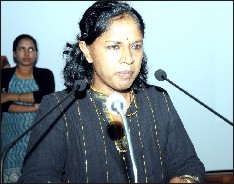
Caption: Ashita Prabhushankar, a successful entrepreneur in the US, delivering a special lecture at JSS Women’s College in city yesterday.

Mysore, May 25

“Listen to your conscience if you want to become a successful entrepreneur. Shed all your inhibitions and come out of social confinements. Learn to take embarrassing situations in your stride and learn from your failures,” adviced Ashita Prabhushankar, a successful entrepreneur in the USA.

She was delivering a special lecture on the topic, ‘My experiences as a woman entrepreneur in US’ at JSS Women’s College in Saraswathipuram yesterday.

Ashita, daughter of noted Kannada litterateur Dr. Prabhushankara, is an alumnus of the college.

“Each individual will have a latent talent which needs to be identified and developed. Thus, anyone can attain success in any endeavour,” she said.

“However, to become a successful entrepreneur, he or she must have worked under another entrepreneur for at least five years,” said Ashita, adding that during her years as a student, her leadership traits were more prominent than academics.

College Principal Prof. N.P. Padaki welcomed. Student Pratheeka compered. Director Dr. K.S. Rajashekar was present.

source: http://www.StarofMysore.com / General News / May 25th, 2012

State records lowest growth rate

Thiruvanthapuram:

Kerala has recorded least growth rate in the fish production during the years 2004-05 and 2010-11, according to an independent research and analysis by the apex industry body of the Associated Chambers of Commerce and Industry of India (Assocham).

According to the survey, the fish production in the state has come down from around 8.66 lakh tonnes in the year 2008-09 to the current level of around 6.82 lakh tonnes. Karnataka has emerged as the leading coastal state with highest growth rate in fish production.

With around five lakh tonnes of annual fish production, Karnataka accounts for almost six per cent of the overall fish production in the country which is currently estimated at 91 lakh tonnes. Besides, in value terms, the fisheries sector in Karnataka is worth around Rs 4,000 crore.

Amid leading coastal states in India, Andhra Pradesh ranks second in terms of growth in fish production with a Compound Annual Growth Rate (CAGR) of about eight per cent and with over 13.5 lakh tonnes of fish production annually.

West Bengal (4.85 per cent), Tamil Nadu (4.47 per cent), Gujarat (3.37 per cent) and Odisha (3.25 per cent) are other leading fish producing states in India which recorded fish production growth rate in between three and four per cent.

Goa has registered a negative growth rate of fish production of around minus 33 per cent as the fish production has slipped from a whopping 9.9 lakh tonnes in 2004-05 to the current level of just 94,000 tonnes mostly due to over-exploitation of fisheries resources.

source: http://www.ibnlive.in.com / Home> South> Southern News / Thiruvananthapuram / The New Indian Express, Express News Service / may 25ht, 2012


US varsity honours Narayana Murthy

Tampa (Florida) May 16

The University of South Florida has honoured Infosys founder N.R. Narayana Murthy with the Global leadership and Free Enterprise Awards for his leadership and contributions to the international business world.

Presenting Infosys chairman emeritus Murthy with the awards at the Patel Centre for Global Sustainability here Monday, USF President Judy Genshaft praised him for his entrepreneurial spirit, according to a university press release.

Earlier, in an informal conversation with past and present students, Murthy said because of his middle class background, it was not as difficult for his company to maintain its values as it might be for the mass of people eking out a living.

‘You need a spirit of sacrifice and you need to have trust,’ he said.

Murthy explained how the company’s ethos has its roots in the very first meeting held at his house in Mumbai with his six fellow founders. Their discussion was focused on profitability.

Murthy focused their attention on ‘seeking respect’, ‘living in harmony with society’ and making sure ‘you don’t shortchange your customers,’ he said. When you do those things, ‘revenue will come. Profit will come’.

In response to a question from about the chances of Murthy entering politics, he mentioned his preference for ‘rational discussion’ and the difficulty the political world offers for such and expressed some hesitation.

Kaushal Chari, chair of the USF information systems and decision sciences department, said Murthy’s story is inspiring for students.

‘He’s a world-class business leader,’ said Chari, who leads a study abroad trip to India every year for business students.

IANS

source: http://www.india.nydailynews.com / Home> News> Desi News / Wednesday, May 16th, 2012

City-based Graduate launches new company in US

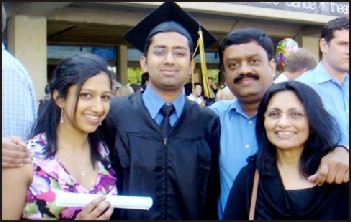
Caption: Siddarth is seen with his parents Padma & Satish and sister Anitha.

Mysore, May 11

Success does not see age or education, instead it sees hard work and enthusiasm to succeed in one’s endeavour. This is true in case of a graduate who, while most of his peers are working at entry-level jobs or in graduate school, is the Chief Technology Officer (CTO) of a medical device startup company.

Siddarth Satish, who has his roots in Mysore, started Gauss Surgical just after finishing Master of Translational Medicine (MTM) programme of Bioengineering Department at University of California, Berkeley, USA.

Siddarth has raised about $1 million in venture funding, hired several full-time staff, recruited a veteran entrepreneur as CEO, and is submitting designs to the US Food & Drug Administration (FDA).

His transition from ChemE undergrad to CTO of his own company in just under two years was due to hard work, brains, ambition and MTM programme. The MTM programme is a one-year master’s degree offered jointly by UC Berkeley and University of California, San Francisco (UCSF), aimed at accelerating the translation of cutting-edge research into advances in patient care.

Finishing up his 2010 Berkeley B.S. in Chemical Engineering, Siddarth joined MTM. He was partnered with fellow students Amer Abdulla and Charles Zhao to work with Professor in Bioengineering Dr. David Rempel. Although not all MTM graduates go on to startups or to work in industry, the unique experience helps students with ambition pursue their passion. The team explored several different projects with collaborators at Stanford Medical Center, including one on virtual instrument pedals that resulted in a patent filing and presentation at the American Academy of Pediatrics. All three decided to focus on another operating room problem: estimating surgical blood loss.

The team completed prototyping to accurately diagnose blood loss before graduating in Summer 2011, and then decided to take their work all the way and form a company: Gauss Surgical.

Siddarth is the son of Padma & Satish, residing in the US since 17 years. City’s industrialist and art patron K.V. Murthy is his maternal grandfather while late Dr. M.S. Nagaraja Rao (former Director General of ASI) was his paternal grandfather. Siddarth has a sister Anitha who will be entering medical school soon.

source: http://www.StarofMysore.com / General News/ May 11th, 2012

Innovation award for Skanray

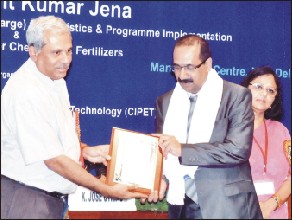
Caption: Balasubramaniam, Director & CTO, Skanray Technologies, receiving the award from K. Jose Cyriac, Secretary, Dept. of Chemicals & Petrochemicals, at New Delhi recently.

Mysore, May 3

Skanray Technologies Pvt. Ltd. won an award for innovation in polymeric products at the 2nd National Awards ceremony for technology innovation in various fields of petrochemical and downstream plastics processing industry held in New Delhi recently. The award is instituted by Ministry of Chemicals & Fertilisers, Govt. of India.

Skanray Technologies won the award for developing ‘Use of Engineering Plastics for Diagnostic X-ray equipment.’

Balasubramanian, Director & CTO, Skanray Technologies, received the award from K. Jose Cyriac, Secretary, Dept. of Chemicals & Petrochemicals.

Skanray was founded in 2007 by a team of reputed engineering and business professionals with decades of experience in industrial and medical devices sectors and having global exposure. Skanray moved into its state-of-the-art manufacturing facility in Hebbal, Mysore and commenced commercial business in 2011.

source: http://www.StarofMysore.com / General News / May 03rd, 2012

Making space for art

Six years ago, Deepak and Deepika Dorai moved to Bangalore from Chennai, where they had started a unique artistic movement called Bimba. They used to run their art hut out of an old home that was razed to the ground — you can almost hear the pain in his voice when Deepak talks about this. Yet, today, the Dorais have successfully recreated their dream project in Bangalore – a distinctive public space for art and performance that is teeming with activity and enterprise.

One of the most cheering aspects of Bimba the Art Ashram is perhaps the space where it’s run: a 100-year-old building on DVG Road in Basavanagudi that was falling into disrepair before the Dorais lovingly restored it. Belonging to an old Bangalore family that has given the Dorais the run of the place, the house, with its many traditional features, could act as a template for how old structures in the city, facing the threat of demolition, can be revived. “It is a house in which 42 children were born; you can say this is very fertile ground,” says Deepak.

To convert the house from a private residence to a public space, Deepika, whose creative energies have directed all the changes, first began by tearing down the boundary walls to create a more open feel. The original pillared entrance has been retained, and as you enter through it you can feel the temperature drop a few degrees, thanks to old-world construction features such as stone and red-oxide floors, high ceilings and hollow-brick walls.

Deepika uses the rooms within the main house to run her artifacts and furniture gallery, and this is also where she retails her clothing line. Deepika creates some unique hand-crafted furniture, ‘upscaling’ old and discarded tables, chairs and beds into one-of-a-kind items. “This is something people working in newspapers before the computer age would remember,” says Deepak pointing to a large metal tray sectioned into small squares – a linotype used in hot-metal typesetting. These ‘trays’ have been used by Deepika to make cupboards (they act as  the doors) and a coffee table (mounted by glass).

Bimba also hosts live performances every Saturday, and these include shows such as one by a practitioner of the Karnataka rod puppetry tradition, a talk by a musicologist on the Jogis’ folk music or a classical vocal Carnatic performance. Along with these, what draws most people to Bimba on Saturdays is the Rasalok theatre – this is also what the ‘art hut’ has become most famous for in recent years. The Dorais call this ‘still theatre of miniature art’; at its  essence these are vibrant storytelling performances using miniature figures and three-dimensional sets, again hand-crafted by Deepika. Most stories are mythological in nature, and two narrations take place in adjoining rooms done by Deepika and her mother Uma Nagraj. These performances form an essential part of Bimba’s activity calendar especially during Navratri, when day-long sessions are held.

EARTH-SENSITIVE ART

While promoting the ideas of earth-sensitive art, we also like to draw people into our performances and our miniature theatre, through which we tell stories that have their roots in mythology. This story-telling tradition has been in my family for generations; my grandmother MN Susheelamma evolved and finetuned the making of a 3-dimensional still scene on a mini-stage as part of her Navaratri festival offering. The key to the visual magic lay in her sense of aesthetics, period and proportions in the miniature space. This practice was continued and improvised upon by my mother Uma Nagraj, who now composes and narrates a magical moment every year. I’m trying to carry on this great artistic tradition.

Deepika Dorai, Founder, Bimba the Art Ashram

source: http://www.timesofindia.indiatimes.com / Home> City>  Bangalore / by Shrabonti Bagchi , TNN / April 29th, 2012

‘Planning a restaurant in Koramangala? Consider food inflation’

From 176  restaurants in 2006,  Koramangala now boasts 432 restaurants, which showcases this business is a jackpot. But be careful before trying your hand at setting up a restaurant of your own, warns  Sajit Chacko, co-founder of  AST Foods in an interview with ET. He advises aspiring restaurateurs to understand challenges, like food inflation and starting with low investments. Edited excerpts:

How did you start AST Foods and how many restaurants do you own in Koramangala?

We are three of us who started AST Foods. We all are passouts of the Institute of Hotel Management (IHM) and have an experience of 10-15 years. I used to do projects for The Leela and then I thought why don’t we open something on our own and that triggered the idea of AST Foods in 2006. We have three restaurants in Bangalore out of which Umerkot is in Koramangala, which was our first restaurant too.

What was the initial investment?

The three of us contributed Rs 3 lakh each and started Umerkot with a seed capital of Rs 9 lakh. Since, we had less capital we took a bank loan where we got 40 percent of the cost and had to repay it in five years. In order to get the restaurant running and spread its flavours, we availed services from our old contacts and goodwill in the industry.

What challenges did you face in this competitive business?

Umerkot was a challenge due to lack of capital. We took the place in Koramangala as it was cheap at that time. Our cuisine is niche – Akbari Gharana – mughlai but non-spicy food. People were skeptical about our restaurant. It became more challenging in the first six months, as the Shinivagalu Main Road where we are located was not well-constructed so nobody would come to our restaurant. I would say that the first year was challenging but then we took off with our niche fan following of people aged above 30 years.

What kind of growth have you seen since inception?

Apart from having loyal customers, the broken road got constructed which became a common road for many more localities in south Bangalore. This helped us to breakeven in two years, which is very difficult in this business. We paid our five-year bank loan in three years. In 2008, when slowdown shook the economy, we also got affected. Though our business dropped to 40 percent that year, we did not bleed since we have a conservative business model. Our business was at its peak in 2009-2010. In 2009, we saw maximum footfalls. We marked around 10 percent revenue increase per annum. We don’t target crazy profits. As I mentioned earlier, we follow a conservative business model. After 2010, profit has been growing at around 3-5 percent per annum.

What is driving the growth of restaurants in Koramangala?

Koramangala is the centre of attraction for south Bangalore. Just like villagers visit the city to hang out, south Bangalore flocks to Koramangala. This locality is an IT hub having maximum disposable income. These Kormangala techies enjoy fine dining and a relaxed ambience, which is driving the growth of restaurants in this tony locality. Moreover, in 2007-10, real estate in nearby areas had undergone development that attracted lot of people. They all frequent Kormangala restaurants.

What is your future plan?

Our plan is to open a new restaurant in every two years.

Tell us about the business.

Restaurant business is a combination of retail and manufacturing. A manufacturing unit takes 8-9 years to breakeven whereas a retail unit can achieve that in six month to 2.5 years. Sustaining the combination of retail and manufacturing is a tough game.

This business is very dynamic and every city and locality has different restaurant patterns. For instance, Bangalore has seen a complete shift in restaurant patterns, population has doubled since a large number of migrants have settled here and all of them have different tastes. In Koramangala, there were 176 restaurants in 2006 now there are 432. Though the figures denote that restaurant business in Koramangala is a jackpot, one should also consider that every month five restaurants opens and three shut down.

Manufacturing drove the Indian economy and no novice tried entering the food sector. Only Udupi opted for this segment. In 2012, the restaurant business transformed. Novices are entering this business and experimenting. It is tough to say who will click as the trend amongst consumers keeps changing. You can see parents eating in some old restaurant and children trying new food or vice versa. Biggest challenge in this industry is that of food inflation. Nobody talks about it or understands it before venturing into it. Food inflation keeps on fluctuating. If grains are short supplied, chicken prices rise. But one cannot keep changing the price in the menu.

Thus, restaurant business will go flat if these factors are not considered and handled well. Restaurant business is unlike regular retail that pays later on.

Which are the biggest industry opportunities for aspiring entrepreneurs in Koramangala?

I can’t suggest business ideas but can talk about seed opportunities in the area. Koramangala has distinctively two types of people, – one who wants maximum comfort coupled with good services and second – who wants value for money and are less dependent on services. I would suggest enterprising people to keep this in mind and take forward from the segment they want to cater. Business like organic food retailing can click well in the area.

What message you would like to give to budding restaurateurs?

The real trick is to start small, as capital is a big challenge. Go for the business where your strength lies instead of flowing with the trend. For example, if you have Rs 10, then observe the market carefully and go for a business where you can make Rs 10 to Rs 12 faster.

source:  http://www.economictimes.indiatimes.com / The Economic Times / Home> Opinion> Interviews / by Rashi Varshney, ET Bureau / April 29th, 2012

Sticking with it

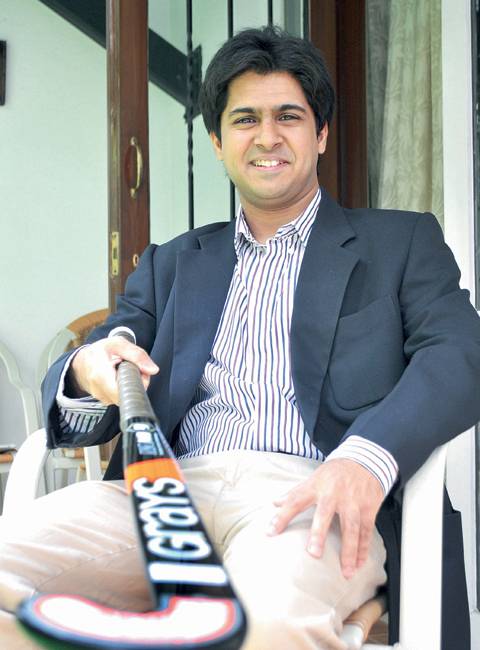
Dhruv Mullick’s only agenda is to bet on sporting talent that is off the beaten track. Inspired by the celluloid story Jerry Maguire, city-based Dhruv has set his sights on the Indian hockey team. A sports entrepreneur, Dhruv is building the brands of two promising hockey players — Raghunath and SK Uthappa just before the Olympics season heats up.

“My idea is to get hockey to a platform where these fantastic players are identified by even school kids. To build brands which can compete with leading cricketers’ brands. But this is just the beginning and we are taking baby steps,” says the entrepreneur. With the London Olympics fast approaching, Dhruv thought this was the right time to build a glamorous image of a much neglected sport. “Raghunath is a typical Kodava lad. His brutal strength as a drag-flicker and commitment to the sport makes him the perfect poster boy of the team. While Uthappa’s talent and the coach’s (Michael Nobb) high ranking, makes him a bankable player. These traits make them brands in themselves,” says Dhruv.

But the going hasn’t been easy. “It is extremely difficult in a cricket-crazy nation to sell non-cricket sports. But the tougher the challenge, the better it gets. The only focus now is to get them as much exposure as possible before the Olympics,” says the shrewd marketing professional. Dhruv who has a BA honours in international business and economics, has trained as a sports brand manager under big names of the Indian sports arena. But his most memorable experience was with cricketing legend Sunil Gavaskar. “The opportunity to work for him and interact with him, is something that I cherish even to this day,” says Dhruv.

Though hockey is his favourite sport, he cannot hide his love for cricket. Not just for school teams, he also managed to play the first cricket season at the university in London. “I played for Regents College during 2004 just for the first season,” he reminisces, adding, “I have a Sunday cricket club with friends. I also play a bit of hockey. But my skills lie off the field,” says Dhruv.

His plan ahead is to ensure that both Raghunath and Uthappa’s brands take off in a big way. The smart entrepreneur concludes by remembering his favourite line from Jerry Maguire, “Show me the money.” And we do hope that hockey as a sport can do that.

source: http://www.DeccanChronicle.com / Home> Tabloid> Bengaluru / by Ayesha Tabassum, DC / April 26th, 2012

Expect sales of Rs 2000 crore in FY13: Prestige Estates

In an interview to CNBC-TV18, Irfan Razack, chairman and managing director of  Prestige Estates Projects says, he expects sales of Rs 2,000 crore in FY13.

Below is the edited transcript of his interview on CNBC-TV18. Also watch the accompanying video (at http://www.moneycontrol.com/news/business/expect-salesrs-2000-crorefy13-prestige-estates_695590-0.html)

Q: I will start with your Chennai project where we understand there has been quite a strong response which has been received. Can you just take us through the details of that first?

A: The Chennai project is in Porur. Name of the project is Bella Vista. We launched it on the Pongal day this year. It has done amazingly well. It is totally more than four million sq ft and it has 2,600 apartments. As of date, we have sold little over 50% of the project, which is fantastic, in just about three months time.

Q: Can you give us an idea of the Bangalore commercial market? We understand that office rents, especially commercial property rents are improving there. On a six months basis year-to-date 2012, how much better is it compared to 2011?

A: In the fiscal year 2011-2012, we have been fortunate, we have leased out something like 3.1 million sq ft of office space. The demand is still there and leasing is still going on. I believe even this year i.e. 2012-2013 we will touch another three million sq ft of leasing. When I say it is our company, overall I think last year Bangalore leasing was something like ten million sq ft. So, pretty much we get a 30% market share here.

Even in Chennai, we completed one of our developments called Prestige Palladium of Mount Road, on Greams Road, even that has done very well, the entire building has been leased out as of date at good rental yields. I believe though the supply may have slowed down because people would have been a little cautious, hence the offtake is quite good. So, the rents also have stabilized and are doing well.

Q: What is the trajectory on rents? Since you spoke about volume as well, give us an idea of how it compares with year ago levels both volume of property that is moving as well as the rents at which they are moving?

A: The rents have gone up. Infact, they have to go up, there is no choice because the input costs have gone up. Also, the good thing is that the supply is getting slowed down a bit, hence the demand-supply ratio gap is not that great and hence the rents also have got pushed up. On the Outer Ring Road, today, we are talking of rentals between Rs 45 and Rs 50, which a year ago we would have been talking of between Rs 38 and Rs 42.

Q: What your project pipeline for FY13 would then look like? Also what sort of pricing do you expect because there are some brokerages which do expect you not to move that much on pricing in order to increase volumes?

A: Infact, I would probably not want the prices to move up because again if I breach my affordability barrier, my volumes and my selling stops. So, as far as I am able get my product in place, the pricing and my costing right, I would rather keep on producing and offering it to the customers at a very reasonable and affordable number.

When I say affordable, it could be affordable in any bracket that is there. Like last year it has been a fantastic year for us, we had given a guidance of Rs 1,500 crore of sales in the FY11-FY12. We have exceeded the Rs 2,000 barrier. I think we are in the range of Rs 2,100 crore is the sales that we have done in FY11-12.

I believe even that same trend will continue in this current year. Though my guidance, I won’t be giving Rs 1,500 crore, but I will be giving a guidance of Rs 2,000 crore for the next year. Hope, we exceed that.

But price range, we are trying to see that even if it goes up, it goes up marginally. So, it helps by us to keep buying and the product doesn’t go out of their rich. Now, with the interest rates going down by half a percent and the likelihood of it going down further because hopefully the economic factors provide for it, I think there will be much more activity.

Q: You said Rs 2,000 crore, you mean FY13 revenues, is that what you are referring to?

A: I am talking about sales. There is a difference between what sales I clock during a financial year and what revenues I book. Our revenues are linked to completion of 30% and occupancy certificates and all of that. So, sometimes the revenue trigger doesn’t kick in. But if you look at it, the volume of sales we have done at some 3,500 in 68 units in FY11-12. We have crossed Rs 2,000 crore barrier. In the year 2012-2013, it will be a guidance of Rs 2,000 crore.

Q: I was looking for a guidance on revenues, what kind of percentage growth in revenues you can expect?

A: Revenues will be lumpy. Though I will have this in the pipeline, ofcourse FY13 booked revenues will be much larger than FY12 because all the sales that I have done in 2011-2012 and 2010-2011 will start coming in for recognition in financial year 2013. Margins also will be pretty much the same as what we have had in the current year. I think margins will hold out.

Q: What is your debt and your debt/equity?

A: Right now, we are looking at a debt/equity ratio of about 0.5 with an overall net debt of about 1,000 crore. Even this debt more than 50% probably even 60% of this debt is basically leased rental discounting, most of our debt that we have is more for capex project. Even if there is some debt on my residential, it is only just to see that there is some bit of flexibility. It is where the capex projects, whether it is hospitality or retail or even office where we are retaining for rental, those are the ones that will consume the cash for the debt.

source: http://www.monecontrol.com / MoneyControl> Home> News> Business>  Business News / source: CNBC-TV18 / Monday, April 23rd, 2012
Industrialist donates Rs. 48 lakh for research on Cotton

Mysore, Apr.13


M. Jagannath Shenoi, Managing Partner of Mangalore Ganesh Beedi and Chairman of Silent Shores Resort, Mysore, today donated the first instalment of Rs. 9 lakh to the University of Agricultural Sciences (UAS) in Dharwad for conducting research on cotton, specifically to create a hybrid variety. He will be donating a total of Rs. 48 lakh in installments for the purpose.

Speaking to Star of Mysore this morning, Rampriyadas, Chartered Accountant of Jagannath Shenoi said that only BT cotton seeds were available in the market and no research had been done in the past 35 years on the indigenous varieties of cotton.

He said that the UAS had come up with the idea of doing research on Indian cotton for which Shenoi agreed to fund the resea-rch programme and added that once the research is completed, cotton seeds would be distributed to the farmers free of cost.

He also said that this variety could be grown using organic manure, without any artificial fertilisers and pesticides.

A cheque for Rs. 9 lakh was handed over to Dr. S.S. Patil, Senior Cotton Breeder, UAS, who is deputed by the VC. Rampriyadas said this was the endeavor of Shenoi to encourage use of desi variety of cotton, thus making farmers self-sufficient.

source: http://www.StarofMysore.com / General News / April 13th, 2012