Category Archives: Business & Economy

New President for MCCI


Mysore, Feb.28

Industrialist Sudhakar S. Shetty was unanimously elected as the President of Mysore Chamber of Commerce and Industry (MCCI) at the Annual General Body meeting held here on Sunday.

The other office-bearers are A.S. Satish (Vice-President), Bhansali (Secretary), R.M. Satish (Joint Secretary) and Subramanya (Treasurer).


Sudhakar Shetty, previously the Vice-President of MCCI, has also served as President of Mysore Hotel Owners Association.


Profile: Born at Koppa Taluk in Chikmagalur District, Sudhakar Shetty settled down in Mysore after his high school education and started his business with a small hotel called ‘Sharada Lunch Home.’

Shetty has served as member of various associations including Hotel Association Trust, Federation of Dakshina Kannada Zilla Sangha and of many educational institutions. He also entered the field of journalism through the evening newspaper ‘Sankranti’.

Awards: He is a recipient of the ‘Man of the year’ award (2001) from the American Bio-graphical Institution; Aryabhatta award (2006); Shikshana Thajna award (2005-06) from the Independent Schools’ Federation of India; The Global Man of the year award (2006) from Vishwa Kannada Sammelana, Bahrain.

He is also an Advisory Board Member of Vidya Vikas Engineering College and Founder Chairman of Jnanasarovara International Residential School, which was established in the year 2004 and President of CBSE, ICSE & State Private Schools Management Association, Mysore Division (CISPMAM).

He is married to Sukalatha and the couple is blessed with two children — Pavan Shetty and Sheetal Shetty.

source: http://www.StarofMysore.com / General News / February 28th, 2012

A toast to the French taste

One literally has to crane one’s neck out of the car window to spot the ‘home of Mariannick’ or Chez Mariannick. Located in Siddapura, off Varthur Road, Chez Mariannick is housed in a brick-and-mortar shack with fields on one side, and signs of concretization on the other. This quaint and rustic French creperie-boulangerie, was first started as a bakery by French-born Mariannick Halai and her husband of Indian origin, Shashi, four years ago.

The home of Mariannick started off as a bakery, in a 10- feet-by-10-feet stone structure located in the middle of a field which the couple had rented from a farmer at Rs 1,100 a month.

“I built our first wood-fire oven in that small plot. My wife and I would carry trays with baguettes and croissants for a kilometre from our apartment. After the baguettes and croissants were baked we would then set off on our scooter and sell our produce to whoever wished to buy them,” recalls Shashi, who worked as a carpenter besides dabbling in other artisan works along with Mariannick in London, before shifting to Bangalore.

Today Chez Mariannick has grown to be a 60-seater restaurant that dishes out a lunch and dinner menu six-days a week, with Sundays off. On Fridays and Saturdays the restaurant serves crepes, while on other days wood-fired pizzas are a staple as are baguettes, croissants and few French desserts. Fresh salad and breads are served to diners “just the way it’s done in France,” Shashi says.

And then comes a straightforward admission: “Nothing comes for free. Call it complimentary and put the price up on the food or just say that’s the meal deal, that’s the combo.” Pizzas come for Rs 350-450, bakery products start at Rs 50.

The couple delivers over 100 croissants and close to 80 baguettes a day to the posh residences in an around Whitefield such as Prestige Ozone and Palm Meadows. They also deliver to Bangalore’s Beverly Hills address, Epsilon, and other high-end gated communities such as Adarsh Palm Vista.

On the difficulties in running an authentic French restaurant Shashi says, “I have only been able to train one person who’s been with us for three years. It’s impossible to get someone who’s committed. You get them, they learn and they move on.” He adds, “Our flavours are what you’ll find in a very good French bakery. And that’s because of Mariannick’s hands. One must understand that in India things always change. Each bag of wheat that you’re going to open will be different from the one opened before. That’s just India.”

source: http;//www.articles.timesofindia.indiatimes.com / City> Bangalore / by Anshul Dhamija / TNN/ March 04th, 2012


Honda Motorcycle to invest Rs 800 cr in 4th unit in Karnataka

Ancillary units around the Honda plant will invest a total of Rs 1,200 crore to manufacture parts for the main unit.

Bangalore, FEB. 28:

Honda Motorcycle and Scooter India (HMSI) will set up its fourth plant in Karnataka at an investment of Rs 800 crore. This will see the total capacity of the company go up to nearly 6 million units.

An official with the Karnataka Government said that Honda has received necessary approvals to set up the fourth plant at Narsapur, near Bangalore. The third plant is also located at the same site and has a capacity to produce 1.8 million units. The investment for the third plant is around Rs 1,200 crore in the Government-allocated 96-acre site.

The first plant, with a capacity of 1.6 million units, is located in Manesar in Haryana and the second plant — with a capacity of 1.2 million units — is located in Tapukara in Rajasthan.

ANCILLARY UNITS

The official said the ancillary units around the Honda plant will invest a total of Rs 1,200 crore to manufacture parts for the main unit. The Honda plant will generate jobs for around 5,000 people.

The company had earlier told Business Line that India will be its biggest global market for two wheelers by 2015. It will account for about 30 per cent of its overall market share, which is now at about 13 per cent.

Honda was earlier looking at setting up the fourth plant in Gujarat but it eventually decided to set up the fourth plant in Karnataka itself. The State Government recently offered tax concessions to Honda for the plant, which includes 40 per cent value added tax payable by the company to the Government as interest-free loan for up to 10 years. The cabinet has also cleared 95 per cent reimbursement of CST for a period of five years and waiver of 100 per cent of land registration cost as well.

HMSI officials had earlier said that the product line-up for the Karnataka plant include, three models of automatic scooters and six motorcycles in 100 cc to 250 cc range.

kgiriprakash@thehindu.co.in

source: http://www.TheHinduBusinessLine.com / Companies / by K. GiriPrakash / Bangalore, February 28th, 2012


Slovenia cosies up to IT City

Bangalore:
The Silicon Valley tag has now brought boutique-country Slovenia closer home. The city’s information technology and cost-effective healthcare has drawn one more country closer – Slovenia. As a first step, a consulate was set up on Monday.

“Slovenia is a getaway to the European market and former Yugoslavia, with a lot of a free access particularly to the latter, so companies specially IT companies travelling to our country should ideally be on an advantage,” Ambassador Janez Premoze told The Times of India.

INVESTMENT HUB?
“It can prove to be ideal investment destination for companies,” added V Ravichandar, Honorary Consul, Republic of Slovenia.

Encouraging IT investments apart, the quality and cost-effective healthcare offered by private players in Bangalore is a key area which Slovenia wants to replicate in their own country. “There is a dearth of specialized medical treatments in the private sector and with the ageing population count going up both government and private players have to co-ordinate to provide quality healthcare cover in Slovenia,” said Premoze.

AYURVEDA, A RAGE
Premoze said India’s Ayurveda is also becoming popular in a big way. There are two ayurveda centres set up in the country. “We want to facilitate an exchange of scientists both at the basic and applied research level from Bangalore,” said Premoze, adding that efforts are on to sustain bilateral exchange of trade between India and Slovenia.

TOURISM FACTOR

“It is a great skiing destination, so the idea is also to project Slovenia as a potential tourist destination,” said Ravichandar. It is learnt that only 5,000-10,000 Indians on an annual basis visit Slovenia while 1,00,000 people from Japan tour the place.

“It is one of the lesser-explored European destinations. With conditions sure to lure the Indian tourist, many more people from Slovenia is likely to touch base here,” Janez pointed out. A high 14% of the country’s GDP is from tourism, but that is largely restricted to a high tourist flow from the European countries.

source:  http://www.timesofindia.indiatimes.com / Home> City> Bangalore / TNN / February 28th, 2012

The monk who makes cheese

Meet Father K L Michael, administrator of a KR Puram-based monastery. This priest from Kerala, now supplies cheese from Bangalore to various parts of the country

A  variety of Italian cheese. Pic: Theresa Varghese.

He’s the monk who makes the cheese and sells it too! Father K L Michael. Administrator of Gualbert Bhavan, a monastery in KR Puram, is a priest with an alter ego as a cheese maker.

How did a priest from Kerala end up supplying cheese from Bangalore to the best of Italian restaurants and star hotels in the country? As Father Michael himself puts it, with a characteristic little smile tugging at his mouth, “It was a long journey.”

A boy of 15, he was among 11 youngsters in the first batch to join the order when a Vallombrosan Benedictine Congregation was set up in Kottayam (in Kerala) in 1988. Five years later, he was sent to Rome where he learnt Italian and theology and prepared for a Masters in liturgy. As he studied and lived within the order, he began to develop a fondness for Italian food.

“We took turns cooking. At first I just threw ingredients together but soon I was able to make fairly good pasta,” he says with a laugh. He was also able to observe at close quarters the various communities that the order nurtured. The Benedictine order follows the motto of prayer and work. When not meditating, the monks and priests engage in income generating activities that will fund the welfare work they do and also help in sustaining each house. Some of these activities traditionally revolve around food and drink. So while there is a community that manages the sale of religious articles, there are also communities involved in the preparation of wine and liqueur. For those who do not know, Benedictine – the sweet liqueur that goes well with brandy – was created out of herbs and spices by a monk in 1510.

Watching these skilled communities, Father Michael pondered over what kind of work he could undertake when he came back to India. Given his partiality towards spaghetti and its ilk, it was not surprising that his mind veered towards cheese. Father Michael was fortunate on two counts – he belonged to the Benedictine order, and spoke fluent Italian. This translated into easy entry into spaces that would otherwise have been closed. With the encouragement of his superiors, he travelled to cheese-making units and learnt the trade. To Aversa, located in the south of Italy, famous for its Mozzarella cheese made of buffalo milk, and to Naples – the place where pizza is said to have originated.

By the time he got back to India and was ordained as a priest in 1998, Father Michael was a liturgical scholar who also knew how to make varieties of Italian cheese. Two years later, when he was sent to Bangalore to establish a house for young monks, he set up Gualbert Bhavan and began work as a novice master, looking after the needs of the approximately ten to 15 students who arrive here annually. But cheese was not far from his mind. Having obtained used machinery from donors in Italy, he began to look around for good quality buffalo milk. After much research, he decided on milk from a village in Hoskote.
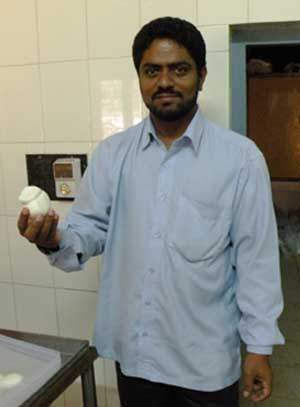
Father K L Michael. Pic: Theresa Varghese.

As he recounts his initial selling experience, Fr Michael is candid about his lack of confidence in his abilities as a cheese maker. “In 2004, I made the first two kilos. Then I looked up the Yellow Pages for Continental restaurants and picked Herbs and Spices in Indiranagar as it was not too far away. I introduced myself to the owner, requested him to try out the cheese and, when he agreed, asked him to let me know what he thought. A week later, he called and told me to get some more.”

It was the beginning of a trajectory. Manjit Singh ofHerbs and Spices, who knew people in the hospitality industry, put out the word. And Father Michael had no reason to look up the Yellow Pages anymore. Within no time he, and his assistant Father Joby, were supplying fresh cheese to five star hotels and Italian restaurants in the city. From there it snowballed to hotels in other cities and from there to Singapore where, according to Father Michael, “For two years we supplied approximately 100 kilos each month to the Pasta Fresca da Salvatore chain of restaurants.”

Vallombrosa cheeses are available at Namdhari’s, Spar, MK Retail, More, Food Zone, Big Market and Tom’s Bakery.

For more information clickhere

Gualbert Bhavan now churns out 45 kilos of cheese each day. Despite the quantity produced, it remains a two-man show, with Father Jinse having replaced Father Joby. The Vallombrosa range, as the brand is known, includes smooth and creamy Mozzarella, small balls of milky Bocconcini, sweet flavoured grainy Ricotta, buttery Burrata, hard and salty Pecorino, tomato paste and olive oil infused Caciotta, rich creamy Mascarpone and, of course, soft stretchy pizza cheese. Except for Mascarpone that utilises fresh cream, all the cheeses are made from buffalo milk, which is creamier and richer than cow’s.

Father Michael recalls how, after his initial success with milk, he found that the supplier was watering down the product. So he cut out the supplier and bought 20 buffaloes, with the aim of ensuring that the source would remain pure. But maintaining the cattle became difficult and when he realised that they were spending more time managing the buffaloes than producing cheese, Father Michael sold off the animals. He then obtained the milk from various buffalo owners in Ramnagaram, an hour’s drive from the city. However, after an initial honeymoon period he found the sceptre of adulteration raising its head again. So it was back to legwork and surveys once again till he finally settled on a farm in Hosur. This is where he currently gets his 170 to 200 litres of milk every day.

Father Michael has recently produced Feta cheese (usually made out of goat milk) from buffalo milk. Though it has been well received, he intends to make Feta the traditional way; the idea being to start a cheese-making unit at the main house in Kottayam where they can also rear goats. The project will be launched by the end of this month.

Did he imagine a mammoth scenario like this when he started out? “Not at all,” replies Father Michael, going on to remark in his mild-mannered way, “It just grew.”

16 Feb 2010

Independent writer and ardent baker who loves all things to do with food.

source: http://www.bangalore.citizenmatters.com / Food> Consumer / by Theresa Varghese / February 16th, 2010
 

KASSIA pleas for tax concession for SMEs

A delegation met chief minister DV Sadananda Gowda to request him to incorporate their demands in the upcoming state budget so as to boost the growth of small scale industries in the state
In a memorandum to chief minister DV Sadananda Gowda on Wednesday, the Karnataka State Small Scale Industries Association (KASSIA) has requested for liberal tax concessions and investment subsidies in the upcoming state budget, in order to boost the growth of small industries in the state.
source: http://www.ciol.com / Thursday, February 23rd, 2012

Wipro awarded US patent

Bangalore, JAN 30:

Wipro Technologies has been granted a patent by the United States Patent and Trademark Office for its Statistics Operations Research Matrix (StORM) methodology.

StORM, a system and method for software test suite optimisation, increases the effectiveness of the testing process while reducing the number of test cases.

The company said that StORM can reduce the software test suite by around 30 per cent.

source: http://www.TheHinduBusinessLine.com / Industry & Economy> Info-Tech / Our Bureau / January 30th, 2012

Tata Global Beverages unit invests in Bjets

Mumbai:

In February 2008, Bjets had said that it aims to become Asia’s largest business jet operator with Tata Group as a significant investor

Tata Global Beverages Ltd said on Tuesday that an overseas unit of the company has invested in Bjets Pte Ltd, a Singapore-based company engaged in the business of owing and operating private jets.

Tata Global did not disclose details of the investment or the size of the stake that the company owns. In February 2008, Bjets had said that it aims to become Asia’s largest business jet operator with Tata Group as a significant investor.


An alliance was announced in February last year involving G.R. Gopinath’s aviation services company Deccan Charters Ltd, Taj Air, the airplane charter company of the Tata group’s Indian Hotels Co. Ltd, and Bjets.

Besides the marketing alliance, Deccan Charters will provide maintenance and operational support for Bjets’ planes.

source: http://www.livemint.com / Corporate News / by P R Sanjai / Tuesday, January 31st, 2012


Gem of a career with opportunities galore

Lucrative trade

The glitter will just does not fade away, it seems. No wonder, a career in the jewellery industry is being seen as an increasingly lucrative option for students.

The burgeoning gold market in India is beckoning students and there was more proof of this when close to thousand students and working professionals thronged Vijaya College for the career fair organised recently by the Gemological Institute of India and Jewellers’ Association, Bangalore.

India is the leading consumer of gold in the world with about 800 million (80 crore) tonnes – 20 per cent of the global consumption. More than 50 per cent of this is used for making gold jewellery.

According to industry sources it is estimated that the size of the Indian jewellery market is Rs 1,25,000 crore annually.

The Indian Diamond Industry has established itself as the world’s largest manufacturing hub of cut and polished diamond in the last many years, contributing 60 per cent of the world’s supply in terms of value, 85 per cent and 92 per cent in terms of volume and pieces respectively. Eleven out of 12 diamonds set in jewellery worldwide are processed in India.

Participating in the panel discussion at the career fair, Vinod Hayagriv, Managing Director of C Krishniah Chetty & Sons, said: “Gems and Jewellery (G&J) is one of the fastest growing sectors in Indian economy, with significant employment opportunities. We at the All India Gems and Jewellery Trade Federation are looking at targeting a 40-lakh strong skilled workforce demand in the next 10 to 15 years.”

Mahesh Rao, Managing Director of Peakok Jewellery Ltd, said: “With the jewellery industry getting professional, there are several openings for designers at the manufacturing level in factories and also at retail jewellery stores.”

Rao said: “They can become entrepreneurs themselves by setting up boutique catering to a niche market.”

Agrees Pratap Kamath, CEO of Abaran Jewellers. He said: “The working atmosphere has changed compared to the past 10 to 15 years. The industry is structured and very well organised with the entry of many retailers.”

Pallavi Foley, designer, opined that one must have a passion for design and fashion to make a mark in the profession. The designers are the link between jewellery houses and fashion, she said.

Says Hayagriv: “Jewellery designers start with preparing design sketches by hand or on the computer. With time, they have options to become merchandisers and heads who manage profitability of companies.”

He said: “They can become consultants for the customers or the manufacturing team. They create detailed drawings, a structural model, computer simulations or full-scale prototyping. Increasingly, computer aided design programmes and tools are being used to create and better visualise the final product.”

Pratap Kamath said: “At the manufacturing level, it involves understanding current trends and developing collections based on the brief provided. At the retail level, designers have opportunities to interact with customers and help them choose the design of their choice,” Kamath said.

A fresher trainee in jewellery designing starts with Rs 10,000 and upwards per month. The salary can go up to between Rs 20,000 to Rs 30,000. With an experience of five years, one can earn about Rs 50,000 per month. Designers can rise to the top management if they possess business acumen.

Says Kamath: “The demand is huge and supply short, therefore the opportunities available are huge. Also, we see the entry of many retail jewellers into the market. This is an indication of the great opportunity for designers. “A five per cent increase from the current figures will really help the industry. Over 5,000 is our estimate of the requirement of specialised professionals,” Kamath added.

source: http://www.DeccanHerald.com / Home> State / Bangalore/ DHNS / by Umesh M Awannavar

Strides sells generics business in Australia & Southeast Asia to Watson Pharma for Rs. 1970-cr

Strides Arcolab Limited has sold 94 per cent shareholding in Ascent Pharmahealth Limited, its subsidiary with operations in Australia and Southeast Asia, to Watson Pharmaceuticals, Inc.  As part of the transaction, Watson also acquired the remaining 6 per cent shareholding associated with Dennis Bastas, CEO of Ascent.  The transaction was signed and closed simultaneously.  The cash offer from Watson values Ascent at an enterprise value of AU$ 375 million which amounts to around Rs. 1970 crore.  After this announcement Strides’ scrip jumped by nearly 16 per cent on BSE and reached at its 52-week high of Rs. 488.80.

Ascent is a top five generic pharmaceutical company in Australia and is present across several countries in Southeast Asia, including Singapore where it is the leading generic pharmaceutical company.

Watson is an integrated global specialty pharmaceutical company engaged in the development, manufacturing, marketing and distribution of generic pharmaceuticals and specialized branded pharmaceutical products focused on Urology and Women’s Health.  Watson has operations in many of the world’s established and growing international markets.

Commenting on the transaction, Arun Kumar, Executive Vice Chairman and Group CEO of Strides Arcolab, said:  “The sale of Ascent is a value enhancing and forward-looking initiative for Strides.  We have been clear about our intention to focus on our highly attractive steriles segment, which we expect to be our growth engine going forward.  The transaction further facilitates the execution of this strategy and unlocks significant value for the Group.  Furthermore, the proceeds from the transaction considerably strengthens our balance sheet.”

Over the last six months, the Strides–Ascent partnership generated significant economic benefit through the transformation of the latter into a vertically integrated generics business with a robust portfolio of marketed and newly developed pipeline products.  In addition, we further expanded the business from its home market in Australia to establish a scalable platform across high-growth emerging markets in Southeast Asia, said the  Strides chief.

“Combining the product portfolios and commercial infrastructures of Ascent, Watson creates a substantial generics business in the region and provides Ascent with a number of new growth opportunities.  We believe that Ascent, its partners, customer and employees across all of its markets will benefit from the continued development under its new owners,”  he added

Paul Bisaro, president and CEO of Watson, said:  “The acquisition of Ascent provides Watson with a successful commercial structure in both Australia and Southeast Asia and a broader pipeline of products to support continued growth.  We are excited to welcome the Ascent employees in Australia and Southeast Asia to our growing global team and anticipate a seamless and rapid integration of the Ascent businesses.”

Jefferies International Limited acted as sole financial advisor to Strides Arcolab.  Middletons, Herbert Smith LLP and DSK Legal acted as legal counsel.

Strides Arcolab, has 13 manufacturing facilities across 5 countries with presence in more than 75 countries in developed and emerging markets.  It is supported  by a 350-scientist team operating out of its global R&D Centre in Bengaluru .

Agila Specialties Private Limited is the specialties unit of Strides Arcolab which was spun off as a separate division post the company’s restructuring in 2009.  It is engaged in the production of oncolytics, penems, pencillins, cephalosporins, ophthalmics, peptides and biosimilars. It  operates from 8 world class global manufacturing facilities, including one of the largest steriles capacity in India and amongst the largest lyophilization (freeze drying) capacities in the world.  Its  marketing network covered 70 countries and it has partnerships with leading pharmaceutical companies globally.

source: http://www.PharmaBiz.com /  Home> News> Corporate / Our Bureau, Bangalore / Tuesday, January 24th, 2012