Category Archives: Nri’s / Pio’s

City-based Graduate launches new company in US

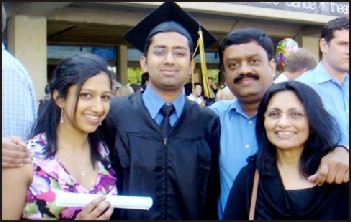
Caption: Siddarth is seen with his parents Padma & Satish and sister Anitha.

Mysore, May 11

Success does not see age or education, instead it sees hard work and enthusiasm to succeed in one’s endeavour. This is true in case of a graduate who, while most of his peers are working at entry-level jobs or in graduate school, is the Chief Technology Officer (CTO) of a medical device startup company.

Siddarth Satish, who has his roots in Mysore, started Gauss Surgical just after finishing Master of Translational Medicine (MTM) programme of Bioengineering Department at University of California, Berkeley, USA.

Siddarth has raised about $1 million in venture funding, hired several full-time staff, recruited a veteran entrepreneur as CEO, and is submitting designs to the US Food & Drug Administration (FDA).

His transition from ChemE undergrad to CTO of his own company in just under two years was due to hard work, brains, ambition and MTM programme. The MTM programme is a one-year master’s degree offered jointly by UC Berkeley and University of California, San Francisco (UCSF), aimed at accelerating the translation of cutting-edge research into advances in patient care.

Finishing up his 2010 Berkeley B.S. in Chemical Engineering, Siddarth joined MTM. He was partnered with fellow students Amer Abdulla and Charles Zhao to work with Professor in Bioengineering Dr. David Rempel. Although not all MTM graduates go on to startups or to work in industry, the unique experience helps students with ambition pursue their passion. The team explored several different projects with collaborators at Stanford Medical Center, including one on virtual instrument pedals that resulted in a patent filing and presentation at the American Academy of Pediatrics. All three decided to focus on another operating room problem: estimating surgical blood loss.

The team completed prototyping to accurately diagnose blood loss before graduating in Summer 2011, and then decided to take their work all the way and form a company: Gauss Surgical.

Siddarth is the son of Padma & Satish, residing in the US since 17 years. City’s industrialist and art patron K.V. Murthy is his maternal grandfather while late Dr. M.S. Nagaraja Rao (former Director General of ASI) was his paternal grandfather. Siddarth has a sister Anitha who will be entering medical school soon.

source: http://www.StarofMysore.com / General News/ May 11th, 2012

Dubai : Bunts UAE Conducts Blood Donation Campaign

Dubai, May 6:
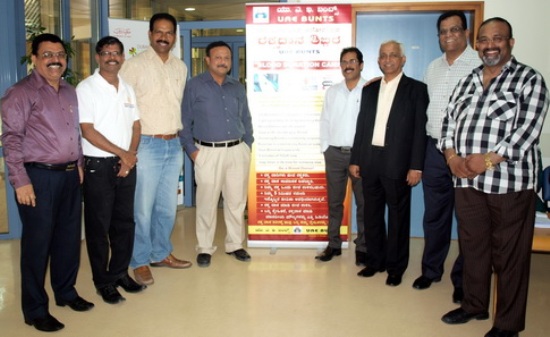
Bunts UAE this year successfully kicked off and concluded ‘Blood Donation’ Campaign at Latifa Hospital, Dubai on the 4th of May, 2012, Friday from 10.00 AM to 2.00 PM with record number of donors participation.

Sudhakar Alva the main man behind this campaign thanked the authorities for being tolerant and supportive in the campaign and promised more contribution to the Blood Bank from all the Indian Communities living in UAE. The Donors poured in great numbers from various parts of UAE into Lathifa Hospital enthusiastically for this great cause. It was also great to see Presidents and Office Bearers of most of the regional Community Associations of Karnataka together in one place for this noble cause. A record was created with more than 100 numbers participation.

As per the Dubai Blood Donation Centre (DBDC), the need for blood is ongoing and must be met every day. The demand for blood is growing faster than the collection rate and DBDC has been requested to have an instant response to the rapid growth in blood demand which is obviously proportionate to the fast growing population of the city along with healthcare facilities. DBDC is the only blood supplier in Dubai. Its services extend to Thalassemia patients (Thalassemia Center at Al Wasl Hospital), road accident and burn victims (Trauma Centre at Rashid Hospital), patients with neonates and maternity health complications (Lathifa Hospital), cases diagnosed with cancer or scheduled for open heart operations (Dubai Hospital) as well as to all private health facilities within Dubai that are entitled for transfusion services.

The Members volunteered along with hospital authorities were busy welcoming donors and filling up the required forms, examining blood samples and getting ready for the extraction of blood all with smiles on their face. They were issued a ‘Donor Card’ exclusively as a proof of their support.
The campaign kicked off with good numbers of Bunt’s voluntarily taking part along with female members and youths. Other patriotic associations who have been willingly doing these types of blood donation campaigns are Karnataka Sangha Sharjah, UAE Amchigele Samaj, Ramarajya Khsatriya Sangha UAE, Padmashali UAE, Kodagu and Dakshina Kannada Gowda Samaja Dubai, UAE Bunts, Billawas Dubai & Northern Emirates, Billawa Balaga Dubai who have already recorded their names in the list of blood donors of India in UAE.

Bunt’s UAE staged a breakfast stall with Snacks, Tea, Coffee, Fruits, Juices etc. at the blood donation campaign was given a boost with the support and participation of prominent community leaders like Sarvotham Shetty of UAE Bunts, Lokesh Puthran, President along with Vice President Yadav Kotian and main co-ordinator of Blood donation campaign in UAE, Bala Salian of Mogaveers UAE, Sudhakar Alva of UAE Bunts, Ravi B. Shettigar, President of Padmashali UAE, Satish Poojary President of Karnataka Sangha Sharjah, Anand Bailoor, Jagannath Bellare, Sudhakar Poojary of Billawas Dubai & Northern Emirates, Sudhakar Thumbe, President of Billawa Balaga Dubai, Representatives of Vishwakarma Seva Sangha & Shodhan Prasad of Nama Tuluveru UAE. Also were Ashok Belman of Gulf Kannadiga and many other prominent members of other well known associations.

The event concluded at around 2 PM
Report: Shodhan Prasad
Photos: Ashok Belman (Gulf Kannadiga)

source: http://www.DaijiWorld.com / Dubai, May 06th, 2012


Sharing experience…: with love… from the land of Golden Gate bridge-3

On May 30, 1995, Star of Mysore had published a news item titled PUC: City gets 2 ranks in which two students B.S. Manjula of JSS College for Women (9th rank in Arts) and B.S. Suryanarayan (9th rank in Science) were featured.


Now, after 17 years, Manjula, a regular reader of Star of Mysore, has written about her experiences at San Francisco State University from where she obtained an MA in Economics.

Currently residing in Fremont, California, Manjula is working as a Research Analyst at Steele Foundation, San Francisco (home to the famed Golden Gate Bridge).

She is the daughter of late Bhadraswamy, a reader at Government B.Ed. College, KSOU and Amrutha. Here we publish the third in a series of her articles which she sent to SOM, saying ‘My day begins with Star of Mysore!’

Daly City Bart became part of my life throughout San Francisco State University (SFSU) days. The impression it left on my mind is something unique. Even today, whenever I see a Bart train (Bay Area Rapid Transit System) whistling through the wind like a tea kettle, I go down the memory lane, riding Bart, re-calling my long association with it.

Bart is a fast-moving train which stops for a few minutes at every station for passengers to board and get off. It was my only means of transport to the University. I travelled from Fremont to Daly city, one-and-a-half-hours one way, weekly four days. SFSU is located on Daly city border. So from Daly City Bart station to the University, SFSU shuttle which would ply every 15 minutes would take us to the University free-of-cost.

I spent time either “relaxing” or observing people. There were people attired in business suites reading a book or working on their laptop as they travelled to San Francisco. There were students chit chatting with their friends, young mothers with the baby still sleeping in the stroller, beautiful women gently applying make-up and sometimes bubbly school kids visiting some place of interest with their teachers.

Morning 8 to 9 and evening 5 to 7, the train would be full to the brim with tired Indian software engineers, a heavy bag dangling from their shoulders obviously containing a laptop. If there were any baseball matches in the Oakland Coliseum (Stadium), the train would be swarmed with men wearing green T-shirts and green caps, even during 10.30 in the night! There were sometimes beggars begging with decency — “Ma’am could you spare some change please.”

I travelled most of the time off peak hours, closing my eyes, relaxing, unmindful of surroundings and co-passengers. Because of this “relaxing” habit, I landed in many embarrassing situations.

Once it so happened, while returning home I dozed off. I was supposed to get down at Bay Fair station and transfer to the Fremont Bart as there were no direct trains after 7 pm to Fremont from Daly City. When I woke up, I was in Castro station which was way ahead of my destination. I immediately got down from the Bart and boarded the San Francisco train. This time, without fail, I got down at Bay Fair and took a Fremont train home. I reached home at 9.30 pm instead of 8.30 pm. In another such “relaxing moment,” I lost my cell phone worth 200 dollars !

Vending machine Vs long queues

I couldn’t help but compare American transport system with our own Indian transport system. Passengers can buy tickets without any hassle by depositing money in the vending machine or get it from any departmental stores like Safe-way or Rallies. When entering the station, just swipe the ticket at the gate and voila ! you are in.

But Indian railway stations are packed all the time. People should enter the station one hour before they begin their journey only to buy tickets standing in queue getting pushed by all. You are lucky if only pushed by people! Recently, I read that online counters are being introduced in India where you can book your tickets in advance. Thanks to the former Railway Minister Laluji ! I had great expectations from Dinesh Trivedi, a trained pilot, highly educated and widely travelled politician, who was sacked last week for taking a bold step which could have improved the Indian Railways.

During peak hours, like our KSRTC and local trains in Mumbai, Bart was also crowded, but I never saw passengers standing on footsteps of a bus or dangling from the windows. Bart doors once closed could not be opened, unless the driver wished to. Another thing that struck me was punctuality of the system. Trains would arrive and depart exactly at the announced time. The driver would announce the approaching station a few minutes before he entered the station so that the passengers could get ready to disembark the train and there would be no delay in continuing the journey.

Cleanliness is another remarkable feature. There were cleaners wearing hand gloves who came in and cleaned the Bart from time to time at several stops, collecting newspapers and empty plastic cups littered on seats or floor.

Poverty in ‘God’s own land’

Bart train was a home to many homeless and old folks who did not have their own place to live. Often I came across such people who travelled from one end to the other just because they wanted to remain inside the train which was a safe refuge to them from the chilling cold and rain. They slept like a log unaware of the climate while the driver announced our arrival at the Daly City station, the last stop in the line.

Poverty or homelessness was not new to me. It was poverty in America, ‘God’s own land’ that was new to me! Even today several people are under the assumption that US is heaven and there is no poverty in there. People with signboards asking for money, people sitting or sleeping with all their belongings in big plastic bags is not uncommon, especially on the streets of San Francisco. They look like a bundle of rags, no life left in their eyes. The problem has worsened with the collapse of housing market, increasing foreclosures and unemployment in the face of recession. Like any other government, the US government is also trying to help these people in the low rungs of the ladder. How far they have been successful, that is a big question mark with increasing numbers carrying sign-boards on the streets.

Understanding ‘Manku Thimmana Kagga’

I got acquainted with some students who were travelling like me to the University everyday by Bart, who later on became my good friends. One day, I was waiting for the Fremont Bart after I finished my economics class. It was around 6.45 pm. I felt someone pulling my sweater and turned to find a Sardar standing, grinning like a Cheshire cat. He was my classmate Surinder Singh (name changed) who was also enrolled in the same graduate economics class as I were. He was about to graduate the next semester. I had never spoken to him earlier. I would literally run soon after the class to catch my Bart since I was always in a hurry to reach home for I had other responsibilities as a woman.

“Hi,” I greeted him.

“Are you travelling to East Bay?” he asked.

“Yes, to Fremont. You?”

“I stay in Oakland… You come all the way from Fremont! Boy, that’s long commute. I often visit Fremont… I come to the Indian restaurants in Fremont and visit Naz Cinemas to watch Hindi movies,” he replied.

By that time, Fremont train arrived and we hopped on to it. Many times he travelled with me in Bart passionately talking about his ambitions. Surinder was born in India but he migrated to US when he was 9 years old with his parents. He was working for a non-profit organisation in Oakland. Though he spent most of his life in US, he still retained love and respect for India. After his graduation, he wanted go to India and do research in sociology. His eyes gleamed whenever he spoke about his research.

Alas, fate had other plans in store for him. After the semester, I rarely saw him as he finished all required courses. When I heard about him again, he was dead.

It was my last semester in the school. I was sitting in the lab working on my research paper. A Japanese friend of mine came and asked me, “Hey, do you know Surinder?”

“Yes I know him. He was with me in Public econ and Macro class. It has been a long time since I met him. What is the matter?” I questioned.

“He is dead,” he said with a grief-stricken voice.

“What? Surinder is dead? How did he die?” I could not believe he was dead. My friend explained that Surinder was in Hongkong with a group of protesters, protesting against WTO. He returned home safely, but after a week, he died in his apartment alone. He must have caught some infectious disease there which caused his death. My friend even showed me a website in which many of Surinder’s friends had paid their homage.

I was shocked to hear about his death. He was too young to die. He aspired to take up the cause of underprivileged and downtrodden. His death left me with many unanswered questions. Was he in pain when he died? Did he want to see his near and dear ones and talk to them at that moment? Did he want to complete his unfinished tasks before he left this world? What was his fault?

He had vanished like that Cheshire cat in Alice’s Adventures in Wonderland leaving behind only his smile hanging in the air.

“That’s the way of life. Everyone has to go one day. Birth and death, pain and pleasure, childhood and old age — no one can ever escape from this cycle,” my husband said when I narrated the incident to him.

“Yes I know, it is inevitable. But it is so hard to accept that he is no more,” I said.

“Yes, I know, it is hard to believe. Accept it or not, that is the eternal truth and we must live with it,” he declared.

There was this song from Manku Thimmana Kagga playing on our music stereo in the car—”Baduku jataka bandi, Vidhi adara saheba; Kudure neen, Avanu peldante payanigaru; Maduvego masanako hogenda kadegodu; Pada kusiye nelavihudu mankuthimma.”

[Meaning: Life is a horse driven cart, fate its driver,

You’re the horse, passengers in it decided by God,

Go wherever fate decides, either to burial ground or marriage hall,

When stumbled, God will support you.]

source: http://www.StarofMysore.com / Features/ Tuesday, March 27th, 2012
A toast to the French taste

One literally has to crane one’s neck out of the car window to spot the ‘home of Mariannick’ or Chez Mariannick. Located in Siddapura, off Varthur Road, Chez Mariannick is housed in a brick-and-mortar shack with fields on one side, and signs of concretization on the other. This quaint and rustic French creperie-boulangerie, was first started as a bakery by French-born Mariannick Halai and her husband of Indian origin, Shashi, four years ago.

The home of Mariannick started off as a bakery, in a 10- feet-by-10-feet stone structure located in the middle of a field which the couple had rented from a farmer at Rs 1,100 a month.

“I built our first wood-fire oven in that small plot. My wife and I would carry trays with baguettes and croissants for a kilometre from our apartment. After the baguettes and croissants were baked we would then set off on our scooter and sell our produce to whoever wished to buy them,” recalls Shashi, who worked as a carpenter besides dabbling in other artisan works along with Mariannick in London, before shifting to Bangalore.

Today Chez Mariannick has grown to be a 60-seater restaurant that dishes out a lunch and dinner menu six-days a week, with Sundays off. On Fridays and Saturdays the restaurant serves crepes, while on other days wood-fired pizzas are a staple as are baguettes, croissants and few French desserts. Fresh salad and breads are served to diners “just the way it’s done in France,” Shashi says.

And then comes a straightforward admission: “Nothing comes for free. Call it complimentary and put the price up on the food or just say that’s the meal deal, that’s the combo.” Pizzas come for Rs 350-450, bakery products start at Rs 50.

The couple delivers over 100 croissants and close to 80 baguettes a day to the posh residences in an around Whitefield such as Prestige Ozone and Palm Meadows. They also deliver to Bangalore’s Beverly Hills address, Epsilon, and other high-end gated communities such as Adarsh Palm Vista.

On the difficulties in running an authentic French restaurant Shashi says, “I have only been able to train one person who’s been with us for three years. It’s impossible to get someone who’s committed. You get them, they learn and they move on.” He adds, “Our flavours are what you’ll find in a very good French bakery. And that’s because of Mariannick’s hands. One must understand that in India things always change. Each bag of wheat that you’re going to open will be different from the one opened before. That’s just India.”

source: http;//www.articles.timesofindia.indiatimes.com / City> Bangalore / by Anshul Dhamija / TNN/ March 04th, 2012


Indian-Born Kamal Bawa Wins Award for Sustainability Work

Washington, Feb 18 (IANS):

Kamal Bawa, an Indian-born professor of biology at the University of Massachusetts Boston, is the 2012 winner of the Gunnerus Sustainability Award, the world’s first major international award for work on sustainability.

Bawa will receive the Gunnerus Gold Medal and the award of 1 million Norwegian Kronor (about $190,000) at a ceremony in Trondheim, Norway, the university said citing a Royal Norwegian Society of Sciences and Letters (DKNVS) announcement.

Bawa, also a faculty fellow at the Centre for Governance and Sustainability, home of the Global Environmental Governance Project, is known for his research on population biology in rainforest areas. His span of work includes biological discoveries made in Central America, the Western Ghats, and the Himalayas in India.

He is also noted for founding, and serving as president, of the Ashoka Trust for Research in Ecology and the Environment (ATREE), a non-profit conservation and development research think tank in Bangalore.

“I am very pleased over the recognition that our work has received,” Bawa was quoted as saying in an interview with a Norwegian newspaper.

“In January, 2011, a University of Pennsylvania study ranked ATREE #19 among the environmental think tanks in the world, and implicitly #1 in Asia, and now the Gunnerus Award–I am naturallyvery happy.”

Until recently, Bawa held the Ruffolo Giorgio Fellowship in Sustainability Science and Bullard Fellowship at Harvard University.

The Gunnerus award is the first major international prize for outstanding scientific work that promotes sustainable development globally, and will be awarded every two years.

The award is named after DKNVS’ founder, Bishop Johan Ernst Gunnerus (1718-1773), and is the result of collaboration between DKNVS, Sparebank1, SMN, and the society Technoport.

source: http://www.daijiworld.com /  United States / Washington,, IANS / Saturday, February 18th, 2012


City Doc Wins Prestigious National Gold Medal

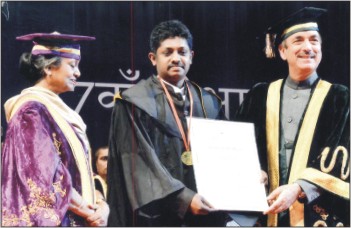
Caption: Dr. Nairuthya Shivathirthan (centre) receiving the NBE gold medal from Union Health Minister Ghulam Nabi Azad at New Delhi on Feb. 1 as Lok Sabha Speaker Meira Kumar looks on.

Mysore, Feb. 4:

City-based well-known gastroenterologist Dr. Nairuthya Shivathirthan was recently presented a Gold Medal for Meritorious Service by the National Board of Examinations, at its 17th convocation on Feb. 1 at Siri Fort Auditorium, August Kranti Marg, New Delhi.

The award and citation was presented to Dr. N. Shivathirthan and others by Union Health & Family Welfare Minister Ghulam Nabi Azad, in the presence of Lok Sabha Speaker Meira Kumar.

Dr. Shivathirthan is the son of late K.N. Shivathirthan and Dr. B. Nirmala, proprietor of Karuna Hospitals in Kuvempunagar and Vinayakanagar in city.

Dr. Shivathirthan is presently serving as the IHPBA Fellow in Minimal Access HPB Surgery at the Institute of Mutualiste Montsouris in Paris, France.

Dr. Shivathirthan graduated in MBBS from the Mysore Medical College in July 2000, obtained MS (General Surgery) degree from the Rajiv Gandhi University of Health Sciences in Sept. 2006, became MRCS (Glasgow) and attained DNB (General Surgery) from National Board of Examinations, New Delhi.

“Receiving the prestigious award was a great moment for me. I have fulfilled my mother’s wish. I intend to serve Mysoreans better by bringing home the experience in health care from abroad,” said Dr. Shivathirthan, who happens to be the first Mysorean to win the NBE gold medal.

His mother Dr. Nirmala, a well known gynaecologist of the city, was beaming with pride on her son’s achievement. “Yes, I am very happy. But more than winning medals, it is important that he treats his patients with love and compassion. Along with vidya (education), one should also cultivate vinaya (humility),” she told SOM today.

source: http://www.StarofMysore.com / General News / February 04th, 2012

Make Chai Not War :U.S sponsored NRI comedy team to spread religious harmony in India

Ohio, Jan 1 (TruthDive):

A trio of Indian origin comedians – Rajiv Satyal, Hari Kondabolu and Azhar Osman will be on an US sponsored Indian tour in an effort to strengthen ties and spread religious harmony. The state department officially announced the trip.

Victoria Nuland, a State Department official said, “We are, indeed, sending an Indian-American comedy group,” adding, “I believe the full tour costs about $100,000. The U.S. Embassy in New Delhi is supporting them with a grant of $88,000.”

The tour named “Make Chai, Not War” will be on from January 4th to 17th and will perform in seven Indian cities: Chennai, Bangalore, Hyderabad, Patna, Kolkata, Durgapur and Mumbai. Nuland cited it as “part of our regular global cultural exchange program that we do around the world,” explaining, “The reason we decided to support this tour is because among the things that they are known for is their talk about religious tolerance, about the importance of breaking down prejudices, and about the positive experiences they had growing up as Indian-Americans in the United States.”

“In addition to doing shows, they’ll also be holding audience discussions on these issues of religious tolerance and doing workshops and having some interviews with the press,” added Nuland.

Rajiv Satyal, who is best known as “The Funny Indian” said, “I’m pretty much going to do my act. But the tone changes, if I do a lot of Indian jokes with an Indian audience, it’s a ‘you guys know what I’m talking about’ thing, whereas, if I’m in Alabama, it’s more explanatory.”

“It’s cool to be able to go to India because that’s where a lot of religious strife has been happening,” he said. “We’re not even really religious on stage. We might do some religious jokes, but it’s more just bringing people together,” he added.

Usman, who is a Muslim is known for his religious swipes. “I never make religion the butt of my jokes,” he said, adding, “I target stupidity, human foibles and fundamentalism.”

source: http://www.truthdive.com / posted by Mohan Ramraj / January 12th, 2012


Rotary Mysore Felicitates Harvard Prof.from CityTY

Caption: Prof. Gita Gopinath who was felicitated by Rotary Mysore is seen with Club President Rtn. T.K. Chittaranjan, chief guest Rtn. Vasudev Murthy and Hon. Secretary Rtn. S.V.Sridhar.

Mysore, Dec. 27:

Rotary Mysore recently felicitated Prof. Gita Gopinath, a Mysorean who is holding the Professorship in the Department of Economics, Harvard University and is the only lady from Asia to hold such a coveted position.

Gita Gopinath completed her schooling and college at Nirmala Convent and Mahajana PU Collage in city before pursuing her studies in Sriram College of Commerce and the Delhi School of Economics. She continued her studies at Princeton University and got her Doctorate from the same University.

Prof. Gita holds a number of honors, Fellowships and awards including the 2011-13 National Science Foundation grant, 2011 Young Global Leader-World Economic Forum and 2006-09 Andrew E. Furer Fellow, Department of Economics, Harvard.

Prof. Gita Gopinath was awarded the Bagwathi prize for the best paper published in the Journal of International Economics for 2003 & 2004. She has also supervised a number of Ph.D students.

Gita is the daughter of T.V. Gopinath and Vijaya Lakshmi of the city.


It’s a windfall for NRE account-holders

Non Resident Indians (NRIs), including many from Dakshina Kannada and Udupi region, may now consider investing in term deposits in domestic banks as banks had announced an increase in the rate of interest offered on specific non-resident external (NRE) rupee term deposits.

The interest rate has been increased from a minimum of 3 per cent to a maximum of 9.75 per cent for various maturity bands. In the past fortnight, the State Bank of India (SBI), the State Bank of Mysore (SBM), Canara Bank, YES Bank, and the Indian Bank had announced the increase in the rates.

At least one more bank is likely to increase the rate of interest it offers. The interest earned on NRE accounts in the bank here was not taxed and the money could be repatriated abroad. While no bank has quantified the amount as numbers are yet to be collected, several bank managers said that it would increase more investments in NRE deposits. Sadashiv, Assistant General Manager, State Bank of India, Mangalore, with the increase the interest rate for NRE deposits was on par with the interest rate given on resident deposits.

Chandrashekhar Kamath, Senior Manager, State Bank of Mysore, said NRIs investing in gold and real estate would now look at investing in term deposits.

Sources in Karnataka Bank said the response to the increased rate of interest had been “good as hitherto, the rate of interest NRIs received was lower than 4 per cent.”

The State Bank of Mysore had increased the rate of interest from 3.82 per cent to 9.5 per cent for NRE term deposits for a maturity band of above 1 year but less than 2 years.

Canara Bank has revised its interest rates on NRE deposits with effect from Thursday. The bank is offering an interest rate of 9.25 per cent for a minimum maturity period of 1 year to a maximum of 5 years maturity, and 9 per cent for a minimum maturity period of 5 years to a maximum of 10 years.

Corporation Bank is likely to increase the rate of interest on NRE deposits, said B.R. Bhat, General Manager of the bank. The bank’s asset liability committee (ALCO) would meet on Friday to decide on the issue. “We have to increase…now, it is the bare minimum (3 to 4 per cent),” he said.

Sources in banks said the rate of interest on NRE deposits had been taken to encourage remittances so that funds flow into India to meet the requirements of the country. Earlier, the Reserve Bank of India (RBI) would tell banks how much rate of interest to quote. Now, the banks could pay more than the domestic rate. Another reason was fall in the value of the rupee in the foreign exchange market. At present, the exchange rate was Rs. 56 for one U.S. dollar. This was encouraging Indians working in West Asia to send more money home. This could be retained in India if a higher interest rate was given, they said.

Karnataka Bank Ltd has increased interest rates on NRE deposits with effect from December 19. A bank release said the bank had increased the interest rates on NRE deposits from 3.82 per cent to 9.75 per cent (for an investment period of one year to less than two years); from 3.51 per cent to 9.50 per cent (for a period of two years to less than three years); and from 3.64 per cent to 9.50 per cent for a period of 3 to 5 years. The rates applied to all fresh NRE term deposits and renewals of maturing deposits from December 19.

source: http://www.TheHindu.com / News> Cities > Mangalore / by Reunuka Phadnis / Mangalore, December 29th, 2011


Dr.Latha Rajashekar to Chair Vishwa Kannada Sammelana in Abu Dhabi

Mysore, Dec. 21 (DV)


Poetess Dr. Latha Rajashekar has been selected as Chairperson of Vishwa Kannada Sahitya Sammelana to be held at Abu Dhabi by Abu Dhabi Karnataka Sangha on Jan. 27.

The Sammelana is being held under the aegis of Kuvempu Kalaniketana, Bangalore, in co-operation with different Kannada Associations of Dubai, Kuwait, Abu Dhabi, Denmark and Singapore. Prominent personalities including Karnataka Chief Minister D.V. Sadananda Gowda and litterateur Prof. Dejagow will participate in the meet.

source: http://www.StarofMysore.com / General News / December 21st, 2011