Category Archives: Nri’s / Pio’s

Mysorean bags ‘Hillier Krieghbaum’ Award

Mysore, Dec. 19:

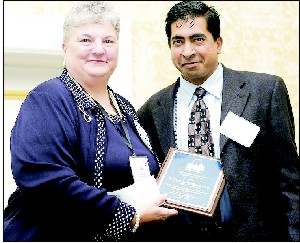
Dr. Sriram Kalyanaraman, a native of Mysore and currently a faculty member at the University of North Carolina’s School of Journalism and Mass Communication, has won the prestigious Hillier-Krieghbaum Award for 2011 conferred by the Association for Education in Journalism & Mass Communication (AEJMC) for “outstanding achievement and effort in research, teaching and service in journalism and mass communication” by anyone under the age of 40 years.

Dr. Kalyanaraman holds the rank of Associate Professor and Director of the Media Effects Laboratory at the University of North Carolina (UNC) at Chapel Hill’s School of Journalism and Mass Communication.

At UNC, he has an adjunct appointment in the School of Information and Library Science and is affiliated with the Interaction Design Lab.

Dr. Kalyanaraman has a bachelor’s degree in engineering from National Institute of Engineering (NIE), Mysore and an interdisciplinary Ph.D. in Mass Communication from Penn State University, USA.

His primary research focuses on the psychology of new technologies, particularly as they inform persuasion and attitude change in online environments. He also studies information processing of persuasive health messages, and social and marketing effects of sexual and violent media content.

Dr. Kalyanaraman is an alumnus of Nirmala Convent, St. Joseph’s High School, Mahajana College and NIE.

He is a guest faculty at Mysore’s International School of Information Management.

source: http://www.starofmysore.com / General News / Monday, December 19th, 2011

Cisco’s New Healthpresence Focuses on Rural India


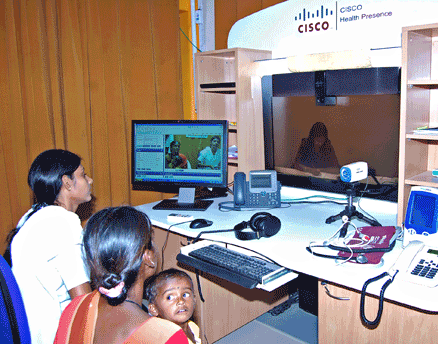
A village woman in K’taka is shown using Cisco’s HealthPresence. (photo courtesy of Cisco)

U.S. technology giant Cisco Nov. 14 unveiled the second generation of its platform for telemedicine, known as Healthpresence, focusing its efforts on India where at least 175 million rural dwellers lack access to any health care services.

Healthpresence allows physicians in several countries to remotely conduct consultations with patients who may be hundreds of miles away. In India, private hospitals, the defense sector and state governments in Karnataka and Madhya Pradesh have signed on to use Healthpresence; the service is already available in 11 districts and can be accessed by up to one million people.

“In India, there’s a huge mismatch between the availability of doctors and where they’re needed,” Vishal Gupta, vice president and general manager of Cisco Global Healthcare Solutions, told India-West by teleconference from Bangalore, where he is based. Patients must often travel hundreds of miles to see a physician, he said, noting that the need for doctors and specialists is most acute in rural India.

“We want to be the ATM of healthcare services,” said Gupta, envisioning Healthpresence kiosks in a variety of rural and semi-urban settings, such as malls.

An earlier version of the product, which was released two years ago, required Cisco’s Telepresence, a high bandwidth platform. But the version of Healthpresence rolled out by Cisco last week can be used on low bandwidth platforms, including desktop computers.

Healthpresence 2.0 features the flexibility to be used across several platforms, from a high-end Telepresence-based system, to a low bandwidth version which is portable and can be used in a mobile medicine van, said Gupta, noting that bandwidth is still an issue in many remote parts of India.

The new version of Healthpresence can be maintained on a server by a service provider who provides repairs and updates to the system, eliminating the need for an in-house IT specialist and lowering the overall cost, said Gupta.

Healthpresence patients sit in a special consulting room – known as a primary health care center – which has a screen allowing them to see their doctor, and specialized diagnostic equipment including a digitized stethoscope which allows a doctor to listen to his patient’s heart and lungs remotely.

A digitized torch and otoscope allow the physician to remotely examine a patient’s ears, nose and throat.

Healthpresence can also be used by specialists.

Sunita Maheshwari, a Bangalore-based pediatric cardiologist and founder of RxDx, which uses Healthpresence to connect to patients in the low-income district of Raichur in northen Karnataka, said Cisco’s product works very well in telemedicine.

“We were skeptical at first, wondering will rural India’s villages accept such technology. But they’re really thrilled because they have a doctor out there for the first time,” the Indian American Maheshwari, who was trained at Yale, told India-West.

RxDx remote clinics provide primary care doctors from 9 a.m. to 5 p.m. on a walk-in basis, and appointments can be made for consultations with specialists. The clinic has a staff of 70 physicians, with a mix of specialties, including pediatrics, and serves about 600 patients a month in Raichur, which is an overnight train journey from Bangalore.

Maheshwari – dubbed the “Queen of Hearts” by India Today magazine – said she hopes to next hook up with practices in remote states such as Bihar to provide Healthpresence services there. She estimated that one-quarter of India’s 700 million village dwellers – 175 million people – currently lack access to any healthcare services.

The Osmania University alumnus said the desktop version of Healthpresence was very scalable and could be used anywhere. “I could be sitting anywhere and treating patients not just in Raichur, but also in Tanzania,” she asserted.

The need for access to healthcare in India has gone up phenomenally with the advent of chronic diseases in the population. The country accounts for 60 percent of the world’s heart disease patients, according to data released last year by the World Health Organization, and is home to 35 million diabetics, the largest number on the globe.

Cancer is also on the rise with almost 400,000 people in India dying each year from various types of the disease. The overall oncology market is growing at about 20 percent per annum, Pradeep Jaisingh, founder and CEO of New Delhi-based International Oncology, told India-West in June.

Gupta stated that the Indian government has shown its commitment to telemedicine, promising to increase funding to public health care.

And in September, Sachin Pilot, India’s young Minister of Communications and Information Technology, unveiled a plan that would lay out 500,000 miles of optical fibre throughout the country, bringing high-speed connectivity to every remote area of India within the next two years.

source: http://www.indiawest.com / News> US Indian / by Sunita Sohrabji, Staff Reporter / December 01st, 2011
All the Raj: Christopher Smith’s Range of Homemade Chutneys

A childhood in India and a book of family recipes lie behind Christopher Smith’s range of homemade chutneys and sauces. Rose Prince watches him whip up a batch of brinjal pickle.

Christopher Smith in his kitchen 

Christopher Smith in his kitchen Photo: CHRIS SCOTT

Christopher Smith spent his 13th birthday on a ship. The boat, which docked at Tilbury, Essex, on December 17 1964, had sailed from India. ‘My mum gave me a pair of long johns,’ Smith remembers. It was his first sight of England. ‘As we came up the Thames, I saw a frost on the ground. It looked like snow.’

Somewhere in the ship’s hold, buried deep in the family’s luggage, was a notebook filled with recipes, belonging to Dolly, Christopher’s mother. The gold words on its cloth cover read: indu indexed diary. compliments of the india united mills. Inside the feint-lined pages are a record of the family’s Anglo-Indian meals, handwritten in pen and ink. Next to the recipes for rock cakes, lemon curd and cheese straws is a recipe for mysoor pak, a crumbly sweet made with sugar, ghee and nutmeg. After the roly-poly, roast beef and cheese soufflé is a recipe for ‘stick curry’. ‘That was a family favourite,’ Smith says. ‘Like a curry with kebabs in it; meat alternating with ginger and onion on the skewers.’

Mulligatawny soup, ginger pop and instructions for ‘Mrs Reddy’s vegetable curry’ hint more clearly at the Smiths’ former life among India’s post-war Anglo-Indian community; a family who, like the characters in a Paul Scott novel, ‘stayed on’ after independence. ‘Mrs Reddy was the mother of one of the boys in the boarding school where my dad was a teacher,’ Smith says. His paternal grandmother and both his father and mother were born in India, but in 1964 his father took the decision to leave, with his wife and four sons. ‘Dad said we should back out, so we left, and came to live in west London.’

Even before putting a foot on the steps of the Smith family home in Ealing, you can smell spices in the street outside. When Christopher Smith opens the front door, the aroma becomes stronger still. On the gas cooker is a huge pan, three-quarters full of brinjal (aubergine) pickle. Smith has been making it all morning. In 2002 he launched a range of Indian condiments named after his parents, St John and Dolly, using recipes from Dolly’s book.

I had contacted Smith, intrigued, having discovered his brinjal pickle in Trinity Stores, a south London deli. Inside the jar was a rich, non-oily mix of spices, hand-cut aubergines and onions, and no stinting on the chilli. I had also found other wonderful sauces: a chilli sauce that was fiery, but which retained the lovely fruity flavour of scotch bonnet chillies; a piquant sweet pickle made from chopped lime zest; and a cinnamon-tinted, hot apple chutney. The colours of each sauce are startling, the textures perfect. Smith’s pickles outclass the competition.

‘My pickle business arose from an odd coincidence,’ Smith says. His mother died in 1993, then his father in 1998. Smith continued to live in the family house, surrounded by their possessions. In 1999, having given up running a photography shop in Ealing, he was visiting a friend in a kitchen shop in Southall. ‘A woman came in, asking for a chattie for making appam,’ Smith says, explaining that appam are breakfast pancakes and chatties the pans you make them in. ‘I called out, “I know appam, I was born in Bangalore,” and the woman said, “So was I.”

‘When I told her my name, she said, “You’re not Dolly Smith’s son, are you?” It turned out she was the daughter-in-law of my mother’s best friend in India, and she then said, “Your mother made wonderful pickles.”’

Smith vaguely remembered the pickles; after their arrival in England his mother would occasionally make a few jars for school sales. Smith went home and dug out the cloth-covered book. He had promised the friend he had met in the shop that he would have a go at making them, so he did. Another friend of his parents tasted the pickles, and reported that they were just as good as Dolly’s originals. Once word got around, orders came in. Two years later Smith started the business properly. He put the name of his parents on the jars, on impulse, with faded photos of their faces. ‘It was a tribute, to the parents I love and to whom I owe so much.

‘All kids should have a childhood like mine,’ Smith says. St John Smith taught at a boarding school in the Nilgiri Hills in Tamil Nadu. Most of the children at the school were from Indian families and Smith recalls one tale of adventure when not in classes. ‘The railway station near the school had horse-drawn carts; you could rent the ponies for a few pence. We rode them through the hills, playing cowboys and Indians,’ he says with an ironic grin. ‘There were people sitting on the side of the road, selling sweets; when we told them we had no pocket money, they gave them to us.’

Along with trapping quails, digging caves and climbing trees, there was mischief: he tells of how his brother Stan, caught stealing fruit from a man’s garden, was held prisoner in his captor’s shed. ‘The man was sitting outside, with a gun. My father had to come and negotiate his release. The next day the man sent a large amount of fruit to the school. That’s how it was – no malice.’

At home his mother had help in the kitchen and rarely cooked. ‘When we were in India I could count the times I saw either of my parents cooking,’ he says. ‘I was weaned on lentils and rice, and we mostly ate curries. I have loved chillies ever since I ate my first.’ Brought up in a poor country, Smith was taught never to waste. ‘When we ate lunch at my school in England, I would ask other boys if I could eat their fat; I also like marrow, and will still crunch on a chicken bone.’

When the family returned to Britain St John sold everything. ‘He arrived here with £300. He went to the local education authority asking for work, but because he obtained his degree in India they would only allow him to teach juniors.’

On the day of my visit Smith had been up before dawn, buying special aubergines for the brinjal pickle from the Western International Market in Southall. ‘I buy chillies from an east London supplier who has a farm in the Dominican Republic. He chooses the reddest ones for me; they make the sauce look good.’

We decide it is time for lunch, and Smith chooses a favourite curry house, the Rajdoot in Ruislip. Smith loves it here, and brings his own pickles to complement the food. ‘The chef, Zak Rahman, never uses ready-made spice mixes or curry pastes, and makes his own chicken stock,’ he says approvingly, as we plough through a fragrant chicken chilli masala and a side dish of sautéed okra, firing it up nicely with a little of Dolly and St John’s chilli pickle, flavoured with tamarind, ginger, garlic and curry leaves. We dip poppadoms into the juicy lime pickle and mop up a spiced dal with hot flatbreads. Smith could be back in the country of his birth. He has not been there since 1998. ‘I tried to find the house in Bangalore where I was brought up, but it had gone,’ he says wistfully. Part of his upbringing is not lost, however. When Dolly Smith packed her cloth-bound notebook in 1964, she was at least taking memories of her kitchen to her new home.

  • St John and Dolly Smith’s pickles: 0797-368 7376; thepickleman.com. Rajdoot, 59 Windmill Hill, Ruislip, west London (01895-634656)


source: http://www.telegraph.co.uk / Food and Drink / by Rose Prince / Apr 15th, 2010

The World of the Kannadiga

Roopa Iyer has taken on the job of representing the state at the World Kannada Conference in London in August this year. Will this be another contentious event?

Yet another Kannada conference at yet another venue. Coming up in London on August 27 and 28 is the World Kannada Conference 2011 — Europe. It is being organised by Sangama, an association of NRIs living in Europe. As Karnataka representative for the conference Roopa Iyer, classical dancer, actor and filmmaker, will decide on participating artists and the culture extravaganza.The sammelana has listed some serious aims too. It will explore how non-resident Kannadigas of Europe can contribute to the economic growth of Karnataka. It will raise funds to build Kannada Bhavana in UK and support Kannada schools at Karnataka. So far, Puneeth Rajkumar and Ramya have been roped in as brand ambassadors. We spoke to Roopa on being part of the event.

There have been many Kannada sammelanas — small and big — of late. How will this be different?
This will be the first of its kind in Europe. And we have good causes —the Kannada Bhavana will act as a centre for spreading Kannada art and culture and also house a library of Kannada books. We will give a boost to Kannada schools in the state. Also, we will target youngsters as it’s the younger generation which carries forward a legacy.

Showcasing Karnataka’s art and culture effectively is a tough job.
We are bringing together the State’s senior-most artistes in films, literature, sports, dance and music — people who are truly responsible for building the current-day culture of Kannada. We are not going to project only young celebrities.

Often such conferences are fraught with rivalry and bickerings. There is also criticism that accomplished artists who are not aggressive about self-promotion tend to lose out in the race for representation.
Proper planning, time-management and taking care that each guest gets due respect, sufficient time and a proper platform will avoid such problems. As for artists, we are looking out for genuine achievers, grassroots workers and unselfish personalities who have contributed to the richness of Kannada culture.

Many Indian cultural events held abroad (this one’s in London) are viewed as an excuse for a foreign jaunt rather than serious promotion of art.
I agree, this happens. We can’t question such people if they come as part of the audience. But our guests — people whom we will invite and take with us — will be genuine achievers. We will invite about 400 persons. Chief Minister B S Yeddyurappa and his son Raghavendra have already agreed to support and attend the sammelana.

source: http://bangaloremirror.com / by Aruna Chandaraju / Wednesday Mar 23rd, 2011

City Origin Scientist Leads Insulin Jab Research

LONDON/BANGALORE:

Researchers, including one of Bangalore origin, found that a new form of insulin that needs to be taken three times a week is as effective as the once-a-day medication. Clinical trials, held in India, Canada, South Africa and the US, showed that the new longer-acting form of insulin, called Degludec, works effectively in controlling blood sugar among patients with Type 2 diabetes.

One in three patients with type-2 diabetes, whose body does not produce enough insulin, currently has to get insulin at least once a day to keep the blood sugar under check.

Researchers, led by Dr Yogish Kudva who and Dr Ananda Basu from Mayo Clinic College of Medicine in the US, said that patients might stick to their medical regime if it was less onerous. Dr Kudva, an alumni of the St John’s Medical College, Bangalore, informed Express over e-mail that the trials were held from January to August 2008. The paper had two other authors from India — Prof P V Rao of the Nizam’s Institute of Medical Sciences University, Hyderabad, and Prof N Thomas of the Christian Medical College, Vellore, according to Dr Kudva.

Asked when the drug could possibly be available in India, Dr Kudva said it would depend on the regulatory agency review of ongoing trial data.

For their trials, the researchers recruited 245 people with Type 2 diabetes, who had not previously been prescribed insulin.

Two-thirds were told to use Degludec once a day or three times a week. The remainder had daily jabs of insulin glargine — a widely used medication. Findings showed similar control of blood sugar levels across all three groups, the researchers reported in the British medical journal ‘The Lancet’.

But those given daily jabs of Degludec had fewer attacks of hypoglycaemia or low blood sugar, they said.

Danish manufacturer Novo Nordisk hopes to apply for licensing approval to market the drug in 2013. (With PTI inputs)


source: http://www.expressbuzz.com / Express News Services / Mar 11th, 2011