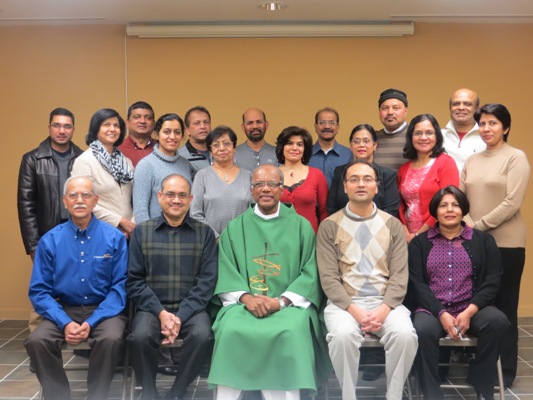
It was not business as usual at the general body meeting conducted by the Mangalorean Konkan Christians association (MKCA) at Techny Mission Center. The elections were held to the executive committee and thereafter there was celebration of Holy Eucharist celebrated by Fr Richard Vaz, SVD.
The meeting was called to order by the president Godwin Rego. After the secret ballot elections, Fr Vaz announced the new executive committee chosen by the general body.
He announced the election of following members for new executive committee: President – Steven D’Souza; vice-president – Ashok Monteiro; secretary – Roshni Carvallo; associate secretary – Stany D’Souza and treasurer – Mercy Concesso.
Following members were chosen for the board of directors: Austin D’Souza Prabhu, Lawrence Mascarenhas, Queenie Mendonca, Francis Mascarenhas, Prima Monteiro, Lincoln Pereira, Lin Martis, Theresa D’Souza, Vissia D’Souza and Eric Fernandes.
Fr Vaz congratulated the newly elected members and wished them well.
The outgoing president Godwin Rego, thanked his executive committee and all the members for their unconditional support in successfully conducting number of programs in the past two years’ term. The incoming president, Steven D’Souza, thanked all the members present for their support and their trust in his leadership. He praised the past executive committee for their excellent service to the community. He further stated that with the help of the members unique strengths, his committee will work hard in taking the association to new heights.
The new executive committee with its members present decided to have following programs for the year 2014: Annual Retreat – April 6; Special Fund Raising Event (event yet to be finalized) – June 21; Annual Picnic – August 2; Monthi Fest – September 6; Christmas Around the World – December 6 and Nathal Fest – December 20.
The meeting was followed by the celebration of Holy Eucharist at the Techny Mission Center. Fr Vaz, in his homily said, “I wish to recognize the spirit that I witnessed in each one of you, the spirit of revival, commitment, dedication and above all to work together in moving ahead with all optimism to make MKCA truly a welcoming family to all. “If you want to walk fast, go alone; if you want to walk far go together”. Let us walk together, crossing all the barriers, covering long distance…just to be with our brothers and sisters”. He also mentioned how Jesus Christ suffered the ultimate humility a human being can ever think of and gave everything that he had, to the salvation of the humanity.
It was a graceful event, filled with renewed spirit, enthusiasm and hopes to take the MKCA to the greater heights.
source: http://www.daijiworld.com / DaijiWorld.com / Home> Top Stories / Report: by Stany G. D’Souza / Monday – February 17th, 2014
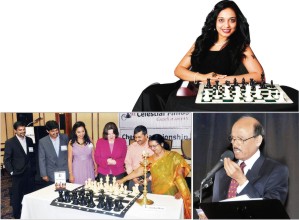
Mysore girl Kavyashree Mallanna, a former Karnataka State Women’s chess champion and National level player, now settled in Boston, USA, is the Founder and Director of Celestial Minds ( A Chess Coaching Centre) and one of New England’s top chess players.
by our Sports Correspondent
A 14-time Chess champion in various catego ries in Karnataka for a decade, Kavyashree pursued her higher studies in California, during which, she acquired United States Chess Federation ‘Expert’ level rating after winning Kolty Chess Club Championship in year 2000.
Chess is a mind game and Mysore has always been producing talented players from time-to-time who have gone to represent the country and the State in different levels.
Mysore girl, M. Kavyashree is one such player who has done Karnataka and Mysore proud with her feats in playing chess from 1989-2000, and won different titles in the State and National levels. Chess remained a part of her life either as a player or as a teacher when she started Prema Chess Lab ( 2003) to train the local talents. Presently she coaches children and chess players of all ages in the United States and also conducts tournaments from time-to-time.
She is the daughter of Prof. Mallanna and Prof. K.R. Premaleela, who are residents of Mysore. Her younger sister Kavana, who is also in the US, is a National level chess player and a former State champion.
Kavyashree went to United States to pursue her higher studies California and after completing her studies, started a chess club (Prema Chess Lab) in 2003 which she renamed in 2012 as ‘Celestial Minds.’
Kavyashree took up to chess at a very young age encouraged by her mother Prof. K.R. Premaleela. She learnt the basics of chess from her mother and senior local chess players initially and later moved on to chess books.
She went on to play chess in the district level and then represented the district in the State level tournaments and went on to win State championships in different age categories (from 1989 to 2000).
Chess, according to Kavyashree, helps an individual to develop lateral thinking, handle multiple tasks, have a holistic view & approach, and balance a situation in a good manner. It is also very helpful for academics.
She loved chess and one fine day quit her IT career and took up to her passion of coaching chess.
Her company ‘Celestial minds’ promotes both music and chess. Love for music is a blessing from her father Prof. S. Mallanna and love for chess is a gift from her mother. Her parents’ hobbies helped Kavyashree find an expression and in balancing a highly competitive career be it chess or IT.
Every September, Kavyashree, through her club conducts tournaments, which gets good response. On the occasion, a musical programme by her father captivated the audience with his songs. Kavyashree’s mother gave away the trophies to the winners.
Kavyashree intends to pursue her passion and love of promoting the game of chess through her club and aims to produce talented players in the days to come. This Mysore girl has made everyone proud with her feats in US and hope she scales greater heights in her coaching career in the days to come.
source: http://www.starofmysore.com / Star of Mysore / Home> Feature Articles / January 27th, 2014
All in the family: Seen in the picture are (front row from left) Sumukh (kneeling), Padma G. Murthy, Mythili Ramakrishna, G. Ramakrishna, G. Satyanarayana, Nirmala Satya, G. Soumi, Shashank Gowri; (standing from left) G. Ananth, Shruthi Ananth, Spurthi Vinay, G.Vinay, G. Subbanarasimha, Srilakshmi Subbanarasimha, Swamini Varadachaitanya, Deepa, Dr. Asha Shekar, Jayanthi B.G Nath, Suvarna Laxman, M.S. Laxman Rao, Dr. G. L. Shekar, Shamsundar and Vijay Simha.
Mysore :
When families split over trivial issues, here is a family of five brothers and five sisters and their children and grandchildren, living with love and affection.
Gowris of Mysore city, known more through the evening English newspaper ‘Samachar’, edited by one of the brothers, G. Satyanarayana, who have a rich past, assembled last Sunday at Hotel Dasaprakash Paradise in Yadavagiri to felicitate two brothers and a sister, who have crossed 70.
The get-together of over 20 members of the Gowri family was marked with homely and happy atmosphere throughout. The extended family of all the five brothers and five sisters are spread over Mysore, Bangalore, Chennai, US, New Zealand and Australia.
The get-together was arranged chiefly to felicitate G. Ramakrishna, former Director of Tourism, Government of India, now settled in Los Angeles (US), who is on a month-long visit to India, on his 80th birthday. Along with him his next brother G. Satyanarayana (Gowri Satya), former Editor of ‘Samachar’, and his immediate sister, G. Padmavathi, wife of late Gurumurthy, Librarian, Sri Venkateswara University, Tirupathi, were also felicitated. A host of their relatives and close common friends were present.
Candle was lit, cake was cut, the couples exchanged garlands and offered a piece of cake to each other and they were felicitated with Petas (turbans), shawls, fruits and flowers, as per Mysore tradition while their friends recalled their association with them during their felicitation speeches.
Popular All India Radio (AIR) Kannada news reader of yesteryears M. Ranga Rao felicitated Ramakrishna with a Mysore Peta and shawl, while Star of Mysore and Mysooru Mithra Editor-in-Chief K.B. Ganapathy honoured Satya with shawl and educationist Sreepada Rao with turban. R.V. Lalithamba honoured Padma with a shawl, flowers and fruits.
Speaking on the occasion, Ganapathy recalled his close association with the brothers and their journalistic career and expressed happiness over the camaraderie at the get-together. He recalled the cordial relations they had in their journalistic career.
During the brief and informal speeches, Ranga Rao recalled his association with Ramakrishna, when both were working in New Delhi.
Andolana Editor Rajashekara Koti was nostalgic of his friendship with Satya and recalled the contribution of the brothers, and in particular their father late G.L. Swamy, for development of tourism and journalism in Mysore. Though Mysore had several attractions to offer, he deplored that the Government was doing very little for development of tourism, despite repeated demands.
NIE-IT Vice-President M. Sreepada Rao, Consumer activist Dr. S.P. Thirumala Rao and Col. (retd.) Dr. Anand also spoke felicitating the Gowri family members.
Ramakrishna recalled his days in the Department of Tourism in India and thanked all for the felicitations.
NIE Principal Dr. G.L. Shekar, who was chiefly responsible for organising the function, said how the Gowri family, whose strength had grown to about 100 members, is well-knit and maintained cordial relations.
The other first generation Gowri family members are G. Subbanarasimha, Gowri Sunder, Swamini Varadachaitanya (formerly G.L. Gayathri), Rama, Suvarna and Jayanthi.
The Gowri clan of G.L. Swamy and G. Meenakshamma has 10 children, 18 grandchildren and 9 great-grandchildren.
Former MLC M. Sathyanarayana Rao, NIE Secretary S.L.Ramachandra, Writer E.R. Ramachandran, Journalists K.V. Sreenivasan and Prabhurajan were among those present.
source: http://www.starofmysore.com / Star of Mysore / Home> General News / January 08th, 2014
Gita Gopinath is seen with first Indian Nobel Laureate Dr. Amartya Sen. Dr. Sen is seen reading a book written by Gita’s grandmother about their family.
To be listed as one of the ‘25 Smartest Indians to look out for’ is no mean achievement for a 41-year-old! The very mention of it makes this intellectual powerhouse blush, as she brushes it aside, wondering how these lists are made! But those who added her, know for sure why Gita Gopinath, deserves to be there.
A Mysorean and a Professor at the renowned Economics Department of Harvard University, she is the first Indian woman after Nobel Laureate Dr. Amartya Sen and the fourth woman in the Department’s history to be granted tenure. Sharing office space with Dr. Sen, Prof. Gita works in the area of international macroeconomics and finance and her field of expertise is regularly showcased on the global scene.
A mother of a 10-year-old, she strongly believes that a woman can successfully juggle home and work with the right kind of family support.
A BA in Economics from Delhi University (Lady Shriram College), MA from the Delhi School of Economics and University of Washington and a Ph.D from Princeton University, Prof. Gita was also chosen as one of the Young Global Leaders in 2011. But it all began in Mysore.
An economist who enjoys Bollywood films and gossip as much as she delves into the financial crisis in the world, Gita is married to former classmate Iqbal Dhaliwal, a Director of Policy at Abdul Latif Jameel Poverty Action Lab at Department of Economics, Massachusetts Institute of Technology. She is the daughter of T.V. Gopinath an Industrialist in city and Viji Gopinath who runs a play home in Kuvempunagar. Here, in the first in our series ‘Mysoreans making us Proud’ we feature this remarkable achiever, as she traces her journey from Mysore to Harvard. Excerpts…
Star of Mysore (SOM): You have so many firsts and prestigious assignments to your credits. How best do we introduce you?
Gita Gopinath (GG): A Professor at Harvard…That’s how I introduce myself!
SOM: You spent your formative years in Mysore, which is still considered as the ‘country cousin’ of the big metros. Did you also have the ‘small-town’ girl feeling when you moved to Delhi?
GG: Yes…. I did my Bachelors in Delhi University and when I went from Mysore to Delhi I certainly felt that way. Most of my classmates were from main brand schools in Delhi. They seem to have a lot more global exposure. They were very good at debating and other kinds of things…They seemed to have a lot of confidence. Coming from Mysore I did feel like I was a small fish in a big pond.
However, one thing I was always good at is, I was never apologetic about my background and I didn’t get intimidated by people coming from so-called better background.
For all the ‘small town’ folks out there, to succeed, I think it’s a combination of not being apologetic about your background and also learning from your environment. At no point should you be intimidated, always believe you are your own person and you have a lot to contribute. At the same time pick up all the good things that are available. If you engage in self-doubt, then you’ll never have the confidence to grow.
SOM: Economics has always been called a ‘dismal science?’
GG: Oh! That goes back a long way. The original kind of Adam Smith’s idea of Economics was that there was no real role for policy in initiating an economic outcome. In that sense it was called a ‘dismal science’…where you would have bad times and you would just have to live with it. But that changed a lot over Kaynes’ revolution and now we don’t think that way. We think there are ways of fixing problems with policy interventions.
SOM: In India, pursuing Economics as a career-building course is not considered a viable option?
GG: Yes and No actually…If you think of Delhi University, its one of the most sought after subjects. This notion that it is not an attractive option for a career is more true outside Delhi and Calcutta Universities. In terms of future careers, Economics is still very strong in places like Delhi.
SOM: You mean there’s a lot lacking in the colleges outside these cities?
GG: I just think that there is not enough depth in the Universities that teach Economics. Except for about 3-4 schools in India, Economics is not taught the way it should be. Say for instance, in the US, even if you studied in the 50th ranked US University, you would still get very good education in Economics.
Economics has changed a lot over time; we have had a lot of mini revolutions in Economics. If those tools are not being taught, then it’s not quite useful.
SOM: There is a lot of parental pressure not to pursue Arts…
GG: What people observe is, if you do Economics from one of the smaller Universities, you don’t really end up getting good jobs.
Also here students enroll in Economics as a last resort and so it’s not surprising that they don’t end up doing very well. It’s true that people should be less obsessed with professional courses but it’s also true that to make it more attractive, there should be good quality education in Economics.
SOM: You are the first Indian woman to be tenured at the Economics Department of Harvard University
GG: If you consider the history of the Harvard Economics Department ever, I would be the fourth woman and the first Indian woman.
Right now, we have 40 tenured faculty of which two are women. Circumstances have changed from when it used to be harder for women. What we have there is what we call a tenure clock. After your Ph.D, you start off as a Asst. Professor and you have about 7 years to prove yourself in terms of publications and your impact in the research field. After 7-8 years, you either get your tenure, which is permanent or you leave. It’s either up or out.
Most of us by the time we finish our Ph.Ds, we are 27-28 and for the next 7-8 years, till we are 36 or so, we can’t do anything but focus on writing papers and for women these are the child bearing ages. That becomes very difficult for women, as they have to make a very hard choice. But now what Universities do is, if you have a child, they stop your clock, that means if the typical clock is 7 years, if you have a child you get 8 years.
Universities these days are trying very hard to find good women candidates.
SOM: Clichéd but still… Does being one among the just the two women in a faculty of 40 men bother you?
GG: I don’t think at any point of time I felt any kind of conscious discrimination or any such thing. What’s true is that you go to take classes and you notice that 90% of your professors are men. You go to a conference and 90% of the people in the room are men. And you always wonder what’s this about !
SOM: Would you have preferred more women though?
GG: Oh! Yes. From my experience I do find that women students in Harvard in the Economics Dept. talk a lot more to me, because there is more affinity and they talk about how it is like to have a career, family, a child etc.
SOM: You have been listed among the 25 Smartest Indians to look out for.
GG: (blushes) I have no idea. I am very honoured to be on that list but honestly I have no idea how they come up with that. But nevertheless I was disappointed that there were only 3 women in that list. If I was to come up with 25 bright Indians, I would come up with 50-50. I guess they are trying to reflect the overall sample and probably there were more men who were successful. I don’t really know what it means to be there.
SOM: Okay, what do you think then that makes a woman smart?
GG: Someone who has found an area that they want to be in, work extremely hard to develop an expertise that sets you apart from others. The only reason why I know my Economics well is I spend 15 hours a day studying.
What distinguishes you is hard work and then you become a person who is less indispensable, because you have created this niche for yourself.
SOM: It’s said, a woman has to work twice as hard as a man to be considered at the same level?
GG: That depends on your family situation. If you are married to a person who expects you to work hard in the house and outside of it, it can be very difficult and almost impossible. In my case I have been very fortunate that I have been married to a person who is very supportive.
What’s true though is in professions where there are fewer women than men, you have to work harder in terms of collaboration and network. May be I feel this way because of the country in which I am working. I have not had any experience of working in India in a field dominated by men.
That said, in some ways India does better. Most of the Banking Heads are women, which is not true in the US.
SOM: You had a slightly different view from C. Rangarajan on Higher tax for the super rich?
GG: What I just said was that, in general raising tax creates distortion, in the sense it affects incentives. Most of the evidences, lots of evidences in fact, we see, suggests that it’s better to make tax system more effective, reduce wastage of government expenditure by improving the quality of deliverance of government schemes. You might be better off reducing on wastages in government expenditure rather than going about introducing new taxes. And in India, the tax base in terms of leakages in the tax system is still quite high. To make it more effective is better than introducing unnecessary tax.
SOM: Did you know that BJP plans to get rid of all taxes? It’s just going to tax on bank transactions?
GG: I haven’t heard of that! This is generally called financial tax but it’s not implemented in any country so far.
SOM: You have said that a State can be a welfare State and also business friendly. How do you rate Karnataka in this context?
GG: I must confess that I haven’t gone deeply into Karnataka’s state. In Karnataka, people recognise Bangalore as an outsourcing major. It’s done well on some business indicators. But what I know is that the political situation is quite messy and that’s problematic. In fact I have some figures for you. In a publication by the World Bank and the International Finance Corporation titled ‘Doing Business in India,’ that measures business regulations and their enforcements in India (the study involved 17 cities), Karnataka stands 13th among the 17 cities which come under cities easiest to do business in India. That’s not very encouraging! Ludhiana, Hyderabad and Bhubaneshwar take the 1st, 2nd and 3rd place respectively, while Chennai, Kochi, and Kolkata take the 15th, 16th and 17th places respectively.
SOM: The fall of the Indian Rupee has come in for a lot of flak?
GG: Among the many variables that affect the value of a rupee is inflation. If you look at the rupee with reference to the dollar and compare India and the US, look at in the last 7-8 years, then inflation in India has been higher.
The other variable is growth and in that dimension India’s growth rate is much higher than the US. It’s come down now, but it’s higher than the US. And by that matrix, India’s rupee should have strengthened. But the question is, which of these two forces were stronger in terms of affecting the value of the rupee.
And when the rupee fell specifically, at that time there was reason to think that the rupee needed to lose some value given the inflation channel was very strong.
But eventually there will be a correction in the rupee. Now that combined with what’s happening externally, besides inflation and besides growth, it matters what’s happening to the interest rate in the rest of the world. When in summer the US said that they would start tapering and the interest rate will go up in the year, for an investor the US becomes more attractive to bring money back in. And we saw withdrawal of money from India going to the US. A combination of all these factors led to the weakening of the rupee. It’s very very hard to predict what will happen to the rupee over a short period of time, better predicted over a longer period of time.
SOM: But the blame was squarely on the ruling government. How fair was that?
GG: I think in this case, the last 3 years there has been a problem with governance in India. There has been a problem with governance in general always. Look at the number of government projects that have been stalled, scams have gone up, bureaucracy has come to a standstill, nobody wants to move anything using scam as excuse. It’s not unfair to blame the ruling government !
SOM: For a layman, how does the future of India seem in terms of the economics?
GG: The layman needs to realise that India’s potential is high. To get the growth to go back up from the low level right now at 4.8% to 6.6 or 7% you don’t have to do very dramatic things say like reforms, get fantastic education for all, change labour laws et al. right away. You need to do all that in the long run.
Right now simpler things like making sure that the projects get going, the ones that have been stalled, put the infrastructure in place, put the investments in place. In that sense it is simpler to engineer growth in India than let’s say in China where it is a bit over invested in infrastructure
Today’s stand is that if there is a more decisive government in power next year, that should be sufficient to get a lot of people interested in India again. So these kind of small things are enough to instil growth again in the country.
SOM: So there’s no big reason for us to feel down and out?
GG: No, the main big uncertainty is what happens next year with the elections. My hope is that even if there’s a bigger coalition but still they will be able to function and be more accepted. My only concern is, if something really messy happens with the Centre and you are going to have another election.
SOM: A photo of your parents also finds a pride of place on your desk? (Industrialist T.V. Gopinath and Viji Gopinath, who runs a Play Home in Kuvempunagar, are her parents)
GG: They are in my heart! They believed I can accomplish much more than what I thought I could. In fact I was in Science stream in PU (Mahajana’s College) and I went to study in Delhi because I wanted to do my IAS. My father called me and told me that there’s something called a President’s Gold medal if you stand first in the Delhi University, after 3 years if you scored the highest, cumulatively … I did win that…He said it as if it was so easy and I never felt it was unattainable. Then he said you should study in Harvard. They kept raising the bar every time and it also helped that my personality is such that I like challenges.
SOM: Do you like to be a role model?
GG: Yes and No. I want people to kind of look at me and see that they too can do it. I want them to see that in international matters they can look like me, an Indian woman, in the sense that I want them to get a lot of confidence.
On the other hand I don’t want them to put me up there. I never did that. I never put anyone on a pedestal.
A lot of what you want to become should come internally. It’s what drives you. One can get inspired, but there shouldn’t be a fan following ! Your strength should come from within and not from anything outside you.
SOM: It’s said Mathematicians, Economists lead a boring life?
GG: I disagree! Of course I enjoy life! Someone who looks at me from outside may find that I’m leading a boring life. I enjoy my life to the hilt. In fact the mathematicians or physicists whom I meet in Harvard lead incredibly enjoyable lives ! It’s just about the definition of enjoyment! I get time to enjoy the smaller nuances of life. Yes I’m a workaholic and I get pleasure from working, but I have time for things I like. I know as much about Bollywood as I know about Economics! Pretty amazing actually and my friends always make fun of me about that.
SOM: Mysoreans are proud of you…How proud are you as a Mysorean?
GG: I spent most of my early years here. Some of my best friends are from Nirmala Convent and they are still my best friends. I liked that I grew up in a small town. You are more empathetic, there’s a little bit more innocence in you which is good and you grow up with some basic principles…like to achieve something you have to work hard for it. I tend to derive pleasure from doing simple things and keeping it simple. So, yes, I am happy I’m from Mysore .
source: http://www.starofmysore.com / Star of Mysore / Home> Feature Articles / December 28th, 2013
Fardeen Khan and wife Natasha welcome their first child, a daughter whom they plan to bring up in Mumbai.
Diani Isabella Khan entered the world on December 11 at 5.33 pm in a London hospital. And papa Fardeen Khan hasn’t stopped smiling since. Speaking to Mirror from London, Fardeen, who was present during the delivery, describes it as an “awesome, lifechanging experience”.The 39-year-old actor admits that he was overwhelmed when he first laid eyes on his daughter, also the grandchild of film icons Firoz Khan and Mumtaz. “It stuns you, shocks you. Your eyes fill up and so does your heart, with pure love and joy,” he says, relieved that both his wife Natasha (Mumtaz’s daughter) and their baby are healthy. “Since she’s just a day old, it’s hard to say yet who she looks like. What’s important is that she has all her toes and fingers, and her brain is intact.”
Natasha, the actor’s wife of eight years, has been in London for the last two years and Fardeen has been shuttling between the British capital and Mumbai.
“Natasha has been through the worst to have our baby and today she deserves all the happiness in the world,” he says emotionally.
So which city will Diani call home?
“Once she’s done with her vaccinations and it’s safe to travel with her, we’ll bring her to Mumbai which is her home. She will be brought up here,” he says.
For now, the entire family is in London to be with the happy threesome. “My mother is here and so are Natasha’s parents (Mayur Madhwani and Mumtaz). I think it’s as special for them as it is for us. I wish my father (Feroz Khan) had been here too. He is greatly missed but I know that whatever joy comes into my life is because of his blessings. I’m a part of him and my daughter is a part of me. I’m gearing up for the life-long responsibility of bringing her up well,” he adds.
The mother and baby will be back home by the weekend and everything’s in place, from a nursery with shades of pink, matching furniture and a wardrobe of little dresses.
“We were aware that we were going to have a daughter which is how we had the name ready. Diani is Portuguese for Divinity and Isabella is a name I have always loved. My daughter will always be Isabella for me. As for her, we’ve given her two names, she can choose what she wants,” he says.
And what’s happening on the career front? “I’ve commissioned two scripts, the films should start next year. I will be acting in one of my productions,” he says. “But before that No Entry 2 should kickstart in June,” he signs off.
source: http://www.bangaloremirror.com / Bangalore Mirror / Home> Entertainment> Bollywood / December 14th, 2013
Karnataka and neighboring states are shown in this map from Wikipedia.
Indians from Karnataka celebrated Rajyotsava Day at the Indian consulate recently to mark the formation of their state 57 years ago.
Prabhat K. Jain, Indian consul for labor affairs, was the chief guest. Vishwanath Hegde, chief patron of the forum; Ilyas Momin, a member of the Indian International School-Jeddah management committee; and Iqbal Yousuf, founder of Jamiatul Falah, were special guests.
The program started the traditional way with the lighting of a lamp, and a song performed by Nagarathna Prasad and her group.
Krish Jangal, president of the forum, welcomed the guests. He spoke about how the state was formed and the functioning of the Karnataka Non-resident Indian Forum (KNRIF). He asked all Kannadigas to help the poor and downtrodden in the state.
Syed Nasir Khursheed, general secretary of the KNRIF, outlined the work of the organization, and how it had helped many poor people since its inception.
Jain thanked Karnataka residents here and in India for assisting various community initiatives. He advised the forum members to help other members of the Indian community. He thanked the forum for recently helping a needy Kannadiga in Jeddah.
Momin highlighted the importance of charity and praised the KNRIF. Yousuf described Karnataka as a major tourist attraction with natural beauty, flora and fauna, historical monuments and exotic beaches.
Sabu Chandra and Roshan Rodrigues choreographed programs to entertain the audience. Mohammed Kaleem, Mohammed Saif, Mohsin, Miss Rehana, Miss Nidhi and others presented favorite Kannada and Hindi songs. Niaz Ahmed, the master of ceremony, hosted a quiz show.
Manzoor Ahmed, vice president, and Sri Harsha, treasurer of the forum, said the program helped bring Kannadigas together. Yashwanth Amin, joint coordinator, and Aijaz Ahmed, the meeting coordinator, said it felt like the celebration was taking place in India.
Shaikh Saoud, Vishwanath Karkera and Mohammed Sahib praised the organizers for setting up a successful function. Alok Pattar, IT coordinator of the forum, organized games. Mohammed Mansoor, event manager of the function, delivered the vote of thanks. The program ended with the national anthem.
source: http://www.arabnews.com / Arab News / Home> Jeddah – by Fouzia Khan / Saturday – 14th December 2013
Kannada Sangha will organise its annual mega cultural event Kannada Vaibhava on Tuesday at the Al Raja School, from 5pm.
Well-known flautist and world famous fusion artist Pravin Godkhindi and his troupe are being specially flown in from Bangalore to perform at the eagerly awaited show in the Kannada Sangha calendar.
“We are once again coming together to put up another mega show to highlight our music, art and culture,” said Sangha president Mr B Rajkumar.
“Pravin Godkhindi is a household name in India and the world over for his contribution to Indian classical music and experimentation with various instruments. I’m sure music lovers in Bahrain can look forward to a memorable evening of classical music.”
Mr Godkhindi became the first Indian flautist to perform the eight-feet contrabass flute and the first Indian to represent ‘Bansuri’ at the World Flute Festival held in Mendoza, Argentina.
He has toured the US, Canada, Spain, Belgium, Germany, Muscat, Qatar, Holland, Bangkok, Singapore, Dubai, Argentina and Portugal for his solo and fusion performances. He has also performed with eminent musicians like Ustad Zakir Hussain, Dr Balamurali Krishna, Pandit Vishwa Mohan Bhatt and Dr Kadri Gopinath.
Three prominent politicians from Karnataka will also attend the event. They are Forest Minister B Ramanath Rai, Health and Family Welfare Minister U T Khader and Kannada and Culture Minister Umashree.
Title sponsors are United Land Bank, Platinum sponsors Metalco, and main sponsors are Al Namal Group, State Bank of India, Prudential Manpower, Auma Bahrain and Malabar Gold and Diamonds.
Entry is free and all are welcome. For more details, contact Mr Rajkumar on 39688395.
source: http://www.gulf-daily-news.com / Gulf Daily News / Home> Local News / Saturday – December 14th, 2013
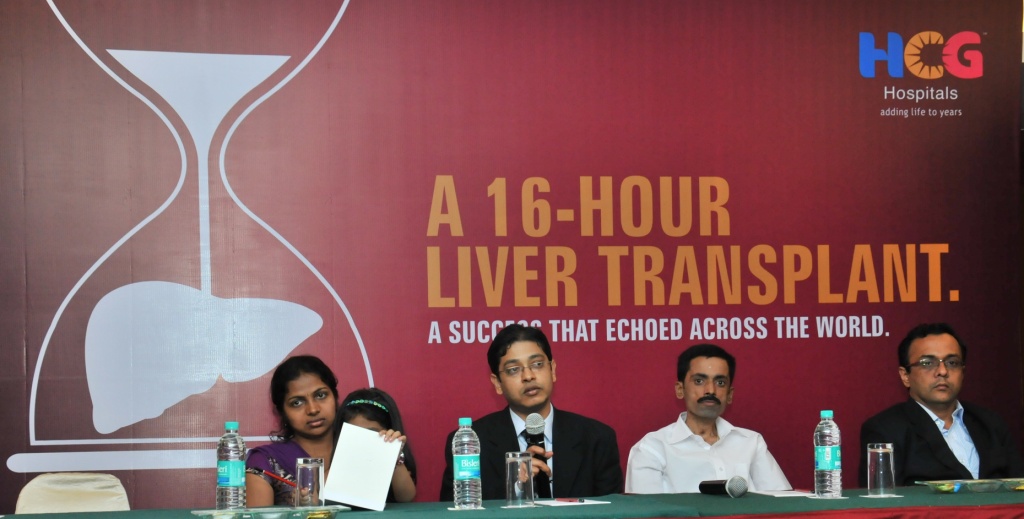
HCG Hospitals, organized a press conference on treating 36 year old Indian from USA, diagnosed with liver cirrhosis, underwent marathon 16 hour liver transplant surgery, with the organ donated from his wife.
A year ago, the patient had weakness and loss of appetite. During his routine health check-ups, he was diagnosed with liver cirrhosis, due to autoimmune hepatitis. After further investigations he was placed on the Liver Transplant waiting list in USA. With time running out, he did not get any organ offers and returned to India, for the liver transplant surgery.
Dr. Basant Mahadevappa, Consultant, Liver Transplant Surgeon, HCG Hospitals, said, “The patient was in a difficult situation, as he was decompensated with severe ascites (Liquid in the abdomen). His wife was worked up for donation. Anatomy of the donor was complicated, and was left with no other donor. With a multi-disciplinary team approach we took up the challenge and performed the transplantation. The patient & the donor are doing well and are on regular follow up.”
(From Left): Mrs. Shilpa Arun Kumar, Donor, Dr. Basant Mahadevappa, Mr. Arun Kumar, Recipient and Dr. Ganesh Bhat
Dr. Ganesh Bhat, Consultant, Gastroenterologist, HCG Hospitals, “The incidence of liver disease is on the rise and 2% to 3% of the people are living with Hepatitis B & Hepatitis C. People diagnosed with hepatitis B, are more likely to develop into liver cancer. Most of the times, its asymptomatic and when the patients start to see the see the symptoms, it’s in an advanced stage, which may require liver transplantation or a liver surgery. Early diagnosis of the disease helps in better medical outcomes.”
Mr. Arun Kumar, Recipient, said, “I was diagnosed with liver cirrhosis, and the only medical solution was Liver Transplant. With my condition worsening & surgery being an emergency I was lucky to find a donor in my wife. She came forward to donate her liver, though it was high risk surgery. I have recovered and got a new lease of life.”
source: http://www.moneylife.com / MoneyLife / Home / Bangalore, Karnataka, India / Business Wire India / November 27th, 2013
Dr. Meenakshi Hegde, a Paediatric Oncologist at Baylor College of Medicine, Houston, Texas, was awarded the 28th Schweisguth Prize from the International Society of Paediatric Oncology for her scientific paper “Combinational targeting offsets antigen escape and enhances effector functions of adoptively transferred T cells in High Grade Glioma,” which was presented at the 45th Congress of the International Society of Paediatric Oncology in Hong Kong last month. The award is given in honour of Dr. Odile Schweisguth, renowned clinician, investigator, founding member and the first President of the Society.
Dr. Meenakshi, hailing from Sirsi, is the wife of Dr. G. Bharath Raj, a renowned Tennis Player and a Psychiatrist at Houston and the proud daughter-in-law of Sumana and D. Guru Raj of Kuvempunagar, Mysore.
Her completed research paper was recently published in Molecular Therapy. The prestigious Schweisguth Prize is awarded only to best scientific contribution to the Paediatric Oncology field in the world.
Her research focuses on developing novel treatment for malignant gliomas that targets more than one tumour associated-proteins simultaneously with the aim of decreasing the risk of tumour recurrence. Malignant gliomas are tumours that often do not respond to even the most aggressive forms of therapy currently available. Less than 25 percent of children with this type of brain tumour survive after five years.
Dr. Meenakshi Hegde completed the research during her fellowship training at Texas Children’s Cancer Centre and at the Centre for Cell and Gene Therapy at Baylor College of Medicine, Houston, USA.
source: http://www.starofmysore.com / Star of Mysore / Home> General News / December 01st, 2013
The commercial ties between the US and India stretch back to 1792 when President George Washington, the first US President, sent an official envoy to the city of Madras and established a permanent presence in city. Ever since, both the countries have recognised the enormous potential of cultivating this partnership. US remains the leading investor in India, both in terms of projects and jobs generated. Foreign Direct Investment from US firms created more than 355,000 jobs between 2007 and 2011. IT industry dominates the sector, with 60%-70% of our revenues coming from the US, said S. Nagarajan, Chairman, CII Mysore.
With this background, CII Mysore is organising an interactive session with Dr. Rajan Natarajan, Deputy Secretary of State, Policy & External Affairs, State of Maryland, USA, on Nov. 28 at Hotel Quorum in city at 5 pm.
Dr. Natarajan will address and interact with industries on US-India Technology Partnership; How to do business with US; New Markets and Investment opportunities for Indian Companies.
Dr. Natarajan was appointed as the Deputy Secretary of State by Governor Martin O’Malley in June 2011. He is the first Indian born-American, who currently holds the highest administrative position in the US and in Maryland’s history. His portfolio include representing the Governor and the Secretary of State at designated public events, advising the Secretary on external affairs, fostering and promoting international diplomatic mission, building public, private and business partnerships, FDI and trade promotion, enhancing educational and institutional collaborations, facilitating technology commercialisation.
In addition, he is responsible for advancing international Sister-State programmes in more than 13 countries that include (China, Japan, Brazil, India, South Korea, Liberia, Nigeria, South Africa, Turkey, Vietnam, Estonia, Ireland, and Russia), coordinating legislative and executive branches of government agencies, policy development and legislative approval, monitor policy implementation, and overseeing the Maryland International Consortium. He is also currently serving as a Member of the Governor’s International Advisory Council.
source: http://www.starofmysore.com / Star of Mysore / Home> General News / November 27th, 2013