TAPMI professor, Dr A Sivakumar’s Case on UPSL- Exploring Operations Strategy Options won the Best Case under Operations Category of ISB – Ivey Global Case Competition 2014. The award, $2000, is being sponsored by Amazon.
The ISB-Ivey Global Case Competition was launched in 2010, has gained prominence in India and abroad and is widely considered an important source for India-centric cases by B-Schools around the globe. An internationally acclaimed subject expert’s panel judges each case in a double-blind review process and provide feedback.
This year, an unprecedented 109 entries from more than 50 B-schools in India and abroad were received including from the United States, Canada, Australia and Switzerland. The cases spanned different management areas such as Strategy, Marketing and Leadership, as well the growing areas of interest such as, Social Enterprise and Business Ethics. This competition plays a critical role in promoting the development of new case material and the use of the case method in management education.
The top cases from this competition are published to the global audience through Ivey Publishing and Harvard Publishing the two largest sources of business cases in the world. Winners in other categories include Academics from IIM-A, SP Jain, MDI.
source: http://www.timesofindia.indiatimes.com / The Times of India / Home> City> Mangalore / Stanley Pinto, TNN / August 22nd, 2014
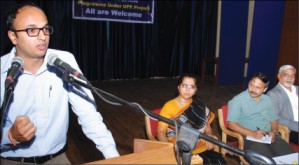
“Grasp what you read as reading should be qualitative and not just quantitative,” suggested Gurudath Hegde, State IAS topper with a national ranking of 25.
He was interacting with students at a programme organised jointly by Maharaja’s College, Yuvaraja’s College and Centre for Proficiency Development and Placement Services (CPDPS) of Mysore University at Maharaja’s College Centenary Hall here this morning.
About 1,500 students of various colleges participated in the programme and interacted with Hegde after listening to the valuable tips given by him.
Speaking on preparations for the competitive exams, the 2013 State IAS topper from Dharwad advised the students to cultivate the basic behaviour of reading books and newspapers and develop a passion for knowledge.
He asked the students to change their mindset first as nothing was impossible and inferiority complex should be shunned. He suggested them to be confident in their work as perseverance and hard work always ensured success.
When students asked whether coaching was essential for competitive examinations like IAS, Hegde answered in the affirmative saying that coaching at a right centre would put the students in the right groove to reach the goal.
He said that during coaching, a student could meet people, interact and exchange ideas and knowledge. However, he contended that a good coaching would involve a lot of money and time but should be utilised properly.
Maharaja’s College Principal Prof. B. Nagarajmurthy, Administrative Officer Vasanth, Yuvaraja’s College Placement Officer Swarnamala, CPDPS Director Dr. Niranjan Vanalli and others were present.
source: http://www.starofmysore.com / Star of Mysore / Home> General News / August 11th, 2014
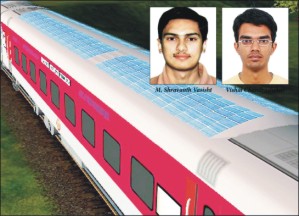
The students of The National Institute of Engineering (NIE) in city always come up with innovative ideas, keeping in mind their contribution to sustainable development. A young engineering graduate from NIE,M. Shravanth Vasisht, had designed Solar-Assisted Power Supply System for rail coaches as part of his academic project in the year 2010, which is now being implemented by the Indian Railways.
Young engineers from city M. Shravanth Vasisht, an Electrical and Electronics Engineering graduate from NIE, Mysore and Vishal Chandrashekar, a Mechanical Engineering graduate from PES College of Engineering, Mandya, have designed Solar-Assisted Power Supply System for Linke Hofmann Busch (LHB) Rail Coaches such as Rajdhani, Shatabdi Express, etc.
Speaking to SOM, Shravanth said that in 2010, as an academic project during the course of engineering at NIE, he had designed this System under the guidance of Dr. B.S. Sridhar, Scientist, Food Engineering Department, CFTRI, Mysore and A. Dhanyavathi, Associate Professor at NIE.
He said that this project was now initiated by him at the Indian Institute of Science (IISc.), Bangalore, along with another Mysorean, Vishal Chandrashekar, under the guidance of Prof. J. Srinivasan and Dr. Sheela K. Ramasesha and added that this would give a boost for the improvement of Railways, about which he had been very keen since 2010.
He said that the idea of installing solar panels on a car was given by Dr. Sridhar and the same was then extended for the conventional rail coach manufactured by ICF, Perumbur in Chennai. He said that this was written as a thesis and submitted to CFTRI and NIE.
A technical paper on the same subject by three authors (Shravanth, Dr. Sridhar and Dhanyavathi) was published in Electrical India in 2011.
When asked, Shravanth said that they found the implementation of solar PV system for a LHB rail coach to be more beneficial as they use EOG (End on Generation) System and added that EOG Scheme of power supply for rail coaches use two diesel generator cars on either ends of the train and their diesel consumption raised their eyebrows.
Coincidentally, a train consisting of LHB hybrid coaches was flagged off between Indore and Yeswantpur which was the first of its kind for South India and second train in India, he said and added they found LHB coaches were of a superior technology and felt that all the conventional rail coaches in India could be replaced by LHB coaches.
Elaborating further, Shravanth said that they felt that these were going to be the next diesel sucking culprits for the country which made us re-initiate this project at our workplace in IISc., where they spoke to their guides Prof. J. Srinivasan, Chairman, Divecha Centre for Climate Change, IISc. and Dr. Sheela K. Ramasesha, Research Scientist, IISc., who then provided a lot of inputs.
He said that spending time on this involved a lot of risk as they were not sure that the Railways would support them, mainly because of lack of encouragement in research fields and pilot projects.
Coincidentally, Union Railway Minister Sadananda Gowda quoted on this idea and we were recognised by the Indian Railways and the work was examined by the Chief Administrator of Indian Railways Organisation for Alternate Fuels, Ministry of Indian Railways, he said and added that they are very much interested in involving us to implement the same.
He said implementation of this scheme may not be possible immediately, as it involves step by step analysis on various experiments like aero-dynamics, vibration analysis, performance of the system in various locations during the transit, reliable control system design, protection from the impact of stones thrown at trains, etc. and expressed confidence that it will be a success if there is cooperation from public.
When asked, he said implementation of this idea is not an impossible dream and neither a novelty and added that probably they would be provided with a coach to carry out experiments.
Speaking about the cost of installation, he said that once the project becomes a success through pilot projects, there would be too many players in the market who can provide better engineering solutions for the challenges that will be faced for implementation which would also reduce the cost of installation and operation costs. If this pilot project becomes a success, one will be able to see Solar Panels mounted on all trains, which will be saving around 90,000 litres of diesel per train per year.
Shravanth has been invited to give a presentation on the same at an International Conference at USA in September this year.
Shravanth is the son of V. Murali Madhav of CFTRI and M. Lakshmi while Vishal is the son of Arun Chandrashekar, a retired Scientist from CFTRI and Lalitha Rangarajan, Associate Professor at University of Mysore. Both Shravanth and Vishal, residents of CFTRI Layout in city, are working as research fellows on Solar energy at IISc.
source: http://www.starofmysore.com / Star of Mysore / Home> General News / August 04th, 2014
IIT-JEE topper from city Prasanth is seen receiving the laptop from ACP (Traffic) Prabhakar Bharki as Srinivas- Past Secretary, Subramanian- Secretary, Nagaraj- Past President, Harsha- Treasurer, Jayanth- President, Raghavendra- Past President, Kumar- Vice President, Prakash- Joint Secretary and Harish- Past Secretary look on.
Mysore :
HIEMA (Hebbal Industrial Estate Manufacturers Association) after reports published in SOM that C. Prasanth, son of Chandra Nayaka, a daily wager, who secured 255th rank in IIT-JEE exam wanted financial help, HIEMA approached him to extend financial assistance.
When they approached him, he said that he wanted a laptop which would be of immense help to pursue his studies.
Few industrialists joined together along with HIEMA and purchased the latest HP Laptop with graphic card as Prasanth had opted for Mechanical Branch.
The laptop was presented to him by ACP (Traffic) Prabhakar Bharki at a function organised in city recently.
The industrialists who supported this cause includes Nagesh of Vinay Packings, Jayanth of Sri Sachidananda Industries, Jayanth of Enn Forgings, Raghavendra Raghavan of Baba Industries, Srinivas of Elcap Systems, Nagaraj of Chamundi Electrial Stampings, Subramanian of Deepak Tools Heat Treaters, Satish of Mysore Chamber of Commerce and Industries, Siddharth of Thimpson Cables, Prabu and Abhisekh of MGM Computers, Lakshmesh of Global Enterprises, Abhilash of Baba Mechanical Industries and Ghouse of Canara Packings.
Prabhakar Barki Asst. Commissioner of Police (Traffic) presented Laptop to Prasanth.
Jayanth- President welcomed the gathering, Raghavendra- Past President of HIEMA introduced the chief guest while Subramanian- Secretary proposed vote of thanks.
source: http://www.starofmysore.com / Star of Mysore / Home> General News / July 29th, 2014
SCHOLAR: Dr. R.L. Kashyap. Photo: K. Bhagya Prakash
Harvard-educated Dr. Rangasami L. Kashyap is fascinated by the Vedas and set up an institute to further his passion.
He has a Masters degree from IISc and a PhD. from Harvard. But Dr. Rangasami L. Kashyap is happiest when he is discussing the Vedas and Vedic studies. The Bengaluru-based scholar was recently honoured by the Bharatiya Vidya Bhavan for his contributions to Vedic study, and conferred an Honorary D. Litt by the Karnataka Sanskrit University. He has translated 23,000 Vedic mantras, in 26 volumes. In addition, he has brought out 50 books in what he calls the “Compact Series”, where each book runs to just 100 pages.
But what is interesting is Kashyap has not studied in a Veda Patasala. “My only acquaintance with Sanskrit in the early years was in school; it was my second language. I was taught Sandhyavandana mantras by my father,” he says.
Kashyap was curious about the import of the Vedas, but there was no one to answer his questions. Formal education claimed most of his time. He stood first in the State in his Inter exams, and went on to do BSc in Physics, Masters at the IISc and PhD in Harvard, where he won the Gordon McKay Prize Fellowship, and completed his PhD in less than three years. He became a faculty member at the department of Electrical and Computer Engineering, at the Purdue University, West Lafayette, U.S. He has published more than 250 research papers and guided 50 doctoral students. His doctoral work, ‘Ho-Kashyap algorithm’ is quoted even today in text books. He, along with with Dr.Ho, started the journal IEEE Transactions of Pattern Analyses and Machine Intelligence. And yet ask him if he gives lectures in his field of study after his retirement, and he replies, “Rarely. All my time is spent in Vedic studies.”
When did he start studying the Vedas? He answers, “When I was in the U.S., I first had my scholarship money and later during my tenure at Purdue, I had more money at my disposal. So I bought books on the Upanishads, the Gita, and translations of the Vedas by Griffith and Keith. I was surprised to find that although Rg Vedic mantras are quoted explicitly in the Chandogya and Brihaddaranyaka Upanishads, this aspect was not touched upon by speakers on Vedanta.”
In any case, with all the questions he had, Kashyap was in need of a guru. The visit to the U.S. by Madhav Pandit from the Aurobindo Ashram, Pondicherry, was a godsend. Kashyap was drawn to the work of Aurobindo and Kapali Sastri, and his translations and interpretations of the Vedas are inspired by their works.
Post-retirement, Kashyap set up SAKSI (Sri Aurobindo Kapali Sastry Institute of Vedic Culture) for the revival of Vedic knowledge. He clarifies that SAKSI has nothing to do with the Sri Aurobindo Ashram or with the Aurobindo Society.
What was it that drew him to the work of Aurobindo and Kapali Sastri? “Aurobindo points out that Vedic mantras had a symbolic meaning. Kapali Sastri identified 30 key words such as Agni and Gau, which occur more than 500 times in the Rg Veda. These help you arrive at the deeper meaning.”
But if there are such deeper meanings, does he mean to say that no one had noticed them before Aurobindo did? “The concept is indicated in the Mahabharata. Madhvacharya in his ‘Rg Veda Bhashya’ said that Vedic passages have three meanings – one referring to Gods (Adhidaivika), one referring to rituals (Adhi-Yajna) and the esoteric meaning (Adhyaatmika). Later, Raghavendra Swami looked at the last aspect more elaborately in his work ‘Mantraartha Manjari.’ Aurobindo made a pertinent observation. He said that to understand the Vedas, the Vedas are the only guide.”
Do the Vedas talk of moksha? “By and large, no. Not in the sense in which we understand it. They talk of the divinisation of human beings.”
Is sanyasa recommended by the Vedas as the way to attain such divinisation? “No. Marriage was not regarded as an obstacle to spiritual progress in the Vedas. That idea came much later.” So how did that idea gain currency? “Some people might have felt that they could get more spiritual ideas that way. But the Vedas don’t have this material versus spiritual idea. They emphasise on holistic perfection.”
Kashyap says women were not excluded from studying the Vedas. He points out that of the 400 Vedic rishis, 30 were women. He says that even the words used to describe women seers show the importance they had – Aditi, because she is not dependent (Nirukta 4/22); Vishrutaa, for she is learned, Dhruva, for she is firm and so on. “Even in the Upanishadic times, you have the example of Gargi participating in philosophical discussions.”
Hasn’t the oral tradition been responsible for the preservation of the Vedas? “Oral chanting was an excellent strategy, because manuscripts could be destroyed. Also when people chant in different ways like krama, jata, ghana etc., errors can be detected. So, we had an Error Correcting and Detecting scheme, thousands of years before the West rediscovered it in the 1950s, for computer and communication applications. But the downside was that when invasions took place, patronage for Vedic learning dwindled, and many sakas were lost. Patanjali speaks of 98 sakas of the Yajur Veda. Today, we have only six!”
Veda patasalas keep alive the tradition even today, with emphasis on oral chanting, I point out. “What is the use of just learning how to chant? The meanings are more important. Sadly, even the teachers often don’t know the meanings. In any case, how many students stay for the entire duration of the course? Once they get the hang of things, they leave to become purohits.”
Kashyap says we shouldn’t look at Western solutions to Indian problems. He says that it is wrong to conclude that with the coming of industrial agriculture, fewer people are engaged in agriculture. What has happened is that work has shifted from the fields to the making of tractors and the monotonous work of extraction of oil, to fuel the tractors and harvesters. Kashyap gives statistics to buttress his arguments against the use of pesticides and fertilisers. “In 1948, farmers in the U.S. used 50 million pounds of pesticides, and crop loss was 7 per cent. In 2000, a billion pounds of pesticides was used and crop loss was 13 per cent. So that shows that the bugs have developed resistance. Organic farming, on the other hand, allows insect predator population to have a healthy presence.”
Kashyap practises what he preaches. He has a completely organic farm at the Edumadu village, near Kanakpura, Bengaluru, where he has cows, and grows vegetables and fruits.
•SAKSI has published 160 titles in eight languages.
•SAKSI has its own recording studio, and 18 CDs have been brought out on the Vedas, Upanishads etc. In addition to chanting, the CDs give the meaning too.
•Teachers in schools catering to the poorer sections of society, have been trained by SAKSI, and they teach Vedic chants to their pupils. The children say their memory power and their creativity have improved, as a result.
source: http://www.m.thehindu.com / The Hindu / Home> Sections / by Suganthy Krishnamachari / July 31st, 2014
Prestigious schools in the city, Bishop Cotton Boys’ School and Bishop Cotton Girls’ School turn 150. As the schools and the Old Cottonians’ Association celebrate the landmark event through the year, Vidya Iyengar brings you some rare photos of eminent personalities who sat on those benches.
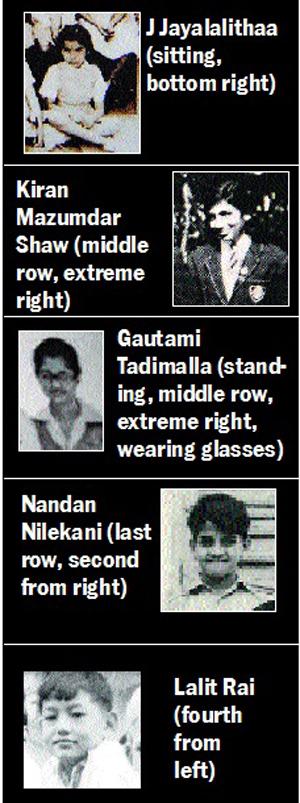
POWERPUFF GIRL J. Jayalalithaa (66) Fatima Jaffer, 68, 7th from left, standing in first row) was a class four student in the early 1950s at the Girls’ School. Her classmate was Tamil Nadu Chief Minister J Jayalalithaa, who studied only in junior school. “I think she was a good student, though I didn’t know much about her. We studied together for a very short time,” she says. Apparently, Jayalalithaa and Jaffer were admitted to the school on the same day — sometime in January (the term back then was between January and December) On Jayalalithaa’s birthday in February every year, sweets are distributed at the school.
FERTILE MIND Dr Kamini Rao (60) Taken in the garden of the Girls’ School in 1962, this photograph of Dr Kamini Rao, the pioneer in the field of Assisted Reproduction in India, shows her in class two. The photograph was taken on Prize day, when she was awarded five prizes. The bright and ambitious student was allowed to come to school in “colour dress”, she recalls, for her outstanding performance.
CHEMICAL POTENTIAL Kiran Mazumdar Shaw (61) We dug out this picture from the school magazine of the ’60s, which mentions that the Chairman and Managing Director of Biocon, Kiran Mazumdar was a senior prefect in 1968. She was part of the games committee (hockey). The 1967 records mention that she was also a junior prefect of the school.
A FLAIR FOR DRAMA Gautami Tadimalla (45) A ctress and Kamal Hassan’s partner, passed out in the early ’80s. Gautami Tadimalla studied until high school in Bishop Cotton Girls’ School. She was a boarder at the school because her doctor parents practiced in Vandiperiyar, Kerala.
INFORMATION-BOUND Nandan Nilekani (59) This is a class photograph of Std 5 B from 1965 which was the centenary year of BCBS. Can you spot business tycoon Nandan Nilekani? Recalling his classmate, CN Kumar (first on the last row), remembers Nilekani as a bright student who’d always stand first in class. He joined in class four from St Anthony’s School. He was part of the Pakenham-Walsh house. “He was there until class six or seven after which he went off to Dharwad,” he says.
MIND OF STEEL General Thimayya The late General Thimayya is a soldier of the Indian Army who served as Chief of Army Staff from 1957 to 1961, the years leading up to the conflict with China in 1962. This picture was taken when the general visited the school circa in as CAOS and met with Rev IL Thomas, Warden, BCBS. A few years later, on retirement from the Indian Army, he went on to command the United Nations peacekeeping force in Cyprus, where he died of a heart attack (1965).
WINNER Lalit Rai (58) A batchmate of Nandan Nilekani, Lalit Rai was a soldier of the Indian Army, who had the task of capturing the strategic heights of Khalubar in the Batalik sub-sector during Operation Vijay in the Kargil War. He was well-known as a football player. Joining the school in class five, he was there until class 10. He was part of the Pope house. Fun and mischievous is how C N Kumar recalls the colonel.
source: http://www.bangaloremirror.com / Bangalore Mirror / Home> Columns> Sunday Read / by Vidya Iyengar, Bangalore Mirror Bureau / July 19th, 2014
The University of Mysore (UoM) Academic Council which met here yesterday, gave nod for direct admission of students who have completed ITI to degree courses.This decision follows after Davanagere University granted permission for ITI and JOC passed students to join Degree courses such as B.A, B.Com and BBM.
The other decision taken by the Council included allowing a Singapore-based University to start an International Centre of Physical Biology at UoM, making Computer knowledge and PU education mandatory for candidates seeking appointment to non-teaching posts, granting affiliation to degree colleges started by the Government at Bettadapura, Saragur, Talkad, Chamarajanagar, Terakanambi and Arehalli and bracing itself to implement ‘Connect to India’ scheme as suggested by the University Grants Commission (UGC).
VC Prof. K. S. Rangappa presided over the meeting, which also took the historic decision of providing admission to students from Hyderabad-Karnataka (HK) region. With the decision, the UoM becomes the first University outside HK region to allot 8 per cent seats to students from the backward region under the provisions of article 371(J) of the Constitution.
source: http://www.starofmysore.com / Star of Mysore / Home>General News / July 19th, 2014
JSS University VC Dr. B. Suresh is seen addressing the press persons in city today as Dr. Basavanagoudappa, Dr. P.A. Kushalappa, Dr. B. Manjunath and Dr. H.G. Shivakumar look on.
Mysore :
The Accreditation Council for Pharmacy Education (ACPE), USA reviewed the Doctor of Pharmacy degree programme of Jagadguru Sri Shivarathreeshwara (JSS) University Colleges of Pharmacy, Mysore and Ooty for the purposes of certification and granted Certification to the College’s Pharm D programme.
Disclosing this at a press conference at Patrakarthara Bhavan this morning, Dr. B. Suresh, Vice-Chancellor of JSS University said that the certification status of the College’s professional degree program is listed in the directory of certified programmes of ACPE on its website and the Board’s review and certification was based on due consideration of the Evaluation Team Report (ETR), the Self-Study Report, and the recommendation of ACPE’s International Commission.
He further said that the purpose of seeking certification is to set benchmark for the quality of pharmacy education and particularly Pharm D programme that the University provides in the region with that of global standards and expectations.
Dr. Suresh said that with this coveted ACPE certification, JSS College of Pharmacy in Mysore and Ooty have not only become the first institution in the country but also in the Asia Pacific region and are now poised to provide education on international standards.
Dr. H. Basavanagoudappa, Principal, JSS Medical College, Dr. P.A. Kushalappa, Director (Academics), Dr. B. Manjunath, Registrar, JSS University and Dr. H.G. Shivakumar, Principal, JSS College of Pharmacy were present at the press meet.
source: http://www.starofmysore.com / Star of Mysore / Home> General News / July 18th, 2014
The CBR at the IISc was set up earlier this year with funding from a charitable trust set up by the former Infosys CEO. (Source: PTI photo)
SUMMARY
Carnegie Mellon University is a world-renowned leader in many areas of research and education.
_________________________________________________
Infosys co-founder and former CEO Kris Gopalakrishnan has announced a donation of USD 1.8 million for the Carnegie Mellon University in the US to establish a research tie-up with the Centre for Brain Research (CBR) at the Indian Institute of Science (IISc) in Bangalore for studying aging related disorders of the brain like Alzheimer’s and Parkinson’s.
“Carnegie Mellon University is a world-renowned leader in many areas of research and education. I am very pleased to support President Subra Suresh’s strategic vision for the collaboration between CMU and IISc through this gift so that we can address one of the grand challenges of our times by understanding the human brain,” Gopalakrishnan said.
The CBR at the IISc was set up earlier this year with funding from a charitable trust set up by the former Infosys CEO.
The partnership between the Carnegie Mellon Universoty, one of the foremost in brain research and the Centre for Brain Research at the IISc aims to leverage the research strengths of the two premier research institutions.
“This partnership will provide opportunities for applying new technologies from fields ranging from imaging to machine learning to address critical questions about neuro-degeneration and one of the most pressing challenges facing humanity is to understand the human brain. Our hope is that this new research collaboration will lead to discoveries about neuro–degenerative diseases that afflict the aging population, and that those findings help improve our diagnostic and treatment capabilities for such diseases,” Carnegie Mellon University president Subra Suresh said.opalkrishnan who was instrumental in taking Infosys from a start up in 1981 to a USD 8 billion revenue company, has a personal wealth valued at USD 1.4 billion and is among the top 1500 billionaires in the world at present.
source: http://www.indianexpress.com / The New Indian Express/ Home> Cities> Bangalore / by Express News Service / Banglaore – July 17th, 2014
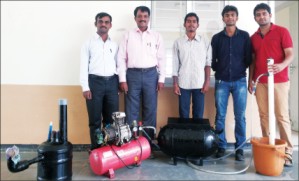
The 8th Semester students of ATME College of Engineering — Syed SuhailKadri, Pradeep and Suhas of Mechanical Engineering Department — under the guidance of K. Srinivasa, Head of the Department and Raghu, Asst. Professor, Department of Mechanical Engineering, have developed a technology to convert Raw Biogas to Enriched biogas, which has the potential to replace Compressed Natural Gas (CNG).
In present times, it is necessary to pay attention towards renewable energy sources such as solar energy, wind energy, biogas etc., due to fast depletion of conventional fuels like petrol, diesel and coal. In this regard, number of research works are going on in development of biogas technology. Biogas consists of 50-60% of methane and 20-30% of carbon dioxide. Due to this high percentage of carbon dioxide, the calorific value of fuel decreases and also affects the environmental pollution. In this project, the technology of enriching of biogas involves increasing the methane content in biogas from 50-60% to 70-80% by reducing the carbon dioxide content using Water Scrubbing process. On doing this, the calorific value of the fuel increases and environmental pollution reduces. This technology can be used for CNG also.
The students thanked the college for their support and facilities provided. The students were congratulated by Chairman of the institution, L. Arun Kumar, college Principal Dr. L. Basavaraj and teaching, non-teaching and management staffs.
source: http://www.starofmysore.com / Star of Mysore / Home> General News / July 17th, 2014