Category Archives: Education

97-year-old First Voter Does a Class Act in Film on Ballot Power

Shyam Saran Negi, independent India’s first voter, in the film.

A Google initiative to inspire Indians to exercise their right to vote has gone viral. The two- minute-30-second motivational film, part of Google’s Pledge to Vote campaign, has in its lead role 97-year-old Shyam Saran Negi, independent India’s first voter.

Negi, popularly known as Masterji, lives in Kalpa village of Kinnaur district in Himachal Pradesh, along with his son C P Negi, a farmer.  Directed by Bangalore-based leading advertisement film maker Manoj Pillai, the film was released on the public domain on Monday evening with the creative agency being Ogilvy, Mumbai.

Sandeep Menon, Director, Marketing, Google India, told Express via an email interaction on Wednesday that old age hasn’t diminished Negi’s belief in India’s democracy and the power of elections. “India’s first general elections were held in early 1952. But an exception was made for Kinnaur in anticipation of snowfall, and the elections were held there in October 1951. That’s when Negi got a chance to cast his first vote. Since then he has voted in every single elections, including each of the 15 Lok Sabha polls. He also continues to be an inspiration to his family, friends and community in Kalpa,” says Sandeep.

The film, shot in Kalpa in early March, had a 100-member crew closely working with the village folk and Negi, a retired government primay school teacher, in executing the project. “The time spent with our protagonist in this lovely mountain town helped in bringing alive not just his story, but even his commitment to the country,” says Sandeep. To a specific query as to what prompted Google to rope in Negi, he says: “These elections are about capturing the imagination of millions of both first-time as well as experienced voters. This film has been developed to inspire them to come out and vote during this election. The story of Negi is a testimony of Indian voters’ belief in the power of democracy.”

While sharing the challenges of shooting in Himachal Pradesh and also engaging elderly Negi to follow the storyline, Manoj felt that those living in cities like Mumbai, Delhi and Bangalore might not associate with the emotions of Negi. “He lives for the nation and his family comes next. He has seen the birth pangs of India, the problems of Partition and the struggle we are undergoing dealing with many complex issues. Masterji is upset with the happenings across the country, yet he comes and votes every time with the hope that things would change,” says Manoj, who heads Thinkpot Productions. Even the Central Election Commission officials have visited Negi couple of years back to felicitate him.

Negi refused to wear the costume initially as demanded by the storyline, and wanted the crew to take money from him. “He agreed only when we explained about the budget that was set aside for his costumes. He told us that he voted without expecting any favour or help from the politicians. He always walked to the polling booth, which is two km from his home, and never accepted the transportation help offered by parties,” says Manoj. He said the crew had to shoot at temperatures as low as – 6 degrees Celsius. “The physical contribution of Negi to the film, in terms of moving around as per the script, is outstanding. There’s a child-like innocence in him and his eyes light up every time we speak about voting,” he adds.

source: http://www.newindianexpress.com / The New Indian Express / Home> Nation / by Anantha Krishnan M – Bangalore / March 27th, 2014

Campus Capsule

RajeshwariBF01apr2014

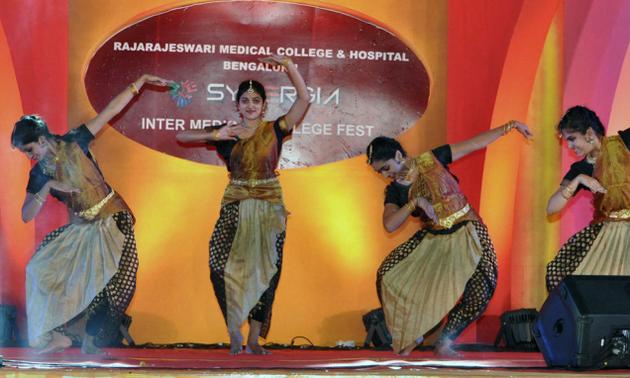
Synergia

“Synergia”, an inter-medical collegiate sports and cultural fest, got off to a start at the Rajarajeswari Medical College and Hospital (RRMCH) with Ramachandra, Medical Director, RRMCH, inaugurating it. Teams from Bangalore and Kolar participated in T-shirt painting, ‘air crash,’ and rangoli and mehendi competitions.

Awareness programme

The NSS unit of M.S. Ramaiah Institute of Technology (MSRIT) and the Criminal Investigation Department, in association with the Narcotics Control Bureau, organised an awareness programme on ‘Drug abuse’ recently. Anil Kumble, former Indian cricketer, inaugurated it. The guest of honour was Kannada actor Vijay Raghavendra.

The introductory speech by D. Roopa, IPS officer, was on the different types of drugs widely used by teenagers and about women’s safety.

KumbleBF01apr2014

Mr. Kumble spoke about the short attention span of the present youth and requested the gathering to keep themselves busy and aim for their goals instead of thinking of ways to get away by taking drugs. He also mentioned his experiences in college and school life. Mr. Raghavendra also spoke about ways to stay away from drugs and asked the youth not to experiment with their body. He sighted Mr. Kumble as the best example for the youth to follow.

Doctors from the National Institute of Mental Health and Neuro Sciences and the officials of Narcotics Anonymous talked about the different types of drugs and about the consequences they may lead to and the prevention measures.

XavierBF01apr2014

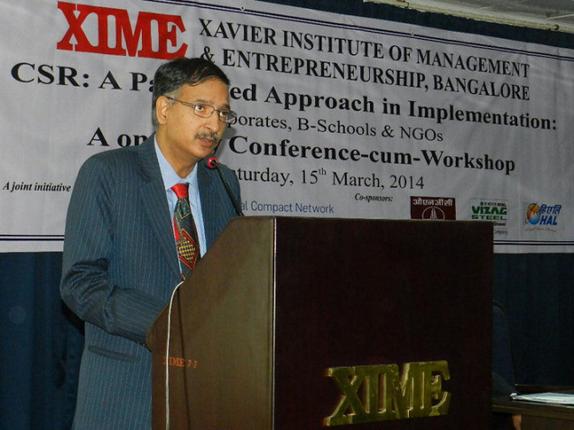
CSR conference

Xavier Institute of Management and Entrepreneurship (XIME), in association with Child Rights and You and Global Compact Network India, organised a one-day conference-cum-workshop on corporate social responsibility (CSR) implementation. ONGC, RNIL and HAL were the sponsors. Representatives from industry, NGOs and B-schools participated in the discussions and workshop.

Pushpa Sundar, trustee, Partners in Charge; Pooran Chandra Pandey, Executive Director, Global Compact Network India; A. M. Muralidharan, President, Volvo India Ltd; M.J. Xavier, Executive Director, VIT University; and J. Philip, President, XIME, spoke during the inaugural session. Later, three different sessions were done for the industry, B-schools and NGOs.

Leaders’ conclave

A leaders’ conclave was held at R.V. College of Engineering (RVCE) during its techno-cultural event ‘8th mile’. Based on the theme ‘Indian leaders in a global scenario’, the event was organised by the Entrepreneurship Cell of RVCE.

The speakers included T.V. Mohandas Pai, chairperson, Manipal Global Education Services; Revathy Ashok, chief co-ordination officer, BPAC; and V.R. Ferose, senior vice-president, SAP Labs India, among others.

Scholarship

The Institution of Engineering and Technology has sought entries for the second edition of its India Scholarship Award, an annual grant with a combined prize of Rs. 8 lakh. The award is designed to celebrat excellence and innovation among undergraduate engineering students. Entries are open for second and third year B.Tech students from AICTE/UGC-approved institutions across two categories – General and Women. Lateral entry students who join B.Tech programme in the second year are also eligible. Entries close on April 25. For more details visit http://scholarships.theiet.in/criteria#criteria

source: http://www.thehindu.com / The Hindu / Home> Features> Education Plus / by Staff Reporter / Bangalore – March 23rd, 2014

Bangalore : BASE student secures First rank in National Talent Search Examination (NTSE)

Bangalore :

Once again the students of BASE bring outstanding results in NTSE Stage I 2014 by bagging 1st & 3rd rank in Karnataka, the results of which were announced recently. The toppers from BASE are Ms. Dhanya Bharath who has secured 1st rank & Mr. Adithya M Niranjan who has bagged 3rd rank in the state. Overall 28 students from BASE who were part of Foundation SnT program have qualified in NTSE Level 1 exams. More than 50,000 students from Karnataka had written the test and 235 students have qualified from the state.

Speaking on the occasion, Mr. Vallish Herur, Director of BASE said: “The tradition of creating success in Karnataka continues this year too. We are very delighted that our student have topped in NTSE Examination. It really feels great to know that the effort we have put in has paid off. From the last two decades, the continuing success of BASE students at various entrance exams can be attributed to the dedicated efforts of its experienced faculty. I extend my hearty congratulations to all the successful students and wish them success in all their future endeavors”.

Adithya Nirajan
Adithya Nirajan

NTSE is a national-level scholarship program conducted by NCERT for students studying in class 10 to identify and recognize students with high intellect and academic talent. It is one of the most oldest & prestigious exams in India. Students pursuing professional courses such as engineering, medicine, management and law are eligible to receive financial assistance up to the post graduation level.


Dhanya Bharath
Dhanya Bharath

Students pursuing basic sciences, social sciences and commerce, financial assistance is provided up to Ph.D Level. The examination is conducted at both State & National levels.


About BASE:

BASE started functioning in the year 1991 from its present premises in Basavanagudi in Bangalore. It was started by Dr. H.S. Nagaraja with the intention of increasing the number of candidates from Karnataka gaining entrance into IITs (Indian Institute of Technology) and NITs (National Institute of Technology). From a modest strength of 4 faculty members and 3 students, BASE has now grown to include 150 teaching faculty and multiple programmes for students from class 5 to 2nd PU/Class12. BASE trains students to qualify in the entrance examinations of world renowned centres of learning such as the IITs of India. BASE has consistently performed since its inception both in terms of growth and an astounding share in the number of BASE students gaining entrance into the IITs and NITs. It is a proud fact that each year, the number of BASE students qualifying to the IITs is more than that of all other institutions in Karnataka put together.

source: http://www.bellevision.com / Bellevision.com / Home> Media Release / March 11th, 2014

BookAdda acquires K12-focused books e-tailer KoolSkool

BookAdda is backed by former Infosys director Mohandas Pai and Growth Story’s co-founder K Ganesh.

BookAddaBF25mar2014

Bangalore-based Ishita Technologies Pvt Ltd, the company behind BookAdda , an online marketplace for books, has acquired rival KoolSkool  from Delhigate Educomm Retail Solutions Pvt Ltd in a cash-and-stock deal.

“This acquisition is complementary to our strength and existing offerings,” said Hemant Kohli, co-founder and CEO, BookAdda, told VCCircle. “While BookAdda is focused on the complete range of books with a catalogue of close to 15 million titles, our other product ACADzone focuses on the competitive exam segment. Now, with the snapping up of KoolSkool, which offers books and stationery items focusing on the K12 segment, we are positioned to offer the entire range of solutions to the learning population in India.”

KoolSkool was founded in 2010 by Suhas Dutta and Vyom Khandelia. Dutta is a technology veteran with more than 22 years of working experience. An alumnus of Berkeley University, he held various roles at Gerson Lehrman Group, Accenture, netdecisions and NIIT, prior to starting the online venture. Khandelia is an IIM Calcutta alumnus, and is currently the director of Position2. In the past, he had held different positions at Afila, Neutron Systems, Ishoni Networks India, and Celstream.

Bookadda.com sells general books in various categories like fiction, non-fiction, mystery, self help, reference and biographies. It also offers books in management, computer, engineering and medical books catering to many university syllabi in India. The firm has partnered with leading online brands such as MeritNation, Edurite, Average2Excellent, Adormi, PracticeGuru, TCY Online, Infinitestudent, Eduwizards, and Oliveboard for the service. BookAdda is backed by former Infosys director Mohandas Pai and Growth Story’s co-founder K Ganesh.

The company has recently introduced a Google preview feature, which allows users to scan and preview books before buying. This feature is available for around 5,000 titles on its platform.

(Edited by Joby Puthuparampil Johnson)

source: http://www.vccircle.com / VC Circle / Home> M & A / by Sainul K. Abudheen / Tuesday – March 11th, 2014

IIM B to launch India’s first aerospace management course

New Delhi :

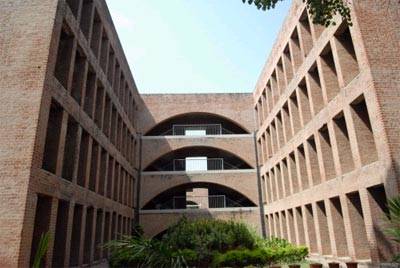
The Indian Institute of Management Bangalore (IIM-B) and Toulouse Business School have signed an agreement to launch India’s first executive general management programme in aerospace and aviation management.  Airbus is sponsoring the two year part-time degree programme to develop and nurture local talent in the field of aerospace, Airbus said in a statement.

BuildingBF22mar2014

The Aerospace MBA will be the first of its kind in India and will be conducted by Toulouse Business School, whose own aerospace MBS course has a strong business focus. Each year up to 75 students will be enrolled in the course.

“India is one of the fastest developing countries in the aviation market and is also one of the richest talent pools for the next generation of business leaders and we want the best to enter the exciting world of aviation,” Dwarkanath Srinivasan, CEO of Airbus India said in a statement. “With more passengers flying each year in India, there is an increasing need for expertise in aviation business,” he added.

Jacques Igalens, dean of Toulouse Business School said: “With the constantly evolving aviation landscape, the aviation industry needs world class leaders to anticipate trends and provide innovative solutions in today’s fast changing and uncertain globalised markets . This programme truly aims at answering this need.”

source: http://www.articles.economictimes.indiatimes.com / The Economic Times / Home> News> News by Industry> Education / by Anumeha Chaturvedi / ET Bureau / March 13th, 2014

Carnegie Mellon University President Visits NIE

 Dr. Subra Suresh, President, Carnegie Mellon University, USA (centre) is seen with (sitting from left) Srinath Batni, Former President, Infosys Science Foundation; Dr. G.L. Shekar, Principal; M. Sreepada Rao, President; H.N. Ramathirtha, Director, NIE Managing Committee and Dr. N. Suresh, Principal (NIE Evening College), (standing) Dr. Bansilal, Dean (Administration & Development); Dr. T. Ananthapadmanabha, Controller of Examination and Dr. B.K. Sridhar, Dean (Academic Affairs).
Dr. Subra Suresh, President, Carnegie Mellon University, USA (centre) is seen with (sitting from left) Srinath Batni, Former President, Infosys Science Foundation; Dr. G.L. Shekar, Principal; M. Sreepada Rao, President; H.N. Ramathirtha, Director, NIE Managing Committee and Dr. N. Suresh, Principal (NIE Evening College), (standing) Dr. Bansilal, Dean (Administration & Development); Dr. T. Ananthapadmanabha, Controller of Examination and Dr. B.K. Sridhar, Dean (Academic Affairs).

Mysore :

Prof. Subra Suresh, President of Carnegie Mellon University (CMU), USA, visited NIE in city recently along with Srinath Batni, Former President, Infosys Science Foundation and NIE alumnus.

During an interaction with NIE President M. Sreepada Rao, Directors and faculty members of NIE, Dr. Suresh said that there are three thrust areas that an educational institution should focus on — data science, which deals with big data impact on the society, sustainable energy and environment. Further, many top-notch Universities across the globe including CMU, are focusing an intersection of science, engineering and technology on one hand and social sciences on the other.

Dr. Suresh is the first Indian who has occupied the highest post of the World’s renowned University- CMU. A distinguished engineer and a scientist, Dr. Suresh is the only current University President to be elected to all the three national academies — Institute of Medicine (2013), National Academy of Sciences (2012) and National Academy of Engineering (2002). He was nominated by President Barack Obama and unanimously confirmed by the US Senate in 2010 as the Director of National Science Foundation, which was then a $7 billion independent federal agency.

NIE Hon. Treasurer S.K. Lakshminarayana was also present on the occasion.

source: http://www.starofmysore.com / Star of Mysore / Home> General News / March 16th, 2014

Students give cops a remote for signals

 Hand-held device will enable traffic policemenmanning junctions to change the sequence and timing of signals

About a year ago, Prof Balaraman, a formerpoliceman now part of the teaching faculty at CMRInstitute of Technology, threw an open challenge to his students. “The challenge was to do a project that can benefit the public,” said Bala Maruthi T, a final semester student. In response to this challenge, Maruthi and two other final year engineering students, Babitha Susan George and Avinash M, teamed up and joined hands with the traffic police to draw up a blueprint that would make the task of manning junctions easier.

The three have devised a remote-controlled device that would help traffic police posted at junctions manipulate traffic lights. The trio has already conducted a round of discussion with traffic police top brass. The top brass are thrilled with the idea and is eagerly looking forward to a demonstration of the device.

The students say the device can help ease traffic jams

Traffic signals in the city currently operate on ‘Zig-Bee’ technology, an automatic system where traffic signals are programmed to a preset sequence and timing. The system is not infallible and has been known to cause delays and jams. To clear congestion, policemen manning junctions are forced to switch to a manual ‘wired-control mode’. This means the constable at the junction, based on his assessment of the traffic situation, controls the lights from a control box mounted on a pole at the junction. While the method offers better management options, police say that it ties the constable down to the control box, often at an obscure location near the junction. Finding no policeman in sight, some motorists tend to break traffic rules, sometimes causing a jam.

“The police officer who witnesses the violation is helpless since he is stationed at the pole,” said Susan George. “He or she is unable to book offenders. Such offences have been known to cause road accidents leading to death or injury.”

With the remote control device, the constable, based on an assessment of the flow of traffic, can choose from among several sequences and timing options and even flip from one option to another. “The device empowers the constable to manage traffic in the best possible manner,” said Avinash. “For instance, if an ambulance approaches the junction, the constable can immediately change signalsto clear a way for the ambulance. Similarly, if traffic is piled up on one road, he can change the timing allowing a longer duration to clear congestion.”

B Dayanand, additional commissioner of police (Traffic and Security) who had a glimpse of the project, said it looks exciting.

source: http://www.bangaloremirror.com / Bangalore Mirror / Home> Bangalore> Others / by Sridhar Vivan and Nischith N , Bangalore Mirror Bureau  / March 15th, 2014

SDMITES win Boroplus all India short-film contest

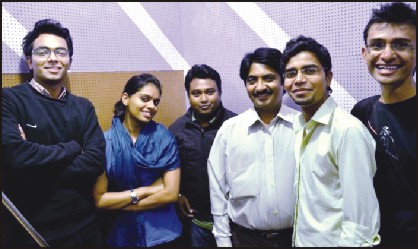
 The Student Team (from left): Himanshu Singh Gurjar, Aastha Vyas, Piyush Kumar, Ravi Shankar, Aman and Omkar Rajyaguru.
The Student Team (from left): Himanshu Singh Gurjar, Aastha Vyas, Piyush Kumar, Ravi Shankar, Aman and Omkar Rajyaguru.

Mysore :

The short film “Who am I” by the students of Shri Dharmasthala Manjunatheshwara Institute for Management Development (SDMites) — Himanshu Singh Gurjar, Omkar Rajyaguru, Piyush Kumar, Aastha Vyas and Ashwin S. Prasad — won the BoroPlus All India Short-Film Making Contest-2014. This year the contest invited entries on the theme ‘Crime against Women.’

The film was expected to speak about the domestic violence, sexual harassment, income inequality, chauvinism, cultural stereotyping. The theme attracted entries across India and 14 entries were shortlisted for the final round. The entries were judged by the jury headed by Ad Guru Alyque Padamsee (Brand Father of Indian advertising, Padamsee has built over 100 brands).

“Who am I” presented the theme and the contest expectation in five minutes which made it to top the contest.

Himanshu Singh Gurjar, who led the “Who am I” team says, ‘“It was then, when there was a storm of Damini’s case (16 December 2012) across the nation that I wondered what is all this happening in the neighborhood in our country, may be in our city next, what if it is our own people? That very thought was awakening for me, I knew it is not possible to change everything but I wanted to raise my voice, against this crime. It was enough of wondering and I knew it is always the action that has stood strong against the injustice.”

Another team member Ashwin S. Prasad says “Who am I is an attempt which is not just a film but also a question from each and every Damini of our society to me, to you and to everyone. We don’t need to answer anyone at all; we just need to answer ourselves. You don’t know her, she may act strong and happy, but she cries to sleep at night. You don’t know the main story behind her story, and you can’t even make assumptions, because her story is far different from yours. But she is present everywhere. We just need to open our realistic eyes.”

This video was not possible without the support of SDM-IMD student community who helped in spreading the message across the nation through social media platform.

The film is available in YouTube in the link:http://www.youtube.com/watch?v=PuYXIbhFHkkorhttp://youtu.be/PuYXIbhFHkk

source: http://www.starofmysore.com / Star of Mysore / Home> General News / March 05th, 2014

Polling lessons part of their syllabus now

Bangalore :

Nagaratnamma, 55, is usually taught basic arithmetic and the Kannada alphabet at her village, 7km off Hoskote and 25km from Bangalore. Of late, she’s been getting lessons in class on how to use the electronic voting machine, the importance of casting one’s franchise and the rights of a voter.

The Election Commission of India has signed an MoU with National Literacy Mission Authority on educating illiterate adults on electoral matters. Electoral literacy is a subject in classes conducted under the Saakshar Bharat Programme, and with the big poll battle drawing closer, it’s being taught extensively across Karnataka.

To make classes fun, instructors plan to use aids like posters, books, slogans, SMS messages, radio jingles and songs. Posters will be put up at learning centres in gram panchayats, jaatas and group discussions will be organized, school and community-level meetings on the topic will be encouraged. Apart from electoral literacy, financial literacy, disaster management and legal literacy have also been added to the syllabus.

The prerak – class coordinator at the gram panchayat level – has to ensure that adults are registered as voters. In case someone is yet to be enrolled, the coordinator has to contact booth-level officers. Preraks are also tasked with the responsibility of educating villagers on the documents required to get themselves enrolled.

“It is not easy to make villagers understand the importance of elections. The general belief is that one vote will not make a difference. We need to make them get over this feeling,” said BH Kamraj, a prerak from Doddagataginabbi, off Hoskote.

The State Resource Centre, Mysore, has prepared the training manual and teaching materials. “Our goal is simple. We want everyone to vote. It’s not just about casting your vote, but also being informed about ethical voting. People should understand that good governance comes from the choices they make. They should be aware of whom they support. Voting percentage in Rajasthan and Chattisgarh surged after EC launched the adult education programme. We hope to bring about change here as well,” said Basavaraj Devanoor, programme coordinator, materials and media unit, SRC.

WHAT ARE THEY TAUGHT

-How to vote

-How to use EVM

-What is a voter ID

-How to register

-What documents do you need

-Who is a people’s representative

-What are democratic rights

-Rights of a voter

-Importance of voting

source: http://www.timesofindia.indiatimes.com / The Times of India / Home> City> Bangalore> Namma Metro / by Sruthy Susan Ullas, TNN / February 26th, 2014

BVB’s village vocational venture

BVBbf06mar2014

For good work to be done, it is important that a person or an institution takes initiative. Bharatiya Vidya Bhavan, founded in 1978, has been working on promoting Indian culture and tradition. The latest being the Village Vocational Venture which is held every year at Kollegal in Chamarajanagar district. This weekend’s Star Supplement introduces our readers to the initiative taken by Bharatiya Vidya Bhavan to help students learn about the richness of rural culture.


Taking students close to village culture

by S.N. Venkatnag Sobers

Located about 77 kms from Mysore is a town called Kollegal, in Chamarajanagar district. Until 1956, Kollegal was part of the Coimbatore district of the Madras Presidency. The States Reorganisation Act of 1956 moved Kollegal to Karnataka primarily organising it along linguistic lines. Kollegal is a name derived from the names of two hermits namely ‘Kauhala’ and ‘Galava’ who were believed to be have been instrumental in the development of Kollegal.

Kollegal, also called ‘Silk City,’ is famous for its handloom silk saree industry. Some historians believe that Silk was introduced in this part of the State by Tipu Sultan, who learnt the secrets of silk. But there is no evidence to prove the matter. Kollegal also has a very rich forest land with Sandalwood and Teak grown in abundance. The town is surrounded by Siddappana Hills, Edni Hills, Koteboli, Kanchanboli, Mallige Boli, Dupada Boli, Biligiri Rangana Betta and Malaki Betta.

A second range of forests include Gunndal, Daigallu, Bombegallu, Burude Forest, Dodda Sampige range, Chikka Sampige range, Kere Dimba, Nallikadru, Dodda Kallu, Atthi Kane estate, Kadigere, Beduguli Estate, Jodigere, Gaddesala, Dimbam, Thalai Male, Adunmale, Satekhana, Akka Thangi Bole(Sisters Hill), Devargatta, Sebunkube, Havina moole, Ere kadu, Ame Kere, Purane, Kyathadevangudi and Banglekodu.

Kollegal was one of the areas which played host to the activities of Sandalwood brigand Veerappan who also poached elephants for their tusks. The town also plays host to many tourist spots which include Malai Mahadeshwara Hills, Hogenakal falls, Gagana Chukki and Bhara Chukki at Shivanasamudra (also known as Bluff) among many other. Also there is a small hill called ‘Maradi Gudda’ which is located in the heart of the city where the foot prints of the Sri Mahadeshwara Swamy are preserved. It is believed that Lord Mahadeshwara Swamy first stepped at this place above the hills.

Though Kollegal is located in Chamarajanagar district, which is one of the backward districts of Karnataka, it has produced some eminent personalities who have gone on to make a name for themselves in society. Among them are the famous sculptor Shilpi Siddalingaswamy, former AICTE Chairman Ramegowda, former BEML CMD K. Aprameya, former HMT CMD N. Ramanujan, who is now the Chairman of Bharatiya Vidya Bhavan, Karnataka among others.

Bharatiya Vidya Bhavan’s presence in Kollegal

Bharatiya Vidya Bhavan (BVB), has gone to become a huge intellectual, cultural and educational movement. The institution was founded by K.M. Munshi, a multi-faceted personality, who was a lawyer, author, constitution-maker, statesman and a social reformer. Now after more than six decades, BVB has become one of the premier institutions in the country and abroad. The institution has been offering education in various subjects which include Sanskrit, Indology, Indian Culture, Indian Classical Music, Dance, Drama, Yoga, Classical Languages, Ancient Scriptures, Arts, Science, Commerce, Modern Management, Mass Communication and Information Technology as well as foreign languages such as French, Spanish, Russian, German and Japanese.

Institutions run by BVB range from Kindergarten to Post Graduate and Research levels. The main objective of BVB is to provide a modern bridge to span the past, present and future built on a strong foundation of the fundamental values of life.

BVB has also set up Centres in London, New York, Lisbon, Mexico City and Durban. There are also plans to start BVB Centres at Geneva, Singapore, Tokyo, Abu Dhabi, Qatar and Kuwait. The institution not only aims at providing quality education with modern facilities to urban students but also to students in rural areas. Besides having a global presence, BVB has also been concentrating on taking quality education to rural areas. A recent endeavour of BVB is the Bhavan’s Geetha Vidyalaya in Kollegal. The School, originally known as ‘Geetha Shishuvihara’ was established in the year 1954 by a team of philanthropists. In the year 1995, A. Krishna Shetty, a philanthropist, donated the site to Geetha Shishuvihara on which the School was constructed.

It was in 1991 that Geetha Shishuvihara started a primary school and since then it has added one class every academic year. Currently, the institution caters from kindergarten to Class 8. Next academic year, the institution will be starting Class 9 as the Department of Public Instruction has given its nod for the same.

Geetha Shishuvihara was taken over by Bharatiya Vidya Bhavan in the year 2009 and was renamed ‘Bhavan’s Geetha Vidyalaya.’ An important personality responsible for BVB taking over the Shishuvihara was A.S. Devendra Gupta of APS in Kollegal. He was instrumental in running the school for many years. Sadly, he passed away in July 2013, soon after the School laid a foundation stone for the construction of a new building. The School has a separate committee headed by K. Shekar as the Chairman. It also involves members of BVB Mysore, who have been guiding the committee on various issues.

After BVB took over the school administration, the school has seen several changes right from providing quality infrastructure to salaries for staff members. The student strength has also increased over the years and slowly, Bhavan’s Geetha Vidyalaya is becoming one of the most sought after institutions in Kollegal and surrounding villages.

Speaking to Star of Mysore, School Secretary Girirajan, said that the school had seen a lot of improvement since BVB took over. “Student strength has gone up, amenities for the school have improved and staff benefits have also increased. Currently, the school administration has also taken up construction of new building which will provide classrooms for students. Slowly, the existing building will be demolished phase-wise to make way for the new building. We have added a Computer lab, Educomp Smart Class and transportation facilities,” said Girirajan.

Village Vocational Venture (V3)

BVB’s activities in Kollegal doesn’t stop at that. One of the unique features of Bharatiya Vidya Bhavan’s education system is that it provides an opportunity for the students of Bhavan’s Priyamvada Birla Institute of Management to learn and educate themselves on rural system of living. Not many institutions which offer management courses concentrate on taking the students to villages to allow them to learn and get hands-on experience of life at grass-roots level.

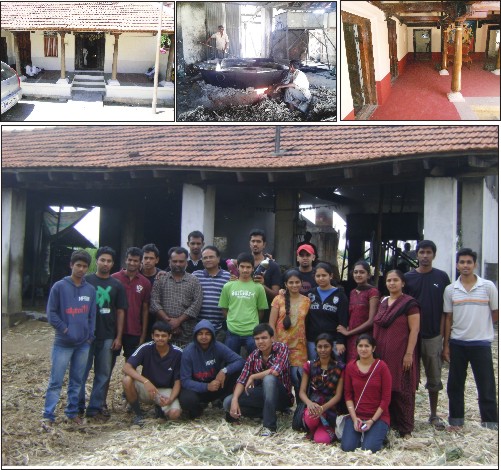
Under the initiative Village Vocational Venture (V3), the management students are taken to Kollegal during their academic year and are made to understand different scenarios that villagers encounter in their everyday life. The two days and one night programme involves a batch of 20 students who are introduced to cottage industry, pottery, sericulture farming and jaggery manufacturing unit.

Speaking to Star of Mysore, Bharatiya Vidya Bhavan, Karnataka Chairman, N. Ramanujan said that students who are the management executives tomorrow should understand the hardship of the rural people, who work as agriculturists, in rural industries, labourers and also the exploitation meted out to them by the middlemen. This apart, the programme also focuses on making students understand the rural lifestyle, which is filled with healthy food and a care-free life.

“They do a lot of work but at the same time they also enjoy life’s simple pleasures. Students are made to experience rural lifestyle by introducing them to different cultures, traditions and rural sports such as kabbadi, lagori, marakothi and others. This programme is to make students understand that the simple joys that they derive actually originate from villages,” said Ramanujan.

The most interesting and fun part of the entire programme is the stay. Students are accommodated in an ancient house believed to be over 300-years- old. The house is the ancestral property of N. Ramanujan, bought by his great grandfather Narayana Iyengar from Krishnaraja Wadiyar II on April 18, 1760 AD. The sale deed executed by Krishnaraja Wadiyar II is well preserved by Ramanujan, who has now donated it to be used for V3 project. The house is located on Doddamane Narayana Iyengar Street near Lakshmi Narayana Temple.

There are around seven rooms where the students are accommodated during their stay in Kollegal. The pillars of the house are made up of Teakwood which adds to its antique value.

Though the house has been maintained in its original state, a few changes have been made to make the students’ stay comfortable.

During their stay at the house, students get to relish some of the best village food served on a plantain leaf. The scheduled morning walks are a delight for the students, as they get to enjoy sugar-cane juice, tender coconut directly from the nature’s bed. They are also taken to paddy fields, jaggery manufacturing units and are briefed about different business opportunities in villages.

Mahatma Gandhi said, ‘India lives in her villages’ and Bharatiya Vidya Bhavan, through its Village Vocational Venture programme, has been successful in introducing the urban students to India’s rich rural culture.

source: http://www.starofmysore.com / Star of Mysore / Home> Feature Articles / March 01st, 2014