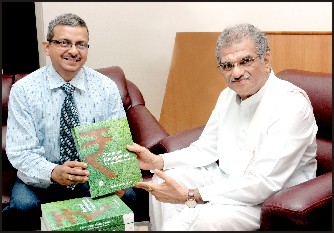
Dr. D. Veerendra Heggade is seen releasing the book as author Dr. N.R. Parasuraman looks on.
Mysore :
Dr. D. Veerendra Heggade, Dharmadhikari of Shri Kshethra Dharmasthala and Chairman, SDM Educational Trust, released the book “Financial Management: A Step-By-Step Approach” authored by Dr. N.R. Parasuraman, Director, SDM Institute for Management Development (SDM-IMD) at SDM-IMD premises here on Jan. 28.
On the occasion, the author introduced and presented an overview of the text book which would be helpful for students in pursuit of Management Education.
Dr. Heggade, while expressing his appreciation, said ‘the book is an excellent work covering all critical areas of corporate finance and application. The book is well planned, the flow is smooth and facilitates easy understanding even to a lay reader. Another facet of the book is its practical thrust and the blending of theory with practice at all stages.’
He also said the book is unique and makes study of finance easy and interesting.
About the Author: Dr. N. R. Parasuraman is Commerce and Law graduate, Fellow member of the Institute of Company Secretaries of India (ICSI) and the Institute of Cost Accountants of India (ICAI). His doctorate was on capital structuring of Indian companies. He has been researching and teaching in the areas of strategic finance, financial derivatives, cost management, portfolio management and international finance.
Dr. Parasuraman has published more than 40 papers on various topics of finance in leading journals. He has also authored a book titled Fundamentals of Financial Derivatives, which featured in the top 10 management bestsellers of Businessworld in August 2008. He has been a visiting adjunct faculty of finance at the Indian Institute of Management, Kozhikode, for more than a decade. He has also been a visiting faculty at the Indian Institute of Management, Bangalore, and the Indian Institute of Management, Rohtak.
source: http://www.starofmysore.com / Star of Mysore / Home> General News / January 30th, 2014
A session on the relevance of Halegannada (ancient Kannada) drew a sharp response at the Dharwad Sahitya Sambhrama on Sunday.
Young Nagaraj Vastare, who has carved a niche for himself in the literary world as a promising writer, sparked off a heated discussion at the session — Why Halegannada Should Be Read — with the claim that the study of ancient Kannada is irrelevant today.
Leading writers S L Bhyrappa, M M Kalburgi, S Shettar, T V Venkatachala Shastri, O L Nagabhushana and C N Ramachandran as well as panelists Hampa Nagarajaiah, B Sukanya and M H Krishnaiah jumped to the defence of ancient Kannada literature.
Nagaraj then contended that there is a widespread feeling among the youth that reading literary works in ancient Kannada will not help address current issues and, hence, such works are outdated.
Nagarajaiah, Krishnaiah and Sukanya explained the importance of being well-versed with history, saying it is the root of any civilization and add to the growth of society in a healthy manner. They argued that since historical events were documented in ancient Kannada, it becomes pertinent to read works written in the language.
Bhyrappa explained how he was inspired by Mahabharata, written by Kumara Vyasa. He also stressed upon the importance of studying Sanskrit, pointing out that writers will find its rich vocabulary resourceful.
All scholars alleged that teachers who were not trained to teach ancient Kannada were goading students into opting out of studying the subject and are also opposing its introduction in the college syllabus.
E-media’s impact: At a session on ‘Electronic Media and Literature’, senior journalist N A M Ismail and author Vasudhendra talked about the vast impact of the online medium on the process of creation of literary works.
They referred to recent trends and developments in online technology and software that have made creation and transmission of literature fast and effective. They also said all the problems related to Unicode have been addressed.
source: http://www.articles.timesofindia.indiatimes.com / The Times of India / Home> City> Hubli> Kannada / by Gururaj Jamkhandi, TNN / January 20th, 2014
Not many organisations come forward to work for the noble cause of bringing up special children and make them lean an independent life. Mysore has a few organisations working for special kids. Their endeavours may yield success or fail. But, the efforts put in by them cannot be ruled out. One such organisation is Sneha Kiran.
Sneha Kiran is a part of Mysore Spastic Society which was started in the year 2002 and has been working for children with Cerebral Palsy (CP). The organisation was started by a group of philanthropists, professionals, volunteers, and parents of children with CP with the objective to cater to the needs of such children.
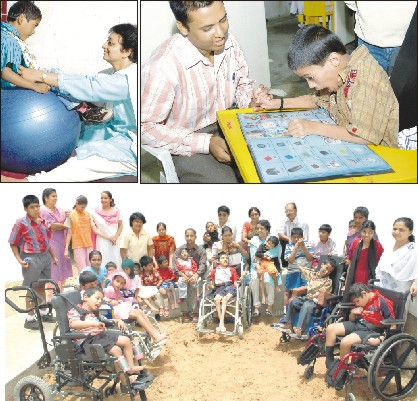
Earlier, Sneha Kiran was working in a space which was donated by Raghunath, President of Sneha Kiran. But now, the organisation has its own building in Bogadi, where around 70 special children with CP are being looked after by the volunteers. Sneha Kiran is the only centre committed to provide help and solace to the families of such children in and around Mysore.
Every good work has an inspiration. For Sneha Kiran the inspiration was Joel, who was affected with Cerebral Palsy and happens to be the son of A.P. James, the Director of Sneha Kiran.
Speaking to Star of Mysore, James said that it was Joel who inspired him to start the organisation. “I used to visit various places for Joel’s treatment. One day a thought struck my mind and I decided to start an organisation to cater to the needs of the children with Cerebral Palsy and that is how Sneha Kiran came into being,” he added.
Sneha Kiran admits children from three years onwards. Children are subjected to various rehabilitation programmes to make them self-dependent. Although there is no cure for Cerebral Palsy, these rehabilitation programmes could avoid their condition from getting worse.
“Children with Cerebral Palsy should be treated as children with problems not problem children. For them, therapy is a way of life and there is a need to try and develop their skills similar to that of normal kids. People should accept them like they accept any other kids. For children affected with cerebral palsy, therapy has to be regular and upgraded accordingly,” said Shashikala Ramnath, an Occupational Therapist.
It is also important that the normal kids interact with these children once in a while so that these children are allowed to gel well with them and such ventures would also help the special children to be accepted by the society.
Sneha Kiran will be celebrating its 10th anniversary tomorrow and a special event has been organised at Silent Shores in this regard.
What is Cerebral Palsy?
It is a term used to describe a group of chronic conditions affecting body movement and muscle co-ordination. It is caused by damage to one or more specific areas of brain, usually occurring during foetal development, before, during or shortly after the birth or during infancy. These children may have the following problems depending on their severity of the brain damage: Delayed milestones, difficulty in posture and movement, muscle tightness or spasm, involuntary movement, impaired hand functions, impaired sight, hearing and speech, seizures and mental retardation. Although the brain damage is non progressive, if left without intervention, the degree of disability faced by the child will increase as the child grows. All the CP children need some rehabilitation to help them to lead a normal within the limits of their condition.
Every student at Sneha Kiran is provided with Physio-Occupational and Speech Therapy, Special Education and Pre-vocational Training. Other inputs include Sensory Stimulation, Functional Academics, Assistive Technology (Use of Specialised adapted devices for computer use), Respite care, Parent counseling and Guidance.
At Sneha Kiran, various rehabilitation programmes are being organised:
• Special education: This begins with sensory-stimulation, classroom programmes, environmental awareness, pre-academics skills to syllabus oriented study. Pre-vocational training for young adults who aspire to working in a community or be a part of sheltered workshop.
• Physio-therapy: To develop control of limbs, improve balance and work for better voluntary skills and muscle strength.
• Occupational therapy: Improve Hand function, self-help skills, aids and adaptations to enable seating, functional skills, mobility and independence to survive.
• Speech and communication: Most children with CP need speech therapy using speech production gestures and pointing skills, to point at pictures, symbols and written words to communicate. This is part of Alternative and Augmentative Communication (AAC). The computer is also a useful tool to aid this communication.
• Assistive Technology: Enabling the use of computers by special access switches for those who are unable to use the keyboard. These include Ball Mouse, flat switch pads that can be pressed easily by various parts of the body. Children can enjoy simple games, cause and effect interaction and then move on to academic programme. The software is specialised to be slower in speed with word prediction features. This technology opens up the world to children who have CP.
Sneha Kiran has specialised equipments like CP chairs, wheel-chairs, specialised Physio equipments, special keyboards and software in order to carry out these activities. Sneha Kiran also provides transportation facilities to the children free of cost. At present, around 70 children are being trained at Sneha Kiran.
Sneha Kiran, is supported wholly by donations from well-wishers. Children go on outings and picnics regularly. Even the parents and staff have picnics to rejuvenate themselves.
Students of Sneha Kiran have also participated in Special Olympics and other events organised by Govt. departments, Rotary and other NGO’S.
Art, music and dance is an integral part of the curriculum which adds colour and joy to the lives of these children.
Those interested in supporting this cause may contact:
Sneha Kiran, CA-01/ B, Railway Layout, Sharada Nagar, Bogadi Mysore-570 026 or call Ph: 0821-2581113 or Mob: 98440-43965. [e-mail:spasticmysore@yahoo.co.in or snehakiranmysore@gmail.com or visit www.mysorespasticsociety.com]
source: http://www.starofmysore.com / Star of Mysore / Home> Feature Articles / January 25th, 2014
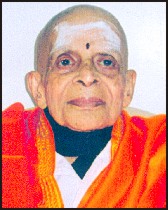
Noted Sanskrit Scholar Mahamahopadyaya Dr. Vid. N. Ranganatha Sharma (98) passed away at his son’s residence in Kuvempunagar here early this morning.
He is survived by two sons — Sadananda, a retired Syndicate Bank Regional Manager and Dr. Nagabushan, a skin specialist at Bangalore — daughters Dr. Sharada and Prof. Jayashree, both residing in the US and a host of relatives and friends. His wife had pre-deceased him several years ago. Last rites were performed at Chirashanthidhama in Gokulam this afternoon, according to family sources.
Ranganatha Sharma’s Profile: Born to an agricultural family at Nadahalli village in Soraba taluk of Shimoga district on 7.4.1916, Vid. Ranganatha Sharma began his career at Chamarajendra Sanskrit College in Bangalore, where he served for nearly 40 years.
He was staying at his elder son Sadananda’s residence at Kuvempunagar for the last couple of years.
A prolific writer, Dr. Ranganatha Sharma was credited with over 80 works, including Kannada translation of Sanskrit version of Valmiki Ramayana and other Sanskrit works on Vishnu Purana, Srimad Bhagavatha, Amarakosha, Bhartruhari etc.
Among the many awards and prizes he has won include Best Teacher Award both at the State and National level, DVG Memorial Award, Tirupati Sanskrit University Award and Hon. Doctorate from Karnataka Sanskrit University, Bangalore.
source: http://www.starofmysore.com / Star of Mysore / Home> General News / January 25th, 2014
I believe this is the only university in the country with the focused mandate of bridging Indian Shastras and Western Sciences. We will develop this University into an IIT class of an Institution for the traditional Health Sciences of India….”
— Sam Pitroda, Advisor to the Prime Minister on Innovation
Among the few good decisions made by the decrepit and discredited BJP government last year, before it plunged into the election process, was to clear the proposal by Foundation for Revitalisation of Local Health Traditions (FRLHT) to set up a health university in Bangalore. The university, named the Institute for Trans-Disciplinary Health Sciences and Technology (IHST), will be launched on Sunday. It’s heritage with science, not mumbo jumbo.
FRLHT, near Yelahanka, has been around in Bangalore for a long time — 20 years. Founded as a trust in 1993 by inventor and innovator Sam Pitroda and Darshan Shankar, FRLHT’s declared mission was the “Application of traditional knowledge blended with modern science and technology to design healthcare solutions that are low-cost, safe, effective and accessible to rural and urban populations in India and globally.” The new university itself has two clear purposes: One, it is for “lowering costs and enhancing access, quality and reach of healthcare to millions,” and two, to “facilitate creation of transformative knowledge and original Indian contributions, to the world of medicine and life sciences.”
What is interesting, and indeed ironical, is that in the midst of all the chicaneries that our netas across political parties are engaged in to scuttle the implementation of the Madhav Gadgil committee recommendations on the Western Ghats, or the modified Kasturirangan panel version of it, these two pioneers chose Bangalore to set up the venture because of its proximity to the ghats. The city is situated so that it provides the best access to both the Western and Eastern Ghats, which are rich in medicinal plants.
Just to remind readers, some netas and sundry entrepreneurs have been severely distressed in peninsular India ever since UNESCO inscribed 39 serial sites in the Western Ghats on the World Heritage List in recognition of their bio-diversity and natural habitat values. The heritage status, alongside the Gadgil committee recommendations, had seemingly put paid to their ‘development’ project proposals in the ghats. Their hopes are now revived since Very-Moving Veerappa Moily has taken over the Union environment portfolio and has begun to approve doubtful proposals at dizzying speed. The good minister, perhaps, should meditate on them through a weekend at Kedarnath. It’s all very quiet over there.
Pitroda and Shankar, and their team of unheralded, quiet and studious professionals, are moved by completely different concerns. They believe that the Indian knowledge systems could have “contemporary relevance” and lament that “post colonial India has forgotten its own heritage.” They are working with the belief that along with the rigour of modern methods and applications standards of medicinal research, if investments could be made in the modernisation of Indian systems of medicine, there could be big dividends in terms of “low cost solutions for millions in primary health care.” To achieve this, they seek the “conservation of medicinal flora, fauna, metal and minerals.”
The field of study is broad and inclusive. They take in “the village-based prakrit stream with one million community-supported healers (birth attendants, bonesetter, herbal healers),” as well as “the town-based samskrit stream with 400,000 licensed physicians.” The database at FRLHT includes 6,560 medicinal plants, 200,000 herbal formulations and 100,000 medical manuscripts. All this to “construct a new Indian model of integrative healthcare for the 21st century.” The database cross-references local systems of medicine and ingredients in several Indian languages and compares them with modern pharmacopeia.
The foundation’s work has been recognised elsewhere in India and abroad. The modest 17-acre campus in north Bangalore has research laboratories and a 100-bed research hospital with over 150 professionals — scientists, physicians and paramedics; botanists, ecologists, Sanskrit scholars, computer programmers, and community health strategists. Among the interventions they propose to evolve are strategies for nutrition, healthy ageing, low-cost delivery of safe drinking water, herbal remedy for malaria, and programmes for trans-disciplinary health sciences and technology. Because, “no single system of healthcare has best health solutions for all health needs.”
FRLHT is an organisation that has been taken seriously by health experts around the world. Among other achievements, it has already led “the largest global program for insitu conservation of medicinal plant gene pools at 110 conservation sites… across 13 States” and, as mentioned, set up India’s “only comprehensive computerised database and herbarium of medicinal plants.” It has even set up a network of village “folk healers.”
This is rare good news for Bangalore, which is otherwise burdened with an inept and unimaginative state government and an officialdom in the limbo of an election year. If Pitroda could do to healthcare and wellness what he and his team of dedicated professionals did for Indian telecommunications, we will all live in a happier and healthier India. So, welcome IHST.
source: http://www.bangaloremirror.com / Bangalore Mirror / Home> Columns> Views / by Prakash Belawadi, BM Bureau / January 17th, 2014
Dr. P. Prakash, professor in Psychology, Mysore University, has been elected as a Fellow by National Academy of Psychology (NAOP), India, for his contribution to the discipline and distinguishing himself as an authority on reading and dyslexia in India.
He has been working in the area employing multiple approaches — methods that include behavioural (including eye tracking), neural (includes brain imaging), and genetic basis of reading and dyslexia.
This year Prof. Prakash has co-edited a volume on Psycholinguistics in South Asia and South East Asia, which has just been published by Cambridge University Press, Cambridge.
A recipient of many prestigious fellowships, he has been a Mombusho scholar (Japanese Government Fellowship, 1991-93) and later AIEJ Fellow (1999) in Japan. He was also a Fulbright Fellow twice – during 2000-01 at A & M University, Texas and later in 2011 at Haskins Laboratories, Yale University. He was also Erasmus Mundus Visiting Professor at Potsdam University, Potsdam, Germany (2006). He was visiting colleague in Singapore National University, University of Alberta (Canada).
source: http://www.starofmysore.com / Star of Mysore / Home> General News / January 29th, 2014
St Gerosa School inaugurated its golden jubilee year recently with a colourful event. The programme commenced with a prayer service. Sr Matilda Monteiro, provincial superior, Sisters of Charity presided over the function.
Unveiling the logo of the golden jubilee celebrations, Sr Matilda in her address urged people to sow the seeds of education in order to reap the harvest a hundred fold.
Fr Bonaventure Nazareth, parish priest of St Vincent Ferrer Church, Velencia was the chief guest of the day. Jacintha Alfred, corporator, Falnir ward, Sr Grace Joseph P, secretary to educational society, sisters of charity, Mangalore, Philomena Tauro, the first teacher of the school were the guests of honour.
Sr Marcelline Braggs, the correspondent of the school, Sr Emma Aranha, the head mistress of the high school, Ida Sequeira and Jean Crasta, the vice-presidents of PTA and GEXSA escorted the guests.
Sr Marcelline Braggs welcomed the gathering. Sr Emma Aranha read out the various programmes of the golden jubilee year. Teacher Nimitha proposed the vote of thanks. Teachers Marie Vas and Molly D’Souza compered the programme.
A colourful programme was showcased by the multi-talented, vibrant and energetic students wearing colourful attire, which captivated the attention of the audience.
source: http://www.daijiworld.com / DaijiWorld.com / Home> Karnataka / Media Release / Mangalore – Sunday, January 19th, 2014
Dr. Arun Srinivas, Senior Interventional Cardiologist, Professor & Head, JSS Hospital, was awarded the prestigious Fellowship of the European Society of Cardiology (FESC) at the ESC meeting held in Mumbai on Jan. 17 & 18.
Dr. Arun Srinivas was awarded the Fellowship for his outstanding services and experience in Interventional Cardiology for over 25 years.
He has the distinction of having pioneered and introduced interventional cardiology services in city 12 years ago.
He has treated more than 50,000 patients and performed over 20,000 angiography and angioplasty procedures, valvuloplaties, congenital heart disease device closures, pacemaker/ICD implantations and peripheral arterial inter- ventions.
Dr. Arun Srinivas is one of the senior-most Interventional Cardiologists in Karnataka and has obtained fellowship in Coronary Interventions & Pediatric Cardiology from Royal Melbourne Hospital, Australia and Peripheral Vascular Interventions from Miami Vascular Institute, Florida, USA.
source: http://www.starofmysore.com / Star of Mysore / Home> General News / January 22nd, 2014
Karnataka Muktaka Sahitya Academy, Mysore, will confer the coveted DGV Muktaka Sahitya Award on Prof. H.S. Lakshminarayana Bhatta, popularly known as ‘Kaggada Bhatta’, during its 14th anniversary celebrations to be held on Feb. 16 in city.
Four eminent personalities — Dr. V.S. Sampathkumaracharya (Music), Dr. J.S. Hegde (Medicine), Prof. B.N. Manjunathaiah (Education) and Prof. S. Shivaji Jois (Literature) — who have rendered yeoman service in their recpective fields will be felicitated on the occasion.
Profile of Prof. Bhatta
Born in 1946, Prof. Bhatta is a M.Sc. Degree holder in Physics, a ‘Visharada’ from All India Hindi Prachara Sabha, an ‘Uttama’ from All India Bhagawad Geetha Study Centre, Gorakhpur. He has served as Professor of Physics in Visweshwarapuram Science College, Bangalore and also as Principal of the same college.
He has given a number of discourses and lectures on DVG’s Mankutimmana Kagga and other Muktaka literatures in and outside the State. He has aired a number of programmes on Kagga on Doordarshan and Akashavani and has participated in online programmes with listeners.
Prof. Bhatta has to his credit a number of books on Kannada Literature including his Ghamaghamisuva Vanasuma, DVG – Timmaguruvina Darshana (Gundopanishat). He has received a number of awards and titles for his work in this field.
source: http://www.starofmysore.com / Star of Mysore / Home> General News / January 20th, 2014
St Agnes Convent, Bendore is all set to celebrate the centenary of its Foundation Day (1914-2014) with a public function on Sunday January 12. The Convent was started in 1914 in order to reach out for the education of girls in the suburban area around Kadri and Kankanady. St Ann’s School, Bolar started by the Sisters of the Apostolic Carmel, founded by Mother Veronica of the Passion, an English woman, in 1870; St Mary’s School, Falnir started to accommodate the increasing number of students; and Victoria Caste School, Dongenkery, Kodialbail (later shifted to Ladyhill) started at the persistent appeal of GSB Community for the education of their daughters, were the only three schools in South Canara district, to impart quality education exclusively for girls, in the much valued medium of English.
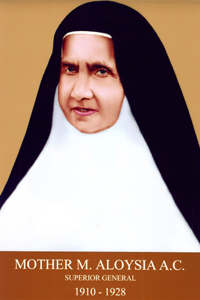
Mother Aloysia, the second Superior General of the Apostolic Carmel after five years of assiduous search and negotiations for some twenty different sites between Kankanady and Kadri, including a plot of “Hulli Mulli” an arid area, and the surrounding plots, which were inhabited by sixteen proprietors in clustered huts and cottages measuring twelve acres of land, were bought on June 29, 1913.
February 8, 1914 was a memorable day in the history of the Apostolic Carmel when Dr Paul Perini, Bishop of Mangalore blessed the whole property and laid the foundation for St Agnes Convent, the residence for the Sisters to carry out their service to women through education. The next day a Secondary English Medium School, as it was called then, was opened with Classes I and II. There were 80 pupils on roll. A week later, an elementary school was opened for the poorer children with 46 pupils on roll. Since then the campus has grown with St Agnes School started in 1914, St Agnes College (the first college in India by an Indian private Management), St Agnes Special School for the Mentally Challenged started in 1970, as the Centenary Memorial of the establishment of the Apostolic Carmel. As the sisters of St Agnes Convent celebrate the hundred years of prayer and service on 12th January 2014, we remain ever grateful to God in transforming the Hulli Mulli Hill into an Educational hub, a light house, a city built on the hill where hundreds of students have been educated and enlightened over the past hundred glorious years and sent out to the wide world as the ambassadors of St Agnes to proclaim to all people that God is our Strength.
The concluding function of the Centenary of St Agnes Convent will be held on January 12. The Centenary Mass will be celebrated by Dr Aloysius Paul D’Souza, Bishop of Mangalore, with a large number of priests concelebrating with him at St Agnes College Auditorium. The Open Air public function that follows will have the Bishop as the president, Dr Sr Agatha Mary, Superior General of the Apostolic Carmel will be the chief guest, Sr Linette, Provincial Superior, J R Lobo, local MLA and Flavia Agnes, alumna, St Agnes and legal and social activist from Mumbai will be the guests of honour. A documentary on the history of St Agnes Convent and a dance drama on the life and times of Mother Aloysia, the founder St Agnes Convent will be the highlights of the programme. The former Superiors of the Convent will also be felicitated. Among the Centenary projects will be the poor students’ fund to be initiated.
St Agnes Convent – Centenary Celebrations
(1914 – 2014)
“Foremost in the roll of Indian women educationists stands the name of Mother Aloysia of the Sacred Heart, the second Superior General of the Apostolic Carmel. Almost a pioneer in the west coast field of education, she has for half a century and more laboured with untiring energy to raise the intellectual standard of our girls to the highest accepted grade.”
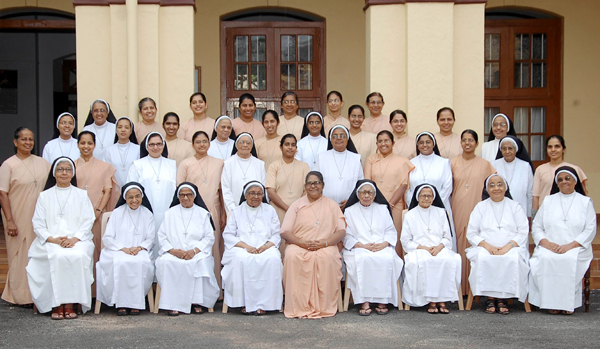
This was the tribute paid by J B Machado, Secretary of the Indian Christian Civic League, Mangalore, for the achievements of Mother Aloysia, in the field of education when nominated for the Kaiser-i-Hind, Gold Medal I Class award from the British Administration, in recognition of her services. We are presenting this valiant woman and her band of committed sisters, who founded St Agnes Convent, Bendore, Mangalore as we are poised to celebrate the Centenary of its establishment and that of the school, St Agnes School. The lamp that was lit by Mother Aloysia at St Agnes in the year 1914 has been kept burning for the past hundred years by every sister who lived at St Agnes with the oil of love, prayer, sacrifice and service.
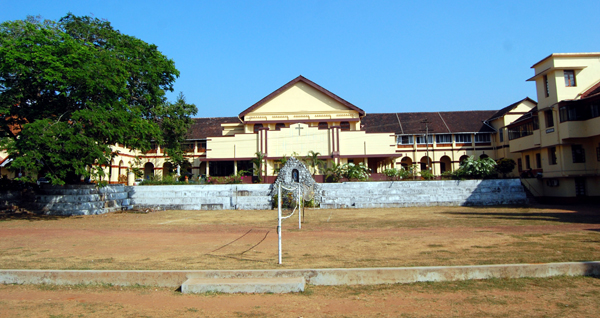
Old Primary School
St Agnes in 1921
‘The Rest’ where St Agnes Special School was started
Mother Veronica, nee Sophie Leeves, an English woman was chosen and called by God to found a “Carmel for the Missions” in India towards the faith formation of the Catholics and the education of the young girls along the west coast. The dream of education that Mother Veronica harboured in her heart when she was serving in Calicut as a sister of St Joseph of the Apparition, “…all along the coast the young girls are entirely without any means of instruction…”, was realized when she started the Apostolic Carmel in France in 1868 and the three sisters trained by her arrived in Mangalore on 19th November 1870. Mother Marie des Anges, French by origin was the First Superior General and was called the Nurturing Mother while the one who shaped the Apostolic Carmel education was Mother Aloysia nee Mary Pia Rosario. The pioneering of quality education for girls thus belongs to the Apostolic Carmel with the starting of St Ann’s Convent and School in 1870, at Pandeshwar, Mangalore preceding even a school of this caliber for boys’ education which happened only in 1880.
In the first decade of the 20th century, St Ann’s High School flourished and St Mary’s, Marjil, the offshoot of St Ann’s, to accommodate the growing number of students and the Victoria Caste School at Dongerkery, Kodialbail, (later shifted to Ladyhill) the outcome of the persistent appeal of the GSB community for the education of their daughters were the only schools in South Canara district, to impart education exclusively for girls, in the much valued medium of English. These schools were nearer the central location of Mangalore. At this time, Mother Aloysia, who was elected as the Second Superior General and who was literally the brain behind the three schools, with her wide vision and deep apostolic spirit saw the need for extending the facilities to a larger number of girls by opening a school for girls in Bendore, the suburb and an underdeveloped area away from the township at Bolar. After five years of assiduous search and negotiations for some twenty different sites, a plot of “Hulli Mulli”, an arid area belonging to the ancestors of Sr Julia’s and the surrounding plots which were inhabited by sixteen proprietors in clustered huts and cottages measuring twelve acres of land, were bought on June 29, 1913.
February 8, 1914 was a memorable day in the history of the Apostolic Carmel when Dr Paul Perini, Bishop of Mangalore blessed the whole property and laid the foundation for St Agnes Convent. The next day a Secondary English Medium School, as it was called then, was opened with Classes I and II. There were 80 pupils on roll. A week later, an elementary school was opened for the poorer children with 46 pupils on roll. Mother Aloysia chose St Agnes as the patron saint of the convent and of all the institutions on the campus with the motto “God is our strength”. Young girls desirous of studying in English medium flocked to St Agnes Convent from Udupi, Kallianpur, Kundapur, Karkal. Mulki, Kinnigoli, Belthangady and other surrounding villages. The original old cottages were fitted up as dormitories and a boarding house was started.
Realizing that girls from their sheltered homes would hardly dare to go as far as Madras, Mother Aloysia envisioned higher education for girls. July 2, 1921 was another day of significance in the history of St Agnes when a college was started under her dynamic leadership and far sighted vision. St Agnes First Grade College was the only one for women in South India and the first in the whole of India to be run by an Indian private management. To meet the ever growing demands for admissions that came in from the rural areas a temporary “L” shaped building was put up on the plot closest to the road. This block stood for 82 years when more spacious buildings came up to accommodate the growing number of students.
Mother Theodosia another woman of caliber and a dynamic personality with practical experience took charge as Principal in 1934. She took the initiative of introducing Science into the Intermediate Course, an option till then not available to women. By adding subjects such as Mathematics in 1936, Natural science in 1937 and Chemistry in 1939, the college gradually blossomed. Through the years under the leadership of Principals and faculty with dynamism and commitment, St Agnes College has grown with several more courses and programmes. In 2007 St Agnes College obtained academic autonomy. Soon after, the Post Graduate Programmes were introduced and another block was erected for the same.
The Intermediate Course was changed into Pre-University in 1955 and at the same time St Agnes College parted ways from Madras University with the re-organization of states and was affiliated under Mysore University. In 2001 St Agnes Pre-university College was bifurcated and was accommodated in a new building.
The year 1970 was a landmark in the history of the Apostolic Carmel, the year of the Centenary of the establishment of the Apostolic Carmel in India. The pioneers of girls’ education in Mangalore had fresher avenues to explore and the education of children with disabilities was found to be the best Centenary Memorial to fill this void in Mangalore as there was no provision for the education of children with disabilities, in particular, the mentally challenged children. St Agnes Special School, the first school for the mentally challenged in the district, was inaugurated on August 4, 1970 with five children, in ‘The Rest’, a cozy house on St Agnes Convent premises with the motto, ‘In Love We Grow’. In 1973 the children were shifted to the premises opposite St Agnes Convent in the new building that was constructed.
The mission of the sisters of St Agnes Convent in educating the youth from Kindergarten to Post graduation has attained fruition where 5330 students illumine the campus today not merely aspiring towards academic excellence but very importantly using the many opportunities for strengthening faith and values of the students. Besides educating the youth, the sisters offer humane services to the society, the local church and the society at large in every possible way. In 1998 the Apostolic Carmel Association (ACA) was started for the purpose of sharing the spirituality of the congregation with lay people.
With heads bowed and hands folded in gratitude to God, as we, the sisters of St Agnes Convent celebrate the hundred years of prayer and service on January 12, we remain ever grateful to God in transforming the Hulli Mulli Hill into an educational hub, a light house, a city built on the hill where hundreds of students have been educated and enlightened over the past hundred glorious years and sent out to the wide world as the ambassadors of St Agnes to proclaim to all people that God is our Strength.
source: http://www.daijiworld.com / DaijiWorld.com / Home> Top Stories / by Sr M Lydia, St.Agnes Convent / Mangalore – January 09th, 2014