Category Archives: Education

Grit and gumption help student achieve rare feat

Dharwad :

Coming from a poor agriculturist family in a parched village of Harlapur in Kundgoltaluk of Dharwad, ShridharBhandiwad could not have dreamt of having a lucrative job in a software company in Bangalore. But his determination to convert the challenges into opportunity has helped him achieve what was once considered impossible.

A fresh engineering graduate, Shridhar is now a software engineer working for BEL at Bangalore and earning a salary package of Rs 6.4 lakh per annum. What is more commendable is Shridhar bagging four gold medals for securing highest marks in the BE Computer science course.

Shridhar, son of Yallappa Bhandiwad and Sulochana did his schooling at Government Kannada Medium School in Harlapur and secured 91 per cent of marks in SSLC. He joined Karnatak Science College in Dharwad for PUC but money was a major constraint to pursue education further.

With an annual family income of Rs 15,000, Yallappa was unable to fund his son’s education. It was at this time that a friend Arvind Joshi informed Shridhar about NGO Vidyaposhak which is helping the deserving economically weak students to pursue education.

Shridhar’s efforts to contact Vidyaposhak clicked. Once in the ambit of Vidyaposhak, Shridhar had no worries over financial arrangement till he completed his BE. Vidyaposhak which studied his family background, economic status and academic performance ensured that he was helped with funds and study materials.

He got 72 per cent in PUC II year science and could get a seat at the University BDT College of Engineering in Davanagere for BE in computer science.

Shridhar did not disappoint those who helped him. Studying hard he managed to remain a topper during the course and secured highest aggregate marks (87.45 per cent) in B E final year and also highest marks in Computer Science subject and won four gold medals.

“But for the support from Vidyaposhak I could not have achieved anything. Right now I have some loans to be cleared and soon I want to start donating to Vidyaposhak,” Shridhar said.

Shridhar wants to do his MTech and help the needy.

source: http://www.articles.timesofindia.indiatimes.com / Home> City> Hubli / by Gururaj Jamkhandi, TNN / Dharwad, April 01st, 2013

City lad represents champion state cricket team for deaf

guruBF03apr2013

Mysore :

K. Guru, a student of 6th Sem. Diploma in Electronics and Communication Engineering, JSS Polytechnic for the Differently Abled played in the First National Deaf T-20 Cricket Championship held from Jan. 29 to Feb. 3 at Secunderabad representing the Karnataka State Cricket Team for Deaf.

The Karnataka team won the Championship. The Principal has congratulated Guru on behalf of the Polytechnic.

source: http://www.StarofMysore.com / Home> Sports News / March 29th, 2013

Yureka begins at Yuvaraja’s College

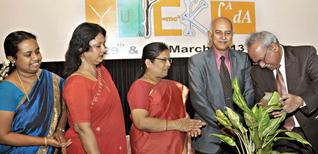
Mangalore University Vice-Chancellor T.C. Shivashankara Murthy inaugurating the science festival in Mysore on Friday.— Photo: M.A. Sriram / The Hindu

Yureka, a science festival, began at Yuvaraja’s College here on Friday. Mangalore University Vice-Chancellor T.C. Shivashankara Murthy inaugurated the two-day event at Maharaja’s College centenary hall.

CFTRI V. Prakash, former director, the Central Food Technological Research Institute, was the chief guest. S.N. Gayathri, principal, Yuvaraja’s College; Maha Jabeen, administrative officer; and Ruby Salestina M, convenor, Jnanavahini committee, were present.

Science Explorer, Chalk Talks, Science quiz, Science on Screen, Wealth Out of Waste, Cooking without Fire are some of the programmes being held. Entertainment programmes too are planned.

In Science Explorer, participants are supposed to uncover the basic laws governing various scientific phenomena in day-to-day life. “The participants’ creativity, imagination, correctness of the proposed concept and explanation will not only fetch them a prize but also make the spectators appreciate the fact that science is all around us,” a press release said.

Awareness

Chalk Talks aims to create awareness about the wonders of science among students and to train them in talk with a chalk instead of a power-point presentation. It aims to encourage them to come up with simple experiments not found in the curriculum.

source: http://www.TheHindu.com / Home> National> Karnataka / by Staff Correspondent / Mysore, March 30th, 2013

Down the memory lane: PRIDE OF INDIA

‘A glimpse into India’s Scientific Heritage’

By K. Vijaya Kumar, Former Jt. Director of Information & Publicity

vijayakumarBF28mar2013This is actually the title of a rare book which my scientist-friend, Retd. Deputy Director of CFTRI, M.C. Shamanthaka Sastry, walking into my flat the other day with this book in hand, highly recommended me to go through it and return.

He briefly mentioned as to how he got this book as a gift (priced Rs. 2,000, pages 200) during his visit to Varanasi on his way back from Nepal in 2007, from a Sanskrit scholar Chamu Krishna Sastry of Samskrita Bharati (who conceived the idea of the book), whom he accidentally met on the banks of Ganga. I am, indeed, thankful to my friend Sastry for his gesture in loaning this valuable book. Later on, about its contents.

Well, I went down with my memory lane over 60 years ago as a high school student in dilemma whether to choose Science or Arts for my future course. My parents thought I was not that intelligent to study Science and myself losing courage, opted for Arts. But I have no regrets as I have developed a scientific temper over the years. Regret is that I did not study Sanskrit but satisfaction is Hindi was second language in my degree class.

Scientific temper

India became the first country in 1976 to include in its Constitution — Article 51A — making it a duty of every citizen to develop scientific temper with humanism. Pandit Jawaharlal Nehru in his book ‘Discovery of India’, as way back in 1946, wrote on scientific temper “as a way of life, a process of thinking, a method of acting and associating with our fellow men.”

In this context, I have to appreciate the initiative of my friend Arjuna Deva of Prajavani and former Chairman of Media Academy, in bringing out a Kannada monthly (Jaana) since 16 years, which devotes to create scientific temper among readers.

Sanskrit & scientific heritage

The ancient Sanskrit language which is considered as divine language is the ‘Soul of India’ and the entire Indian culture is hidden in Sanskrit. Here, I have to recollect how 43 years ago in 1970, late Pandit K.N. Varadaraja Iyengar took a bold and adventurous step and succeeded in launching a Sanskrit newspaper ‘Sudharma’ making Mysore proud to have the only Sanskrit daily in the world. In later years, his son K.V. Sampath Kumar has developed it as e-paper (sudharma.epapertoday.com) having readership across the country and abroad online. One has to remember Founder-Editor late K.N. Varadaraja Iyengar for his contribution in popularising Sanskrit.

About the book

I have a reason to bring this book in my column so that readers will appreciate how India can take pride in its scientific heritage from the time of Vedas and its contribution to the world in the development of science. Chamu Krishna Sastry, All India General Secretary of Samskrita Bharati (Publisher – First published in 2006), who conceived the idea of bringing to light the science available in Sanskrit texts and he vested with ‘Team Nagpur,’ consisting of several scholars of Nagpur in various discipline to select the works and quotes covering the spectrum of science.

Why ‘Pride of India’?

As a preface to the text, Chamu K. Sastry raises, nay, quotes two examples under this title:

The 20th century has seen unprecedented development in knowledge and technology. Car to spacecraft — all have been invented and commercialised in the lifetime of a person. At the end of this epochal growth, humanity is at crossroads:

“The Green Revolution — high yielding varieties of seeds, chemical fertilisers and pesticides — was the blessing which saved India from ruinous famines and equally ruinous Food Import Bills in 1960s. Today the brains in agriculture and chemical technology are searching desperately for ways and means of restoring the soil fertility which has completely eroded by the Green Revolution.”

“Allopathy has taken great strides in the last three decades. Unknowingly, in this avalanche of development, basic tenets of Allopathy have been lost. ‘The doctor ties the bandage but it is He who heals the fracture’ is the axiom that drove the course of treatment that doctors chose some years ago. This axiom is based on the premise that the body has the potential to heal itself. Today, the adverse side effects of allopathic treatment are so acute and widespread that there is a longing for alternate medicines in every part of the world.”

Having raised the above two examples, Chamu K. Sastry writes — “We need an alternate mindset to find innovative solutions. The world is looking to the East inclusive of India for such a solution.”

Certainly, India has solution from its rich vedic scriptures when one goes back to our scientific heritage.

The book for all Indians

Suffice it to conclude with this review on the book by Dr. M.R. Srinivasan, former Chairman, Atomic Energy Commission (which gives in a nutshell the contents of the book): “This elegantly brought out publication presents in a concise way advances made by the Indian civilisation, in the past, in a variety of fields including mathematics, physics, astronomy, civil engineering, mechanical engineering, metallurgy, chemistry and medicines. I recommend the book ‘Pride of India’ to all our citizens so that they can appreciate the rich heritage of science and technology that existed in the past in India.”

e-mail: kumarkv59@gmail.com

source: http://www.StarofMysore.com / Home> Feature Articles / March 22nd, 2013

150th anniversary celebrations of ‘ Sarada Vilas ‘

Former President of India Dr. A.P.J. Abdul Kalam will inaugurate the 150th anniversary celebrations of Sarada Vilas Educational Institutions at a function organised at the college Centenary Hall in city on Mar. 23 at 11 am.

SaradaBF26mar2013

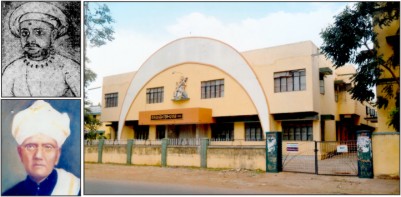
Caption:    Founders Bhakshi Narasappa and Venkatakrishnaiah (Tataiah)

About the institution: A little more than 150 years ago, in 1861, a new star took birth in the educational realm of the then State of Mysore. It was founded by Rao Bahadur Bhakshi Narasappa, who enjoyed the confidence of the then king Mummadi Krishnaraja Wadiyar and was named Sarada Vilas Anglo-Sanskrit Pathashala which was housed inside the Palace temple premises. The Pathasala had the credit of being the first private school in the then Mysore State.

Both Mummadi Krishnaraja Wadiyar and Rao Bahadur Bhakshi Narasappa were fully aware of the value of education and hence nurtured the school in every possible way which had just 20 students in the first year but grew from strength to strength quickly.

As the strength increased, the space inside the temple was not sufficient to accommodate the students. Narasappa volunteered to shift the school to his own building at Makkaji Chowk, popularly known as Bhakshi Narasappa Choultry and was financially assisted by K. Seshadri Iyer, the then Dewan of Mysore. The school found itself in a tight spot owing to the demise of Narasappa and resignation of the Head Master Mandikal Ramasastri. To overcome all administrative and financial problems faced by the school, the Government of Mysore set up a Committee in 1899 with M. Venkatakrishnaiah, affectionately called ‘Tataiah,’ as the Hon. Secretary. Tataiah was committed to the cause of education and took the responsibility of strengthening the school which ultimately turned it into a model school.

As more and more students joined the school, once again the constraint of space became an acute problem and the king of Mysore permitted the school to use the first floor of Lansdowne Building.

Tataiah, who recognised the need for a high school, strived hard and founded the Boys High School in 1919. He desired to house the school in its own building and succeeded in getting a sprawling campus in Krishnamurthypuram. The High School was shifted to a new building in Krishnamurthypuram and he rendered yeomen service to the school as Hon. Secretary of the Committee till his demise in 1933.

The legacy of Tataiah was carried forward by M.S. Ramaswamy, who took over the mantle from Tataiah and transformed his vision into reality while S. Ramarao took charge as the Hon. Secretary following Tataiah’s demise and strived to take the institution to greater heights.

Ramaswamy, who had big dreams, got the govt. approval and founded the Intermediate College in 1945. He continued his hard work with great vigour and was responsible for starting Degree College in 1952 and served as its Principal for 20 years. In the year 1954, Sarada Vilas Law College was started, which was the second Law College in the State at that time. Sarada Vilas Teachers College was started in 1963 and in 1992, Sarada Vilas College of Pharmacy came into being.

The management, which felt the need to impart education to girls, started an exclusive High School for girls in 1961 which was a milestone of Sarada Vilas Educational Institutions and started Pre-Primary and Higher Primary School in 1992. Now under the umbrella of Sarada Vilas Educational Institutions, there are various schools and colleges which cater to the educational needs of students of all ages. The objective of Sarada Vilas is to give quality education at affordable cost to all sections of society as it believes in creating good citizens who in turn will strive hard to create a good society. Sarada Vilas offers PG course in pure Sciences like Physics and Chemistry, and Applied Sciences like Microbiology and Biotechnology and is sure to go a long way in helping students acquire higher degrees and pursue research.

source: http://www.StarofMysore.com / Home> General News /March 20th, 2013

Puttur: SDM College, Ujire crowned champions at ‘Media Rang’

Puttur, Mar 14:

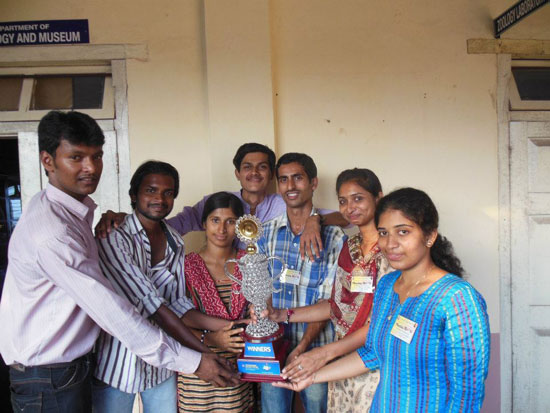
In the recently concluded media fest ‘Media Rang’, held on March 13, organized by the Department of Journalism of Vivekananda College, Puttur, post graduate students from SDM College emerged as the overall winners of the fest.

Vinod KS, chief reporter of Vijayavani (Mangalore), was the chief guest and Dr Madhav Bhat, principal; Vivekananda College presided over the program. Dr Arun Prakash, lecturer from economics department, Vivekananda College was also present on the occasion.

putturBF15mar2013

The fest witnessed tough participation from the students of various colleges in the several competitions organized as a part of ‘Media Rang’.

Finally, MCJ (PG) students of SDM College, Ujire emerged overall champions by winning most of the competitions. Alva’s college from Moodbidri  won the runners up honor.

source: http://www.daijiworld.com / Home> Karnataka /  by Sumanth Kashyap, Daijiworld Media Network – Puttur / Thursday, March 14th, 2013

Green signal for spiritual university evokes sharp criticism

HarshaBF13mar2013

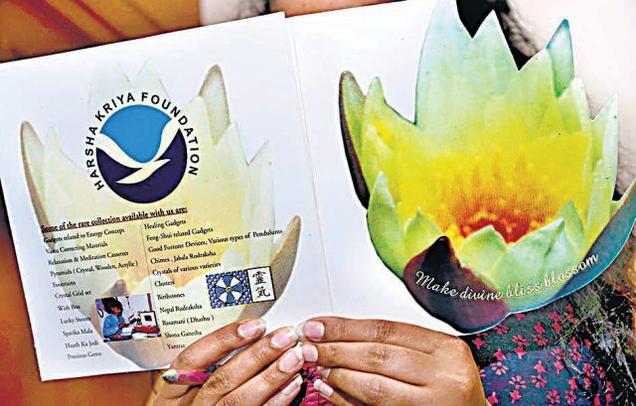
Harsha Kriya Foundation brochure. /  Photo: K. Murali Kumar / The Hindu

It is a blatant attempt to saffronise higher education’

From a tiny room on the first floor of a small building in a quiet area of Basaveshwaranagar, the Harsha Kriya Foundation runs its affairs. The Foundation has recently got the green signal for setting up the Amrutha Sinchana Spiritual University, the first of its kind in Karnataka.

Speaking to The Hindu in an office filled with such arcane objects as gems, shells, floating stones, and photographs of spiritual healers at work, Harish M., trustee of the Foundation and the university, said: “The university will offer degrees and diplomas in courses such as human energy field, feng shuirudraksha, numerology, gems and crystals. Academic courses are likely to start from 2014-15. We want to offer specialised courses to promote Indian traditions.”

Mr. Harish’s printed bio-data states he is a “healer, counsellor and trainer,” who has “counselled and healed more than 1.5 lakh cases, ranging from cardiovascular and endocrinal disorder to medically rejected cases.”

The Amrutha Sinchana Spiritual University Bill was one of the 17 passed recently by the Assembly to set up private universities in the State.

The Governor has signed eight of these bills into law. This clears the decks for the universities to start functioning as soon as they set up their infrastructure.

The Amrutha Sinchana Spiritual University Act, 2012, states that the university will impart “value-added education, life and life-skills, [and] minimise [the] suffering of fellow human beings to promote and popularise drugless energy.”

Alongside, it has the mandate of “advancement of the spiritual in the form of adyathma or spiritualshakti given by ancient yogis established in the healing process through systematic instruction, teaching, training, healing process.[sic]”

Its 40-acre campus will be located at Ghati Subramanya in Doddaballapur on the outskirts of Bangalore.

The university has drawn criticism from educationists, student bodies, scientists and political parties alike. “The basic criteria for forming a university have not been met,” said Ananth Naik, State president of the Students’ Federation of India. In a memorandum to the Governor, the SFI called the Act a “blatant attempt to saffronise higher education.”

Academic and writer G.K. Govinda Rao said academics should oppose this “most unscientific varsity.” “We can’t sleep over this, we must oppose it. The State appears to have forgotten its responsibilities.”

Sabyasachi Chatterjee, professor at the Indian Institute of Astrophysics, pointed to the constitutional provisions such an Act violated. “Article 51A (h) of the Constitution has highlighted the need to develop scientific temper, humanism and the spirit of inquiry and reform. Instead, here the State is promoting irrationality.”

Prabhu Nott, a professor of the Indian Institute of Science, said that while he was not opposed to research in spirituality, he was “uncomfortable” as “this government holds a record of promoting Hindu religion over other religions.”

Minister defends Act

But Minister for Higher Education C.T. Ravi defended the Act. “Research can be conducted to revive ancient Indian traditional methods,” he said.

Asked whether this fulfilled the stated objective for opening private universities, namely, the increase of Gross Enrolment Ratio in higher education, he said that while universities were focussing on job-oriented courses, there was a huge need for in-depth research into traditional methods too.

source:  http://www.TheHindu.com / Home> News> National> Karnataka / by Tanu Kulkarni / Bangalore, March 11th, 2013

TECHNIEKS-13 TO KICKSTART

TechNieksBF13mar2013

Mysore, Mar. 7 :

National Institute of Engineering’s (NIE) three-day annual techno-cultural fest techNIEks-13 will kickstart tomorrow at the Golden Jubilee Complex of the College on Manadavadi Road here.

Cine actor and Founder of Natana School of Drama Mandya Ramesh will inaugurate the fest at 10 am. The programme will be presided over by NIE President S.R.Subba Rao.

techNIEks 2013 is being held not only to create the best entertainment platform Mysore has ever seen, but also to make the audience socially responsible.

techNIEks 2013 will see the campus feature the carNIEval, the Village and the Dance Floor, wherein the campus will be decorated accordingly to showcase the feature.

The carNIEval will have the college decorated in multi-colours, creating an awe-inspiring bonanza. The Village will see the students from different parts of the country depict their cultural heritage using various media. The parking lot will be converted into a dance floor wherein the students and public will showcase their dancing skills and also features dances by professional street dancers.

Major events lined up during the fest are African Band, Beat Boxing, Rock Arena, Radium Dance, 10k Marathon, Mirror Dance, Thematic Fashion Show, totalling to over a 100 events spread throughout the fest.

Day 1: Rock Arena: Competition among the top student rock bands of South India will be held from 10 am to 5 pm at the Diamond Jubilee Sports Complex in the college premises.

NIE Raodies: A series of challenging events testing the will power of the participants from 10 am to 5 pm.

Karaoke: A hunt for the best singers from 10 am to 5 pm.

Wanna be RJ/VJ: A competition to hunt the best RJ/VJ at 11 am.

CPU Assembly Contest at 11 am; Cooking Without Fire at 11.30 am.

Art Hub: Art expo showcasing cultural heritage, landscapes and abstracts by local artists at the Golden Jubilee Block from 10 am to 5 pm.

The Village: Showcasing various cultures of India by students at NIE parking lot from 11 am to 5 pm.

Classical dance by Nithyashree Shetty at Diamond Jubilee Sports Complex at 6 pm and Mile Sur Mera Tumhara group singing by NIE Group at 7.30 pm.

Day 2: Air Crash: Character virtualisation to convince the judges to save your life at 12 noon; Drum Duet by the students of NIE at Diamond Jubilee Sports Complex at 6 pm and Radium Dance by Beyond Taalas at 8 pm.

Day 3: techNIEks 10k Marathon for general public on the cause Vote to be the Change at Diamond Jubilee Sports Complex from 5.30 am to 9 am.

Minute to Win it: A series of challenges to be completed within a minute at 11 am; Fastest Finger First: A challenge for the fastest text message typist at 1 pm; Remote Controlled Car Race at 3.30 pm.

Fashion Show by the students of the college based on several innovative themes at Diamond Jubilee Sports Complex between 7 pm and 8.30 pm and Mirror Dance by Ashvithi Shetty and Adhvithi Shetty at Diamond Jubilee Sports Complex at 7.45 pm.

For details, contact Jyeshta Shetty (99867-58855) or Shahed Hashmi (95912-46789) or visit website: www.technieks.com.

source: http://www.StarofMysore.com / Home> General News / March 07th, 2013

Look around, talent is everywhere

KarthikBF09mar2013

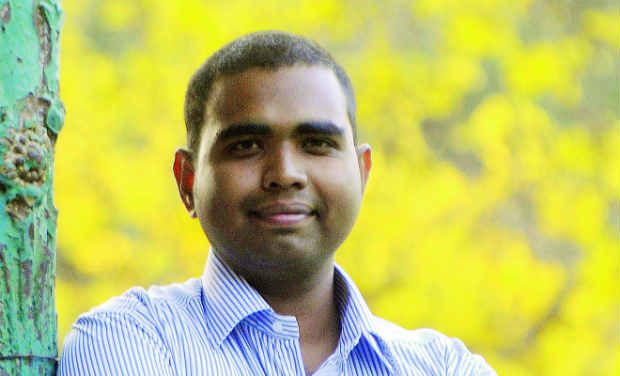
  Karthik Muralidharan — R. Samuel

Bengaluru:

 “I have known failure, that’s why I do what I do”, said Karthik Muralidharan. At the age of 23, he conducts motivational sessions for students from the weaker sections of society. “The fact that I was unable to do as well as I should in school really crippled me at first, until one day, I realised I wasn’t the only one”, Karthik says. “All I wanted to do was quit.”

Now, he wants to tell people that failure isn’t the end of the world and that no matter how bad things get, they are not alone. The idea of social development, of bringing everybody on to a level playing field, where everybody has room to grow came to him. “None of this was part of the plan,” he said. “I had no idea I would work with financially deprived students and I didn’t see myself doing what I do today”.

In college, Karthik began giving motivational talks, which proved very lucrative. “I was making a lot of money and things seemed to be going well.” His work brought him to Magadi, where he met a young Muslim woman who would change the way he saw the world.

“The odds she faced were tremendous. Even so, she overcame them all and went on to make something of herself.”

The untapped potential in these areas, he realised, was huge. All they needed was an opportunity. “The boy who delivered the newspaper everyday was doing his MSc and it made me realise that there is so much talent out there going to waste.”

Corporate gigs haven’t reeled him in, “not yet”, he says honestly. “There is much money to be made there, but I don’t want to get carried away. There’s something I want to do and I don’t really aspire for a Mercedes”.

The young and impressionable are driven almost entirely by the opinions of their peers, most of the time, they don’t know why they do what they do, Karthik says. “Young people are very fond of the word ‘scope’,” he said laughing. “Placements and the prospect of financial gain are what drive them, usually down a path they are ill-suited to.”

This is when corporate sharks like to move in with promises and false hopes. “In the name of training, companies exploit,” he said. Creating a sense of inadequacy and promising to fill the void is a popular tactic, which corporations use ruthlessly to their own advantage. “The only aim is to make a little money and maybe fulfil the requirements of a few”.

“Companies have a 60% rule,” he said, “but if you really scrutinise it, you’ll find that even the person who made the rule has no idea why he did so. A memory game is all that stands between a student and his future.” Trapped now in a vicious cycle, where success is the only end game and there is only one way to get to it – to conform,  youngsters, most of whom are completely confused anyway, become easy prey. “People with good marks do science, because the humanities imply weakness,” he said. To be a doctor or an engineer is the only way to go, even today, when the world is open and information is available to all those who seek it.

“I met a girl once, a Commerce student, who told me she wanted to be a doctor,” Karthik recalls. “When I asked her how she intended to do that, she said her friends told her she could.”
Communication skills are a rarity, mainly because so many people fail to see how important they are.

A large section of the rural population doesn’t know what an IIT is, or an IIM, he reveals. When these students enter mainstream colleges, they find themselves completely out of place. Their peers seem miles ahead of them, an unpleasant reminder of how far they need to go and how alienated they have been from the world.

His methods are simple. “I might go to a college and tell my students there to organise a blood donation camp, or pledge their eyes. That makes them aware of how much they can do, it motivates them, makes them more confident.” In that way, everybody becomes a leader. There’s more to life, he says, than a namesake degree but no real education, placements without progress. “I want my students to be nourished physically, emotionally, mentally and spiritually.”

The greatest strength comes from within. It was Sheldon Kopp, psychotherapist and author of If you meet the Buddha on the road, kill him! who said, ‘The most significant battles are waged from within.’ When those are taken care of, the universe falls into place. One might even call it magic.

source: http://www.DeccanChronicle.com  / Home> News> Current Affairs / DC / by Darshana Ramdev / Monday 04th,  2013
Mangalore University awards Hon. Doctorates

MloreUnivBF04mar2013

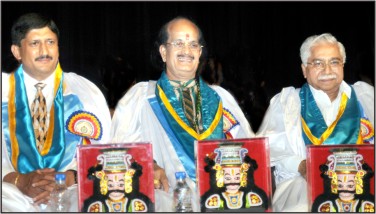
Caption:  From left: Olympian A.B. Subbaiah, saxophone exponent Kadri Gopalnath and litterateur Dr. Chandrashekar Kambara who received the honorary doctorates from Mangalore University on Saturday.

Mangalore, Feb. 26 :

Olympian A.B. Subbaiah, saxophone exponent Kadri Gopalnath and litterateur Dr. Chandrashekar Kambara were awarded honorary doctorates (honoris causa) by the Mangalore University at its 31st Convocation held on Saturday.

Chancellor-Governor H.R. Bhardwaj, who presided over the function, presented the doctorates. Science & Technology Department (Government of India) Secretary Dr. T. Ramasami was the chief guest. Vice-Chancellor Prof. T.C. Shivashankara Murthy presented the University report.

source: http://www.StarofMysore.com / Home> General News / February 26th, 2013