Category Archives: Education

Small is Beautiful

Theme: Is education the greatest weapon for change in the developing world?

Theme sponsored by the David Rattray Memorial Trust

Stepping indoors from the searing subcontinental July heat, Kalavathi takes a seat in her office at the end of a long corridor decorated with scientific symbols and multiplication tables. “Today the children will talk about their ‘bhavishya'” she exclaims.

‘Bhavishya’ or future in Kannada, the dialect of the southern Indian state of Karnataka, is fervently on the minds of the children. Their voices; “miss, miss I want to become an engineer…miss, miss I want to work in computing,” resonate through the classrooms. With Bangalore’s burgeoning economy growing annually at an estimated 10.3% only a few miles away, these hopes and dreams have every chance for succeeding.

Images of poverty and riches side-by-side are synonymous with the emerging world; Bangalore is a microcosm for this. Connecting the divide does not have to be complex. Small is Beautiful is a collection of essays written by economist E.F Schumacher championing the role of empowering people in the development process. The right education can empower individuals to make the important marginal changes which lead to brighter futures.

Aptly named, the Hope Foundation School provides for around 400 children living in the surrounding slums of Tannery Road, on the outskirts of Bangalore. Driving down MG Road, the bustling commercial heart of the city, you pass billboards adorned with the face of Deepika Padukone, a Bollywood actress. Raised and educated in Bangalore, her image serves a reminder to the children of how dreams can be turned into reality. The reality is that education in any form – art, music, science or language – provides the seeds for opportunity.

As the head teacher, Kalavathi places an emphasis on creating a positive learning environment, “we now provide free mid-day meals for the children to encourage them to come to class.” The school was established by the Hope Foundation in 1993, and teaching began in a humble building. The success of the school’s smaller projects, including the mid-day meal scheme has attracted sponsorship. As a result a new building complex has been developed adjacent to the original site, allowing the school to expand its student base.

Every morning Mary, the deputy head teacher, completes registration and collects Rupees from the students. They are not paying for their education. They are learning the basics of financial literacy and savings. The school is also their bank. Kalavathi proceeds down the corridor and enters a classroom. The children arise and all but the clucking chickens in the school yard can be heard. “Namaskara” she says, and the children sit down. As an English-medium school children are taught English from an early age, which is vital for their future. English is the language of commerce in India. Despite having over 20 official languages, the 2001 census data showed that the number of Indian English-speakers was more than twice the UK’s population.

Furthermore, the Hope Foundation’s computer training programme in Bangalore has multiplied rapidly to extend to 8 centres in 2007, beginning with just 4 computers in 1998, and the student base has trebled. Those benefitting from this programme belong to the local community. This small classroom learning on the outskirts of Bangalore is reflective of the larger economic processes occurring in the city. Vast swathes of global technology businesses such as IBM, Google and Yahoo are attracted by the city’s English and computer savvy labour force. “The jobs are complex, and they change rapidly, so we need really smart people,” said Roy Gilbert, Google’s operations director in India for Fortune magazine in 2007. Many of the school’s children have a poor home life, torn apart by alcoholic fathers and a lack of regular income. This specialized education in computing and English is a perfect passport for them to obtain employment, and break the poverty cycle.

The second United Nations (UN) Millennium Development Goal-to achieve universal primary education underlies the other goals, including combating hunger and gender inequality. Small changes to encourage greater female attendance in school can also reap rewards through female empowerment. Dr Dhondo Keshav Karve, an early 20th century social reformer on women’s welfare in India emphasized the phrase; “when you educate a woman, you educate a whole family.”

Half of the students at the Hope Foundation School are girls, and regular parent-teacher meetings have been put in place to ensure their mothers remain keen to keep their daughters in education. Girls in the local area would otherwise be coerced into being house maids or selling incense sticks in the slum. In the Indian state of Kerala, emphasis was placed on integrating women into the education process, such that the literacy rate for women was reported to have risen from 36 to 88 percent between 1951 and 2001. The UN estimates that Kerala now has the highest Human Development Index in India-higher than that of most developed countries. Small changes to what and who is taught can bring about positive changes for the future.

Change comes not from just being educated but by acting on what is taught. Kalavathi walks out of the main school building and onto the dusty school yard, advancing toward the school’s garden plot. This plot is a perfect symbol for how education works. It may appear quite literally ‘grass roots’, but it is in these chutes of knowledge, that the children and surrounding community can learn about food sustainability and develop a cost-effective way for feeding their families.At the 2010 Presidential Summit on Entrepreneurship, Barack Obama spoke of his time as a community organiser in Chicago, “real change comes from the bottom up, the grass roots, starting with the dreams and passions of individuals serving their communities.” By focusing on what is required, rather than implementing ‘one size fits all’ solutions we can improve the core issues.

As the school day draws to a close, Kalavathi gathers the children under the shade of the school’s iconic Flame tree or ‘Gulmohar’ in Hindi. Today the children have planted the small seeds of Hope. Tomorrow they can grow toward success, anchored firmly by their roots.

source: http://www.guardian.co.uk / Theme sponsored by the David Rattray Memorial Trust / Wednesday, May 30th, 2012
 

City boy is second in State (Science)

Mysore, May 24

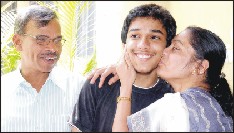
“I did not slog the whole year, but for the last five months. Otherwise I might have scored some more,” said Shreyas A. Nayak, a student of Marimallappa’s PU College who secured highest marks in II PU (Science) in the district and is 2nd in State.

Shreyas who scored 590, is the son of Akshata and Ananth Nayak, Manager, Bank of Maharashtra, Devaraj Urs Road.

Sharing his happiness with a section of the press, Shreyas said he aspires to become an engineer.

source: http://www.StarofMysore.com / General News / Thursday, May 24th, 2012

She reads lips to excel


Mysore, May 24

Profound hearing loss did not deter this girl who secured 82 % in the II PU exam.

Kautilya Vidyalaya’s Sushma is the daughter of Minor Irrigation Assistant Executive Engineer H.F. Rayanagoudar and Uma, Headmistress of Rotary School for the Hearing Impaired.

She joined tuitions during the initial classes but when she found difficulty in understanding the concepts in class, she preferred to study on her own.

In class, Sushma would try to to understand lessons by lip reading what the teachers said which had to be in a slow manner for her to grasp.

Says her brother Praveen, their mother played a major role in her achievement and adds that Sushma was planning to pursue computer science engineering. Sushma had secured 91% in SSLC exam.

source: http://www.StarofMysore.com / General News / Thursday, May 24th, 2012

Prof. N.S.Ramegowda to be feted on his 70th Birthday on June 2

Seminar on ‘Contemporary Challenges of Higher Education’ to be inaugurated by External Affairs Minister S.M. Krishna

Mysore, May 30- For-mer Vice-Chancellor of Karnataka State Open University (KSOU) Prof. N.S. Rame-gowda who turns 70, will be feted at a function to be held on June 2 at Kalamandira in city. A seminar on ‘Contemporary Challen-ges of Higher Education’ will also be held on the occasion.

Disclosing this to press persons at Pathrakarthara Bhavan here yesterday, MP and President of the Dr. N.S. Ramegowda Felicitation Committee, A.H. Vishwanath said the felicitation programme and the seminar will be inaugurated by Union Minister for External Affairs S.M. Krishna at 11 am.

Vishwanath said Dr. Ramegowda, who is at present the Chief Executive Officer of Sri Kshetra Adichunchanagiri, was being honoured in recognition to his contributions to the field of education.

He also said that former MP and scion of the Royal family Srikantadatta Narasimharaja Wadiyar will felicitate Dr. Ramegowda and former Chief Minister H.D. Kumaraswamy will preside over the function.

Housing Minister V. Somanna will release the felicitation volume in Kannada and English and Prof. Krishnegowda St. Philomena’s College will deliver the felicitation address.

The seminar on ‘Contemporary Challenges of Higher Education’ will begin at 2.30 pm.

Bangalore University former VC N.R. Shetty, who is also the President of the Forum of Former Vice-Chancellors’ of Karnataka Universities, will chair the seminar on the issue ‘Relevance of higher education: Context of societal and national growth’ and the seminar will be addressed by University of Mysore former Vice-Chancellor Dr. N.S.Hegde.

Kuvempu University Former Vice-Chancellor Dr. P.Venkataramaiah will speak on the topic ‘Access and equity: Gross enrolment ratio in India and Karnataka’ and Bangalore’s University of Agricultural Sciences Vice-Chancellor Dr. K. Narayana Gowda will speak on the topic ‘Quality crises in higher education.’

At 4 pm, Dharwad University of Agriculture Sciences former Vice-Chancellor Prof. M. Mahadevappa, University of Mysore Vice-Chancellor Prof. V.G. Talwar, KSOU Vice-Chancellor Prof. K.S. Rangappa and Rani Chennamma University Vice-Chancellor Prof. B.R. Ananthan will participate in the discussions.

Felicitation Committee General Secretary N. Puttegowda, Shivaprasad, Puttaswamy and Govindegowda were present at the press meet.

source: http://www.StarofMysore.com / General News / May 30th, 2012


KEA has a tech trick up its sleeve: Online admissions to PU colleges

The Karnataka Education Board is all set for a virtual revamp. With the Karnataka Pre University Education Board giving its nod to the online admission process of PU Colleges, the era of online progression seems to have dawned upon the state. Following the success models of Andhra Pradesh, Delhi and Chandhigarh, the Karnataka Examination Authority (KEA) has shed light on its plans of making CET counselling for seat allocation online.

The objective is to increase transparency and reduce hassles for students and parents. Online admission into PU colleges, which has already seen implementation with application forms available online, has been lauded by many as a preferred change. But will a similar fate await the proposed CET online counselling too?

The proposed process involves annual verification of documents and testimonials of students in helpline centres after the declaration of CET results; issue of an individual ID and password to each student through which the online portal can be accessed; entry of a student’s choices in terms of college, category, course and discipline. He can opt for more than one course too though he will be required to prioritise his options. For example, a student can enter options of engineering and medicine, but he must prioritise if he should enter engineering or medicine as his first option.

This will happen in three rounds, with a seven-day gap to exercise the available options, during which a student can either take admission, seek a better option or surrender his seat to apply in the next round of counselling. The surrendered and non-allocated seats will be pooled in for the next round of counselling. Seat allotments will begin with medical, followed by ISMH (Indian Systems of Medicine and Homeopathy), engineering and architecture.

Though the suggested process seems infallible, the big question is its practicability. Students across the state have their anxieties and confusions, which are leading to unfounded speculations.

Reflecting the concerns of many students, Anagha K, a student of Deeksha Integrated PU College (PCMB), who is awaiting her CET results, said: “The primary concern is the list of choices that one has to provide. A lot of thought must be put in, and several permutations and combinations must be done with regard to the priority list. If we go wrong in preparing this list, our future is at stake.”

Piyush Sharma, a student of Kumaran’s PU College (PCME) said: “There is uncertainty as we wouldn’t know whether or not we’re really in merit for a particular course in a particular college. The only source we have of finding out is the previous year’s seat matrix, which has its set of limitations”.

The FAQs on the website clarify doubts. But a lack of confidence in the ability of the process, apprehension owing to its first time and uncertainty of technical glitches have caused alarm and panic among students.

According to the website, a student can enter as many options as she likes. Also, she can change his options as many times, within the stipulated date.

Ameen Mudassar, career counsellor and director, CIGMA India, said that this kind of options list would result in a superficial demand for top colleges, for every student, irrespective of his merit, would want to try his luck at getting into the top colleges.

He said: “The KEA should roll out the process much in advance. They must ensure there is no deficiency in communication of the procedure to students. Infrastructure issues like the software, servers, etc should be taken care of.”

There seems to be unequivocal optimism over one aspect though. This step would solve the issue of seat blocking. Elaborating, Mudassar said: “Previously, a student could block seats in various institutions simultaneously. Such unclaimed seats would eventually become management seats, much to the disadvantage of meritorious students.”

The current proposal aims to solve this.

Another major concern is about students who are not fortunate enough to acquire computers or computers with internet facilities and those without the know-how of using them. A total of 6 lakh students appeared for the II PU exams this year, of which 1,83,093 were from rural areas. Of a total of 1.2 lakh students who appeared for CET this year, a major chunk was from the rural parts of the state. These students will be left in the lurch if the process of online counselling does not implement modalities for a horizontal inclusion of these factions. Helpline centres and kiosks for aiding such students are proposed.

The country has seen much of the education process shifting gears to go virtual. It is time saving, convenient and reduces spatial divide of many students. Exams like IIT- Humanities (IIT HSEE) and CAT have gone online. Though there were initial glitches, experience is honing them for the better. Common Law Admission Test (CLAT) and AIEEE counselling have also gone online, without many hiccups. Online processes are definitely a move forward, but proper and handy information, accessible communication and helplines putting in that extra effort for an inclusion of the disadvantaged student community and finally, but most importantly, ensuring a fail-proof technology and software are the ingredients that would make it an effective potion.

source: http://www.dnaindia.com / Home> Analysis> Report / by Pragati KB / Place: Bangalore / Agency: DNA / Monday, May 28th, 2012

Where fear ends, learning begins

As frustrated students turn their backs on the many marvels of science, it wouldn’t be too far from the truth to say that theory can really bog down even the most enthusiastic spirit. So, children digress from the idea of innovation, preferring to pick an engineering degree or a media course over a life of research and discovery.

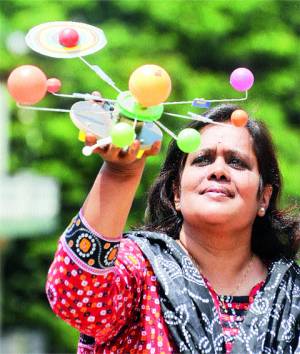
When Dr Sujata Virdhe discovered the many joys of experiential living, there was no stopping her on her journey to her dream. She quit a job at the Indian Space Research Organisation where she worked as a scientist in the fields of satellite power systems, solar energy and indigenisation of electronic components for two decades, and decided to follow her dream.

Dr Sujata Virdhe —R. Samuel

To open the eyes of every child to the magnificent universe of which we are all a part, where miracles happen every day should we choose to see them.

Catering to children between the ages of 10 and 15, the Sunday Science School (SSS) has already received a wonderful response from Maharashtra, where it was first started. The first branch in Bengaluru was set up in Domlur, with the second being inaugurated in Vijayanagar on Sunday. Dr Virde is looking at centres in Mysore, Dharwad, Hubli, Mangalore and Udupi.

“Eminent educationists feel that there is a need for hands-on learni of science, which is made unduly complicated by definitions and descriptions. This takes away the real beauty of the subject and students not only lose interest but become terrified by science,” says Dr Virdhe.

Hence, the science-by-doing module, which is aimed at kindling a love for science and research in every child. “Trained science communicators can communicate science using our readily available practical material to prepare our children for logical, rational and scientific thinking,” Dr Virdhe says.

It all started when Dr Virdhe met students whose parents were very worked up about their children being unable to grasp even the simplest scientific concepts. “I took them to the kitchen and taught them, which was when I discovered experiential learning and how important it is,” says Dr Virdhe.

Driven by a deep interest in the subject, Dr Virdhe began to collect information from textbooks for 7th grade to 12th grade children, designing her own syllabus to make learning science as hands-on and fun as possible. “The SSS wouldn’t have happened without my brother, Suyash Dake, who quit a lucrative IT job in Pune to help me realise my dream,” she says.

As a hobby, Dr Virdhe began designing tools and toys that would teach children science in the most fun way possible. “I happened to give some students a practical workshop on photovoltaic cells, which is how I knew that my passion was designing toys to teach children.”

While there are many, many products out there that can help children learn, most don’t reach them at all, for parents are simply too busy to bother. “We want to fill this gap in parenting because many parents don’t really have the time to spend with their kids,” she says.

At SSS, children are provided with all the materials they need and asked to conduct experiments with them. While the kids are given the help they need, they are, for the most part, allowed to
figure things out on their own. “We have two hours a week and when I see how engrossed the children become, it makes me want to take this to schools, too.”

Parents these days, feels Dr Virdhe, simply don’t have the time to run around for their children. Even if they are willing to do what it takes, finding materials is so hard to do and involves so much
running around that the task is given up on even before it is begun.

The first level makes sure that the children are given a strong foundation, while Level 2 has more
in-depth experiments in electronics, electromagnetism, apex microscopes and the like. “It’s like high school science and a lot more,” explains Dr Virdhe.

Dr Virdhe says the response in Maharashtra was overwhelming and has motivated them to push the dream even further. As children are allowed to explore their boundaries at their own pace, the ultimate aim of education is slowly achieved, for kids are not left with truckloads of information through which they must navigate. Instead, they are left with a tool far greater than that — imagination.

source: http://www.DeccanChronicle.com / Home> Channels> Cities> Bengaluru / by Darshana Ramdev / DC, Bengaluru / May 28th, 2012


Braving odds, they come out with flying colours in SSLC exams

Mysore:

The inmates of the government-run girls’ home here, who had to go through the dark realities of life, have come out with flying colours in the recently-held SSLC examinations.

Sindhu of Chitradurga secured the highest marks – 488-while Niveditha scored 412 out of 625 marks. Except one, all the 13 students appeared for the exam emerged victorious.

Girls’ home superintendent Geethalakshmi told TOI that Sindhu had struggled hard in life after her father died when she was young.

Her mother Poornima was shattered after the death of her husband Chandru. Later, she got admitted all her four girl children to government rehab centres in Hassan, Bijapur and Udupi.

Sindhu was relocated to Mysore from Hassan centre a year ago. As per her request, all her sisters were also brought to Mysore centre later. Lavanya, Ranjitha, Hemalatha, Kavitha, Niveditha, Mamatha M, Shobha S, Lakshmi N, Vidya, Kalaveni and Nirosha too had to face many challenges in their life. This success is a morale booster for them who are now hoping for a better future.

ODANADI INMATES SHINE

Six out of seven inmates of Odanadi Seva Samsthe passed the SSLC examinations this year. Rathna, who had worked as a bonded labour for two years, was one among them. Saraswathi, Nischitha, Manjunath, Ganesh and Hema are the other students. Odanadi is working for the welfare of sex workers and their children.

BLINDNESS, NO HINDRANCE

All the four students of Helen Keller Blind School in Mysore secured first classes in the examinations.

Mahadevaswamy secured the highest marks in the school with 443 marks. Prathap bagged 439 marks while Rameshnayaka and Nataraju B secured 420 and 419 respectively.

Mahadevaswamy and Prathap scored 98 marks in mathematics. Nataraju B managed to score 97 in social studies.

source: http://www.timesofindia.indiatimes.com / Home> City> Mysore / TNN / May 18th, 2012

Two Bangalore kids score perfect at International Maths Olympiad

Bangalore:

It’s double delight for Bangalore as two eight-year-olds from a city school grabbed first rank at the International Olympiad of Mathematics with a perfect score.

Adit Chatterjee and Rutajit Bharadwaj, students of Class III in Vidyashilp Academy, won the competition outperforming thousands of their counterparts from over 3,000 schools in 14 countries. The Olympiad has two rounds, testing students’ competence and proficiency in Mathematics. Their mental ability and reasoning skills are also on test. The competition is conducted for each grade separately. Questions are objective with multiple choices.

“Maths is fun to do… it’s kind of creative. You don’t have time to get distracted. I love decimals and fractions. You’ve to rack your brains for that,” said Adit. But ask him the humdrum question on what he wants to become when he grows up — “I want to become an Olympic swimmer!” is his apt and unexpected answer.

Adit loves swimming, said his father, Amit Chatterjee. “Getting him to practise Maths was very challenging. We used to do Maths drills while driving to the pool,” he said.

So what does the other wizard, Rutajit, want to do when he grows up? “I want to become an astronaut. I want to go to the space. The planets will look beautiful, the Sun will be bright, stars will shine and I want to land on the Moon!” Well, there’s no stopping Rutajit when you ask him about his future plans.

“I like Maths because it makes you smart. You can use the skills in your daily life,” the boy said.

“He was very excited about the competition as he loves Maths. He worked out sample papers and that further developed his interest. We have been telling him that if he’s good in Maths, it’ll be easier to analyze and apply logic even in daily life,” said Sham Prasad KN, his father, a software engineer.

Kalpana Mohan, principal, Vidyashilp Academy said: “Both the kids are intelligent, not because they came first in a competition but because we find them extremely active in extra-curricular activities that the school offers.”

source: http://www.timesofindia.indiatimes.com / Home> City> Bangalore / TNN / April 05th, 2012


Rs 50-cr grant for UAS Dharwad welcomed

Bangalore:

In recognition of the yeoman service to research and development by the University of Agricultural Sciences (UAS), Dharwad – among the nation’s premier agriculture universities – was rewarded with a special `50-crore grant this budget.

Union Finance Minister Pranab Mukherjee made the announcement in the Lok Sabha on Friday while presenting the 2012-13 budget. UAS Dharwad had won accolades few years ago when its scientists developed hybrid colour cotton varieties, in addition to their research on vegetable and cash crops.

Varsity Vice-Chancellor R R Hanchinal told Express that the special grant was a vindication of the university’s accomplishments in recent years. “He said that the grant will be utilised to set up a farmers’ knowledge centre and create infrastructure at the Krishi Mela site in the University.” The university has four colleges, 25 research stations, six extension education units, five Krishi Vigyan Kendras with and has its jurisdiction over 7 districts of northern Karnataka including Bagalkot, Bijapur, Dharwad, Belgaum, Gadag and Uttara Kannada. “The university which was established in 1986 has developed numerous varieties of high-yielding variants of cotton and other food crops,” he added. The university has also to its credit of being the first varsity to start a Krishi Community Radio Station on agriculture. The Krishi Mela, the annual agri-exhibition of the university, attracts lakhs of farmers.

source: http://www.ibnlive.in.com / South> Bangalore / The New Indian Express and Express News Service / March 17thy, 2012

Unique Shakespeare Expo at St. Philo’s

Mysore:

The Literary Club of St. Philomena’s College, Mysore, presented an astonishing and highly educative literary exhibition during the last weekend.

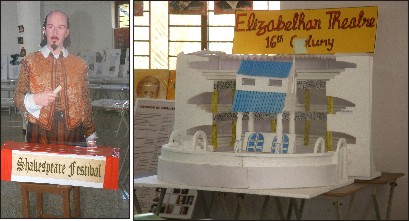
The English Dept. and Functional English Dept. came together under the banner of the Literary Club to present an event that took students, professors and connoisseurs of Mysore down the memory lane with a series of programmes under the title ‘Shakespeare Festival.’

The programme was a package that comprised a colloquium, interaction session on Shakespeare’s plays, a few competitions with cash prizes and a mind-blowing exposition of 37 plays, sonnets and longer poems of Shakespeare apart from a whole section devoted to Strat-ford-upon-Avon and production of Shakespeare plays in different parts of the world.

The expo was an artfully arranged and slick presentation of over 600 display cards, photographs, snapshots, posters of plays and portraits of almost all major British and European writers influenced by the bard, from the private collection of Prof. B.N. Balajee.

The rich colourful presentation of myths and legends of the western world, lovely pictures of Shakespeare’s flowers and birds along with the dramatic contexts in which they appear in his plays were kept for the visitors’ view.

The exhibition had utilised the Fandex card originals published from New York, pictures and plates from various masterpieces of drama capturing scenes of plays from Shakespeare’s plays through the ages along with unique productions of other European and English plays. It was a feast to students of literature, research scholars and lecturers of English.

Students who had only heard about the Globe Theatre, London and RSC Shakespeare Company Stratford could see the photographs of celebrated actors like Michael Redgrave, Richard Burton, Sir John Gielgud and Laure-nce Olivier. One was surprised to see Indian productions of Sha-kespeare, Berkley production of Harvest and Texas production of Nagamandala.

The picture presented the pillars among Indian playwrights who wrote in English that included colourful and impressive pictures of Girish Karnad, Manjula Padmanabhan, B.V. Karanth and K.V.Subbanna.

The picture depicting the life of Shakespeare in Stratford-upon-Avon and fine brochures of RSC, Broadway and Globe Theatres provided informative details about the growth of theatre and the Bard’s contribution to drama.

The exhibition had unique quotes here and there with impressive water co-lour portraits of English poets from Chaucer to Auden and portraits of Arundhati Roy, Salman Rushdie and Vikram Seth and were especially worth seeing.

The expo had a section devoted to over 50 pictures depicting a semiotic interpretation of English literature from 1485 to 2010.

Many visitors were busy taking pictures of rare exhibits and most young visitors wrote down the list of abbreviations used in electronic messaging format. The exhibition also had a thermocol model of Elizabethan Theatre made by PU students.

The exhibition which was part of the Shakespeare Festival on Feb. 25 and 26 for the first time brought for Mysore an extraordinarily visual depiction of Shakespeare’s literary art in particular and world drama in general.

The visitors could write a line about why they admired the plays of the bard and join the competition that offered Rs. 1,000 prize to one lucky visitor.

The exhibition was conceived and directed by Prof. Balajee of the Functional English Dept. with support from Rev. Fr. Leslie Moras, Principal and technical support from Prof. Babu of the Malayalam Dept. — OSR

source: http://www.StarofMysore.com / Feature Articles / March 03rd, 2012