Category Archives: Agriculture

Scientists name new spider after Harry Potter character

Bengaluru :

For any hardcore Harry Potter fan, the Sorting Hat, and the medieval wizard Godric Gryffindor is basic knowledge. Three entomologists, who stumbled upon a new species of spider have decided to pay tribute to the character by naming it after him. Though the arachnid bears resemblance to the ‘Sorting Hat’ of Hogwarts School of Witchcraft and Wizardry, it would be hard to spot it if you are trekking in the Western Ghats.
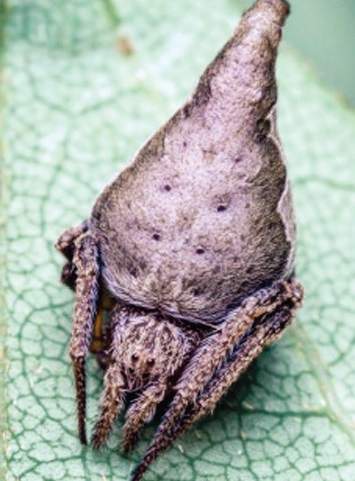
spiderbf13dec2016


Eriovixia gryffindori, is the new spider species discovered, details of which was published in the recent edition of Indian Journal of Arachnology.
The discovery of the arachnid was made at ‘Kans’ forestland of Central Western Ghats at Hosanagara taluk of Shivamogga district, by Javed Ahmed, Rajashree Khalap and Sumukha J N. While Javed and Rajashree hail from Mumbai, Sumukha is from Shivamogga.

Describing the etymology of the spider, the scientists write that naming it after Gryffindor – after whom one of the four houses in Hogwarts School of Witchcraft and Wizardry is named and who once owned the Sorting Hat – was, “An ode from the authors, for magic lost, and found, in an effort to draw attention to the fascinating, but oft overlooked world of invertebrates, and their secret lives.”
Prior to it, they express their fondness of J K Rowling, author of the Harry Potter series as a ‘wordsmith extraordinaire’.
“This uniquely shaped spider derives its name from the fabulous, sentient magical artifact, the sorting hat, owned by the (fictitious) medieval wizard Godric Gryffindor, one of the four founders of Hogwarts School of Witchcraft and Wizardry, and stemming from the powerful imagination of Ms. J K Rowling….” they wrote.

While the team found a female specimen of the Gryffindor spider, they are yet to describe the holotype of a typical male of the species. The paper notes that the particular species of spider is known to be distributed only from Shivamogga district, as of now.
The spider mimics dry foliage, making it ideal for it to reside almost undetected on the forest floor.

source: http://www.newindianexpress.com / The New Indian Express / Home> Cities> Bengaluru / by Express News Service / December 13th, 2016
He turns arid land into lush farm

Mangaluru :

Where there’s a will there’s a way. Odduru Farm at Ganji Mutt in Bantwal Taluk, located nearly 25 km away from Mangaluru, is a classic example of this.

rajeshbf28nov2016

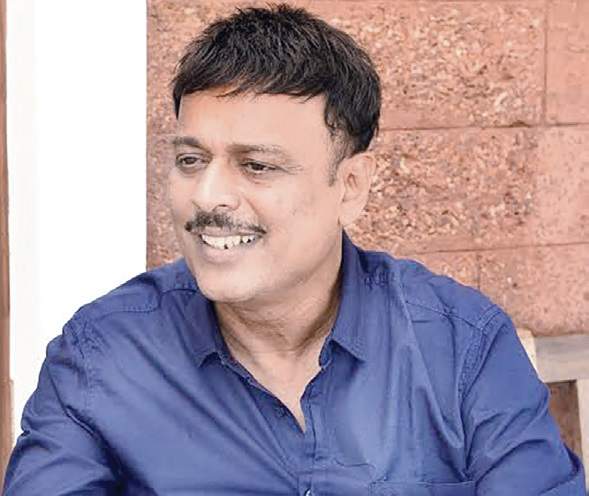
A once barren land where one could only find laterite rocks is now home to lush greenery, all thanks to the sheer determination and perseverance of a progressive farmer Ulepadyguttu Rajesh Naik. When Bantwal taluk was declared a grey area owing to deficient water, Naik decided to do the unthinkable and turned his 120-acre arid land lush green through organic farming.

rajesh02bf28nov2016

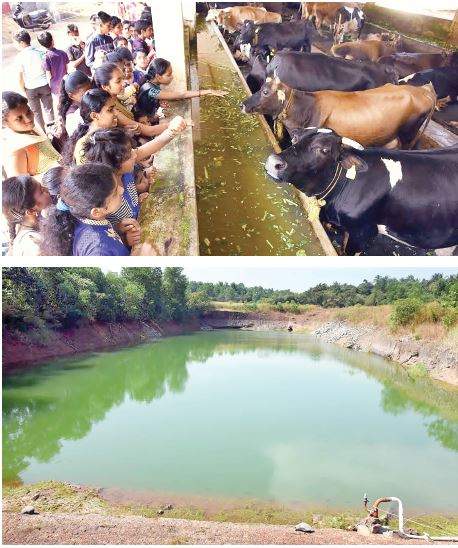
A BSc graduate, Naik (58) had never hankered after a routine job. He had his interests deep-rooted in agriculture. His family had a large patch of land, but it was never cultivated as it was situated on a plate of laterite stone. The barren land and lack of water, however, failed to dry out his enthusiasm. He used the laterite plate for cutting out stones for construction, and soon water started oozing from the bottom of the plate. A water tank was thus formed. He has two such large tanks today that never go dry.
The bigger challenge was to transform the barren land into thriving farm land, which took Rajesh to several places in search of models. But none impressed him. Finally, in 1986, he decided to go with his own model of a fully developed organic farm on a dry patch of 120 acres. “It has not been an easy journey. Organic fertilisers enrich soil slowly, but my patience and perseverance paid off finally,” says Rajesh.

On his 120 acres of land, he now grows arecanut, coconut, banana, cashew, different types of vegetables, pepper and fruits among others by using organic manure. The farm has as many as 10,000 arecanut and 1,500 coconut trees. Two artificial lakes, 50-ft deep at the centre, provide water to the entire land. His land has yielded great results and products.

Over 650 litres of milk are also produced at his farmland. The bio-gas slurry produced by over 180 cows, is used for plantation of coconut, arecanut, vegetable plants among others. He also generates electricity from bio-gas, which almost meets his requirement of power. Naik’s multi-farming activities can provide an idea or two to those, who always complain against less income by agriculture.

“Small land holders must always opt for multi-crop plantation. Loss is inevitable in case of single-crop farming in times of erratic monsoons. With technological advancement and organic solutions, it is not difficult to earn profits,” said Naik.

source: http://www.newindianexpress.com / The New Indian Express / Home> States> Karnataka / by Ganesh Mavanji / Express News Service / November 27th, 2016