Category Archives: Agriculture

Tree cheers to the forest man of Mysuru

Ramesh, a 42-year-old resident of Chandagalu, has undertaken the Herculean task of converting Karighatta Hill, located in the reserve forest area near Srirangapatna, into a huge green patch.

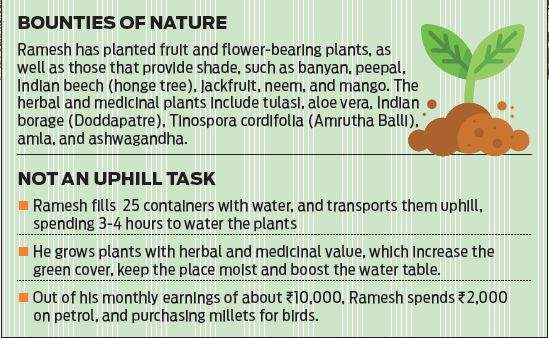
Y Ramesh goes about his task of filling watering cans from a canal, transporting them to the forest and watering the trees. He also leaves seeds for birds | K Rathna

A local answer to cane crisis

JaggeryBF30jan2019

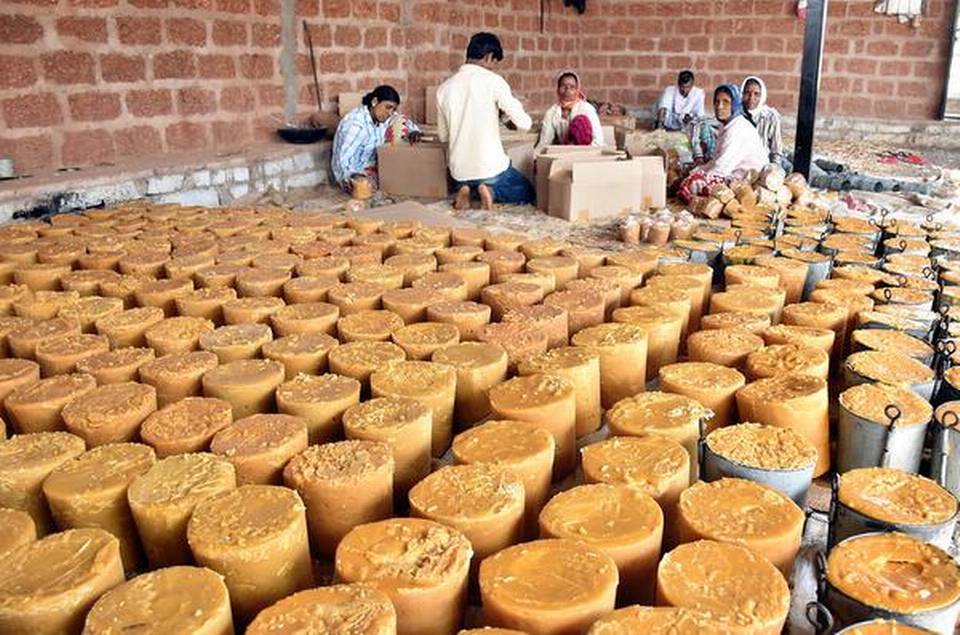
A small jaggery unit assures growers a hassle-free harvest and timely payment

While sugarcane farmers are still bogged down by settlement of dues from cane factories, growers in around 10 villages around Rajapur in Chittapur taluk of Kalaburagi district have found alternative avenues to sell their produce. Skirting the factories, they are now going to a local jaggery unit which promises a hassle-free harvest and timely payment.

Sudhakar V. Patil, once a sugarcane farmer himself, set up a jaggery unit in Rajapur investing ₹25 lakh in 2017. The unit can crush 30 tonnes of cane a day. Last year, the unit crushed around 2,000 tonnes and is expected to get more business this season. Farm scientists believe that replicating such experiments could go a long way in solving the cane crisis.

Till last year, the cane growers of these villages were having a tough time. There was no sugar factory within a 100-km radius and mills would take their produce only by the end of the season. Many complained that they had to bribe factory agents to get their crop harvested and transported early. Then, there was inordinate delay in payment. The situation was so bad that some farmers chose to set their fields ablaze than wait endlessly for factories to take the crop.

“I purchase cane from the farmers paying ₹100 less per tonne than what the sugar factories pay. Yet, farmers prefer to sell their crop to me as I am prompt in paying them. I clear the dues within 40 days. Sometimes, I pay in advance as well,” Mr. Patil said.

Raju Teggelli and Vasudev Naik, farm scientists attached to KVK (Krishi Vigyan Kendra), view it as an “effective model” to address the cane crisis.

They are open to offering guidance to those who come forward with similar initiatives. They have opened a small retail outlet on KVK premises in Kalaburagi for selling the jaggery produced in Mr. Patil’s unit.

“Large problems can have local solutions. People with relatively better financial stability should come forward to establish small agro-processing units in rural areas. Such initiatives help both farmers and local entrepreneurs. It can generate job opportunities too,” said Mr. Teggelli.

Mr. Patil employs 25 persons at his unit of which 15 are skilled jaggery makers from Uttar Pradesh; the rest are locals. Jaggery makers are paid at ₹230 per each quintal of jaggery they produce. They together make around 20 quintals of jaggery a day.

Mr. Patil believes in minimising middlemen in the marketing chain. Nearly two-thirds of jaggery produced in the unit is sold directly to retailers and the rest to wholesalers.

He has also formed some teams to sell the product directly to consumers in the nearby villages. He now plans to create his own brand and make jaggery-based products soon.

source: http://www.thehindu.com / The Hindu / Home> News> States> Karnataka / by Kumar Buradikatti / Kalaburagi – January 25th, 2019

Organic farmer Narayan Reddy passes away

L. Narayan Reddy
L. Narayan Reddy

L. Narayan Reddy, 84, a pioneer of organic farming in Karnataka passed away in his sleep on Monday at his Marenahalli farm near Doddaballapur. He was known as Karnataka’s Masanobu Fukuoka, after the pioneer organic farmer of Japan. Mr. Fukuoka had even visited his farm in 1988.

Known for his simplicity and practical approach to farming, Mr. Reddy never minced words when he criticised what he called the “lopsided agricultural policy” that rendered agriculture unsustainable. He hailed from a village near Varthur on the city’s outskirts and started with chemical farming in 1970s, only to soon realise that it was unsustainable and he was incurring losses.

Influenced by Fukuoka’s book on farming, he took to organic farming. “Organic farming is not just about mere cultivation practices but is a lifestyle in itself,” he argued, adding that agriculture was a philosophy of living in harmony with nature.

Following the rapid urbanisation of Varthur, he bought land at Marenahalli near Doddaballapur and built his farm there in his old age. Though he was not formally educated in farming, he was known for experiments and a scientific approach to farming. Several foreign universities sent their students on study visits to his farm. He was awarded the Nadoja award and an honorary doctorate from Kannada University, Hampi.

Jagadish Reddy, his grandson, told The Hindu that Mr. Reddy, who stayed healthy till the end, rarely went to the hospital. “He had been suffering from an incessant cough for a week. He agreed to get a full body check-up done on Sunday evening. We were supposed to take him on Monday morning. But he passed away in his sleep,” he said.

source: http://www.thehindu.com / The Hindu / Home> News> States> Karnataka / by Staff Reporter / Bengaluru – January 14th, 2019

Iceberg lettuce in drylands of Kalaburagi?

Raju Teggalli (extreme left), head of Kalaburagi’s Krishi Vigyan Kendra, along with scientists and students inside the shade-net where exotic vegetables are being grown .

Scientists are experimenting to see if foreign crops can thrive in this environment

If agricultural scientists in Kalaburagi succeed in an experiment they are carrying out, farmers of this dry northern district could soon be growing exotic vegetables such as iceberg lettuce and broccoli in their farms.

To help farmers of the backward district get better income, scientists of Kalaburagi’s Krishi Vigyan Kendra (KVK) are experimenting if high-income yielding foreign crop varities can thrive in this environment. In the first phase, they have imported five exotic vegetable seeds — iceberg lettuce, straight lettuce, cherokee lettuce, broccoli and red cabbage — from the Netherlands and planted them on the campus.

“These vegetable seeds can be produced only in cold environments, in areas with less than 20 degrees Celsius temperature. But, they can be grown in Indian conditions during winter. We have planted half of these seeds inside the shade-net and remaining outside. We are giving organic fertilizer and water to both. If there is not much difference between those grown inside and outside, we will recommend the farmers to grow them outside the net so that the shade-net costs too can be saved,” Vasudev Naik, a horticulture scientist, told The Hindu.

The scientists have formed a couple of teams for a survey to assess the marketing potential of the new vegetables.

“Domestically grown cabbages and cauliflowers are sold at around ₹25 a kg or less as compared to ₹80 a kg that red cabbage and broccoli are sold at. Iceberg lettuce is sold at over ₹200 a kg. These are supplied from faraway places to Kalaburagi market in limited quantity,” Akshata Biradar, a student who participated in the market survey, said.

Scientists feel that the experiment could pave way for better utilisation of shade-net and polyhouse farming in the region. “The government is offering subsidies for shade-net, polyhouse and drip-irrigation equipment. But farmers are failing to use them,” Raju Teggalli, a senior scientist and the head of Kalaburagi KVK, said.

source: http://www.thehindu.com / The Hindu / Home> News> States> Karnataka / by Kumar Buradikattikalaburagi / December 31st, 2018

Organic mela, Chitra Santhe on December 30

Mysuru Karnataka: 23-12-2018: Mysuru Winter Festival Logo   | Photo Credit: M_A_SRIRAM
Mysuru Karnataka: 23-12-2018: Mysuru Winter Festival Logo | Photo Credit: M_A_SRIRAM

Over 60 farmers and women’s groups likely to set up stalls

The Krishnaraja boulevard in front of the Law Court complex here will be converted into an organic farm produce mela between 9 a.m. and 5 p.m. on December 30 as part of the ongoing Mysuru Winter Festival.

An estimated 60 to 80 organic farmers and women’s groups are expected to set up stalls on one side of the boulevard, starting from Mahatma Gandhi’s bust in front of Law Court complex till the Crawford Hall premises.

Deputy Director of Agriculture, Mysuru, Somashekar told The Hindu that organic farm produce and value-added millet products will be available at the mela.

Ramesh, president of the Federation of Mysuru, Mandya and Chamarajanagar Regional Organic Farmers’ Association, said about 35 different organic items, including rice, ragi, jaggery, pulses, spices, dry fruits, besides value-added eatables like chakli and chutney powder, will be made available. Mr. Ramesh said the federation is represented by more than 6,000 organic farmers from the three districts, besides scores of women’s self-help groups that deal in value addition of the organic produce.

Chitra Santhe

Meanwhile, on the other side of the Krishnaraja boulevard, a Chitra Santhe or exhibition-cum-sale of artefacts will be held from 9 a.m. to 5 p.m.

The Mysuru district administration has cancelled the Open Street festival during the ensuing Winter Festival in the backdrop of complaints of alleged harassment and molestation of women during the event held at Krishnaraja boulevard during Dasara earlier this year.

In view of the complaints, the district administration has not only scrapped the Open Street festival, but has also issued instructions to wind up Chitra Santhe and the mela by 5 p.m.

source: http://www.thehindu.com / The Hindu / Home> News> States> Karnataka / by Special Correspondent / Mysuru – December 24th, 2018

Karnataka Cooperative Milk Producers Federation launches Nandini buffalo milk

Nandini, the well known milk brand of Karnataka Cooperative Milk Producers Federation (KMF), has introduced buffalo milk.

File Photo of a buffalo (PTI)

Belgavi :

Nandini, the well-known milk brand of Karnataka Cooperative Milk Producers Federation (KMF), has introduced buffalo milk. Speaking to reporters, KMF chairman Vivekrao Patil said buffalo milk is considered ‘A2 milk’ that has high content of calcium and vitamin D which help burn calories effectively.

“We have released half litre packs… One litre of buffalo milk will cost Rs 60 for consumers while farmers are being paid Rs 38 per litre including the incentive of Rs 5”, Patil said.

About 60,000 litres buffalo milk is being collected every day from 35,000 farmers in various parts of the district. As much as 35,000-litre milk packed in flexi packets is being supplied to Bangaluru and local markets while the remaining milk is used to make kunda, penda, paneer and other products, he said. “We have also got orders for buffalo milk from Goa, Sangli and Pune”, he added.

There are several private milk organisations which indulge in adulteration and the Deputy Commissioner should take action against them, he urged.

source: http://www.newindianexpress.com / The New Indian Express / Home> States> Karnataka / by Express News Service / December 23rd, 2018

Aquaponics model proves a hit at exhibition

The aquaponics model that was developed by the University of Agricultural Sciences, Bengaluru | Photo Credit: H.S. Manjunath

Vegetables are grown over an aquarium in it

One can grow vegetables without soil in three separate trays kept on top of an aquarium using the water drawn from below. The water from these vegetable trays goes through pipes back to the aquarium.

This model of aquaponics — a form of aquaculture — developed by the Inland Fisheries Unit of University of Agricultural Sciences, Hebbal, Bengaluru, was among the exhibits that drew attention of people at the exhibition held on Friday at the College of Fisheries as part of its golden jubilee celebration.

Chief Scientific Officer of UAS’s Inland Fisheries Unit B.V. Krishnamurthy said they developed the model to popularise aquaponics in Karnataka. This form of aquaculture was popular in Kerala, he said. Mr. Krishnamurthy said seven different types of fishes, including Nile Tilapia, which is available in the unit, can be used in the acquarium. Lettuces and other high value short duration leafy vegetables can be grown in the trays, he said.

Among the others exhibits that attracted attention included the estuarine cage farming model developed by Central Marine Fisheries Research Institute, Mangaluru.

Scientist Purushottama G.B. said their cage farming model developed in 2009 has been adopted by several fishermen to harvest snapper (locally called Kemberi) and few other fishes available near estuaries. “Such harvesting helps fishermen earn income during the off season when they do not go to the sea for fishing,” he said.

The exhibition was inaugurated by in-charge Vice-Chancellor of Mangalore University Ishwar P. He also inaugurated the two-day All India Fisheries Colleges Cultural and Sports meet.

Speaking on the occasion, Mr. Ishwar said the Mangalore University was among the few universities in the country that has a separate sports policy. A separate sports and culture policy was necessary to support younger generation, he said.

Dean (Fisheries), College of Fisheries, H. Shivananada Murthy, said it was the first time that a sports and culture meet of the 30 fisheries colleges in the country was being held. Because of short notice of the event, only eight colleges were attending the meet. Mr. Murthy said the sports and culture meet of fisheries colleges would be an annual feature.

source: http://www.thehindu.com / The Hindu / Home> News> Cities> Mangaluru / by Special Correspondent / Mangaluru – December 15th, 2018

Agriculture labourer gets Mangaluru Press Club Award

Amai Mahalinga Naika from Amai village in Bantwal taluk.

Amai Mahalinga Naik single-handedly drilled tunnels to get water for his land

Amai Mahalinga Naik, who single-handedly worked to irrigate his two-acre land and succeeded in raising a small plantation has been chosen for the Mangaluru Press Club Award, 2018.

Mr. Naik, 73, a resident of Amai village near Adyanadka in Bantwal taluk, was chosen by a panel of Balakrishna Gatti, Vasanth Kumar Perla and Nagaveni Manchi for the award, Club General Secretary Ibrahim Adkasthala said in a release. The award would be presented during the Press Club Day to be celebrated on January 5 at Urwa Church Hall.

An agriculture labourer and expert in climbing areca and coconut palms, Mr. Naik was working in the fields of Amai Mahabala Bhat. Realising his desire to own agricultural land, Mr. Bhat donated him two acres of land four decades ago; but being on hill slopes, it lacked accessibility to water sources.

Unmindful of the obstacles, Mr. Naik began drilling tunnels to fetch water as he was aware open well would not yield any water on the hill slope. He drilled not one, but seven tunnels and at the end, he got water that was suffice to raise his small plantation. He also built a water storage tank digging the ground on the land.

The slope terrain helped Mr. Naik introduce the drip-irrigation network in the field through gravitational force. He was engaged in his routine palm climbing for half a day and spent the rest of his time drilling tunnels. Mr. Naik also fell off a tree 14 years ago. Though he survived the fall, he could no longer climb palms and restricted himself to his field work.

With the help of his wife Lalitha and their three children, Mr. Naik has now raised areca, coconut, banana and pepper crops on one acre of the land and forest in another acre. As many as 300 areca and 75 coconut palms and 200 banana plants are on his field. He only uses conventional manure and does rainwater harvesting on his land. All these measures Mr. Naik implemented without taking any bank loans, depending solely on his work as a labourer.

source: http://www.thehindu.com / The Hindu / Home> News> States> Karnataka / by Special Correspondent / Mangaluru – December 18th, 2018

Lalbagh to create digital record of its plant wealth

Plants will be identified and named according to their place of origin, species, and their flowering season.

The project will be completed in eight months

Lalbagh Botanical Gardens’ green wealth — around 900 genera and over 2,500 plant species — has earned it the moniker ‘Kew of India’.

As the Horticulture Department continues to increase the green cover in the garden, keeping a record of the number of plant and trees, details of the species, the botanical names, and their exact location in the garden has become increasingly difficult. The solution is a digital repository.

To help keep a detailed record of the plant wealth, the department has now tied up with taxonomists from the city to create a digital repository of the plants.

“The project, called the Plant Wealth project of Lalbagh, was initiated six months ago. With the help of professor Ravi Kumar, a taxonomist, and three other scientists, we will be creating a digital record of the plants in Lalbagh,” said M. Jagadeesh, Joint Director (Parks and Gardens).

Under the project, which will take another eight months to be completed, the plants will be identified and named according to their place of origin, species, and their flowering season. “Once the survey is over, the digitisation process will begin. Global Positioning Systems will be set up to locate the plants in the garden. The system will help us identify the plant species and its location,” said Mr. Jagadeesh, and added that while the project would make the department’s work of managing the largest green space in the city easy, it would also give information to the public.

“After documentation, we are planning to bring out an illustrative book on the plant wealth in Lalbagh. Also, an index book will be created where the names of all plants will be written in alphabetical order with relevant information. We are planning to create an mobile application as well, which can be used by the visitors to locate and learn about the plants in Lalbagh,” he said.

source: http://www.thehindu.com / The Hindu / Home> News> Cities> Bengaluru / by Staff Reporter / Bengaluru – December 08th, 2018

This repository in Shivamogga has 190 native paddy varieties

Conservation effort: A file photo of M.K. Naik (second from left), Vice-Chancellor of the University of Agriculture and Horticulture Sciences, handing over a stack of native paddy to a farmer in Shivamogga.

UAHS has set up a seed bank and a museum for farmers

At a time when concerns are being expressed over the shrinking gene pool of native paddy varieties, known for their unique taste, aroma and medicinal qualities, the University of Agricultural and Horticultural Sciences (UAHS), Shivamogga, has achieved significant strides in their conservation by establishing a seed bank and a museum.

The seed bank established at the UAHS, Shivamogga, is the repository of 190 native paddy varieties. Not only are these seeds offered to interested farmers for free, the information on their cultivation is also provided by experts.

S. Pradeep, director of the Organic Farming Research Centre of the university, told The Hindu that the paddy varieties suggested differ from one agro-climatic zone to another. The flood-resistant varieties, including ‘Nereguli’ and ‘Yeedikuni’, are prescribed for farmers who have land on river banks that swell during monsoon, while for farmers who cultivate paddy under rain-fed method, the drought-resistant varieties are given.

The work of conservation of native paddy varieties commenced with the establishment of the research centre on the campus in 2007. Sahaja Samrudha, a forum of farmers involved in promoting native farming practices and in marketing the foodgrains cultivated under organic farming method, also joined hands with the university.

In the initial period, senior scientists, teaching staff serving here and the students did elaborate field work to collect paddy seeds from farmers. ‘Nereguli’, ‘Yeedikuni’, and other flood-resistant paddy varieties were collected through field work in Talaguppa, Anavatti, and Jade Gram Panchayat limits on the banks of the Varada in Shivamogga district. These varieties can survive even if they are submerged in floodwaters for over 15 days. As part of the field work, the staff members and students visited paddy-growing villages in Koraput district of Odisha, and Bardhaman in West Bengal.

Exchanging seeds

Interestingly, in many villages, farmers refused to sell the seeds of native paddy varieties in their possession and instead opted for exchanging them. In Odisha, farmers gave away seeds of ‘Limchuri’ and ‘Gadaakutta’ varieties in their possession in exchange for ‘Gandhasale’ and ‘Rathnachudi’ varieties with the university students.

During kharif season, all 190 native paddy varieties are cultivated on a 10-acre land on the university campus without administering chemical inputs. After harvesting, the seeds are distributed among interested farmers. Prior to harvesting, Kshetrotsava, a field day, is held in which farmers can visit the plot and select the seeds they need.

A museum has also been established on the campus, where native paddy varieties are displayed with information related to the method of their cultivation and their origin.

M.K. Naik, Vice-Chancellor of the UAHS, Shivamogga, said the university plans to conduct research on nutritional value of each native variety of paddy in its repository and publish the findings.

The university will seek help from institutes such as the National Institute of Nutrition, Hyderabad, and the Central Food Technological Research Institute, Mysuru. The scientific confirmation of the nutritional benefits would help create a brand value for these paddy varieties, he said.

source: http://www.thehindu.com / The Hindu / Home> News> States> Karnataka / by Veerandra P.M. / Shivamogga – December 02nd, 2018