Category Archives: Agriculture

Jallikattu champs, born in Karnataka

Racing bull: A Hori Habba enthusiast displays a Hallikar sporting breed at Tadasanahalli, in Shikaripur taluk. | Photo Credit: Vaidya

Drought-hit farmers rescued by the popularity of their bulls in Tamil Nadu

Vishnuvardhan, Sudeep, Darshan Thoogudeepa, Yash, and Duniya Vijay are not only popular Kannada film stars – all of them are also sturdy bulls from Karnataka that are taking Tamil Nadu’s Jallikattu by storm, with some of them selling for as much as ₹12 lakh, and earning their breeders a neat profit.

The bulls, reared and trained in the semi-arid Shikaripur taluk of Shivamogga district, have acquired a reputation for agility, speed and sturdiness. They are in great demand in Tamil Nadu following the resumption of Jallikattu in the State.

Shikaripur’s racing bulls are fetching almost double the money the farmers invested on purchasing the calf, and rearing and training it.

Trained for local sport

The bulls get trained in the local bull-catching sport, ‘Hori Habba.’ In Shikaripur taluk alone, more than 120 Hori Habba events are held between Deepavali and Sankranthi. The sport involves making bulls of the ‘Amruth Mahal’ and ‘Hallikar’ breeds run in the ring. Whoever succeeds in catching or taming them wins. Mr. Kumaranna, a farmer from Gandhi Nagar village of Shikaripur said that it costs him around ₹12,000 a month to keep the bull fighting fit. Four years ago, he bought a six-month old male Hallikar calf for ₹50,000. Recently, he sold it to a Jallikattu enthusiast from Tamil Nadu’s Vellore district for ₹12 lakh. Another bull reared by Zakir Saab in Narasapura was sold to a buyer from Alanganallur in Madurai district for ₹11 lakh.

Nandan Sommananavar, who is doing research on Hori Habba in Kuvempu University said that in the past six months enthusiasts from Tamil Nadu bought more than 60 bulls from Shikaripur. The bulls are typically named after Kannada films (Mylari, Raja Huli, Tagaru, Hathavadi, Saarathi) and film stars.

source: http://www.thehindu.com / The Hindu / Home> News> National / by Veerandra P.M. / Shivamogga – June 08th, 2018

‘Tree Man’ of Channapatna spent earnings to create urban forest

Bhoohalli Puttaswamy

“How many saplings you have planted so far to build a green tomorrow? If you have planted any, it is commendable. If not even a single, plant at least one and nurture it. There is only one earth and we all should strive to preserve it for the future generations as well as our better tomorrows.” – This is the advice of Bhoohalli Puttaswamy to whoever he meets.

The 63-year-old retired history lecturer from Bhoohalli of Channapatna taluk is popularly called the ‘Tree Man of Channapatna’. In a little over 11 years, he has single-handedly planted around 4,000 saplings on barren lands, roadsides and government land. He has also involved students in planting over 500 saplings in and around Channapatna.

One of the tree parks created by environmentalist Bhoohalli Puttaswamy in Channapatna. He has planted over 4,000 saplings at different parts Channapatna taluk in Ramanagaram district since 2007.

Tree parks

The sexagenarian has converted 3.5 acres of barren land at Bhoohalli into an urban forest by planting nearly 500 saplings of varieties of native species. He created ‘Jeeveshwara Vana’ with 500 saplings next to Mahadeshwara Temple on Channapatna-Sathanur Main Road, and ‘Vidyarthi Vana’, next to Jeeveshwara Vana, with the involvement of students of various colleges. While he created ‘Kavi Vana’ near Bhoohalli with around 1,000 saplings, he increased the green cover with varieties of saplings at Kempegowda Layout in Channapatna.

It all started with an effort to prevent encroachment of a government land at Bhoohalli, he said.

Speaking to The Hindu on Monday, Mr. Puttaswamy stated that some influential elements eyed the government land at Bhoohalli years ago and began exercises to grab it. Upon learning of this, Mr. Puttaswamy rushed to the village and trying to save the land, alerted the villagers about the incident and later planted saplings. “Nearly 800 grown trees are there now,” he said.

IRs. 18 lakh

Environmentalist Bhoohalli Puttaswamy working at Jeeveshwara Vane at Channapatna of Ramanagaram district.

Mr. Puttaswamy claimed that he had spent nearly ₹18 lakh to plant saplings, and has been spending ₹15,000 a month to nurture them. “I hire tankers for watering the saplings during summer,” he said.

According to Rudreshwar, a folk enthusiast from Ramanagaram, the Tree man has spent most of his retirement benefits and earnings on planting saplings. “Mr. Puttaswamy mobilises students and volunteers, digs pits himself, plants saplings and nurtures them,” Mr. Rudreshwar, who is also a close aide of Mr. Puttaswamy, said.

Retired principal

Mr. Puttaswamy retired a few ago back as the Principal of the Government First Grade College of Channapatna, after serving for 32 years. He has penned 12 books on various issues.

source: http://www.thehindu.com / The Hindu / Home> News> States> Karnataka / by M. T. Shiva Kumar / June 05th, 2018

60 mushroom species documented at Yenepoya campus

Mangaluru :

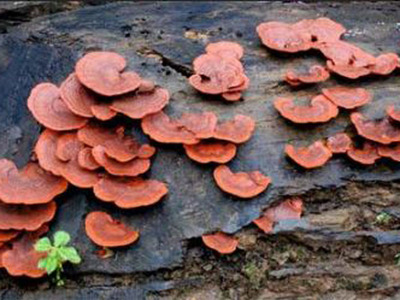
In an unique initiative, Yenepoya (deemed to be university), has undertaken a comprehensive study of the mushrooms present on the Derlakatte campus.

MushroomsYenepoyaMPOs29may2018

The study, which was conducted over a period of six months, has yielded rich information on the macrofungal resources of the campus. About 60 species of mushrooms have been observed on the campus, out of which about 40 have been described in the book. Out of the 40 species published, 12 species are edible, 12 species are medicinal, two species ectomycorrhizal and one species is parasitic. Two species which are rare and known to be poisonous are also recorded.

The information was documented in a ready reference book titled ,‘Macrofungal resources of Yenepoya University’. Yenepoya chancellor Abdullah Kunhi released the book at a ceremony held on the campus on Tuesday, in the presence of vice-chancellor M Vijayakumar and registrar G Shreekumar Menon. The book is dedicated to M Abdul Rahiman, former vice-chancellor, Kannur and Calicut Universities.

Yenepoya is the first educational institution in the region to initiate such a study of mushrooms on the campus. Though mushrooms play a unique role in the ecosystem, importance is always given to only flora and fauna, said sources. Yenepoya has initiated other similar studies to document the flora and fauna of the campus too.

The study of macrofungal life on the campus was undertaken by a research team led by K R Sridhar, Dr N C Karun and Dr Bhagya B Sharma from June-November 2016.

Yenepoya has striven to make its 32 acre campus into an eco-friendly zone. The institution has undertaken various measures for greening the campus with different landscapes like lawns, arboretum, bamboo thickets, medicinal plant garden, areca plantation and acacia grove. The campus includes a large rainwater harvesting pond, roof water harvesting facilities, waste water treatment and recycling plant, vermicompost unit and solar power generation facility. The university carries out a regular environmental audit of the campus and has an eco club for students. It is hoped that these activities will inculcate a love for nature among the students who study here, and inspire them to act as brand ambassadors for nature conservation in their future life.

source: http://www.timesofindia.indiatimes.com / The Times of India / News> City News> Mangalore News / by Kevin Mendonsa / TNN / May 23rd, 2018

Farmer couple in Periyapatna cultivates 15 varieties of ladies finger

Farmer couple Shankar and Roopa have cultivated 13 different varieties of Ladies Finer at their land in Periyapatna taluk

Mysuru:

Organic farming is no longer just a buzzword that inspires those living in cities to leave their highly lucrative and conventional, ‘Nine to five’ jobs and return to the roots, and till the soil to reap the dividends of their labour. Tucked away in a small village in Periyapatna taluk, a farmer couple has successfully managed to cultivate 15 different varieties of ladies using organic means.
With the help of the city-based NGO Sahaja Samrudha, farmer couple Shankar and Roopa have managed to harvest a rich yield of ladies finger crop – all 15 varieties are of Indian origin – on their half acre plot in Hittnehebbagilu village in Periyapatna taluk. The NGO had organised Field Day on May 17 to encourage farmers to grow indigenous varieties of vegetables.

The seeds of the many varieties of ladies finger and other vegetables have been collected by Sahaja Seeds, an organisation that has gathered them at crop and agriculture fairs held across the country. It was from Sahaja Seeds that Shankar and Roopa managed to get the seeds for their plot.

Star okra from Odisha, red bhindi from Puducherry, Sri bhindi from Sri Lanka, besides breeds local to Karnataka are among those that have been cultivated by Shankar and Roopa, in what was an experiment to see if different breeds of ladies finger could be grown under the same climactic conditions.

The farmer couple planted 30 seeds of each variety in single beds, and have managed to reap a rich yield, with each plant bearing at least 25 ladies finger, much to their delight.

“I have not used chemical fertilisers or pesticides in my plot. I used a type of organic pesticide called Jeevamrutha, which has earthworm compost as one of its ingredients. Compared to growing other vegetables, cultivating these Indian varieties of ladies finger did not require as much money. The seeds will be processed further,” Shankar told TOI.

Asha of Sahaja Seeds, said that on Field Day, farmers were shown a wide assortment of seeds of ladies finger. “Farmers, who had years of experience, selected those varieties that promised a good yield. Women from the village, meanwhile, prepared dishes using the ladies finger, and we held tasting sessions throughout the day. Farmers have already chosen what varieties they want to cultivate,” she told TOI.

Assistant professor at the College of Horticulture JS Aravind Kumar said, “Organic breeds are rich in nutritional value, when compared to other vegetables. In the coming days, through participatory varietal selection, more farmers in Periyapatna will be able to grow different breeds of vegetables. Lately, there is a lot of buzz around organic food and health consciousness, and demand for ‘Desi’ ladies finger will be high on the market.”

source: http://www.timesofindia.indiatimes.com / The Times of India / News> City News> Mysore News / May 24th, 2018

Indo-Israeli tie-up increases mango produce in Kolar

MangoBF28may2018

Bengaluru :

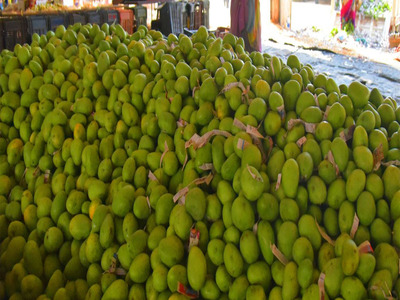
Mango cultivators in Hogalagere village of Kolar have reason to cheer. The yield has doubled as more than 600 mango trees can be grown within one acre of land as against the previous limit of 60.

Lavanya, project manager at the Kolar centre of excellence for mango cultivation and horticulture, said this has been possible only due to the partnership between India and Israel. “The tie-up has helped us get better yields since 2016,” added Lavanya. Earlier, it was possible to grow only 60 mango trees in an acre but employing the root stocking technique, where grafting is done to increase production, has upped the number to 600. “This method reduces the lifespan of trees. Normally, a mango trees lives for 100 years but the technology decreases it to 25 years,” explained Lavanya.

The partnership began with a project called Mashav, initiated by the Israeli foreign ministry, which is aimed at achieving sustainable development and ensuring food security. Under the project, work is on in four main sectors — agriculture and rural development, socio-economic development, rural and urban development and education. It began in 2008 was later extended.

At present, the Kolar centre is growing Mallika, a mango variety which is being sold at Rs 80 per kg. “The yield has been comparatively good. We use drip irrigation to water the trees and don’t depend on rain,” said Lavanya.

The Indo-Israel agricultural cooperation has benefited both the countries, said the deputy chief of mission, Embassy of Israel, Dana Krush. “The new Karnataka chief minister HD Kumaraswamy had visited Israel in August and wanted to send state farmers to the country to learn new technologies and implement them here,” said Krush.

source: http://www.timesofindia.indiatimes.com / The Times of India / News> City News> Bangalore News / TNN / May 25th, 2018

IIHR in the process of developing elite mango variety

The proposed variety is an improvement on the Amrapali variety, to get red colour from Vanraj

The biggest mangoes (Tenneru variety from Andhra Pradesh), with each fruit weighing around 2 kg, alongside smaller varieties.   | Photo Credit: Handout E Mail
The biggest mangoes (Tenneru variety from Andhra Pradesh), with each fruit weighing around 2 kg, alongside smaller varieties. | Photo Credit: Handout E Mail

If mango is the king of fruits, the Alphonso variety is the king among mangoes due to its taste, attractive colour and moderate size. However, horticultural scientists are in the process of developing another elite mango variety, which is said to be superior to Alphonso.

What is a matter of pride for the State as well as the Garden City of Bengaluru is that the research is taking place in the Hessarghatta-based Indian Institute of Horticultural Research (IIHR).

Dr. M. Shankaran, principal scientist in IIHR’s Fruit Crops Division, told The Hindu that the researchers are trying to get ‘red shoulders’ for the proposed elite variety from the Vanraj variety of mango. “The new variety is going to be an improvement on the Amrapali variety of mangoes by getting characteristics responsible for colour from the Vanraj variety,” he said. “The research has entered the fifth year,” he pointed out.

The new elite variety is expected to be preferred for exports, he said.

IIHR researchers are also working towards developing mango varieties that can be grown in saline soil. If successful, several non-mango regions of the country, particularly coastal areas, may see cultivation of the fruit, Dr. Shankaran said.

For this, the scientists have chosen root stocks from the natural varieties, which have resistance to salinity. These root stocks will be grafted with other improved varieties to get good quality fruits with resistance to salinity, he said. “Presently, such natural varieties do not have quality fruits while the varieties with quality fruits do not have resistance to salinity,” he noted.

Meanwhile, the three-day mango and jackfruit diversity fair began on Thursday at the IIHR campus in Hessarghatta with 350 varieties of mango and 150 varieties of jackfruits, including those grown by farmers, on display.

The varieties of mango on display include appe midi (used as pickles), table varieties and those preferred for juice. A dozen exotic varieties from various countries, including the US, too were on display.

The jackfruit collection had interesting variety in terms of taste, colour and size.

Custodian of genetic diversity

In a bid to encourage farmers to protect native varieties, the IIHR on Thursday nominated farmer Shankaraiah from Hulikatte of Gubbi taluk in Tumakuru district as custodian of an unique variety of jackfruit being grown by his family.

The jackfruit with copri red flakes is very sweet in taste and weighs around 3 kg. As per the agreement, IIHR scientists will take up multiplication of the variety and also sell them. Proceeds from the sale would be shared by the farmer and the institute.

This is the second such farmers’ variety to be identified by the IIHR under the custodian of genetic diversity scheme. Recently, another jackfruit variety titled ‘Siddu jackfruit’ from the same district had been chosen.

Cine personality-turned-environmentalist Suresh Heblikar inaugurated the three-day fair in the presence of environmentalist Yellappa Reddy and IIHR Director Dr. M.R. Dinesh and Additional Director of Horticulture Dr. Parashivamurthy.

A mango that weighs two kg

It was not just the variety, but also the variations in size, colour and shape that mesmerised visitors.

The fair displayed the biggest mangoes with each fruit weighing around 2 kg (Tenneru variety of Andhra Pradesh) and several small-size varieties whose fruits weighed just around 40 gm.

There was one variety from Andhra Pradesh titled ‘elephant head’, as it resembled the head of a pachyderm.

source: http://www.thehindu.com / The Hindu / Home> News> Cities> Bengaluru / by B S Satish Kumar / May 24th, 2018

Bengaluru gets first Geographical Indication-based products store

GIbf11may2018

Bengaluru :

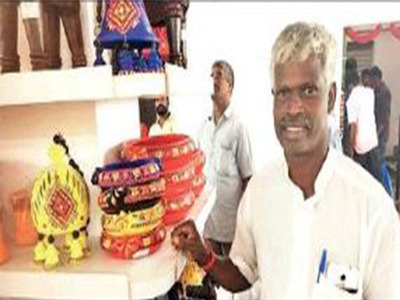
The city has got a unique store which endorses some of the Geographical Indication (GI) products such as Channapatna toys and Devanahalli pomelo among others. This is also said to be the first GI-based products store in the country.
Located in HSR Layout, the store has been started by a group of GI product enthusiasts and will display unique items from artists and agriculturalists. The GI tag that is given to products that possess special features corresponding to a particular geographical location. This tag can be used for agricultural, natural and manufactured goods, emphasizing the heritage of each location.

Around the world, 10,000 products have GI tag, out of which 350 are from India with Karnataka  leading it with 36. The products include Mysore silk, Mysore agarbatti, Bidriware, Channapatna toys and dolls, Nanjangud bananas, Byadagi chilli, Devanahalli pomelo among others.

“It feels nice to set up a store for all GI products because this showcases the culture of the country,” said S J Tejas, owner of the store, which was started under the banner of Geographical Indications Tagged World Premium Products Limited (GITWPL).

The famous Villianur Terracotta works with huge statues of horses and elephants caught the eyes of many visitors at the shop on the first day. “We’ve been practising this artwork for many years now but after the GI tag was given to us, it gave more confidence and pride,” said artist V K Munuswamy. Because of the GI tag, he could take his art to Geneva, he added.

Ravi Kumar, an industrialist, said: “This is a unique store with products ranging from fruits to ornaments.”

source: http://www.timesofindia.indiatimes.com / The Times of India / Home> News> City News> Bangalore News / TNN / May 11th, 2018

His farm-fresh innovations are helping many farmers

Sharanabasappa Patil has invented several low-cost equipment and methods that are helping farmers reap benefits

Sharanabasappa Patil of Hal Sultanpur village in front of his Solar hydroponics

Kalaburagi  :

THIS farmer from Kalaburagi does not hold any degree in agriculture science, but that did not deter him from turning his field into a laboratory for innovations. In his 5-acre-farmland, both ideas and creativity take shape, and his innovations leave everyone in awe. Sharanabasappa Patil of Hal Sultanpur village has invented several low-cost equipment that are helping farmers of not only Karnataka, but also the neighbouring states.

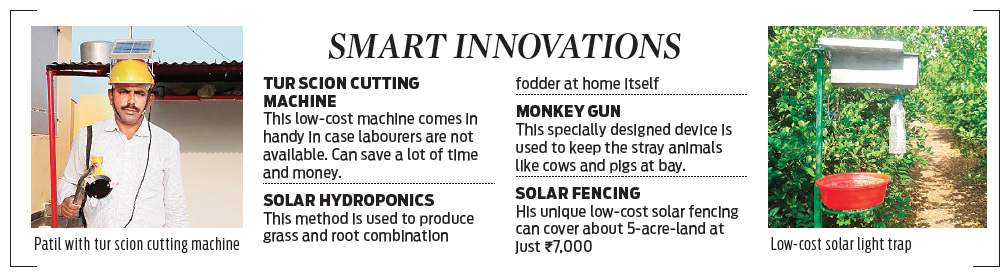
Till date, he has eight inventions to his credit, and people from as far as Visakhapatnam visit his farmland to get an insight into ways to do farming with affordable equipment.Low-cost solar sirens, solar light trap and tur scion cutting machines are some of the innovations that have earned Patil accolades at the state level. He has won many prizes till date, including Krishi Pandit Award and Raita Vignani Award given by agriculture department and University of Agriculture Sciences, Raichur, respectively. He had also bagged the first prize at the state-level innovative farmers’ conference held in 2017.

“When I visited his farmland in Hal Sultanpur, I was completely bowled over by his innovations. I requested Patil to visit Visakhapatnam, and with his help I got my field covered with low-cost solar fencing. Now, I am adopting most of his innovations by using the machines and methods employed at his farmland,” says Ravindra from Visakhapatnam.

Patil02BF11may2018

Ningappa Molakera of Chimmeidalayee village says, “Many farmers of my village have put low-cost solar fencing around their fields. On their advice, I recently visited Hal Sultanpur to get myself acquainted with the new method of keeping animals and birds away from the field. I also procured the unique tur scion cutting machine from Patil.”

Tur scion cutting machine has helped thousands of farmers of the region who could not afford labourers. “Since workers are not easily available these days, this low-cost machine comes in handy and saves lot of time and money,” says Ningappa.

Patil’s another innovation is Solar hydroponics which can produce fodder without using land. He has also invented a monkey gun device to keep the stray animals like cows and pigs at bay.From where does he get the ideas to innovate? To this, the progressive farmer replies: “Necessity is the mother of invention. Drought, shortage of water for crops and attack on crops by pigs and pests are the trigger behind my inventions. Whenever any problem arises, I try to solve it rather than just complaining about it.”
And in his endeavours, he is also supported by the Agriculture Research Centre of Kalaburagi. “He has created wonders on his farmland. We provide him expert opinions and suggestions which help him fine tune his innovations and equipment,” says Centre head and senior agriculture scientist RajuTeggalli.

source: http://www.newindianexpress.com / The New Indian Express / Home> States> Karnataka / April 29th, 2018

Rubber farmers to get free rain guard

Bengaluru :

Tyre manufacturer MRF Limited will provide free rain guarding materials to about 7,500 rubber farmers in Chikkamagaluru, Kodagu, Udupi and Mangaluru.
MRF stated on Monday that they have identified seven cooperative as well as rubber processing societies in the state for implementing this programme.

“With four months of heavy rainfall, marginal farmers in Karnataka are unable to eke out their living by tapping rubber as they are unable to afford rain guarding materials. Seeing their plight, MRF has now stepped in deciding to extend support to such farmers” said a press release.
“We have decided to cover 8,005 hectares of rubber plantations in Karnataka with more than 32 lakh rubber trees for rain guarding this year,” said Arun Mammen, vice chairman and managing director of MRF Limited.

source: http://www.timesofindia.indiatimes.com / The Times of India / News> City News> Bangalore News / by Christin Mathew Philip / April 24th, 2018

‘Pesticide-free’ poly-houses are catching on

A farmer in Karnataka grows sensitive broccoli using biotechnologies for the first time in country

At a time when all things “organic” is the buzzword, poly-houses are becoming a cause for concern due to high pesticide residues in the produce following indiscriminate use of chemicals.

In fact, the sustainability of poly-house cultivation is facing a threat as a sizeable number of them have closed due to soil degradation and attack by nematodes — harmful soil bacteria — and fungi, which have resulted in massive devastation of crops.

The Indian Institute of Horticultural Research (IIHR) has now come out with a series of technologies and practices to reduce the use of chemicals in poly-house cultivation.

“The main focus is to turn the high-end poly-house cultivation into a sustainable farm and economic activity,” said M.S. Rao, head of IIHR’s Division of Entomology and Nematology.

“This will result in not only production of pesticide-free produce, but it will go a long way in improving the financial health of poly-houses,” he said, while indicating that closing down poly-houses would result in a loss of ₹900 crore.

What has come as a shot in the arm for the IIHR is that a 24-year-old farmer Raju in Doddaballapur taluk near Bengaluru has used this technology showing it is possible to grow broccoli, a crop highly susceptible to various pests and diseases, without pesticides.

It is the first time in the country that broccoli has been grown in a chemical-free manner in a poly-house.

Of course, the experiment is not completely organic as the farmer has used a certain amount of fertilizers. But, the produce has been selling like hot cakes to exporters at a premium price since it is pesticide-free.

Mr. Raju, who migrated to Karnataka from Andhra Pradesh, took up poly-house cultivation on about one acre of land in Doddaballapur, of which broccoli is grown on half an acre.

What has enthused scientists is that he has trounced the general perception that chemical-free farming and reduction in fertilizers would lead to drop in yield. The farmer’s yield has not only increased by about 30% by using the natural plant growth promoters as well as bio-fertilisers and bio-pesticides of IIHR, but the cost of cultivation too has dropped by about 30% as he has not used chemicals and pesticides. He was able to earn about ₹4.18 lakh in 90 days.

Dr. Rao said the farmer used bio fungicide, bio nematicide, bio bactericide, bio fertilizers, neem and pongamia soaps as well as plant growth promoters developed by the IIHR.

It has helped improve soil fertility and reduce soil-borne pathogens.

If a farmer uses these chemical-free and cost-effective applications for two to three years, there is no need for soil enrichment for the next five years, he said.

Biotechnologist-turned entrepreneur J. Gavaskar, who has taken licences from the IIHR to mass produce and also sell some of its biotechnologies, says the awareness among farmers is slowly increasing about such bioapplications. “Big farmers and some Farmer Producers’ Organisations from Pune, some cities in Andhra Pradesh, Tamil Nadu and Kerala are trying out these chemical-free applications,” he said.

Other successes

Dr. Rao said ICAR-IIHR has demonstrated similar success stories in capsicum, European cucumber, tomato, gerbera, carnations grown under protected conditions in various poly-houses and guava, pomegranate, tomato, okra, brinjal, tuberose grown under open field conditions in Karnataka, Tamil Nadu, Kerala, Andhra Pradesh, Madhya Pradesh, Punjab, Maharashtra, and Bengal.

Farmers can get details on such microbial applications and bio-pesticides from the IIHR by contacting its director or Prof. M. S. Rao Ph: 9480607571; email: msraobio45 @gmail.com s

ource: http://www.thehindu.com / The Hindu / Home> News> States> Karnataka / by B.S. Satish Kumar / Bengaluru – March 28th, 2018