Category Archives: Agriculture

Karnataka: Facebook group for farmers runs online agriculture manifesto

AgricultureFBmpos24mar2018

Puttur :

Ahead of the upcoming assembly elections in Karnataka some of the agriculturists in the state have started an online agriculture manifesto campaign through a Facebook group.

The Facebook group created by the agriculturists has 2.77 lakh active members across the world. According to Mahesh Pucchapadi , one of group’s admin, the group members include both Indians and NRIs.

Earlier, the group members were from the areas of Puttur and Sullia only, but now it has members from across the world, said Ramesh Delampadi, one of the group admin.

Manifesto for Farmers

It is said that the youths are not interested in agriculture but the recent trend has seen high salaried people too turning to agriculture sector. So with the technological advancement, the expectations of the agriculturists have risen. The admins say that they discuss the problems faced by the agriculturists in their Facebook group.

Following are the group’s demands for political parties and their election manifesto:

– 24 hours power supply for agriculture pump sets
– Market Price Declaration for agricultural products
– Support price announcement when price falls down for agri products
– Support for using modern technology

– Control of mediator

– Supporting educated people who enter the agriculture sector

– Hiring science graduates to village level of agriculture technological information

– Water refilling system to be made mandatory.

– Taluk level agriculture warehouses.

– Support for cattle farming and products selling

Read this story in Kannada

source: http://www.timesofindia.indiatimes.com / The Times of India / Home> City News> Bangalore News / by Vijay Karnataka / March 23rd, 2018

Profits mushroom for this urban farmer

Kamala
Kamala

Kamala makes IRs. 30,000 a month after turning her Bengaluru house into a mushroom farm

A small house can turn into an urban farm, yielding a tidy income. That is what it did for 40-year-old Kamala, who gave up her job as a garment worker in Bengaluru and turned her house in a 1,200 sq. ft. plot into a mushroom farm.

Two decades of back-breaking work in different garment factories in the city convinced the woman, who has a pre-university education, that it was time to try something less strenuous. “The continuous hard work does not even give you enough time to visit the washroom. It started making me feel as though I was in jail,” she recalls.

She quit the garment job that was fetching her ₹8,000 a month and chanced upon an article on mushrooms in a magazine. Inspired, she went to Indian Institute of Horticultural Research (IIHR), 4 km from her house on Tumakuru road on the city’s outskirts, and enrolled in a mushroom cultivation course.

“A short training session by experts was offered, after which I launched cultivation in my house about two years ago. It started with two to three kg a month. Now I grow 50 to 60 kg of oyster mushrooms a month without engaging labour, and earn a profit of about ₹30,000,” she says proudly.

What she cultivates is sold to hotels and vegetable shops regularly. Now that Ms. Kamala has mastered the basics, she has joined a training programme at IIHR on value addition: turning leftover mushrooms into sambar powder and ready-to-eat products.

Her quest now is to set up an unique hotel that is dedicated to mushroom dishes in her husband’s home town of Kushalanagar in Kodagu district. He works as a supervisor in a garment unit, and the couple have a daughter and a son.

“I know I have the potential to increase mushroom production five-fold. But I cannot raise the resources required for such an increase on my own. I am looking for government assistance in any form,” she says.

Ms. Kamala has become an example for her former colleagues in the garment industry, and some have adopted her business model. “People from farming families too can add to their incomes with mushrooms,” she says. On Thursday, she was honoured by the IIHR for her achievements at the inaugural session of its three-day national horticultural fair which attracted farmers from several States.

source: http://www.thehindu.com / The Hindu / Home> News> States> Karnataka / by B S Satish Kumar / Bengaluru – March 16th, 2018

Meet the men behind Vistara Farms, makers of goat cheese and goat-milk yoghurt

Vistara Partners (from left) Ramesh, Chetan, Ravi and Krishan Kumar pose in front of their farm | Photo Credit: G.P. Sampath Kumar

Goat’s milk for health was an old wives’ tale, but 20 friends gave up their jobs to make it a marketable product

What’s common between an IT accountant, a driver, a retail manager and a grocery store-owner? Goats.

The overwhelming smell of goat dung greets us as we walk into Vistara’s farms in Kunthur, Karnataka. The auditory accompaniment is the bleating of hundreds of goats and the hysterical barking of the Mudhol guard dog. Inside the farm, the goats, grouped according to size and sex, stand in their wooden stalls, eyeing us.

The big male goats reach almost to our shoulders. They push around in their pens, their long, silky brown ears flapping around their big, bony faces. As a welcome drink, we are offered a glass of fresh goat milk, still warm and frothy. The taste is not unlike cow milk, but with an added smokiness. Krishna Kumar A.N. and his friends show me around their farm with a sense of proud proprietorship.

With kid gloves

When Krishna starts talking about his goat farm, it’s difficult to get a word in edgeways. On the nearly 160 km drive from Bengaluru to this farm in Kunthur, Krishna has barely paused in the recital of his dream of promoting goat-milk products. His loquacity is apparently quite typical, quip his close friends, who are now his partners at Vistara Farms and are travelling with us.

“I’m just a bridge,” Krishna says, when described as the prime mover behind Vistara, but he is not just any bridge. He has been the link that has brought together 20 people from diverse experiences to turn an ordinary village remedy into a business venture.

Krishna persuaded them to put in their small savings, and he took a personal loan by mortgaging his mother’s jewellery. They bought a farm near Kunthur and began stocking up on goats. Now they have two farms and 200 goats supplying 50 litres of milk per day.

“When we were young, if someone fell ill in our village, they would say, ‘give him goat milk,’” says R. Chetan Kumar, 31, one of Krishna’s friends, who now manages Vistara’s marketing. And as the last days of school drew to an end and the discussions of what to do with their lives got more heated, they remembered the health benefits of goat milk and the fact that it wasn’t easily available. Nor had goat milk caught on in the cities. Krishna and his friends wanted to turn this to their advantage. “We decided to go into business together and start a goat-milk farm,” he says.

The village wisdom is seconded by Sagari Ramdas, veterinary scientist and member of Food Sovereignty Alliance. She says: “In rural areas, the milk of the mother goat is reserved for the goat kids and some of it is used for tea and as a medicine. Traditionally, goat milk has always been used for the sick, the elderly, children and TB patients. It is thought to be good for healing fractures.”

The dream notwithstanding, it wasn’t until 2013 that the friends could buy four acres of land for their farm. Then it was time to buy the goats. After talking to breeders, Krishna zeroed in on the Beetal breed. They purchased the first 15 Beetals from Tavarekere in Begaluru, and the rest from markets in Pune, Punjab and Mysuru. From here on, getting goat milk to the market seemed easy enough.

But it wasn’t. In the first few months after starting the farm, they lost over 150 goats. First, the feed was wrong. Next, the pens were too cold. Next, mosquitoes attacked the goats. Neither villagers nor government officials were able to help. The fledgling farmers drew a blank. So they fell back on their own instincts to set things right. “Our goats are like us. If we are comfortable in their pen, they will be too,” says Ravi Kumar D, one of the partners.

They all had day jobs then, but started to visit the farm more frequently. The pens were covered with polynet to keep out the mosquitoes and the cold. The protein content of the feed was reduced. Finally, the results showed.

By early 2016, the crisis was over and they finally began to supply raw goat milk in 200 ml plastic packets in Bengaluru. Each of them would take turns to deliver the milk. They could make ₹50,000 per month just by selling in their own area.

It’s different

However, the supply of raw milk always comes with the risk of spoilage, which is not only a loss but also lowers the profit level. After many rounds of discussion, the group decided to try their hand at making cheese, which has a longer shelf life and fetches a higher price. They contacted cheese-maker Aditya Raghavan, who spent days at the farm to finetune the product.

Four months into production and Vistara now has three types of soft goat cheese and five varieties of yoghurt under the brandname ‘Basta’, which means goat in Sanskrit. Their factory is a small ground floor unit in Vijaynagar.

We arrive there early in the morning to watch the raw milk, which has been preserved in the fridge all night, being boiled in a double boiler. In the fridge are two sets of soft cheese, made a day apart, wrapped in muslin, and a big block of feta, ready to be packed.

Krishna and company are very proud of their feta as it is 100% goat milk, unlike most of feta available in upmarket stores that is usually 90% cow milk and only 10% goat milk. Priced at ₹320 for a 100gm packet, customers seem to love it, and feta currently accounts for 60% of their sales.

Firm footing

Vistara’s other product is their fruit-flavoured goat-milk yoghurt. They have four uncommon flavours — custard apple, honey-banana, chikoo and tender coconut — and the yoghurt contains real fruit pulp. In 2016, Vistara Farms was established as a private company. The friends are so buoyed up they just bought a second farm in Malavalli, 40 km away. Other friends have opted to join the business. A few months ago, the friends finally quit their jobs and became full-time goat farmers.

Plans are on to increase the number of goats to 3,000 and start exporting the cheese to other cities. One future model they are considering is to give the goats to the villagers for upkeep and take only a steady supply of milk.

It was quite a modest dream; did they think they would come this far? Their only response is a cheesy grin.

The writer is happiest unearthing stories and chasing them down.

source: http://www.thehindu.com / The Hindu / Home> Field Notes> Society / by Priti David / February 10th, 2018
Organic cultivation links Bayaluseeme with coastal belt

Members of Savaya Krushika Grahaka Balaga re-packing organic rice purchased from farmers in north Karnataka. | Photo Credit: H_S_Manjunath

A group of consumers in Mangaluru has been purchasing produce directly from farmers in north Karnataka

The organic cultivation of foodgrains has brought some farmers in north Karnataka closer to a consumer group in Mangaluru.

The Savaya Krushika Grahaka Balaga (SKGB), a group of 45 like-minded consumers of organic produce in Mangaluru, have been purchasing organic foodgrains from 10 farmers in Bayaluseeme since August 2017.

The SKGB has purchased about 2 tonnes (2,000 kg) of produce six times since then. Members of the consumer group include doctors, engineers, bank employees, home makers and advocates.

The SKGB has a WhatsApp group and collects indents on the quantity of produce required by each member every month. The produce is purchased directly from the farmers.

Once the produce arrives in Mangaluru, members of the group repack it as per the demand.

The cost of produce, transportation, repacking is calculated and the price per kilogram fixed. The produce is then taken home.

“We don’t stock any produce, as only the required quantity of produce is purchased,” Sameera Rao E. Kinya, secretary of SKGB, told The Hindu.

Explaining the benefits to both farmers and consumers, he said that the consumers got produce at a cheaper rate as compared to purchasing from organic outlets or shops. “We have found that organic produce need not be costly like in the open market,” he said.

As the farmers have been identified after thorough examination and field visits by some organic farmers from Dakshina Kannada, the members need not have any doubt about the quality of the produce.

On the other hand, the growers got a good price for their produce.

Mr. Rao said that the SKGB mainly purchases foodgrains because they are not grown in the coastal belt. The suppliers are marginal farmers with land holdings of up to 20 acres.

If more consumers form such mini groups and purchase produce directly, it would ensure a sustained market for organic farmers. It would also prompt more farmers to go the organic way, he said.

To create more avenues to their suppliers, the SKGB organised a two-day organic mela in Mangaluru from February 24 at Balam Bhat Hall.

source: http://www.thehindu.com / The Hindu / Home> News> Cities> Mangaluru / by Raviprasad Kamila / February 24th, 2018

App to link farmers with buyers and sellers launched

A girl trying to climb a coconut tree with the support of climbing equipment during the Krishi Sangama programme at Oddur Farm at Ganjimutt near Mangaluru. | Photo Credit: H_S_Manjunath

IT and BT Dept. has sanctioned IRs. 8 lakh for mobile application

A mobile application, Farmsurge, to connect farmers, scientists, institutions, buyers and sellers, developed by Arunya Foundation, Mangaluru, was released during the inauguration of the two-day Krishi Sangama, a farm fair, which began at Ganjimath, near here, on Saturday.

Speaking after launching it, H. Kempe Gowda, Joint Director, Agriculture, Dakshina Kannada, said the app can provide information on government facilities and schemes available to farmers from time to time.

Mr. Gowda said that the app has options to create different groups, like farmers cultivating arecanut, coconut, paddy, jowar, ragi etc., and provides a platform for interaction. It has ‘buy request’ and ‘sell request’ categories for farmers and a category of notification.

He said the IT and BT Department of the government has sanctioned ₹8 lakh to the foundation for developing the app under the innovation promotion scheme of the government. In that, the government has released ₹4 lakh and the balance would be released later.

The team of youth, who developed the app, had to compete with others who have developed similar apps. The government selected this app after its own assessment. B.K. Deva Rao of Mittabagilu, near Ujire in Dakshina Kannada, who has preserved about 150 varieties of paddy, and who inaugurated the Krishi Sangama asked youth not to drift away from paddy cultivation.

He asked them to pursue education and other professions by reserving some time for paddy cultivation.

The youth can cultivate paddy in fields which have been left barren by its owners for various reasons. Mr. Rao said his efforts in conserving paddy variants has won him about 15 awards, including the SRISTI (Society for Research and Initiatives for Sustainable Technologies and Institutions) Samman award. The 73-year-old Mr. Rao, explained how use of chemical fertilisers brought down 45 varieties of paddy being cultivated by him since 1960s to about eight varieties in the late 1980s. He quit application of chemical fertilisers in 1988 and went the organic way, thus saving up to 150 varieties. Since the shelf life of paddy seeds is only up to eight months, he has to grow them every year in small plots to preserve the seeds.

The foundation has organised the Krishi Sangama at Oddur farm.

source: http://www.thehindu.com / The Hindu / Home> News> Cities> Mangaluru / by Special Correspondent / Mangaluru – February 05th, 2018

New buzz in town

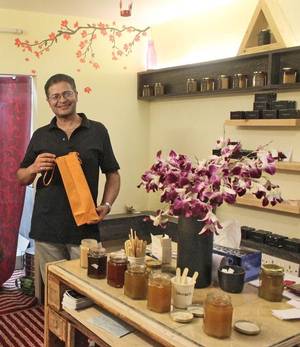
SudharshanRaoBF16jan2018

One man’s quest to find different types of honey and educate people on its consumption led him to start one of the country’s first honey boutiques

It was an amalgam of experience, education and desire to offer something unique, safe and wholesome that got Sudarshan Rao thinking about honey. His love for honey began in Northeastern India where he was working on a tea project. After tasting the local honey, Rao was surprised at its depth of flavour. Thus was born HoneyRus in a bid to change people’s outlook towards the nectar.

The genesis

“The foundation of HoneyRus has been research,” says Rao. “I aim to be a source of information on the fascinating and evolving world of bees and honey. For example, honey is now used in surgical bandages for its capacity to heal wounds that have become resistant to antibiotics. In that context it is called surgi honey.” Rao spent almost three years before they put their product out in the market. “We wanted to be really sure about our products so our research continues to be multidimensional.” They specifically provide single flower honey, educate people on what makes it unique, health benefits, and its usage.

Why honey

“Your question is your answer!” he exclaims. “Honey is a complex food product, it is antibacterial, antiviral, and it’s hygroscopic (absorbs moisture). The fact that people wonder “why honey’ “what is so different about it” is what drove us to research more on the topic. It is a rather underrated food product in India that has health benefits and gourmet potential.” “We go where the bees go!” says Rao. “A bees’ job is to pollinate and the honey, a building block for hive building, and we’re the thieves. Jokes apart, the best way to source honey is to let the bees do what they do best.” As an agribusiness professional, Rao feels that there is no substitute to the real thing. The closest one can get to the source, the better.

More than just one

The Honey Board of USA recognises about 300 monofloral varieties. Polyfloral varieties are infinite. When we say a honey is monofloral we mean the bees have foraged mostly on one particular crop. “If your honey doesn’t taste, look, feel, and flow differently each time you buy one, you aren’t eating the right honey! There’s hundreds of flower species so it’s not possible for your honey to taste the same each time.

There are mono and poly flora honeys, blended ones, processed and unprocessed variants. At HoneyRus we carry seasonal honey and predominantly single flower source variants.” HoneyRus has a generous collection of raw and infused varieties such as neem, acacia, wild borage and rainforest honey (from the Sunderbans). In the variant they have ginger, cinnamon and tulsi.

A green connect

Since the team at HoneyRus works so closely with nature, they are invariably affected by the levels of wastage witnessed on a daily basis. Which is why when it came to building the boutique they kept two things in mind; Simple and Recycle. “We have used-reused wood and engaged small and independent professionals for assistance and the build-up,” says Rao.

A delicate eco-system

The honey industry is severely exposed to consumerism, so the need for honey and honey-based products is constantly high. “There is also a growing demand for honey internationally, due to their colony collapse and consumption,” he says. “The challenge this poses to an intricate ecosystem is the burden it places upon these angels of agriculture. Be it indiscriminate use of pesticides, poor management of bee colonies, rapid spread of diseases among bees, and in some cases declining floral resources, increasing costs of food testing, an item consumer demands, but is not always willing to pay for, and inadequate consumer awareness.”

In the long run, HoneyRus hopes to show people what can be done with honey as food, a healthy alternative and a cosmetic applicant. They are also planning to sell honey-based products sooon. They deliver across India and are located at 14th A Main Road, Indiranagar, Bengaluru. Call 7022224850

source: http://www.thehindu.com / The Hindu / Home> Life & Style> Food / by Rehna Abdul Kareem / April 06th, 2017

How areca farms in Karnakata are nurtured by the bounties of foliage forests

Dry grass from the savannahs is harvested between December and May every year and also used as cattle fodder during the trying summer months. | Photo Credit: M.A. SRIRAM

Soppinabettas are vital sources of mulch and manure, fruit and fodder

The small, door-less thatched hut — only large enough to shelter one person — looks out of place, standing alone on the forest’s edge. As we approach it, an acrid smell hits us. Grey smoke wafts from a wood fire on the floor, above which is a large batch of uppage or Malabar tamarind halfway through the process of curing.

Rudra Gowda, an areca and paddy farmer in Hukkali village in Karnataka’s Uttara Kannada district, collected the uppage from a soppinabetta (a forest patch allocated to him) nearby. “We get only ₹80 per kilo of uppage now, but it is very useful,” he says. “The oil from the seeds is good for cooking and we make alcohol with the fruit.”

The soppinabettas of northern Karnataka harbour a staggering diversity of trees, and fruit extraction is just one of the economic activities that these heavily-managed forests support. Areca (and sometimes paddy) farmers in districts including Shimoga, Chikmagalur and Uttara Kannada have usufruct rights over these foliage or leaf manure forests: they collect green foliage and dry leaf litter to use as crop manure.

The foliage also arrests weed growth and soil erosion, while maintaining soil moisture. Wood collected from these forests are a primary source of fuel. And as for medicine, “everyone in our village knows what plant to harvest from the forests for common illnesses,” says Rudra.

Post-monsoon bounty

Soppinabettas often comprise savannahs and grasslands, where farmers graze their livestock. Post-monsoon, several grasses — locally known as karada (often a mix of native grass species like Themeda triandra) and prized as a mulch plant for areca – grow in the bettas. Farmers take special care to fence off their livestock from the bettas during this time. Dry grass is harvested between December and May every year and also used as cattle fodder during the trying summer months.

While farmers have extracted these resources and nurtured these forests for around 2,000 years, they got official rights to use them in the late 1860s when the British allocated patches to farming households to prevent them from harvesting vegetation from natural forests. “The British gave us these lands,” says Raghunath Gowda, who owns a 25-acre areca farm in Ammenalli village in Uttara Kannada and has rights over almost 225 acres of soppinabetta. “Now the forest department has given us papers to support our rights after a re-survey.”

On paper, for every acre of areca crop, farmers have access to up to nine acres of forest; paddy cultivators receive up to four acres for each acre of rice in some areas.

Dry grass from the savannahs is harvested between December and May every year and also used as cattle fodder during the trying summer months. | Photo Credit: M.A. SRIRAM

Scientists studying the soppinabettas of Sringeri hill town (Chikmagalur district) in 2011 found that individual farmers collect around 31 metric tonnes of leaf litter and approximately 19 metric tonnes of green foliage every year.

Yet, despite such high resource extraction and human activity, soppinabettas  remain crucial habitats for biodiversity. Scientists observed as many as 114 bird species in the areca-betta landscape of Uttara Kannada; other teams have recorded more than 220 species of trees and 41 orchid species in Sringeri. Then there are the mammals: Raghunath says he has seen wild boar, leopards, gaur and sambhar in these lands.

But today, encroachment and over-extraction threaten the bettas. Legal provisions to create more agricultural areas have also caused reductions in betta lands in some areas, says Sharachchandra Lele, Senior Fellow at Bengaluru’s Ashoka Trust for Ecology and Environment, who has studied the soppinabetta system in Uttara Kannada. “In some districts, there has been extensive conversion to coffee or other plantation crops,” he says.

A sense of ownership

In 2012, scientists found that areca plantations consume six times more compost than paddy fields but generate almost four times more revenue; so farmers in Sringeri were increasingly converting paddies to areca plantations, putting a strain on bettas.

And yet, “It turns out that betta use is sustainable because there is individual control over them,” says Lele. “It has belied the claims of British and Indian foresters that such rights would, or has, led to outright forest degradation.”

“The tragedy of the commons has been largely averted because of the sense of ownership each farmer has over his betta,” says Indu K. Murthy, consultant scientist at the Centre for Sustainable Technologies, Indian Institute for Sciences. “A lot depends on the individual farmer and how he manages his soppinabetta.”

To ensure that farmers do not extract too much vegetation, Karnataka’s forest laws mandate that every hectare of betta should contain a minimum of 100 trees, of which 50 should be forest species. Raghunath however, claims he does not know of such conditions. And yet the importance of conserving the land is clear to him.

“Without soppinabettas, our areca plantations will not be productive. So we make sure it is well maintained and that we extract vegetation from different areas of the betta each year.”

source: http://www.thehindu.com / The Hindu / Home> Sci-Tech> Agriculture – Field Notes / by Aathira Perinchery / January 06th, 2018

GI tag for ‘Gulbarga Tur Dal’ in a month

Dean of the Agriculture College, Kalaburagi, Jayaprakash R. Patil addressing A press conference in Kalaburagi on Wednesday.

The Kalaburagi red gram, “Gulbarga Tur Dal”, which is known internationally for its superior quality, will soon be added to the list of Karnataka producers with the Geographical Indication (GI) tag.

Dean of Agriculture College Jayaprakash R. Patil and senior agriculture scientist Raju Teggalli, addressing presspersons at the Agriculture Research Station in Kalaburagi on Wednesday, said that the University of Agriculture Sciences (UAS) Raichur and the Karnataka Red Gram Development Board, with the help of ICRISAT, Intellectual Property Facilitation Centre (IPFC), Hyderabad, filed an application with the Geographical Indications (GI) Registry in September 2017. Geographical Indication (GI) tag for “Gulbarga Tur Dal” will be awarded within a month from now.

Dr. Patil said that the red gram grown here has distinctive features having to do with this region’s unique soil and climatic conditions. The prominent characteristics of the crop grown in Kalaburagi district are good taste and aroma compared to those grown elsewhere. It consumes less time to cook when compared to tur dal grown in other regions.

Dr. Teggalli added that initially conferring of GI status may not work wonders for the farmers of the district, but in the long run, farmers and manufactures will be able to get better price for the brand in the market.

Red gram is considered to be the main kharif crop in the region. Of the total 9 lakh hectares of red gram cultivated across the State, 3.7 lakh hectares under red gram is in Kalaburagi district.

Farm scientist Muniswamy said that securing GI for the product will help farmers in getting premium price and creating international demand for produces. “The ultimate beneficiaries of this whole process are farmers,” he added.

source: http://www.thehindu.com / The Hindu / Home> News> States> Karnataka / by Staff Reporter / Kalaburagi – January 10th, 2018

A fruit that is sweet, sour and cost-effective

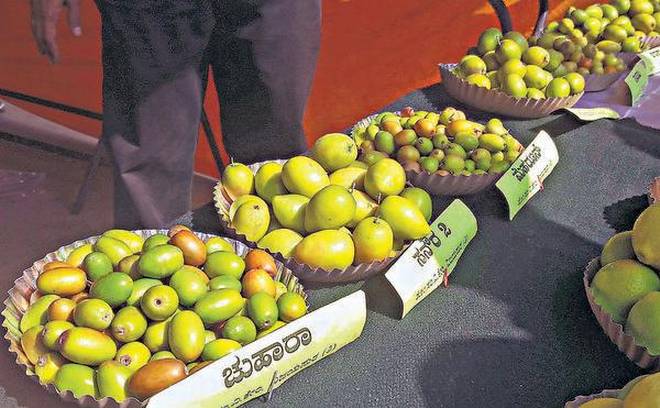
JujubeBF10jan2018

UHS-B promoting cultivation of jujube that grows well in dry areas of north Karnataka

The University of Horticulture Sciences-Bagalkot (UHS-B) is extensively promoting jujube (botanical name Ziziphus) in north Karnataka, mainly in Vijayapura and Bagalkot, because of the suitability of climate for this tasty fruit.

A blend of sweet and sour tastes, jujube is a tropical fruit and best suitable for dry land areas. Keeping this in mind, the university’s centre located at Tidagundi village of Vijayapura taluk has been promoting and popularising some eight varieties of jujubes in the region.

“This fruit is cost-effective and can be cultivated in areas that have limited water resources. Since Vijayapura and Bagalkot have limited access to irrigation, this crop comes as a boon to farmers there,” said Siddanna Thoke, Assistant Professor, Department of Fruits of the university. Having set up a stall in the Krishi Mela which started on the premises of Regional Agriculture Research Station at Hittanahalli village of the taluk on Sunday, Mr. Thoke said farmers who have limited land can cultivate this crop for higher earning. Around 110 saplings could be planted in an acre and the total cost per acre comes to around ₹20,000.

Fruit bearing starts in the first year itself but the quantity increases only from the second year.

The plant could last for at least two decades and it gives fruits till these many years. “Each acre could produce about 10 tonnes of fruits, and a farmer could earn at least ₹1.5 lakh/annum from an acre of plantation.”

Mr. Thoke said that the university is promoting varieties such as Chuhara, Mehroon, Dondon, Ilachi, Kadaka, Umran, and Apalbare. The most popular among them are Mehroon and Kadaka.

Claiming that the crop has minimum pest problem and needs limited water, that too only for the first two years, Mr. Thoke called it as a “future crop” as it does not require spaying of chemical pesticides.

source: http://www.thehindu.com / The Hindu / Home> News> States> Karnataka / by Firoz Rozindar / Viyayapura – January 10th, 2018

Siri and Shrestha organic brands to hit the market soon

Visitors at the two-day Millet Mela that was inaugurated in Mysuru on Wednesday.

People can now look forward to certified organic produce that will be promoted under the brand names Siri and Shreshta in the State.

This is a bid to ensure quality and authenticity of the produce, which will be certified by the Karnataka State Organic Certification Agency (KSOCA), which was established for the purpose and duly accredited as per the National Programme for Organic Productions, Government of India.

The certification and branding will help filter fake organic produce from the market. H.A. Suresh, assistant director of KSOCA, told The Hindu on the sidelines of the Millet Mela here on Wednesday that as per the new norms of the food safety regulator, organic produce should also sport a common logo which was unveiled recently. The produce will be branded and marketed by the organic federation constituted on the lines of the Karnataka Milk Federation, he said.

Over the past three years, ever since the KSOCA was established, an increasing number of farmers have shown an inclination to switch to the organic mode. As on date, there are 566 farmer groups, each with at least 100 members, across the State.

Besides this, there are four horticultural groups, while 100 individuals have taken to organic practices ina agriculture“Karnataka is among the leading States promoting organic farming. Area under organic production is 81,000 hectares,” said S.S. Parashivamurthy, quality manager at KSOCA.

The production is around 1.64 lakh tonnes of agricultural produce and it is expected to increase with additional area being brought under organic cultivation, he said.

“The Mysuru-T. Narsipur-H.D. Kote-Kollegal-Chamarajanagar belt has a good number of organic farmers and similar groups are active in Belagavi, Dharwad, coastal regions and parts of north and central Karnataka,” Mr. Suresh said.

In Nanjangud, a cluster of villages was identified where 48 farmers are practising organic farming on 100 acres of land, according to the group president Rangaswamy Naik. “Though the yield was initially low, it was compensated by the decline in investment and good income,” said Mr. Naik.

Horse gram, green gram, black gram and chilli are being cultivated under organic conditions. The KSOCA is confident of promoting organic farming as a viable practice and of increase the coverage area.

source: http://www.thehindu.com / The Hindu / Home> News> States> Karnataka / by R. Krishna Kumar / Mysuru – December 27th, 2017